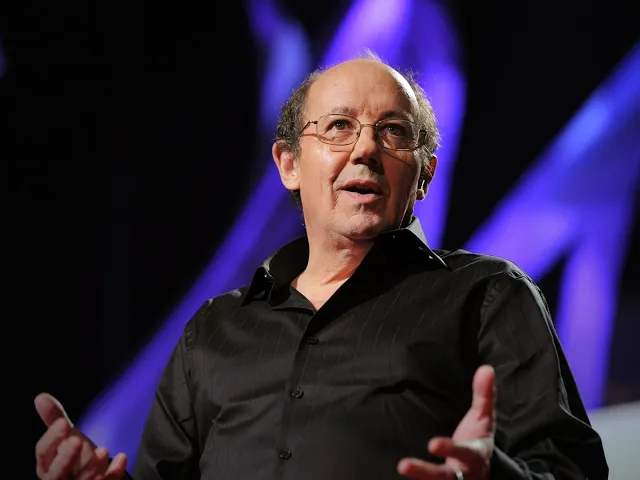
The history of our world in 18 minutes | David Christian | TED
TED
0:16 First, a video.
0:24 Yes, it is a scrambled egg.
0:29 But as you look at it, I hope you'll begin to feel just slightly uneasy.
0:36 Because you may notice that what's actually
0:39 happening is that the egg is unscrambling itself.
0:42 And you'll now see the yolk and the white have separated.
0:44 And now they're going to be poured back into the egg.
0:48 And we all know in our heart of hearts
0:50 that this is not the way the universe works.
0:54 A scrambled egg is mush— tasty mush— but it's mush.
0:57 An egg is a beautiful, sophisticated thing that can create even
1:01 more sophisticated things, such as chickens.
1:04 And we know in our heart of hearts
1:06 that the universe does not travel from mush to complexity.
1:10 In fact, this gut instinct is reflected
1:13 in one of the most fundamental laws of physics,
1:15 the second law of thermodynamics, or the law of entropy.
1:19 What that says basically is that the general tendency of the universe
1:24 is to move from order and structure to lack of order,
1:29 lack of structure— in fact, to mush.
1:31 And that's why that video feels a bit strange.
1:35 And yet, look around us.
1:39 What we see around us is staggering complexity.
1:43 Eric Beinhocker estimates that in New York City alone,
1:46 there are some 10 billion SKUs, or distinct commodities, being traded.
1:50 That's hundreds of times as many species as there are on Earth.
1:55 And they're being traded by a species of almost seven billion individuals,
1:59 who are linked by trade, travel,
2:01 and the Internet into a global system of stupendous complexity.
2:07 So here's a great puzzle:
2:10 in a universe ruled by the second law of thermodynamics,
2:14 how is it possible to generate the sort of complexity I've described,
2:19 the sort of complexity represented by you and me and the convention center?
2:26 Well, the answer seems to be,
2:28 the universe can create complexity, but with great difficulty.
2:33 In pockets, there appear what my colleague,
2:36 Fred Spier, calls "Goldilocks conditions"— not too hot,
2:40 not too cold, just right for the creation of complexity.
2:44 And slightly more complex things appear.
2:46 And where you have slightly more complex things,
2:48 you can get slightly more complex things.
2:51 And in this way, complexity builds stage by stage.
2:56 Each stage is magical because it creates the impression of something
3:01 utterly new appearing almost out of nowhere in the universe.
3:04 We refer in big history to these moments as threshold moments.
3:09 And at each threshold, the going gets tougher.
3:12 The complex things get more fragile, more vulnerable;
3:17 the Goldilocks conditions get more stringent,
3:20 and it's more difficult to create complexity.
3:24 Now, we, as extremely complex creatures,
3:28 desperately need to know this story of how
3:31 the universe creates complexity despite the second law,
3:34 and why complexity means vulnerability and fragility.
3:40 And that's the story that we tell in big history.
3:43 But to do it, you have do something that may,
3:46 at first sight, seem completely impossible.
3:48 You have to survey the whole history of the universe.
3:52 So let's do it.
3:54 (Laughter) Let's begin by winding the timeline back 13.7 billion years,
4:02 to the beginning of time.
4:12 Around us, there's nothing.
4:14 There's not even time or space.
4:18 Imagine the darkest,
4:20 emptiest thing you can and cube it a gazillion times and that's where we are.
4:25 And then suddenly, bang!
4:29 A universe appears, an entire universe.
4:31 And we've crossed our first threshold.
4:33 The universe is tiny; it's smaller than an atom.
4:35 It's incredibly hot.
4:37 It contains everything that's in today's universe,
4:39 so you can imagine, it's busting.
4:41 And it's expanding at incredible speed.
4:44 And at first, it's just a blur,
4:46 but very quickly distinct things begin to appear in that blur.
4:49 Within the first second, energy itself shatters into distinct
4:53 forces including electromagnetism and gravity.
4:57 And energy does something else quite magical:
4:59 it congeals to form matter— quarks that will
5:04 create protons and leptons that include electrons.
5:07 And all of that happens in the first second.
5:09 Now we move forward 380,000 years.
5:14 That's twice as long as humans have been on this planet.
5:17 And now simple atoms appear of hydrogen and helium.
5:23 Now I want to pause for a moment,
5:25 380,000 years after the origins of the universe,
5:28 because we actually know quite a lot about the universe at this stage.
5:32 We know above all that it was extremely simple.
5:35 It consisted of huge clouds of hydrogen and helium atoms,
5:39 and they have no structure.
5:41 They're really a sort of cosmic mush.
5:44 But that's not completely true.
5:46 Recent studies by satellites such as the WMAP
5:50 satellite have shown that, in fact,
5:52 there are just tiny differences in that background.
5:55 What you see here, the blue areas are about
5:59 a thousandth of a degree cooler than the red areas.
6:03 These are tiny differences, but it was enough for the universe to move
6:06 on to the next stage of building complexity.
6:08 And this is how it works.
6:10 Gravity is more powerful where there's more stuff.
6:15 So where you get slightly denser areas,
6:18 gravity starts compacting clouds of hydrogen and helium atoms.
6:22 So we can imagine the early universe breaking up into a billion clouds.
6:25 And each cloud is compacted, gravity gets more powerful as density increases,
6:30 the temperature begins to rise at the center of each cloud, and then,
6:34 at the center, the temperature crosses
6:36 the threshold temperature of 10 million degrees,
6:39 protons start to fuse, there's a huge release of energy, and— bam!
6:46 We have our first stars.
6:48 From about 200 million years after the Big Bang,
6:52 stars begin to appear all through the universe, billions of them.
6:57 And the universe is now significantly more interesting and more complex.
7:03 Stars will create the Goldilocks conditions for crossing two new thresholds.
7:08 When very large stars die, they create temperatures so high that protons begin
7:14 to fuse in all sorts of exotic combinations,
7:17 to form all the elements of the periodic table.
7:20 If, like me, you're wearing a gold ring, it was forged in a supernova explosion.
7:25 So now the universe is chemically more complex.
7:29 And in a chemically more complex universe, it's possible to make more things.
7:33 And what starts happening is that, around young suns, young stars,
7:39 all these elements combine, they swirl around,
7:41 the energy of the star stirs them around,
7:44 they form particles, they form snowflakes, they form little dust motes,
7:49 they form rocks, they form asteroids,
7:51 and eventually, they form planets and moons.
7:53 And that is how our solar system was formed, four and a half billion years ago.
8:00 Rocky planets like our Earth are significantly more complex than
8:05 stars because they contain a much greater diversity of materials.
8:08 So we've crossed a fourth threshold of complexity.
8:12 Now, the going gets tougher.
8:16 The next stage introduces entities that are significantly more fragile,
8:20 significantly more vulnerable, but they're also much more creative
8:25 and much more capable of generating further complexity.
8:28 I'm talking, of course, about living organisms.
8:32 Living organisms are created by chemistry.
8:34 We are huge packages of chemicals.
8:38 So, chemistry is dominated by the electromagnetic force.
8:41 That operates over smaller scales than gravity,
8:43 which explains why you and I are smaller than stars or planets.
8:48 Now, what are the ideal conditions for chemistry?
8:50 What are the Goldilocks conditions?
8:52 Well, first, you need energy, but not too much.
8:56 In the center of a star, there's so much energy that any atoms
8:59 that combine will just get busted apart again.
9:02 But not too little.
9:03 In intergalactic space, there's so little energy that atoms can't combine.
9:08 What you want is just the right amount, and planets, it turns out,
9:11 are just right, because they're close to stars, but not too close.
9:15 You also need a great diversity of chemical elements,
9:19 and you need liquids, such as water.
9:22 Why?
9:23 Well, in gases, atoms move past each other so fast that they can't hitch up.
9:28 In solids, atoms are stuck together, they can't move.
9:33 In liquids, they can cruise and cuddle and link up to form molecules.
9:41 Now, where do you find such Goldilocks conditions?
9:43 Well, planets are great, and our early Earth was almost perfect.
9:50 It was just the right distance from its
9:51 star to contain huge oceans of liquid water.
9:54 And deep beneath those oceans, at cracks in the Earth's crust,
9:58 you've got heat seeping up from inside the Earth,
10:01 and you've got a great diversity of elements.
10:03 So at those deep oceanic vents, fantastic chemistry began to happen,
10:08 and atoms combined in all sorts of exotic combinations.
10:12 But of course, life is more than just exotic chemistry.
10:17 How do you stabilize those huge molecules that seem to be viable?
10:22 Well, it's here that life introduces an entirely new trick.
10:28 You don't stabilize the individual; you stabilize the template,
10:32 the thing that carries information, and you allow the template to copy itself.
10:37 And DNA, of course, is the beautiful molecule that contains that information.
10:42 You'll be familiar with the double helix of DNA.
10:45 Each rung contains information.
10:48 So, DNA contains information about how to make living organisms.
10:53 And DNA also copies itself.
10:55 So, it copies itself and scatters the templates through the ocean.
10:59 So the information spreads.
11:01 Notice that information has become part of our story.
11:04 The real beauty of DNA though is in its imperfections.
11:07 As it copies itself, once in every billion rungs, there tends to be an error.
11:13 And what that means is that DNA is, in effect, learning.
11:18 It's accumulating new ways of making living
11:21 organisms because some of those errors work.
11:23 So DNA's learning and it's building greater diversity and greater complexity.
11:27 And we can see this happening over the last four billion years.
11:30 For most of that time of life on Earth,
11:33 living organisms have been relatively simple— single cells.
11:36 But they had great diversity, and, inside, great complexity.
11:40 Then from about 600 to 800 million years ago, multi-celled organisms appear.
11:45 You get fungi, you get fish, you get plants, you get amphibia,
11:51 you get reptiles, and then, of course, you get the dinosaurs.
11:55 And occasionally, there are disasters.
11:59 Sixty-five million years ago,
12:01 an asteroid landed on Earth near the Yucatan Peninsula,
12:05 creating conditions equivalent to those of a nuclear war,
12:08 and the dinosaurs were wiped out.
12:11 Terrible news for the dinosaurs, but great news for our mammalian ancestors,
12:18 who flourished in the niches left empty by the dinosaurs.
12:22 And we human beings are part of that creative evolutionary pulse
12:28 that began 65 million years ago with the landing of an asteroid.
12:33 Humans appeared about 200,000 years ago.
12:36 And I believe we count as a threshold in this great story.
12:40 Let me explain why.
12:42 We've seen that DNA learns in a sense, it accumulates information.
12:47 But it is so slow.
12:50 DNA accumulates information through random errors,
12:53 some of which just happen to work.
12:56 But DNA had actually generated a faster way of learning:
12:59 it had produced organisms with brains,
13:01 and those organisms can learn in real time.
13:05 They accumulate information, they learn.
13:07 The sad thing is, when they die, the information dies with them.
13:12 Now what makes humans different is human language.
13:16 We are blessed with a language, a system of communication,
13:19 so powerful and so precise that we can share what we've
13:23 learned with such precision that it can accumulate in the collective memory.
13:28 And that means it can outlast the individuals who learned that information,
13:33 and it can accumulate from generation to generation.
13:36 And that's why, as a species, we're so creative and so powerful,
13:40 and that's why we have a history.
13:43 We seem to be the only species in four billion years to have this gift.
13:48 I call this ability collective learning.
13:51 It's what makes us different.
13:53 We can see it at work in the earliest stages of human history.
13:57 We evolved as a species in the savanna lands of Africa,
14:01 but then you see humans migrating into new environments,
14:04 into desert lands, into jungles, into the Ice Age tundra of Siberia— tough,
14:09 tough environment— into the Americas, into Australasia.
14:13 Each migration involved learning— learning
14:15 new ways of exploiting the environment,
14:17 new ways of dealing with their surroundings.
14:19 Then 10,000 years ago,
14:21 exploiting a sudden change in global climate with the end of the last ice age,
14:26 humans learned to farm.
14:28 Farming was an energy bonanza.
14:31 And exploiting that energy, human populations multiplied.
14:34 Human societies got larger, denser, more interconnected.
14:39 And then from about 500 years ago,
14:42 humans began to link up globally through shipping,
14:45 through trains, through telegraph, through the Internet,
14:49 until now we seem to form a single
14:53 global brain of almost seven billion individuals.
14:56 And that brain is learning at warp speed.
15:00 And in the last 200 years, something else has happened.
15:03 We've stumbled on another energy bonanza in fossil fuels.
15:07 So fossil fuels and collective learning together
15:09 explain the staggering complexity we see around us.
15:16 So— Here we are, back at the convention center.
15:21 We've been on a journey, a return journey, of 13.7 billion years.
15:26 I hope you agree this is a powerful story.
15:29 And it's a story in which humans play an astonishing and creative role.
15:34 But it also contains warnings.
15:37 Collective learning is a very, very powerful force,
15:41 and it's not clear that we humans are in charge of it.
15:47 I remember very vividly as a child growing up in England,
15:50 living through the Cuban Missile Crisis.
15:52 For a few days, the entire biosphere seemed to be on the verge of destruction.
15:59 And the same weapons are still here, and they are still armed.
16:05 If we avoid that trap, others are waiting for us.
16:08 We're burning fossil fuels at such a rate
16:11 that we seem to be undermining the Goldilocks
16:14 conditions that made it possible for human
16:16 civilizations to flourish over the last 10,000 years.
16:20 So what big history can do is show us the nature
16:24 of our complexity and fragility and the dangers that face us,
16:28 but it can also show us our power with collective learning.
16:32 And now, finally— this is what I want.
16:39 I want my grandson, Daniel, and his friends and his generation,
16:45 throughout the world, to know the story of big history,
16:49 and to know it so well that they understand both
16:53 the challenges that face us and the opportunities that face us.
16:58 And that's why a group of us are building a free,
17:02 online syllabus in big history for high-school students throughout the world.
17:07 We believe that big history will be a vital intellectual tool for them,
17:12 as Daniel and his generation face
17:15 the huge challenges and also the huge opportunities
17:19 ahead of them at this threshold moment in the history of our beautiful planet.
17:26 I thank you for your attention.
17:28 (Applause)