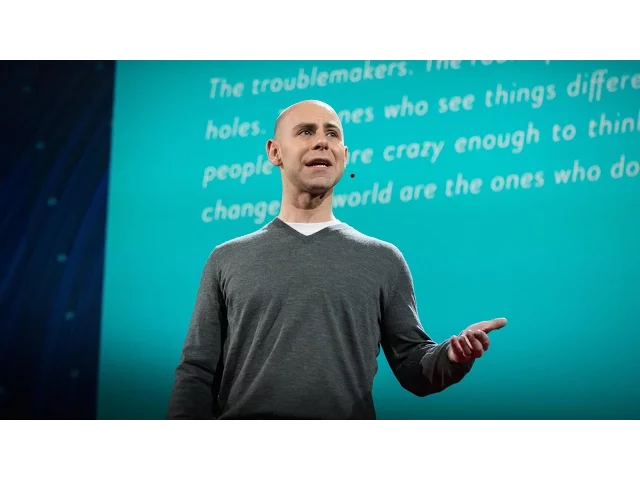
The surprising habits of original thinkers | Adam Grant | TED
TED
0:13 Seven years ago, a student came to me and asked me to invest in his company.
0:17 He said, "I'm working with three friends, and we're going to try to disrupt
0:21 an industry by selling stuff online." And I said,
0:24 "OK, you guys spent the whole summer on this, right?" "No,
0:26 we all took internships just in case it doesn't work out." "All right,
0:30 but you're going to go in full time once you graduate." "Not exactly.
0:34 We've all lined up backup jobs." Six months
0:38 go by, it's the day before the company launches,
0:40 and there is still not a functioning website.
0:43 "You guys realize, the entire company is a website.
0:45 That's literally all it is." So I obviously declined to invest.
0:53 And they ended up naming the company Warby Parker.
0:55 (Laughter) They sell glasses online.
1:00 They were recently recognized as the world's most
1:03 innovative company and valued at over a billion dollars.
1:05 And now?
1:06 My wife handles our investments.
1:10 Why was I so wrong?
1:13 To find out, I've been studying people
1:14 that I come to call "originals." Originals are nonconformists,
1:19 people who not only have new ideas but take action to champion them.
1:23 They are people who stand out and speak up.
1:26 Originals drive creativity and change in the world.
1:29 They're the people you want to bet on.
1:31 And they look nothing like I expected.
1:34 I want to show you today three things I've learned
1:37 about recognizing originals and becoming a little bit more like them.
1:42 So the first reason that I passed on Warby
1:45 Parker was they were really slow getting off the ground.
1:49 Now, you are all intimately familiar with the mind of a procrastinator.
1:54 Well, I have a confession for you.
1:56 I'm the opposite.
1:57 I'm a precrastinator.
2:00 Yes, that's an actual term.
2:01 You know that panic you feel a few hours
2:03 before a big deadline when you haven't done anything yet.
2:06 I just feel that a few months ahead of time.
2:09 (Laughter) So this started early: when I was a kid,
2:15 I took Nintendo games very seriously.
2:18 I would wake up at 5am, start playing and not stop until I had mastered them.
2:24 Eventually it got so out of hand that a local newspaper came
2:27 and did a story on the dark side of Nintendo, starring me.
2:31 (Laughter) (Applause) Since then, I have traded hair for teeth.
2:44 (Laughter) But this served me well in college,
2:52 because I finished my senior thesis four months before the deadline.
2:58 And I was proud of that, until a few years ago.
3:01 I had a student named Jihae, who came to me and said,
3:05 "I have my most creative ideas when
3:08 I'm procrastinating." And I was like, "That's cute,
3:10 where are the four papers you owe me?" (Laughter) No,
3:13 she was one of our most creative students,
3:15 and as an organizational psychologist, this is the kind of idea that I test.
3:20 So I challenged her to get some data.
3:22 She goes into a bunch of companies.
3:23 She has people fill out surveys about how often they procrastinate.
3:27 Then she gets their bosses to rate how creative and innovative they are.
3:31 And sure enough, the precrastinators like me,
3:33 who rush in and do everything early are
3:36 rated as less creative than people who procrastinate moderately.
3:40 So I want to know what happens to the chronic procrastinators.
3:43 She was like, "I don't know.
3:45 They didn't fill out my survey." (Laughter) No, here are our results.
3:51 You actually do see that the people who wait until the last
3:55 minute are so busy goofing off that they don't have any new ideas.
4:00 And on the flip side, the people who race in are in such a frenzy
4:05 of anxiety that they don't have original thoughts either.
4:09 There's a sweet spot where originals seem to live.
4:13 Why is this?
4:15 Maybe original people just have bad work habits.
4:18 Maybe procrastinating does not cause creativity.
4:22 To find out, we designed some experiments.
4:25 We asked people to generate new business ideas,
4:28 and then we get independent readers
4:30 to evaluate how creative and useful they are.
4:33 And some of them are asked to do the task right away.
4:36 Others we randomly assign to procrastinate by dangling Minesweeper
4:40 in front of them for either five or 10 minutes.
4:43 And sure enough, the moderate procrastinators are 16
4:47 percent more creative than the other two groups.
4:51 Now, Minesweeper is awesome, but it's not the driver of the effect,
4:54 because if you play the game first before you learn about the task,
4:58 there's no creativity boost.
4:59 It's only when you're told that you're going to be working on this problem,
5:03 and then you start procrastinating,
5:04 but the task is still active in the back of your mind,
5:07 that you start to incubate.
5:09 Procrastination gives you time to consider divergent ideas,
5:12 to think in nonlinear ways, to make unexpected leaps.
5:16 So just as we were finishing these experiments,
5:18 I was starting to write a book about originals,
5:21 and I thought, "This is the perfect time to teach myself to procrastinate,
5:26 while writing a chapter on procrastination." So I metaprocrastinated,
5:32 and like any self-respecting precrastinator,
5:35 I woke up early the next morning and I
5:37 made a to-do list with steps on how to procrastinate.
5:39 (Laughter) And then I worked diligently toward
5:47 my goal of not making progress toward my goal.
5:52 I started writing the procrastination chapter,
5:54 and one day— I was halfway through— I
5:56 literally put it away in mid-sentence for months.
5:59 It was agony.
6:02 But when I came back to it, I had all sorts of new ideas.
6:06 As Aaron Sorkin put it, "You call it procrastinating.
6:09 I call it thinking." And along the way I discovered
6:13 that a lot of great originals in history were procrastinators.
6:17 Take Leonardo da Vinci.
6:19 He toiled on and off for 16 years on the Mona Lisa.
6:24 He felt like a failure.
6:26 He wrote as much in his journal.
6:30 But some of the diversions he took in optics transformed the way
6:33 that he modeled light and made him into a much better painter.
6:37 What about Martin Luther King, Jr.?
6:40 The night before the biggest speech of his life,
6:42 the March on Washington, he was up past 3am, rewriting it.
6:46 He's sitting in the audience waiting for his turn to go onstage,
6:50 and he is still scribbling notes and crossing out lines.
6:54 When he gets onstage, 11 minutes in, he leaves his prepared remarks
6:58 to utter four words that changed the course of history:
7:01 "I have a dream." That was not in the script.
7:07 By delaying the task of finalizing the speech until the very last minute,
7:11 he left himself open to the widest range of possible ideas.
7:15 And because the text wasn't set in stone, he had freedom to improvise.
7:20 Procrastinating is a vice when it comes to productivity,
7:23 but it can be a virtue for creativity.
7:27 What you see with a lot of great originals is
7:29 that they are quick to start but they're slow to finish.
7:33 And this is what I missed with Warby Parker.
7:35 When they were dragging their heels for six months,
7:38 I looked at them and said, "You know, a lot of other companies are starting
7:42 to sell glasses online." They missed the first-mover advantage.
7:46 But what I didn't realize was they were spending all that time trying
7:49 to figure out how to get people to be comfortable ordering glasses online.
7:53 And it turns out the first-mover advantage is mostly a myth.
7:56 Look at a classic study of over 50 product categories,
7:59 comparing the first movers who created the market
8:02 with the improvers who introduced something different and better.
8:06 What you see is that the first movers had a failure rate of 47 percent,
8:10 compared with only 8 percent for the improvers.
8:15 Look at Facebook, waiting to build
8:16 a social network until after Myspace and Friendster.
8:21 Look at Google, waiting for years after Altavista and Yahoo.
8:24 It's much easier to improve on somebody else's idea
8:27 than it is to create something new from scratch.
8:30 So the lesson I learned is that to be original you don't have to be first.
8:35 You just have to be different and better.
8:38 But that wasn't the only reason I passed on Warby Parker.
8:41 They were also full of doubts.
8:43 They had backup plans lined up,
8:45 and that made me doubt that they had the courage to be original,
8:49 because I expected that originals would look something like this.
8:55 (Laughter) Now, on the surface,
9:00 a lot of original people look confident, but behind the scenes,
9:03 they feel the same fear and doubt that the rest of us do.
9:06 They just manage it differently.
9:08 Let me show you: this is a depiction
9:10 of how the creative process works for most of us.
9:16 (Laughter) Now, in my research,
9:21 I discovered there are two different kinds of doubt.
9:23 There's self-doubt and idea doubt.
9:25 Self-doubt is paralyzing.
9:26 It leads you to freeze.
9:28 But idea doubt is energizing.
9:30 It motivates you to test, to experiment, to refine, just like MLK did.
9:35 And so the key to being original is just a simple
9:39 thing of avoiding the leap from step three to step four.
9:43 Instead of saying, "I'm crap," you say, "The first few drafts are always crap,
9:48 and I'm just not there yet." So how do you get there?
9:52 Well, there's a clue, it turns out, in the Internet browser that you use.
9:57 We can predict your job performance and your commitment
9:59 just by knowing what web browser you use.
10:03 Now, some of you are not going to like the results of this study— (Laughter)
10:08 But there is good evidence that Firefox and Chrome
10:11 users significantly outperform Internet Explorer and Safari users.
10:15 Yes.
10:17 (Applause) They also stay in their jobs 15 percent longer, by the way.
10:23 Why?
10:23 It's not a technical advantage.
10:25 The four browser groups on average have similar typing
10:28 speed and they also have similar levels of computer knowledge.
10:31 It's about how you got the browser.
10:34 Because if you use Internet Explorer or Safari,
10:36 those came preinstalled on your computer,
10:39 and you accepted the default option that was handed to you.
10:42 If you wanted Firefox or Chrome, you had to doubt the default and ask,
10:46 is there a different option out there,
10:47 and then be a little resourceful and download a new browser.
10:51 So people hear about this study and they're like, "Great,
10:54 if I want to get better at my job,
10:56 I just need to upgrade my browser?" (Laughter) No,
10:59 it's about being the kind of person who takes the initiative
11:02 to doubt the default and look for a better option.
11:05 And if you do that well, you will open yourself up to the opposite of déjà vu.
11:10 There's a name for it.
11:12 It's called vuja de.
11:13 (Laughter) Vuja de is when you look at something you've seen many
11:19 times before and all of a sudden see it with fresh eyes.
11:23 It's a screenwriter who looks at a movie script that can't
11:27 get the green light for more than half a century.
11:29 In every past version, the main character has been an evil queen.
11:34 But Jennifer Lee starts to question whether that makes sense.
11:37 She rewrites the first act, reinvents the villain as a tortured hero
11:41 and Frozen becomes the most successful animated movie ever.
11:45 So there's a simple message from this story.
11:47 When you feel doubt, don't let it go.
11:50 (Laughter) What about fear?
11:55 Originals feel fear, too.
11:57 They're afraid of failing, but what sets them apart from the rest of us
12:01 is that they're even more afraid of failing to try.
12:04 They know you can fail by starting a business that goes
12:07 bankrupt or by failing to start a business at all.
12:10 They know that in the long run,
12:12 our biggest regrets are not our actions but our inactions.
12:15 The things we wish we could redo,
12:17 if you look at the science, are the chances not taken.
12:21 Elon Musk told me recently, he didn't expect Tesla to succeed.
12:25 He was sure the first few SpaceX launches would fail to make it to orbit,
12:30 let alone get back, but it was too important not to try.
12:34 And for so many of us, when we have an important idea, we don't bother to try.
12:38 But I have some good news for you.
12:41 You are not going to get judged on your bad ideas.
12:43 A lot of people think they will.
12:45 If you look across industries and ask people about their biggest idea,
12:49 their most important suggestion,
12:50 85 percent of them stayed silent instead of speaking up.
12:55 They were afraid of embarrassing themselves, of looking stupid.
12:58 But guess what?
12:59 Originals have lots and lots of bad ideas, tons of them, in fact.
13:04 Take the guy who invented this.
13:07 Do you care that he came up with a talking doll
13:09 so creepy that it scared not only kids but adults, too?
13:13 No.
13:14 You celebrate Thomas Edison for pioneering the light bulb.
13:18 (Laughter) If you look across fields,
13:23 the greatest originals are the ones who fail the most,
13:26 because they're the ones who try the most.
13:28 Take classical composers, the best of the best.
13:31 Why do some of them get more pages in encyclopedias
13:34 than others and also have their compositions rerecorded more times?
13:38 One of the best predictors is
13:39 the sheer volume of compositions that they generate.
13:43 The more output you churn out, the more variety you get and the better
13:47 your chances of stumbling on something truly original.
13:50 Even the three icons of classical music— Bach, Beethoven,
13:53 Mozart— had to generate hundreds and hundreds of compositions
13:57 to come up with a much smaller number of masterpieces.
14:01 Now, you may be wondering,
14:03 how did this guy become great without doing a whole lot?
14:07 I don't know how Wagner pulled that off.
14:10 But for most of us, if we want to be more original,
14:13 we have to generate more ideas.
14:16 The Warby Parker founders, when they were trying to name their company,
14:20 they needed something sophisticated, unique,
14:22 with no negative associations to build a retail brand,
14:25 and they tested over 2,000 possibilities before
14:27 they finally put together Warby and Parker.
14:32 So if you put all this together,
14:33 what you see is that originals are not that different from the rest of us.
14:37 They feel fear and doubt.
14:39 They procrastinate.
14:40 They have bad ideas.
14:42 And sometimes, it's not in spite of those qualities
14:45 but because of them that they succeed.
14:48 So when you see those things, don't make the same mistake I did.
14:51 Don't write them off.
14:52 And when that's you, don't count yourself out either.
14:55 Know that being quick to start but slow to finish can boost your creativity,
14:59 that you can motivate yourself by doubting your ideas
15:02 and embracing the fear of failing to try,
15:04 and that you need a lot of bad ideas in order to get a few good ones.
15:08 Look, being original is not easy, but I have no doubt about this: it's
15:13 the best way to improve the world around us.
15:16 Thank you.
15:17 (Applause)