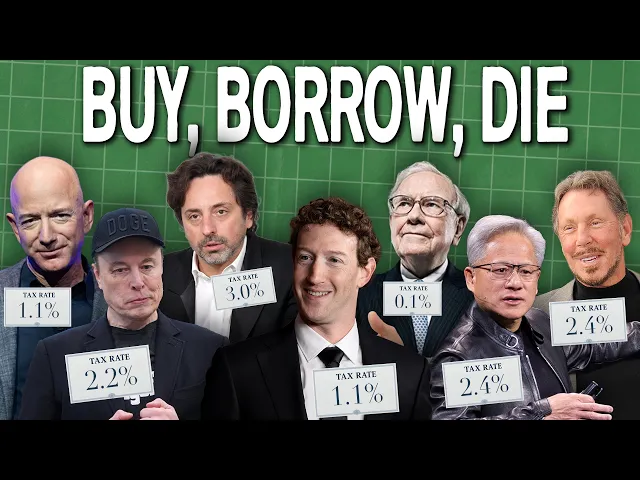
Why Is It So Hard To Tax Billionaires?
How Money Works Uncut
0:00 Most developed countries in the world today
0:02 have some form of progressive taxation on earnings.
0:04 The more money you make, the more money you pay in taxes,
0:08 both nominally and proportionally through higher tax brackets.
0:10 Even here in America,
0:12 the top 1% in recent years has paid more than 40% of all federal income tax.
0:17 Although that is likely to change after this year's
0:20 one big beautiful bill significantly readjusted tax rates.
0:22 Before that though, it may surprise you
0:25 to learn that over the last four decades,
0:27 the share of income taxes paid by the highest earners
0:29 has actually been increasing according to select data from the IRS.
0:33 That's the story anyway.
0:35 But there has always been one exception, billionaires.
0:38 According to recent data, the average billionaire is now paying a lower rate
0:43 of tax than even the bottom 10% of households.
0:45 And the good news for us here in America is
0:48 that this trend is actually significantly worse in other European countries.
0:52 The reason why these statistics can even be
0:55 mathematically possible at the same time is because
0:57 there is a big difference between the top 1% and the top 1% of income earners.
1:02 The former are extremely adept to using
1:04 the tax systems and good old-fashioned fear-mongering
1:07 while the latter are primarily the people
1:09 actually adding real value to the economy.
1:11 So why is it so hard to actually tax the ultra wealthy?
1:14 And what could go wrong if we did it anyway?
1:18 Our economy is growing.
1:19 Our population is growing.
1:20 Why?
1:20 because of the energy and daring of entrepreneurs that are
1:23 growing and dominating in the industries of the future.
1:26 Well, a billionaire backlash is brewing in California
1:29 over a proposed bill that would tax the ultra
1:33 rich with some reportedly ready to move their businesses
1:36 and their money across the country to Florida.
1:39 So, major corporations, financial firms,
1:41 and also people continue to relocate their headquarters or operations
1:44 from high tax states like California and New York.
1:47 If I hight tail down to Florida and buy a mansion down there,
1:51 leaving be home a mansion in New York City worth $5 million.
1:54 That mansion that stays in New York, that's going to be taxed.
1:58 Is that right?
1:59 That that sounds pretty right.
2:01 Anytime the idea of effective taxation is being discussed,
2:04 there is one counterargument that comes up more often than any other.
2:08 Record number of millionaires are
2:10 expected to relocate internationally this year.
2:12 800,000 New Yorkers are prepared to leave the city.
2:17 An estimated 16,500 very rich people will leave this country this year.
2:22 Yeah, that's right.
2:23 If we try to tax rich people,
2:25 they are just going to leave taking with them their money,
2:28 their jobs, and their businesses.
2:30 Ironically, if all the rich people leave,
2:31 then we won't even get the taxes they were paying.
2:34 Which means that by trying to increase revenue,
2:36 we might actually end up shrinking it.
2:38 Capital Flight or Tax Flight has become
2:40 a massive focus around the world once again,
2:42 particularly in the UK and now in the newly
2:45 formed Socialist People's Republic of New York City because
2:47 they are at risk of losing the very individuals
2:49 that shaped their economies into what they are today.
2:52 Headlines have been flooded with high-profile
2:54 people either leaving or threatening
2:55 to leave these places and go somewhere more accommodating like Miami,
2:59 Dubai, Singapore, or Switzerland.
3:01 But the question is, would that actually be such a bad thing?
3:05 can't decide whether to leave uh the state or the country.
3:08 Time to move on and leave the state
3:11 of California permanently and we're going to go to Florida.
3:13 Making a big move.
3:14 He's heading to Miami or at least he's been there for quite some time.
3:17 And it comes with an added bonus.
3:19 No state income tax.
3:21 Don, we're talking about Elon Musk moving from California to Texas.
3:25 I'm leaving.
3:25 Okay, then.
3:26 That was always allowed.
3:28 There's a theoretical concept in economics about
3:31 the relationship between tax rates and actual tax revenue.
3:34 If tax rates are very low,
3:35 then naturally tax revenue will also be low because not many
3:38 people are willingly going to send a check to the government.
3:42 As rates increase, so does revenue, but only up to a point.
3:45 Eventually, if you raise taxes any higher, it will actually result in lower
3:49 overall revenue because business activity is disincentivized,
3:52 or yes indeed, because people will move to somewhere else with lower taxes.
3:57 Plotting out this relationship gives you what economists call the LER curve,
4:00 named after Arthur Lafer, who popularized the idea during,
4:04 well, you guessed it, the Reagan administration.
4:06 Now, the idea itself is not inherently wrong, but it requires a lot of nuance,
4:12 and without that, it's often used in really
4:14 dumb ways to justify equally dumb fiscal policy.
4:17 The first problem is mistaking exactly where on the graph most places exist.
4:22 Pundits for lower taxes will say that we are on this side of the graph.
4:25 Which means that if only we lowered rates,
4:27 it will stimulate more economic activity
4:29 and actually result in higher total revenue,
4:31 which can be used to fund government programs or pay down debt.
4:34 It's a neat idea that you have probably heard a lot before,
4:37 but it's not really backed up by most data.
4:40 A 2017 study conducted on 27 OECD countries found that almost
4:43 all of them were unsurprisingly on this side of the graph,
4:47 where raising rates on top earners would simultaneously raise tax revenue.
4:50 Out of all of the countries in the study,
4:53 the biggest gap between the actual tax rate
4:55 and revenue maximizing tax rate was in Mexico, Slovakia, and the United States.
4:58 Now, the reason why this gap was so big was more than just simply
5:02 the fact that we don't tax as much as most of our European counterparts,
5:05 but we will get to that soon.
5:07 For now, despite what you may have been told,
5:09 the analysis overwhelmingly suggests that we are
5:11 indeed on this side of the curve.
5:13 Now, in the interest of fairness, the second mistake that people make by trying
5:16 to read these lines is assuming that the one
5:19 and only goal of tax policy is to milk
5:21 the maximum possible amount of money out of people.
5:24 The revenue maximizing tax rate and the optimum
5:26 tax rate are not always the same thing.
5:29 Lowering rates can be a good way to give average households a budgetary reprieve
5:32 or higher taxes can be used on vices to try to stem their use.
5:35 But the biggest mistake of all is the assumption
5:37 that most rich people choose their home by sorting low
5:40 to high on a global tax database and they
5:42 are ready to jump ship the second the bill arrives.
5:45 The reality is a lot more nuanced than that.
5:48 To put it generously, the 2024 global wealth report by UBS
5:52 found that European countries with higher tax
5:54 rates generally had a higher rate of wealth growth over the last 15 years,
5:58 even after including high net worth immigration.
6:00 Globally, the countries with the highest median wealth per capita all generally
6:04 had very high and progressive rates of taxation on income and consumption.
6:08 Closer to home, people have been threatening
6:10 to leave places like New York for decades now.
6:12 And yet, even after adjusting for inflation,
6:14 their millionaire populations are higher than they have ever been before.
6:18 New Yorkers are going to flee.
6:20 They're going to flee New York because of Zor Mani.
6:23 To my liberal friends who keep saying, "Well,
6:25 tax rates don't matter." Then why is it Sean that everybody is leaving New York?
6:30 Don't you see what's happening even in New York City?
6:32 They're running out of money.
6:34 Why?
6:34 Because the rich people are moving.
6:36 New York's population of millionaire earners, that has nearly doubled.
6:39 Since 2010, there are 34,000 New Yorkers
6:42 making at least a million dollars or more.
6:44 New York City is not even a particularly
6:46 difficult place to not live in for tax purposes.
6:48 Because if you really wanted to, you could go
6:51 and live in New Jersey and commute in every day.
6:53 If you are particularly wealthy,
6:54 you could do what a lot of hedge fund billionaires do and live in Miami and make
6:58 sure not to spend more than 182 days a year in your New York holiday home.
7:02 Extreme examples like this do happen,
7:04 and they get a lot of attention from everybody when they do because one side
7:08 of the debate uses it to highlight how
7:10 ultra wealthy people dodge and skirt around laws,
7:12 so we should tax them more effectively.
7:13 And the other side uses it to highlight
7:15 how ultra wealthy people dodge and skirt around laws,
7:18 so we shouldn't bother trying at all.
7:20 But for all of the attention they get, they are rare.
7:23 And overwhelmingly for most wealthy people,
7:24 the business opportunities available in New
7:26 York against the inconvenience and cost
7:28 of commuting just make it worth paying the slightly higher taxes.
7:32 Now, that would be the end of that.
7:34 If only it wasn't for the curious cases of California and the United Kingdom.
7:39 So, it's time to learn how many works to find out
7:42 if a max exodus of rich people is actually a problem.
7:45 This video is sponsored by Storyblocks.
7:47 We use a lot of footage in our videos.
7:50 And if you've ever bought stock clips individually,
7:52 you know how expensive that can get.
7:54 That's where Story Blocks comes in.
7:56 It gives us unlimited downloads of high-quality human-made stock video,
8:00 music, sound effects, and templates all for one predictable subscription cost.
8:04 Whether you need cinematic B-roll,
8:06 motion graphics, or the perfect background track,
8:08 Story Blocks has everything in one place,
8:10 making our workflow faster and more affordable.
8:13 Plus, everything is royalty-free with clear-cut licensing,
8:16 so we never have to worry about copyright claims.
8:18 You can even whitelist your YouTube channel directly
8:21 in your account to help prevent music claims,
8:23 which is a feature exclusive to Storylocks.
8:25 If you want to start making videos like ours and build your own business,
8:28 a Storyblock subscription is the perfect place to start.
8:31 To start telling better stories with the tools I use,
8:34 head to storyblocks.com/howmoneyworks Uncut or click
8:37 the link in the description.
8:38 They're offering 15% off any annual plan for a limited
8:42 time and that discount is only available through my link.
8:45 Okay, so it wouldn't be fair to talk
8:47 about rich people fleeing without talking about the UK.
8:50 According to some estimates,
8:52 the UK lost almost 10,000 high- netw worth individuals
8:55 in the last calendar year to net outward migration.
8:58 Now some people have highlighted some
9:01 structural problems with the Henley and partners
9:03 report on which this is based and we will get into that but overall
9:07 their methodology is at least somewhat consistent over time and it does draw
9:11 on expertise and collaboration from a wide
9:14 range of industry professionals and global bodies.
9:16 The point is it shows that the UK was once a magnet for global wealth as people
9:20 were attracted to its accommodating financial center and high-end
9:23 amenities that catered almost exclusively to the ultra wealthy.
9:26 But over time, the country and in particular the city
9:28 of London saw that these wealthy people were causing some problems.
9:31 I made a video about this just three months ago.
9:34 So I am not going to give you the whole spiel,
9:37 but the cliff notes are they drove up home prices.
9:39 They turned the financial system into a laundry
9:41 machine and they didn't actually contribute that much to the economy relative
9:44 to the concessions that were made to attract them.
9:47 Yeah, sure.
9:47 Some global billionaires hired a lot of maids and service staff,
9:50 but the average Brit probably wouldn't consider being
9:53 a butler to Bor's war crimesky an ideal economic outcome.
9:56 Now, to be fair, there were higher skilled roles like
9:59 financial services that developed around these wealthy individuals as well.
10:02 But a 2022 paper found that a majority of this work was done offshore anyway,
10:06 providing questionable benefits to the country.
10:08 As policies were introduced to curtail moneyaundering and actually get something
10:12 out of all the wealth that was being parked in London,
10:14 these wealthy individuals did indeed start leaving.
10:16 The exact numbers are up for debate,
10:19 but wealthy people are moving out primarily to places like
10:22 Dubai that are becoming what London was 10 years ago.
10:25 A low tax money laundry with some Gucci store stapled on.
10:29 So yeah, millionaire exoduses do happen.
10:32 But London is more of the exception that proves the rule.
10:34 When a country was filled up to begin with by people
10:37 just looking for the best deal for them and their money,
10:39 then of course those are the same kind of people
10:41 to move on just as quickly when a better deal becomes available.
10:44 Competing in a race to the bottom to be the lowest bidder for a few
10:48 thousand wealthy individuals looking to pay back
10:50 as little as possible is a losing proposition.
10:52 Even if you win, your prize is a collection of people
10:55 with no local attachment who by definition don't want to contribute.
10:59 But even while all of this was happening,
11:01 the number of millionaires in the UK actually increased.
11:04 This homegrown wealth is also much less likely to leave because,
11:08 well, it's their home.
11:10 Most people, even those with extremely high incomes,
11:12 aren't going to leave their home cities,
11:15 social networks, families, customs, and way of life over some tax savings.
11:19 And that's assuming that they even could.
11:21 On a small scale, we saw this play out
11:23 over the last 5 years between California and Texas.
11:26 Moving between states is easier than moving between countries.
11:28 This enabled a lot of remote workers and entire businesses
11:31 to shift from expensive high-tech cities in California to more businessfriendly,
11:36 cheaper, and lower tax states like Texas.
11:38 But as people were forced back into offices and the AI
11:41 bubble started blowing back towards a proven tech hub,
11:43 places like Austin are facing serious shocks in their housing market,
11:46 which had boomed on the expectation that these temperamental
11:49 tech workers would keep on coming forever.
11:51 The channel Upton did a great on the ground video on this a few months ago,
11:55 so I will leave a link to that in the description.
11:57 A lot of wealth in an area is tied
11:59 to that area itself and even more comes from its institutions.
12:03 In that 2017 study on the LER curve,
12:05 America had the highest revenue maximizing tax rate out of all OECD
12:09 countries because we have so many
12:11 domestic industries that generate enormous fortunes.
12:13 A wealthy American could renounce their citizenship and move
12:16 overseas for lower taxes or more accommodating regulations.
12:19 But almost nobody does it because having
12:21 unfettered access to Silicon Valley, Wall Street, American real estate,
12:25 or financial system is worth more to most wealthy people than some tax savings.
12:29 The study's method found that we could set top
12:31 marginal tax rates as high as 76% and most
12:33 people would just have to suck it up and pay
12:36 it because leaving would have a higher opportunity cost.
12:39 This study wasn't suggesting that we should do that, but it was suggesting
12:42 that the idea that raising taxes would lower revenue wasn't grounded in reality.
12:46 Now, even with all this, it's important
12:49 to acknowledge that as people get wealthier, setting up a life in a new country
12:52 and moving wealth around the globe does become easier.
12:55 These people are also naturally more high-profile
12:58 than your average run-of-the-mill high net worth individual.
13:00 So, they do get more attention.
13:02 But in terms of general economic activity, job creation, and entrepreneurship,
13:07 it's much better to have 1,000 extra millionaires than one single billionaire.
13:10 And this is what we have overwhelmingly seen in major
13:13 centers where the wealth exodus is getting the most attention.
13:16 There is a chart that really puts
13:18 this whole discussion into perspective because it highlights just
13:21 how much of a big deal wealthy people
13:22 threatening to leave their home country really is.
13:24 It's right here.
13:25 This is the total migration rate of dollar millionaires
13:28 amongst all of the countries seeing the biggest outflows.
13:31 And no, this isn't me screwing up my graphs again.
13:34 The report that compiled these numbers
13:36 generously said that reported numbers of millionaires
13:38 migrating in 2024 represented approximately 0%
13:41 of millionaires at global and national levels.
13:44 The UBS global wealth data book estimates that there
13:46 are about 60 million millionaires in the world today.
13:49 A few thousand of them finding a new home is not statistically significant.
13:53 This is also including wealthy people that just happen to move
13:55 to countries for reasons other than saving on tax like avoiding conflicts,
13:59 political instability, or just moving to a nice place for retirement.
14:02 But all right, all right.
14:03 Let's say for the sake of argument that there was some kind
14:06 of change that actually did scare away a lot of wealthy people.
14:09 Would that actually be a problem?
14:11 Well, yes.
14:11 and places like South Africa, Lebanon, Venezuela,
14:14 and Russia have over several years seen this kind of capital flight.
14:18 But it wasn't wealthy people leaving that destabilized these countries.
14:21 It was the instability that caused the wealthy people to leave.
14:25 Even if we ignore correlation and causation for a second, several studies,
14:28 including some from Nobel Prize winners,
14:30 have been done on the impact of these people immigrating.
14:33 What they have found is that overwhelmingly the biggest loss is the expertise
14:36 of skilled workers rather than the money of a few wealthy investors.
14:40 Losing a handful of doctors, engineers, lawyers,
14:42 and institutional managers hurts a lot more than losing some cash.
14:46 Money can be printed, and infrastructure can't be taken away in a suitcase.
14:50 But human capital is both mobile and very hard to replace.
14:54 Under normal circumstances, these people are far less likely to move away
14:58 from their home since qualifications like
15:00 medical degrees are not always transferable.
15:02 So, yes, this could be a problem if your definition of wealthy
15:06 person includes high-end skilled professionals rather
15:09 than just exclusively independently wealthy asset owners.
15:11 Fortunately, the best way to get these people to stick around is to just
15:15 make sure that institutions are well-run
15:17 and that people feel comfortable in their home.
15:20 So, most rich people aren't leaving.
15:21 But that doesn't mean that they are paying
15:23 as much as the topline numbers would have you think.
15:26 The actual business of avoiding tax is very real,
15:29 very creative, and somehow very legal.
15:32 Last year, ProPublica, a nonprofit investigative journalism organization,
15:37 leaked a cache of IRS files that contains
15:40 tax information about the richest people in America.
15:43 Dozens of journalists and forensic accountants were
15:45 able to reverse engineer a number of systems
15:48 that billionaires used to pay much lower rates
15:51 of income tax than most regular working Americans.
15:54 Some were so good at working their numbers that they paid no income tax at all.
15:58 And some billionaire accountants were even good
16:00 enough to get their wealthy clients classified
16:02 as low or middle inome earners so they didn't miss out on a stimulus check.
16:07 ProPublica went on to publish 10 of the biggest
16:09 and most morally questionable loopholes that the IRS files revealed.
16:13 You probably won't be shocked to learn
16:15 that most of these loopholes aren't possible
16:17 for us regular people to take advantage of, but a few of them are.
16:21 Of the 10 that ProPublica has published, five are genuine problems with the tax
16:25 code that really do justify some policy reviews.
16:28 Three are just good business practices that everybody should be doing,
16:31 and two are really just filler that the website needed
16:34 to get to number 10 because it made for a catchier headline.
16:37 Capital gains are the taxes that you pay
16:39 when you sell an asset or equity for profit.
16:41 If you buy a share for $10 and sell it for $100,
16:44 you will pay a capital gains tax on the $90 in profit you just made.
16:49 Capital gains taxes are very important to rich
16:52 people because their fortunes overwhelmingly come from their investments,
16:55 not from their regular jobs.
16:58 Income tax, state tax, inheritance tax, capital gains taxes.
17:02 In fact, up until his retirement as Amazon CEO,
17:06 Jeff Bezos only received an $80,000 a year salary for his work.
17:10 Most of his money and most of the money of other billionaires
17:14 comes from the appreciation in the value of the assets they own.
17:17 The problem comes when they need money.
17:19 They are still people after all, and they need to buy food,
17:23 clothes, homes, and fuel for their private jets, you know, the essentials.
17:26 The simple way for them to get this cash
17:28 would be for them to sell some of their assets.
17:30 This is especially easy when their assets are liquid,
17:33 like shares in a public company.
17:35 If they do this though, they will have to pay capital gains taxes if the assets
17:39 they are selling are worth more than what they were purchased.
17:42 And hopefully, if the billionaire is making good investments,
17:44 this will be the case.
17:46 If the billionaire wants to avoid this, they can work out just how much
17:49 they want to live off of for the year and they take out a loan.
17:53 They don't pay tax on cash they receive as a loan.
17:55 And if they put up collateral,
17:56 like the shares that they were thinking of selling,
17:58 then they will pay a very low interest rate.
18:01 As an added benefit,
18:02 if the assets appreciate at a higher rate than the interest rate on the loan,
18:06 they will actually be better off than before,
18:08 even considering the tax advantages of this hilariously named buy tax strategy.
18:14 Unfortunately, the loans that the billionaires use
18:16 to make this work are only available to the type of people that have
18:20 the department of the bank dedicated just to them.
18:24 Under what circumstances would you be obligated to cooperate
18:27 with an FBI or or US Justice Department investigation, for example?
18:32 The diploma is a diploma.
18:34 Wait, the closest thing that regular people will get
18:39 to this is a home equity line of credit,
18:41 which in many ways is just a small-scale version of the same strategy.
18:45 On the topic of real estate,
18:47 it is the centerpiece of many billionaires portfolios,
18:50 not in small part thanks to the amazing
18:52 range of tax breaks available in this industry.
18:55 The government wants people to invest in homes.
18:57 So, it has tax policies to encourage investors to give people a place to live.
19:02 Similar tax breaks are available to oil drilling and farming.
19:05 It's a good bet that anything
19:07 that the government views as an essential industry probably
19:10 has some favorable tax policies written to sweeten
19:12 the deal for billionaires putting their money there.
19:15 One of the biggest allowances made to investors,
19:18 specifically in real estate, is a 1031 exchange.
19:21 This is a tax rule that lets investors sell
19:24 investment properties for a profit and not pay capital gains
19:27 tax on it so long as they use that profit
19:30 to buy more investment properties within a certain time period.
19:32 This has let property mogul flip their way to enormous
19:36 property empires without paying a scent in tax along the way.
19:40 To make this better for them,
19:41 they can subtract the depreciation of their buildings
19:43 from the rental income they make.
19:45 Which means with some clever accounting,
19:47 they can have millions of dollars in cash coming in completely tax-free.
19:51 If you think property mogul are bad,
19:53 they have nothing on the owners of sports teams.
19:55 These guys are the absolute kings of profiting off something
19:59 that no policy maker would be brave enough to campaign against.
20:03 Nope.
20:03 Americans love their sports,
20:04 and it's a huge industry that makes team owners a lot of money.
20:08 Voters want to keep their teams, which means cunning team owners can
20:12 effectively ransom city governments into paying
20:14 for lavish stadiums for their teams under the guise of being a community center.
20:18 But the griff goes much further than that.
20:21 Sports teams are considered a depreciating asset,
20:24 which means even if they are making
20:26 a lot of money and actually increasing in value,
20:28 the owner can claim a portion of what they paid
20:31 for the team as a tax deduction in the years following their purchase.
20:34 As if that wasn't good enough, player contracts are often set up in such a way
20:39 that they are effectively considered a piece of equipment,
20:42 not unlike a delivery truck or a fax machine.
20:45 That means that the players too can be counted as depreciating assets,
20:49 which despite feeling icky in principle,
20:51 can sometimes mean that sports team owners
20:53 can claim depreciation twice on the same investment.
20:56 It's a real business.
20:57 It's it's not, you know, what's the right word?
21:00 Um, it's not a trophy asset like it used to be.
21:04 it has to make money.
21:05 One of the smartest things a billionaire can do to avoid taxes is to die.
21:09 The United States does have inheritance taxes,
21:12 but there are so many loopholes in it
21:15 that it's basically not worth talking about.
21:17 Spouses, for instance, don't pay any inheritance tax on assets that are
21:21 left to them by their late husband or wife.
21:23 This is actually a good policy because nobody wants a widow
21:26 to have to sell her family home to pay an estate tax.
21:30 But the IRS files have again shown
21:32 that some billionaires take this generosity to the extreme.
21:35 There is a tax rule called the stepped up basis.
21:38 What this rule does is that when someone
21:40 dies and passes their assets to an inheritor,
21:42 the capital gains gets counted from what the asset
21:45 was worth at the time of the person's death.
21:48 For example, say a billionaire made their fortune
21:50 by investing in Apple in the early8s.
21:52 If they sold their shares today, they would have to pay capital gains on almost
21:56 all the shares value because it had appreciated so much.
22:00 Instead, if they simply die,
22:02 they can leave their shares to their partner or their children.
22:05 And now the capital gains will be calculated at Apple's current valuation.
22:08 If the inheritors then sold the shares immediately,
22:11 they would pay no capital gains taxes at all, saving the millions.
22:16 But for some billionaires, this is still not good enough.
22:19 one billionaire who will remain nameless because I don't want to get
22:23 sued inherited an oil company from her late husband in the early 2000s.
22:27 She then did something you don't see rich people doing often.
22:30 She told the IRS that the company was worth more than it really was.
22:34 She did this because within reason, the IRS will agree to the value of a private
22:39 company because without being listed on a public market,
22:42 it is really hard to find out what a company is actually worth.
22:45 Once the IRS agreed that the company was worth $1.6 $6 billion.
22:49 She would later go on to sell it for $1.2 billion.
22:52 Since capital gains were calculated based off the $1.6 billion figure,
22:57 her accountants provided to the IRS.
22:59 This looked like a $400 million capital loss.
23:02 Not only did this mean that she paid no taxes,
23:05 it also meant that she was able to use this madeup loss to offset
23:09 the income she made from her other investments in the years that followed.
23:12 I will leave a link to the full story in the video
23:15 description because I have not even covered half of it here.
23:18 It really is a wild ride.
23:19 We all have to play by the tax rules, but those rules were written for the rich.
23:24 If there isn't some loophole or scheme that will let a rich person
23:28 avoid tax or claim an income so low that they actually get government subsidies,
23:32 then they still have one trick left up their sleeves.
23:35 They just use their money to lobby the government to introduce new tax laws,
23:39 which will let them get away with paying less.
23:42 A $50,000 campaign contribution is a great investment if
23:45 it gets a tax bill passed that saves them millions.
23:48 A common theme amongst all of these tax loopholes is
23:51 that they take advantage of systems that were designed to do good.
23:54 We love sports and the joy that they bring.
23:57 Communities should be supported.
23:59 We should be building more houses by encouraging investment in them.
24:03 We shouldn't make people homeless because they need
24:05 to pay a tax on their husband or wife's estate.
24:08 And it's not fair to tax people for taking out a loan.
24:12 These rules are the same for everyone, but they are designed for the majority,
24:16 not a tiny handful of people that can make sure that these reasonable laws are
24:20 written in such a way that they
24:22 can reap some pretty unreasonable benefits from them.
24:24 And the thing is that none of this is a bug.
24:27 It's a feature.
24:28 The complication of the tax code is what
24:30 makes it possible to use some pretty sophisticated loopholes.
24:33 The Federal Tax Code, when written out from beginning to end,
24:37 is about 2,600 pages long.
24:39 Depending on who you ask, it can be as long as 70,000 pages if you include
24:43 all the relevant legal rulings on the contents of the code itself.
24:47 This snowballing complexity would be a big enough headache by itself.
24:50 But the biggest problem of all is that the federal
24:54 government only collects about a dozen different taxes.
24:56 The guidelines on what these taxes are, how they are calculated,
24:59 and how they are collected takes up a total of about 250 pages.
25:03 Everything else in the code is allowances,
25:06 credits, deductions, offsets, incentives, and deferments.
25:08 And that's just federal taxes.
25:11 Things become exponentially more complicated when local
25:14 and state taxes are included as well.
25:17 Now, it doesn't matter if you believe that all taxes are theft
25:19 or if you think that the rich should be taxed out of existence.
25:23 The current system is broken in just the right way.
25:26 So, it's no secret that tax loopholes benefit the rich,
25:30 and that's for two reasons.
25:31 However, most people choose to just focus on one.
25:34 The first reason is because wealthy people can
25:37 afford to pay the billable hours of accountants
25:39 and tax lawyers to set up their personal finances
25:41 and business structures to take advantage of these loopholes.
25:44 According to the National Association of Tax Professionals,
25:47 the average cost to prepare an individual return in America in 2023 was $248.
25:53 That's already more expensive than it should be.
25:56 But tax services go way up from there.
25:59 Tailored tax services that submit the paperwork
26:01 required to take advantage of some of these loopholes can cost tens of thousands
26:04 of dollars every year to put together.
26:06 That means that it's only worth it for people that can save
26:09 hundreds of thousands of dollars in tax by diligently structuring their affairs.
26:12 The second reason that tax loopholes only benefit the rich
26:15 is because they are the ones that pay tax.
26:18 According to data from the IRS and compiled by the Tax Foundation,
26:22 roughly 153 million Americans paid federal income taxes in 2021.
26:26 That's about half the population.
26:28 Of those, the top 1% of earners paid almost half of all income taxes.
26:33 That just mathematically means that anything to offset taxes is
26:36 going to benefit higher income earners more than people earning less.
26:40 The Tax Foundation is a think tank that lobbies for lower, flatter taxes.
26:44 So, it does have an agenda with this data,
26:46 but it's still pulled directly from the IRS, so the numbers don't lie.
26:50 But the fact that thousands of pages of tax
26:53 loopholes is good for high-income earners isn't actually the problem.
26:56 Hot take alert.
26:57 But let me explain.
26:59 On this income chart, where would you place Jeff Bezos?
27:03 Probably the top 1%, right?
27:04 He is, after all, one of the richest men in the world.
27:08 But depending on the year, he has actually spent just as much time down here.
27:13 According to tax document leaks published by ProPublica, in 2011,
27:16 Jeff Bezos legally reported an income so low that he actually
27:20 qualified for and claimed a $4,000 tax credit for his children.
27:24 The people who actually make up most of the 1% of highest
27:28 income earners are more often
27:30 highly skilled professionals like doctors, lawyers,
27:32 and tech workers who still get a regular
27:34 W2 paycheck or draw a salary from their small
27:36 business but can't defer their income to when
27:38 it's convenient for them and their team of accountants.
27:40 But while criticizing a system that counts a man like this as low
27:44 income and in need of family assistance is fun and easy,
27:46 it distracts from three other more serious
27:48 problems with the overcomplication of the tax code.
27:51 The first major problem is that it
27:53 lifts up some businesses while pushing down others.
27:56 One of the reasons why homes have become
27:58 so unaffordable is because they are treated like
28:00 a financial asset as much as they are
28:02 like a place for people to live their lives.
28:05 Homes have several advantages over other financial assets
28:07 that make them particularly attractive to investors of all sizes.
28:10 From small-time landlords with a single rental property all
28:13 the way to the largest investment firms on the planet.
28:15 If you want to invest into real estate,
28:17 you can get cheap leverage through a mortgage that won't
28:20 be margin cold like a loan to buy other financial assets.
28:23 Real estate also cash flows well, so in the right markets,
28:26 your rental income could cover your mortgage repayments.
28:28 But as if real estate needed a sweetener, there is also an extensive list
28:32 of tax benefits available to real estate investors.
28:35 For example, a 1031 exchange lets a real estate investor sell
28:39 their property for a profit and not pay any capital gains
28:42 taxes as long as they use the money to buy one
28:46 or more other properties of equal or greater value within 180 days.
28:49 This means real estate is one of the few investment vehicles
28:52 where you can trade up a portfolio while deferring taxes indefinitely.
28:55 Or put another way, incentives for hoarding real
28:58 estate are literally written into the tax code.
29:00 Just this incentive is so common that it's
29:02 become its own verb amongst savvy property investors.
29:05 They will 1031 a property which means they will trade it
29:09 up for bigger property or more properties while saving on the tax.
29:12 Real estate has so many tax incentives that the federal office of the comproller
29:16 set up a directory to help people navigate what they are eligible for.
29:19 The reason these incentives exist is because at one point in time
29:23 the government thought it would be a good idea to encourage property investment.
29:28 The 1031 exchange dates back over 100
29:30 years to 1921 when it was first introduced.
29:33 Back then, real estate investing was very different from today.
29:37 The good news is that America isn't the worst example of this.
29:41 Canada, China, New Zealand,
29:42 and especially Australia have even more generous tax incentives for real estate.
29:47 So perhaps it's unsurprising that their housing is even less affordable.
29:50 But in America, it's not just real estate.
29:53 The property market may be one of the most distorted markets for tax incentives,
29:58 but there are 9,834 sections in the tax
30:01 code that have all accumulated over decades.
30:03 It is very easy to pass new tax incentives.
30:06 It's almost impossible to take them away without getting voted out.
30:10 Anytime the government wants to incentivize
30:12 some new type of business, investing,
30:14 or labor activity, they can create a tax incentive to achieve it.
30:17 And that's created a landscape where it's just
30:19 more taxefficient to run your own business, your savings,
30:22 and your investments in a certain way,
30:24 even if it comes at the expense of the wider economy.
30:27 But distorting already highly problematic markets is just
30:30 the first problem with the loophole arms race.
30:32 According to a report by ProPublica,
30:34 someone earning $20,000 a year is now more likely to be
30:37 audited by the IRS than someone earning over $400,000 a year.
30:41 This is because the IRS is so
30:44 underfunded and so understaffed that it can't argue its own tax code as well
30:48 as the private sector tax lawyers representing wealthy individuals.
30:51 To maintain its audit numbers,
30:52 the IRS has resorted to a strategy I like to call sledgehammering
30:57 blueberries where they will come down hard on the softest, easiest targets.
31:01 The earned income tax credit is another overly complicated tax incentive.
31:05 But this one is given to low-income households to encourage them
31:09 to earn their own income instead of relying solely on welfare.
31:12 This is a great idea,
31:14 but the problem is the instructions for claiming this credit
31:17 are 41 pages of very dense financial and legal jargon.
31:21 Michelle Lion Drumble, a tax professor at Washington and Lee School of Law,
31:25 reported in an interview with ProPublica that even
31:27 her third-year law students couldn't understand these IRS guidelines.
31:30 So, what hope does an untrained worker making a minimum wage have?
31:34 The incentive to audit low-income workers trying
31:36 to get a basic credit sounds bad, but it's just one symptom of the second
31:41 problem with an overly complex tax system.
31:43 Filing taxes is expensive, stressful, and time-conuming.
31:46 You need to play a game with the IRS where you both think of a number,
31:50 and if they don't match,
31:51 you get hit with an even more stressful and time-consuming audit.
31:54 This means that almost everybody filing a tax return needs
31:58 to pay for the service of a professional tax accountant,
32:00 even if they have really simple finances.
32:02 I was a financial professional for about half a decade.
32:05 And even I wouldn't dare do my taxes without an accountant.
32:08 Every year, Americans spend hundreds of thousands of dollars
32:11 to work out how much they have to give Uncle Sam.
32:14 But it doesn't have to be like this.
32:17 Most other advanced countries don't have the system.
32:19 Most other tax agencies tell their citizens how much
32:22 they owe from their tax withholdings from their paycheck.
32:25 From this number, you can still claim deductions as they are allowed.
32:28 But the system is simple and user-friendly enough that most people
32:31 can prepare and lodge accurate returns for themselves in under an hour.
32:34 America has been trying to make simple tax
32:37 returns a thing from as far back as Reagan,
32:39 who promised a return-free system like these other countries.
32:42 But today, according to a report by the IRS themselves,
32:45 Americans spend a collective 2 billion hours preparing personal tax returns.
32:49 If those man-hour were spent on working
32:51 something productive at the average national rate,
32:54 it would be over $220 billion in additional economic output.
32:58 Or put another way, approximately the GDP
33:01 of Hungary is wasted on doing taxes every year.
33:04 There are two reasons that we still have this system despite
33:08 politicians from both sides of the aisle pushing the easy alternative.
33:12 The first reason is intense political lobbying
33:14 from tax preparation companies that profit off this inefficiency.
33:17 According to open secrets and regulatory filings,
33:20 Turboax's parent company into it,
33:22 spent a record $3.8 million on federal lobbying in 2023 alone.
33:27 That's just one tax preparation company in one year.
33:30 So, it's safe to say that the political will to fix the system has been eroded.
33:34 The second reason you have to play the guessing game
33:37 with the IRS every year is that our tax code
33:39 is simply too complicated to make a return-free system work
33:42 for most people like it does in most other advanced economies.
33:45 And that's the third major problem with the tax loophole arms race.
33:49 It makes people hate taxes.
33:51 You probably hate taxes, but how much of that is because you
33:55 hate actually giving your money to Uncle Sam?
33:57 And how much of that is because you
33:59 hate the stress and time that goes into them?
34:01 Making taxes suck is a very good way to make
34:04 people vote for a system that sounds more simple,
34:06 even if it's not in their financial best interest.
34:08 Here's a question for you.
34:10 Why are long-term capital gains taxed at a lower
34:13 rate than the income tax for high earners?
34:15 The top federal tax rate for people working
34:17 for an income is 37% before state income taxes in FICA,
34:20 but the long-term capital gains tax rate is a maximum of 20%.
34:24 With the vast majority of people paying just 15%.
34:27 So, why do people who work for their money pay
34:30 more in taxes than people who sit on appreciating assets?
34:32 There are two technical answers and one real answer.
34:36 The first technical reason that is often used to explain
34:39 this disparity is that inflation makes things more expensive over time,
34:42 even if their real value hasn't improved.
34:44 If you buy a house for $100,000 and then 20 years later sell it for $200,000,
34:49 you would have $100,000 in capital gains.
34:52 But if inflation have the purchasing power of the dollar in that time,
34:55 then even though you have made no real gain,
34:57 you would still owe $15,000 in capital gains taxes.
35:00 The argument is that a lower capital gains tax
35:03 is only fair to offset this kind of thing.
35:06 The second argument was first put forth by Tony Atkinson
35:08 and Joseph Stiglet in a paper titled the design of tax
35:12 structure where they said that taxes on investment profits were unnecessary
35:15 because the money to buy assets comes from labor income anyway.
35:19 So taxing those assets is unnecessary double taxation.
35:21 Even Stiglets himself later admitted that this thinking was flawed because
35:25 there are other ways to obtain assets other than working for them.
35:28 But people were still very happy to promote these ideas because
35:31 it justified the real reason that taxes have remained so favorable.
35:35 And that's because capital gains income is really what
35:37 most of the world's richest people actually live on.
35:39 Tax reform is very hard when the only people that have the time
35:43 and expertise to understand it are
35:44 the ones benefiting from the current broken system.
35:47 So if you can't fix the tax code, what do you do with all of that money?
35:51 Well, if you're a billionaire, you give it away.
35:54 Sort of.
35:54 Mark Zuckerberg and his wife Priscilla Chan
35:57 announced a major shakeup to their pledge goal of donating 99% of their Facebook
36:01 shares within their lifetime to their foundation.
36:03 This made a lot of people very angry and was widely considered a bad move.
36:08 The focus of the controversy was the fact
36:10 that the business leaders would be moving their foundation attention away
36:13 from social issues and towards in their own words
36:16 going allin on AI powered biology for our next chapter.
36:19 So yeah, a man whose company is going allin
36:23 on AI investment and has said he really wants
36:26 to live forever is channeling his charitable work almost
36:29 exclusively towards AI that will help people live forever.
36:32 Now people can and should be able to put
36:35 their money towards whatever they think is important.
36:37 But of course the problem here is that this little PEP project is going
36:41 to have questionable real world benefits for most
36:44 people while simultaneously emitting serious tax revenue.
36:47 Now, despite the unflattering headlines and understandable backlash,
36:51 the Zuck is actually far from the worst offender in this little game.
36:56 Large taxdeductible donations have been used
36:58 to dictate the direction of scientific research, launder reputations,
37:01 and ironically be used to shape public policy further
37:04 away from the idea of just taxing these people instead.
37:07 On top of this, there is a new type of quasi venture charity that is
37:11 quietly becoming much more popular amongst some
37:13 of the richest people in the world.
37:15 There are a few examples that honestly need
37:17 to be getting a lot more attention than they are.
37:19 Just look at something like Open AI.
37:21 Remember when it was supposed to be
37:23 a nonprofit dedicated to the good of humanity?
37:25 What ever happened to that, you might wonder?
37:27 Well, it may end up being the guinea pig
37:29 for a lot of new technologies to follow the same path.
37:32 The spending, regulatory hurdles,
37:33 and public push back has gotten to a point where it raises the question,
37:37 at what point would it be easier and cheaper to just pay the damn taxes?
37:41 Now, I want to start off this video by saying that I have read your comments
37:45 and I know that you all say I can be a bit of a Grinch.
37:48 Now, in my defense, one of the most
37:50 important parts of critical analysis is being critical.
37:53 But you're right, I could be a bit more positive about things.
37:57 So, I promised in this video about how modern
38:00 charitable giving has become a blight on real societal progress.
38:03 There actually will be a lot of positive takeaways.
38:05 But before that, we need to address
38:07 three major problems with our record generosity.
38:10 According to aggregated data from Giving USA,
38:12 total charitable contributions to 501c nonprofits
38:16 and charitable institutions reached $593 billion in 2024.
38:20 We don't yet have the data from 2025, but the trend is clearly upwards.
38:25 In a vacuum, this is clearly a good thing.
38:27 Not only does giving to charity help social
38:29 issues that may not be addressed by government spending,
38:32 it also increases civic-mindedness.
38:33 And there is one other positive that comes out of this all as well.
38:37 If people are finding money to give to charity,
38:39 it's normally a pretty good indication
38:41 that their own financial lives are stable enough to lose a few dollars here
38:44 and there without putting themselves in serious distress.
38:47 Today, the first problem has come from the fact that the concentration
38:51 of charitable giving has somehow outpaced even regular wealth inequality.
38:54 Accounting for inflation, in 1993,
38:56 households that earn less than $200,000 a year
38:59 made up 77% of all charitable giving.
39:02 Extremely wealthy households making over a million dollars
39:05 a year contributed just 10% to the total pot.
39:08 By 2019, the average household share had half to just 33%
39:12 and contributions from those on over a million had more than quadrupled,
39:16 all within the span of just 26 years.
39:18 I also say average households like people bringing home
39:21 $200,000 a year are not doing better than most.
39:24 But this is what the researchers used.
39:26 One last thing is that yes, this data only goes up to 2019
39:30 because this information is notoriously hard to produce, but more on that later.
39:35 Anyway, for now, the point is that charities have increasingly become extremely
39:38 dependent on a very small pool of donors and their own discretion.
39:42 In fact, the vast majority of large charitable contributions
39:45 are made to foundations that the wealthy donors themselves control.
39:48 The problem this creates was made very clear
39:51 when the Chan Zuckerberg Initiative last refocused their efforts.
39:54 when they stopped funding social causes to reshift their focus towards science.
39:58 A school that was exclusively relying on them closed down overnight,
40:02 displacing 400 underprivileged students.
40:03 In a press release, it was announced that the school was closing down due
40:07 to a lack of funding without pointing
40:10 to the logical irony that they were the funding.
40:12 In cases like this, it is important to remember that a large
40:15 chunk of projects like that school
40:17 were still indirectly funded with taxpayer dollars.
40:20 Not directly through government budgets,
40:22 but rather indirectly through emitted revenue.
40:24 If a school for underprivileged children truly was necessary,
40:27 just taking a portion of the tax concessions
40:30 given to something like Zuckerberg's Institute could publicly fund
40:32 it and remove the possibility that it gets closed
40:35 down overnight because the tastes of two people change.
40:38 It sounds bad, but again, comparatively,
40:40 while it makes it really easy to dislike him,
40:43 Zuckerberg is still far from the worst offender in this game.
40:46 It gets much, much worse.
40:48 The organizational structure that Zuckerberg uses for his charitable
40:51 giving isn't actually officially a foundation at all.
40:53 Now, that means that the tax concessions are
40:55 not as immediate as more typical charitable family foundations.
40:58 But getting rid of this status has given them a lot more flexibility.
41:02 They still control the shares they donate.
41:05 They don't need to disclose their executives.
41:07 They can invest and receive returns
41:09 and they can make direct political donations.
41:11 Now, credit where credit is due.
41:13 They are a lot more transparent than they need
41:15 to be given that this is effectively just a private company.
41:19 But they are also setting a blueprint for what
41:22 less public-f facing billionaires could do with similar initiatives.
41:24 And at the end of it all, it's not like they are giving up their tax deductions.
41:28 Okay?
41:28 So even if it was only around
41:30 for 9 years and then unceremoniously shut down overnight,
41:33 you could still make the argument that a school
41:36 for underprivileged children in an expensive area like
41:38 Palo Alto did some good for society while
41:41 it was operating with no glaring conflicts of interest.
41:44 But who really benefits off other forms
41:46 of charitable giving is a little less clear.
41:48 At least it could be argued that Zuckerberg is just
41:51 shifting his money around to whatever is trending at the time.
41:54 10 years ago it was DEI
41:55 and serving underprivileged communities and today it's AI
41:58 vaporware but there are other groups that are
42:01 a lot more deliberate with their giving.
42:03 The second major problem is that these contributions are often used
42:06 to win over more than just hearts and minds and the IRS.
42:10 They are often explicitly pushing a questionable or just some popular agenda.
42:14 The Waltons of the Walmart family fortune have actually
42:17 committed to their school funding for more than 9 years.
42:20 But at the same time, their contributions are being used to fund policy
42:23 debates around charter schools versus traditional public schooling.
42:26 Other contributions are even more direct than that.
42:29 Ideological think tanks across the political
42:31 spectrum like the Heritage Foundation, Brookings Institute,
42:34 and the Center for American Progress also take
42:36 in millions of dollars every year in deductible contributions.
42:40 Even when the agenda is not so transparent,
42:42 the true benefits are often equally unclear.
42:44 If you spend enough time going around between concert halls,
42:48 prestigious schools, or museums, you are going to see lots of different
42:51 family names on lots of different buildings.
42:53 Now, this is clearly a case where your own
42:56 personal opinions could be different than someone else's.
42:59 But as charitable giving has become
43:00 more concentrated amongst very wealthy people,
43:02 a lot more of the spending is going towards projects
43:05 and infrastructure that will overwhelmingly be enjoyed by other wealthy people.
43:09 Ballet theaters, curated art galleries,
43:11 and endowments for high-end schools are all nice things to have,
43:15 but there are arguably things that average
43:17 people need more immediately right now.
43:19 A famous or perhaps now infamous example of this is
43:23 Harvard's enormous endowment that is used to fund buildings,
43:26 research, and scholarships.
43:27 Donations to this endowment are generally taxdeductible,
43:31 but there is an argument to be made
43:33 that people attending Harvard generally no longer need a leg
43:35 up and their existing scholarships could easily be funded
43:38 through their existing $57 billion if they really wanted to.
43:42 Again, the value of these investments is a matter of personal opinion
43:46 and even most of you watching
43:48 still thought that donations should be taxdeductible.
43:50 But if they are, it's important to remember that a tax
43:53 break is effectively the same as a tax incentive.
43:55 And if you wouldn't personally support
43:57 taxpayer money being prioritized towards these projects,
44:00 that is effectively the same problem.
44:02 Something like Zuckerberg shift into AI powered health
44:05 research would also arguably fall into this category.
44:07 A lot of great health outcomes could be achieved right now
44:10 by just funding simple health care for people who can't afford it.
44:14 Highly advanced medical treatments to extend human lifetimes are
44:17 clearly something that are of interest to wealthy people directly.
44:20 The true public benefit of these donations versus the lost public benefit
44:24 of the tax revenue is even more questionable when it comes to gifted assets.
44:28 One of the most popular charitable categories
44:30 amongst wealthy philanthropists is supporting the arts.
44:33 But the value of art is famously a subjective gift.
44:36 There have been a few great videos made here
44:38 on YouTube about the sneaky tricks that it enables,
44:40 and I will leave a link to them below.
44:43 But the simple rundown is that you buy a painting for $10,000,
44:46 wait a few years, and feature that artwork
44:48 around some of the galleries you support,
44:50 and have that painting revalued later for millions of dollars,
44:53 and then donate it at that value to one of these foundations.
44:56 You just bought yourself a million-doll tax deduction for $10,000 real dollars.
45:00 Now, maybe you still think if some rich guy
45:02 wants to stick his name on a building that's
45:04 open to the public or some elite students or put
45:07 their weird artwork in a gallery, just let them.
45:09 The reality is that a lot of these people pay ridiculously low tax rates anyway.
45:13 So, the deductions were never the primary motivation in the first place.
45:17 But it gets worse.
45:19 Open AI was initially founded as a nonprofit organization with a stated
45:23 goal of researching artificial intelligence for the benefit of humanity.
45:26 The donations made to start
45:28 the organization's early research were taxdeductible,
45:30 as they were with every designated nonprofit.
45:33 Now, the OpenAI nonprofit still exists as a minority 26%
45:37 owner of the for-profit subsidiary within this complex corporate structure,
45:41 but the scope and goals of OpenAI have clearly
45:43 changed as it ramps up for a predicted IPO.
45:46 And the group CEO speaks very openly about
45:48 the value he is bringing to his shareholders.
45:51 How can the company with 13 billion
45:53 in revenues make 1.4 trillion of spend commitments?
45:57 You know, and and you've heard the criticism, Sam.
46:01 First of all, we're doing well more revenue than that.
46:03 Second of all, Brad, if you want to sell your shares, I'll find you a buyer.
46:08 I I just enough like, you know, people are I I think there's a lot
46:12 of people who would love to buy OpenAI shares.
46:14 I don't I don't think you want, including myself.
46:17 Including myself, people who talk with a lot of like breathless concern
46:21 about our comput stuff or whatever that would be thrilled to buy shares.
46:25 So, I think we we could sell, you know,
46:26 your shares or anybody else's to some of the people
46:28 who are making the most noise on Twitter, whatever.
46:30 Other big foundations have clearly seen this lesson play
46:33 out and they have learned a lot from it.
46:35 You can charitably give money to research some amazing new technology.
46:38 And well, if it doesn't work out,
46:40 you can talk about your philanthropic contributions
46:42 to cutting edge research and enjoy your tax deductions.
46:45 But if the technology does work, you can shift it into a for-profit
46:49 company that you maintain significant control over.
46:51 In such a case, you may retroactively lose your tax deductibility.
46:55 But if, oh, I don't know, as a random example,
46:59 you just happen to fund AI research to massively slow down aging,
47:02 well, a few million dollars in tax refunds would be
47:05 meaningless compared to the potential market value of this technology.
47:08 This has the potential to reshape longshot venture capital to make
47:11 it a game of if it wins, the investors win.
47:14 And if it fails, the investors, sorry, I mean philanthropists,
47:18 still get their pre-tax deductions on their seed round invested capital.
47:22 Now technically this is illegal to qualify for tax deductibility.
47:26 The donor cannot get any tangible benefit from their donation.
47:30 But clearly there are ways around these rules.
47:32 If a highly valuable new technology is developed, it can just be licensed out
47:37 to a separate organization with no nonprofit restrictions.
47:40 This business move is already becoming very popular
47:42 with companies looking to skirt around antirust regulation.
47:45 Instead of directly gaining ownership
47:47 of the target organization through a share buyout,
47:50 be it a competitor or a nonprofit research organization,
47:52 the investors will just hire all of the talent from them
47:55 and then pay a big licensing fee to use their IP.
47:58 Analysts have dubbed this move the Halo acquisition or hiring and licensing out,
48:02 which is allowing mostly large tech companies to buy
48:06 potential competitors without officially having to acquire their business.
48:08 In a case where a nonprofit develops an equally marketable technology,
48:12 their in-house talent could just be hired across and the research license out.
48:16 Now, effective regulators are supposed to step
48:19 in and challenge these schemes before they become present.
48:22 But, well, that's probably not going to happen.
48:25 And the thing is that a lot of the people running these charity scams,
48:29 well, we have absolutely no idea who they are.
48:33 According to Forbes,
48:34 America has 735 billionaires worth a combined $4.5 trillion.
48:38 But how many billionaires are there really?
48:42 When Forbes publishes their list,
48:44 they add a small qualifier that almost nobody notices.
48:48 There are 735 listed billionaires in America
48:51 because nobody knows how many there really are.
48:54 Forbes employs more than 50 employees in 16 countries to compile their list.
48:58 According to their methodology article,
48:59 they use public financial records, interviews with employees,
49:02 rivals, attorneys, and they attempt to validate
49:05 the numbers by contacting the billionaires directly.
49:07 Some cooperate and give Forbes access to their personal
49:10 finances so they can report a more accurate number.
49:13 But the magazine admits that most don't.
49:15 But on the other hand, um, you know,
49:19 these billionaires often don't want you to look under the hood
49:24 and they're constantly finding clever ways
49:27 and different ways to filter their money,
49:30 move it around, try to hide it, or or, you know,
49:34 just coming up with just new um, you know, tax strategies.
49:37 Much of the list is an estimated guess,
49:39 but there are also a lot of billionaires out there
49:42 that will never show up on the list even though they should.
49:45 The list is really, you know, a list of individual billionaires rather than,
49:49 you know, widespread family fortunes.
49:51 And the same thing for people asking
49:54 about Vladimir Putin or or things like that.
49:57 It's hard to break out where money is so intermingled with the government.
50:02 One group are the crony government leaders using
50:04 their country's central bank as their own personal credit card.
50:07 But I think there is another group that is even more interesting than that.
50:10 Forbes and Bloomberg,
50:11 who both get a lot of online attention from their billionaires list,
50:14 have behind closed doors, admitted that they have no way of keeping
50:17 track of the most common type of American billionaire.
50:19 In an interview with the New York Times, Kiri Dolan,
50:21 the editor who oversees the Forbes team responsible for the annual list,
50:25 gave a profile of a billionaire that they would never be able to find.
50:28 She told the Times that it's someone who quietly sold a stake
50:31 in a business for, say,$ 250 million in the '90s and then invested it.
50:35 Well, that's it.
50:36 That's all there is to it.
50:38 $250 million is a big exit, especially back in the '90s,
50:42 but it wouldn't have made the news unless it was a well-known household brand.
50:45 Most good businesses of this size are boring
50:47 and only sell their products to other businesses.
50:50 As a former investment banker who has worked on a lot of these deals personally,
50:53 I can tell you that $250 million exits happen every day.
50:57 And sometimes it's not even the founders who
50:59 are walking away with all of the money.
51:01 Silent early investors in a private company would only show up on the paperwork
51:05 in the part that tells the acquirer where to send the money.
51:07 If a person took all of their earnings from a sale
51:10 in 1999 at the height of the dotcom bubble and put
51:12 all of that into the market and then spent a meager
51:15 $1.2 million a year or $100,000 a month on themselves,
51:18 they would now be worth $3.3 billion
51:20 and nobody would know unless they wanted them to.
51:23 There are flashy individuals that want to show off their wealth.
51:26 And there are billionaires that couldn't avoid attention
51:28 because the companies they founded are too wellknown.
51:30 But most billionaires are invisible to everybody but their close family,
51:34 their accountant, and the IRS.
51:36 There are three very important reasons why these billionaires do this and two
51:40 fascinating strategies they use to make sure they stay under the radar.
51:43 The first reason that most billionaires try very hard to stay off
51:46 the Forbes list is because of the problems that come with public notoriety.
51:49 Lottery winners are routinely harassed by people begging for money,
51:52 filing frivolous lawsuits,
51:53 and family members pitching them a business idea over Thanksgiving dinner.
51:57 The average lottery winner is seven times more
51:59 likely to declare bankruptcy than the average American.
52:02 And the public attention they get is a big reason why.
52:04 Not only is getting chased for your money annoying and costly,
52:07 it can be dangerous.
52:09 Known wealthy people are the logical targets of kidnappings,
52:12 burglaries, and blackmail.
52:13 High-profile business leaders and celebrities employ personal security.
52:18 But it's difficult for these teams to always cover all their family members.
52:21 Personal security is also expensive
52:23 and inconvenient because they need to travel,
52:24 work, and live with you to remain effective.
52:27 A nice relaxing life enjoying your riches can quickly
52:30 turn into another job of managing a security team.
52:33 Executive Protection agents serving Bollywood's biggest stars
52:35 can earn more than $300,000 a year.
52:38 If nobody knows who you are or what you have in your Schwab account,
52:42 then all of these problems can be avoided.
52:44 And that's just the first reason.
52:45 The second reason that most billionaires try very hard
52:47 to avoid being included on the Forbes list is
52:50 because they don't want to be seen alongside
52:52 the same people that normally get included in the magazine.
52:54 A lot of people that get articles written
52:56 about them in Forbes paid for the privilege.
52:58 Magazine subscriptions are down and selling online ads
53:01 doesn't make nearly as much money as selling
53:03 physical copies did back when it was
53:05 the most popular way to read these publications.
53:08 Magazines like Forbes have had to look for alternative
53:10 revenue sources and doing paid articles is a lucrative option.
53:13 People with seuite career ambitions will get
53:15 their PR manager to pay the magazine a few
53:18 thousand to write a fluff piece about how
53:20 they reshaped corporate culture at their last company.
53:22 For a few thousand more,
53:24 they can be included on a list like the Forbes 30 under 30.
53:27 Most of these lists are comprised of people that paid to be there with a few
53:31 big names like Sam Bankman Freed and Martin
53:33 Schrelli smattered in to give the list some credibility.
53:36 It was once an honor to be among Forbes's annual
53:39 selection of 30 innovative business people under 30 years old.
53:43 But in recent years, more and more individuals who have appeared
53:46 on the list have ended up behind bars.
53:48 Forbes reports on a lot of people that want
53:50 attention because they are the easiest people to report on.
53:53 Business people normally only want attention if it serves them in some way.
53:56 Linking a Forbes article on your resume and LinkedIn profile could be
54:00 a good career move and worth the few thousand dollars it cost.
54:03 But for people who are already rich,
54:04 it looks like they are desperate for attention.
54:06 There is no way to tell who was written about in Forbes on their own merit,
54:10 who was written about unwillingly,
54:12 and who was written about because they paid for it.
54:14 Established billionaires don't want people to assume it's the latter,
54:17 so they just avoid media attention altogether.
54:19 The other group of people that pay magazines like Forbes to write about
54:23 them are scammers that make their money
54:25 by selling online courses or cryptocurrency projects.
54:27 If you watch some of their ads,
54:29 you will see that they brag about being featured in Forbes or Money Magazine,
54:32 which gives them a lot of credibility,
54:34 and they can win over some skeptical customers.
54:36 Most people will think that magazines like this wouldn't
54:39 play any part in promoting a scam, but they would.
54:41 Could it be that the Forbes 30
54:44 under 30 list really just attracts entrepreneurs who
54:47 really don't have a legitimate business just
54:49 to land on their list for social proof?
54:51 The business people that billionaires work
54:52 with every day know about this paid publicity.
54:55 So for them showing up in Forbes is a mark against someone's business case.
54:59 The third reason that most billionaires avoid
55:01 publications like Forbes is plain old selection bias.
55:04 The people getting featured in Forbes magazine are usually
55:07 at the height of their careers or business success.
55:09 After that, there is a long way to fall and not a long way left to go up.
55:13 The people that are heads of major companies
55:15 or members of high-profile families can't avoid it.
55:18 But anybody that seeks out attention knows the risks
55:20 and does it anyway because they like the attention.
55:23 People with these character traits will long-term be less
55:26 likely to manage their wealth and their business effectively.
55:28 They will be more likely to take large risks
55:31 and be overly assured in their own business skills.
55:34 People like Kevin Olirri would be a lot wealthier today if they had
55:37 just invested their early career winnings
55:39 into the market and then did nothing else.
55:41 Someone's financial success becoming public information can also
55:44 turn a lot of their customers off their brand.
55:46 People like to support small family businesses over soulless corporations.
55:49 But if they find out that the owners are already billionaires,
55:53 their customers loyalty will not be as strong.
55:55 On the expense side, a known billionaire will also be
55:58 offered more expensive options anywhere they go.
56:00 They will get over quoted by contractors
56:02 and get judged for negotiating discounts.
56:04 There are very few benefits of having one's wealth publicly
56:07 known and there are a lot of problems it causes.
56:10 Smart billionaires understand this and smart
56:12 billionaires are more likely to stay billionaires.
56:14 So, you have just become a billionaire
56:16 and you want to stay completely anonymous.
56:18 Excellent.
56:19 I have clearly taught you how money works.
56:21 So, here is what you are going to need to do.
56:24 If your money is coming out of the sale of a business,
56:27 make sure it is a private sale.
56:29 These days, launching your company onto public markets through an IPO is only
56:33 really necessary if you are going to be the next Facebook or Amazon.
56:36 And if your company is that big, sorry, it's already too late for you.
56:39 A private equity exit or acquisition from a bigger
56:42 company is quieter and easier to in most cases.
56:44 And terms of the deal don't have to be public record in the press release,
56:48 so there is nothing for the journalists at Forbes to dig up.
56:51 Once you have secured the bag, you should then invest it broadly in the market
56:55 and avoid putting too much money into any one company.
56:57 If you own 5% or more of any public company,
57:00 you must file what is known as a form 13D with the SEC.
57:04 13Ds are public for anybody to see because the SEC wants investors
57:08 to be aware of who the biggest shareholders are in a public company.
57:11 If someone with more than 5% of the company shares needed to sell quickly,
57:15 they would push down the stock's price significantly.
57:17 Investors should pay close attention to who a company's top shareholders are.
57:20 Because if it's the people that will be in a bad financial situation personally,
57:24 it will be bad for the stock price, even if the business fundamentals are good.
57:28 As a billionaire that values their privacy,
57:30 you would be best served to limiting any individual
57:32 investments to no more than 4.99% of the company's shares.
57:35 This has the additional benefit of making sure you are diversified as well.
57:40 Another way the SEC can snitch on you
57:42 to Forbes magazine is through a form three.
57:44 This must be filed if you own more than 10% of a public
57:47 company or if you are a company officer like a CEO, CFO, or chief legal counsel.
57:52 A form 3 also needs to be filed if you are a company director.
57:55 So, if you want to stay hidden, don't take too many of these positions.
57:59 You can have a billion-doll portfolio,
58:01 and only the holdings you have in the companies
58:03 you are a director of will be public.
58:05 So, if you want to sit on a few boards,
58:07 you can, but it will put your name out there.
58:09 The other way that your wealth
58:10 becomes public knowledge is through lawsuit discovery.
58:13 If you get sued, anything that gets turned
58:15 up by the lawyers is entered into public record,
58:17 except for in the rare circumstances that evidence gets sealed.
58:20 The best way to avoid lawsuits is to avoid detention.
58:23 So, as a new billionaire that's trying to stay out of the public eye,
58:27 you are already doing everything right.
58:28 Billionaires will also take advantage of holding
58:30 companies and trusts set up in states
58:32 that have strong asset protection and privacy laws like Nevada and North Dakota.
58:36 If you live outside of America, you should consult my video on the Panama Papers
58:40 to find out how the global billionaires get it done.
58:42 Once you have the accounting set up,
58:44 the next step is to just avoid the oensacious displays of wealth.
58:47 You can still live in a beautiful home.
58:50 Just make sure it's in a private area
58:52 and that it's not the most expensive in the area.
58:54 You can still drive a nice car, but don't post about it all over social media.
58:58 You can still fly private,
59:00 but don't put a logo or name down the side of your plane.
59:02 Your best defense is being too boring to write about
59:05 and for your actual wealth to be too difficult to verify.
59:08 But here's the deal.
59:10 Even the billionaires we do know about are having problems.
59:13 As it turns out, having a lot of money
59:15 and keeping a lot of money are very different skills.
59:18 Now, I know it might be hard to feel too bad
59:20 about the financial struggles of people earning 10 times the median income.
59:24 And the general response to this report online was uh not too sympathetic.
59:28 But it does reveal a lot about the way our economy
59:32 has changed since this report was first published just 10 years ago.
59:36 Now, history is of course filled with endless
59:38 stories about people who have blown through enormous fortunes,
59:40 but these have been rare exceptions to the rule.
59:43 And these stories have mostly come from athletes,
59:45 celebrities, and lottery winners.
59:46 People who make a lot of money in a short period of time and then
59:50 get themselves into trouble by assuming
59:51 that they will always make that much money.
59:53 In the past, most financial professionals would
59:56 generally agree that beyond a certain income level,
59:58 you can just brute force your way through a lot of dumb financial decisions.
1:00:01 And as long as you maintain that income,
1:00:03 you'd have to try pretty hard to not get richer every year.
1:00:07 But today, financial hardship amongst the top 1% of income
1:00:10 earners has gone from a rare cautionary tale to the majority.
1:00:13 And ironically, one of the biggest groups contributing
1:00:15 to this trend are those same financial professionals.
1:00:17 So, if this data is to be believed, one of two things have happened.
1:00:22 Either rich people have gotten a lot dumber with their money or certain
1:00:25 industries have just gotten a lot better at taking it from them.
1:00:29 Sometimes when parsing through economic data,
1:00:30 it's important to see the funny side in it all.
1:00:33 And one of the funniest developments of the last decade
1:00:35 is the growing levels of inequality amongst the top 1%.
1:00:38 According to studies conducted by UBS and Elrada,
1:00:42 there are between 50 and 60 million millionaires in the world at the moment.
1:00:45 But even amongst this group of extremely wealthy global residents,
1:00:48 the top 1% amongst them still holds almost a third of their collective wealth.
1:00:52 Now these studies were tracking accumulated wealth rather than annual income.
1:00:56 But it still showed the same problem.
1:00:58 Nobody feels poorer everyday than really rich people.
1:01:01 Except for very particular careers like service staff,
1:01:04 people overwhelmingly interact with other people
1:01:06 from within their general income grouping.
1:01:08 If you work an upper middle class professional job,
1:01:10 there is a good chance your partner also works a middle-class professional job.
1:01:14 You will live in a neighborhood with other upper middle-class professionals.
1:01:17 Your friends from college would have gone on to get similar middle-class jobs.
1:01:21 And your kids will probably go to school
1:01:23 with other kids from other middle-class families.
1:01:25 An article published by the Journal
1:01:27 of Nature that tracked over 72 million Facebook
1:01:30 connections found that socioeconomic status was the main
1:01:32 determinant of who you were friends with.
1:01:34 This means that day in and day out, you are going to interact with people
1:01:38 living a somewhat similar lifestyle to your own.
1:01:40 Sure, within this group, there will be some differences in take-home pay.
1:01:43 Your neighbors might be a rung above you on the corporate ladder,
1:01:46 and you might feel the need to keep up with their new cars or nice vacations,
1:01:49 but apart from a few small details,
1:01:51 people 10% below you and people 10% above you on the income
1:01:55 distribution spectrum are going to live the same kind of life.
1:01:58 In other words, within your social circle,
1:02:00 inequality usually isn't that extreme.
1:02:02 The study also found this to be true for households with the lowest incomes.
1:02:06 They overwhelmingly interacted with other low-income households,
1:02:09 which had a negative impact on economic mobility.
1:02:11 The old adage of it's who you know,
1:02:13 not what you know, is unfortunately absolutely true.
1:02:15 And if the only people you know aren't
1:02:18 in a position to give you any special favors,
1:02:20 it's much harder to get ahead regardless of ability.
1:02:23 But that's a separate issue that we don't have time to get into today.
1:02:26 Where this gets really interesting, though,
1:02:28 is by moving the scale all the way to the top.
1:02:31 It's only here that extreme inequality is visible within a decile of wealth.
1:02:35 If you earn half a million dollars a year
1:02:37 as an analyst at a private equity firm,
1:02:39 you are wealthy by almost anybody's standards.
1:02:41 But compared to your general partner who is making 10 million a year,
1:02:45 you are basically destitute.
1:02:46 Basically, nowhere else on the income spectrum would you be
1:02:49 working alongside someone else that made 20 times more than you.
1:02:52 That general partner will also be raising money
1:02:54 from billionaire investors who by comparison make them look poor.
1:02:57 And then when those mere single-digit billionaires fly to Davos,
1:03:01 they are going to be rubbing shoulders with other
1:03:03 business people several hundred times richer than them.
1:03:05 There are several orders of magnitude in income
1:03:08 and wealth variance within just the top 1%,
1:03:10 which means lifestyle comparison is far more damaging.
1:03:13 If you work as a roofer,
1:03:15 your colleagues might convince you that you need to lease a new F-150.
1:03:17 If you work in a hedge fund, your colleagues might convince you to fly
1:03:21 private to Art Basil for the networking.
1:03:23 This is part of the reason why people making only $200 to $300,000
1:03:26 a year were doing significantly better financially in the Goldman Sachs study.
1:03:30 On average, these people were still living in the real
1:03:33 world and were largely exposed to other normal people.
1:03:36 Demographers have dubbed this socioeconomic fractality
1:03:38 and it was actually first observed by Vfredo
1:03:40 Paro when he was pouring over tax documents more than 100 years ago.
1:03:44 You may know this guy from the paro principle or the 8020 rule.
1:03:48 So that's pretty cool.
1:03:49 But in the 100 years since this was first observed, some things have changed.
1:03:53 Recent booms in global wealth have further
1:03:55 divided this tiny group of wealthy people.
1:03:57 And that's done two things.
1:03:59 The first is that it's created absolutely hilarious situations
1:04:02 that you are all welcome to point and laugh at.
1:04:04 Like this guy complaining in a local PaloAlto
1:04:07 paper that billionaires building their mega mansions were,
1:04:09 and I quote, running rough shed over average millionaires like himself.
1:04:13 This is unironically just one of many,
1:04:16 many instances of millionaires complaining about how hard they have it now.
1:04:20 But while it's fun to laugh, there is something more here.
1:04:23 Inequality has always existed.
1:04:25 And as dumbfounding as the recent spike
1:04:27 in millionaires living paycheck to paycheck is,
1:04:30 it does shine some light on some other concerning developments.
1:04:34 So the extreme concentration of wealth at the very top
1:04:36 of the distribution has become more pronounced over recent years.
1:04:39 But it's not new just by itself.
1:04:42 Merely wealthy people have always been exposed to extremely wealthy people.
1:04:46 Just because they have gone from a 100 times wealthier
1:04:49 to 400 times wealthier doesn't really change the arithmetic of inadequacy.
1:04:53 What this has changed though is how expensive it is to be a rich person.
1:04:57 Now the most obvious example of this is the cities people are living in.
1:05:01 Unless you are running your own business or working as a specialist doctor,
1:05:05 there are really only a few cities in America
1:05:07 with jobs that pay more than $500,000 a year.
1:05:10 And the house prices in all of these cities
1:05:12 are amongst the most expensive on the planet.
1:05:13 If you want an average family home
1:05:15 within commuting distance of Seattle, Silicon Valley, Manhattan, or even Miami,
1:05:19 you are going to be paying seven figures for the privilege.
1:05:22 Put a 50-year mortgage on that.
1:05:23 And then after income, property, and state taxes in most of these centers,
1:05:27 that is going to leave you with around
1:05:29 $50,000 a year in actual disposable income.
1:05:31 Now, I know what you were thinking.
1:05:33 $50,000 a year after taxes and housing are
1:05:35 accounted for would be a dream for most families.
1:05:37 And you would be absolutely right.
1:05:39 But there are two reasons why for many ultra- high-income earners, it's not.
1:05:43 The first reason is quite simply that just
1:05:46 because someone is earning a high income
1:05:48 does not mean that they are smart with money or even that smart in general.
1:05:52 People who choose high prestige careers are
1:05:55 rather shockingly often motivated by well prestige
1:05:58 which means they will happily go into debt
1:06:01 to keep up appearances around their peers.
1:06:03 $50,000 after taxes and housing can easily pay for a comfortable lifestyle,
1:06:07 but it doesn't cover a luxurious lifestyle.
1:06:09 People who land high-income roles also have
1:06:12 a sense of entitlement to these luxuries
1:06:14 since it often takes years of highly competitive schooling to get there.
1:06:17 So, once they have made it through all of that and landed their first real job,
1:06:22 it's time to treat themselves.
1:06:23 Of course, the career path where this is most common is medical doctors.
1:06:27 An article published by the British Medical Journal
1:06:29 as well as a separate survey from the University
1:06:32 of Pennsylvania found that most American physicians were
1:06:34 graduating medical school with practically zero financial literacy.
1:06:37 And yes, despite the name,
1:06:39 the British Medical Journal judges us here in America, too.
1:06:43 Anyway, this doesn't actually make doctors that unique by itself.
1:06:46 Most people have practically zero financial responsibility.
1:06:49 The difference is that because of their much higher than average incomes,
1:06:53 people like doctors are given access to far
1:06:55 more dangerous financial tools right from the beginning.
1:06:57 When you add in the fact that these young graduates are also already comfortable
1:07:01 with having taken out six-figure debt to get
1:07:03 through medical school in the first place,
1:07:05 it's really easy for a bank to sell them a big
1:07:08 home loan and a car loan on top of that.
1:07:10 Even seasoned financial professionals can get in trouble
1:07:12 with this stuff if they are not careful.
1:07:14 So, giving this much rope to someone without a clue is very dangerous.
1:07:17 It would be like skipping through to the end
1:07:20 of a very challenging video game and giving yourself a maxle character.
1:07:24 Theoretically, you have all the right tools to deal with endgame content.
1:07:26 But unless you actually know what you are doing,
1:07:28 you can easily get yourself into trouble if even the smallest thing goes wrong.
1:07:33 Now, doctors get a lot of attention for this because
1:07:35 financial stress amongst practitioners has
1:07:37 been connected to worse patient outcomes, which is bad for everybody.
1:07:41 But they are not alone.
1:07:42 Even finance bros who should theoretically be
1:07:44 good at this stuff frequently take on too
1:07:47 much debt to keep up with everybody around
1:07:49 them and find themselves living paycheck to paycheck.
1:07:51 So yeah, high-income earners not being as smart as they
1:07:54 think they are may come as a shock to them,
1:07:56 but maybe not so much as a shock to you.
1:07:59 But the second reason why financial hardship has become
1:08:02 so common amongst these people is because companies have realized
1:08:04 that this is where the money is now and they
1:08:07 have rushed in to fill any gaps in their budgets.
1:08:09 The old team at Micro did a great video
1:08:11 a few months ago about the hyperinflation of the hyperw wealthy.
1:08:14 I will leave a link to it below if you are interested in the details,
1:08:18 but the rough summary is that the number of products, services,
1:08:21 and experiences dedicated exclusively to extremely
1:08:24 wealthy people has exploded in recent years.
1:08:27 20 years ago, there was only one production
1:08:29 car that retailed for more than a million, and that was the Bugatti Veyron.
1:08:33 Today, even after accounting for inflation,
1:08:35 there are more than 100 different models in this price range,
1:08:39 and new offerings frequently cost in excess of $5 million.
1:08:42 This is a clear example.
1:08:43 But even for people at the plebeian end of the 1%,
1:08:47 high-end hotels, credit cards, social clubs, sports, events, clothing,
1:08:50 airline seats, even high-end gyms,
1:08:52 and grocery stores have all developed to offer
1:08:55 an exclusive service at a massively inflated price.
1:08:58 Not all high-income earners will buy this stuff,
1:09:00 and even those who do won't buy all of it.
1:09:02 But the point is that there are more
1:09:04 options than ever at the buffet of conspicuous consumption
1:09:07 and even half a million dollars a year won't
1:09:09 buy all you can eat like it used to.
1:09:11 Now again, I know it's hard to feel too bad for these people,
1:09:15 but all of this still comes with two very big caveats.
1:09:18 The first is that the only reason
1:09:20 why highincome household budgets are being targeted
1:09:22 so hard is because the budgets
1:09:24 of average incomes have already been optimally exploited.
1:09:27 Between the various flavors of consumer debt and price increases,
1:09:30 most people don't have that much left to give,
1:09:32 which means companies are almost being forced
1:09:34 to go up market to grow their revenue.
1:09:36 I have mentioned it before,
1:09:38 but even Walmart has attributed most of their recent sales growth to targeting
1:09:41 higher income consumers since most other households have already been maxed out.
1:09:45 High-income households are only starting to feel the pinch
1:09:48 because everybody else has already been thoroughly juiced.
1:09:51 Oh yeah, and the final most important caveat is that a lot
1:09:54 of these high-income households can still end
1:09:56 up doing just fine in the long run.
1:09:58 Their paycheck to paycheck isn't yet the same as everybody else's.
1:10:02 Struggling to make the mortgage payments on a home in Seattle
1:10:04 may be just as financially stressful as struggling to make rent.
1:10:07 But in 30 years, those people should have fully paid off
1:10:10 a home in one of the most expensive cities on the planet.
1:10:13 High-income employees also get benefits like employer-funded retirement accounts
1:10:16 or restricted stock units that can provide a scheduled liquidity
1:10:19 boost even if they are living paycheck to paycheck
1:10:21 for the rest of the year to cover their living expenses.
1:10:23 Wealth inequality and income inequality go handin
1:10:26 hand because if you earn a high income,
1:10:29 you can build up wealth faster than someone with a lower income.
1:10:32 But what we are seeing today is thanks to massive asset price appreciation,
1:10:35 you still won't be able to build wealth with your income
1:10:38 faster than people can create income from their wealth.
1:10:41 And remember, this is all just taking place within the top 1%.
1:10:44 But for the rest of us, we made an extended cut video explaining why in many
1:10:49 ways having a boring job is actually not a bad thing,
1:10:51 which is up on the screen to go and watch now.
1:10:54 And don't forget to like and subscribe to keep on learning how money works.