Peer Review and the Quest for Truth: Crash Course Scientific Thinking #4
CrashCourse
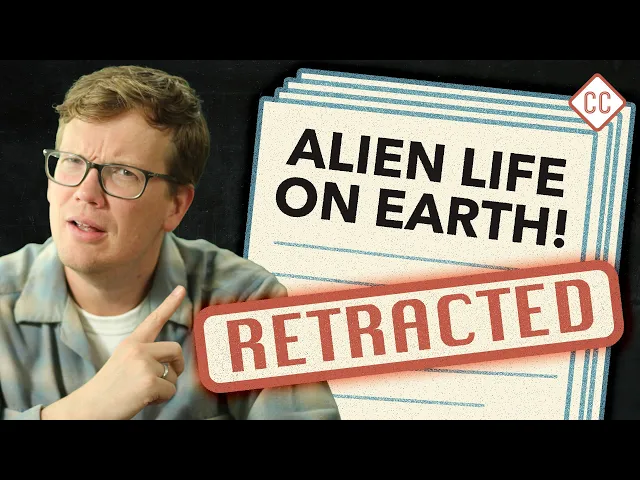
0:00 Alien life may have been discovered [music] right here on Earth.
0:04 Or at least that's what some headlines seem
0:06 to indicate in 2010 after a NASA-backed study was released.
0:10 But that was over a decade ago.
0:12 So, where are all the aliens?
0:14 Well, the truth is [music] out there.
0:16 But, as always, it's more complex.
0:19 Hi, I'm Hank Green and this is Crash Course Scientific Thinking.
0:25 [music] Now, I'm not saying I don't believe in aliens.
0:30 The universe is vast and full of opportunities for life.
0:32 Also, I would never say that because they might be listening.
0:35 But let's clear up a big misconception right at the top.
0:37 This study, which was published in the prestigious journal
0:40 Science in 2010 and reported by lots of news outlets,
0:44 never actually claimed to find aliens.
0:46 That was an unfortunate miscommunication on the part of the media.
0:50 What the study actually claimed to find was arsenic-based life,
0:55 which admittedly sounds a lot more boring than aliens.
0:57 But if it were true, it would be very revolutionary.
1:01 Unfortunately, the claim did not hold
1:04 up under closer examination of the evidence.
1:06 After the original announcement, new headlines ran stating that actually maybe
1:11 we didn't find anything all that strange.
1:13 As a science person on the internet,
1:15 but also like a regular person trying to navigate my own media feed,
1:19 the it's frustrating when we are given contradictory science stories.
1:23 But there are lots of reasons why stories like this one
1:26 are more nuanced than they come off in the news.
1:29 We'll talk a lot more about how science
1:31 gets communicated in the news in a later episode,
1:33 but today I want to tell you about how this study was received by the scientific
1:38 community and why it serves as a great
1:40 example of one of science's biggest superpowers, self-correction.
1:45 So, what happened?
1:47 The research was done in California's salty, arsenic-filled Mono Lake,
1:51 which for a poison-loving microorganism is like the Amalfi Coast.
1:55 Researchers found this bacterium, GFAJ-1, which seemed like it might replace
2:01 phosphorus with arsenic in its molecular makeup.
2:05 Which would be super weird and cool because the fundamental
2:08 building blocks of life as we know it are carbon,
2:11 hydrogen, nitrogen, oxygen, sulfur, and phosphorus, but definitely not arsenic.
2:16 This would be like making a smoothie with yogurt, berries, greens, and glass.
2:21 So, the team set up an experiment where they put that little GFAJ-1 bacteria
2:26 in a salty lake water environment that had
2:28 very little phosphorus and lots of arsenic.
2:31 That arsenic-laced water shouldn't have supported life.
2:35 But, the bacteria [music] did not die.
2:36 It grew and grew seemingly on arsenic alone.
2:40 After all their hypothesizing, observing, and experimentation,
2:44 the team felt like they had made a breakthrough.
2:46 So, they wrote about their findings in a super exciting study
2:49 called a bacterium that can grow by using arsenic instead of phosphorus.
2:53 A true banger.
2:54 Here's the thing.
2:55 The scientific process doesn't stop with the writing.
2:58 In order to get published in a real academic journal,
3:00 articles typically go through peer review.
3:03 A system where experts check one another's work
3:06 to make sure it meets the standards for scientific quality.
3:09 Reviewers assess whether a study's methods are sound
3:12 and if the findings actually support the conclusions.
3:15 The peer review process makes good work better by bringing up
3:19 ideas and concerns researchers might never think of on their own.
3:23 But, what actually happens when a paper is undergoing peer review?
3:25 Like, let's say that I did my own experiment and wrote a paper about it.
3:29 In my secret laboratory in my basement,
3:31 I tested out a new kind of eco-friendly sunscreen and found
3:35 that it works better than all the other sunscreens on the market.
3:38 How do I get that paper into a scientific
3:40 journal and share my legitimized findings with the wider world?
3:44 I think that it might be time for some sage advice.
3:52 [music] I can help you there, Hank.
3:57 Also, I loved your title, Awesome Sunscreen Club.
3:59 It's the best.
4:00 Seriously, subscribe now.
4:01 I mean, I tell it like it is, Sage.
4:02 Uh so, when do I get published?
4:04 Well, there are a few things that need to happen before that.
4:07 First, you have to submit your paper.
4:09 That's like step one.
4:10 Then the journal will send your article to a team
4:12 of scientists [music] who work in your same field.
4:14 For your study, there'll probably
4:15 be people like photobiologists and dermatologists,
4:17 people who know sunscreen [music] and skin disease.
4:20 So, those are the peers in peer review.
4:22 It wouldn't make sense to send a paper about sunscreen to an astronomer.
4:26 Exactly.
4:27 Your peers' job is to answer a big but basic question.
4:31 Is what I'm reading actually supported by the evidence provided?
4:34 They'll also ask questions like, is this study relevant to the field?
4:37 Does it effectively build on the current state of research?
4:40 Or does it overlook known sunscreen-related issues?
4:44 And the questions don't end there.
4:46 They'll also want to find out if you use sound methods.
4:48 Did you measure the results in trustworthy ways?
4:51 Did you analyze the results correctly?
4:53 And do the results really imply what you say they do?
4:55 So, like if hypothetically my sunscreen wasn't quality controlled,
4:59 or my sample size was too small, or my statistical analysis was whack,
5:02 which of course it never would be, but if it was,
5:05 then that's the reviewer's job to catch those mistakes.
5:08 Yes, but again, only as it relates
5:11 to the very specific field of sunscreen research.
5:14 Like, if you mixed up two very common sunscreen ingredients in your test,
5:18 they'd want you to know about it because they're experts in sunscreen.
5:22 And peer review is all about field-specific experts reviewing each others' work.
5:26 So, how long does peer review last?
5:28 The whole process can take some time,
5:30 so the world may have to wait for the latest by Hank Green et al.
5:34 And even then, there will be more peer review that happens after it's published.
5:39 And that's been today's Sage Advice.
5:42 Thanks, Sage.
5:44 So, it's hard to get past that initial peer review.
5:46 Scientists have to make sure they've checked all
5:48 the right boxes and that their research is solid,
5:51 which matters because the big collaborative effort
5:53 of science depends on trust and really good scrutiny.
5:57 [music] New researchers base their work on earlier discoveries and peer
6:01 review helps make sure those discoveries are supported by evidence.
6:05 But sometimes, despite our best efforts,
6:08 papers do make it into publication with flawed data,
6:11 which is what happened with the arsenic-based life study.
6:14 As Sage mentioned, peer review doesn't end with journals.
6:18 And in fact, it's only after a study
6:20 is published that the most intense peer review begins.
6:23 A published study is one of the main ways
6:25 scientists present their work to other scientists in their field.
6:29 Those other scientists then approach the same question
6:32 from different angles in order to test the findings themselves.
6:36 After a study is published,
6:38 scientists might try to replicate its results using the same data
6:42 as the original study to see if they arrive at the same conclusions.
6:46 Very basically, they rerun the numbers.
6:49 Others might try a different experiment using
6:51 the same methodology but with all new data.
6:54 Basically asking if someone else does this study,
6:57 will they come to the same conclusion?
6:58 And in the case of groundbreaking arsenic-based life, they didn't.
7:02 Other scientists tested that same strain of GFAJ-1 and tried to grow it
7:08 just like the original experiment on arsenic
7:10 instead of phosphorus, and it didn't work.
7:13 The new studies found that while
7:15 the bacteria grow in a low phosphorus environment,
7:18 it couldn't grow with no phosphorus at all,
7:20 which while interesting, was not revolutionary.
7:24 Dr.
7:24 Rosie Redfield, a lead researcher on one of those new studies,
7:27 explained that the environment the original experiment used to grow
7:30 the original bacteria probably contained just
7:34 enough phosphorus to support its growth.
7:36 So this arsenic-based alien wasn't an alien after all.
7:39 It actually required phosphorus just like everybody else.
7:43 The original study wasn't repeatable.
7:45 After the news broke, the journal Science accepted corrections
7:48 from other researchers and attached them
7:51 to the original study explaining where the experiment had gone wrong.
7:54 Some scientists called for the journal
7:56 to retract the study completely and in 2025, the paper was officially retracted.
8:02 When a publication retracts a study,
8:03 they usually slap a big warning label at the top
8:06 of it to let other folks know it has been retracted,
8:09 but they leave it up as a form of transparency.
8:11 So, it could still be read but with the knowledge
8:14 that it had been retracted for error.
8:16 Ultimately, the saga of this study is a valuable tool that shows
8:19 us how powerful the scientific process
8:21 actually is when it comes to self-correction.
8:24 Failed repetitions, corrections, niche drama about really specific bacteria,
8:29 all those things are good for science as a whole,
8:32 even if it might not seem that way from the outside.
8:34 Because while the paper's conclusion may have been ultimately flawed,
8:37 it sparked new discussions about how we would know
8:40 if we really did find an alien-ish life form.
8:43 All of this underscores a big point about science.
8:46 Breakthrough knowledge almost never comes out of one study,
8:50 which is a real problem with how science is often covered in the news.
8:52 The most newsworthy papers are going to be
8:55 the ones that are the most surprising.
8:57 But when a study introduces a shocking new truth,
9:00 it's going to need way more than one paper before it becomes settled science.
9:05 For now, it's important to understand that all one study
9:08 really shows us is what happened in that one study.
9:11 New scientific knowledge comes when a community
9:14 of scientists validate and repeat research, which takes time.
9:18 But again, it's worth it because otherwise,
9:21 scientists can [music] waste time wandering off in the wrong direction.
9:25 So, where does that leave us on aliens and arsenic?
9:27 Well, at the end of the day,
9:29 scientists didn't stop looking because that's the work of science,
9:33 to understand the universe through the collection
9:35 of evidence and the testing of ideas.
9:37 It builds on itself, both its successes and its failures,
9:41 and both are absolutely integral to learning about the universe.
9:46 So, we don't have proof of any arsenic-based life, alien or otherwise,
9:49 but there are still plenty of things we do have
9:52 proof for, like how cancer forms or how evolution happens,
9:56 and scientists will continue [music] to test the limits
9:59 of what we know and how we can know it.
10:01 Something we'll talk about more in our next episode
10:04 when we discuss the nature of uncertainty and scientific consensus.
10:08 I'll see you then.
10:09 This episode of CrashCourse Scientific Thinking
10:11 was produced in partnership with HHMI BioInteractive,
10:14 bringing real science stories to thousands
10:16 of high school and undergrad life science classrooms.
10:19 If you're a teacher, visit their website for resources that explore
10:22 the topics we discussed in the video today.
10:24 [music] Thanks for watching this episode of CrashCourse Scientific Thinking,
10:27 which was filmed in Missoula,
10:28 Montana, and made with the help of all of these nice people.
10:31 If you want to help keep CrashCourse free for everyone forever,
10:35 you can join our community on Patreon.