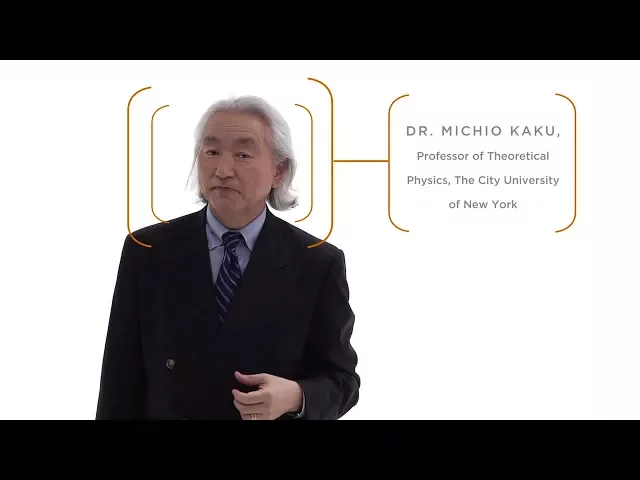
Michio Kaku: The Universe in a Nutshell (Full Presentation) | Big Think
Big Think
0:10 My name is Professor Michio Kaku.
0:12 I'm a professor of theoretical physics at the City University
0:16 of New York and I specialize in something called string theory.
0:21 I'm a physicist.
0:25 Some people ask me the question, "What has physics done for me lately?
0:29 I mean, do I get better color television,
0:31 do I get better internet reception with physics?" And the answer is yes.
0:35 You see, physics is at the very foundation of matter and energy.
0:40 We physicists invented the laser beam, we invented the transistor.
0:45 We helped to create the first computer.
0:48 We helped to construct the internet.
0:50 We wrote the World Wide Web.
0:53 In addition, we also helped to invent television, radio,
0:57 radar, microwaves, not to mention MRI scans, PET scans, x-rays.
1:02 In other words, almost everything you see in your living room,
1:08 almost everything you see in a modern hospital,
1:11 at some point or other, can be traced to a physicist.
1:15 Now, I got interested in physics when I was a child.
1:20 When I was eight, a great scientist had just died.
1:22 I still remember my elementary school teacher coming into the room
1:26 and announcing that the greatest scientist of our era has just passed away.
1:31 And that day, every newspaper published a picture of his desk.
1:37 The desk of Albert Einstein.
1:39 And the caption said, I'll never forget,
1:43 "The unfinished manuscript of the greatest work of the greatest
1:47 scientist of our time." And I said to myself, "Why couldn't he finish it?
1:52 I mean, what's so hard?
1:54 It's a homework problem, right?
1:56 Why didn't he ask his mother?
1:58 Why can't he finish this problem?" So as a child of eight,
2:01 I decided to find out what was this problem.
2:04 Years later, I began to realize that it was the theory of everything,
2:09 the Unified Field Theory.
2:13 An equation that would summarize all the physical forces in the universe.
2:18 An equation like E=mc².
2:20 That equation is half an inch long
2:23 and that equation unlocks the secret of the stars.
2:27 Why do the stars shine?
2:29 Why does the galaxy light up?
2:31 Why do we have energy on the earth?
2:35 But then there was another thing that happened
2:36 to me when I was around eight years old.
2:38 I got hooked on the Saturday morning TV shows.
2:42 In particular, Flash Gordon.
2:44 And I was hooked.
2:47 I mean, every Saturday morning watching programs about alien from outer space,
2:52 star ships, ray guns, invisibility shields, cities in the sky, that was for me.
2:58 But after a few years, I began to notice something.
3:02 First of all, I began to notice that well,
3:04 I didn't have blond hair and blue eyes, I didn't have muscles like Flash Gordon,
3:10 but it was a scientist who made the series work.
3:14 In particular, a physicist.
3:15 He was the one who discovered the ray gun, the star ships.
3:20 He was the one who created the invisibility shield.
3:23 And then I realized something else.
3:25 If you want to understand the future, you have to understand physics.
3:30 Physics is at the foundation of all the gadgetry,
3:34 the wizardry, all the marvels of the technological age,
3:39 all of it can be traced to the work of a physicist.
3:41 Physics and the Impossible Physics and the Impossible Most of science
3:46 fiction is in fact well within the laws of physics,
3:49 but possible within maybe 100 years.
3:51 And then we have impossibilities that may take 1,000 years or more.
3:57 That includes time travel, warp drive, higher dimensions,
4:02 portals through space and time, star gates, worm holes.
4:08 You know, if you were to meet your grandparents at the year 1900,
4:12 they were dirt farmers back then.
4:14 They didn't live much beyond the age of 40, on average.
4:18 Long distance communication in the year 1900 was yelling at your neighbor.
4:23 And yet, if they could see you now,
4:26 with iPads and iPods and satellites and GPS and laser beams,
4:30 how would they view you?
4:32 They They would view you as a wizard or sorcerer.
4:36 However, if we can now meet our grandkids of the year 2100,
4:41 how would we view them?
4:44 We would view them as gods, like in Greek mythology.
4:48 Zeus could control objects around him by pure thought.
4:54 Materialize objects just by thinking.
4:56 And there're perks to being a Greek god,
4:59 Venus had a perfect body, a timeless body.
5:02 And we are beginning now to unravel the genetics at the molecular level,
5:08 of the aging process.
5:09 And then Apollo, he had a chariot that he could ride across the heavens.
5:14 We will finally have that flying car
5:16 that we've always wanted to have in our garage.
5:20 By the year 2100, we will have the power of the gods.
5:24 To paraphrase Arthur C.
5:26 Clark, "Any sufficiently advanced technology is indistinguishable
5:30 from from divinity." So let's now begin our story.
5:38 The History of Physics The history
5:40 of physics is the history of modern civilization.
5:44 Before Isaac Newton, before Galileo,
5:47 we were shrouded with the mysteries of superstition.
5:51 People believed in all sorts of different kinds of spirits and demons.
5:56 What made the planets move?
5:59 Why do things things interact with other things?
6:02 It was a mystery.
6:04 So, back in the Middle Ages, for example, people read the works of Aristotle.
6:09 And Aristotle asked the question, "Why do objects move toward the earth?
6:14 And that's because," he said, "objects yearn, yearn to be united with the earth.
6:19 And why do objects slow down when you put them in motion?
6:24 Objects in motion slow down because they
6:27 get tired." These are the works of Aristotle,
6:30 which held sway for almost 2,000 years until
6:34 the beginning of modern physics with Galileo and Isaac Newton.
6:41 When the ancients looked at the sky,
6:44 the sky was full of mystery and wonder, and in the year 1066,
6:50 the most important date on the British calendar, there was a comet,
6:55 a comet which sailed over the battlefield of Hastings.
6:59 It frightened the troops of King Harold, and a young man from Normandy,
7:02 swept into England and defeated King Harold at the Battle of Hastings,
7:11 creating the modern British monarchy.
7:15 But the question is, where did the comet come from?
7:19 What was this comet that mysteriously paved
7:21 the way for the coming of the British monarchy?
7:25 Well, believe it or not, that same comet,
7:28 the very same comet that initiated the British monarchy,
7:33 sailed over London once again in 1682.
7:36 This time, everyone was asking the question, "Where do comets come from?
7:43 Do they signal the death of the king?
7:47 Why do we have messengers from heavens in the sky?" Well,
7:51 one man dared to penetrate the secrets of comets, and that was Isaac Newton.
7:57 In fact, when Isaac Newton was only 23 years old,
8:01 he stumbled upon the universal force of gravitation.
8:05 According to one story, he was walking on his estate in Woolsthorpe,
8:10 and he saw an apple fall.
8:12 And then Isaac Newton saw the moon,
8:15 and then he asked the key question which helped to unlock the heavens.
8:20 If apples falls, does the moon also fall?
8:24 And the answer was, "Yes." And answer overturned thousands of years
8:33 of mystery and speculation about the motions of the heavens.
8:38 The moon is in freefall, just like an apple.
8:42 The moon is constantly falling toward the earth.
8:47 It doesn't hit the earth, because it spins around the earth,
8:51 and the earth is round, but it's acting under a force, a force of gravity.
8:58 So Newton immediately tried to work out
9:01 the mathematics and he realized that the mathematics
9:03 of the 1600's was not sufficient to work out the motion of a falling moon.
9:09 So what did Isaac Newton do?
9:11 When he was 23 years old,
9:13 not only did he stumble upon the force of gravity, but he also created calculus.
9:19 In fact, he created calculus at the rate at which you learn it,
9:24 when you are a freshman in college.
9:27 And why did he create calculus?
9:29 To calculate the motion of a falling moon.
9:33 The mathematics of his age was incapable of calculating
9:37 the trajectories of objects moving under an inverse square force field,
9:41 and that's what Isaac Newton did.
9:43 He worked out the motion of the moon.
9:46 And then he realized that if he understands the moon,
9:50 he also understands the motion of the planets in the solar system.
9:57 And Isaac Newton invented a new telescope.
9:59 It was the reflecting telescope and he was tracking the motion of this comet.
10:06 Well, it turns out that everyone was talking about the comet,
10:10 including a rather wealthy Englishman by the name of Edmund Haley.
10:15 So Edmund Haley, being a wealthy merchant, decided to make a trip to Cambridge
10:21 to talk to England's illustrious scientist, Sir Isaac Newton.
10:25 Well, Edmund Haley asked Newton, "What do you make of this comet?
10:30 No one understands comets, they're a mystery.
10:33 They've been fascinating people for centuries,
10:36 for millennia, what are your thoughts?" And then,
10:39 I paraphrase, but Isaac Newton said something
10:42 like this, he said, "Oh, that's easy.
10:46 That comet is moving at a perfect ellipse.
10:49 It's moving in an inverse square force field.
10:52 I've been tracking it every day with my reflecting telescope and the path
10:58 of that comet conforms to my mathematics exactly." And of course,
11:03 we don't know what Edmund Haley's reaction was,
11:06 but I paraphrase, he must have said
11:09 something like this, he said, "For God's sake,
11:12 man, why don't you publish the greatest work in all of scientific history?
11:17 If correct, you have decoded the secret of the stars, the secret of the heavens.
11:25 Nobody understands where comets come from." And then Newton responded and said,
11:31 "Oh, well, it costs too much.
11:33 I mean, I'm not a wealthy man, it would cost too much to summarize this calculus
11:38 that I've invented and to work out all the motion of the stars." And then Haley
11:43 must have said this, he must have said, "Mr.
11:45 Newton, I am a wealthy man.
11:47 I have made my fortune in commerce.
11:50 I will pay for the publication of the greatest
11:54 scientific work in any language." And it was Principia.
12:01 The principals, the mathematical principals that guide the heavens.
12:06 Believe it or not, this is perhaps one of the most important works ever
12:11 written by a human being in the 100,000 years since we evolved from Africa.
12:17 Realize that this book sets into motion a physics of the universe.
12:23 Forces that control the motion of the planets,
12:29 forces which can be calculated, forces which govern the motion of cannonballs,
12:35 rockets, pebbles, everything that moves,
12:38 moves according to the laws of motion and the calculus of Sir Isaac Newton.
12:45 In fact, even today, when we launch our space probes,
12:48 we don't use Einstein's equations,
12:50 they only apply when you get near the speed of light or near a black hole.
12:55 We use Newton's laws of gravity.
12:56 They are so precise that when we shoot
12:59 a space probe right past the rings of Saturn,
13:02 we use exactly the same equations that Isaac Newton unraveled in the 1600's.
13:08 That's why we have glorious photographs of the rings of Saturn.
13:09 That's why we have fly-by's right past Neptune.
13:10 That's why we've been able to unravel the secrets of the solar system,
13:13 compliments of the laws of motion of Isaac Newton.
13:18 So what Newton did was not only did
13:21 he set into motion the ability to calculate planets,
13:24 he also set into motion a mechanics.
13:28 Machines now operated upon well-defined laws: Newton's three laws of motion.
13:35 The first law of motion says that objects in motion stay in motion forever,
13:42 unless acted on by an outside force.
13:44 You see that in an ice skating rink.
13:47 You should a puck and it goes all the way down forever,
13:51 unless acted upon by an outside force.
13:53 That's different from Aristotle's law of motion.
13:57 Aristotle said, "Objects in motion eventually stop,
14:01 because they get tired." The second law of motion says,
14:06 force is mass times acceleration.
14:08 And that equation made possible the Industrial Revolution.
14:13 Steam engines, locomotives, factories, machines,
14:19 all of it due to the mechanics set
14:21 into motion by Isaac Newton's second law of motion,
14:24 force is equal to mass times acceleration.
14:27 And then Newton had a third law of motion.
14:29 For every action, there's an equal and opposite reaction,
14:32 that's the law of rockets.
14:34 That's why we have rockets that can sail into outer space.
14:38 which could have been calculated by Isaac Newton himself.
14:38 So the lesson here is, when scientists unravel the first force of the universe,
14:45 gravity, that number, 25,000 miles per hour,
14:38 that's the escape velocity of the earth, a number So the lesson here is,
14:41 when scientists unravel the first force of the universe,
14:45 gravity, that set into motion the Industrial Revolution.
14:49 A revolution which toppled the kings and queens of Europe,
14:54 which displaced feudalism, ushering in the modern age.
14:58 All because a 23-year-old gentleman looked up and asked the question,
15:04 "Does the moon also fall?" You know, when I was a kid growing up in California,
15:11 I would see pictures of the Empire State Building.
15:13 And I said to myself, "How could that possibly build such a big
15:17 building and not know that it's going to fall?
15:20 I mean, why doesn't it fall?
15:22 They didn't build scale models of the thing,
15:24 you couldn't have an Empire State Building that big
15:26 to test whether it's going to fall or not.
15:29 How did they know ahead of time that that building wouldn't fall?
15:33 And the answer is: Newton's laws of motion.
15:37 In fact, today, I teach Newton's laws of motion,
15:40 and you can actually calculate the forces
15:42 on every single brick of the empire state building,
15:46 using Newton's second law of motion, force is mass times acceleration.
15:51 When Newton unraveled the force of gravity, that was the first force.
15:57 Now, let's take a look at the second force,
16:00 an even greater force which has touched all of our lives,
16:05 and that is the electromagnetic force.
16:08 Ever since humans saw lightning bolts light up the sky,
16:12 ever since they were terrified by the sound of thunder,
16:16 they've been asking, "Do the gods propel lightening bolts and create thunder?
16:21 Are they angry at us?" Scientists began to realize that the lightning
16:27 bolts and the thunder can be duplicated on the earth.
16:31 That we can actually create mini lightning bolts using electricity.
16:36 But it wasn't until the 1800's that finally we begin
16:40 to unlock the second great force which rules the universe,
16:44 the electromagnetic force.
16:46 Michael Faraday would give Christmas lectures in London,
16:50 fascinating everyone from adults to children.
16:53 And he would demonstrate the incredible properties of electricity.
16:59 Some people, for example, ask a simple question.
17:00 If you're in a car or an airplane,
17:02 you get hit by a lightening bolt, why don't you all get electrocuted?
17:06 Why don't you all die?
17:07 Well, Faraday answered the question.
17:10 He would create a cage.
17:12 He would walk into this steel cage,
17:15 electrify it, and he wouldn't get electrocuted at all.
17:18 That's called a Faraday cage and every time you walk into metal structure,
17:23 you get shielded by this metal object.
17:26 Well, what Michael Faraday did was, he helped to unleash the second
17:32 great revolution with something calls Faraday's Law.
17:36 A moving wire in a magnetic field,
17:40 has this electrons pushed, creating an electrical current.
17:45 That simple idea unleashed the electric revolution.
17:52 And that's why we have hydroelectric generators,
17:54 dams that produce enormous amounts of power,
17:57 That's why people build nuclear power plants.
18:00 That's why we have electricity in this room right now!
18:04 On a very small scale, you use that in your bicycle.
18:06 When you put a bicycle lamp on your bicycle,
18:09 the turning of the wheel spins a magnet.
18:13 The magnet then pushes electrons in a wire
18:16 and that's why electricity lights up in your bicycle lamp.
18:19 So in other words, electricity and magnetism were unified into a single force.
18:25 We once thought that electricity and magnetism were separate.
18:29 Now we know they are in fact the same force.
18:35 So if a moving magnet can create an electric field,
18:39 this means that a moving electric field can create a magnetic field.
18:44 But if they can create each other, why can't they oscillate and create a wave?
18:51 So that moving electric fields create magnetic fields,
18:55 create electric fields, create magnetic fields, infinitum to create a wave?
19:00 Well, around the time of the American Civil War, a mathematical physicist,
19:05 James Clerk Maxwell, calculated, using the work of Faraday,
19:09 the velocity of this wave.
19:13 And in one of the greatest breakthroughs of all time,
19:16 James Clerk Maxwell calculated the velocity of this wave
19:19 and found out it was the velocity of light.
19:23 And then he made this incredible discovery: this is light.
19:30 That's what light is.
19:33 It doesn't by accident travel at the speed of electricity, it is light itself.
19:42 wave, and that wave is called light.
19:42 And the equations were written down by James Clerk Maxwell.
19:45 Unfortunately, Michael Faraday And the equations
19:43 were written down by James Clerk Maxwell.
19:45 Unfortunately, Michael Faraday himself did not have a formal education.
19:49 He could not put into mathematical form his own work.
19:53 James Clerk Maxwell was a theoretical physicist, just like myself.
19:57 He wrote down the mathematical physics of oscillating electric
20:00 fields and magnetic fields and they are called Maxwell's equations.
20:05 These equations have to be memorized by every physicist in grad school.
20:11 You cannot get your PhD without memorizing these equations.
20:14 Every engineer deals with radar and radio has to memorize these equations.
20:19 And so, if you go to Berkley,
20:21 where I got my PhD, you can buy a t-shirt which says,
20:25 "In the beginning God said, the four-dimensional divergence of an antisymmetric,
20:32 second rank tensor equals zero, and there was light.
20:36 Ladies and gentlemen, this is the equation for light.
20:44 of light, we physicists today want to have
20:44 a one inch equation that summarize all physical reality.
20:44 Well, Michael Faraday in his own lifetime was heralded as a great scientist,
20:44 and how many scientists do you know appear on money?
20:44 Well, there he is, on the British 20-pound note.
20:44 So it's very rare that a scientist appears on a nation's currency,
20:44 but so great was a contribution of Michael
20:44 Faraday that there he is on the 20-pound note.
20:44 The Electromagnetic Revolution and The Nuclear Age The consequences
20:44 of the electromagnetic revolution touch all of us.
20:47 This is a picture of the The consequences
20:45 of the electromagnetic revolution touch all of us.
20:47 This is a picture of the earth from outer space.
20:51 Look at this picture.
20:52 Europe electrified, you can actually see the fruits
20:56 of all of our efforts to create electricity,
20:59 to energize our lives, in one picture, seeing the earth from outer space.
21:05 So let's now talk about how Faraday
21:08 and Maxwell's work touches your life as well.
21:12 This is the internet.
21:14 The internet is a simple byproduct of the electromagnetic force.
21:16 And you can see that where there is the internet, there is prosperity.
21:21 There is science, there's entertainment, there's economic activity.
21:25 Where there's no internet, there's poverty.
21:28 And in the future, the internet will be
21:32 miniaturized and it will be placed in your glasses.
21:35 Your glasses will recognize people's faces and display their biography
21:38 next to the image as you talk to them, and then when they speak Chinese to you,
21:44 your glasses will translate Chinese into English
21:47 and print out subtitles right beneath their image.
21:50 So in the future, you will know exactly who
21:53 you are talking to without even talking to them,
21:57 and this means that at a cocktail party,
22:00 if you're looking for a job, but you don't know who the heavy hitters are,
22:03 in the future you will know exactly who to suck up to.
22:07 In the future, chips will only cost a penny,
22:11 because we can manufacture tinier and tinier transistors You will
22:16 have Faraday's electromagnetic force inside your body This is a pill.
22:20 It has a chip in it.
22:22 The chip is smaller than an aspirin pill, It also has a TV camera and a magnet.
22:28 When you swallow it, the magnet guides the camera,
22:31 taking pictures of your stomach, your intestines, because we all know
22:35 what middle-aged men fear the most: colonoscopies.
22:38 And, this gives new meaning for the expression "intel inside." Now,
22:45 let's talk about the next great forces which rule the universe.
22:50 We talked about gravity, which allows us to calculate the motion of the planets.
22:55 The mechanics created by Newton helped to unleash the Industrial Revolution.
23:00 Michael Faraday worked out the electromagnetic force,
23:04 which gave us the wonders of the electric age.
23:07 And now, let's talk about the nuclear age, the stars and the sun.
23:14 People have been fascinated by the sun,
23:18 Apollo was the god that strode across the heavens in his fiery chariot.
23:22 But hey, when you calculate how long coal or oil will burn like the sun,
23:26 you realize that in just a few hundred years, the sun would burn to a crisp.
23:33 So what could possibly last for billions of years?
23:37 There must be a new force, a nuclear force.
23:42 Einstein and others helped to unravel the secret of the stars.
23:47 The nuclear force comes in two types, weak and strong.
23:52 The weak nuclear force governs radioactive decay.
23:56 The strong nuclear force is one of the strongest forces in the entire universe.
24:00 It's so strong it holds our protons together,
24:04 ever since Genesis, the beginning of time.
24:08 The equation which allows for the liberation
24:12 of energy is Einstein's famous equation E=mc².
24:16 What Einstein showed was that the faster you move, the heavier you get.
24:22 So your weight is not a constant.
24:24 When you move very rapidly you get heavier,
24:27 something which we measure every day in the laboratory.
24:31 Now, this means that the energy of motion transformed into mass,
24:37 because you get heavier.
24:39 Now, listen carefully.
24:41 The faster you move, the heavier you get.
24:45 Which means that the energy of motion, "E" turns into "m", your mass.
24:50 And the relationship between E and m is very simple,
24:53 it takes one second to write it down on a sheet of paper, it is exactly E=mc².
25:01 So the nuclear force helped to explain the secret of the sun.
25:05 But it also created a Pandora's box,
25:08 because inside the nucleus of the atom, are particles.
25:13 And when you smash these particles, what do you get?
25:18 More particles.
25:19 And when you smash them, what More particles.
25:22 In fact, we are drowning in subatomic particles.
25:26 Hundreds, thousands of subatomic particles every time we smash atoms.
25:31 Now, we smash atoms using something called atom smashers,
25:35 or particle accelerators.
25:36 I built my own particle accelerator when I was in high school.
25:41 When I was in high school, I went to my mom one day and I said,
25:46 "Can I have permission to build a 2.3 million electron volt betatron
25:51 particle accelerator in the garage?" And my mom said, "Sure, why not?
25:56 And don't forget to take out the garbage!" And as a high
26:00 school kid I asked for 400 pounds of transformer steel.
26:03 I asked for 22 miles of cooper wire.
26:06 Because I wanted to create a six kilowatter,
26:08 10,000 gauss magnetic field, to energize my atom smasher.
26:11 With 22 miles of copper wire, how could you wind it?
26:14 We did it on the high school football field.
26:17 With 22 miles of copper wire on the goalpost, gave it to my mother,
26:21 she ran to the 50 yard line unraveling the spool of wire,
26:25 she gave it to my father who then ran to the goalpost
26:28 and we wound 22 miles of copper wire on the high school football field.
26:33 Well, finally my atom smasher was ready.
26:36 It consumed six kilowatts of power,
26:38 that's every single ounce of power my house could deliver.
26:45 I plugged my ears, I closed my eyes, I turned on the power,
26:49 and I heard this huge crackling sound as six
26:53 kilowatts of power surged through my capacitor bank and then
26:57 I heard a "pop pop pop" sound as I
27:00 blew out every single circuit breaker in the house.
27:03 The whole house was plunged in darkness.
27:07 My poor mom, every time she'd come home she'd see the lights flicker and die.
27:13 And she must've wondered "why couldn't I have a son
27:16 who plays baseball?" Why can't he learn basket ball?
27:19 And for god's sake why can't he find a nice Japanese girl?" I mean,
27:24 why does he have to build these machines in the garage?
27:27 Well, these machines that I built in my garage
27:31 earned the attention of a physicist Edward Teller, father of the hydrogen bomb.
27:36 And he arranged for me to get a scholarship to Harvard.
27:40 And my career got a head start!
27:42 He knew exactly what I was doing.
27:45 I didn't have to explain to him that I was experimenting with antimatter.
27:49 I was creating anti-electrons in my mom's garage,
27:51 and using atom smashers to eventually create beams of antimatter.
27:57 Antimatter is the opposite of matter.
27:59 It has an opposite charge.
28:01 So an electron has negative charge.
28:04 The positron, or anti-electron, has positive charge.
28:07 This means that you can now create anti-molecules and anti-atoms.
28:12 Anti-hydrogen was made at CERN, outside Geneva,
28:15 Switzerland And also at Fermilab outside Chicago
28:18 Where you have anti-electrons circulating around anti-protons.
28:23 And in Brookhaven National Laboratory on Long
28:25 Island just recently they detected anti-helium!
28:30 We have two anti-protons with two anti-neutrons to create anti-helium.
28:35 For every piece of matter there is a counterpart made out of anti-matter.
28:40 And when the two collide, by the way,
28:43 it releases the greatest energy source in the universe.
28:48 It is 100 percent conversion of matter
28:51 to energy by Einstein's equations E=mc squared.
28:58 Inside the nucleus of the atom we have
29:01 particles upon particles when you smash them apart.
29:05 In the 1950's we were drowning in subatomic particles.
29:09 In fact, J.
29:10 Robert Oppenheimer, the father of the atomic bomb, once made a statement.
29:16 He declared that "the Nobel Prize in physics should go to the physicist who
29:21 does not discover a new particle this year."
29:24 That how many particles were being discovered.
29:29 So, let's talk about the Particle Zoo.
29:32 Right now, we physicists have unlocked hundreds,
29:36 thousands of subatomic particles.
29:38 And we've been able to piece them together into a jigsaw puzzle.
29:44 It's called the "standard model." It has 36 quarks,
29:48 19 free parameters, 3 generations of quarks no rhyme,
29:54 no reason, but this is the most fundamental basis
29:57 of reality that we physicists have been able to construct.
30:02 Billions of dollars.
30:03 20 Nobel prizes.
30:04 have gone into the creation of the standard model.
30:09 and it is the ugliest theory known to science, but it works.
30:13 There's one piece missing, and that one piece missing is called the Higgs-Boson.
30:19 We expect to find it.
30:20 We want to create a higher version of this theory and that theory,
30:26 we think, is string theory.
30:30 String theory is based on the simple idea
30:33 that all the four forces of the universe Gravity,
30:37 electromagnetic force, and the two nuclear forces, can be viewed as music.
30:44 Music of tiny little rubber bands.
30:46 So if I had a super microscope,
30:48 and I could look right into the heart of an electron What would I see?
30:53 I would see a vibrating rubber band.
30:55 And if I "twang" it, it turns into a neutrino.
30:57 I "twang" it again and it turns into a quark.
30:59 I "twang" it again and it turns into a Yang-Mills particle In fact,
31:03 if I "twang" it enough times, I get thousands of subatomic particles
31:07 that have been cataloged patiently by physicists.
31:14 String theory, we think, is a theory of everything.
31:18 Now, string theory, in turn,
31:20 can be summarized in an equation about an inch long That's my equation!
31:25 This is called string field theory.
31:27 And how will we test it?
31:32 We are building a machine.
31:33 The biggest machine of science ever built in the history of the human race.
31:38 Outside Geneva, Switzerland.
31:41 It is the Large Hadron Collider.
31:45 So the Higgs-Boson, we think, will be created by the Large Hadron Collider.
31:50 A tube 17 miles in circumference with two beams of protons
31:54 circulating in opposite directions Then slamming
31:58 together creating a shower of particles,
32:01 and among these particles we hope to find the Higgs-Boson, but not only that.
32:06 We hope to find particles even beyond the Higgs-Boson.
32:09 The next set of particles beyond the Higgs-Boson are "sparticles" The next
32:13 layer of the jigsaw puzzle are
32:16 called sparticles—super particles Nothing but higher vibrations,
32:19 higher musical notes of a vibrating string.
32:23 And what else can we do?
32:25 We can also unlock secrets of the big bang.
32:28 You see, Einstein's equations break down and the instant
32:31 of the big band and the center of a black hole.
32:35 The two most interesting places in the universe
32:40 are beyond our reach using Einstein's equations.
32:44 We need a higher theory, and that's where string theory comes in.
32:49 String theory takes you before the Big Bang, before Genesis itself.
32:53 And what does string theory say?
32:56 It says that there is a multiverse of universes.
33:02 Where did the Big Bang come from?
33:05 Well, Einstein's equations give us this compelling picture
33:08 that we are like insects on a soap bubble.
33:12 A gigantic soap bubble which is expanding.
33:16 and we are trapped like flies on fly paper,
33:18 we can't escape the soap bubble and that's called the Big Bang Theory.
33:23 String theory says there should be other
33:26 bubbles out there in a multiverse of bubbles.
33:32 When two universes collide it can form another universe.
33:36 When a universe splits in half it can create two universes,
33:40 and that, we think, is the Big Bang.
33:43 The Big Bang is caused by either the collision
33:48 of universes or by the fissioning of universes.
33:53 If there are other dimensions,
33:55 if there are other universes, can we go between universes?
34:00 Well that, of course, is very hard,
34:03 but Alice in Wonderland gives us a possibility that maybe
34:08 one day we might create a wormhole between universes.
34:13 This is a wormhole.
34:16 Think of taking a sheet of paper and putting two dots on it.
34:20 The shortest distance between two points is a straight line.
34:25 But if I can fold, if I can fold
34:27 that sheet of paper Then perhaps I can create a shortcut.
34:32 A shortcut through space and time, called a wormhole.
34:36 This is a genuine solution of Einstein's equations.
34:40 We can actually see this in string theory.
34:42 The question is: how practical is it to go through one of these things?
34:47 We don't know.
34:48 In fact there's a debate among physicists today, Stephen Hawking,
34:52 many physicists are jumping into the game of trying to figure out
34:57 whether it's physically possible to go all the way through a wormhole.
35:03 Because if you could, then you might be able to use this as a time machine.
35:08 Since string theory is a theory of everything, it's also a theory of time.
35:15 And time machines are allowed in Einstein's equations,
35:18 but to build one is extremely difficult.
35:22 Far more energy is required than a simple Delorean with plutonium.
35:31 You know, trillions of years from now the universe is going to get awfully cold.
35:35 We think the universe is headed for a big freeze.
35:39 Stars will blink out, stars will cease to twinkle,
35:42 and the universe will be so big it'll be very cold.
35:46 At that point all intelligent life in the universe must die.
35:52 The laws of physics are a death warrant for all intelligent life.
35:58 There is only one way to escape the death of the universe,
36:03 and that is leave the universe.
36:06 We are now entering the realm of science fiction,
36:09 but at least now we have equations equations of string theory which will
36:13 now allow us to calculate if it is possible to go through a wormhole,
36:19 to go to another universe where it's warmer,
36:21 and perhaps we can start all over again.
36:27 If you were to summarize the march of physics through the last 10,000 years
36:34 it would be the distillation of the laws of nature into four fundamental forces.
36:40 Gravity, electricity and magnetism, and the two nuclear forces.
36:44 But then the question is "is there a fifth force?"
36:47 A force beyond the forces we can measure in the laboratory.
36:51 And believe it or not there are physicists
36:54 who have looked very carefully for a fifth force.
36:57 Some people think maybe it's psychic phenomena.
37:00 Maybe it's telepathy.
37:01 Maybe it's something called psi power.
37:04 Maybe it's the power of the mind.
37:06 Maybe consciousness!
37:07 Well, I'm a physicist.
37:10 We believe in testing theories to make
37:13 sure they are falsifiable and reproducible.
37:16 We want to make sure that on demand
37:19 your theory works every single time without exception.
37:23 And if your theory fails one time, It's wrong.
37:26 In other words, Einstein's theory has
37:29 to work every single time without exception.
37:32 One time Einstein's theory is proven to be wrong, the whole theory is wrong.
37:37 Well, so far we can reproduce these four physical theories,
37:41 but a fifth theory cannot be reproduced.
37:44 We've looked for it.
37:45 Some people think that maybe a fifth force may be short range.
37:49 Like, not over the nucleus of an atom, but ranging over several feet.
37:53 And we can't find any.
37:57 We physicists in the last ten years have discovered
38:02 a new energy source larger than the galaxy itself.
38:06 Dark energy.
38:08 Realized in our universe today 73 percent of our universe,
38:12 matter and energy, 73 percent is in the form of dark energy.
38:17 The energy of nothing!
38:18 That's what's blowing the galaxies farther and farther apart.
38:22 That's the energy of the Big Bang itself.
38:25 Kids ask the question, "If the universe banged,
38:28 what made it bang?" And the answer is dark energy.
38:32 73 percent of the universe's energy is dark energy.
38:36 23 percent is dark matter.
38:38 Dark matter is invisible matter.
38:39 If I held it in my hand it would go right through my hand.
38:42 It holds the galaxy together.
38:44 23 percent of the universe is dark matter.
38:47 Stars made out of hydrogen and helium make up four percent of the universe.
38:52 And then what about us?
38:54 We, the higher elements.
38:56 We made out of oxygen, carben, nitrogen, tungsten,
39:00 iron We make up .03 percent of the universe.
39:06 In other words, we are the exception.
39:09 The universe is mainly made out of dark energy.
39:12 The universe is mainly made out of dark matter.
39:16 Overwhelming the stars, overwhelming the galaxies in fact.
39:20 Now what is dark matter, which makes up 23 percent of the universe?
39:25 No one knows.
39:27 String theory gives us a clue, but there's no definitive answer.
39:33 So in other words, for you young aspiring physicists out there in the audience,
39:38 You may be saying to yourself right now, "Why should I go into physics?
39:42 Because you guys already have a candidate for the unified field theory, right?
39:46 Just realize that every single physics textbook is WRONG.
39:51 Every single physics textbook on the Earth says
39:54 that the universe is mainly made out of atoms Right?
39:57 There it is!
39:58 The universe is mainly made out of atoms.
40:00 Wrong!
40:01 In the past ten years we have come
40:04 to the realization that most of the universe is dark.
40:08 And there's a whole shelf full of Nobel Prizes for the young
40:12 people who can figure out the secret of dark matter and dark energy.
40:19 Let me give some advice to you if you are a young physicist,
40:23 perhaps just getting out of high school You have dreams of being Einstein,
40:28 you have dreams of working on string theory
40:30 and things like that and then you hit freshman physics.
40:34 Let me be blunt: We physicists flunk most student taking elementary physics.
40:40 And we're more or less encouraged to do so by the engineering department.
40:43 We don't want to train engineers who make bridges that fall down.
40:47 We don't want to create engineers that create skyscrapers that fall over.
40:51 There's a bottom line: you have to know the laws of mechanics.
40:55 So before you can work with the laws of Einstein,
40:58 you have to work with the laws of friction, levers, pulleys and gears.
41:02 As a consequence we have a very high flunk-out rate in elementary physics.
41:06 So if you're a young physicist graduating
41:08 from high school with stars in your eyes,
41:10 and you encounter freshman physics for the first time, watch out!
41:15 If you have a rough time, that's the way it is.
41:19 I started out my life as an experimental physicist.
41:22 Then I went to Harvard and then I talked to my adviser,
41:26 one of the world's greatest experiment physicists,
41:28 Professor Pound And he told me maybe it's time to give it a rest.
41:32 He said to me, "Your skills are much better suited to what you love the most,
41:37 which is theory." "Mathematics.
41:39 The world of higher dimensions." And I realized that he was probably right.
41:45 The thing about physics, or science that really intrigues me the most is to find
41:51 the most fundamental basis for everything
41:53 Rather than trying to massage a theory,
41:56 or make a theory prettier, Why not find out why it works?
42:00 What makes it tick?
42:01 And that's what I do for a living.
42:03 I'm a theoretical physicist.
42:04 Thank you very much!