How Much Longer Can We "Hide" The Inflation?
How Money Works
0:00 Late last week, the official consumer price
0:02 index inflation figure rose to 4.2% year-over-year,
0:05 the highest annualized rate seen since the postcoid price surge of 2022.
0:09 This by itself was not a great result.
0:12 Even though these official numbers really
0:14 just confirmed what most people already knew, things are getting more expensive.
0:18 But what they didn't capture is what is likely to still be coming down the pipe.
0:23 Last month, the producer price index,
0:25 which tracks a basket of items that businesses
0:27 use to provide goods and services to consumers,
0:30 saw its largest single increase in the last decade,
0:32 with the only exception of a single
0:34 month at the height of post-pandemic inflation.
0:36 Now, the reasons are pretty obvious.
0:38 Fuel prices trickle through to almost everything that needs to be transported.
0:42 Sprinkle in persistent tariff uncertainty, market consolidation,
0:46 and a lot of resources being redirected towards data center
0:48 buildouts instead of providing service
0:50 infrastructure to regular people and businesses.
0:52 Now, eventually these companies will either be forced to accept
0:55 lower profit or just pass these higher prices along to consumers,
0:58 which will ultimately be a decision made for them
1:01 by how much more those consumers can financially bear.
1:03 Again, not exactly surprising stuff anymore.
1:05 And if anything, the cost of living crisis we are currently experiencing is
1:10 arguably not as bad as wider economic
1:12 conditions might suggest, for now at least.
1:15 But the implications of these numbers are worth understanding because they are
1:18 likely to mean a lot more than just yet even higher prices.
1:22 This kind of inflation is putting a new Fed in a very difficult position.
1:26 The logical move would be to raise interest rates.
1:29 But that runs the risks of sweeping out the last leg holding up the economy,
1:33 which is the stock market.
1:35 A stock market that is already gearing up
1:37 to digest three mega IPOs in the next few months.
1:40 The other options involve either sacrificing the American consumer,
1:43 the American worker, or the American dollar.
1:46 The other unfortunate reality worth keeping in mind is
1:48 that no matter what we do with our financial levers, we can't print more oil.
1:52 And any price increases from here are going to be on top of a cost
1:56 of living level that was already forcing a lot of people to go without.
2:00 Are you concerned, Mr.
2:01 President, about the latest inflation number which came out this morning?
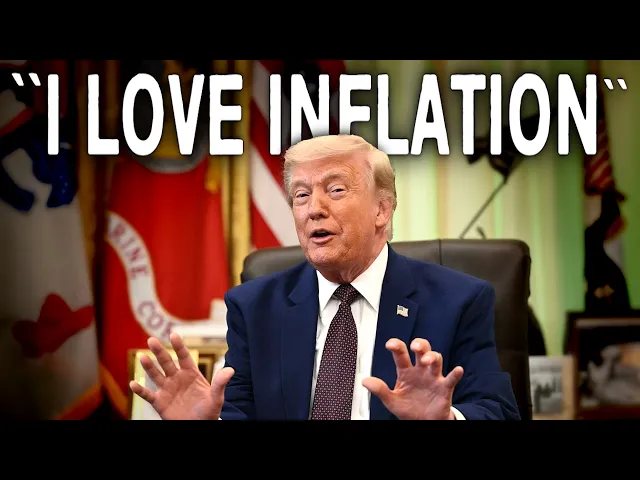
2:04 Could that be a No, I love it.
2:06 The numbers were right.
2:07 You know what I really love?
2:09 I love the inflation.
2:10 spending all of that money on housing,
2:13 food, child care, transportation, health, and taxes.
2:16 There's nothing left over.
2:17 And it's hard to imagine that if I'm making $120,000, I'm barely making it.
2:22 The numbers at the gas pumps keep going up.
2:25 539, 559, and 579.
2:27 This is ridiculous.
2:28 We went from 3 to 5.
2:30 Domestically, we've got about 216 million barrels of gasoline available to us.
2:35 That seems like a lot, but 190 million barrels is considered critical.
2:40 Okay, so inflation has clearly been creeping up,
2:43 and that's on top of levels well above what would be considered optimal.
2:47 But for now, at least, there are, or at least were,
2:49 a few things that have been shielding us
2:51 from the full effects of just how unaffordable things have become.
2:55 The first of those sacrificial shields is
2:57 that we have been burning through inventories.
2:59 In early 2025, companies stocked up on anything
3:02 and everything they could keep in their warehouses.
3:04 mostly in an attempt to get ahead of tariff disruptions.
3:07 And where possible, they have just been using their stock
3:10 piles to keep prices competitive for as long as they can.
3:13 In the first quarter of 2025 alone,
3:16 businesses added around 172 billion worth of inventory,
3:19 which according to government GDP data
3:21 was the largest quarterly inventory buildup
3:23 outside of the pandemic recovery in records going back to the 1940s.
3:28 This obviously doesn't apply to perishables that can't be stored indefinitely,
3:32 but specifically things like component parts
3:34 and other goods were piled up in bulk.
3:36 Small businesses didn't have a warehouse to do this.
3:39 So mostly this has been a benefit to larger retailers and B2B suppliers.
3:43 A big box retailer could fill distribution centers
3:46 with a year's worth of patio furniture before the tariffs landed.
3:49 The local warehouse buying through a distributor
3:51 got a few extra weeks stock at best, which was kind of part of the plan.
3:56 For big companies, this was an opportunity to run anti-competitive pricing
3:59 without actually running anti-competitive pricing.
4:01 Because in theory, it wasn't their fault that their smaller market
4:05 rivals didn't order supplies before a 30% tax was slapped on everything.
4:09 Obviously, this isn't great, but for consumers and end producers,
4:13 it at the very least delayed price increases.
4:15 When the tariffs hit,
4:17 Goldman Sachs estimated that companies were only passing along
4:20 about a fifth of the cost increases to consumers.
4:22 A year later, their estimates put that figure closer to 3/4 and still rising.
4:27 Researchers at the Fed went a step further last month
4:30 and described what we are seeing now as uh full pass through.
4:34 So, that cushion is mostly spent.
4:36 We still don't 100% know what is happening with tariffs either.
4:40 The Supreme Court struck down the biggest batch of them in February,
4:43 but the White House has still been going back and forth on new
4:46 ways to get around these rulings and re-implement something in its place.
4:50 For now, since the first round of tariff rules weren't legally enforceable,
4:53 the government will at some point have to pay
4:57 back around $166 billion in refunds to about 330,000 importers.
5:01 Money that is unlikely to find its way back to consumers.
5:05 This refund process has been incredibly slow and administratively difficult,
5:09 which is again disproportionately impacting smaller businesses that don't have
5:13 the time or the manpower to wait for this cash.
5:15 There was also a lot of speculation around these rulings with certain
5:19 companies buying the rights to tariff refunds before they were confirmed.
5:22 They would go to businesses and pay them some money to write up a contract
5:26 that would entitle them to tariff refunds
5:27 if and when they were ever handed back.
5:30 One trade attorney at Foley and Lardner
5:32 reported getting hundreds of emails a day offering
5:34 to buy his clients refund claims with offers
5:37 that started around 20 cents on the dollar.
5:39 So yeah, apparently this is a whole industry now.
5:42 A lot of desperate small businesses took those pretty crappy
5:45 deals just to get some money back to make payroll.
5:48 The investors themselves have made 400% returns off
5:51 this desperation within the span of just a few months,
5:54 which is clearly how the free market ought to be working.
5:57 Now, arguably, these investment firms still accepted the risks
6:00 that these tariffs may never be paid back,
6:02 in which case they would lose all the money they paid to these businesses.
6:05 But it probably didn't help that the actual
6:07 architect of the tariff plan in the first place
6:10 also had direct interest in an investment firm
6:12 betting against the legality of those very same tariffs.
6:15 Now, even outside of particularly
6:17 egregious examples like that, this financialization
6:19 of government tools is making it
6:21 particularly difficult for smaller businesses to compete.
6:23 But the point here is that once inventories run dry,
6:25 we will be more directly exposed to the increased
6:28 prices to actually make or import stuff,
6:30 which at the moment is climbing about one
6:32 and a half times as fast as the headline inflation number.
6:35 Now, the reason why this pressure on small businesses is such a big
6:39 deal is because larger companies aren't going to cover this gap forever.
6:42 They have accepted tighter margins for now because they
6:44 realize that there is only so much consumers can bear.
6:47 But if smaller businesses are pushed out of these markets,
6:50 there won't be much competition left stopping major retailers
6:53 from passing along these input price shocks and then some.
6:56 So yeah, this inventory draw down has been
6:58 softening the inflationary blow for the last 12 months.
7:01 And that's the first layer of armor that has more or less been used up.
7:05 But within the last 100 days in particular,
7:07 there has been one inventory cash that we have been drawing on harder than ever.
7:11 And that's our strategic petroleum reserve.
7:12 So, it's time to learn how money works to find out
7:15 how much longer we can hide away the real inflation problem.
7:19 This video is sponsored by ODO.
7:21 ODU is the all-in-one business management platform that pulls sales,
7:25 accounting, inventory, manufacturing, e-commerce,
7:27 and CRM into a single connected system.
7:29 Instead of forcing you to juggle five different
7:31 tools that do not talk to each other,
7:33 what makes ODU work is how seamlessly it ties everything together.
7:37 You only install the apps you actually need and they share data automatically.
7:41 We use ODU ourselves.
7:42 Our How many works library runs entirely on ODO and having
7:46 everything in one dashboard has made the day-to-day so much smoother.
7:49 It's also intuitive and highly customizable, which makes it a good fit for small
7:54 to medium-sized businesses that have limited technical
7:56 expertise and want software that adapts to how
7:58 they work instead of the other way around.
8:00 And because ODU automates the routine stuff,
8:03 invoicing, restock alerts, follow-ups,
8:04 you spend less time doing admin or stitching
8:07 tools together and more time actually running your business.
8:10 If you want to see how ODU can streamline your own business,
8:12 you can book a free meeting with an ODU expert or try the full platform free
8:16 for 15 days with no credit card required
8:18 or even keep any single app free for life.
8:21 Check it out using my link in the description.
8:24 Okay, so companies private stockpiles have quietly been absorbing
8:26 a lot of the price pressure for the last year,
8:29 but the one doing the heaviest lifting
8:31 right now belongs to the federal government.
8:33 The strategic petroleum reserve is quite literally a huge pool of oil kept
8:37 in four separate underground caves which is in theory made for times like this.
8:41 If we need a stabilized supply and by extension prices during unstable times,
8:45 we can draw down these reserves to put
8:47 more oil into the market and avoid huge swings.
8:50 It's pretty simple, but it won't last forever.
8:53 According to the Department of Energy's own numbers,
8:56 the reserve held about 411 million barrels at the start of the year.
9:00 As of last week, it was down to around 349 million,
9:03 sitting at under just half of its theoretical maximum of 711
9:07 million barrels after weeks of the largest draw downs in its history.
9:12 The rate at which we have been drawing oil from, it would be
9:14 fine if the conflict in Iran really did only last a few weeks.
9:17 But we are now more than 3 months in.
9:20 And despite recent peace talks,
9:21 there is still a long way to go before things get back to normal.
9:25 The US has committed 172 million barrels
9:28 to the coordinated international release and completing
9:30 that commitment would leave the reserve at its lowest level since 1982 directly
9:35 following the most severe oil crisis in history which for context took place
9:39 over 2 years to get to where we are now just after 100 days.
9:43 Now, another technical but important detail is
9:45 that we can't draw these reserves down to zero.
9:48 to maintain the cavern integrity of the locations
9:50 where we actually keep all of this oil,
9:52 we need to keep about 150 million barrels in there at an absolute minimum.
9:56 So, in plain English, at our current rate of draw down,
9:59 we are about 10 weeks away from hitting a hard limit on this supply cushion.
10:02 If this runs out, I truly cannot emphasize how we are.
10:06 Prices will flow through a lot more
10:08 of the economy than direct costs at the pump.
10:10 Almost everything in America is moved with diesel engines.
10:13 According to the American Trucking Associations,
10:15 trucks alone carried almost 3/4 of all domestic freight tonnage in 2024.
10:19 For consumer prices,
10:20 one of the sharpest recent movers has been the cost of air travel,
10:24 which was in turn caused by everything we covered in last week's video.
10:28 Jet fuel used in a 737 and diesel used
10:31 in a truck or a locomotive are actually surprisingly similar fuels.
10:34 They are both middle distillates pulled from the same part of the barrel.
10:38 So the increased cost of shipping yourself to Cancun is roughly
10:41 analogous to the increased costs of shipping anything else everywhere else.
10:45 Jet fuel prices have already doubled over
10:47 the last year according to EIA price data.
10:50 Regular diesel is up almost 60%.
10:53 Marisk, the world's second largest shipping company,
10:55 says the conflict is adding around $500 million a month to its
10:59 costs and that one carrier alone moves about 14% of everything you buy.
11:03 The International Energy Agency has called
11:05 this the largest supply disruption in the history
11:08 of the global oil market with around 14 million barrels a day still shut in.
11:12 If the strategic reserve here in America and other similar
11:15 reserves around the world can no longer make up the difference,
11:18 there is nothing left standing between us
11:19 and bearing the full force of that disruption.
11:22 Now, technically, America is a net fossil fuel exporter.
11:25 And the old team at Micro did a great video on why that unfortunately does
11:29 not really matter by actually tracing every
11:31 barrel of oil that goes through our country.
11:33 So I will leave a link to that video in the description.
11:36 But the most important TLDDR is that almost all
11:39 of our fossil fuels outside of the strategic reserve belong
11:41 to private companies that are just going to sell
11:44 to the highest bidder no matter where in the world they are.
11:47 With global supplies this short,
11:48 Bloomberg now describes American barrels as the supplier
11:51 of last resort for everyone else, which keeps our prices pinned to the global
11:55 crisis price regardless of how much we produce.
11:58 So fuel costs became everything costs.
12:00 I know this isn't exactly new news, but transport and energy isn't the only
12:05 limited resource suppliers are currently contending with.
12:07 And even if the war in Iran theoretically
12:10 ends tomorrow in its entirety with no ongoing consequences,
12:13 which is probably wishful thinking to put it mildly,
12:17 there are still additional headwinds against prices.
12:19 At the same time as we are dealing with energy constraints,
12:22 a lot of skilled tradesmen, energy components, materials,
12:25 and government attention has been tied up in building data centers.
12:28 Now we have already spoken endlessly about these projects
12:31 and their uh logical payoff but the point here is that they are a huge strain
12:37 on limited components like well everything from ram trucks,
12:40 ram trucks, tradesmen, concrete rebar,
12:42 commercial building equipment and most crucially electrical infrastructure
12:45 with a particular choke point being electrical transformers.
12:48 These little metal boxes could provide power
12:51 to local energy grids or a real factory.
12:53 Both of which would increase the supply
12:55 of essential services or consumer goods respectively.
12:57 Or they could sit in a warehouse waiting for data centers to go online.
13:01 And at the moment there is just more money supporting the latter option.
13:04 Now to play devil's advocate a bit here, if these projects do eventually deliver
13:09 the productivity miracle they are promising,
13:10 some of this spending will potentially have a deflationary impact.
13:14 But that is an optimistic outcome that may not be passed to consumers.
13:17 won't be for the more essential components of CPI like you know food
13:21 and energy and is unlikely to pan out for some time now if at all.
13:25 In the meantime, your transformer sitting in a warehouse
13:28 does nothing for your power bill this year.
13:30 Local utilities, for example,
13:32 are basically paying RAM prices to do routine maintenance on their grids.
13:36 Utilities report that transformers,
13:37 which do need to be replaced as part of ongoing grid maintenance,
13:41 now cost four to six times what they did before
13:44 2022 with waiting lists that can stretch out to 4 years.
13:47 And all of that is getting passed along to everybody,
13:50 even if there are no data centers directly
13:52 on your grid competing for that precious supply of electrons.
13:55 The same kind of thing is happening for skilled tradesmen.
13:58 Data center projects are paying electricians around
14:00 a 32% premium over traditional construction work
14:03 with specialized electricians in Northern Virginia
14:06 and Texas commanding up to $280,000 a year.
14:09 Obviously, that is an amazing opportunity for those guys and nobody
14:13 is going to begrudge them for cashing in while they can.
14:16 But the businesses building houses and factories are
14:18 having to compete on price for the same people.
14:21 A cost that will eventually need to be
14:22 passed along through higher housing or goods costs, respectively.
14:25 The country is already short around 300,000 electricians.
14:28 And in Texas, home builders say competition for them
14:31 is delaying housing construction by a couple of months.
14:34 Now, all of this is obviously not great,
14:37 but one of the biggest problems with fixing it is
14:40 that the cure is going to hurt almost as much as the illness.
14:43 The logical first step would be to end the war
14:46 in Iran and at the very least provide clarity on tariffs.
14:49 But we have tried that about 30 times now.
14:52 The most recent second signing of the Treaty of Versailles is
14:55 certainly the most noteworthy step towards bringing the war to a close,
14:59 albeit with significant concessions from America.
15:01 But it should also be noted that even if this peace deal does stick this time,
15:06 Hormuse tolls may still continue.
15:07 They will just be called environmental fees instead of tolls,
15:11 which it must be emphasized is exactly the same thing.
15:14 Although maybe it's better for Auron's ESG credentials.
15:16 So, in the meantime, while all of that is still getting worked out,
15:20 this is going to fall on the Fed
15:22 that really only has two tools at their disposal.
15:25 Sucking money out of circulation or raising the interest rates.
15:28 But these have their own problems.
15:30 If we raise rates, that means investors can get
15:33 better returns by just parking their money somewhere safe,
15:36 which might tempt a few more people to cash
15:38 out on an already very frothy investment market.
15:41 Why risk being on the wrong side of a bubble
15:44 when the 30-year Treasury will pay you over 5%,
15:46 effectively guaranteed more than it has paid at any point since 2007?
15:51 Maybe the market will offer better returns,
15:53 but even the most optimistic investors are seeing the warning signs.
15:57 This is especially risky right now because there's going to be an even greater
16:01 demand for cash as three IPOs and a major capital raise come from SpaceX,
16:06 OpenAI, Anthropic, and Google.
16:07 SpaceX, which listed this week,
16:09 raised $75 billion at a $1.75 trillion valuation,
16:12 which made it the largest IPO in history.
16:15 OpenAI confidentially filed for its own IPO just days
16:19 before that listing at a valuation of over $850 billion.
16:22 And Enthropic has already filed for its own at over a trillion.
16:27 Google has also announced plans to raise up to $80 billion in new equity,
16:31 which is kind of the thing that mega caps basically never do,
16:34 but it's been forced into continue funding its data center expansion.
16:38 These companies are all going to be holding their hand out
16:40 at the same time as the government is holding its handout,
16:43 offering better rates than almost any time
16:45 in the past 20 years for the privilege.
16:47 If the Fed raises rates or pulls money out of the market,
16:50 there is going to be even less cash
16:51 to go around amongst these hungry, hungry hippos.
16:54 This is why the market reacted so badly to this week's inflation announcement.
16:58 In theory, higher inflation should actually be good for the market.
17:02 Because people will naturally want to put their money into real
17:05 businesses as a hedge against the declining value of the dollar.
17:08 But because there is so much demand for cash,
17:10 any sign that interest rates are going to tempt
17:13 people to lock that cash up is really scary.
17:15 An even more perverse sign of the same paradox is
17:18 that the market is now really afraid of good jobs reports.
17:22 Last Friday, payrolls came in at almost double what forecasters expected,
17:25 which was the third month in a row, the number has beaten consensus.
17:29 Stocks and bonds both sold off because
17:32 traders immediately started pricing in rate hikes.
17:34 In a normal economy, lots of people getting new jobs should be a good sign
17:38 for businesses like the ones listed on the stock market, right?
17:42 More people with jobs means money to spend,
17:44 as well as being an indication that companies are confident enough to hire.
17:48 But we aren't a normal market at the moment.
17:51 Valuations are stretched so far that it would take decades of good
17:54 consumer spending to pay back a lot of the values we are seeing,
17:57 which is such a long time horizon that it has basically become irrelevant.
18:01 So what is actually happening is that good jobs numbers remove the one excuse
18:05 that the Fed could hold up to lower rates or at least leave them alone.
18:09 The Fed has a triple mandate to maintain stable prices,
18:12 stable rates, and maximum employment.
18:14 If employment is apparently really good and prices are going up,
18:18 then in theory they have no choice but to raise interest rates.
18:21 The brand new Fed chair, Kevin Walsh, who was only sworn in a few weeks ago,
18:25 completed his first ever policy meeting in the big chair
18:28 last week with exactly that combination sitting on the table.
18:31 Now, we have already made another video on why those job
18:34 numbers may not actually be all they really seem in reality.
18:37 So, I will leave a link to that below instead of going over it all again.
18:40 But the point is that as long as the job numbers look good,
18:43 at least on paper, and the inflation numbers look bad,
18:46 interest rates are likely to increase.
18:48 But okay, this is about inflation, not the stock market.
18:52 So, for the sake of this video, who cares?
18:55 Current stocks are overwhelmingly owned by wealthy
18:57 people who can theoretically afford the loss.
19:00 According to the Fed's own distributional accounts,
19:02 the wealthiest 10% of households hold
19:04 around 87% of household-owned corporate equities,
19:06 and the top 1% alone holds about half.
19:09 However, those wealthy people are the ones
19:12 currently doing a large share of the spending.
19:15 By Moody's estimates,
19:16 the top 10% of earners now account for almost half of all consumer spending,
19:20 which is the highest share in records going back to 1989.
19:23 A booming stock market makes these people feel good.
19:26 And when they see big numbers in their Schwab account,
19:28 they are more likely to splurge on goods
19:30 and services that provide opportunities to every other household.
19:33 But if Green Line does not go up, that could knock out the last leg that has
19:37 been holding up our economy for a long time now.
19:40 Both companies and wealthy households would stop spending on capex and luxuries,
19:44 respectively, eliminating the biggest growth sectors of the economy,
19:48 potentially causing an employment crisis just as bad,
19:51 if not worse, than the cost of living crisis.
19:53 Okay, so what if we just let inflation run hot?
19:56 Well, that has its problems, too, even beyond just higher prices.
19:59 The US dollar is already under stress as the global reserve currency.
20:03 Something that buys us extraordinary privilege in international
20:06 markets both for imports and for debt.
20:08 The dollar share of global foreign exchange reserves has slipped
20:11 to its lowest level in roughly three decades of IMF records.
20:15 And the dollar index briefly broke below 97 earlier this year,
20:19 back to lows it hadn't seen in years
20:21 before the war sent everything scrambling back into dollars.
20:24 If our dollar inflates away, we will start to lose that privilege.
20:27 Now, a cheaper dollar does make American exports more competitive,
20:30 which is why some people in Washington have openly argued for one,
20:34 but that math works a lot better when one of our biggest
20:37 imports isn't suddenly around 40% more expensive than it was a year ago.
20:41 Also, we are still a massive net importer of goods and services
20:44 that will get relatively more expensive if our dollar gets weaker,
20:47 compounding the problem of prices on shelves.
20:49 In the short term, if wages are adjusted upwards,
20:52 it may help smooth things over for a little while.
20:55 But realistically, it will just leave wage earners
20:57 further behind on already significant cost of living pressures.
21:01 Long-term, it would significantly undermine the easy capital we
21:04 have been blessed with over the last 80 years.
21:06 Our debt has always been a burden to carry,
21:09 and keeping it manageable relies on being
21:11 able to grow faster than the debt does,
21:13 while simultaneously doing everything we can to carry the weight responsibly.
21:17 Right now, that debt is just shy of $40 trillion,
21:20 and it grew by about $3 trillion over the past year.
21:23 The economy underneath it managed less than two.
21:26 The interest alone is costing around a trillion a year.
21:29 At the same time, we are doing a lot of things
21:32 that are shifting that weight around
21:33 while simultaneously shooting ourselves in both feet.
21:35 Now, one ray of hope in these numbers is that out of everything,
21:38 cars are getting cheaper.
21:40 New vehicle prices fell again in this report as manufacturers have
21:43 undermined their own market in some of the dumbest ways possible.
21:46 So, go and watch this video next to find out how.
21:48 And don't forget to like and subscribe to keep on learning how money works.