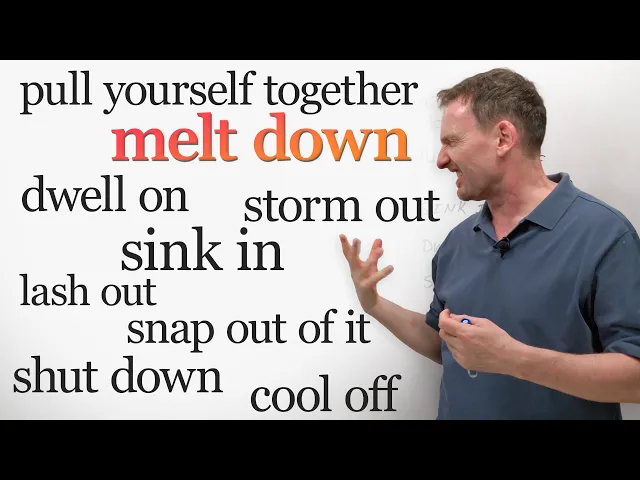
12 Emotional English Phrasal Verbs: lash out, storm off, sink in...
Adam’s English Lessons · engVid
0:00 Today's video is about phrasal verbs,
0:01 which I think you're all very familiar with by now.
0:04 I've made many videos about phrasal verbs,
0:07 but in the past I used to present the phrasal verbs to you in sets,
0:12 like put on, put in, put out, put through,
0:15 and so on, to make sure you understand all the different uses of it.
0:19 What I want to do today, I want to start showing you phrasal
0:23 verbs in particular contexts that they're used.
0:26 And the reason it's important to know this is because native speakers,
0:30 we use phrasal verbs all the time.
0:32 It's just part of everyday vocabulary, right?
0:35 And I know that it's very difficult to learn
0:38 phrasal verbs without actually knowing their meaning first,
0:40 and then just memorizing them.
0:42 So, again, just in case you're not familiar with phrasal verbs,
0:46 it's a verb with what looks like a preposition, it's actually a particle,
0:50 but a verb and preposition that together create
0:53 a different meaning than the two words individually.
0:58 Okay?
0:59 Let's start with "lash out".
1:02 What does it mean to "lash out"?
1:03 So, if somebody hears some bad news or somebody...
1:08 You did something bad to somebody, their reaction,
1:11 their emotional reaction to that situation
1:14 or that action might be to attack you.
1:17 Right?
1:18 Okay?
1:18 They will...
1:19 And not only you, they will attack everybody.
1:22 But "lash out" basically means, like, lash out everywhere, in all directions.
1:27 They don't care who they attack, and it could be a physical attack,
1:31 like they'll hit you, or it could be a verbal attack.
1:34 They'll yell at you, they'll swear at you, they'll curse you,
1:38 and they'll most likely do it to everybody who comes in contact with them.
1:43 It's a very emotional, very rage reaction to whatever happened.
1:49 Okay?
1:49 So, next we're going to look at "shut down".
1:52 Now, some people, they lash out, they get very angry, they get very responsive.
1:57 Other people go the complete opposite direction.
2:01 Something bad happens, or they get bad news,
2:03 or somebody did something bad to them.
2:05 For example, kids who are bullied, often they just shut down.
2:11 Right?
2:11 They're like a robot that turns off and does nothing.
2:15 They don't want to react in any way, they become very quiet,
2:18 they don't go out, they don't socialize with people,
2:21 they don't really do much of anything.
2:24 So, we say that this person just shut down,
2:27 just stopped behaving like a regular person would.
2:31 Right?
2:32 Other people, and I have to admit,
2:34 this has happened to me many times, but I sometimes zone out.
2:40 So, somebody's speaking to me, and maybe I'm not that interested,
2:44 or maybe I've heard it a million times
2:46 from this person and I don't want to hear it anymore,
2:50 my mind starts wandering off and I have no idea what's in front of me.
2:55 I don't hear anything, I don't see anything,
2:57 my mind is in a completely different place.
2:59 I'm in a different zone, a different area, a mental area.
3:03 Right?
3:04 So, we say this person's just zoned out, just doesn't know what's going on.
3:08 Another way you might hear this expression, some people tune out,
3:14 they just stop hearing whatever's being said to them, they don't pay attention.
3:19 They can see you talking,
3:20 but they're not listening to you anymore, so they tune out.
3:23 Some people, their mind just goes somewhere else, they zone out.
3:28 Other people, and again,
3:29 there are all kinds of emotional reactions to all kinds of situations.
3:33 Some people take things well, some people take things very badly.
3:38 So, if somebody storms out, for example, storms out of the room,
3:42 they get all angry, they make a big noise about leaving.
3:46 Maybe they'll shut the door really hard, they'll slam the door,
3:49 they'll just make some noise as they're going out,
3:52 they'll throw a bottle at you as they're leaving the room,
3:55 but overall what they're doing is they're storming out.
3:58 That's the expression that we use to describe that.
4:01 Some people melt down, right?
4:04 So, some people shut down, they basically close off.
4:09 Other people melt down, which is a little bit different,
4:12 they basically lose all self-control.
4:15 It's like their brain melts inside their head,
4:18 and there's nobody controlling the system anymore, right?
4:22 So, we can also use this often as a noun.
4:26 "She or he is having a meltdown" as one word, compound.
4:31 A meltdown or that person melted down and started yelling at everybody,
4:37 and you see this on news channels these days a lot,
4:41 where you have people from different opposing views,
4:44 and one person says something and the other person just melts
4:47 down and starts yelling and doing all kinds of craziness, then.
4:50 If that happens, if somebody's having a meltdown,
4:54 what you might want to say to them is pull yourself together, right?
4:59 Gain control of yourself.
5:01 So, you're basically...
5:02 You've fallen apart, which is actually not on my list.
5:05 Fall apart is another one of these good phrasal verbs.
5:08 If somebody is falling apart,
5:10 if somebody's having a meltdown or if somebody's lashing out,
5:13 just tell them, "Relax.
5:16 Pull yourself together and continue on as before." Right?
5:21 So, gain control of yourself.
5:25 "Sink in".
5:26 Sometimes people don't react right away.
5:29 They may hear bad news or somebody
5:31 may insult them or something happens and they're...
5:34 That's a bad thing, but they don't react right away, and you...
5:38 You know, maybe you're looking at them,
5:39 like, you know, "Why aren't you reacting?
5:41 You should be very angry.
5:42 You should be very upset." Or "You should be very
5:44 happy." It could be the other way around as well.
5:47 That's because the information has not sunk in yet.
5:52 They heard it in their ears; it hasn't gotten into their brain yet.
5:55 They haven't processed it.
5:57 So, if some...
5:58 When something sinks in, it means they absorbed it and they processed it.
6:03 If it hasn't sunk in yet, it's still coming and the shock is
6:07 still coming and the reaction is still coming.
6:10 "Dwell on".
6:10 Some people tend to dwell on things for a long time.
6:15 "Dwell on" means keep in mind; they stay in the same place,
6:19 basically, in the same state of mind.
6:22 So, if I insult somebody and they get very angry- and that's fine,
6:27 they storm out of the room and I go on with my life- a week later,
6:32 they're still angry at me.
6:33 They're still thinking about it.
6:35 They still want to lash out, but I'm not around so they can't,
6:39 but they are still dwelling on that moment that I insulted them.
6:44 Right?
6:45 So, they're still very angry and they hold
6:47 on to that emotional reaction that they had a week ago.
6:51 Whenever something bad happens in life- this is
6:53 just a life tip- don't dwell on it.
6:56 Let it go and go on with your life and let things happen,
7:01 because things will happen.
7:03 Now, if, again, you're having this emotional reaction
7:06 and if you're dwelling on some bad news,
7:09 a friend- hopefully a good friend- will come to you and say,
7:12 "Snap out of it." It means basically stop thinking about this stuff.
7:16 Stop being depressed.
7:17 Stop being angry.
7:19 Snap out of it.
7:20 Wake up and go on with your life and let things go.
7:25 And if you're really angry,
7:27 somebody eventually will come to you and say, "Go away.
7:30 Get out of the room.
7:31 Go cool off." So, it basically means you're very hot now.
7:36 You're hot with anger.
7:37 Go somewhere else, cool off, calm down, come back and we can have a discussion
7:43 again and fix whatever the problem may be.
7:46 Okay?
7:46 So, all of these are just everyday phrasal verbs.
7:49 Some of them you can guess at in context,
7:52 some of them you need to know what they mean in order to be able to use
7:56 them well and to understand them when you hear them or see them in writing, etc.
8:01 Okay?
8:01 So now, if you want to make sure you
8:04 really understand these, go to www.EngVid.com and take the quiz.
8:06 There's a quiz making sure you understand all of these.
8:10 You can also ask questions in the comments section below.
8:13 And come back next time for more useful vocabulary tips,
8:16 grammar tips, writing tips, test tips, and so on and so forth.
8:20 Okay?
8:20 See you then.
8:21 Bye-bye.