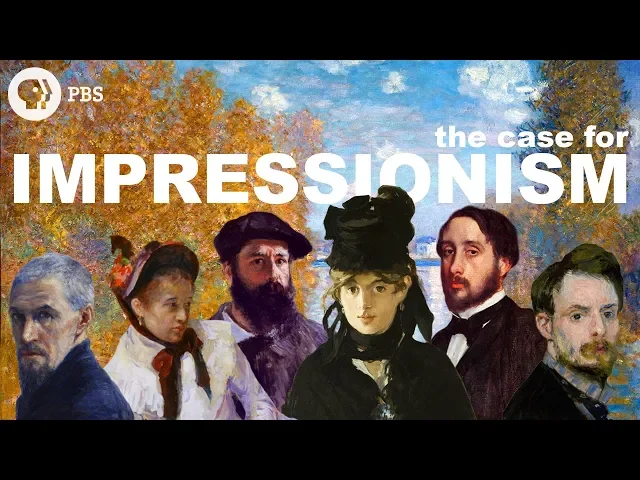
The Case for Impressionism
The Art Assignment
0:00 Is this painting you’re looking at right now good, or is it bad?
0:04 What about this painting, exhibited the same year?
0:06 Is it better because it’s forms and figures are more clearly defined?
0:10 Because it tells a dramatic story?
0:11 Or is this one better because it captures a fleeting moment,
0:15 recorded just as the artist witnessed it?
0:18 Its brushwork more lively, colorful, and expressive.
0:21 When Impressionist paintings are presented in museums
0:23 today and sold for millions at auction,
0:26 no one questions their legitimacy as works
0:28 of art worthy of attention and esteem.
0:31 But when they were first exhibited in Paris in 1874,
0:35 they were regarded as unfinished, slapdash, lowbrow, and renegade.
0:39 With the way art history has since evolved, or in the view of some, devolved,
0:43 how do we understand these pictures whose
0:46 original power lay in their ability to shock,
0:49 especially when to contemporary eyes they look old, and totally unradical?
0:55 What remains of their power?
0:56 Why should we look and them, and what do we see?
0:59 This is the case for Impressionism This new
1:05 style didn’t arrive out of the clear blue sky,
1:07 but the paintings were often created under one.
1:09 A hallmark of the art that would come to be known as Impressionist
1:12 was that many were painted outside of the studio and in the world,
1:16 or as the French say en plein air.
1:18 Unlike the slow, studio-based approach that held sway
1:21 at the annual salons of the French Royal Academy,
1:24 whereby tonal gradations were gradually built
1:26 up with layer upon layer of glazes, Impressionist works were frequently begun if
1:32 not completed entirely out of doors.
1:34 These artists used smaller canvases that were easy to transport
1:37 and finish quickly before the light or weather changed.
1:41 Artists had been painting in the landscape for some time,
1:43 like Dutch artists of the 17th Century, and even more recently in England,
1:47 where the likes of John Constable won admirers
1:50 for his pictures of villages and countrysides, and J.
1:52 M.
1:53 W.
1:53 Turner wowed with his own highly dramatic and abstracted scenes from nature.
1:57 In France, where Impressionism was brewing,
2:00 painting in the landscape was an established practice,
2:03 artists escaping Paris and political instability to observe
2:06 nature and render it in a relatively lifelike manner.
2:09 These artists also experimented with style and technique,
2:12 trying out looser brushwork and brighter colors.
2:14 But landscapes were considered to be genre painting and less
2:18 important in the eyes of the Academy that, more than nature,
2:21 valued the study of ancient Greek and Roman art.
2:24 Figures were to be strongly defined,
2:26 and set amid ordered and harmonious compositions.
2:29 This was the kind of subject matter favored by the Academy,
2:33 pulling from history, mythology, and religion.
2:35 They didn’t want to see regular people doing regular stuff.
2:39 The so-called Reaslists had already challenged the academy’s
2:42 values by painting scenes from contemporary life,
2:45 sometimes admitted to the salon and sometimes denied.
2:48 Gustave Courbet built his own pavilion during the 1855 Paris World’s Fair,
2:53 circumventing the official juried exhibition,
2:56 and showing this painting where, it’s worth noting,
2:58 the focus is on a landscape painter.
3:00 In 1863, the state organized a special
3:03 exhibition to feature works rejected by the Salon,
3:07 including challengers to the status quo who wanted to paint
3:09 their own way and show the here and now.
3:12 Like Édouard Manet, who would not go on to show with the Impressionists,
3:15 but was close friends with them,
3:18 endorsed their work, and shared numerous interests and techniques.
3:21 The artists who participated in the first
3:24 Impressionist exhibition in 1874 had shown
3:26 their art within the Salon and also grown tired of having work rejected from it.
3:31 So they put together their own show
3:33 in the former studio of the photographer Nadar,
3:35 calling themselves the Anonymous Society of Painters,
3:39 Sculptors, Printmakers, etc.
3:40 There was no state involvement, no jury, no hierarchy of subject matter.
3:44 They were each exploring their own concerns,
3:46 not working toward any shared mission or manifesto.
3:50 If there had been a manifesto it could have only read something like:
3:54 “Not the Salon” or “I want to do my own thing,
3:57 thanks.” But IN GENERAL we could say
3:59 this group was mostly painting from modern life, cityscapes and landscapes,
4:03 using a brighter palette of colors, broken brushstrokes,
4:07 and loosely defined forms, that gave the works an air of spontaneity.
4:11 So much so that art critic Louis Leroy commented on the accuracy
4:14 of the title of one of Claude Monet’s paintings on display, Impression: Sunrise.
4:18 To Leroy, it was merely an impression,
4:21 a sloppy and unfinished sketch, unsuitable for display or sale.
4:25 He dubbed the show “Exhibition of the Impressionists” as an insult,
4:29 but another critic recast the name in a positive light,
4:33 saying of the new work: “It’s lively, brisk, light— captivating.
4:37 What a rapid grasp of the object and what an amusing facture.
4:41 It’s summary, agreed,
4:42 but how spot on the marks are!” As you know the name stuck,
4:47 and the artists came around, too.
4:49 Impressionist landscapes, unlike those that came before,
4:52 often betrayed their place in time, showing city folk in the latest fashions
4:56 or enjoying leisure activities in the Paris suburbs.
4:59 New railway lines had made travel out of the city easier than ever,
5:03 and the Impressionists were unafraid to show signs of this new way of life,
5:08 and also of the increased industrialization around them.
5:10 Life was getting faster, and it followed that art should, too.
5:14 Paris had changed enormously in the preceding decades,
5:17 having undergone wholesale renovation beginning in the 1850s.
5:21 A crowded, medieval city had been replaced with one that was much more open,
5:26 cleaner, and safer, with wide boulevards,
5:28 public gardens, and lots and lots of light.
5:31 And the Impressionists did love their light,
5:34 trying again and again to arrest its ephemeral effects.
5:37 They liked to show it broken by clouds, dappled and filtering through the trees,
5:42 oh and especially as it reflects on water.
5:45 Even when painting interiors, which they did indeed do,
5:48 they loved to include a window,
5:50 often with sheer drapes through which light could filter.
5:53 Because they were often capturing atmospheric effects
5:55 that would change with the passing minutes,
5:58 the paintings have the feel of improvisation,
6:00 even if they took a while to get just right.
6:03 Monet often worked on several canvases at once,
6:06 shuffling to different works as the light changed,
6:09 or returning to the same spot daily
6:11 to patiently await the return of the desired conditions.
6:14 New and brighter pigments had recently become available,
6:17 which the Impressionists put to good use,
6:19 juxtaposing vivid colors in ways that were startling to audiences at the time.
6:24 Even shadows, it turned out, didn’t have to be just black or brown or gray.
6:28 Studies on color that had been
6:30 published in 1839 by chemist Michel-Eugène Chevreul,
6:33 had a hand in this experimentation,
6:35 providing a guide for how complementary colors could be
6:38 shown side by side to appear more vibrant and intense.
6:42 An early review asserted these artists were painting things,
6:45 “not just as they are,
6:46 but just as they appear to be.” And this was the revelation of Impressionism.
6:51 To paint trees one need not understand their structure,
6:54 that they’re composed of a wooden trunks with branches and leaves extending out.
6:58 One need only lay down rough smudges of greenish brown to approximate
7:02 the visual sensation the forms give off from a particular distance,
7:07 as the light hits them in a certain way.
7:09 You don’t even need to know they are trees.
7:11 The artist could be an alien, recently arrived on planet earth,
7:15 who knows nothing of the objects before them but makes
7:17 a record of the visual stimuli they perceive nonetheless.
7:20 (Assuming this alien has some sort of eyes,
7:23 of course.) But not all Impressionists painted like that.
7:26 Edgar Degas was a master draftsperson,
7:29 using strong lines to delineate forms, often human ones, with clear expertise.
7:34 His innovation came in his unexpected compositions,
7:37 showing subjects off-center, from oblique angles, or closely cropped.
7:41 The popularity of Japanese art at the time can be seen in many
7:46 Impressionist works through their flattening of forms and use of open space.
7:49 The arrival of photography had also revealed new ways of framing images,
7:54 suggesting the possibility of unbalanced, snapshot-like compositions,
7:57 long before cameras would reach snapshot size and speed.
8:01 Some have theorized that now that photography could capture reality so well,
8:05 painting was then freed from the shackles
8:07 of realism and could do what paint does best,
8:10 which is being colorful and tactile, and you know, painty.
8:14 This new kind of art also involved more women and represented them in new ways.
8:19 Berthe Morisot participated in all but one of the Impressionist exhibitions,
8:23 and gave us remarkable views into the domestic
8:25 sphere and lives of well-to-do women.
8:28 Mary Cassatt joined the ranks as well,
8:30 and became known for depicting women and children as well as her own family.
8:34 Women of a variety of classes were subjects for the Impressionists,
8:37 and not just nude and lying on a bed anymore,
8:40 but shown doing the things they actually do,
8:43 in the home as well as out in the world,
8:46 enjoying Paris’s nightlife, and also being it.
8:48 A population boom following the Franco-Prussian war had brought
8:52 about a new mixing of genders and social classes,
8:55 which we see unfolding in Impressionist depictions of street life,
8:59 cafe culture, and various forms of entertainment.
9:01 The membership of this motley crew of artists fluctuated with each exhibition,
9:06 including names you’ve definitely heard of as well as ones you probably haven’t.
9:09 By their last exhibition in 1886,
9:11 few of the artists were working in style you’d likely identify
9:16 as “Impressionist.” Core members had evolved
9:18 their own styles and were exhibiting independently.
9:21 And the artists we now consider Neo-Impressionist had arrived,
9:24 like Georges Seurat and Paul Signac,
9:26 who were interested in the more scientific aspects
9:29 of color and how our eyes process it.
9:31 What we call Post-Impressionism had reared its head
9:33 as well in the form of the young Paul Gauguin.
9:36 By 1886, Impressionism had become a global tendency,
9:39 with artists around the world exploring
9:42 similar techniques and styles and subject matter.
9:45 That “Impressionism” as a word exists owes a credit
9:48 to the concurrent expansion of the popular press,
9:51 the first art-movement-with-a-name to be covered widely and with reviews
9:55 ranging from neutral to complementary to openly hostile.
9:57 The art market had recently strengthened as well,
10:00 bolstered by a stronger French economy.
10:02 And a new category of collector had emerged,
10:05 interested in apartment-scale pictures rather
10:07 than castle or cathedral-scale ones.
10:10 Art dealer Paul Durand-Ruel was a primary
10:13 force behind selling the Impressionists’ works, both in Europe and America,
10:17 where the paintings were snapped up and eventually gifted
10:20 to the museums where many are still held today.
10:22 It was a newly common pratctice among dealers to encourage
10:25 their artists to find their own niche in the market,
10:28 each to peddle their own singular vision.
10:31 And it’s that singular, subjective vision that Impressionism has come to embody.
10:35 What these artists were able to capture, and what still enthralls us,
10:38 is not the world as you see it or as a large crowd might,
10:42 but the world as only they see it.
10:45 It’s why their last names still hold power,
10:48 evoke strong associations, sell for millions at auction, and draw crowds.
10:53 When you look at an Impressionist work,
10:55 you’re aware that a person stood before the canvas,
10:57 applying the paint mark by mark,
10:59 from their own particular viewpoint, and in their own distinct manner.
11:02 In it we can see the beginnings of the cult
11:05 of the individual that has since taken hold,
11:07 inklings of the now widespread thirst to share our everyday views of the world,
11:12 each from our own angles and in our own styles.
11:16 Impressionism was one of the first of a string of avant-garde art movements,
11:20 each rejecting tradition and embracing the modern,
11:22 promoting new ideas about what art could be and what it could do.
11:26 Whether or not you’re familiar with the succession of “isms” that followed,
11:30 you already know the narrative: students learn from their teachers,
11:34 but then repudiate their lessons and push on to forge their own paths.
11:38 Novel methods over time lose their ability to shock,
11:41 new ideas replace old, and the cycle continues.
11:44 And now it’s gotten ever faster.
11:46 An 1874 review of the first Impressionist exhibition posed the question,
11:50 “Is the absence of rules a good thing?
11:53 Only the future will enlighten us…” And enlighten us it has,
11:57 demonstrating the breadth of what the pursuit
11:59 of singular vision can bring forth.
12:01 But the best case for Impressionism is the art itself.
12:04 In a museum filled with the dark and dramatic art that preceded it,
12:09 and the often confounding art that follows, Impressionism is really… pleasant.
12:13 It’s not violent or distressing or sentimental or moralistic.
12:18 It’s recognizable subject matter rendered in an interesting
12:22 but not overtly challenging--by contemporary standards--kind of way.
12:26 It’s an optical delight, giving us windows into a fascinating historical moment,
12:31 created by supremely talented artists who pushed art in new directions
12:35 to better represent that moment and their own view of it.
12:39 And that is enough.
12:41 Thanks to all of our patrons for supporting the Art Assignment,
12:45 especially our grandmasters of the arts Vincent Apa,
12:48 John Thomas, and Ernest Wolfe.