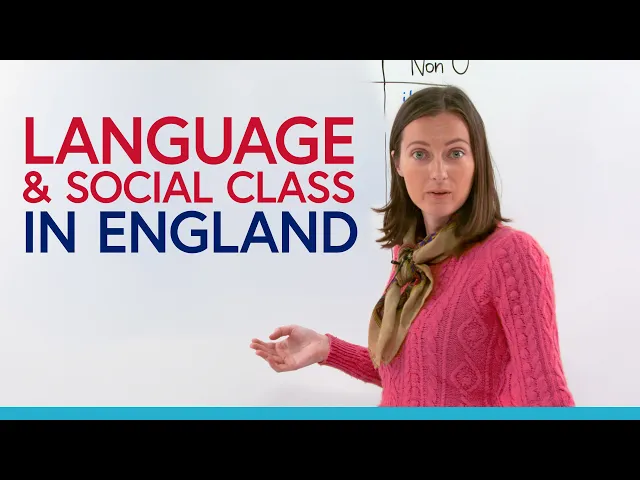
How do posh people speak? Learn about language and social class in England
English Jade · Learn English with engVid
0:00 Hi everyone.
0:00 In this lesson, we're going to look at what posh is,
0:04 who are posh people, and also look at the language of posh people.
0:09 But let me start with "What is posh?", because maybe you haven't heard of it.
0:14 This is, I would say, something specific to English,
0:18 because it has to do with the class system here.
0:22 And the class system is how the society is organized, from top to bottom.
0:28 Not in some kind of official way,
0:31 like you get a piece of paper that says what class you're in.
0:36 But it is the family you're born into and it has an impact on the kind
0:41 of school you go to, or the kind of job you do when you grow up.
0:47 So, although it's not an official formal thing,
0:50 it's something that affects life in the UK for English people,
0:55 or- I said the UK there.
0:58 Life in England for English people, and it's still in the rest of the country,
1:03 but I don't- I'm not sure how strong it is there, or how it is different.
1:08 I'm talking about the English prospective.
1:10 Okay, so starting with a diagram here of the different classes in England.
1:19 This is not to scale.
1:23 This is an estimate of how big the different classes are,
1:28 the different social classes.
1:30 So, if we start at the top with the crown, that's where the queen would be.
1:35 She's at the top, because she's the queen.
1:40 Then, this first chunk here, U, means "upper class".
1:45 It's quite small compared to the rest.
1:48 Here are all the people, all the 60 million or however many people here,
1:54 and here is the upper class.
1:57 Small amount of people is at the top.
2:01 Next, we have the upper middle class, and that's a bit bigger.
2:07 Next, we have the middle class, and now we're almost around half the population,
2:16 a bit less when we include the middle class.
2:21 Then, we have the working class.
2:25 That's the biggest section.
2:27 And the precariat.
2:29 This is a new class.
2:31 I'll explain about it after.
2:33 So, going back to the top.
2:35 What kind of- how would we recognize these different groups of people?
2:39 How would we know who they are?
2:42 Well, as a native-born English person, you just- you just know and you can tell.
2:50 It's the language people use, it's how they dress,
2:53 it's the job they do, things like that.
2:56 But let's talk about jobs.
2:58 What kinds of jobs would these people do, as an example?
3:02 So, an upper class person.
3:04 In the past, upper class people didn't work.
3:07 They didn't need to work, because they inherited their money.
3:12 But nowadays, they do work a lot of the time.
3:18 So, they might do jobs like being the head of a charity,
3:24 or they might work in banking in the city,
3:28 or they might be- many actors are from upper class backgrounds.
3:34 So, they tend to do jobs with really, really high status.
3:38 Social power, and even better if it makes a lot of money as well.
3:43 Next, we have the upper middle class.
3:47 These are people who do things like- a surgeon.
3:53 A surgeon would be upper middle class.
3:56 An architect would be upper middle class.
3:59 Professions that earn them a lot of money.
4:02 And the professions that are hard to get into as well.
4:07 Next, the middle class.
4:09 Middle class- first thing that comes
4:12 to mind is teacher and managers in businesses.
4:18 Middle class.
4:21 Working class would be the jobs such as trades- tradespeople jobs.
4:35 Bricklayer, electrician, roofer, a nurse, working class.
4:43 Those that I mention there, those are skilled working-class jobs.
4:49 Working class could also- the lower part of the working
4:55 class could also include jobs- like working in retail.
5:01 Yeah, working in retail, being a farmer, things- but not owning the farm.
5:07 If you own the farm, you're up here.
5:10 But if you work on a farm, you're here.
5:13 Now, because the class system changes and evolves,
5:17 it's called "working class", right?
5:20 But many of the people in the working class don't actually work.
5:26 They get money from the government.
5:29 They don't go to work.
5:32 They're on benefits.
5:34 Sometimes, it's because people can't get a job.
5:37 They don't have any skills, really.
5:40 No one wants to give them a job at all.
5:43 Or if they do find work, it's very temporary.
5:46 It's just a few days and then the job's finished
5:51 and the job doesn't have any good benefits to working there.
5:56 Benefits in the sense of earning a pension and it's not stable.
6:02 Things that- if your job's like all- it's not secure.
6:07 Or you have no job and no one will give you a job,
6:12 you would be in what's called the precariat class.
6:16 Precariat means it's not stable here.
6:18 So yeah, bear that in mind.
6:24 English people can just tell, generally, where other people are in here.
6:34 And a good question to answer now is also,
6:37 how much does it change in a person's life?
6:41 You know, are you sort of born here and then you climb
6:45 all the way up to the top by becoming successful, becoming rich?
6:50 Well, it doesn't really happen a lot.
6:54 There is flexibility.
6:55 Some people go up to a profession much higher than
7:00 their parents were in, and the situation they were born in.
7:04 But the thing about class is that a great extent of it is how you were born.
7:12 So, over here in England,
7:13 it's not only just about how much money you've got, it's where you're born.
7:18 So, we have very, very wealthy people, for example,
7:24 David Beckham and his wife, Victoria Beckham who is called "Posh Spice".
7:31 They must be super, super, super millionaires.
7:34 But they are not considered upper class or upper middle class.
7:40 Or, depending on- I don't know where to put them, but they- basically,
7:47 they've got all the money to live up here or really, really high up here,
7:54 but they- their personalities haven't really changed so
7:58 much to make them different kind of person.
8:01 So, it's- it could be really different in your country,
8:07 depending on whether the social hierarchy is so old, in a sense.
8:12 We've been doing this for a really long time over
8:16 here in England because of the Queen and all that, so.
8:20 So, now we've got that out of the way.
8:22 Now, let's go and talk about posh actors.
8:26 How can you find examples of posh people and their language?
8:32 Well, you could look for movies with these actors
8:36 in, because these will give you good examples.
8:39 If you like the way that the posh actors
8:43 speak and you can learn to speak more like them.
8:46 So, there's Benedict Cumberbatch.
8:49 He's in the series "Sherlock",
8:53 and that character he plays in "Sherlock" is posh.
8:59 But in all his other movies as well, he plays posh characters.
9:04 Tom Hiddleston.
9:05 He was in the movie "War Horse".
9:09 He played somebody posh in that.
9:12 There's a film that came out a few years ago called "The Riot Club",
9:19 "Riot Club" or "The Riot Club".
9:22 And this was about students from Oxford University,
9:26 which is the top university or the second-top university.
9:31 The- if you're posh, that's one of the best universities to go to.
9:40 So, the film is about how those students live and how they- it's about what
9:50 life is like for you if you're rich at one of those very, very top schools.
10:00 Then we have Tilda Swinton.
10:04 She is quite an arty kind of actress.
10:09 Doesn't necessarily always play the super, super posh character in the film,
10:16 but she is a genuine real posh person from her family background.
10:21 So, she's an example of the upper class person who is an actress.
10:28 And then there's Keira Knightley,
10:30 and when Keira Knightley was younger and in many films,
10:35 she was always playing Jane Austen kinds of characters in her films.
10:40 So, that's a good sign.
10:42 If you see those traditional English movies
10:44 with the big dresses and old-fashioned speaking,
10:48 that's a good sign that the actor or actress is posh or from a posh background.
10:57 Usually, those kind of films get those kind of actors and actresses.
11:01 Okay, so now I'm going to talk about- we're
11:08 talking about posh people and the language they use.
11:13 The hard thing about it when you try to do a lesson on it
11:18 is that you don't really meet many people who admit to being posh.
11:22 They say, "Oh yeah, I'm posh".
11:24 You don't really admit it and I think it's a case today that many people
11:31 who are from posh backgrounds adapt their language
11:36 down when they're around the "normal" people.
11:39 So, they don't speak really, really posh.
11:42 So, it's hard for you to hear it and catch exactly how posh people speak now.
11:51 Plus, having distance really, really helps.
11:54 So, it's hard to see it right now, how posh people speak now,
11:59 but you know twenty years later, when you look back.
12:02 Maybe it's easier to say and say, "Oh, posh people spoke like this".
12:07 So, what I'm going to talk about now is how posh
12:15 language was thought of and perceived back in the past, okay?
12:23 So, this comes from 1955, this discussion about how posh people speak,
12:31 from the writing of Nancy Mitford.
12:34 Nancy Mitford was a journalist and a kind
12:38 of socialite- upper class socialite from those times.
12:43 And one of the things she did was wrote about- one
12:47 of the things she's famous for is writing about U and non-U language.
12:54 U language means upper class language.
12:57 Non-U language means not upper class.
13:01 And these people are the social climbers.
13:06 They could be the middle-class people who
13:10 earned more money and sort of climbing up.
13:14 And these- or these could be the upper middle class people as well,
13:19 who are spending time with upper class people.
13:22 So, what this means is whoever was not born in the upper class and had
13:32 the right education and spent time in the right
13:37 schools learning all the correct upper class language.
13:40 If you were not like that, then your language
13:45 wouldn't- it would sound like you don't belong there.
13:50 Your language would give you away as not really
13:54 belonging in the upper class parties or wherever you go.
13:57 So, let's look at the signs in- according to Nancy Mitford in 1955,
14:06 the- how we can describe non-U language,
14:11 not upper class, the people climbing up,
14:16 they spoke in a way that was refined, fashionable, fancy.
14:23 And they used French origin words.
14:27 So, if we look at those descriptions, that sounds- well yeah,
14:32 speak like that, it all sounds good, doesn't it?
14:35 Refined, you know, it's like elegant.
14:39 French origin words, sounds sophisticated.
14:42 And they would use words such as "serviette", "toilet",
14:48 and they would say "pardon?" when they want to say "What did you say?" Now,
14:56 this all sounds good, but Nancy Mitford says this is- this looks bad.
15:03 This makes you look like you really don't belong here.
15:06 You shouldn't speak like this, and anyone who
15:09 is really posh does not speak this way.
15:13 It's not what you expect.
15:15 If you are upper class,
15:18 if you're like Nancy Mitford, your language is more direct.
15:25 You say what it is.
15:27 You've got nothing to prove.
15:30 You know that you're upper class.
15:32 You know that you come from a good family.
15:36 You know that your family has connections.
15:38 You know you have all the money you need.
15:41 So, you're not trying to be refined
15:44 or elegant like these people, or fashionable.
15:47 You don't care.
15:48 You have everything- you have all the status you need.
15:51 You don't need to try hard with your language.
15:54 And what's interesting about the upper class
15:57 for this time in 1955 was that they, in Nancy Mitford's opinion,
16:03 is that they used many of the same words as the working class people.
16:09 So, the upper class people, back at that time,
16:12 were using a lot of the same words as the working class people,
16:17 because these were the traditional words of the things they were saying.
16:23 Whereas these ones were changing their language
16:26 to sound better in their opinion.
16:28 Oh, this is the right way to speak.
16:31 But they were trying a little bit too hard.
16:35 So, Nancy Mitford said this is how we know the difference between
16:40 someone who is really upper class and someone who is just trying.
16:44 Now, we've got some example words coming up.
16:48 Let's look at some examples of upper
16:50 class words compared to non upper class words.
16:54 The first words are all to do with things in the home.
17:00 So, the upper class word is "house" and in Nancy Mitford's opinion,
17:06 the non upper class word is "home".
17:09 They're synonyms, we use them in the same way,
17:13 but one word shows that you belong here with the Queen,
17:18 and the other word shows that you, you know, climbing up higher.
17:22 Next, we have "drawing room" and "sitting room".
17:27 These are the room in your house where
17:32 you entertain people when they come to visit.
17:36 The non upper class people would say "lounge".
17:39 And if we remember that the non upper class people
17:45 like words that have the French origin or sound more refined,
17:50 because "lounge" comes from French.
17:52 This is why it's attractive for them to use.
17:56 Next, we have "lavatory" and lavatory is generally shortened to "loo".
18:06 This is still- saying "Where's the loo?" is still a- even though it was 1955,
18:16 it's still one of the things to show how posh is someone,
18:22 because there are many,
18:24 many people who will- can only say the word "loo" or "lavatory",
18:31 and they can't say that word "toilet".
18:34 They have to avoid saying that word.
18:37 It's too- it's too low!
18:40 So yeah, this one is still the case.
18:45 "Toilet" comes from French as well; toilette comes from French.
18:50 Sofa, it's where you sit in your lounge and watch the television.
18:56 Ah, ah, ah.
18:57 If you're upper class, you probably never watch television,
19:01 but they do have sofas.
19:03 Whereas the non upper class people would sit on their settees or couches,
19:11 but "settee" is even lower than "couch", I would say, in my sense of it.
19:21 Next, in 1955, the upper class people said "looking glass".
19:26 I'm going to look at the looking glass at my reflection.
19:31 But I don't think they say it now.
19:34 If you're upper class,
19:36 please let me know whether you say "looking glass" because I don't know,
19:41 I need your feedback on this one.
19:43 These days, do you still say "looking glass"?
19:46 Whereas the non upper class people said "mirror".
19:50 And when they go to restaurants or when they're eating,
19:55 the upper class people would use their napkin, you know, very, very gently.
20:01 And the non upper class people would
20:05 probably go like that or something, you know.
20:08 Or maybe just use their hand.
20:11 Anyway, the word they would use is "serviette".
20:13 So, these words are group together now.
20:17 We're moving on from the home.
20:19 The upper class word is to say you feel "sick".
20:24 I'm feeling terribly sick.
20:26 But if you're not upper class, you say "ill".
20:30 I'm ill.
20:31 Next, the upper class people, because they're more direct and they say- they say
20:39 what they see or they tell it how it is, at least in those times.
20:45 They would say a person is "rich",
20:47 who has got lots of money, who is absolutely stinking rich.
20:50 Whereas the non upper class people would say "wealthy", wealthy.
20:54 It's not so- wealthy is more of a sophisticated kind of word.
21:03 Even though it means about money, in a way, it's not so much about money.
21:10 "Rich" makes us imagine piles of gold coins in a way that "wealthy" doesn't.
21:17 Next, upper class people talk about false teeth.
21:20 Obviously, back in 1955,
21:22 there were a lot more people who had false teeth because they,
21:28 especially in England, you know what our dentists are like here.
21:31 So, they lost a lot of their teeth and they
21:35 didn't have them unless they wore their false teeth.
21:39 Whereas the non upper class people, they said "dentures".
21:43 Believe that probably comes from French.
21:46 Let me know in the comments.
21:49 Upper class people said "spectacles", not "glasses".
21:54 And they would talk about riding their bike or bicycle,
22:00 whereas the non upper class people would say "cycle".
22:05 And when it came to eating, the upper class people would say "pudding",
22:11 whereas the non upper class people said "dessert".
22:15 So, we are many years on from 1955 now.
22:21 Definitely some of the examples in this lesson don't apply anymore.
22:27 For example, "looking glass".
22:29 But I think it's true that, in our times,
22:33 there will still- there still is vocabulary that upper class people use that's
22:39 specific to them that, perhaps people who don't come from their social group,
22:45 or who didn't go to the schools with them,
22:49 people just don't know this language that they use.
22:53 They wouldn't know what's the right word to say,
22:57 because they just haven't been around all the other people that say those words.
23:02 If you didn't go to the expensive school, you just wouldn't learn it.
23:06 And like I said, at the beginning of the lesson,
23:09 upper class people these days often change
23:13 their language down to talk to the normal people.
23:17 So, you- it's hard to know what- it would be very interesting to know,
23:24 but hard to find out.
23:26 What are the words, such as this today?
23:29 It would be really interesting to know, but personally, I don't know.
23:34 So, there's another- if you've got any examples,
23:37 you can leave a comment of words that you know
23:40 are posh that people use today in the upper class.
23:43 So, thank you for watching and what you can do now is a quiz on this lesson.
23:48 See you again soon.
23:49 Bye!