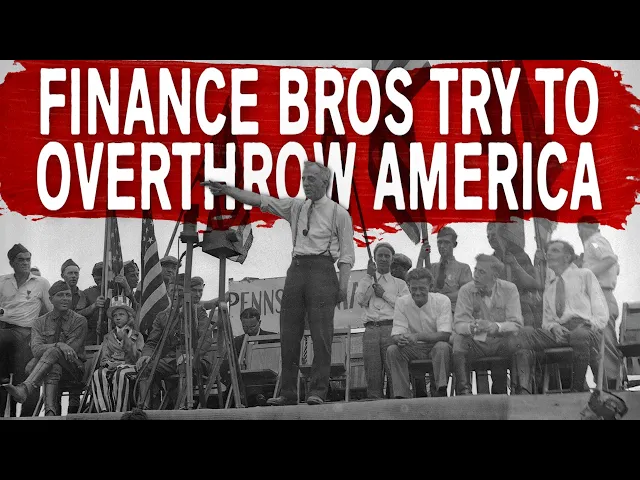
America's Forgotten Coup Was... Really Dumb
How Business Worked
0:00 I know it might be hard to believe today,
0:02 but there was a time when a group of wealthy
0:04 businessmen in America secretly schemed to take control of American politics.
0:09 The only problem they had was they weren't very good at it yet.
0:13 The business plots, also dubbed the Wall Street PCH or the Smemedly Butler coup,
0:18 was an attempt by a group of financiers
0:21 to rally disenfranchised veterans to literally march on Washington,
0:25 oust then President Franklin Roosevelt,
0:27 and then replace him with retired Marine General Smemedley Butler,
0:31 who would act as a temporary dictator just to get
0:34 the company back on track because that always ends so well.
0:38 The only problem with this plan though was the man
0:41 who the financiers wanted at the center of it.
0:44 It turned out that even though he did
0:46 not personally believe in a lot of Roosevelt's politics,
0:48 a highly decorated World War I marine general was a well something of a patriot.
0:54 He immediately exposed the plan to reporters and later
0:59 before Congress in a testimony that went absolutely nowhere.
1:03 Despite being potentially one of the most
1:06 openly treasonous conspiracies against America ever,
1:09 nobody was criminally charged, and the men involved got to live out
1:12 their lives with their wealth and reputations intact.
1:15 Now, the details of the story itself are crazy enough,
1:18 and they can give us some unique insights
1:20 into just how unhinged politics really was back then.
1:23 But beyond that, something that is even
1:25 more interesting is the context that motivated
1:28 one of the most genuine attempts at a coup d'etatar in modern American history.
1:33 I talked with an investigator for this committee who
1:36 came to me with a subpoena on Sunday, November 18th.
1:39 He told me they had unearthed evidence
1:42 linking my name with several such veteran organizations.
1:46 There is an old saying used by doctors that you
1:49 keep on poking until you find the spot that hurts.
1:53 Now, that might not be board certified medical advice, but in 1933,
1:57 there was obviously something that made a group of wealthy businessmen so
2:01 uneasy that they would risk being charged with treason to fix it.
2:06 So, what exactly was it that was making wealthy people,
2:09 and Wall Street in particular, so angry at Roosevelt?
2:12 Well, there were actually three things.
2:15 Once you understand those, the story
2:17 of how this all unfolded becomes even funnier,
2:20 if not a little bit more concerningly relevant to today.
2:25 The first thing is that all of this was
2:27 happening in the wake of the Great Depression,
2:30 the single most severe economic downturn in American history,
2:32 and something that these very same finance years were largely responsible for.
2:37 Before the depression hit, 1920s had been a golden age for American finance.
2:42 The stock market was booming, credit was flowing freely,
2:46 and wealthy investors were making fortunes on increasingly reckless speculation.
2:51 When the bubble burst in 1929, the fallout was catastrophic.
2:56 Banks failed by the thousands, unemployment hit 25% and families that had been
3:01 comfortable just years earlier were lining up for bread.
3:05 The financiers who had fueled the speculation
3:08 largely survived with their way of life intact.
3:12 Their workers did not.
3:14 By 1932, the country was desperate enough to do
3:18 something it hadn't done in over a decade.
3:21 Elect a Democrat in a landslide.
3:23 Franklin Delano Roosevelt had one with a mandate to fix the mess.
3:27 And he wasted absolutely no time.
3:30 He came up with the New Deal,
3:33 a sweeping package of reforms designed to put people back to work,
3:37 regulate the financial system that had just blown up,
3:40 and build a safety net for the millions
3:42 of Americans who had fallen through the floor.
3:46 It included public works programs, financial regulations, labor protections,
3:50 and new agencies with enough power to actually enforce them.
3:55 Now, to millions of ordinary Americans, this was a lifeline.
3:59 Wall Street.
3:59 They saw it as an act of war because
4:03 the New Deal dared to even the playing field a bit.
4:07 Labor unions gained legal protections.
4:09 Workers gained bargaining rights.
4:11 And for the first time, the federal government was actively stepping
4:15 in to control the speculation and financialization
4:18 of everything that had gotten the country into the mess in the first place.
4:25 Naturally, Wall Street was absolutely furious.
4:28 Roosevelt was openly accused of being
4:31 a socialist and having even more radical sympathies.
4:34 You're affected communist.
4:36 I'm a New Deal Democrat.
4:38 I said suspected.
4:39 That was the political climate,
4:41 especially in the context of what was going on in Europe at the time.
4:45 Support Roosevelt's reforms and you were one
4:48 step away from marching alongside the Boleviks.
4:50 So, the New Deal was the most visible source of Wall Street's fury.
4:55 But there was something else Roosevelt did
4:57 that hit even closer to their wallets.
5:01 In April 1933, just weeks into his presidency,
5:05 Roosevelt signed Executive Order 6102,
5:07 which gist straight up made it illegal for American citizens
5:12 to hold gold outside of narrow exceptions for things like jewelry.
5:16 Most people think that 1971 was the year America left the gold standard.
5:21 The reality is that outside of very
5:24 special exceptions for other national governments,
5:26 it was 1933 that saw a greater restriction on individuals
5:31 ability to hold onto gold as a store of wealth.
5:35 Americans were forced to surrender the gold coins, gold bullion,
5:39 and gold certificates to the Federal Reserve in exchange
5:42 for paper dollars at a fixed rate of $2067 per ounce.
5:46 Then a year later, Roosevelt raised the official price of gold to $35 per ounce.
5:53 Now, if you're thinking,
5:55 "So what?" Think about what that meant for the people who had
5:58 just been forced to hand over their gold at $20 an ounce.
6:02 The government bought it at one price
6:05 and then immediately revalued it upward by roughly 40%.
6:08 The wealth that had been sitting in those gold
6:12 reserves effectively transferred to the federal government overnight.
6:16 For ordinary Americans in the midst of the Great
6:19 Depression who had no gold to give up, this was irrelevant.
6:22 Most people were far too busy trying to find
6:25 work to worry about the price of bullion.
6:27 But for wealthy financiers who had significant gold reserves,
6:31 this was in their eyes government sanctioned theft.
6:35 So then why did he do it?
6:37 Well, this might annoy the gold bugs,
6:40 but the reason behind it was actually sound.
6:43 Ditching the gold standard gave the government
6:47 more flexibility to fight the depression.
6:50 Our friends Jory Shassford at Money and Macro and Economics Explained have
6:55 both done far more detailed videos on why this was the case.
6:59 But the TLDDR is that balancing inflation, interest rates, employment,
7:03 and national debt is hard enough without tying
7:06 all those to fixed gold reserves and market prices.
7:10 Moving towards a fiat currency for domestic operations meant that banks could
7:16 be stabilized with money that didn't need physical gold to back it up.
7:20 Inflation could be introduced to stop people hoarding what wealth they could
7:25 and instead encourage them to spend their money before it got devalued.
7:29 Circulating money in turn would help the whole system get moving again.
7:34 But despite the upsides to the broader economy,
7:38 societywide advantages don't make it feel any less
7:41 like a robbery when the gold was yours.
7:44 So at this point, you had angry
7:46 financiers watching their political influence get undercut
7:49 by the New Deal and their personal wealth get devalued by the gold seizure.
7:55 But there was still one more thing.
7:57 Something that took people who were wealthy and angry
8:01 and made them wealthy and angry and actually dangerous.
8:04 They had a model that was already playing out across
8:08 the Atlantic where countries that had been just as, if not more,
8:13 devastated by the depression were finding a very different kind of solution.
8:18 Benito Mussolini had taken power in Italy,
8:21 crushed the labor unions, silenced political opposition,
8:24 and handed enormous influence back
8:27 to the industrialists who had funded his rise.
8:30 And by most accounts, the Italian economy was stabilizing.
8:34 Portugal under Salazar, Hungary under Horthy,
8:37 Spain sliding in the same direction under Franco.
8:40 And then of course even in 1933 it was possible
8:44 to see the early signs of what was happening in Germany.
8:48 Now the pattern was difficult to miss.
8:51 In country after country economic crises were
8:54 pushing politics towards one of two extremes.
8:57 Authoritarian communism on the left or authoritarian fascism on the right.
9:02 The Wall Street finance years obviously weren't fans of communism.
9:06 And Roosevelt's New Deal looked uncomfortably close to it in their eyes.
9:11 But fascism, fascism had some real appeal for wealthy industrialists.
9:15 It crushed organized labor.
9:17 It protected private property, at least for the right people.
9:21 And it let businessmen call the shots
9:23 instead of getting pushed around by regulators.
9:25 And the thing is, it wasn't just that they found the idea attractive in theory.
9:31 They were watching it work.
9:33 Real countries with real economies recovering under systems that gave business
9:38 the power that these Wall Street types felt they were losing at home.
9:42 Mussolini had done it.
9:44 He'd taken a broken economy and handed
9:46 the keys to the industrialists who funded him.
9:49 If you were a wealthy American sitting in a New
9:52 York club watching your gold get seized and your workers unionize,
9:55 that looked like a solution.
9:57 Of course, we know now that these systems rarely worked long term.
10:01 And we made an entire video last month about how Hitler in particular,
10:06 in fact, did not save the German economy.
10:08 But we can see that now with the benefit of hindsight.
10:11 So, you had a group of extremely wealthy,
10:14 extremely angry men who had just watched their gold get seized,
10:18 their power get threatened, and who could look across the ocean and see what
10:22 appeared to be a working alternative playing out in real time.
10:26 And that's the part of the story
10:28 everyone basically agrees on because what these men
10:31 reportedly did next makes the rest of it
10:34 look like a polite disagreement over tax policy.
10:36 They didn't just complain at their clubs or write angry letters to senators.
10:41 They went out and tried to organize an actual
10:45 coup against the president of the United States.
10:48 The man they chose to lead it.
10:51 They could not have picked worse if they tried.
10:54 So, it's time to learn how history works and to find out
10:57 what happened when Wall Street picked the wrong marine to lead their coup.
11:02 This video is sponsored by Masterclass.
11:04 Masterclass just launched something that caught my attention.
11:07 Masterclass certificates.
11:08 One of the programs they're offering
11:11 is a certificate in AI fundamentals designed
11:14 to help professionals build practical AI skills they can actually use at work.
11:19 AI fluency is quickly becoming the kind of skill that separates
11:23 people who get ahead from people who get left behind.
11:26 And the problem isn't that people don't want to learn it.
11:29 It's that most of the resources out there are either too technical,
11:32 too shallow, or taught by people who have never actually applied any of it.
11:37 This certificate program is built by Masterclass and taught by people
11:41 who are actually working with AI at high level right now.
11:46 It's not passive video lectures.
11:48 It's hands-on activities, real frameworks,
11:50 and a final capstone project you can actually put in your portfolio.
11:55 By the end, you'll learn how to redesign your workflows,
11:59 make better decisions with AI, and actually apply it in your day-to-day life.
12:03 That's the kind of edge that compounds over a career.
12:07 Ready to futureproof your career?
12:09 Explore the new masterclass certificate in AI fundamentals
12:12 and use my link to get 15% off.
12:15 You can also scan the QR code on screen right now to get started.
12:22 Major General Smemedley Darlington Butler was by any measure
12:25 one of the most decorated soldiers in American history.
12:29 He had served in nearly every major conflict
12:33 from the SpanishAmerican War through the First World War,
12:36 earning two medals of honor along the way,
12:39 which even in an era of frequent military engagement was almost unheard of.
12:44 He was also by the early 1930s extremely popular with veterans.
12:49 He spoke their language.
12:50 He'd fought alongside them.
12:52 And more importantly, he'd been very publicly fighting for them.
12:56 In 1932, thousands of World War I veterans had marched on Washington,
13:01 demanding early payment of the bonus
13:03 certificates they'd been promised for their service.
13:06 President Hoover's response was to send in the army to tear gas them,
13:10 and burn down their camps.
13:12 Butler had been one of the loudest voices defending those veterans.
13:17 He'd visited their encampments, spoken at their rallies,
13:20 and publicly called out the government for treating
13:23 its own soldiers like an enemy force.
13:26 Now, from the financia's perspective,
13:28 Butler looked like the perfect figure head, conservative, decorated,
13:33 beloved by hundreds of thousands of angry veterans,
13:36 and with every reason to resent the current political establishment.
13:40 What they apparently didn't do was check what he'd actually been saying lately.
13:46 The approach started in the summer of 1933.
13:50 A bond salesman named Gerald Maguire,
13:52 connected to some serious Wall Street money,
13:55 reached out with what seemed at first like a pretty normal ask.
13:59 Maguire wanted Butler to attend an upcoming American Legion convention
14:03 and deliver a speech pushing for a return to the gold standard.
14:08 Of course, that happened to align perfectly
14:11 with the financial interests of the people Maguire worked for.
14:15 Butler was suspicious, but he listened.
14:18 Over the following weeks, the requests got stranger.
14:22 Maguire showed up with bank statements.
14:24 Serious money, millions.
14:26 He'd started talking about trips he'd taken to Europe,
14:30 where he'd personally studied how veterans organizations had been
14:34 used to back fascist movements in Italy and France.
14:38 and Butler kept listening, not because he agreed with any of it,
14:42 but because he wanted to know how far these people were willing to go.
14:48 Eventually, Maguire told Butler that a group of wealthy men wanted him
14:53 to lead an army of 500,000 veterans in a march on Washington.
14:59 Not entirely unlike what Mussolini had done in Italy a decade earlier,
15:04 and reportedly the direct inspiration for the plan.
15:07 The stated plan was to support the president
15:11 by installing Butler as a so-called secretary of general affairs,
15:15 a position that didn't exist and one that would
15:18 effectively make him a dictator operating alongside Roosevelt.
15:22 Roosevelt would remain as a figurehead.
15:25 Butler and the financiers behind him would actually run
15:29 the country because that always works out exactly as planned.
15:33 So, by now you're probably thinking that Butler
15:36 acquiesced and did exactly what the financers wanted, right?
15:40 Well, not at all.
15:42 He went straight to the press.
15:45 Not quietly, not politely, just straight to a journalist named Paul Comy French,
15:51 who independently confirmed several details of Maguire's story.
15:55 And then Butler went to Congress.
15:58 In November 1934, he testified before the McCormack Dickstein Committee,
16:03 a congressional body investigating so-called unamerican activities,
16:07 and laid out the entire conspiracy in detail.
16:11 He named names.
16:12 He described meetings.
16:13 He explained the plan from start to finish.
16:16 The committee investigated.
16:18 They interviewed witnesses.
16:19 They found Butler's testimony credible.
16:21 And then nothing happened.
16:24 No one was arrested.
16:25 No one was charged.
16:27 No one went to trial.
16:29 The committee's final report acknowledged that evidence of a conspiracy existed,
16:33 but the men behind it were never held accountable.
16:36 Now, there were a few reasons for this.
16:40 First, Butler blew the whistle so fast that the conspirators
16:44 never actually got far enough to incriminate themselves.
16:47 There was no army assembled, no march, no written orders,
16:52 just meetings and promises that any lawyer
16:55 could squint at and call casual political discussion.
16:59 So, no smoking gun.
17:01 Second, and this is where it gets legally weird,
17:05 treason has very specific standards in the United States.
17:09 Extreme political views, not a crime.
17:11 Wanting to overthrow the government, still not technically illegal.
17:15 You actually need concrete action.
17:17 And the conspirators had been careful enough to stay on the legal side
17:21 of that line right up until the moment they needed Butler to step over it.
17:28 They were careful.
17:29 Third, and yeah, this one's the worst part.
17:32 The men behind the plot were some of the richest,
17:35 most connected people in America.
17:37 Prosecuting them would have been a complete disaster
17:40 during an economy that was already on life support.
17:43 Roosevelt made a calculation.
17:45 let it die quietly rather than drag the country through a treason
17:49 trial that could spook an economy that was barely starting to recover.
17:54 Whether that was pragmatism or cowardice depends on who you ask.
17:59 Now, the financiers chose Butler because they believed he was one of them,
18:04 a decorated conservative who had spent his career in service to American power.
18:08 If they had actually listened to what Butler
18:10 had been saying in the years before the plot,
18:13 they would have heard something very different.
18:15 For most of his career, Butler had been exactly the kind of man they wanted.
18:20 He fought in the Philippines, in China, in Honduras, Haiti, Nicaragua.
18:25 Wherever American corporate interests needed a military presence,
18:29 Smemedley Butler showed up.
18:30 But somewhere along the way,
18:32 he started asking who exactly he'd been fighting for.
18:35 By the late 1920s, Butler had begun publicly
18:40 questioning whether America's foreign interventions were really about democracy
18:44 or whether they were about making sure United Fruit
18:47 kept its plantations and Standard Oil kept its drilling rights.
18:51 By the early 1930s, that questioning had turned into outright denunciation.
18:56 He called himself a racketeer for capitalism
18:59 and a highclass muscleman for Wall Street,
19:02 arguing that for 33 years he had basically been an enforcer
19:06 for banks and big business dressed up in a marine uniform.
19:11 His rhetoric by 1933 was arguably further to the left than Roosevelt's own.
19:17 He was denouncing capitalism, calling out bankers by name,
19:20 and demanding that the working people who actually fought the wars
19:23 see a fair share of the wealth those wars had created.
19:27 And despite being a lifelong Republican,
19:29 Butler had actually supported Roosevelt in the 1932 election.
19:33 So, the financiers had picked the one decorated war hero in America
19:38 who had already decided that men exactly like them were the problem.
19:43 There's an argument that if Butler had been
19:46 less of a patriot and more of an opportunist,
19:49 if he'd actually gone along with the plan
19:51 and been installed as this temporary dictator,
19:53 he may well have ended up more hostile
19:56 to the finances interests than Roosevelt ever was.
19:59 They didn't just pick the wrong man.
20:01 They picked their own worst nightmare.
20:03 After the hearings faded from the news,
20:06 Roosevelt went on to become the longest serving president in American history.
20:10 He pulled the country through the rest of the depression.
20:13 He led America through the Second World War.
20:15 He built the institutions that would create
20:17 the largest middle class the world had ever seen.
20:20 And perhaps the most ironic part,
20:22 economic recovery that followed actually made the men who
20:26 tried to overthrow him wealthier than they had been before.
20:30 The regulations they hated, the unions they feared,
20:32 the New Deal they tried to destroy,
20:34 all of it helped build the most broadly prosperous economy in American history.
20:39 The postwar boom lifted everyone,
20:41 including the very financiers who had been so terrified of Roosevelt's
20:45 reforms that they were willing to risk treason to stop him.
20:49 They were wrong and they got rich anyway.
20:52 The business plot is often treated as a footnotes,
20:56 a bizarre episode that didn't go anywhere and therefore doesn't matter.
21:00 But the reason it matters has nothing to do with whether the plot succeeded.
21:04 It's what it reveals about the conditions
21:07 that produce these kinds of conspiracies.
21:09 A group of extremely wealthy people threatened by reforms designed to help
21:14 ordinary citizens looked across the Atlantic
21:17 at authoritarian movements and thought,
21:19 "Yeah, that could work here." They didn't see fascism as a warning.
21:23 They saw it as a business model.
21:25 The fact that they failed doesn't change the fact that they tried.
21:29 And the fact that nobody was punished is itself part of the story.
21:33 If you want to see what happened when that playbook actually succeeded,
21:37 go watch our video on Mussolini.
21:39 Because the plan the Wall Street
21:40 conspirators were following didn't come from nowhere.
21:43 It was already running in real time in Rome.
21:46 And it showed exactly how a movement could ride economic pain into power,
21:51 crush institutions, and sell control as national renewal.
21:55 And don't forget to like and subscribe to keep on learning how history works.