Speaking English: You ACTUALLY Need This To Speak Well
Rachel's English
0:00 Is your accent holding you back when speaking English,
0:03 or your listening comprehension of English?
0:06 Understanding native speakers and fast English isn’t
0:09 about understanding the sounds of American English,
0:12 it’s about all the other things: linking, reductions.
0:15 The more you study them, the more effortlessly you’ll be able
0:20 to speak fast English and understand native speakers.
0:25 Movies, TV, real life.
0:27 Understanding English conversation can be hard,
0:30 but with the exercises we’ll do today,
0:32 you’ll be well on your way to more effortless English conversation.
0:35 Today, we’re going to do just that in eight conversations and monologues.
0:40 Here’s the first one we’ll study with the analysis we’ll do together.
0:45 Rachel.
0:46 Yeah.
0:47 Remind me to review with you which pot is decaf, and which is regular.
0:52 Okay.
0:52 Fine.
0:53 Gunther, you know what, I am a terrible waitress.
0:56 Do you know why I'm a terrible waitress?
0:59 Because I don't care.
1:00 I don't care.
1:01 I don't care which pot is regular and which pot is decaf.
1:03 I don't care where the tray spot is.
1:06 I just don't care.
1:07 This is not what I want to do.
1:10 So, I don't think I should do it anymore.
1:13 I’m going to give you my weeks notice.
1:16 What?
1:17 Gunther, I quit.
1:21 Does this mean we're going to have to start paying for coffee?
1:32 And now with the analysis.
1:34 Rachel Rachel Rachel Rachel, first syllable stress and the pitch goes up.
1:41 Ra-chel and the pitch goes up because he's trying to get her attention.
1:46 It's like saying Rachel do you hear me.
1:48 Pitch goes up Rachel Rachel Rachel Rachel
1:54 yeah then she does a really breathy response.
1:57 Yeah.
1:58 Yeah.
1:59 Up-down shape.
2:01 The breathiness just sort of shows exasperation and that she's kind of over it,
2:06 She's kind of over this job.
2:12 Yeah.
2:12 Yeah.
2:12 Yeah Remind me to review with you which pot is decaf, and which is regular.
2:16 And then this next set group is pretty long.
2:18 What do you hear as the most stressed syllables?
2:22 Remind me to review with you which pot is decaf, and which is regular.
2:26 Remind me to review with you which pot is decaf, and which is regular.
2:29 Remind me to review with you which pot is decaf, and which is regular.
2:33 It's longer so there are a few.
2:36 I'm hearing re-mind the stress syllable of that first
2:40 word the verb remind me to review with you,
2:44 review some on that verb as well which pot is decaf and which pot is regular.
2:53 So, the two verbs and then the difference between coffees,
2:59 decaf and regular and we do have a few reductions.
3:03 We actually have a dropped D here in the stressed word,
3:07 in the stressed syllable.
3:08 It's not uncommon to drop a D between two
3:11 constants especially when the first one wasn't N like this.
3:15 So, it's remin' me, remin' me and this is a pretty common two-word phrase.
3:20 Remind me to do this.
3:22 Remind me to call mom.
3:23 Remind me to pick up the dry-cleaning.
3:26 Remind me...
3:28 Re-mind me.
3:30 I diphthong N and then write into the M with no D, remin' me.
3:36 Remind me...
3:37 Remind me...
3:38 Remind me...
3:39 Now, the word to is not reduced and that's not very natural.
3:44 It's pronounced with the true T and the OO vowel.
3:47 Remind me to review with you and when I was
3:51 trying to think about why he would do this fully pronounced.
3:54 It is still unstressed, so the stress is right but by not reducing that word
3:59 it sounds a little bit more formal and this character
4:02 is supposed to be a little bit odd and so
4:06 by not doing a reduction that's one way to develop that character,
4:10 but it is still unstressed.
4:12 Remind me to review, me to re...
4:15 Me to re...
4:17 Me to re....
4:18 These three syllables all flatter in pitch compared
4:21 to the up-down shape of the stressed syllables mind and view.
4:27 Remind me to review Remind me to review Remind
4:30 me to review with you which pot is decaf, and which is regular.
4:33 Review with you which pot is decaf then
4:36 these five words all a little bit lower in pitch.
4:41 Less of the up-down shape of stress.
4:44 Review with you which pot is decaf...
4:46 Review with you which pot is decaf...
4:47 Review with you which pot is decaf...
4:50 The two words pot and is are linked.
4:55 Which pot is...
4:55 Which pot is with the flap T and that's really common when one word ends in a T,
5:01 a vowel or diphthong and T and the next word begins with a vowel or diphthong,
5:06 very common to link with a Flap T.
5:08 Pot is, pot is, pot is, pot is decaf.
5:11 pot is decaf ...pot is decaf...
5:13 pot is decaf Decaf is short for decaffeinated.
5:19 Decaffeinated coffee.
5:20 So, in the whole word de-caffeinated its caf that stressed
5:24 but when we shorten it for some reason the stress
5:28 changes and it's de-caf it's not decaf but it's de-caf
5:33 so the stress changes now we have first syllable stress.
5:37 Also, the vowel changes it's the E vowel
5:41 in the word decaffeinated it's a SCHWA de-caffeinated,
5:45 but we can't ever have a SCHWA in a stressed syllable and so
5:51 the vowel changes de-caf de-caf ...decaf ...decaf ...decaf and which is regular.
5:59 Decaf and which is regular.
6:00 So, in the word and the D is dropped.
6:04 That reduction happens almost every single time you'll hear this word.
6:08 Sometimes the vowel reduces he doesn’t,
6:11 but he does drop the D in decaf, and which one is regular.
6:15 ...decaf and which is regular ...decaf in which is regular
6:21 ...decaf in which is regular Decaf an' which is regular.
6:23 Regular and his pitch does go up a little bit at the end.
6:27 That's not super common for statements but it does sometimes happen.
6:31 Here he might be doing it to soften what he's saying.
6:35 You know, he's basically saying you messed up and I need to teach you
6:40 how to do this it could also be used to say in a way
6:43 I can't believe that you don't know the difference why would I have
6:46 to teach you this which is regular ...which is regular ...which is regular...
6:52 which is regular Okay.
6:54 Fine.
6:55 Okay.
6:56 Okay.
6:56 The second syllable stressed there.
6:58 It's a little bit harder to hear because the audience is laughing but okay.
7:03 K is the one with the up-down shape, okay.
7:06 Okay.
7:07 Okay.
7:08 Okay.
7:09 Fine.
7:09 Fine.
7:10 Fine.
7:11 A little flatter fine shows a little bit of exasperation.
7:16 Okay.
7:17 Fine.
7:18 Okay.
7:19 Fine.
7:19 Okay.
7:20 Fine.
7:21 Okay.
7:22 Fine.
7:22 Gunther, Gunther, Gunther and it goes
7:26 up in pitch first syllable stress Gun-ther.
7:30 She goes up in pitch because she's not done talking.
7:32 She has something to say and we all know it's important.
7:37 So, let's hear what she has to say.
7:41 Gunther, Gunther, Gunther, you know what?
7:42 You know what?
7:43 What's the stress there?
7:44 ...you know what?
7:46 ...you know what?
7:47 ...you know what?
7:48 You know what?
7:49 You know what?
7:51 Dah, dah, dah.
7:51 Know and what are both longer and the word you is said very quickly.
7:56 It's actually reduced it's not you it's yu, yu,
8:00 yu know what and everything links together really smoothly you
8:04 know what and that phrase ends with a stop T.
8:08 There's not a release of air.
8:10 ...you know what?
8:12 ...you know what?
8:13 ...you know what?
8:14 I am a terrible waitress.
8:16 In this next sentence what are the stressed syllables?
8:20 I am a terrible waitress.
8:22 I am a terrible waitress.
8:24 I am a terrible waitress.
8:27 I am a terrible waitress.
8:30 So, I and terr the most stressed.
8:34 Am and a lower in pitch flatter everything links together smoothly.
8:40 I am a terr.
8:42 I am a terrible waitress.
8:45 I am a terrible waitress.
8:47 I am a terrible waitress.
8:49 Actually, I take that back I and am
8:52 don't link together really there's a little lift there.
8:55 I am a terrible waitress and by separating
8:58 those it brings a little bit more stress to it.
9:02 I am a terrible waitress.
9:04 So, by separating it off it makes it even more clear
9:09 brings even more prominence to her, what she is saying about herself,
9:14 I am a terrible waitress.
9:17 I am a terrible waitress.
9:19 I am a terrible waitress.
9:21 I am a terrible waitress.
9:23 Imma, Imma, Imma lower in pitch flatter terrible lots of stress there.
9:29 There's a true T and she gives it
9:32 a little bit extra air to bring even more stress.
9:35 Whenever we exaggerate a beginning consonant it brings
9:39 more stress to that word, I am a terrible.
9:43 I am a terrible...
9:45 I am a terrible...
9:47 I am a terrible...
9:48 Terrible, three syllable word with first syllable stress.
9:52 ...terrible ...terrible ...terrible waitress.
9:55 Waitress, waitress, two syllable word, first syllable stress.
10:00 Do you notice anything about the T.
10:03 Listen to just this word.
10:05 ...waitress.
10:06 ...waitress.
10:07 ...waitress.
10:08 It actually sounds like a CH waichress, waichress.
10:14 ...waitress.
10:15 ...waitress.
10:16 ...waitress.
10:16 Do you know why I'm a terrible waitress?
10:19 Okay, and in the next sentence what's our stress?
10:22 What are our most stressed syllables?
10:25 Do you know why I'm a terrible waitress?
10:28 Do you know why I'm a terrible waitress?
10:30 Do you know why I'm a terrible waitress?
10:33 Do you know why, lots of stress on why and again stress on terr,
10:39 terrible and a little bit on waitress,
10:42 waitress, So, these first three words flatter in pitch;
10:47 less important that energy leads up to that peak and why.
10:51 Do you know why...
10:52 Do you know why...
10:54 Do you know why I'm a terrible waitress?
10:56 Do you know why I am a terrible.
10:59 Actually, I wrote this with a contraction, but I don't hear that as I'm,
11:03 I hear that as two syllables I am, I am a, I am a, I am a, but they
11:08 all link together really smoothly I am a, I am a.
11:12 They're all unstressed, flatter in pitch.
11:13 Not I am a, that would be all three stressed but it's
11:17 I am a, I am a, I am a I am a...
11:22 I am a...
11:23 I am a terrible waitress.
11:24 I am a terrible and then we get a big up-down shape.
11:28 Lots of stress after those three flatter words with the stressed word,
11:35 the adjective terrible.
11:37 ...terrible ...terrible...
11:39 terrible waitress?.
11:40 Because I don't care.
11:42 What are our most stressed syllables in this next phrase.
11:46 Because I don't care.
11:49 Because I don't care.
11:51 Because I don't care.
11:53 Because I don't, because I don't care.
11:59 I and care are the most stress, but all of these words are clearly pronounced.
12:04 Because can be reduced it's not.
12:07 She actually puts a quick E vowel so if you look it up
12:11 in the dictionary this would be an I or maybe a SCHWA but sometimes when people
12:16 are being extra clear or even just
12:18 out of habit these little unstressed syllables
12:21 that have the letter E in them can be pronounced with the E vowel be,
12:27 be, be, because, because.
12:29 Because Because Because Because second syllable stress K, UH as in butter Z cuz,
12:38 cuz and there is some up-down shape to that too because, because.
12:43 Because Because Because I don't care.
12:47 How is the word don't pronounced?
12:50 I don't care.
12:51 I don't care.
12:53 I don't care.
12:54 I'm actually going to put an up-down shape of stress on that too.
12:57 I really think she's stressing each one
13:00 of these words for emphasis I don't care, I don't care, I don't care.
13:06 All of those to me feel long and with a little bit of that up-down shape.
13:11 I don't care.
13:12 I don't care.
13:14 I don't care.
13:15 I'm hearing a really subtle stop T there.
13:18 I don't care, I don't care, and that tiny lift signifies the T, the stop T.
13:25 Okay, now we get I don't care two more times.
13:27 Let's listen to the pronunciation.
13:30 I don't care.
13:32 I don't care.
13:33 I don't care.
13:34 I don't care.
13:35 I don't care.
13:37 I don't care.
13:38 There I is less stressed, and it's more smoothly connected as one
13:42 thought instead of each word being stressed.
13:45 Stress on don't and more stress on care.
13:48 I don't care, dah, dah, dah.
13:51 I don't care.
13:52 I don't care.
13:53 I don't care.
13:54 I don't care and again a very subtle quick lift here signifying the stop T.
14:00 It's definitely not, I don't care but it's I don't care, I don't care.
14:06 I don't care.
14:08 I don't care.
14:09 I don't care.
14:10 I don't care which pot is regular.
14:11 I don't care which pot is regular I don't care again stress on that word.
14:16 I don't care which pot is re-gular and again
14:20 there was that subtle lift that signifies that stop T.
14:25 It's not completely dropped.
14:27 That would be I don' care, I don' care, don' care.
14:31 We do drop that T sometimes especially if
14:33 the next word begins with a vowel or a diphthong
14:36 but when it's a consonant it's much more common
14:39 to make a quick stop T I don't care; I don't care which pot is regular.
14:44 I don't care which pot is regular.
14:46 I don't care which pot is regular.
14:48 I don't care which pot is regular and which pot is decaf.
14:51 I don't care which pot is pot is, pot is, pot is.
14:54 Do you notice just like the other character she
14:57 is linking those two words with a flap T.
14:59 Pot is, pot is, which pot is regular
15:02 and then she really stretches which doesn't she?
15:06 Which pot is regular and which pot is decaf.
15:09 ...which pot is regular and which pot is decaf.
15:11 ...which pot is regular and which pot is decaf.
15:14 ...which pot is regular and which pot is decaf.
15:16 Does she connect these two words with a flap T again?
15:19 Listen.
15:21 ...which pot is decaf.
15:22 ...which pot is decaf.
15:24 ...which pot is decaf.
15:25 Yes, she does.
15:26 That's a flap T connecting pot is, pot is, pot is.
15:30 ...which pot is decaf.
15:32 ...which pot is decaf.
15:33 ...which pot is decaf.
15:34 The word and she does do a full reduction, So,
15:38 she reduces the D and the vowel n, n, n, n, n.
15:43 I say to my students it can sound like
15:46 this word in said very quickly regular 'n, regular n' which.
15:51 ...which pot is regular and which pot is decaf.
15:53 ...which pot is regular and which pot is decaf.
15:56 ...which pot is regular and which pot is decaf.
15:58 You know this is the third time now that we're seeing
16:01 and hearing the word pot and I want to point out
16:04 it's the letter O and that causes some people to round
16:07 their lips and sort of shut it down but it's more open.
16:11 It's the AH as in father vowel pot, AH, AH, pot, pot.
16:19 ...which pot is...
16:20 ...which pot is...
16:21 ...which pot is decaf Decaf,
16:23 a little bit of stress on that stressed syllable D, decaf.
16:29 ...decaf ...decaf ...decaf.
16:31 I don't care where the tray spot is.
16:34 I don't care and another break here, I don't care.
16:38 She does a little lift and again there's a stop T there, I don't care.
16:43 Most of the stress on care.
16:45 I don't care.
16:46 I don't care.
16:47 I don't care where the tray spot is.
16:50 Where the, where the, where the, flatter lower in pitch unstressed then we
16:54 have tray spot is and she connects spot and is with a flap T.
17:01 Ending T coming after a vowel or diphthong followed
17:04 by a vowel or diphthong linking that with a flap T.
17:11 ...where the tray spot is.
17:13 ...where the tray spot is.
17:13 ...where the tray spot is.
17:14 Now, what is tray spot.
17:17 This is not a very common phrase, common thing.
17:21 I guess that what she's referencing is probably something that came
17:24 up earlier in the episode that the tray that she's
17:28 supposed to take drinks out on has a particular spot
17:31 and she was not putting it in its particular spot.
17:35 ...where the tray spot is.
17:39 ...where the tray spot is.
17:39 ...where the tray spot is.
17:40 Also, just like pot we have the letter O but it's the AH as in father vowel.
17:47 ...tray spot is.
17:50 ...tray spot is.
17:51 ...tray spot is.
17:51 I just don't care.
17:52 This is not what I want to do.
17:54 Then she says two more phrases,
17:56 but she links them all together into one thought group.
17:59 Every word smoothly connects to the next word.
18:02 I just don't care.
18:03 This is not what I want to do.
18:05 I just don't care.
18:06 This is not what I want to do.
18:08 I just don't care.
18:09 This is not what I want to do.
18:11 I just don't care this is not,
18:14 a little bit of stress there, not what I want to do.
18:19 So, care and do get a lot of stress.
18:22 Notice the word not.
18:24 Again, the letter O it's the AH as in father vowel.
18:28 I just don't care.
18:29 This is not what I want to do.
18:31 I just don't care.
18:31 This is not what I want to do.
18:33 I just don't care.
18:34 This is not what I want to do.
18:36 Let's look at the first part of this thought group.
18:39 I just don't care, dah, the pitch, the melody everything is rising.
18:44 The energy rising up towards that peak of stress on care.
18:48 I just don't care.
18:50 Again, a stop T there.
18:52 Now, the T in just is actually totally dropped
18:56 and this is really common with this word and any word
18:59 that ends in an SC cluster or a T cluster
19:02 of any kind when the next word begins with a consonant.
19:06 We usually drop the T, very common to drop the T between
19:10 consonants and just link the two words together,
19:12 I jus' don't, jus' don't, right from the S into the D.
19:17 I just don't care.
19:18 I just don't care.
19:19 I just don't care.
19:20 This is not what I want to do.
19:22 This is lower in pitch, this is not,
19:25 this is not said more quickly and again they
19:28 link together just like every word in this thought group.
19:31 This is, this is, this is not.
19:34 This is not...
19:35 This is not...
19:36 This is not...
19:36 This is not with a stop T.
19:38 Now, why is this a stop T?
19:40 Pot and spot, those words linked in with a Flap T.
19:45 That's because the next word began with a vowel or diphthong.
19:48 Here, the next word begins with a consonant sound W.
19:51 So, that ending T is a Stop T.
19:54 This is not what I want to do.
19:56 This is not what I want to do.
19:58 This is not what I want to do.
20:00 This is not what I want to do.
20:02 Listen to just the words what I want to.
20:06 ...what I want to...
20:08 ...what I want to...
20:09 ...what I want to...
20:09 Said very quickly these are unstressed, flatter in pitch, less clear.
20:14 What I, these two words link together with a Flap T, what I, what I.
20:19 Want to, that gets reduced, that gets changed to wanna what I wanna,
20:24 what I wanna, what I wanna.
20:27 …what I want to...
20:28 ...what I want to...
20:29 ...what I want to...
20:30 Listen to those four words together again
20:32 and then there's going to be a little break.
20:34 Try to repeat it back so you'll hear it three times and then
20:38 you try to say it and try to match exactly what she's doing.
20:43 There's a lot of simplification you might want to pronounce more than she is,
20:47 try not to, just repeat.
20:49 ...what I want to...
20:50 ...what I want to...
20:51 ...what I want to do.
20:55 And then all of that links into the next word,
20:59 the stressed word do with that longer length and that up-down shape.
21:04 ...do ...do.
21:06 ...do.
21:07 So, I don't think I should do it anymore.
21:12 Okay.
21:12 In this next sentence what do you hear
21:15 as the peak of stress for the whole sentence.
21:18 So, I don't think I should do it anymore.
21:20 So, I don't think I should do it anymore.
21:22 So, I don't think I should do it anymore.
21:25 So, I don't, little bit of stress there.
21:28 So, I don't but then even more stress on.
21:31 So, I don't think I should do it anymore.
21:35 Definitely the peak of stress is do and all
21:37 of the words lead up to that and then
21:40 all of the words after that kind of fall away from that peak of energy,
21:44 that peak of volume, that peak of stress.
21:47 So, I don't think I should do it anymore.
21:49 So, I don't think I should do it anymore.
21:51 So, I don't think I should do it anymore.
21:53 So, I don't think, so I don't think up.
21:57 Again, I would write that as a really light quick Stop T.
22:01 So, and I said really quickly.
22:06 Not that clear.
22:07 I don't think I hear an O diphthong in so.
22:12 So, I don't think...
22:13 So, I don't think...
22:14 So, I don't think...
22:15 It's more just like sou, sou, sou I don't, sou I don't, sou I don't.
22:18 I guess I would right that as the SCHWA so, so, so I don't,
22:21 so I don't, so I don't linking together really smoothly, really quickly.
22:27 So, I don't think...
22:28 So, I don't think...
22:29 So, I don't think...
22:29 These first two words unstressed then we have think I should.
22:35 Let's listen to just those three words.
22:37 ...think I should...
22:38 ...think I should...
22:39 ...think I should...
22:40 Think I should, think I should, think I should, think I should.
22:43 A little bit more length on think.
22:45 Think I should, think I should, think I should linking together really smoothly.
22:51 The word should is like just an SH and a SCHWA.
22:56 The next word begins with the D and so these really combine,
23:00 wouldn't make the D twice.
23:02 Single D sound and it really goes with the stressed feeling.
23:07 So, you could almost just think of the D in should as being dropped should do,
23:13 should do, should do.
23:15 ...think I should do it anymore.
23:17 ...think I should do it anymore.
23:19 ...think I should do it anymore.
23:21 Should do it anymore.
23:23 What do you think we're going to hear with this T when we study it.
23:26 It's the end of a word.
23:27 The sound before is a vowel and the next word begins with a vowel.
23:31 I should do it anymore.
23:33 I should do it anymore.
23:35 I should do it anymore.
23:37 Do it anymore.
23:38 Did you guess the Flap T?
23:39 You were right.
23:40 it any, it any, dah, dah, dah, dah, dah.
23:42 The tongue just flaps against the roof of the mouth.
23:45 So, we have a lot of stress on do, some stress on don't,
23:49 some stress on think and then the other words are said really quickly.
23:53 We have some reductions.
23:55 This contrast is really important in American English.
23:57 It's one of the characteristics that makes it sound American.
24:01 ...do it anymore.
24:02 ...do it anymore.
24:04 ...do it anymore.
24:07 I'm going to give you my week’s notice.
24:09 Okay.
24:10 In this next sentence what are the most stressed words?
24:13 I'm going to give you my week’s notice.
24:15 I'm going to give you my week’s notice.
24:17 'm going to give you my week’s notice.
24:19 I'm going to give you my week’s notice.
24:25 So, basically she's saying she quits, and she'll work one more week.
24:30 I'm going to give you my week’s notice.
24:32 I'm going to give you my week’s notice.
24:34 I'm going to give you my week’s notice.
24:36 Okay, before the first stressed word give what do we have?
24:44 I'm going to...
24:44 I'm going to...
24:44 I'm going to...
24:44 I am going to become muh, muh.
24:48 I actually did another video on this about how extreme this reduction is.
24:53 We lose the I, we lose the G,
24:56 so this did become this is common to be reduced to gonna,
25:00 going to becomes gonna but sometimes when the contraction I am comes before
25:07 we actually replace the beginning G with the M so it's just monna,
25:09 monna, monna, monna, monna.
25:10 I'm going to...
25:14 I'm going to...
25:15 I'm going to give you my week’s notice.
25:16 I'm going to give, I'm going to give, I'm going to give.
25:19 I am going to, those are five syllables and they get reduced to two,
25:26 monna, monna, monna.
25:27 I'm going to give...
25:28 I'm going to give...
25:29 I'm going to give...
25:30 I would write that in IPA with the M consonant,
25:34 UH as in butter and then the end in the SCHWA, monna, monna, monna, monna give.
25:39 I'm going to give you...
25:41 I'm going to give you...
25:41 I'm going to give you my week's notice.
25:42 I'm going to give you my.
25:44 You and my lower in pitch, unstressed and then week's notice,
25:50 stress on weeks and notice falls off in pitch from that, week's notice.
25:55 I'm going to give you my week's notice.
25:57 I'm going to give you my week's notice.
25:59 I'm going to give you my week's notice.
26:01 The T in notice is a Flap T because it comes
26:05 between two vowels and it does not start a stressed syllable.
26:08 ...week's notice.
26:10 ...week's notice.
26:11 ...week's notice.
26:12 What?
26:13 Okay.
26:13 So, I've just listened to him saying this about a thousand times to try
26:18 to determine if I thought I heard a little escape of air before the W, what.
26:23 I think I do hear a really, really light one.
26:26 That's not very common anymore, it's something my mom does,
26:29 and my friend said her mom does it.
26:32 We love our moms.
26:33 They're in their seventies and it's not
26:36 really that current to speak that way anymore.
26:39 So, by making that little escape of air is again making him just a little
26:45 bit different like when he didn't reduce
26:47 to before and is maybe part of his character.
26:49 Maybe this guy in actual conversational English would
26:53 be making just a pure W sound what, what but instead it's what, what, AH,
26:59 AH and the vowel is closer to the AH as in father vowel whereas
27:03 I think it's more common to make it the UH as in butter vowel.
27:07 Both are acceptable pronunciations,
27:09 but the difference is what versus what, UH, UH, what.
27:14 What?
27:15 What?
27:17 What?
27:17 And he does a little light release of a True T.
27:22 Again, not the most common way to pronounce that T.
27:25 It would be more common to make that a stop what, what.
27:28 What?
27:29 What?
27:31 What?
27:32 Gunther, I quit Okay what is our stress of this sentence?
27:36 Gunther, I quit.
27:38 Gunther, I quit.
27:39 Gunther, I quit.
27:41 Gunther, I quit.
27:43 Gun, the stressed syllable of his name Gunther, I quit and then the verb.
27:50 So, the two middle syllables less stressed, lower in pitch Gun-ther, I quit.
27:56 Gunther, I quit.
27:58 Gunther, I quit.
27:59 Gunther, I quit.
28:00 And she does do a True T release here making that word even more clear,
28:06 making it an even stronger statement.
28:09 Gunther, I quit.
28:10 Gunther, I quit.
28:12 Gunther, I quit.
28:16 Does this mean we're going to have to start paying for coffee?
28:18 Okay.
28:19 Then Chandler with his asides, so funny.
28:23 What's the stress here?
28:24 It's under his breath, it's a little bit less clear but we
28:28 can still hear the contrast between stressed and unstressed.
28:31 Does this mean we're going to have to start paying for coffee?
28:33 Does this mean we're going to have to start paying for coffee?
28:36 Does this mean we're going to have to start paying for coffee?
28:38 Does this mean, a little bit of stress on mean.
28:40 Does this mean we're going to have to start pay-ing for coffee?
28:47 Mean, pay and co.
28:49 We have some reductions.
28:51 Let's look at the first two words does this.
28:57 Does this...
28:57 Does this...
28:57 Does this...
28:57 So, the word does would be written in IPA fully pronounced D,
29:01 UH as in butter, Z and the word this voiced TH as in sit and S.
29:08 Does this but what he did here
29:11 is something that you'll hear in conversational English.
29:14 Does this mean, does this mean.
29:16 We drop the first sounds of does we take the Z and we replace the TH,
29:21 zis, zis, zis, zis mean, zis mean, zis mean smoothly linked together.
29:27 Does this mean?
29:28 Does this mean?
29:29 Does this mean we're going to have to start paying for coffee?
29:31 We're going to have to start.
29:32 We're going to have to start then we have
29:35 a bunch of words that are lower in pitch,
29:40 unstressed compared to pay, we're going to.
29:44 Going to is reduced, gonna, gonna have to start, gonna have to start.
29:45 Going to have to start.
29:46 Going to have to start.
29:47 Going to have to start.
29:48 have to, have to, have to, have to.
29:50 So, this is being pronounced HAHF.
29:55 The V sound gets turned to an F because of the next sound being a True T.
29:59 When these two words go together that happens a lot.
30:03 True T but then SCHWA- have to, have to, have to, have to.
30:07 We're going to have to start, we're going to have to start.
30:10 ...we're going to have to start...
30:11 ...we're going to have to start...
30:12 ...we're going to have to start...
30:13 And then stress on pay, we're going to have to start pay-ing.
30:17 ...we're going to have to start paying...
30:18 ...we're going to have to start paying...
30:19 ...we're going to have to start paying for coffee?
30:21 Paying for coffee and then we have one final reduction.
30:24 The word for pronounced fer,
30:27 such a common reduction, fer, fer, paying fer coffee.
30:32 ...paying for coffee?
30:34 ...paying for coffee?
30:35 ...paying for coffee?
30:36 And it goes up in pitch because it's
30:38 a yes/no question even though he's not expecting an answer.
30:41 It's just a joke.
30:43 ...paying for coffee?
30:44 ...paying for coffee?
30:45 ...paying for coffee?
30:47 Rachel quits her job.
30:48 Let's listen to this whole conversation one more time.
30:52 Rachel.
30:53 Yeah.
30:54 Remind me to review with you which pot is decaf, and which is regular.
30:59 Okay.
30:59 Fine.
31:00 Gunther, you know what, I am a terrible waitress.
31:03 Do you know why I'm a terrible waitress?
31:05 Because I don't care.
31:06 I don't care.
31:07 I don't care which pot is regular and which pot is decaf.
31:11 I don't care where the tray spot is.
31:13 I just don't care.
31:15 This is not what I want to do.
31:17 So, I don't think I should do it anymore.
31:21 I’m going to give you my week’s notice.
31:23 What?
31:24 Gunther, I quit.
31:28 Does this mean we're going to have to start paying for coffee?
31:34 You want to get personal.
31:35 Where were you born?
31:37 Huntsville, Alabama.
31:37 But technically, I don't remember that part.
31:39 First job?
31:40 Soldier.
31:40 Straight out of high school.
31:42 Left the ranks a full bird colonel.
31:43 Then?
31:44 Spy.
31:44 Where?
31:45 It was the Cold War, we were everywhere.
31:47 Now?
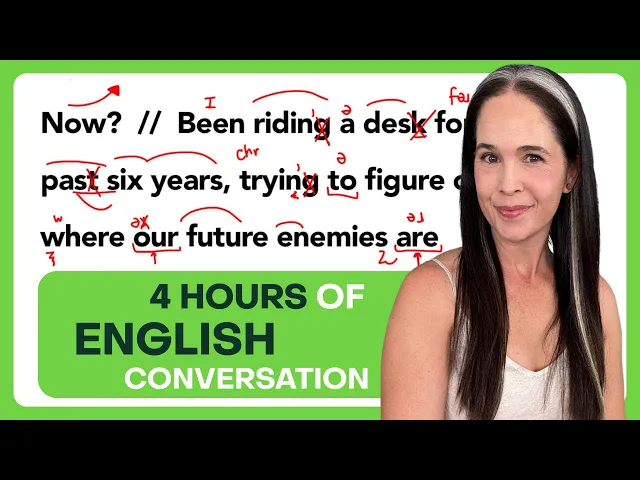
31:47 Been riding a desk for the past six years,
31:48 trying to figure out where future enemies are coming from.
31:51 Never occurred to me they would be coming from above.
31:55 Now the analysis.
31:57 You want to get personal.
31:59 I love this sentence because there's such contrast
32:01 between the stressed and unstressed syllables and words.
32:04 He really stresses the word 'you' at the beginning.
32:08 You want to get personal.
32:10 You want to get personal.
32:13 You want to get personal.
32:14 You want to get personal.
32:16 And in the stressed syllable of 'per', the first syllable is also stressed,
32:21 but the three words 'want to get' are all much lower in pitch,
32:28 much less clear, flatter than the 'you',
32:31 up-down shape, higher pitch of the stressed word 'you'.
32:36 You want to get personal.
32:38 You want to get personal.
32:40 You want to get personal.
32:42 Listen to just 'want to get'.
32:46 Want to get— Want to get— want to get— want to get— Much less clear than 'you'.
32:54 Now listen to the word 'you' with 'want to get' together,
32:59 stressed and then unstressed.
33:01 You want to get— A big difference there
33:06 in the quality of those stressed versus unstressed syllables.
33:09 We have a reduction.
33:11 'want to' becomes 'wanna'.
33:13 Want to get— want to get— want to get— And the word
33:17 'get' has a Stop T because the next word begins with a consonant.
33:21 Get, get, get, get, want to get, want to get.
33:24 Want to get— want to get— want to get personal.
33:27 Hey guys!
33:27 I wanted to pop in here to tell
33:27 you that Skillshare is again sponsoring this video.
33:27 Now, I know that you do a lot of learning online and I do too!
33:27 And Skillshare is a great place to go and to continue that learning.
33:28 You may have noticed about a month ago,
33:28 I made a video called my morning routine.
33:28 And in that video, as I was making it,
33:28 I found out that vlogging is actually kind of hard.
33:28 It's definitely its own separate skill.
33:28 I found Skillshare has a course from an awesome
33:28 YouTuber on vlogging that I'd like to take.
33:28 Come to Skillshare and search on whatever your interest is.
33:28 You'll find courses in English so you'll be able to study vocabulary,
33:28 and phrases used when talking about this topic you're passionate about.
33:28 It's twice the learning!
33:28 If you sign up, tell me in the comments below what course
33:28 you end up taking I'm so interested in learning more about you guys!
33:28 Follow this link or the link in the video
33:28 description for your own code to get 2 months FREE!
33:28 Okay, let's get back to the analysis.
33:29 You want to get personal.
33:30 Then the unstressed syllables, son--, al--,
33:33 both said really quickly, those both have the schwa,
33:37 and in both of these cases, they're followed by a syllabic consonant,
33:41 that means the consonant takes over the schwa.
33:44 We don't make a separate vowel sound.
33:46 So we go right from S into N.
33:49 Sn, sn, sn— person, person.
33:51 And then right from N into L, without making any kind of vowel sound.
33:57 Nal, nal, nal, nal.
33:58 Now, this is a Dark L, which does have a vowel-like quality.
34:04 You want to get personal.
34:06 You want to get personal.
34:08 You want to get personal.
34:10 You want to get personal.
34:11 Whoa!
34:11 Different day, different outfit, important announcement.
34:11 Did you know that with this video,
34:11 I made a free audio lesson that you can download?
34:11 In fact, I'm doing this for each one
34:11 of the youtube videos I'm making this summer,
34:11 all 11 of the learn English with movies videos.
34:11 So follow this link, or find the link in the video
34:11 description to get your free downloadable audio lesson.
34:12 It's where you're going to train all of the things
34:12 that you've learned about pronunciation in this video.
34:12 Back to the lesson.
34:12 Now, here is how Americans make the L in this case.
34:15 It's a Dark L, it's at the end of a thought group,
34:18 it doesn't link into anything.
34:20 We make that without lifting the tongue tip.
34:24 Can you do that too?
34:25 We make the Dark L with the back part of the tongue.
34:29 Uhl, uhl.
34:29 Back part of the tongue presses down a little bit,
34:32 uhl, uhl, while the tongue tip stays forward.
34:35 I find that most of my students are
34:37 so heavily trained in lifting their tongue tip,
34:40 that it's a very difficult habit to break.
34:43 I want to challenge you to do this.
34:46 Per-so-nal— uhl— your tongue is lifted for the N, bring it back down,
34:51 nal— uhl— and use the back of the tongue to make the dark sound for the Dark L.
34:58 Personal.
35:02 Where were you born?
35:03 She's speaking quickly here without much emotion, very straight faced.
35:07 Where were you born?
35:08 Where and born, both are stressed words there.
35:12 Where were you born?
35:13 Where were you born?
35:14 Where were you born?
35:15 Where were you born?
35:16 They both have that up-down shape,
35:18 were you— on the other hand, are much flatter, much faster.
35:22 Were you, were you, were you.
35:24 The word 'born' this would be written
35:26 with the AW as in law vowel, followed by R.
35:29 When these two sounds come together in the same syllable,
35:32 like here, the AW as in law vowel is not pure.
35:35 It's not AW but it's owh.
35:38 My lips round more, the tongue pulls back a little bit, born, born.
35:45 Where were you born?
35:48 Where were you born?
35:49 Where were you born?
35:51 Where were you born?
35:51 Huntsville, Alabama but technically, I don't remember that part.
35:54 So this is a longer thought group.
35:56 He says: Huntsville, Alabama but technically, I don't remember that part.
35:59 No brakes.
36:00 If it's no brakes, then that means it's one thought group.
36:03 So I've written in here with Huntsville Alabama,
36:05 on this slide, and on the next slide, is the second half of the thought group,
36:10 but he didn't actually put a break there.
36:13 Huntsville, Alabama but technically, I don't remember that part.
36:16 Huntsville, Alabama but technically, I don't remember that part.
36:19 Huntsville, Alabama but technically, I don't remember that part.
36:22 The stress of these multi-syllable words, we have huntsville,
36:27 first syllable stress, Alabama, so the most stressed syllable is bam--,
36:33 and the first level has a little secondary stress,
36:38 so I would put the primary stress marker there, secondary stress marker there.
36:43 The other two A's are schwas.
36:45 Actually, just a few weeks ago on the channel, I made a video of how to go over
36:51 the pronunciation of the 50 states and their capitals,
36:54 we talked about the four A's in this word.
36:57 Click here or in the video description to check out
37:00 that video that goes over the pronunciation of the 50 states.
37:05 Huntsville, Alabama Huntsville, Alabama Huntsville,
37:09 Alabama but technically, I don't remember that part.
37:11 But technically, I don't remember that part.
37:15 Our stressed syllables, very clear,
37:17 but tech— but technically, I don't remember that part.
37:21 Those have higher pitch, they have the up-down shape, that curve.
37:26 The rest is a little bit flatter.
37:28 It's either leading up to a peak, or falling away from a peak.
37:32 But tech— but, but— But technically, I don't remember that part.
37:38 But technically, I don't remember that part.
37:40 But technically, I don't remember that part.
37:42 Now we have an ending T, and a beginning T.
37:45 Those will combine into a single sound,
37:47 one true T, but technically, but technically.
37:54 But technically, but technically, but technically.
37:58 He's pronouncing this word as three syllables, first syllable stress,
38:02 tech— and the ch here makes a hard K sound.
38:06 Tech-nic— the C here makes a hard K sound.
38:11 Tech-nic-lly— and then he's not pronouncing this at all, just an LY ending then.
38:21 Tech-nic-lly— technically.
38:22 Technically.
38:23 Technically, I don't remember that part.
38:25 And all of these words linked together really smoothly.
38:30 Technically, I don't re— Okay what's
38:32 happening with the N apostrophe T contraction?
38:35 We have lots of different ways we pronounce that.
38:38 And in this particular case,
38:40 I think I'm actually hearing the whole thing dropped.
38:43 Doh remember— doh, doh.
38:46 So we have the D consonant, oh diphthong,
38:50 and then I hear that linking right on to the next sound, which is the R.
38:56 I don't remember that part.
38:58 I don't remember that part.
38:59 I don't remember that part.
39:01 Now, it doesn't sound like 'do' because 'do' has different sounds.
39:05 It has the D consonant, and the oo vowel.
39:07 So the fact that we have this oh diphthong,
39:10 that's how we know it's the negative.
39:12 Doh— don't remember.
39:13 Don't remember.
39:14 But I actually, I definitely don't hear the T.
39:17 For a second, I listened to it on a loop,
39:20 I was asking myself: do I hear a light quick N?
39:23 I don't think I really do.
39:25 I think it's just dropped.
39:26 Don't remember.
39:27 Don't remember.
39:28 Don't remember.
39:28 Don't remember.
39:29 Doh, oh, oh, oh, oh.
39:31 Just the OH diphthong right into the R.
39:34 Isn't it crazy?
39:35 We can pronounce this contraction without the N apostrophe T at all,
39:39 without the part that makes it a negative.
39:41 But I still hear it as that word because of the OH diphthong.
39:46 I don't remember that part.
39:48 I don't remember that part.
39:50 I don't remember that part.
39:51 Are you pronouncing this word?
39:53 Remember?
39:54 Try to pronounce it with the schwa.
39:57 Remember, re-re-re, remember remember,
40:04 I want you to listen to just the last three words.
40:11 Remember that part.
40:13 Remember that part.
40:14 Kind of mumbly, it's at the end of the thought group,
40:18 it's losing the vocal energy,
40:19 and when I'm listening to the word 'that', which would have
40:22 a Stop T in most cases because it's followed by the P here,
40:26 I actually think I am also not hearing that.
40:28 That part, that part, that part, that part, that part.
40:32 I think he drops it.
40:34 TH, quick AA vowel, and then right into the P.
40:38 That part, that part, that part, that part.
40:41 The ending T, he's also not really pronouncing that too clearly.
40:44 I would still write that as a Stop T, I don't think it's dropped,
40:48 that would sound like par— and I don't hear that.
40:50 I hear: part, part, and that more abrupt end is the Stop T.
40:55 But let's listen to these last three words
40:58 on a loop again and think about how you
41:00 have to simplify everything in your mouth to be
41:03 able to say this this quickly and this unclearly.
41:06 It's a little bit mumbled.
41:08 This is pretty common for how words come out at the end of a thought group.
41:12 They're definitely less clear.
41:14 Remember that part.
41:18 First job?
41:19 First job?
41:20 First job?
41:21 Two stressed words.
41:22 They're both a little bit longer.
41:25 First job?
41:26 And pitch goes up at the end because she's asking the question.
41:29 She wants to know what was his first job.
41:32 Notice how we're pronouncing the T here.
41:34 This T is dropped because it comes between two consonants.
41:38 That's really common to do that when we have an ending
41:42 cluster like the ST cluster in 'first' or 'just' or 'must'.
41:46 When it's followed by a word that begins with a consonant,
41:49 you'll hear that T dropped.
41:51 That helps to link the two words together more smoothly.
41:53 So right from the S into the J sound.
41:57 First job.
41:57 Also note we have the letter O here.
42:00 I know my students see that and they want to do some lip rounding.
42:04 No lip rounding in this sound.
42:06 It's the AH as in father vowel.
42:08 It is not job, actually,
42:10 this reminds me of Tom who's a Rachel's English teacher.
42:13 His name is the same, single syllable has the letter O.
42:17 It makes the AH as in father vowel.
42:20 And even so, almost all of his students say something like:
42:24 Tom, Tom, instead of Tom, ah-ah, with no lip rounding,
42:28 even though he reminds them it's not an OH sound, it's the AH vowel.
42:33 We see the letter O, we have such a strong association.
42:36 But in English, one of the challenges is to break
42:39 your association between what you see on the page,
42:42 and the actual natural American pronunciation.
42:44 Because as you can see, we change things quite a bit.
42:48 We drop sounds, vowels are not what we think they are,
42:52 so the vowel in 'job' and in the word 'Tom' is the AH as in father vowel.
42:58 Oh— First job?
43:00 First job?
43:02 First job?
43:03 Soldier.
43:03 Soldier.
43:04 Soldier.
43:05 Two-syllable word, first syllable stress, soldier.
43:11 DI here is pronounced as a J sound,
43:16 which we would write in IPA: dj— soldier, soldier.
43:22 Soldier.
43:23 Soldier.
43:24 Soldier.
43:25 And the L here, this is the break of the syllable.
43:30 Soldier.
43:30 So the L comes after the vowel.
43:33 That makes it a Dark L.
43:35 He made it without lifting his tongue tip.
43:38 I make it without lifting my tongue tip.
43:41 Soldier.
43:42 Soldier.
43:42 I'm not lifting my tongue tip at all there,
43:47 I'm using the back of my tongue for a more dark sound, for the Dark L.
43:51 I challenge you to do the same thing.
43:54 Do not lift your tongue tip.
43:55 An L is a Dark L when it comes after the vowel or diphthong in a syllable.
44:02 Soldier.
44:02 Soldier.
44:03 Soldier.
44:04 Soldier.
44:05 Straight out of high school.
44:07 Five-word thought group, the word 'straight' and 'high', most stressed.
44:11 School also has some length,
44:13 but it's at the end of the thought group, the pitch isn't as high.
44:16 Straight out of high school.
44:18 Straight out of high school.
44:20 Straight out of high school.
44:22 Straight out of high school.
44:23 Straight out of high school.
44:25 We have an STR beginning cluster,
44:27 strai— strai— the T can come out as a CH there.
44:32 Stch— strai— strai— straight out of— straight out
44:37 of— Just make sure you make it light.
44:40 Don't put too much ch— air in it.
44:43 Strai— strai— then these four letters, a-I-g-h, all make the AY diphthong.
44:55 Straight out of high school.
44:57 All of the words in this thought group are really smoothly connected.
45:00 We have a couple Flap T's linking words together,
45:04 like connecting 'straight out'.
45:06 Straight out, straight out, dadadada.
45:13 Straight out ah— straight out ah— Another Flap
45:13 T connecting here.Straight outta— The word 'of' reduced, it's just the schwa.
45:17 Straight outta— straight outta— straight outta— straight
45:20 outta— dadadadada— two flaps linking those words.
45:24 Straight out of high school.
45:26 Straight out of high school.
45:28 Straight out of high school.
45:29 High school.
45:30 High school.
45:32 High school.
45:33 And again, we have a Dark L.
45:35 I guarantee you he is not lifting his tongue tip.
45:38 Don't lift your tongue tip as you practice this.
45:42 High school.
45:45 Left the ranks a full bird colonel.
45:47 So, the word 'left' stressed,
45:49 'ranks' also sort of stressed, but also not totally clear.
45:54 We'll talk about that in a second.
45:56 Then the last three words, even more clear, even longer.
45:59 Full bird colonel.
46:08 Left the ranks a full bird colonel.
46:10 Left the ranks a full bird colonel.
46:10 Left the ranks a full bird colonel.
46:10 So the rhythm pattern of these first four words,
46:13 I would say, is still: da-da-da-da.
46:16 Stressed, unstressed, stressed, unstressed.
46:18 Even though 'left' and 'ranks' are said more quickly,
46:22 it really slows down then on 'full bird colonel'.
46:25 He's really stressing all three of those words.
46:29 Left the ranks a full bird colonel.
46:34 Left the ranks a full bird colonel.
46:34 Left the ranks a full bird colonel.
46:34 Left the ranks, left the ranks.
46:37 T is dropped, it comes between two other consonants.
46:40 Left the, left the.
46:41 So a quick F goes right into the voiced TH,
46:46 which doesn't come through the teeth here,
46:49 because it's beginning an unstressed word.
46:52 Left the, the, the, the— I make that sound
46:56 by just pressing my tongue on the backs of the teeth.
46:59 It's not at the roof of the mouth, that would make it sound like a d,
47:03 but the tongue tip doesn't come through the teeth either.
47:05 Left the, left the, left the ranks.
47:08 Left the ranks a— Left the ranks— The N here
47:15 is the NG sound because it's followed by the letter k.
47:21 Ranks, ranks, ranks.
47:22 And I really feel like it's very subtle here.
47:26 He says this word quickly, a little unclearly.
47:29 It almost sounds like 'rakes' without the ng to me.
47:33 Left the ranks— left the ranks— left the ranks a full bird colonel.
47:38 Full— we have a Dark L.
47:41 Don't lift your tongue tip.
47:44 Try it: full, full, full bird.
47:48 'bird' has the UR vowel, and that's overtaken by the R so you don't
47:52 actually need to try to make a vowel at all.
47:56 Make the B sound, the R sound, the D sound.
48:00 Bird, bird.
48:00 Now the word 'colonel'.
48:03 Okay, that's obviously...
48:05 This is one of the weirdest words
48:07 in American English as far as letters and sounds.
48:11 Full bird colonel.
48:12 Full bird colonel.
48:13 Full bird colonel.
48:15 We have the K sound, which we get from the letter C,
48:19 then we have the same sound combination as in 'bird',
48:22 the ur vowel and the R consonant.
48:25 Where's the R, exactly?
48:27 So where's the O?
48:29 Don't know.
48:29 Where's this O?
48:30 Don't know.
48:31 It's just very strange.
48:32 I don't know how this word evolved, it'd be interesting to look into that.
48:37 Colonel.
48:38 Two-syllable word, first syllable stress, K sound, R sound:
48:42 ker— ker--, and then a very quick: nl, nl, nl.
48:46 And Dark L sound at the end.
48:49 Colonel.
48:50 Colonel.
48:54 Then?
48:55 Then?
48:56 Voice goes up in pitch, she's asking a question, it's not a statement.
49:01 She's saying what's next?
49:05 Then?
49:06 Then?
49:06 Spy.
49:07 Spy.
49:08 So his voice has a little bit of popcorn quality.
49:11 There's not a full engagement of the air.
49:14 Quick up-down shape of a stressed syllable.
49:16 That is a statement.
49:18 It comes down.
49:19 Spy.
49:20 Spy.
49:26 Where?
49:27 Where?
49:28 Now this one also comes down and she also has a popcorn quality of her voice.
49:34 Uhhhh— where?
49:35 Where?
49:36 Instead of: where?
49:37 Where?
49:38 Which has more volume, more air.
49:41 Where?
49:45 Now, why does this one go down in pitch,
49:47 where the other question statement went up in pitch?
49:49 That's a great question.
49:50 The general rule is for the most part, if it's a yes/no question,
49:55 it goes up in pitch, if not, it goes down in pitch.
49:59 But there are always exceptions when she said 'then?' going up here,
50:02 that was not a yes/no question, but going up made us know it was a question.
50:06 Here, the pitch of 'where' it goes down.
50:08 We still know it's a question.
50:12 Where?
50:15 The word 'where' as a statement wouldn't exist, wouldn't really make sense.
50:19 And I'm trying to think: would I ever make the intonation of 'where' go up?
50:23 And I would.
50:24 I would if someone had told me where something was, and I didn't hear them,
50:28 and I needed them to say it again, then I would say: where?
50:31 But this is her first time asking the question: where?
50:35 She's making it a statement.
50:37 Where?
50:40 It was the cold war, we were everywhere.
50:42 Okay, this is interesting.
50:43 We have: it was the cold war.
50:46 It was the cold war.
50:48 Stress on 'cold'.
50:49 It was the— those three words, hmm, how are they pronounced?
50:55 It was the cold war— I'm hearing a Z sound, I'm hearing a schwa.
51:00 It was the cold war— it was the cold war— Now,
51:03 I know that the phrase grammatically would be 'it was
51:06 the cold war.' but he says those three words really quickly,
51:12 just combines them into two sounds.
51:15 It was the cold war— it was the cold
51:19 war— It was the cold war— We were everywhere.
51:21 Then the words: we were everywhere.
51:23 We were— pitch goes up, energy goes up.
51:26 We were eh— we have the peak on the EH vowel, everywhere.
51:30 And then the pitch comes down.
51:32 We were everywhere.
51:33 We were everywhere.
51:35 All connected, smoothly together.
51:38 We were everywhere.
51:41 We were everywhere.
51:41 We were everywhere.
51:42 Now?
51:42 Now?
51:43 Now?
51:43 Again, her pitch goes up, showing it's a question.
51:46 Now, this is a word that we could make as a statement.
51:50 Now?
51:51 Like if someone said: hey rachel!
51:53 When are you leaving?
51:54 Now.
51:55 So by making the intonation go up, now?
51:58 It's inviting that question by a conversation.
52:01 Now?
52:02 Now?
52:03 Now?
52:04 Now?
52:04 Been riding a desk for the past six years,
52:06 trying to figure out where future enemies are coming from.
52:09 Then he has a really long thought group.
52:12 Actually, let's add the end of this thought group here to this slide.
52:16 So we have lots of words that are a little bit longer, a little bit clearer.
52:23 Been riding a desk for the past six years—
52:29 Been riding a desk for the past six years—
52:31 Been riding a desk for the past six years—
52:33 Been riding a desk for the past six years,
52:35 trying to figure out where our future enemies are coming from.
52:38 Trying to figure out where our future enemies are coming from.
52:41 Future.
52:41 A little bit of length on 'enemies co--',
52:44 but we have some reductions, what are you noticing?
52:47 First let's look at the first word.
52:50 Been riding, EE is pronounced as the letter IH, that's actually not a reduction,
52:56 but it's just the pronunciation, but it's said very quickly.
53:01 Been, been, been, been.
53:01 Been riding, been riding— Been riding, been riding,
53:04 been riding a desk— Riding a desk— riding a— riding
53:09 a— NG sound is changed to just an N sound.
53:13 Ridin a— And that links right into the schwa.
53:18 Ridin a— ridin a— Been riding a, Now, we have 'desk for the'.
53:24 I want you to listen to those three words, and listen especially for the K.
53:31 Been riding a desk for the— Desk for the— desk
53:34 for the— desk for the— K is dropped.
53:37 Comes between two consonant sounds,
53:39 we sometimes do that when we're linking things together.
53:44 Desk for the— Been riding a desk for the— Desk
53:48 for the— desk for the— 'for the', both said really quickly,
53:52 we have a for reduction,
53:54 the word 'the', tongue tip does not need to come through the teeth for that TH,
53:58 you can just touch it at the back of the teeth, the back of the front teeth.
54:02 For the, for the, for the, for the.
54:04 How fast can you say that?
54:06 For the, for the, for the.
54:08 Desk for the, desk for the.
54:11 Desk for the— desk for the— desk for the past six years.
54:12 Now look, let's look ahead.
54:14 We have STS, a cluster, the T comes between two other constant sounds.
54:19 Do you think it's dropped?
54:21 I think it is.
54:22 Let's hear.
54:23 The past six years.
54:24 The past six years.
54:26 The past six years.
54:27 Past six years.
54:28 Past six years.
54:29 Past six years.
54:30 Okay, yup.
54:31 It is dropped.
54:33 Past six.
54:33 Those two words connected with the single S and actually,
54:35 I'm gonna write a little bit of length on that word too.
54:39 Past six years, past six years.
54:42 I think they all have a little bit of length to them.
54:45 The past six years.
54:46 The past six years.
54:47 The past six years, trying to figure out where future enemies are coming from.
54:52 Trying to figure out— okay, that has...
54:56 That's not how it's pronounced.
54:59 The TR, I am hearing a CHR, trying, trying, that's really common.
55:04 Now the ING, again, he's dropping the G sound.
55:09 He's making that an N sound.
55:11 Tryin, tryin, tryin.
55:12 The word 'to' this word is reduced to just the schwa.
55:16 We don't usually drop the beginning sound, we do make that a Flap T sometimes.
55:21 But I have noticed we do sometimes drop
55:23 that altogether when the sound before is an N, and that's what's happening here.
55:28 Tryna— tryna— tryna— Trying to figure out, Trying to figure out,
55:32 trying to figure out, trying to figure out.
55:35 Figure out.
55:35 Figure out.
55:36 Figure out.
55:37 Figure out.
55:37 Also said pretty quickly, out, we have a Stop T here,
55:41 figure out, figure out, figure out.
55:43 Because the next word begins with a consonant, the W sound.
55:47 Trying to figure out,
55:50 where our future enemies— WH word but he makes just a clean W sound.
55:55 There's no wh, wh, wh, where in front, it's just: where, where.
56:00 The word 'our' pretty unclear.
56:02 I would probably write that schwa R, it's reduced.
56:07 Where our, where our, where our, where our.
56:11 Where our future enemies— where our future
56:13 enemies— where our future enemies— You know,
56:15 I would normally write this schwa R,
56:17 but I actually almost think I'm just hearing it like a schwa.
56:20 Where our— where our future— where
56:22 our future enemies are— That's not too common,
56:25 but I do think that's what he's doing here.
56:27 Where our future— where our future enemies are— He's just speaking so quickly.
56:32 This particular word is said so quickly.
56:34 Now, when it's all linked together, I totally get it.
56:37 It would sound weird to pronounce 'our' that way
56:40 if it wasn't linked in as part of the sentence.
56:44 Where our future enemies— This word 'our' and this word 'are',
56:52 both often reduced to something that sounds pretty much the same, schwa R.
56:58 Of course, over here, I said the R was dropped but here, I do hear it.
57:02 Enemies are— enemies are— enemies are— ending
57:04 Z sound linking right into the next sound.
57:08 Zar, zar— enemies are— Enemies are— coming from— Are coming from— are
57:15 coming from— are coming from— so he has three ING verbs here,
57:20 and for each one of them, he's changed the NG sound into an end N sound.
57:25 I do tell my students not to do this all the time.
57:30 It just doesn't sound quite right,
57:32 mixed in with other things that students tend to do.
57:35 There will be some native speakers that do it all the time,
57:39 that will definitely sound like an accent,
57:41 a regional accent in the us, and that's fine.
57:44 Especially, you know, if you live there, you might want to pick that up.
57:48 Although people in the US move around so much,
57:50 I can't say that, you know, everyone in a particular region speaks that way.
57:55 A lot of people would speak with a more standard accent.
57:58 And that's what I teach.
57:59 So I just want to talk about that here,
58:01 he's done it three times, a student watching this might think: oh, it's...
58:05 We should be doing this all the time.
58:07 I wouldn't say that.
58:09 The last word 'from', not reduced.
58:11 Sometimes, we reduce this word to: from, from, but the vowel is not reduced.
58:16 It is the UH as in butter vowel.
58:18 We generally don't reduce the last word in a sentence, or a thought group.
58:22 Coming from, Never occurred to me they would be coming from above.
58:29 So let's talk about stress.
58:32 Never occurred to me they would be coming from above.
58:38 And the most stress on that last word because this is what is unusual.
58:42 The enemies are coming from above.
58:45 Never occurred to me they would be coming from above.
58:48 Never occurred to me they would be coming from above.
58:51 Never occurred to me they would be coming from above.
58:54 Also, grammatically, we would have the word 'it' here.
58:57 The word 'it' is implied.
58:59 It never occurred to me.
59:01 But he doesn't say that, he just says:
59:03 never occurred to me— Never occurred to me— Never occurred to me— Never
59:07 occurred to me— Never occurred to me— So in the stressed syllable of occur,
59:15 we have that R vowel again.
59:19 Occur— ur— occured— So you don't need to try to make a vowel there.
59:23 It's really the R sound.
59:26 Occurred.
59:27 Occurred.
59:27 Occurred.
59:30 A little bit of stress on the first syllable
59:33 of ne— never uh— then the R links into the schwa.
59:37 Never uh, never uh, never occurred— Never
59:43 occurred— to me— Never occurred to me— occurred
59:45 to me— so the ED ending here is a little light D sound, not released.
59:51 Then he makes the word 'to' with a true T,
59:54 and the vowel is reduced to the schwa.
59:57 Occurred to— occurred to— do you hear that D
1:00:01 sound in my vocal cords before I make the T?
1:00:06 Occurred to— occurred to me— occurred to me— Occurred to me—
1:00:12 occurred to me— occurred to me they would be coming from above.
1:00:16 So we have the stressed syllable: occurred— then we have 'to me they would be',
1:00:24 all of these words before the next stressed word.
1:00:29 To me they would be coming— To me they would be
1:00:32 coming— To me they would be coming— To me they would be,
1:00:34 to me they would be, to me they would be, to me they would be.
1:00:38 A little bit flatter in pitch but you don't have much of that up-down shape.
1:00:41 To me they would be, to me they would be, to me they would be.
1:00:44 Now, I hope you're noticing the L in 'would' is always silent.
1:00:47 To me they would be, to me they would be.
1:00:50 A very light D sound in the vocal cords here, again, not released.
1:00:54 That would be: they would be.
1:00:56 They would be.
1:00:57 They would be.
1:00:59 We don't hear that.
1:01:00 They would be, they would be, they would be.
1:01:02 That's what we hear.
1:01:03 They would be.
1:01:04 Little D sound, the vocal cords are vibrating, that's a voiced sound,
1:01:10 but it's not released, I go right into the B sound.
1:01:14 To me they would be— coming from above.
1:01:19 Coming from above.
1:01:20 We have interesting stress here.
1:01:21 He's playing with it a little bit because of the surprise
1:01:25 of the enemies coming from above, from outer space.
1:01:28 Coming from above.
1:01:30 Da-da-da-da-da.
1:01:30 Really stressing that last syllable.
1:01:34 Now, here we have an ING word, he does pronounce that as an ING word.
1:01:38 He makes the NG sound instead of an N sound.
1:01:41 Coming, coming, coming, coming, coming from, coming from.
1:01:44 Now, here I probably would write this as the from reduction
1:01:47 with a schwa instead of the UH as in butter vowel.
1:01:53 Coming from, coming from above.
1:01:57 Coming from above.
1:01:59 Coming from above.
1:02:01 The last thing I want to talk about is
1:02:03 he does do a little lift here: from above.
1:02:05 When I was practicing it one time, I did it with the link:
1:02:09 from a, from a, from a, from above, from above.
1:02:11 But no, it's not how he does it.
1:02:14 He says: from above, from above, from— little break, above.
1:02:17 Putting that little break there makes that word even more stressed.
1:02:22 If we linked it into the word before,
1:02:25 it would sound a little bit more conversational.
1:02:27 But by putting a little lift there,
1:02:29 a little break in the sound, it brings more stress to that word.
1:02:33 Wow.
1:02:33 The enemies are coming from above.
1:02:37 Coming from above.
1:02:42 Let's listen to this whole conversation one more time You want to get personal.
1:02:47 Where were you born?
1:02:48 Huntsville, Alabama.
1:02:48 But technically, I don't remember that part.
1:02:51 First job?
1:02:51 Soldier.
1:02:51 Straight out of high school.
1:02:53 Left the ranks a full bird colonel.
1:02:55 Then?
1:02:55 Spy.
1:02:56 Where?
1:02:56 It was the cold war, we were everywhere.
1:02:58 Now?
1:02:58 Been riding a desk for the past six years,
1:03:00 trying to figure out where future enemies are coming from.
1:03:02 Never occurred to me they would be coming from above.
1:03:08 Too tight?
1:03:10 Uhmmm A little?
1:03:11 No.
1:03:11 Leave it for now.
1:03:12 We’ll see.
1:03:13 'kay.
1:03:14 If it feels too tight later, I’ll let you know.
1:03:20 So, do you have a vision?
1:03:21 Mm-hmm.
1:03:22 What is it?
1:03:23 I want to take with your permission, I’d like to go to here.
1:03:28 What do you think David?
1:03:29 I don’t know.
1:03:29 That might be too much.
1:03:31 You should try it.
1:03:32 It’ll always grow.
1:03:33 I know, but in the meantime, what if I hate it?
1:03:35 Well, it won’t be too short.
1:03:37 I think it’ll be good because it’s going to have layers and movement.
1:03:41 Can you do one inch longer than that?
1:03:43 Okay, fine.
1:03:44 Okay, thank you.
1:03:45 Darn it.
1:03:46 Darn it (laugh).
1:03:47 I just don’t have the balls.
1:03:49 Well, but you could grow a set.
1:03:51 I know, I could, but I’m too busy feeding
1:03:56 a baby and building a business and all that.
1:04:01 Yep.
1:04:01 And now the analysis Too tight?
1:04:02 Too tight?
1:04:03 Tight?
1:04:03 Pitch going up at the end.
1:04:05 She was asking me a question.
1:04:09 Too tight?
1:04:10 Too tight?
1:04:11 Notice she had a clear stop T at the end of the word tight.
1:04:17 Tight?
1:04:17 Tight.
1:04:18 So, that sounds different than the word tie,
1:04:22 which has the same sounds only no T.
1:04:27 Tight.
1:04:28 Tie.
1:04:30 Tight.
1:04:31 Tight?
1:04:32 The word tight is a lot more abrupt because of this stop than tie,
1:04:38 which has more of a curve in the voice.
1:04:41 Too tight?
1:04:42 Too tight?
1:04:43 Umm...
1:04:43 A little?
1:04:44 Then she said “a little?” as in a little too tight?
1:04:49 A little?
1:04:50 Again, her voice went up in pitch at the end.
1:04:52 Umm...
1:04:53 A little?
1:04:55 A little?
1:04:56 Little is a really tough word.
1:04:58 The double T is a flap, so it sounds like the American D.
1:05:03 It might sound like the R in your language.
1:05:07 Little.
1:05:08 Little.
1:05:08 Little.
1:05:09 A little?
1:05:12 It also has a dark L, and when I say this word,
1:05:16 I don’t move the front top of my tongue away
1:05:19 from the roof of the mouth between the flap and the L.
1:05:25 Little.
1:05:25 I go from using the front of the tongue to the back,
1:05:28 but I don’t actually move the front of the tongue.
1:05:31 A little?
1:05:32 A little?
1:05:33 A little?
1:05:36 No.
1:05:36 Leave it for now.
1:05:37 We'll see.
1:05:37 'kay.
1:05:38 No.
1:05:39 Leave it for now.
1:05:40 Leave it for now.
1:05:41 A couple things to note.
1:05:43 How did I pronounce the word for?
1:05:46 For now.
1:05:47 With the schwa.
1:05:49 So, the schwa is absorbed by the R sound.
1:05:56 For.
1:05:56 For.
1:05:56 Leave it for.
1:05:57 Leave it for now.
1:05:58 Leave it for now.
1:05:59 Also, a stop T in it.
1:06:01 Less time to pronounce it.
1:06:03 No release.
1:06:04 It for.
1:06:05 It for.
1:06:06 It for.
1:06:06 Leave it for now.
1:06:07 Leave it for now.
1:06:09 Leave it.
1:06:11 Leave it.
1:06:12 One way that can help you connect these two words is
1:06:16 to maybe think of the V sound as beginning the word it.
1:06:20 Vit.
1:06:21 Leave it.
1:06:22 Leave it.
1:06:23 Leave it for now.
1:06:25 Leave it.
1:06:26 Leave it for now.
1:06:27 We'll see.
1:06:28 We'll see.
1:06:29 We'll see.
1:06:30 We'll see.
1:06:30 How did I pronounce we will?
1:06:33 We'll see.
1:06:35 The contraction.
1:06:37 We'll.
1:06:37 We'll.
1:06:38 We'll.
1:06:39 I made a schwa sound here, and then the dark L was the dominant sound.
1:06:44 We'll.
1:06:45 We'll, uhl,uhluhl.
1:06:46 Where the back of the tongue pulls back.
1:06:53 We'll.
1:06:54 We'll see.
1:06:55 We'll see.
1:06:56 I don’t lift the tip of my tongue to finish the dark L.
1:07:01 We'll, ul.
1:07:02 I can leave it down.
1:07:04 I'm just using the back of my tongue to make the dark L.
1:07:09 We'll see.
1:07:10 We'll see.
1:07:10 We'll see.
1:07:11 'kay.
1:07:14 My sister-in-law said a really quick, 'kay.
1:07:17 'kay, 'kay.
1:07:19 'kay.
1:07:20 This is short for the word okay.
1:07:23 You’ll hear it shortened to K a lot.
1:07:27 K.
1:07:28 K.
1:07:28 K.
1:07:29 'kay.
1:07:29 Now let me show you what makes exercises like these special in the academy.
1:07:29 You not only have the analysis but you have
1:07:29 a soundboard where you can play with listening and repeating.
1:07:29 As you do this you can really improve your skills in linking,
1:07:29 reductions, perfecting vowels and developing a feel of American English.
1:07:29 Each conversation is broken down into little phrases and you
1:07:29 can listen to them over and over doing the play it,
1:07:29 say it method which will really help you sound more natural.
1:07:29 Do you have a vision?
1:07:29 You can listen at a regular pace.
1:07:29 Do you have a vision?
1:07:29 And slow motion, this helps you figure out what exactly is being said,
1:07:29 what exactly you hear, which is so important for the flow of conversation.
1:07:29 So let’s just try this now.
1:07:30 I’m going to play this three times.
1:07:30 After each time, you repeat it back just like you hear it.
1:07:30 Do you have a vision?
1:07:30 I've found when my students work like this with the play it,
1:07:30 say it method that they’re able to make
1:07:30 corrections to themselves without me even saying anything.
1:07:30 Their ears and their mouth,
1:07:30 their body just starts working together to make corrections
1:07:30 in a way that makes them sound so natural.
1:07:30 Leave it for now.
1:07:30 So if this is something that looks interesting to you, I’d like to go to here.
1:07:30 As a training tool then head over
1:07:30 to RachelsEnglishAcademy.com What if I hate it?
1:07:30 Oh, I don’t think you’re going to hate it?
1:07:30 Repeating like this builds those pathways in your brain,
1:07:30 builds your understanding of the American sound and builds your American voice.
1:07:30 Now let’s jump back to that analysis.
1:07:30 If it feels too tight later, I'll let you know.
1:07:33 If it feels too tight later, I'll let you know.
1:07:37 If it feels.
1:07:38 The word feels was longer.
1:07:40 It had that up-down swell.
1:07:42 If it feels.
1:07:44 If it feels.
1:07:45 If it feels-— The word if was really short.
1:07:51 F-feels.
1:07:51 F-feels.
1:07:52 There was almost no vowel, just a very quick ---ih,
1:07:55 but if I had just said f-feels and just
1:07:59 made the F sound attaching it to the next word,
1:08:02 she would have known what I meant.
1:08:04 Another stop T here, because the next word begins with a consonant.
1:08:09 F-feels.
1:08:09 F-feels.
1:08:11 If it feels— too tight later— Too tight later.
1:08:14 Too tight later.
1:08:16 So, unlike the word T-O, which can often reduce, the word T-O-O never reduces.
1:08:24 It will have the -ooh as in boo vowel.
1:08:27 If it feels too tight later.
1:08:30 If it feels too tight later— What do you notice about tight?
1:08:34 Again, a stop T.
1:08:36 The next sound is a consonant.
1:08:38 Too tight later.
1:08:40 Later.
1:08:41 Later.
1:08:41 How did I pronounce that T?
1:08:45 Too tight later.
1:08:47 That T was again flap T.
1:08:51 Later.
1:08:52 Later.
1:08:53 Later.
1:08:54 Later I'll let you know.
1:08:55 I'll let you know.
1:08:57 The word 'I'll' reduced.
1:08:59 So it sounds like the word 'all'.
1:09:02 I'll let you know.
1:09:04 I'll let you know.
1:09:06 I'll let you know.
1:09:07 I think you're probably noticing the strong -ch sound instead of a T.
1:09:13 Let you.
1:09:14 Let you.
1:09:15 I'll let you know.
1:09:15 Let you know.
1:09:17 This often happens in American English when the T
1:09:20 sound is followed by the word you or your.
1:09:23 Let you know.
1:09:25 What else about the word you?
1:09:28 The -ooh vowel was reduced to the schwa.
1:09:32 Let you.
1:09:33 Let you.
1:09:36 I'll let you know.
1:09:37 I'll let you know.
1:09:38 This is a pretty common phrase.
1:09:40 I'll let you know.
1:09:41 Practice that a couple times.
1:09:43 I'll let you know.
1:09:44 I'll let you know.
1:09:45 I'll let you know.
1:09:48 So, do you have a vision?
1:09:50 Mm-hmm.
1:09:51 So.
1:09:52 I kind of drew that word out a little bit.
1:09:55 So, So.This is a diphthong.
1:10:01 The OH as in No diphthong.
1:10:03 OH.
1:10:04 So, make sure that your lips do move they will round more.
1:10:08 So.
1:10:08 For the second half of the diphthong.
1:10:13 So, Do you have a vision?
1:10:15 Do you have a vision?
1:10:17 Do you have a vision?
1:10:18 The -ooh vowel in do was very fast.
1:10:22 It could even be interpreted as a schwa.
1:10:26 Do you have?
1:10:27 Do you have?
1:10:27 Do you have?
1:10:28 Do you have?
1:10:28 a vision?
1:10:29 Also, the word 'you' is very fast.
1:10:32 Do you have a vision?
1:10:34 And it could have been the schwa,
1:10:36 but I think I actually am hearing a real -ooh vowel there although it's fast.
1:10:40 Do you have a vision?
1:10:43 Do you have a vision?
1:10:44 Have a.
1:10:45 Have a.
1:10:45 Here we have an ending consonant linking into a beginning vowel.
1:10:50 Remember, we're talking about sounds when we deal
1:10:53 with these rules of linking and other things, not letters.
1:10:58 So, even though the letter E is here, it's silent.
1:11:01 The final sound is the V sound.
1:11:04 Have a.
1:11:05 Have a.
1:11:06 Have a.
1:11:07 So, we can link that really nicely into the article -ah.
1:11:12 Have a vision?
1:11:14 Do you have a vision?
1:11:15 Vision.
1:11:15 Here the letter S makes the -zh sound.
1:11:21 Vision.
1:11:22 Vision.
1:11:23 Vision?
1:11:23 Do you have a vision?
1:11:25 Do you have a vision?
1:11:26 And my voice is going up in pitch at the end.
1:11:29 I'm asking her a yes-no question.
1:11:31 Do you have a vision?
1:11:32 Do you have a vision?
1:11:35 Mm-hmm.
1:11:37 Mm-hmm.
1:11:38 Mm-hmm.
1:11:39 This is a common response.
1:11:42 Yes.
1:11:42 Mm-hmm.
1:11:43 Mm-hmm.
1:11:44 Mm-hmm.
1:11:44 Do you have a response like that in your language?
1:11:47 That’s sort of just a grunt that doesn't even involve opening your mouth?
1:11:51 Mm-hmm.
1:11:52 Mm-hmm.
1:11:53 Mm-hmm.
1:11:54 That's a common one in American English.
1:11:57 Mm-hmm.
1:11:58 What is it?
1:11:59 I want to take with your permission.
1:12:02 What is it?
1:12:03 What is it?
1:12:04 How did we say that so quickly and link things together?
1:12:08 First of all, the T here comes between two vowel sounds.
1:12:12 So, I linked those words with a flap T.
1:12:16 What is it?
1:12:17 What is it?
1:12:18 What is it?
1:12:20 And also, the letter S makes the Z sound in this word,
1:12:24 and the Z did connect into that next word.
1:12:28 Zit.
1:12:28 Zit.
1:12:29 What is it?
1:12:31 What is it?
1:12:33 What is it?
1:12:34 So, we linked all three of these words
1:12:37 together by an ending consonant to beginning vowel link.
1:12:42 What is it?
1:12:43 What is it?
1:12:45 What is it?
1:12:48 Try that with me and follow the same
1:12:51 stress pattern where 'is' is the most stressed.
1:12:54 What is it?
1:12:54 What is it?
1:12:57 What is it?
1:12:59 What is it?
1:13:00 I want to take, with your permission.
1:13:03 I want to take.
1:13:04 I want to take.
1:13:05 So, you can probably notice that she is saying wanna, not want to.
1:13:10 I want to— I want to take.
1:13:13 So, she's combining these words, dropping the T sound.
1:13:18 Want to.
1:13:18 Want to.
1:13:19 With the schwa at the end.
1:13:21 I want to take.
1:13:23 I want to take.
1:13:24 I want to take with your permission.
1:13:29 With your permission.
1:13:31 She's hesitating here a little bit.
1:13:33 With your permission.
1:13:35 With your permission.
1:13:36 Because she knows she needs my permission to do this.
1:13:40 Your permission.
1:13:41 How does she pronounce the word 'your'?
1:13:43 Your permission.
1:13:45 It's reduced.
1:13:47 Schwa R.
1:13:49 Your.
1:13:50 Your.
1:13:51 Your— permission.
1:13:52 Your permission.
1:13:53 With your permission, I'd like to go to here.
1:13:57 What do you think, David?
1:13:58 I'd like to go to here.
1:14:00 Okay, a couple interesting things here.
1:14:02 I'd like to go to here.
1:14:05 So, she's saying I would like.
1:14:08 I'd.
1:14:08 She won't do this if I don’t give her permission,
1:14:12 but this is what she wants to do.
1:14:15 I'd like— So, she's using the contraction I would to I'd.
1:14:20 I'd.
1:14:20 I'd like— to go to here.
1:14:22 I'd like to go to here.
1:14:24 Okay.
1:14:25 The word to.
1:14:26 It appears twice.
1:14:27 Both times, she uses the schwa.
1:14:30 The first time it's a clear true T.
1:14:34 Like to.
1:14:35 I'd like to.
1:14:36 I'd like to.
1:14:37 T-T-T.
1:14:38 But the second time you barely hear it.
1:14:42 I'd like to go to here.
1:14:45 I'd like to go to here.
1:14:46 It's a light flap.
1:14:48 So, she made a true T here because the sound before was unvoiced,
1:14:53 an unvoiced consonant K.
1:14:55 K.
1:14:57 I'd like to go to here.
1:14:58 And because this sound is unvoiced,
1:15:01 she's going ahead and making the T sound unvoiced as well.
1:15:05 Like to.
1:15:06 Like to.
1:15:06 I'd like to.
1:15:08 So, it's a K sound.
1:15:10 She's stopping the air and she's not releasing the K.
1:15:15 Like to.
1:15:16 She's going straight from the stop of air into the true T sound.
1:15:20 Like to.
1:15:20 Like to.
1:15:21 I'd like to.
1:15:22 Like to.
1:15:22 Like to.
1:15:23 So, you might not even hear the K.
1:15:26 I'd like to.
1:15:27 I'd like to.
1:15:28 But the back of her tongue is moving up to the soft palette to make the K.
1:15:31 A native speaker will hear that as a K
1:15:35 sound even though the K isn't released before the T.
1:15:38 I'd like to go to here.
1:15:40 I'd like to go to here.
1:15:42 What do you think, David?
1:15:44 What do you think, David?
1:15:45 Okay, that was really unclear.
1:15:46 Very mumbly.
1:15:47 What do you think?
1:15:48 What do you think?
1:15:52 What do you think?
1:15:54 With a flap T here, dropping the D sound
1:15:58 and just making a flap to connect these two words,
1:16:02 but my flap was pretty sloppy.
1:16:05 What do you.
1:16:06 What do you.
1:16:07 What do you.
1:16:09 What do you think?
1:16:09 Not a clear flap against the roof of the mouth at all.
1:16:12 The word 'you' was reduced.
1:16:14 Instead of the -ooh vowel, I used the schwa.
1:16:17 What do you think?
1:16:18 That is a very common phrase.
1:16:20 What do you think?
1:16:21 What do you think?
1:16:24 What do you think?
1:16:25 This is how you ask somebody’s opinion.
1:16:27 What do you think?
1:16:28 What do you think, David?
1:16:30 What do you think, David?
1:16:31 I don't know.
1:16:32 That might be too much.
1:16:34 You should try it.
1:16:36 Okay.
1:16:36 Then I got really mumbly before that might be too much.
1:16:41 Listen to just that little bit again while I
1:16:43 tried to figure out what I wanted to say.
1:16:46 I don't know.
1:16:48 That might be too much.
1:16:51 I don’t know.
1:16:52 That might be too much.
1:16:53 Very unclear.
1:16:54 A native speaker would definitely understand aow as I don't know.
1:16:59 I don't know.
1:17:00 I don't know.
1:17:01 That might be too much.
1:17:03 But I basically didn't make a D sound.
1:17:05 I don't know.
1:17:07 I don't know.
1:17:09 I don't know.
1:17:09 That might be too much.
1:17:10 I don't know.
1:17:11 I don't know.
1:17:12 Would be a much clearer way to pronounce that.
1:17:15 I was mumbling.
1:17:16 I didn't want to do what she wanted to do.
1:17:19 I felt bad about it.
1:17:20 I was trying to figure out what to say about it.
1:17:24 I don't know.
1:17:26 I don't know.
1:17:26 I don't know.
1:17:27 I don't know.
1:17:28 A very unclear way to say I don't know, but Americans will certainly do that.
1:17:32 I don't know.
1:17:34 I don't know.
1:17:35 That might be too much.
1:17:36 And I'm continuing my mumble here.
1:17:39 That might be too much.
1:17:41 That might be too much.
1:17:42 That might be too much.
1:17:43 I'm really only saying an -ah or an -uh kind of vowel here.
1:17:48 That might be too much.
1:17:50 I'm not really saying the -th, and I am not even really making a T sound.
1:17:54 That might be too much.
1:17:56 Eh-Eh-Eh-Eh.
1:17:57 That might be too much.
1:17:59 That might— be too much.
1:18:00 That might be too much.
1:18:02 I am making a stop T at the end of might.
1:18:05 Might be.
1:18:05 That might be too much.
1:18:07 That might be too much.
1:18:08 That might be too much.
1:18:09 That might be too much.
1:18:10 You should try it.
1:18:11 You should try it.
1:18:13 You should try it.
1:18:14 Okay, what about the word should?
1:18:17 She's not really making the final D sound.
1:18:20 Now, the L in the word should is always silent.
1:18:23 You should try it.
1:18:26 It's not part of the sounds, but the D usually is or sometimes is,
1:18:31 but we often drop that in conversation,
1:18:33 especially when the next sound is a consonant.
1:18:37 You shuh-shuh-shuh.
1:18:38 Uh.
1:18:39 So, just the -uh vowel.
1:18:43 You shuh.
1:18:44 You shuh.
1:18:48 You should.
1:18:48 Try that.
1:18:49 You shuh.
1:18:49 You shuh.
1:18:50 You should try it.
1:18:51 You should— try it.
1:18:53 You should try it.
1:18:54 You should try it.
1:18:56 You should try it.
1:18:57 Now, so often, people make a -tr sound and make it a -chr sound.
1:19:04 Try.
1:19:05 But my sister-in-law actually didn't do that.
1:19:07 She made a pretty clear tr sound.
1:19:10 Try it.
1:19:10 Try it.
1:19:11 Try it.
1:19:12 You should try it.
1:19:13 You should try it.
1:19:16 Try it.
1:19:17 Vowel to vowel link here, and then a stop T.
1:19:23 Try it.
1:19:24 Try it.
1:19:25 So, she made everything there really smooth, really connected.
1:19:29 You should try it.
1:19:33 You should try it.
1:19:36 You should try it.
1:19:37 You should try it.
1:19:38 You should try it.
1:19:40 It’ll always grow.
1:19:41 It’ll.
1:19:42 It’ll.
1:19:42 This is just like the word little that we discussed earlier.
1:19:47 It’ll— It will.
1:19:48 And it's a flap that comes between the -ih
1:19:53 vowel and the schwa L or the dark L here,
1:19:58 but you don’t need to bring your tongue back down after the flap.
1:20:01 You can just put it up to the roof of the mouth
1:20:04 for the flap and then move the back of your tongue for the dark L.
1:20:08 It’ll.
1:20:08 It’ll.
1:20:09 It’ll always grow.
1:20:10 It’ll— always grow.
1:20:12 Always grow.
1:20:13 Always grow.
1:20:14 Notice she doesn't really make an L sound there.
1:20:19 It's more just a clear al, al.
1:20:22 Always.
1:20:23 Always— Always instead of always.
1:20:28 So, that's a shortcut you can use for that word.
1:20:32 Always.
1:20:33 Always.
1:20:33 It’ll always grow.
1:20:35 Always— It’ll always grow.
1:20:37 I know, but, I know, but.
1:20:40 I know, but.
1:20:42 Really stressing the word know, there.
1:20:46 I know, but.
1:20:49 I know, but.
1:20:51 Stop T at the end of but.
1:20:53 An abrupt end there.
1:20:55 I know, but in the meantime, what if I hate it?
1:20:58 In the meantime.
1:20:59 In the meantime.
1:21:00 This is a pretty common phrase.
1:21:02 Mean is very stressed there compared to the other words.
1:21:06 In the.
1:21:07 In the.
1:21:07 In the meantime— In the meantime.
1:21:11 In the meantime.
1:21:14 This means until then.
1:21:18 In the meantime.
1:21:20 Shortcut with a phrase like ‘in the’.
1:21:23 You have an N and the voiced -th sound.
1:21:28 In the meantime.
1:21:29 You can make the N with the top part
1:21:32 of the tongue touching the roof of the mouth,
1:21:35 even with the tip of the tongue out.
1:21:38 So the tip of the tongue can already be
1:21:41 making the -th shape with the tip through the teeth.
1:21:46 Nn the.
1:21:47 In the.
1:21:48 You can make the N with the part of the tongue that's
1:21:51 further back while the tip of your tongue prepares for the next sound.
1:21:54 This will help you make that more quickly.
1:21:57 In the.
1:21:58 In the meantime.
1:21:59 In the meantime, what if I hate it?
1:22:03 What if I hate it?
1:22:04 What if I hate it?
1:22:06 How did I say that so quickly and link those words together?
1:22:11 What if I hate it?
1:22:12 Well, there's only one word that was really stressed there,
1:22:14 that was really long, and that was the word 'hate'.
1:22:17 What if I hate it?
1:22:18 What if I hate it?
1:22:20 The rest of the words were very fast.
1:22:22 And we linked together the words what and if with the flap T.
1:22:27 What if.
1:22:27 What if.
1:22:28 What if I.
1:22:30 What if I— What if I.
1:22:32 The F linked right into the I diphthong.
1:22:37 What if I.
1:22:39 What if I— What if I hate it?
1:22:41 What if I hate it?
1:22:42 What if I hate it?
1:22:43 And again, we had a flap T linking hate and it.
1:22:48 Hate it.
1:22:49 Hate it.
1:22:50 Hate it.
1:22:51 Hate it?
1:22:53 And a stop T at the end of it.
1:22:56 What if I hate it?
1:22:58 What if I hate it?
1:23:00 I think you're probably starting to notice that we very rarely make true Ts.
1:23:05 Okay, maybe very rarely is an exaggeration, but more often than not,
1:23:11 a T is either a stop T or a flap T.
1:23:15 What if I hate it?
1:23:16 Well, it won't be too short.
1:23:18 I think it’ll be good because it's going to have layers and movement.
1:23:22 Well, it won't be too short.
1:23:24 It won't be.
1:23:25 It won't be.
1:23:26 What about those Ts again?
1:23:29 Well, it won't be— She is making her sentence more smooth.
1:23:34 She's linking words together more easily by making those stops.
1:23:38 Well, it won't be.
1:23:39 It won't be too short.
1:23:41 It won't be— too short.
1:23:45 Again, too with the OO vowel not reduced.
1:23:47 We don’t reduce that word.
1:23:51 Too short.
1:23:52 She's stressing the word too.
1:23:54 It won't be too short.
1:23:56 It's the main word, the main stressed word of that sentence.
1:24:01 Well, it won't be too short.
1:24:05 It won't be too short.
1:24:07 All of the words before are leading up to it,
1:24:10 and the word after it is falling away from it.
1:24:12 It won't be too short.
1:24:14 So, she's saying, it might be short, but it won't too short.
1:24:19 It won't be too short.
1:24:21 I think it’ll be good.
1:24:23 I think it’ll be good.
1:24:25 Again, the ‘it will’ contraction, it’ll.
1:24:27 It’ll.
1:24:28 With that flap it’ll.
1:24:31 It’ll be good.
1:24:31 I think it’ll be good.
1:24:33 I think it’ll be good.
1:24:35 Think and good.
1:24:37 Longer than I.
1:24:39 It’ll be.
1:24:40 I think it’ll be good.
1:24:43 I think it’ll be good— cuz it's going to have layers.
1:24:46 Cuz it's going to have.
1:24:48 cuz it's, it's.
1:24:49 cuz it's.
1:24:49 So, she changed the word because to just cuz.
1:24:55 Cuz.
1:24:56 Cuz it's, Cuz it's, cuz it's, cuz it's.
1:25:00 And she linked the Z into the next word, the vowel, it's.
1:25:03 Cuz it's, cuz it's, cuz it's.
1:25:06 Because it is.
1:25:08 Cuz it's.
1:25:09 That's how Americans will pronounce those three words very often.
1:25:14 Cuz it's, cuz it's.
1:25:16 Cuz it's— going to have layers and.
1:25:18 Going to have layers and.
1:25:20 You probably noticed 'going to' was pronounced 'gonna'.
1:25:26 It's going to have.
1:25:27 It's going to have.
1:25:28 It's going to have layers and.
1:25:30 Going to have layers and.
1:25:32 Okay, which word there is the most clear, the longest, the most stressed?
1:25:37 Going to have layers and-— Going to have layers and.
1:25:43 Definitely the word layers.
1:25:47 Layers and.
1:25:49 Layers and-— The next word, and, was reduced to just the N sound.
1:25:55 Layers and.
1:25:57 Layers and— And the Z sound connected into the word and.
1:26:02 S pronounced as a Z here.
1:26:04 It's going to have layers and movement.
1:26:07 Can you do one inch longer than that?
1:26:09 Movement.
1:26:10 Movement.
1:26:11 Here she does make a nice true T.
1:26:17 Movement.
1:26:17 Movement.
1:26:18 Can you do one inch longer than that?
1:26:21 Can you do one inch longer than that?
1:26:24 I'm really stressing the word one.
1:26:26 Can you do one inch longer than that?
1:26:29 I don’t really agree with her, so this is what I'm asking for as the compromise.
1:26:34 Can you do one inch longer than that?
1:26:37 What did you notice about the word can?
1:26:41 Can you?
1:26:42 That was reduced.
1:26:43 Can.
1:26:44 This is usually how we pronounce this word.
1:26:48 When it's a helping verb and it's usually a helping verb,
1:26:51 that means it's not the main verb in the sentence.
1:26:55 The main verb is do.
1:26:56 So, I'm going to reduce can.
1:26:59 Can.
1:26:59 Can.
1:27:00 Can you do one inch longer?
1:27:02 One inch longer?
1:27:04 Can you do one inch longer than that?
1:27:09 Longer than that.
1:27:10 Longer than that.
1:27:11 Longer than that?
1:27:13 What about the word than?
1:27:16 Reduced.
1:27:16 It had the schwa.
1:27:19 Longer than.
1:27:20 Longer than.
1:27:21 Longer than— that?
1:27:22 Longer than that.
1:27:24 And again, a stop T at the end of that.
1:27:28 Longer than that.
1:27:29 Longer than that?
1:27:31 Okay, fine.
1:27:32 Okay, thank you.
1:27:33 Darn it.
1:27:34 Okay, fine.
1:27:35 She's kind of saying it quietly.
1:27:37 She really didn't want to agree with me at all.
1:27:40 Okay, fine.
1:27:41 Okay, fine.
1:27:42 Okay, fine.
1:27:43 Okay, fine.
1:27:45 Pitch falling off.
1:27:48 She's a little disappointed.
1:27:52 Okay, fine.
1:27:53 Okay, thank you.
1:27:56 And I said, okay, thank you.
1:27:58 I reduced the word okay to just K.
1:28:01 K, thank you.
1:28:02 Okay, thank you.
1:28:04 I'm also speaking quietly here.
1:28:06 It was like painful for us to come up with something we agreed on here.
1:28:11 We both kind of gave up more than we wanted.
1:28:14 So, we both kind of mumbled our agreement.
1:28:17 Okay, fine.
1:28:18 Okay, thank you.
1:28:19 Darn it.
1:28:21 Darn it.
1:28:21 Darn it is like, oh man, I'm disappointed.
1:28:24 That's not how I wanted that to go.
1:28:26 Darn it.
1:28:28 Darn it.
1:28:29 She makes a stop T at the end of it.
1:28:31 That's because it's at the end of a thought, the end of a sentence.
1:28:35 Darn it.
1:28:36 Darn it.
1:28:37 (laughing) I repeat what she says.
1:28:40 Darn it.
1:28:41 Even though I'm not disappointed.
1:28:43 I just don’t have the balls.
1:28:44 Well, but you could grow a set.
1:28:46 I just don’t have the balls.
1:28:48 Okay, a couple of things.
1:28:50 The word just.
1:28:51 So often, we drop the T.
1:28:53 We do this when the next word begins with a consonant.
1:28:57 I just don’t.
1:28:58 I just don’t.
1:28:59 I just don’t-— I just don’t.
1:29:02 This helps up connect the word.
1:29:06 We drop the T when it comes between two consonants all the time.
1:29:12 I just don’t have.
1:29:13 I just don’t have— Don’t have.
1:29:15 Don’t have.
1:29:16 Don’t.
1:29:17 Very quick stop here.
1:29:19 So, it's not a dropped T, but it's sort of a weak stop.
1:29:24 I just don’t have.
1:29:25 I just don’t have.
1:29:26 I just don’t have— the balls.
1:29:28 I just don’t have the balls.
1:29:31 I'm stressing the words don’t and balls, and notice that the S is a Z there.
1:29:38 I just don’t have the balls.
1:29:41 Well, but you could grow a set.
1:29:44 Well, but you could grow a set.
1:29:46 But you could.
1:29:47 But you could.
1:29:49 Again, ending T.
1:29:50 The word you becomes a -ch.
1:29:53 But you.
1:29:55 But you.
1:29:56 But you— could grow a set.
1:29:57 And did you notice the L is silent in 'could'?
1:30:01 But you could grow a set.
1:30:03 Grow a set.
1:30:05 With a stop T.
1:30:08 Grow a set.
1:30:09 If you're unsure what these idioms mean,
1:30:12 check out the lesson that goes with this video,
1:30:15 Vocab, Idioms, and Phrasal Verbs.
1:30:19 I just don’t have the balls.
1:30:21 Well, but you could grow a set.
1:30:23 I know, I could, but I'm too busy feeding a baby and— I know, I could.
1:30:30 I know, I could.
1:30:32 So, these two mini phrases have that up-down shape.
1:30:37 I know, I could.
1:30:40 Again, the L in could is silent.
1:30:48 I know, I could— but I'm too busy.
1:30:51 But I'm too busy.
1:30:52 But I'm.
1:30:53 But I'm.
1:30:54 Connecting those two words with a flap T.
1:30:58 But I'm.
1:30:59 But I'm.
1:31:00 But I'm— too busy.
1:31:02 Too busy.
1:31:03 Again, the word too, not reduced.
1:31:07 It's got the pure -ooh vowel.
1:31:10 Too.
1:31:11 Too.
1:31:12 But I'm too busy.
1:31:14 But I'm too busy.
1:31:16 Did you notice the word busy has a letter S, but the S is pronounced as a Z?
1:31:21 Busy.
1:31:22 Busy.
1:31:22 Busy.
1:31:23 Also, the letter U represents the -ih sound here.
1:31:29 That doesn't happen too often.
1:31:33 Busy.
1:31:33 Busy.
1:31:34 Busy— feeding a baby and— Feeding a baby and.
1:31:39 Feeding a baby and.
1:31:41 Stressing the stressed syllable of feed.
1:31:45 Feeding a baby.
1:31:48 They both have first syllable stress.
1:31:53 Feeding a baby, all connected with the schwa for the word 'a'.
1:32:04 Feeding a baby and— Feeding a baby and.
1:32:08 Baby and.
1:32:09 The word and was reduced to just the schwa N sound.
1:32:14 So, it just kind of sounds like an N sound at the end of the word before.
1:32:19 Baby and.
1:32:19 Baby and— Feeding a baby and.
1:32:23 Feeding a baby and.
1:32:24 I'm too busy feeding a baby and building a business and all that.
1:32:29 Yep.
1:32:30 Building a business and all that.
1:32:32 So, just like feeding a baby.
1:32:36 Feeding a baby, Building has stress on the first syllable.
1:32:41 Building a business.
1:32:45 Building a business.
1:32:46 Business also has stress on the first syllable.
1:32:49 So, again, these two words were linked
1:32:52 together with the article a, pronounced shwa -uh.
1:32:56 Building a business.
1:32:59 Business.
1:33:00 Just like in the word busy,
1:33:02 the letter S here makes the Z sound and the letter U makes the -ih vowel.
1:33:08 Biz.
1:33:09 Busy.
1:33:10 Business.
1:33:12 Business Building a business and all that.
1:33:14 Yep.
1:33:15 Business and.
1:33:16 Again, reduce the word 'and' to just the schwa N sounds,
1:33:21 which just sounds like an N.
1:33:25 And all that.
1:33:26 And all that.
1:33:28 All that.
1:33:29 Stop T.
1:33:32 And all that.
1:33:33 Yep.
1:33:33 She agrees with me.
1:33:36 She doesn't like it, but she agrees.
1:33:39 Yep.
1:33:40 Yep.
1:33:40 Very abrupt.
1:33:42 And all that.
1:33:42 Yep.
1:33:42 Stop P, not releasing it.
1:33:45 Yep.
1:33:46 Yep.
1:33:46 This is my sister-in-law, who cuts everyone’s hair in the family.
1:33:51 She has very good ideas.
1:33:52 She's very good at it, but I tend to like my hair long,
1:33:56 and she wanted to go just a little shorter.
1:33:59 Let's listen to the whole dialogue again.
1:34:02 Too tight?
1:34:03 Umm… A little?
1:34:04 No.
1:34:04 Leave it for now.
1:34:05 We’ll see.
1:34:06 'kay.
1:34:07 If it feels too tight later, I’ll let you know.
1:34:10 So, do you have a vision?
1:34:12 Mm-hmm.
1:34:12 What is it?
1:34:13 I want to take, with your permission, I’d like to go to here.
1:34:18 What do you think David?
1:34:19 I don’t know.
1:34:20 That might be too much.
1:34:21 You should try it.
1:34:22 It’ll always grow.
1:34:23 I know, but in the meantime, what if I hate it?
1:34:26 Well, it won’t be too short.
1:34:28 I think it’ll be good because it’s going to have layers and movement.
1:34:32 Can you do one inch longer than that?
1:34:33 Okay, fine.
1:34:34 Okay, thank you.
1:34:35 Darn it.
1:34:36 I just don’t have the balls.
1:34:38 Well, but you could grow a set.
1:34:40 I know, I could, but I’m too busy feeding
1:34:43 a baby and building a business and all that.
1:34:47 Yep.
1:34:49 What did you do today?
1:34:50 Ah, Stony slept in.
1:34:52 And that was a miracle.
1:34:54 And you beat my dad at golf.
1:34:56 that has, has that happened before?
1:34:58 Probably not.
1:34:59 Dad says he's just gotten terrible.
1:35:01 Today he was a little bit terrible, for him.
1:35:03 He says that that's his new normal.
1:35:07 Maybe.
1:35:09 That's unfortunate.
1:35:11 That's too bad.
1:35:14 Now we’ll study how words reduced, linked together,
1:35:14 how sounds were dropped to improve your listening skills and American accent.
1:35:14 What did you do today?
1:35:16 There's one stressed word in this phrase.
1:35:18 Can you feel what it is?
1:35:21 Let's listen three times.
1:35:25 What you do today?
1:35:26 What did you do today?
1:35:29 It's always where the pitch change happens.
1:35:33 We have a peak of stress, a peak of melody on the word do.
1:35:41 What did you do today?
1:35:44 And everything either leads up to that or falls away from that.
1:35:48 What did you do today?
1:35:50 What did you, what did you, what did you, what did you.
1:35:56 These first three words said really quickly, what did often becomes wud,
1:36:02 we drop the T link and then just leave the D, What you do, what you.
1:36:09 What did you— Whadju.
1:36:11 So, we drop every sound except for the D what did
1:36:17 becomes wud but then d plus j can make a j sound,
1:36:23 jj, jj, jj, so what did you becomes whadju.
1:36:28 Let's write the whole thing out in IPA.
1:36:33 Whadju What did you do.
1:36:43 What did you do today?
1:36:44 Do today.
1:36:46 Do today.
1:36:47 So the word ‘today’, the first vowel is always the schwa, never make that to.
1:36:56 Always make that t.
1:36:57 But the first T can be a flap if it links into a word
1:37:02 that ends with a vowel or diphthong and that's what I'm doing here,
1:37:05 I'm making that a flap oops, let me write that a little bit more clearly.
1:37:11 A flap t, do today.
1:37:14 And then this is also a flap because it's a d between two consonants.
1:37:18 Flap T and flap D sound the same.
1:37:21 Do today.
1:37:30 Ah, Ah, thinking.
1:37:32 Sort of a mix between uh as in butter and a as in father.
1:37:40 Ah.
1:37:40 Ah, Ah, Stony slept in.
1:37:44 Stony slept in.
1:37:45 Two stress syllables there.
1:37:47 First, the first syllable of the proper noun.
1:37:50 Stony slept in.
1:37:52 Then, the second part of the phrasal verb.
1:37:57 And it's all smooth and connected.
1:38:04 Stony slept in.
1:38:05 So the word slept ends in the PT cluster.
1:38:09 A cluster that ends in t if the next word begins with a consonant,
1:38:14 we usually drop it if the next word begins
1:38:17 with a vowel or diphthong, we usually say it.
1:38:20 Let's try to listen really closely and see what David is doing.
1:38:29 Stoney slept in.
1:38:31 Oh man, I I don't even really feel like I hear it but slept in, slept in.
1:38:36 That's not sounding right to me,
1:38:38 so even though I'm trying to isolate a t sound, I don't really hear it.
1:38:44 I still think you should think of that as a true T.
1:38:47 Super light, slept in, slept in, slept in.
1:38:54 Slept in.
1:38:55 And that was— And that was.
1:38:57 Little break here, breaking up thought groups thinking about what
1:39:02 to say and the A vowel held out a little bit.
1:39:06 A as in bat followed by n, d is dropped.
1:39:10 And.
1:39:10 When we have A followed by N, it's not an but ae,
1:39:16 a little bit of a more relaxed sound going into the uh
1:39:21 as in butter or you could think of it as the schwa.
1:39:24 And.
1:39:31 And that was— So the N right into the th sound of that, no break.
1:39:37 Then we have a as in bat, stop T.
1:39:42 And then was.
1:39:43 I would definitely say that's reduced it's not uh
1:39:47 as and butter but it's the schwa, was, was, was.
1:39:52 And that was— a miracle.
1:39:57 A miracle.
1:39:58 A miracle.
1:39:59 Little two-word thought group the article.
1:40:02 A schwa, just links right in the word, a miracle.
1:40:08 So, no break there Miracle first syllable stress.
1:40:15 Miracle.
1:40:15 Miracle.
1:40:16 A miracle.
1:40:20 Now if you look this word up in IPA,
1:40:23 you'll see I as in sit vowel in the stressed syllable.
1:40:33 Mir-acle.
1:40:33 A miracle.
1:40:36 Miracle when the I as in sit vowel is followed by R, it is not I as in sit.
1:40:42 It's more like e as in she, so it's not me like in miss,
1:40:48 miss, miracle me but it's me, ee, ee meer.
1:40:52 Miracle.
1:40:53 Ending in a dark L don't lift your tongue tip for that.
1:40:56 Make that with the back part of the tongue, uhl, uhl, uhl, miracle.
1:41:02 A miracle.
1:41:05 And you beat my dad at golf.
1:41:07 Okay, then my sentence.
1:41:09 What are the stress syllables there?
1:41:12 Let's listen three times.
1:41:13 And you beat my dad at golf.
1:41:15 And you beat, and you beat.
1:41:21 Stop t, beat my dad at golf.
1:41:27 So, we have stressed, unstressed, stressed, unstressed, stressed.
1:41:36 [flap] And you beat my dad at golf.
1:41:42 And you beat my dad at golf.
1:41:44 And, again, D dropped.
1:41:45 And, and, and you, and you, and you, and you, and you.
1:41:51 Smooth connection.
1:41:51 And you— beat my dad at golf.
1:41:55 And you beat my dad at, dad at.
1:41:59 The word at reduced stop T and the vowel reduces to the schwa,
1:42:06 this sounds a lot like the word ‘it’ even though it's ‘at’.
1:42:14 Bad at, bad at golf.
1:42:17 bad at golf.
1:42:18 Golf.
1:42:18 This word is tricky.
1:42:20 It can be written with either the ah as in father or ah as in law vowel,
1:42:26 I think a is a little bit more common so we have G vowel LF.
1:42:33 So the L comes after the vowel in this syllable that means it's a dark L.
1:42:41 Golf.
1:42:42 And really it blends with that vowel doesn't it?
1:42:49 It's not golf but golf.
1:42:54 Golf.
1:42:54 So it can be a little bit more open for the ah vowel then a little bit more
1:43:00 closed the back of the tongue gets even closer
1:43:02 to the back of the throat for the dark l.
1:43:05 Golf.
1:43:06 But the tongue tip never lifts.
1:43:11 Golf.
1:43:13 And then finally the F.
1:43:18 Golf.
1:43:19 Golf.
1:43:24 that has— Stressing that and then moving up
1:43:28 because I'm asking a question that has stop T,
1:43:31 the ending sound in has is a Z but I change what I'm going to say.
1:43:37 So there's a little lift here a little break.
1:43:40 That has, that has, that has.
1:43:42 that has— That has, has that happened before?
1:43:46 That has, has that happened before?
1:43:49 So then I rather than making the statement that has never happened before,
1:43:55 I asked the question, ‘has that happened before?’ And haa, haa, has this stress,
1:44:02 we're going up because this is a yes no
1:44:05 question and yes no questions generally go up and pitch
1:44:08 which means our stressed syllables towards the end will
1:44:12 go down and up instead of up and down.
1:44:16 Has that happened before?
1:44:17 Has that, has that.
1:44:20 I would say the word has is reducing to the schwa, has, has, has.
1:44:29 So then it can kind of sound like the word his, his, his, his that, has that.
1:44:36 Stop T, not releasing it.
1:44:40 Has that happened, happened.
1:44:46 Has that happened— before?
1:44:47 Happened before?
1:44:48 And my intonation is just going up and I
1:44:50 really do get pretty high there at the end.
1:44:55 For?
1:44:56 For?
1:44:56 For?
1:44:57 Happened before?
1:44:58 That happened before?
1:45:02 Mmm, Mmm, another thinking sound we make, Mmm, just the M consonant, Mmm.
1:45:11 Mmm Probably not.
1:45:12 Probably not.
1:45:14 Two stressed syllables there.
1:45:16 Pro, probably not.
1:45:18 Stop T to N, probably.
1:45:22 It's really common to reduce this to probably so we drop that.
1:45:29 It's just two syllables probably.
1:45:32 Probably.
1:45:32 Probably not.
1:45:36 Dad says he's— Dad says he's.
1:45:39 Dad says he's.
1:45:41 So I'm stressing says dad says he's.
1:45:46 Now of course we say,
1:45:48 say but when we add an S the a diphthong changes to E, says.
1:45:55 And this letter S is a Z sound.
1:46:02 Says.
1:46:02 Dad says he's.
1:46:05 Dad says he's— And I do pronounce that H there.
1:46:07 I could have dropped it dad says he’s but I said dad says he's, he's, he's.
1:46:13 And this is short for he has,
1:46:16 he has gotten and that letter s is a z so this letter s is going to be a z.
1:46:28 Dad says he's— Dad says he's.
1:46:30 So the D here in Dad it's not released dad,
1:46:35 but we do vibrate the vocal cords for that.
1:46:42 Dad says he's.
1:46:44 Dad says he's— Just gotten— Just gotten.
1:46:48 Stressing just, just gotten, just gotten.
1:46:53 Even though that word is stressed, the t is still dropped.
1:46:58 St ending cluster linking into a consonant so, so common to drop that T.
1:47:07 Just gotten.
1:47:09 Just gotten— Let's look at the word gotten.
1:47:13 We have g consonant, a vowel, t schwa n.
1:47:17 When we have these sounds together, t schwa n,
1:47:22 we do a stop T got n and we go right
1:47:28 into the n so you can think of there as being no vowel here.
1:47:34 Gotten, got, gotten.
1:47:35 Not gotten.
1:47:36 That's not a very common pronunciation in American English but gotten, gotten.
1:47:43 Gotten— Terrible.
1:47:46 Terrible.
1:47:47 Three syllable word, first syllable stress, terrible.
1:47:51 And I'm giving that a really clean clear true t and I'm
1:47:57 even pausing just a bit before to let the stop air build up,
1:48:03 terrible, to let that t be even more exaggerated because this is
1:48:08 not a word that has a meaning that sort of in the middle.
1:48:13 It's extreme.
1:48:13 He's not just a little bit bad, but he's really, really bad now, he's terrible.
1:48:18 Which is why there's a little extra stop,
1:48:22 a little extra air in that t to stress it.
1:48:26 Terrible.
1:48:30 So for this word we have a true t starting a stressed syllable e as in bed r,
1:48:39 schwa and then b schwa dark l, ter.
1:48:43 So I want to talk about this e followed by r.
1:48:49 The r consonant changes some of our vowel
1:48:52 sounds when they're in the same syllable
1:48:54 together like they are here and r does change a so it's not quite te,
1:49:01 te, but it's te, ter, so not as much jaw drop,
1:49:06 not as much space between the tongue and the roof of the mouth,
1:49:10 a little bit more closed down.
1:49:12 Teeeer, ter, terrible.
1:49:13 And of course this is a dark l,
1:49:18 don't lift your tongue tip for that, bull, bull, bull.
1:49:25 No kind of vowel sound there just b dark l, bull, bull, terrible.
1:49:32 Terrible.
1:49:36 Today he was a little bit terrible.
1:49:37 Today he was a little bit terrible.
1:49:40 so we have today, quite a bit of stressed there.
1:49:44 Today he was a little bit.
1:49:47 Then these are more unstressed.
1:49:49 Today he was a little bit terrible.
1:49:55 Tiny bit of stress on li, little bit terrible,
1:49:58 stress on terrible again, a true t there starting our stressed syllable.
1:50:04 A little bit terrible, for him.
1:50:09 For him and then a little add-on for him
1:50:12 with one stressed syllable and the word for reduced.
1:50:16 So not for him but for, for, for him, for him, for him, for him.
1:50:27 For him, today he was a little bit terrible, for him.
1:50:30 Today, today so very very light true t here.
1:50:35 Earlier, I made it a flap T because the word was linking into a vowel,
1:50:40 here it's the beginning of his sentence really light true T
1:50:44 but again as always schwa in that first syllable ttt today.
1:50:51 today— today he was a little bit terrible, for him.
1:50:54 So if we listen to Just he was a little bit,
1:51:00 he was a little bit— You can see how that's all lower in pitch,
1:51:09 less clear, less vocal energy, that is unstressed.
1:51:12 He was up becomes he was a, he was a, he was a.
1:51:18 The E vowel linking smoothly into the w.
1:51:22 That's not was, that's was, was reduced.
1:51:26 And that ending s is a z sound, that z links right into the schwa,
1:51:30 he was a, he was a, he was a.
1:51:33 He was a little bit— He was a little bit,
1:51:36 he was a little bit, he was a little bit, little, little, little, little,
1:51:41 said quickly that's a tricky word we've got a flap t followed by schwa l.
1:51:50 Little, little, little, little, little.
1:51:52 Oops, I didn't write that as schwa did I?
1:51:55 Let's change that.
1:51:57 That should be written like this.
1:52:01 Little, little, little, little.
1:52:04 He was a little bit— The way I do this sequence,
1:52:09 flap t schwa l is I don't actually flap my tongue because I don't bring it down.
1:52:15 Li, this is a true sorry a light l
1:52:19 starting so you do lift your tongue tip there.
1:52:23 Li, so I lift the tongue I bring it down for the vowel
1:52:27 then I put the tongue tip back up for the T sound.
1:52:31 Little, but I don't release it.
1:52:34 I tend to leave the tongue tip up and then make the dark
1:52:39 l sound at the back of the tongue with the tongue tip up.
1:52:42 So if I say little my tongue starts up for the light
1:52:47 L and it ends up for the flap T dark L.
1:52:52 Little.
1:52:53 It's kind of confusing to explain because the flap
1:52:57 t is made with the front of the tongue
1:53:01 so it goes up but rather than flapping it down I do something with the back,
1:53:07 I bring the back of the tongue down and back a little bit for that dark l.
1:53:14 Little, little, a little bit.
1:53:17 a little bit.
1:53:18 It's tricky and you might want to just work on that sound by imitating it
1:53:23 and I know that we do have
1:53:25 that in the soundboards I believe in the consonants chapter.
1:53:28 Sorry the consonants course in, it's either the T chapter or the L chapter.
1:53:37 We have a soundboard with this sequence,
1:53:40 flap T dark L little, a little bit, a little bit.
1:53:46 A little bit.
1:53:48 terrible.
1:53:49 Now we have ending T beginning T you can think of it as a stop T true t
1:53:57 or a drop T true T little bit terrible
1:54:00 but we stop the air once and we release it once.
1:54:05 Bit te, bit terr, and that's the true T sound.
1:54:10 a little bit terrible.
1:54:13 a little bit terrible for him.
1:54:15 He says that that's his new normal.
1:54:17 He says that that's his new normal.
1:54:20 A couple stressed syllables there.
1:54:26 He says that that's his new normal.
1:54:37 He says that that's his new normal.
1:54:39 He says.
1:54:40 Again it looks like it should be says but it's say as in bed he says.
1:54:47 now I love this.
1:54:49 We have the same word twice in a row once it's contracted for that is.
1:54:56 But we have that that and the first one is reduced, that, he says that.
1:55:01 So we have the schwa and then that t is
1:55:05 a stop t because the next word begins with a consonant.
1:55:09 He says that, he says that.
1:55:12 He says that.
1:55:13 He says that— that's his new normal.
1:55:16 He says that that's.
1:55:18 So we have that that's, that that's.
1:55:20 The second time the vowel is not reduced it is the a as in that vowel.
1:55:27 He says that that's— He says that that's .The that's.
1:55:32 So it looks like same word same pronunciation but no.
1:55:37 One of them is functioning as a function
1:55:40 word and the other one is being stressed.
1:55:43 That that's.
1:55:44 He says that that's— his new normal.
1:55:49 He says that that's his, that’s his.
1:55:52 I'm dropping the H in his.
1:55:54 Now we're watching a tennis match here
1:55:57 and you can hear that racket hitting the ball.
1:55:59 I hope that doesn't mess you up too
1:56:01 much when you're working with this soundboard here.
1:56:03 That that's his, that that's his.
1:56:05 That that's his— New normal.
1:56:13 Uhhuhuh.
1:56:14 Those two up down swells of the intonation.
1:56:19 Those are our two stressed syllables.
1:56:26 New normal.
1:56:29 New normal.
1:56:30 Normal.
1:56:30 We just talked about how r changes the e as in bed.
1:56:34 It also changes ah as in law.
1:56:37 So the first syllable of normal would be written with these sounds,
1:56:41 the ah as in law vowel,
1:56:43 this is very much so changed by the r consonant so it's not law,
1:56:50 no normal but it's no,uhuhl.
1:56:53 Lips round more, tongue shifts back a little bit more
1:56:56 maybe even up a little bit getting in towards that r.
1:57:01 No- o, o, or nor, nor, this is in quarter.
1:57:09 Normal.
1:57:09 Horse, o, o, o, changed a vowel.
1:57:15 Normal.
1:57:18 And we end with schwa L dark L, do not lift your tongue tip for that.
1:57:27 Normal.
1:57:27 Uhl,uhl,uhl, uhl.
1:57:28 I'm just making that with the tongue tip down pressing
1:57:31 the back of the tongue down and back a little bit.
1:57:38 Uh,uh,uhl, normal.
1:57:40 Normal.
1:57:42 Maybe.
1:57:44 Maybe, maybe.
1:57:44 First syllable stress we're sort of giggling
1:57:47 it's just the pits getting older guys.
1:57:49 My dad at this point he was probably 73, 74.
1:57:53 For a while, he kept getting better at golf and now he's starting to get worse.
1:58:00 Maybe.
1:58:05 It's unfortunate.
1:58:06 That's too bad.
1:58:07 So then we both make a comment starting with that's.
1:58:12 That's unfortunate and that's too bad.
1:58:15 It's unfortunate.
1:58:16 That's too bad.
1:58:17 It's unfortunate.
1:58:18 That's too bad.
1:58:20 It's unfortunate.
1:58:20 That's too bad.
1:58:22 So David does the reduction where he just uses
1:58:25 the ts sound and links it into the next word.
1:58:28 The th and the a vowel totally dropped it's unfortunate.
1:58:32 We do this quite a bit, ts can mean it's.
1:58:36 It can mean lets like if I was to say let's go,
1:58:41 let's go, that would be let's go and that's.
1:58:45 It can also mean what’s like if I was going to say what’s up, what's up.
1:58:53 So all of these can be reduced to just the ts sound and that's what he's doing.
1:58:59 It's unfortunate.
1:59:02 It's unfortunate.
1:59:04 Sun, sun, sun.
1:59:05 So it's linking right into the vowel.
1:59:09 It's unfortunate.
1:59:10 Stress on the second syllable it's unfortunate.
1:59:18 Stop t.
1:59:21 It's unfortunate.
1:59:23 It's unfortunate.
1:59:24 That's too bad.
1:59:26 And then I don't really reduce it.
1:59:28 That's, that's, that's, that's.
1:59:30 It's not super stressed or anything but I'm
1:59:33 not really changing or dropping any of the sounds.
1:59:37 that's, that's, that's, that's.
1:59:39 I definitely do reduce this to just ts sometimes but I'm not here that's,
1:59:44 that's, that's, that's too bad.
1:59:47 T-o-o never reduces,
1:59:50 it's always a true t and the u vowel to, to, that's too bad.
2:00:00 That's too bad.
2:00:02 And that is my stressed word, everything leads up to it.
2:00:07 That's too bad, and then falls away from it.
2:00:11 Bad, bad, bad, the ending d there not bad, d,
2:00:15 not released but I do make the sound with the vocal cords, bad.
2:00:22 That's too bad.
2:00:27 Let's listen to this whole conversation one more time.
2:00:30 What did you do today?
2:00:31 Ah, Stony slept in.
2:00:33 And that was a miracle.
2:00:35 And you beat my dad at golf.
2:00:37 that has, has that happened before?
2:00:39 Probably not.
2:00:40 Dad says he's just gotten terrible.
2:00:42 Today he was a little bit terrible, for him.
2:00:45 He says that that's his new normal.
2:00:48 Maybe.
2:00:49 That's unfortunate.
2:00:50 That's too bad.
2:00:54 Seizures create anxiety, which can trigger aggression.
2:00:57 Yeah, but like randomly attacking other people?
2:01:00 Uh, it’s not random.
2:01:01 You know, it was your flash, That's what set him off.
2:01:05 Hey.
2:01:06 Well.
2:01:07 How’s he doing?
2:01:08 He’s much better.
2:01:12 I imagine that I owe you all an apology.
2:01:20 Now, the analysis.
2:01:20 Seizures create anxiety, which can trigger aggression.
2:01:24 Okay so there's a little bit of a cymbal crash,
2:01:26 a little bit of leftover music, or sound effect as he begins speaking.
2:01:32 But he says the word 'seizures' and then there's a little bit,
2:01:35 a little bit of a lift.
2:01:36 Seizures create anxiety, which can trigger aggression.
2:01:40 Seizures create anxiety, which can trigger aggression.
2:01:44 Seizures create anxiety, which can trigger aggression.
2:01:47 Seizures create anxiety— so I would maybe
2:01:50 separate that into its own little thought group.
2:01:54 What's the stressed syllable in the word 'seizures'?
2:01:57 Seizures create anxiety— Seizures create anxiety—
2:02:01 Seizures create anxiety— Seizures— first syllable stress.
2:02:05 Seizures.
2:02:06 A little curve up, then a curve down,
2:02:10 and the second unstressed syllable just falls into that line.
2:02:17 Seizures, zures, zures, zures.
2:02:20 Seizures.
2:02:22 Seizures.
2:02:22 Seizures.
2:02:23 That's sort of a tricky word.
2:02:24 We have the DJZ sound, which isn't too common.
2:02:27 So first syllable stressed, sei— zures, zures, zures,
2:02:31 then the DJZ sound right into the schwa R sound.
2:02:37 Zures, zures, and a super light, light Z at the end,
2:02:42 you could even think of that as being a super light S, seizures, seizures.
2:02:47 Seizures.
2:02:49 Seizures.
2:02:50 Seizures create anxiety, which can trigger aggression.
2:02:54 Create anxiety, which can trigger aggression.
2:02:57 What are our stressed syllables here?
2:03:00 Create anxiety, which can trigger aggression.
2:03:03 Create anxiety, which can trigger aggression.
2:03:06 Create anxiety, which can trigger aggression.
2:03:08 We have a few stressed syllables.
2:03:13 Create anxiety, which can trigger aggression.
2:03:18 Those are the four syllables that are a little bit longer,
2:03:21 and have more of that up-down shape.
2:03:23 The other syllables are flatter, lower in pitch, and said more quickly.
2:03:28 Create anxiety, which can trigger aggression.
2:03:31 Create anxiety, which can trigger aggression.
2:03:34 Create anxiety, which can trigger aggression.
2:03:37 So a lot of those other syllables
2:03:39 are actually unstressed syllables within the stressed word.
2:03:42 Like the first syllable crea— crea— crea— in the word 'create'.
2:03:46 So even when we're talking about stressed words,
2:03:49 we only ever mean the stressed syllable that has that up-down shape.
2:03:54 Unstressed syllables in a stressed word are said quickly and more simply.
2:03:59 Create, create, create, create, create.
2:04:02 Create anxiety, create anxiety, create anxiety.
2:04:07 Now, here we have a T that links the two words together.
2:04:11 Create anxiety, create an— create an— And that is a flap T, to connect.
2:04:20 Create anxiety.
2:04:22 Create anxiety, create anxiety, create anxiety.
2:04:27 Another word that's a little tricky,
2:04:29 that you may not be sure how to pronounce by looking at the letters.
2:04:32 So we have AN, but actually, the letter N here makes the NG sound so
2:04:38 we're making that with a back of the tongue: an— an— Create anxiety.
2:04:45 Create anxiety.
2:04:47 Create anxiety.
2:04:48 Anxie— the stressed syllable, the letter X makes the Z sound here.
2:04:55 Anxie— And we have the AI as in buy diphthong.
2:05:00 Anxi— iety, iety, iety, iety, and then two unstressed syllables.
2:05:06 IH vowel, flap T, which I write as the D
2:05:09 because the flap T sounds like the American D between vowels,
2:05:13 and then an ending EE sound.
2:05:15 Unstressed, and make a quick flap with your tongue there:
2:05:18 iety, iety, iety, iety, iety, anxiety.
2:05:22 Practice that word with me.
2:05:25 Four syllables, second syllable stress: An— xie— ety, anxiety, anxiety.
2:05:34 Create anxiety.
2:05:36 Create anxiety.
2:05:38 Create anxiety.
2:05:39 Create anxiety, which can trigger aggression.
2:05:42 So then we have two more unstressed words,
2:05:45 which can, before our stressed word 'trigger'.
2:05:48 So how are these two words pronounced?
2:05:52 Which can trigger— which can trigger— which can trigger—
2:05:56 Which can— which can— which can— which can— Very fast,
2:05:59 low in pitch, flat, remember, we really need this contrast of this kind of word.
2:06:05 Which can— which can— which can— against words that have that up-down shape,
2:06:09 that stressed syllable like 'anxiety'.
2:06:12 So 'which can', it's a clean W sound, there's no escape of air,
2:06:19 but just: which, which, which,
2:06:22 with the IH vowel said very quickly, ending CH sound,
2:06:26 which can— which can— which can— goes right into the K
2:06:30 sound of 'can' and you're probably noticing that vowel is reduced,
2:06:34 it's the schwa: can, can, can.
2:06:37 Which can— which can— which can— When 'can' is a helping verb,
2:06:43 meaning it's not the only verb, it reduces.
2:06:46 Can trigger, trigger is the stressed word so it becomes:
2:06:50 can— can trigger, can trigger, trigger is the main verb.
2:06:55 Which can trigger— which can trigger— which can trigger—
2:06:59 The TR cluster can be a CHR and usually is,
2:07:03 here, I think he is making a clean T sound: trigger, trigger, trigger, trigger.
2:07:09 Try that: trigger, trigger, trigger,
2:07:12 instead of: trigger, trigger, trigger, trigger, trigger, trigger.
2:07:18 Trigger, This word is tough.
2:07:22 We have two R sounds.
2:07:24 Trr-— if you're having a hard time with the word,
2:07:27 practice it slowing down the R.
2:07:31 Trrrrigger.
2:07:32 Both times.
2:07:34 Holding out the R will help you fine-tune the position,
2:07:38 your ear and your mouth can work together to make a sound that's more accurate.
2:07:43 Trrriggerrr.
2:07:46 Trigger.
2:07:50 Trigger aggression— Trigger aggression— trigger aggression—
2:07:53 Two stressed words in a row,
2:07:55 but again, it's only the stressed syllable that has that up-down shape.
2:08:00 The other syllables said simply, quickly, unstressed.
2:08:03 So we have the ending schwa R sound, the schwa beginning the word aggression.
2:08:10 Tri— gger a— gger a— gger a— gression.
2:08:17 Trigger aggression— trigger aggression—
2:08:20 trigger aggression— Trigger aggression— So
2:08:22 make sure that you really feel that change in intonation,
2:08:26 that up-down shape on your stressed syllables.
2:08:31 Aggression— Here, the double S is making the SH sound, schwa N is the ending:
2:08:38 sion— sion— sion— Aggression— aggression— aggression— Yeah,
2:08:44 but like randomly attacking other people?
2:08:46 Okay, she's feeling like hmmm...
2:08:49 Aggression is one thing, but randomly attacking is another thing,
2:08:54 and can siezures really cause that?
2:08:56 So in this thought group, what are her stressed words?
2:09:01 Yeah, but like randomly attacking other people?
2:09:04 Yeah, but like randomly attacking other people?
2:09:07 Yeah, but like randomly attacking other people?
2:09:10 A little bit of length on 'yeah' a little bit more height,
2:09:14 yeah, but like, but like, much flatter, lower in pitch.
2:09:18 Yeah, but like randomly attacking other people?
2:09:23 Rand— and tack— are most stressed syllables there.
2:09:29 Even though 'other people' could both be content words,
2:09:32 they're not said with stress, I would say, they sound flatter, less energy.
2:09:38 Yeah, but like randomly attacking other people?
2:09:41 Yeah, but like randomly attacking other people?
2:09:44 Yeah, but like randomly attacking other people?
2:09:47 Listen to just 'other people'.
2:09:49 Listen to how quietly they're said.
2:09:51 Other people— There, at the end of the sentence,
2:09:55 she's lost her vocal energy, she's not stressing these words.
2:09:59 The words that are most important are 'randomly' and 'attacking'.
2:10:04 Yeah, but like randomly attacking other people?
2:10:07 Yeah, but like randomly attacking other people?
2:10:11 Yeah, but like randomly attacking other people?
2:10:12 Whoa, different day, different outfit, important announcement.
2:10:13 Did you know that with this video,
2:10:13 I made a free audio lesson that you can download?
2:10:13 In fact, I'm going this for each one
2:10:13 of the YouTube videos I'm making this summer,
2:10:13 all eleven of the Learn English with Movies videos.
2:10:13 So follow this link, or find the link in the video
2:10:13 description to get your free downloadable audio lesson.
2:10:13 It's where you're going to train all of the things
2:10:13 that you learned about pronunciation in this video.
2:10:13 Back to the lesson.
2:10:13 Yeah, but like randomly attacking other people?
2:10:13 Yeah, but like randomly attacking other people?
2:10:17 Yeah, but like randomly attacking other people?
2:10:22 As you imitate with the audio that goes with this video lesson,
2:10:25 make sure that you're really paying attention to things like volume as well.
2:10:29 One thing that I work with my students on sometimes is taking the energy
2:10:33 and volume out of the voice towards the end of a thought group.
2:10:37 That really helps bring an American feeling to what they're saying.
2:10:42 Yeah, but like randomly attacking other people?
2:10:45 Yeah, but like randomly attacking other people?
2:10:48 Yeah, but like randomly attacking other people?
2:10:51 Let's talk about a few other things.
2:10:53 We have a stop T in 'but'.
2:10:55 Yeah but like, but like, but, but, but, but.
2:10:58 Because the next word begins with a constant, the L consonant.
2:11:01 Then we also have a stop consonant, the K sound, and it's not released.
2:11:07 She doesn't say: like randomly— like randomly— like— We
2:11:11 do not hear that release, that's also a stop.
2:11:15 Like randomly, like, like, like.
2:11:17 The back of her tongue probably goes up into position for the K
2:11:20 very quickly rather than releasing the air and going into the R.
2:11:24 She just goes right to the R.
2:11:26 Like randomly— So we don't hear that little escape of air.
2:11:32 It's common to do this with stop consonants,
2:11:35 to drop the release when the next word begins with a consonant.
2:11:41 But like randomly— but like randomly— Yeah, but like randomly— Yeah,
2:11:47 but like randomly— Yeah, but like randomly attacking other people?
2:11:51 Okay, let's talk about our two stressed words here.
2:11:54 Randomly attacking.
2:11:55 So first of all, I want to say, in the stressed syllable,
2:11:59 ran--, we have the AA vowel followed by N.
2:12:05 Ran— We don't say it like that, we put an UH
2:12:09 sound in between even though you won't see that in the dictionary.
2:12:12 Raauh— that's what happens because the back of the tongue
2:12:17 relaxes before the front of the tongue lifts, so we get a UH sound in there.
2:12:26 Raa— Raa— Ran— So not 'ran', not pure AH.
2:12:33 Raa— Raa— Ran— ran— randomly.
2:12:37 Now, the D sound, a little hard to detect here.
2:12:44 It's followed by schwa M, dan-dmm— and I don't think she really lifts her tongue
2:12:51 and brings it back down for a D sound.
2:12:54 Randomly, dom— dom— dom— dom— you want to go right into an M sound from that D.
2:13:00 Try to make that as fast of a transition as possible.
2:13:05 And because it's schwa M, we don't need to try to make a vowel here.
2:13:10 We have four consonants that take over the schwa:
2:13:15 RL, M, N, and that means they're called syllabic consonants,
2:13:19 that means you don't try to make a vowel, they overtake the schwa.
2:13:25 Whenever you see schwa M, just think M, random, dum-dum-dum-dum.
2:13:31 Randomly— Randomly— attacking other people?
2:13:37 Attacking— attacking— listen to how unstressed the first and last syllables are.
2:13:44 Attacking— Ah-ttack-ing— Really focus on that as you practice this word.
2:13:55 Actually, just practice it right now.
2:13:57 Break it up.
2:13:58 Ah-ttack-ing— attacking— attacking— Here,
2:14:00 the T is a true T because it begins a stressed syllable.
2:14:08 And a T that begins a true syllable is always a true T,
2:14:12 unless it's part of the TR cluster, then you might make it a CH.
2:14:16 Attacking— attacking— make sure that first syllable is a schwa,
2:14:20 uh— attacking— Attacking— attacking other people?
2:14:26 And again, we've already discussed it,
2:14:29 but just make sure that this is low in volume,
2:14:33 simplify your mouth movements, these words are unstressed.
2:14:40 Attacking other people?
2:14:42 Attacking other people?
2:14:43 Attacking other people?
2:14:45 Other people— other people.
2:14:46 And the pitch goes up a little bit at the end it's a yes/no question.
2:14:52 Attacking other people?
2:14:54 Attacking other people?
2:14:55 Attacking other people?
2:14:56 Uh, it's not random.
2:14:58 Okay then we have the word 'uh',
2:15:00 just a little filler word as he's thinking, and then a three word thought group.
2:15:05 Talk to me about the stress here.
2:15:07 How do you feel the stress goes?
2:15:09 Repeat it, feel it, and find the most stressed syllable.
2:15:15 Uh, it's not random.
2:15:16 Uh, it's not random.
2:15:18 Uh, it's not random.
2:15:20 Uh, it's not random.
2:15:25 I think 'not' is the most stressed word there.
2:15:28 Not random.
2:15:29 So here she's saying 'randomly' and he's saying it's not random,
2:15:33 not, contradicting that, so that's gonna have the most stress.
2:15:37 It's not random.
2:15:39 Stop T after 'not' because the next word begins with a consonant.
2:15:44 Not random.
2:15:45 And remember, just like with randomly, try not to make a vowel here:
2:15:50 random— dom— dom— dom— random— Random— random—
2:15:55 random— You know, it was your— Okay,
2:15:58 so the way that I've written it with the commas which makes sense
2:16:02 grammatically is not actually how he broke it up with his thought groups.
2:16:07 He put a little break after 'your'.
2:16:10 You know, it was your— You know, it was your— You know, it was your— You know,
2:16:17 it was your— you know— You know,
2:16:19 it was your— So 'know' the most stressed word in that thought group,
2:16:24 and actually, 'you' is reduced, its yuh with the schwa,
2:16:29 not the OO vowel but ye— ye— you know— We say the word 'you' this way a lot.
2:16:35 In the phrase 'you know', it becomes: ye know, ye know.
2:16:40 The word 'you're' also reduces: yer, yer, not: you're, but yer.
2:16:47 You know, it was your— You know, it was your— You know,
2:16:52 it was your— Z sound in 'was', Y sound in 'your' or yer.
2:16:58 They sound together a little bit like the DJZ.
2:17:03 It was your— was djz— But I probably
2:17:06 wouldn't tell my students to practice it this way.
2:17:10 In that case, it would probably end up sounding too heavy.
2:17:12 Was your— was your— was your— I would still concentrate
2:17:16 on making a light Z sound connecting to the Y.
2:17:21 Was your— was your— Was your— It was your— It was your— Stop T in 'it',
2:17:29 was, I would write that with the schwa.
2:17:32 Was, was, was.
2:17:33 Instead of was, less jaw drop, different kind of vowel.
2:17:40 Was— it was your— It was your— flash— Flash, then he puts another break here,
2:17:47 so the word 'flash' is its own little thought group here,
2:17:51 it's a single syllable, and it is stressed, has that up-down shape.
2:17:57 Flash by putting that stop before, and separating it into its own thought group,
2:18:03 we bring more emphasis to that word.
2:18:07 Flash, That's what set him off.
2:18:13 Okay, now in the rest of the thought here,
2:18:17 the last thought group, what is our stressed word?
2:18:20 That's what set him off.
2:18:22 That's what set him off.
2:18:24 That's what set him off.
2:18:25 I would say our stressed words are: That's what set him off.
2:18:30 'What' has a little bit of length too.
2:18:34 But 'that's' and 'off' are our most stressed, highest pitch, up-down shape.
2:18:41 That's what set him off.
2:18:42 That's what set him off.
2:18:44 That's what set him off.
2:18:46 What set him— what set him— what set him— A little bit lower in pitch,
2:18:50 a little bit flatter, what set him— what set him— Stop T
2:18:54 in 'what' because the next word begins with a consonant.
2:18:58 Now, you may think stop T in 'set' because
2:19:01 the next word begins with a consonant, but actually,
2:19:03 he dropped the H sound that's a really common reduction,
2:19:06 so now the word 'him' begins with a vowel.
2:19:09 It's um, um, um.
2:19:10 So the T does come between two vowels,
2:19:13 he does use it to link, and it's a flap T.
2:19:16 Set him, set him, set him.
2:19:18 That's what set him off.
2:19:19 That's what set him off.
2:19:20 That's what set him off.
2:19:23 Set him off— set him off— So two words that are flatter,
2:19:28 lower in pitch, unstressed, compared to 'off'.
2:19:31 Set him off— set him off— set him off— Set him off— set him off— set him off—
2:19:42 Hey.
2:19:44 Well.
2:19:44 Hey.
2:19:44 Hey.
2:19:45 Okay, so compared to 'set him off—' which is lower in pitch,
2:19:49 hey, hey, is a lot higher in pitch, isn't it?
2:19:52 It's more friendly, he's greeting the person who had an issue.
2:19:55 Bringing the pitch up, friendly tone.
2:19:59 That's a lot different than: hey.
2:20:02 Hey!
2:20:02 Hey!
2:20:03 More upbeat, more positive sounding.
2:20:06 Hey.
2:20:08 Hey.
2:20:10 Well.
2:20:10 Well.
2:20:11 Well.
2:20:12 Single word in a thought group, up-down shape.
2:20:16 Well.
2:20:17 Well.
2:20:17 The L isn't too clear, that's a dark L.
2:20:21 She did not lift her tongue tip for that.
2:20:24 Well.
2:20:25 Uhl, uhl, uhl, uhl.
2:20:28 That dark sound at the end of the dark L is made with a back of the tongue,
2:20:32 tongue tip stays down.
2:20:33 If you bring your tongue tip up, you're making too much of this L.
2:20:38 Well, uhl, uhl.
2:20:39 Well.
2:20:40 Well.
2:20:40 Well.
2:20:41 Well.
2:20:41 Try that, practice it, tongue tip down.
2:20:45 Hey.
2:20:46 Well.
2:20:47 Hey.
2:20:47 Well.
2:20:48 Hey.
2:20:48 Well.
2:20:49 The back of the tongue, uhl, uhl, uhl, pushes down and back a little bit.
2:20:53 That's how we get the dark sound.
2:20:55 Hey.
2:20:56 Well.
2:20:57 Hey.
2:20:58 Well.
2:20:58 Hey.
2:20:59 Well.
2:20:59 How's he doing?
2:21:01 Okay, now he speaks quietly, and the door is opening,
2:21:04 so it's a little bit harder to hear what's going on.
2:21:07 But listen to it again and tell me what you think the stressed words are.
2:21:12 How's he doing?
2:21:14 How's he doing?
2:21:15 How's he doing?
2:21:17 How's— How's he doing?
2:21:19 'How's' and 'do' the most stressed syllables there.
2:21:22 How's he doing?
2:21:23 How's he— how's he— What's happening in the word 'he'?
2:21:27 How's he— The H is dropped.
2:21:29 So then it's just the EE vowel, ending Z sound, links right into the EE.
2:21:34 How's he— how's he— How's he doing?
2:21:37 How's he doing?
2:21:39 How's he doing?
2:21:40 And it's a little hard to tell because the end
2:21:42 of the word is really covered by the door,
2:21:44 but I think he is dropping the NG sound and making just an N sound.
2:21:49 Doin, doin, doin.
2:21:53 How's he doing?
2:21:54 How's he doing?
2:21:56 How's he doing?
2:21:57 He's much better.
2:21:59 And she responds, three words, stress on the middle syllable.
2:22:05 He's much better.
2:22:07 Smoothly linked together.
2:22:09 The H here isn't dropped, but it's pretty light, so keep that in mind.
2:22:15 He's much better.
2:22:17 He's much better.
2:22:18 He's much better.
2:22:20 He's much better.
2:22:21 He's much better.
2:22:25 And also keep in mind that 'much' is the peak of stress,
2:22:29 and the word 'he's' leads up to that peak,
2:22:32 and the word 'better' falls away from that peak.
2:22:35 So it's all smoothly connected.
2:22:36 And what are you hearing for the T's in this word?
2:22:40 He's much better.
2:22:42 He's much better.
2:22:43 He's much better.
2:22:45 Flap T.
2:22:46 Double T, a single flap T, because the T sound comes between two vowels.
2:22:53 Now here, we have schwa R.
2:22:56 Remember, R is a syllabic consonant,
2:22:58 so you don't need to try to make a vowel sound, it's just: rrrr.
2:23:03 But even though the R takes over the vowel,
2:23:08 in IPA it is written schwa R, you do make a flap T,
2:23:12 you do count that as a vowel when you're thinking about is this a flap T or not?
2:23:17 T does come between vowels even though in practice the are absorbs the vowel.
2:23:21 Is that confusing enough for you?
2:23:24 Better, better.
2:23:25 The thing with these rules is it can be useful to know them,
2:23:30 but what's ultimately the most useful is to listen to how native speakers do it,
2:23:36 and really imitate that.
2:23:37 He's much better.
2:23:39 He's much better.
2:23:41 He's much better.
2:23:45 I imagine that I— I imagine that I— Imaa— maa— longer, more stressed,
2:23:53 I imagine that I— Now,
2:23:56 the unstressed syllable at the end does continue to go up, I think.
2:24:01 I imagine, imagine that I— And then it comes back down,
2:24:06 but the length is definitely on the stressed syllable 'ma' with the AA vowel.
2:24:12 I imagine that I— I imagine that I— I imagine
2:24:18 that I— I imagine that I— Make sure you link 'I',
2:24:24 the AI diphthong with the vowel IH: Ai-ih— Ai-ih— Ai-ih— smoothly.
2:24:29 Sometimes when it comes to linking a vowel
2:24:32 or diphthong to another vowel or diphthong,
2:24:34 students don't feel comfortable with that.
2:24:36 Feels too sloppy, too connected, and they want to restart the voice:
2:24:40 I imagine— but don't do that.
2:24:41 Really try to link those together:
2:24:43 Ai-ih— Ai-ih— Ai-ih— I imagine— I imagine that— I imagine
2:24:50 that— I imagine that I— What's happening with 'that' and 'I'?
2:24:55 Can you hear that?
2:24:57 That I— that I— that I— That I— that I—
2:25:03 that I— Definitely a flap T linking those two words.
2:25:07 Also, the vowel AH, that, is reduced.
2:25:11 It's a schwa: that I— that I— that I— So the word 'that' becomes: duh, duh,
2:25:19 duh, duh, schwa flap: that I— That I— that I— that I— owe you all an apology.
2:25:29 Okay, let's just listen to this final thought group a couple times on a loop.
2:25:35 Listen to the music of it.
2:25:37 Owe you all an apology.
2:25:39 Owe you all an apology.
2:25:41 Owe you all an apology.
2:25:44 The more I listen to something like this, the more I hear the music,
2:25:47 the more I just think life is an opera.
2:25:49 We sing everything we say.
2:25:52 Owe you all an apology.
2:25:56 Da-da-da-da-da-da-da.
2:25:57 Da-da-da-da-da-da-da.
2:25:57 You could dance to that, couldn't you?
2:26:03 Da-da-da-da-da-da-da.
2:26:04 Owe you all an apology.
2:26:06 Owe you all an apology.
2:26:07 Owe you all an apology.
2:26:08 I love exploring that, and that really helps us find the stress.
2:26:12 Owe you all an apology.
2:26:14 When we listen on a loop, I think it really makes the stress super obvious.
2:26:21 'Owe' and 'pol, our two stressed, longer up-down shape syllables there.
2:26:28 Owe you all an apology.
2:26:37 Owe you all an apology.
2:26:38 Owe you all an apology.
2:26:39 Owe you all an apology.
2:26:40 Owe you all an a— Owe you all an a— Then these four syllables here,
2:26:41 you all an--, and the first unstressed syllable of the stressed word 'apology',
2:26:46 flatter in pitch, you all an a--, you all
2:26:49 an a— And all really linked together, very smooth.
2:26:53 Owe you all an a— Owe you all an a— Owe you all an a— you
2:26:58 all an a— you all an a— you all an a— Can you do that?
2:27:02 Just imitate those four syllables.
2:27:10 You all an a— you all an a— You all an a— You all an a— Now,
2:27:14 the word 'all' ends in a dark L,
2:27:17 and you generally don't need to lift your tongue tip for an— a Dark L.
2:27:21 However, when it links into a word that begins with a vowel, like here,
2:27:25 we have the schwa in the word:
2:27:27 an, an, an, then I think it is useful to lift the tongue tip.
2:27:31 You all an a— you all an a— you all an a— It helps
2:27:35 to find the dark L moving into a word that begins with a vowel or diphthong.
2:27:40 So you can lift your tongue tip here.
2:27:43 You all an a— If it was the end of the thought group,
2:27:48 or it linked in to a word that began with the consonant,
2:27:51 I probably wouldn't lift the tongue tip.
2:27:52 I owe you all.
2:27:53 I really owe you all.
2:27:55 Owe you all.
2:27:57 Owe you all.
2:27:58 There, I'm making a dark sound, light,
2:28:00 subtle at the end, but I'm not lifting my tongue tip.
2:28:03 But because we're linking into a word that begins with a vowel,
2:28:06 let's do go ahead and lift the tongue tip there.
2:28:08 You all an a— you all an a— you all an apology.
2:28:17 Owe you all an apology.
2:28:17 Owe you all an apology.
2:28:17 Owe you all an apology.
2:28:19 The L in 'apology' is a dark L because it comes after the vowel in the syllable.
2:28:26 But again, it's followed by another vowel here,
2:28:29 another vowel sound, so I would lift the tongue tip.
2:28:31 Apol— llluh— apology.
2:28:37 Apology.
2:28:39 Apology.
2:28:40 Mmm...
2:28:40 I love that.
2:28:41 I love listening to the music of the speech.
2:28:44 This was a great little snippet of conversation,
2:28:47 just 15 seconds but so much to study.
2:28:50 Flap Ts, linking, difficult words,
2:28:53 breaking them down by syllables, the music of speech.
2:28:58 Let's listen to the whole conversation one more time.
2:29:01 Seizures create anxiety, which can trigger aggression.
2:29:04 Yeah, but like randomly attacking other people?
2:29:06 Uh, it's not random.
2:29:07 You know, it was your flash, That's what set him off.
2:29:13 Hey.
2:29:13 Well.
2:29:14 How's he doing?
2:29:15 He's much better.
2:29:19 I imagine that I owe you all an apology.
2:29:27 Girl 1: I'm sorry.
2:29:30 Girl 2: I just saw Meredith.
2:29:34 Jackson left without talking to you?
2:29:36 He just left?
2:29:37 Girl 1: I wish I could blame this on him
2:29:40 but I told Link about you before I even knew.
2:29:44 Girl 2: Jackson left?
2:29:45 Girl 1: I was really kind of awful to Owen.
2:29:49 I was really...
2:29:50 I was really awful to Owen.
2:30:00 Girl 2: Jackson left.
2:30:06 And now, the analysis.
2:30:06 Girl 1: I'm sorry.
2:30:06 Rachel: I am sorry.
2:30:08 She uses the contraction 'I'm' which would be
2:30:12 written in IPA with the AI diphthong, I'm.
2:30:16 But she doesn't really say "I" does she?
2:30:20 like mm, mm, mm sorry, mm sorry.
2:30:25 Girl 1: I'm sorry.
2:30:29 Rachel: I've definitely noticed this before in the I AM contraction.
2:30:33 People will take just the M sound and link it on the next word.
2:30:38 msorry, msorry.
2:30:39 Try that.
2:30:41 Girl 1: I'm sorry.
2:30:43 I'm sorry.
2:30:44 I'm sorry.
2:30:45 Rachel: So it's short little 2 word
2:30:48 thought group and the stressed syllable is sorr.
2:30:51 Mmsorrry.
2:30:52 And then the voice falls in pitch as it comes off that stressed syllable.
2:30:58 There are no skips or jumps.
2:31:00 Everything is smoothly connected.
2:31:01 Mmsorry, mmsorrry.
2:31:02 The ending unstressed syllable.
2:31:05 Just a really quick E as in SHE vowel -y, -y.
2:31:12 Mm sorry.
2:31:14 Girl 1: I'm sorry.
2:31:16 I'm sorry.
2:31:16 I'm sorry.
2:31:17 Girl 2: I just saw Meredith.
2:31:20 Rachel: Okay then we have a 4-word thought group.
2:31:25 I just saw Meredith.
2:31:27 What are the stressed syllables there?
2:31:30 Girl 2: I just saw Meredith.
2:31:36 Rachel: I just saw Meredith.
2:31:40 Just and Mer are the most stressed syllables there.
2:31:45 Now, "saw" is a verb and that's a content word
2:31:48 those are sometimes stressed but in a sentence with multiple content words,
2:31:52 they're not all going to have the same stress.
2:31:55 And I would say "saw", even though it's not reduced or anything like that, it
2:32:00 is lower in pitch compared to the other stressed syllables.
2:32:04 I just saw Meredith.
2:32:06 All linked together.
2:32:07 Smooth pitch changes, no skips, no breaks.
2:32:11 What about this T?
2:32:13 How does she pronounce that?
2:32:16 Girl 2: I just saw Meredith.
2:32:22 Rachel: She drops it.
2:32:23 It's common to drop the T between two consonants.
2:32:26 So here it comes between S and S.
2:32:29 And so actually these two words link together with just a single S sound.
2:32:35 Just saw, just saw, just saw.
2:32:39 Girl 2: I just saw, I just saw, I just saw Meredith.
2:32:43 Rachel: I'm going to stop here for a minute guys
2:32:43 because I have something important to tell you really quick.
2:32:43 If you would like this kind of analysis,
2:32:43 I'm going to do 11 videos in a row starting June 18.
2:32:43 It's the summer of blockbuster movies.
2:32:43 We're going to be learning English with movies and I'm going
2:32:43 to make and extra free audio lesson to go with each video lesson.
2:32:43 If you want that, you'll have to sign up.
2:32:43 I'm not going to bombard people with emails so I only want
2:32:43 to send people these free downloadable audio lessons if you want them.
2:32:43 So if you want to study English movies this summer
2:32:44 follow this link here or in the video description below.
2:32:44 Pass it on to your friends, we're going to be doing this together,
2:32:44 it's going to be so fun, I cannot wait to spend my summer with you.
2:32:44 Okay now, back to this analysis.
2:32:44 Girl 2: I just saw Meredith.
2:32:45 Rachel: Meredith.
2:32:46 Merrredith.
2:32:47 Make sure your tongue is not flapping for the R in "Meredith" or "sorry".
2:32:56 The tongue never flaps for the R in American English
2:32:59 so it does not bounce against the roof of your mouth.
2:33:02 It should be pulled back a little bit.
2:33:03 The tip is pulled back a little bit within the mouth.
2:33:06 It's not touching anything.
2:33:07 Sorrry.
2:33:07 Merrredith.
2:33:08 And then the 2 unstressed syllables are lower in pitch.
2:33:13 Edith, edith, edith.
2:33:15 And then they have a different feeling,
2:33:17 a different shape than 'Mer' which has that up-down shape.
2:33:20 Now this does end in an unvoiced th sound,
2:33:23 tongue tip does come through the teeth for that, Meredith.
2:33:27 That can be a tricky sound for some people.
2:33:32 Girl 2: Meredith.
2:33:34 Meredith.
2:33:35 Meredith.
2:33:36 Jackson left without talking to you?
2:33:40 Rachel: Stressed syllables?
2:33:41 The stressed syllable of the name.
2:33:44 Jackson left without talking to you?
2:33:47 And the pitch goes up in the end because it's a yes/no question.
2:33:53 And that is usually how we deal with the intonation with a yes/no question.
2:33:57 It's how we show it's a yes/no question.
2:34:01 Jackson left without talking to you?
2:34:02 It's different than "Jackson left without talking
2:34:05 to you." Pitch goes down, that's a statement.
2:34:09 Here, pitch goes up, it's a question.
2:34:12 Girl 2: Jackson left without talking to you?
2:34:15 Jackson left without talking to you?
2:34:17 Jackson left without talking to you?
2:34:18 Rachel: The letter o here is the schwa son-Jackson, Jackson, son, son, son.
2:34:24 So you'll say that quickly with no jaw drop.
2:34:26 Don't try to make a vowel there.
2:34:28 Just s into n sound.
2:34:30 Son, the schwa will happen on it's own.
2:34:32 Schwa gets absorbed by the n.
2:34:34 Now what about this T?
2:34:35 I said we usually drop the T when it comes between two consonants.
2:34:39 Here's the F consonant and here's the W consonant.
2:34:42 How does she pronounce that?
2:34:45 Girl 2: Jackson left without...
2:34:50 Rachel: She does release it with a very light true T.
2:34:53 So even these rules we usually do this, they're not always.
2:34:59 There's always some exception that some will make.
2:35:03 So she articulates that T.
2:35:05 Girl 2: Jackson left without, Jackson left without,
2:35:08 Jackson left without talking to you?
2:35:10 Rachel: Ta without Ta.
2:35:12 We have a word that ends in a T the next word
2:35:15 begins in a T in these cases we link with a single T.
2:35:18 And it is a true T.
2:35:20 This T starts a stressed syllable and when every T starts a stressed
2:35:24 syllable that's not part of the TR cluster, it is a true T.
2:35:30 Girl 2: Without talking to you?
2:35:32 Without talking to you?
2:35:33 Without talking to you?
2:35:34 Rachel: Without talking, without talking.
2:35:37 Now are you noticing what's happening here?
2:35:41 It's not talking with the ng consonant.
2:35:44 She drops the ng consonant and instead makes it an n consonant.
2:35:51 Talkin', talkin', talkin', talkin' to you?
2:35:55 Girl 2: Talkin' to you?
2:35:57 talkin' to you?
2:35:58 talkin' to you?
2:35:59 Rachel: Talking to.
2:36:01 So she says talkin'.
2:36:03 But then what does she do with to?
2:36:05 How is this word pronounced?
2:36:07 Fully pronounced it would have the true T and the U vowel.
2:36:11 But what do you hear?
2:36:13 Girl 2: Talkin' to you?
2:36:15 talkin' to you?
2:36:16 talkin' to you?
2:36:17 Rachel: Talkin.
2:36:18 Talkin.
2:36:19 It's actually reduced to just the schwa sound.
2:36:24 So sometimes we'll make it a true T.
2:36:28 Tu, tu.
2:36:29 And then the schwa.
2:36:31 We do that when the sound before is unvoiced.
2:36:35 Sometimes we make it a flap T.
2:36:37 Talkin' to, talkin to.
2:36:39 to to to to.
2:36:40 The tongue bounces against the roof of the mouth.
2:36:42 And I have noticed sometimes when it comes after an n,
2:36:45 the T sound is dropped altogether and it
2:36:47 becomes just a schwa that links the word together.
2:36:50 So she straight goes from the N sound
2:36:53 into the schwa and then right into the JU diphthong.
2:36:56 Talking to you, talking to you.
2:36:59 Reductions like this, reductions and linking.
2:37:02 It's just everywhere in spoken American English practically every sentence.
2:37:08 Girl 2: Talkin' to you?
2:37:10 talkin' to you?
2:37:11 talkin' to you?
2:37:12 He just left?
2:37:13 Rachel: He just left?
2:37:14 He just left?
2:37:15 What do you think is the stressed syllable in that thought group?
2:37:21 Girl 2: He just left?
2:37:26 Rachel: He just...
2:37:27 flatter in pitch.
2:37:29 Left?
2:37:30 That's where we get more energy in the voice.
2:37:33 And it does go up again because again, it's a yes/no question.
2:37:38 That makes it different from a statement.
2:37:40 He just left.
2:37:41 He just left?
2:37:43 "He" and "just": unclear, lower in pitch,
2:37:46 lower in volume and what happens to this T?
2:37:49 Girl 2: He just left?
2:37:52 He just left?
2:37:54 He just left?
2:37:55 Rachel: It's totally dropped.
2:37:57 Comes between two consonants, the S sound links right to the L sound.
2:38:02 He just, he just, he just, he just.
2:38:04 See how simply you can make that.
2:38:06 You don't want to use a lot of mouth movement because they're unstressed words,
2:38:10 you want to say them quickly so we simplify things.
2:38:14 He just, he just, he just.
2:38:16 Girl 2: He just left?
2:38:19 He just left?
2:38:20 He just left?
2:38:22 Rachel: He just left?
2:38:23 And then we do have a very light release of a true T here.
2:38:27 We often release a true T when it's in a cluster.
2:38:30 Here it's in an ft cluster, unless it links to another word.
2:38:34 Here it's in the end of a thought group.
2:38:37 So that will generally be released with a light t sound.
2:38:42 Girl 2: Left?
2:38:45 Left?
2:38:46 Left?
2:38:47 Girl 1: I wish I could blame this on him
2:38:50 but I told Link about you before I even knew.
2:38:52 Rachel: That's a long thought group.
2:38:54 There's a little bit of a lift here.
2:38:57 Maybe between where I put the comma for grammatical purposes.
2:39:01 But it's a lot of words.
2:39:02 Let's look at the first chunk.
2:39:04 What do you think are the stressed syllables there?
2:39:07 Girl 1: I wish I could blame this on him,
2:39:11 I wish I could blame this on him, I wish I could blame this on him..
2:39:16 Rachel: I...wish I could blame this on him.
2:39:21 And the pitch going up signals I'm not done talking,
2:39:24 there is more I would like to say.
2:39:27 Remember these stressed syllables, these longer syllables,
2:39:30 are our anchors in the sentence and we need those clearer stressed syllables
2:39:35 in contrast to the unstressed syllables that are
2:39:39 said much more quickly, much more simply.
2:39:42 Girl 1: I wish I could blame this on him...
2:39:50 Rachel: So I is lower in vocal energy, lower in pitch I, I, I wish.
2:39:56 I wish I.
2:39:57 I could, I could, I could.
2:40:00 These words also unstressed, lower in pitch, lower in energy.
2:40:05 Girl 1: I wish I could, I wish I could, I wish I could blame this on him..
2:40:10 Rachel: This and on also unstressed, less clear.
2:40:14 This TH is really unclear.
2:40:16 It's unvo..
2:40:17 it's voiced.
2:40:18 And the voiced TH in an unstressed word
2:40:22 can be made without the tongue tip coming through.
2:40:25 Blame this, this, this, this.
2:40:27 It just touches behind the bottom or actually
2:40:29 both the bottom and top teeth in the front.
2:40:33 This, this, this, this.
2:40:34 Doesn't have to come all the way through.
2:40:36 But I almost feel like she drops it.
2:40:39 That's how unclear it is.
2:40:40 Blame this, blame this, blame this on him?
2:40:43 blame this...
2:40:44 So you could try it with a very very light TH or you could try it dropping it,
2:40:49 and linking it in, and see how that sounds.
2:40:53 Girl 1: I wish I could, I wish I could, I wish I could blame this on him...
2:40:58 Rachel: On him, on him...
2:40:59 We sometimes drop the H in him.
2:41:02 She doesn't.
2:41:02 The S goes right into the AW vowel.
2:41:05 On him.
2:41:06 And then the N goes right into the H, everything smoothly linked together.
2:41:12 Girl 1: On him, on him, on him but I told Link about you before I even knew.
2:41:19 Rachel: But I told Link about you before I even knew.
2:41:24 I think those are the most stressed syllables
2:41:28 in the 2nd half of this thought group.
2:41:32 Everything linked together so smoothly.
2:41:35 But I, but I but I but I but I but I.
2:41:38 The T becomes a flap T between two vowels or vowels and diphthongs.
2:41:42 That's what happens here.
2:41:43 We have the uh vowel, the AI diphthong,
2:41:47 that's a flap T and it links the word smoothly But I, but I.
2:41:51 Here it's beginning, the T is beginning a stressed syllable so it's a true T.
2:41:56 But I told.
2:41:58 I told.
2:41:58 I told, I told.
2:42:00 Right from the AI diphthong into the T sound, no brake.
2:42:05 Girl 1: But I told, but I told, but I told Link about you before I even knew.
2:42:10 Rachel: So we have L,D,L.
2:42:12 I don't know that I would say she drops the D
2:42:17 but it's very very subtle and I think you could drop the D.
2:42:22 I told Link, I told Link, I told Link.
2:42:25 I think you could probably get away with that.
2:42:28 Girl 1: But I told, but I told, but I told Link about you before I even knew.
2:42:37 Rachel: Link about, Link about, k k k.
2:42:43 Ending K link right on to the next sound the schwa.
2:42:46 Link, k k k.
2:42:47 Link about, link about.
2:42:47 Girl 1: Link about you.
2:42:48 Rachel: About you, about.
2:42:49 Stop T, about you.
2:42:51 So a little lift there to signify the stop .This, the break in sound.
2:42:58 Signifies the stop T.
2:42:59 Now another common way to pronounce a word that ends in T followed by U is a ch,
2:43:05 about you, about you.
2:43:06 Have you ever heard that?
2:43:07 She doesn't do that.
2:43:08 She makes a quick stop T about you, about you Girl 1:
2:43:13 About you, about you, about you before I even knew.
2:43:17 Rachel: Before I even knew.
2:43:18 A little bit of length also on the stressed syllable before.
2:43:24 Before I.
2:43:25 Smoothly linked together.
2:43:27 I even.
2:43:28 Sometimes when we have a word that ends in a vowel diphthong.
2:43:33 Here it's the AI diphthong and a word that begins in a vowel diphthong.
2:43:37 Here it's the E vowel.
2:43:38 People want to put a little brake there.
2:43:40 Restart their voice because they feel like linking two
2:43:43 vowel sounds is too unclear but we wouldn't do that.
2:43:47 We would say I even, I even.
2:43:49 Girl 1: Before I even, before I even, before I even.
2:43:54 Rachel: Listen to how she links I and even Girl 1:
2:43:59 Before I even, before I even, before I even.
2:44:02 Rachel: Really smooth.
2:44:03 And then here we have the ending N sound.
2:44:06 Even knew.
2:44:06 Beginning N sound linked together with the single sound.
2:44:11 So, I just really want to stress how smooth everything is.
2:44:15 Before I even knew.
2:44:17 Girl 1: Before I even knew.
2:44:24 Girl 2: Jackson left?
2:44:25 Rachel: And she asks her question again, Jackson left?
2:44:31 And it goes up because again she's asking it as a yes/no question.
2:44:37 Jackson left?
2:44:38 And a very light release of a true T there.
2:44:43 Girl 2: Jackson left?
2:44:45 Jackson left?
2:44:47 Jackson left?
2:44:48 Girl 1: I was really kind of awful to Owen.
2:44:50 I was really...
2:44:51 Rachel: Again a longer thought group, starts really quietly.
2:44:55 And I was, and I was, and I was...
2:44:59 Girl 1: And I was, and I was, and I was really kind of awful to Owen.
2:45:04 Rachel: Then we have a little bit more volume on "really",
2:45:08 which is more stressed here.
2:45:10 And I was really.
2:45:12 Girl 1: And I was really...
2:45:17 Rachel: And I was.
2:45:19 All unstressed, very soft.
2:45:22 The word "and" gets pronounced just as schwa n.
2:45:25 And I, and I, and I.
2:45:26 Links right into the AI diphthong,
2:45:29 links right into the word 'was' which was actually pronounced 'was'.
2:45:34 Was, was, was, was.
2:45:36 Very fast.
2:45:36 Reduced with a schwa.
2:45:37 Let's practice just those 3 words together.
2:45:39 And I was, and I was, and I was, and I was.
2:45:43 So if you're trying to fully pronounce everything and say 'and I was',
2:45:46 It's going to sound really different isn't it?
2:45:48 And I was, and I was, and I was.
2:45:51 That makes the anchor of the stressed syllable really a little bit more clearer.
2:45:57 Girl 1: And I was really, and I was really,
2:46:01 and I was really kind of awful to Owen.
2:46:03 Rachel: Really kind of awful to Owen.
2:46:08 And again pitch goes up, she's not done talking, she keeps right on going.
2:46:14 Girl 1: Really kind of awful to Owen,
2:46:16 really kind of awful to Owen, really kind of awful to Owen.
2:46:20 I was really...
2:46:21 Rachel: I was really.
2:46:23 Again, big time "was" reduction.
2:46:26 Was, was, was, was, I was, I was, I was really.
2:46:32 Girl 1: I was really, I was really, I was really...
2:46:37 Rachel: Kind of.
2:46:39 How does she pronounce that?
2:46:42 She drops the D sound kinda, kinda.
2:46:45 nd she changes the whole word of to just the schwa.
2:46:49 Kinda, kinda, kinda.
2:46:50 It would not be weird to make the D sound kinda, kinda.
2:46:55 I think that's actually more common to pronounce
2:46:57 the D and then link it to the schwa,
2:47:00 but it's unstressed, it's low in pitch, it's got less energy.
2:47:03 And she does drop that D.
2:47:05 Kinda, kinda, kinda.
2:47:06 Girl 1: Kind of awful, kind of awful, kind of awful to Owen.
2:47:12 Rachel: What about the word 'to' here?
2:47:15 She does make that a true T and then a schwa.
2:47:19 She could have made that a flap T, awful to, awful to, awful to.
2:47:24 But she makes it a light true T, awful to, awful to, awful to.
2:47:30 Girl 1: Awful to Owen, Awful to Owen, Awful to Owen.
2:47:32 I was really...I was very awful to Owen.
2:47:36 Rachel: Now, I was very awful to Owen.
2:47:41 Ver and O get the most stressed, awful gets some too.
2:47:47 Another "was" reduction.
2:47:48 It's not was but it's was, was, was said very quickly.
2:47:53 I was, I was, I was.
2:47:55 Girl 1: I was very awful to Owen.
2:48:00 Rachel: Actually, you know what?
2:48:02 I don't even hear the word I.
2:48:04 I wrote it when I was originally typing this up.
2:48:07 I thought I heard it.
2:48:09 But it might just be the I thought
2:48:11 that because I knew it was there grammatically.
2:48:13 But now when I'm hearing it.
2:48:15 When I'm listening and really listening for that I, I don't hear it.
2:48:20 Girl 1: I was very awful...
2:48:23 Rachel: Maybe just the quietest, lowest in pitch little vowel before was.
2:48:31 What about to?
2:48:35 Girl 1: I was very awful to Owen.
2:48:38 Rachel: Again super light true T and then a schwa.
2:48:42 Awful to Owen.
2:48:44 And again there's no brake.
2:48:47 Everything, every word glides smoothly
2:48:51 into the next word within this thought group.
2:48:54 Girl 1: Awful to Owen.
2:49:00 Awful to Owen.
2:49:04 Awful to Owen.
2:49:08 Girl 2: Jackson left.
2:49:09 Rachel: Okay now what's different about this?
2:49:13 Girl 2: Jackson left.
2:49:15 Jackson left.
2:49:16 Jackson left.
2:49:18 Rachel: Jackson left.
2:49:20 Now it's a statement because the pitch goes down.
2:49:24 So the firs two times she said it as a question Jackson left?
2:49:28 and now she says it as a statement.
2:49:32 Jackson left.
2:49:32 She wants this woman to acknowledge what
2:49:35 that means 'Jackson left.' Girl 2: Jackson left.
2:49:41 Jackson left.
2:49:42 Jackson left.
2:49:43 Rachel: And again a very light release of a true T.
2:49:48 So much to study in this short, short scene.
2:49:53 Girl 2: Jackson left.
2:49:55 Jackson left.
2:49:56 Jackson left.
2:49:57 Rachel: Let's listen to the whole conversation one more time.
2:50:02 Girl 1: I'm sorry.
2:50:04 Girl 2: I just saw Meredith.
2:50:07 Jackson left without talking to you?
2:50:09 He just left?
2:50:10 Girl 1: I wish I could blame this on him
2:50:12 but I told Link about you before I even knew.
2:50:16 Girl 2: Jackson left?
2:50:18 Girl 1: And I was really kind of awful to Owen.
2:50:22 I was really...I was really awful to Owen.
2:50:26 Girl 2: Jackson left.
2:50:29 Hey.
2:50:30 How'd the interview go?
2:50:31 Ugh.
2:50:32 I blew it.
2:50:33 I wouldn’t have even hired me.
2:50:35 Oh.
2:50:35 Come here, sweetie.
2:50:37 Listen.
2:50:37 You're going to go on, like, a thousand interviews before you get a job.
2:50:48 That's not how that was supposed to come out.
2:50:51 It's just the worst Christmas ever.
2:50:53 You know what, Rach, maybe you should just,
2:50:55 you know, stay here at the coffee house.
2:50:57 I can’t.
2:50:57 It's too late.
2:50:58 Terry already hired that girl over there.
2:51:01 Look at her, she's even got waitress experience.
2:51:09 Ugh.
2:51:10 And now the analysis.
2:51:10 Hey.
2:51:10 How'd the interview go?
2:51:11 Chandler starts out up down shape of stress hey, hey, uh, uh.
2:51:17 Hey.
2:51:17 How'd the interview go?
2:51:19 Hey.
2:51:20 How'd the interview go?
2:51:23 Hey.
2:51:23 How'd the interview go?
2:51:24 Hey.
2:51:24 How'd the interview go?
2:51:25 His H is not very clear or loud here hey, hey, hey.
2:51:31 Hey.
2:51:32 How'd the interview go?
2:51:33 Hey.
2:51:34 How'd the interview go?
2:51:35 Hey.
2:51:36 How'd the interview go?
2:51:37 Hey.
2:51:37 How'd the interview go?
2:51:39 How'd the interview go?
2:51:41 The stressed syllable of interview is the most
2:51:45 stressed syllable in that whole thought group,
2:51:48 how'd the and the first two words lead up to that peak.
2:51:53 How'd the interview go, and the last three syllables come away from that peak.
2:51:59 Now, are you noticing how that T is pronounced?
2:52:03 Interview, it's totally dropped.
2:52:04 It's fairly common to drop the T when it comes after N like an interview,
2:52:09 internet, international.
2:52:12 How'd the interview go?
2:52:13 How'd the interview go?
2:52:14 How'd the interview go?
2:52:15 The apostrophe D here is the word did.
2:52:19 We can also do would,
2:52:21 how'd you do that, how would you do that but in this case it's did,
2:52:27 how'd, how’d, how’d.
2:52:28 Just a D sound at the end: how'd the.
2:52:32 Now, we don't release the D.
2:52:35 We have the OW, diphthong OW and D voiced TH.
2:52:39 How'd the— So the D is subtle.
2:52:42 The tongue is in position, the vocal chords make the noise but then
2:52:46 the transition goes quickly into the voiced TH,
2:52:51 how the, how the— and Chandler does say the E
2:52:55 as in she vowel for the word the instead of the.
2:52:59 That's because the next word begins with a vowel
2:53:01 or diphthong and that is the rule.
2:53:03 If the next word begins with a vowel
2:53:05 or diphthong the final sound of this word is the E as in she vowel however I
2:53:11 have noticed Americans don’t follow that rule very closely.
2:53:14 But Chandler does here, the interview.
2:53:17 How'd the interview go?
2:53:18 How'd the interview go?
2:53:21 How'd the interview go?
2:53:22 Ugh.
2:53:22 I blew it.
2:53:23 Ugh.
2:53:23 Ugh.
2:53:24 Just a sound of exasperation ugh but even that has an up-down shape ugh.
2:53:33 Ugh.
2:53:33 Ugh.
2:53:33 Ugh.
2:53:34 I blew it.
2:53:34 I is really hard to hear almost imperceptible; I blew it.
2:53:40 I know it's there grammatically, but we really barely hear it.
2:53:45 Blew, I blew it, blew is the stressed syllable there.
2:53:51 I blew it.
2:53:52 I blew it.
2:53:53 I blew it.
2:53:53 I blew it, blew it.
2:53:55 She does release a true T here and the two words link together very smoothly.
2:54:01 If you blow something that means you do a poor job at it.
2:54:06 You can blow an interview, you can blow a test,
2:54:09 you can blow a project, you can blow a first impression.
2:54:13 Ugh.
2:54:14 I blew it.
2:54:15 It did not go well.
2:54:17 I blew it.
2:54:18 I blew it.
2:54:20 I blew it.
2:54:21 I wouldn't have even hired me.
2:54:23 Okay.
2:54:24 In her next sentence what are our most stressed words?
2:54:27 I wouldn't have even hired me.
2:54:29 I wouldn’t have even hired me.
2:54:31 I wouldn’t have even hired me.
2:54:33 I wouldn't have even hired me.
2:54:36 I has a lot of stress there.
2:54:38 That's a little unusual.
2:54:40 I wouldn't have even hired me.
2:54:42 High and a little bit on me too.
2:54:45 So, usually we don't stress I but for the meaning in this sentence, she is.
2:54:51 I wouldn't have even hired me.
2:54:53 I wouldn’t have even hired me.
2:54:55 I wouldn't have even hired me.
2:54:58 I wouldn't have even hired me.
2:54:59 Let's listen to just those three words wouldn't have even.
2:55:04 ...wouldn't have even ...wouldn't have even
2:55:06 ...wouldn't have even Wouldn't have even,
2:55:08 wouldn't have even, wouldn't have even, wouldn't have even.
2:55:10 A little bit hard to tell that's wouldn't have even if you hear just that.
2:55:15 So, wouldn't have becomes wouldn't have,
2:55:17 wouldn't have, wouldn't have, wouldn't have.
2:55:20 ...wouldn't have ...wouldn't have ...wouldn't have even.
2:55:22 Wouldn't have even becomes wouldn' have even.
2:55:28 So, the T.
2:55:29 I listened to it a bunch of times to decide.
2:55:32 Did I think it was totally dropped or did I think it's a little bit of a stop T?
2:55:36 I think you could do either.
2:55:37 You could do a really light stop T, or you could just drop it:
2:55:40 wouldn' have— Wouldn' have even, wouldn' have even, wouldn' have even.
2:55:44 The H is dropped, the word have is reduced to SCHWA V wouldn' 'ave even,
2:55:52 wouldn' 'ave even, wouldn' 'ave even, wouldn' 'ave even, wouldn' ''ave even.
2:55:53 ...wouldn't have even ...wouldn't have even ...wouldn't have even
2:55:56 These kinds of simplifications are key in American English.
2:56:00 They provide contrast to the stressed syllables
2:56:03 the stressed words like the word hired.
2:56:06 ...wouldn't have even hired me.
2:56:08 ...wouldn't have even hired me.
2:56:10 ...wouldn’t have even hired me.
2:56:12 The ed ending in hired is a D sound because
2:56:15 the sound before was voiced it was the R consonant, hired me.
2:56:20 So, we have the R sound, the D sound and the M sound.
2:56:24 The D is very subtle.
2:56:26 I actually don't think I really hear it.
2:56:29 I feel like it's more dropped hired me, hired me hired me.
2:56:34 ...hired me ...hired me ...hired me If anything,
2:56:38 it's just a very subtle D sound in the vocal chords
2:56:43 just like up here the D sound before the voiced TH.
2:56:45 So, it's not a clear D.
2:56:47 It's not hired me but it's hired me, hired me.
2:56:51 If anything, it's just d, d, d a very quick subtle D sound not released.
2:56:58 Just the vocal cords vibrating with the tongue in the position.
2:57:02 ...hired me.
2:57:04 ...hired me.
2:57:05 ...hired me.
2:57:07 Oh.
2:57:08 Oh.
2:57:08 Oh.
2:57:08 His voice sort of has a nasal quality to it here I'm just noticing.
2:57:13 Oh, oh, a little bit of sympathy, oh.
2:57:18 Oh.
2:57:19 Oh.
2:57:20 Oh.
2:57:20 Come here, sweetie.
2:57:23 What is our stress in this three word thought group?
2:57:26 Come here, sweetie.
2:57:28 Come here, sweetie.
2:57:29 Come here, sweetie.
2:57:31 Come here, sweetie.
2:57:32 Come here becomes c'mere, c'mere, c'mere.
2:57:36 The word come reduced.
2:57:38 I would write that K SCHWA M and actually M takes over the SCHWA.
2:57:44 It's a syllabic consonant so it's really just like KM, k'm here, k'm here.
2:57:49 The H is dropped, come 'ere, come 'ere,
2:57:52 come 'ere, come 'ere, sweetie, come 'ere sweetie.
2:57:55 Come here, sweetie Come here, sweetie.
2:57:59 Come here, sweetie.
2:58:01 And stress on that k'm 'ere sweetie.
2:58:05 Sweetie with a flap T because the T comes between two vowels sweetie,
2:58:09 k'm 'ere sweetie, k'm 'ere sweetie.
2:58:11 So, it's not come here it's k'm 'ere.
2:58:13 That's a very common way to pronounce those two words together,
2:58:16 k'm 'ere, k'm 'ere sweetie.
2:58:19 Come here, sweetie.
2:58:20 Come here, sweetie.
2:58:22 Come here, sweetie.
2:58:24 Listen.
2:58:24 Listen.
2:58:26 First syllable stress we have that up-down shape listen
2:58:29 and the second syllable just comes in on the way down.
2:58:32 The T in listen is silent.
2:58:34 That's just the pronunciation, it's not something Americans do,
2:58:37 it's the actual official pronunciation.
2:58:40 Up here the actual official pronunciation of here is
2:58:43 with the H but every once in a while we drop it like in this phrase
2:58:47 but in this word it's just not ever pronounced, listen.
2:58:51 Listen.
2:58:53 Listen.
2:58:54 Listen.
2:58:54 You're going to go on, like...
2:58:57 Okay.
2:58:57 So, he puts a little break here.
2:58:59 So, in this thought group what do you hear as being the most stressed syllable.
2:59:04 You're going to go on like...
2:59:06 You're going to go on like...
2:59:08 You're going to go on like...
2:59:09 You're going to go on like.
2:59:12 You're going go- I hear go, the verb as the most stressed.
2:59:17 You are going to becomes you're gonna, you’re gonna, you're gonna.
2:59:25 You are you’re becomes yer, yer, yer.
2:59:25 Just a Y sound and a R sound.
2:59:27 You don't need to try to make the SCHWA.
2:59:29 R is also a syllabic consonant, it overpowers the SCHWA yer, yer, yer.
2:59:35 Going to becomes gonna so you are going to is you're gonna,
2:59:42 you're gonna, you’re gonna, you're gonna You're going to...
2:59:45 You're going to...
2:59:46 You're going to...
2:59:47 You're gonna go, you're gonna go.
2:59:50 You're going to go....
2:59:51 You're going to go...
2:59:52 You're going to go on like...
2:59:53 On and like just falling in pitch away from the peak of stress at go.
2:59:58 Go on like, go on like.
3:00:00 ...go on like...
3:00:02 ...go on like...
3:00:03 ...go on like a thousand interviews before you get a job.
3:00:08 Okay and in this next thought group what is the most stressed syllable?
3:00:13 ...a thousand interviews before you get a job.
3:00:16 ...a thousand interviews before you get a job.
3:00:19 a thousand interviews before you get a job.
3:00:23 A thousand.
3:00:24 I think thou has the most stress.
3:00:26 A thousand interviews before, a little bit of stress here as well,
3:00:32 before you get a job, but I think the most stress is on thousand.
3:00:37 So, that word begins with an unvoiced TH.
3:00:39 You do need to bring your tongue tip through the teeth for that a thousand.
3:00:44 ...a thousand...
3:00:46 ...a thousand...
3:00:47 ...a thousand...
3:00:48 And the letter A here just a SCHWA.
3:00:51 A thousand, oops I just realized there's a typo here isn't there?
3:00:56 There's an A in that word a thousand.
3:00:59 ...a thousand...
3:01:00 ...a thousand...
3:01:02 ...a thousand interviews...
3:01:04 Interviews, interviews,
3:01:06 again he drops the T it's a very normal and natural pronunciation interviews.
3:01:12 ...interviews...
3:01:13 ...interviews...
3:01:14 ...interviews...
3:01:15 It's so weird I have never noticed this about Ross
3:01:18 before and yes I've seen this show but his R
3:01:22 in interviews and before is a little weak which is
3:01:27 a little bit of a New York accent interviews before.
3:01:32 ...interviews before...
3:01:33 ...interviews before...
3:01:35 ...interviews before you get a job.
3:01:37 I definitely recommend you stick with a standard
3:01:39 American accent which does have a bit
3:01:42 of a stronger R sound in those words interviews before you get a job.
3:01:46 ...interviews before you get a job.
3:01:49 interviews before you get a job.
3:01:51 interviews before you get a job.
3:01:54 Before you get a job, before you get a job.
3:01:57 You can really feel that stress before you get a job, da-da-da-da-da-da.
3:02:02 It starts to feel like a music a little bit
3:02:04 when you study the stress before you get a job.
3:02:07 You get a, all lower in pitch flatter.
3:02:11 Again, the letter A is just a quick SCHWA linking the words together.
3:02:14 The T in get is a flap T.
3:02:16 It comes between two vowels, it links those words together, you get a job.
3:02:23 ...you get a job.
3:02:25 ...you get a job.
3:02:28 ...you get a job.
3:02:30 That's not how that was supposed to come out.
3:02:33 So, of course what he meant was it takes a lot of tries to actually get a job.
3:02:38 What it sounded like was she's not going to interview very well and is
3:02:42 going to have to do it a thousand times before she gets a job.
3:02:45 So, that's what he meant when he said
3:02:47 that's not how that was supposed to come out.
3:02:49 We say that if we say something and the meaning didn't quite come across right.
3:02:55 That's not how that was supposed to come out.
3:02:58 That's not how that was supposed to come out.
3:03:00 That's not how that was supposed to come out.
3:03:03 That’s not how that was supposed to come out.
3:03:05 That's not how that was, that's not how that was supposed to come out.
3:03:13 Come out, a phrasal verb.
3:03:16 That's not how that was supposed to come out.
3:03:18 That's not how that was supposed to come out.
3:03:21 That's not how that was supposed to come out.
3:03:23 That's not how that was...
3:03:25 So, we have a full A vowel in that's
3:03:27 both times it doesn't reduce that’s not how that was.
3:03:32 We have a stop T in this word that.
3:03:35 That was, that was, that was.
3:03:37 It's not released, that would be that was, that was over pronounced.
3:03:42 We don't release our T's very often.
3:03:45 This is a stop T because the next word begins with a consonant.
3:03:48 The word was is not pronounced was, that's stressed.
3:03:52 It was pronounced waz, waz.
3:03:55 That's unstressed that waz, that waz.
3:03:58 That's not how that was supposed to come out.
3:04:02 That's not how that was supposed to come out.
3:04:05 That's not how that was supposed to come out.
3:04:07 That's not how that was supposed to come out.
3:04:10 Supposed to, these two words go together pretty frequently,
3:04:15 and we don't say supposed to, we say spose to, spose to.
3:04:21 ...supposed...
3:04:22 ...supposed...
3:04:23 ...supposed to come out.
3:04:25 Listen to just supposed to come.
3:04:29 ...supposed to come...
3:04:30 ...supposed to come...
3:04:32 ...supposed to come...
3:04:32 Supposed to come, supposed to come, supposed to come.
3:04:35 So, we lose the first syllable,
3:04:37 we lose the vowel and it's really just an SP, spo,
3:04:41 spo then we have the O as a no diphthong
3:04:45 and the stressed syllable spose to, to then we have S, a true T or a flap T.
3:04:52 Honestly his T sounds weak to me so I wouldn't
3:04:55 write it as a true T, spose to, spose to.
3:04:57 I would say that was more of a flap T D
3:05:01 sound sposed to, sposed to, sposed to and then a SCHWA.
3:05:04 SO, supposed to, three syllables becomes two sposed to, sposed to.
3:05:10 ...supposed...
3:05:11 ...supposed...
3:05:13 ...supposed to come out.
3:05:14 And a stop T at the end of out because it's at the end of a thought group.
3:05:19 ...was supposed to come out.
3:05:20 ...was supposed to come out.
3:05:22 ...was supposed to come out.
3:05:24 This is just the worst Christmas ever.
3:05:27 So, Phoebe she's not feeling good about Christmas
3:05:29 I wrote this is but I actually think it's,
3:05:32 it's, it's just the, it's hard to hear,
3:05:35 people are laughing and it's not very stressed
3:05:38 but really I think I'm just hearing an S
3:05:40 sound or a TS sound which means it's would have been it instead of this is,
3:05:45 it's just, it's just, just, just, just.
3:05:48 It's just the worst...
3:05:52 It's just the worst...
3:05:55 It's just the worst...
3:05:55 It's just the worst, t, t, t, t.
3:05:56 Just a quick TS sound.
3:05:57 We do reduce the word it's this way.
3:06:00 We also reduce the word let's this way, let's go, let's go,
3:06:05 let's go and we reduce the word that's this way, that's okay for example.
3:06:11 That's okay can become 's okay, So, we have a few words also what is,
3:06:16 what that can reduce to just the TS sound.
3:06:18 It's just the worst.
3:06:21 It's just the worst...
3:06:24 It's just the worst...
3:06:25 It's just the worst Christmas ever.
3:06:26 What is the stress of this phrase?
3:06:28 We know it's is not stressed because it's reduced,
3:06:31 it’s low in pitch and it's kind of hard
3:06:33 to hear but what are the stressed syllables,
3:06:36 the ones that are the clearest, the easiest to hear?
3:06:42 It's just the worst Christmas ever.
3:06:45 It's just the worst Christmas ever.
3:06:47 It's just the worst Christmas ever.
3:06:48 It's just the worst Christmas ever.
3:06:50 Worst and ev' have the most stress.
3:06:55 Now let's look at our Ts.
3:06:57 We have a bunch that are dropped.
3:06:59 When a T is part of an ending cluster like the ST cluster and the next
3:07:02 word begins with a consonant like it does here with the, that T is dropped,
3:07:07 jus' the and that's what she does take a listen.
3:07:10 It's just the worst Christmas ever.
3:07:13 It's just the worst Christmas ever.
3:07:16 It's just the worst Christmas ever.
3:07:18 Then even in the stressed word worst it's
3:07:21 dropped because the next word begins with a consonant.
3:07:25 So, in both of those cases even though the word
3:07:29 just and the word worst even though those words
3:07:32 do have a T sound the T was dropped
3:07:36 because in this case the T came between two consonants.
3:07:39 Now, in the word Christmas the T also
3:07:42 comes between two consonants and it's also dropped although,
3:07:45 I guess I shouldn't say it's dropped because dropped means
3:07:49 that it’s normally there and it's actually not normally there.
3:07:51 There is no T sound in Christmas even though there
3:07:54 is a letter T because it comes between two consonants.
3:07:58 Chrismas, Chrismas.
3:07:59 So, we have just the worst Christmas but all with a no T's.
3:08:07 Jus' the wors' Chrismas ever.
3:08:11 It's just the worst Christmas ever.
3:08:12 It's just the worst Christmas ever.
3:08:13 It's just the worst Christmas ever.
3:08:15 You know what, Rach, maybe you should just...You know what, Rach...
3:08:18 You know what, Rach...
3:08:20 Know, definitely the most stressed word of that three word thought group.
3:08:24 You know what, Rach...
3:08:27 The word you, I actually think that that was reduced.
3:08:30 I think not the OO vowel,
3:08:32 but I think it was actually reduced to the SCHWA yu, yu, yu know, yu know what.
3:08:37 That's a pretty common reduction for the word too.
3:08:40 Yu know, Yu know what.
3:08:42 You know what...
3:08:43 You know what...
3:08:44 You know what, Rach, maybe you should just...
3:08:46 And all of those words linked together really smoothly, you know what.
3:08:51 Stop T, end of the thought group.
3:08:54 Rach, again up-down shape.
3:08:56 It's a stressed syllable.
3:08:59 You know what, Rach...
3:09:01 You know what, Rach...
3:09:02 You know what, Rach, maybe you should just...
3:09:03 Maybe you should just and then the thought group ends here.
3:09:07 There's a little pause.
3:09:09 Let's look at these four words.
3:09:11 Maybe you should just...
3:09:13 Maybe you should just...
3:09:14 Maybe you should just...
3:09:16 Maybe you should just, stress on may and just.
3:09:22 Maybe you should just...
3:09:24 Maybe you should just...
3:09:25 Maybe you should just...
3:09:26 You should just.
3:09:27 Okay.
3:09:27 We have a couple reductions here.
3:09:30 The word should is pronounced sh, just SH and a SCHWA said quickly linking right
3:09:35 into the next sound which is the J sound of just.
3:09:39 So, the L is always silent, but the D was also dropped there.
3:09:43 I've noticed we do this sometimes when the next
3:09:45 word begins with a consonant you should just, you should just, you should just.
3:09:51 Then we also have a dropped T.
3:09:53 Now, why?
3:09:54 Before we dropped the T in just because it
3:09:57 linked into a word that began with a constant.
3:09:59 Here it doesn't but it's just such a habit to not pronounce
3:10:03 the T in just that we don't do it sometimes even when we pause.
3:10:07 Maybe you should jus'.
3:10:09 It simply ends in an S sound.
3:10:11 Maybe you should just...
3:10:13 Maybe you should just...
3:10:14 Maybe you should just, you know...
3:10:16 You know, what's the stress there ...you know...
3:10:20 ...you know...
3:10:21 ...you know...
3:10:22 You know, it's definitely on no the word you again is reduced just like
3:10:27 it was up here in the phrase you know what, you know, you know.
3:10:32 ...you know...
3:10:34 ...you know...
3:10:35 ...you know, stay here at the coffee house.
3:10:37 And in the rest of this sentence
3:10:40 in this thought group what are the most stressed syllables?
3:10:43 ...stay here at the coffee house.
3:10:45 ...stay here at the coffee house.
3:10:47 stay here at the coffee house.
3:10:49 I’m getting stay, a little bit on here, stay here at the coffee house.
3:10:56 So, four words that are a little bit longer.
3:10:59 In the word coffee the stressed word it's
3:11:02 only the stressed syllable that has that length.
3:11:04 The unstressed syllable will still be very short
3:11:07 but at and the are not fully pronounced like that.
3:11:11 They are lower in pitch at the, at the, at the, flat and the word at reduces,
3:11:17 the vowel changes to the SCHWA,
3:11:19 the T is a stop T at the, at the, at the, here at the, here at the.
3:11:26 ...stay here at the...
3:11:27 ...stay here at the...
3:11:29 stay here at the coffee house.
3:11:31 I can't.
3:11:31 Her voice is really breathy here.
3:11:33 She's a little bit I don't know if desperate is the right word
3:11:37 exasperated but she's just she's frustrated
3:11:40 and that's what's coming out in her voice.
3:11:42 That's what this extra breathiness is doing.
3:11:46 I can't.
3:11:47 I can't.
3:11:49 I can’t.
3:11:50 I can't, stress on the word can’t.
3:11:52 She does do a True T release.
3:11:55 We often don't do that so she's really stressing it by making that a True T.
3:11:59 I can't.
3:12:01 I can’t.
3:12:03 I can't.
3:12:04 I can't.
3:12:05 It's too late.
3:12:06 It's too late.
3:12:08 Too and late both stressed and again she does a True T release here where
3:12:13 we would often make that a stop T because it's at the end of a sentence.
3:12:18 So, by making these all True Ts she's showing her desperation, her frustration.
3:12:24 The T in the word too is always a True T.
3:12:28 It's too late.
3:12:30 It's too late.
3:12:31 It's too late.
3:12:32 Terry already hired that girl over there.
3:12:35 What's our stress in this sentence?
3:12:37 Terry already hired that girl over there.
3:12:40 Terry already hired that girl over there.
3:12:42 Terry already hired that girl over there.
3:12:45 Terry, the name, the stressed syllable of Terry.
3:12:48 Terry already hired that girl over there.
3:12:53 Those are the most stressed syllables.
3:12:56 Also, the word Terry also has a True T.
3:12:58 We're actually getting some True T practice
3:13:01 here because it begins a stressed syllable, Terry already hired.
3:13:06 Terry already hired...
3:13:07 Terry already hired...
3:13:09 Terry already hired...
3:13:10 Terry already hired, Terry already hired, already, already, already.
3:13:14 She's not making an L sound in the word already and that's pretty common.
3:13:19 I don't do that either.
3:13:20 Already, already, already, already, just a really quick vowel and then
3:13:25 the stressed syllable already, already, already.
3:13:27 Terry already...
3:13:28 Terry already...
3:13:30 Terry already...
3:13:31 That's an all as in AH vowel already,
3:13:34 already, already, already, already hired that girl.
3:13:38 Again, the D sound not released just a quick vibration
3:13:41 in the vocal cords before going on to the next sound.
3:13:44 Hired that girl, Stop T in that because the next word begins with a consonant.
3:13:50 Terry already hired that girl...
3:13:54 Terry already hired that girl...
3:13:55 Terry already hired that girl...
3:13:56 Now, I know girl can be one of the trickiest words.
3:13:59 It's got the R vowel GU R and then a Dark L, gurl.
3:14:08 One thing that can help is to use the stress to your advantage,
3:14:12 use the up-down shape gurl and use that fall
3:14:17 down in the pitch for your Dark L gurl, gurl, gurl over there.
3:14:26 ...girl over there.
3:14:27 ...girl over there.
3:14:29 ...girl over there.
3:14:30 You do need to make sure you're making
3:14:32 a dark sound otherwise it won't sound right.
3:14:34 It's not a light L, it's a dark L because
3:14:37 the L comes at the end of the syllable girl.
3:14:40 When I make that sound I don't lift my tongue tip at all, girl.
3:14:46 Now, you will lift it quickly before
3:14:49 the O diphthong to differentiate girl over, over,
3:14:53 girl over but you want the dark sound before you lift your tongue tip
3:14:58 otherwise it sounds like girl and that's
3:15:01 not quite American girl, girl over there.
3:15:06 ...girl over there.
3:15:08 ...girl over there.
3:15:09 ...girl over there.
3:15:11 If you're a Spanish speaker make sure you're making a V and not a B,
3:15:15 Vvvvv you can see some of your teeth when you make that sound.
3:15:19 If your lips are closed then it's a B.
3:15:22 Try to work on a separate V sound over there.
3:15:25 ...girl over there.
3:15:27 ...girl over there.
3:15:29 ...girl over there.
3:15:30 And she laughs a little bit as she says there, there.
3:15:34 ...there.
3:15:35 ...there.
3:15:36 ...there.
3:15:37 Look at her.
3:15:38 What's our stress in this three word thought group.
3:15:42 Look at her.
3:15:43 Look at her.
3:15:45 Look at her.
3:15:47 Look at her.
3:15:48 Very obvious first word stress,
3:15:51 look at her and then the unstressed words just come
3:15:54 in on the way down for the pitch, look at her.
3:15:58 Now, this is a light L because it comes at the beginning of the syllable
3:16:03 or in this case the word so you will lift your tongue tip, look at her.
3:16:08 The word at what do you notice about the pronunciation.
3:16:11 Look at her.
3:16:13 Look at her.
3:16:15 Look at her.
3:16:16 It's not AH at but it's look at her.
3:16:20 It almost sounds like the word it which has the /I/ as in sit vowel.
3:16:24 It's the SCHWA look at her and I think that the SCHWA and the IH
3:16:29 as in sit vowel sound pretty much the same
3:16:32 when the IH is unstressed and they're said quickly,
3:16:35 look at her and there is a stop T there, look at her.
3:16:40 Look at her.
3:16:41 Look at her.
3:16:43 Look at her.
3:16:44 That double O in look is the same vowel as in push or sugar.
3:16:50 Don't let the double-O fool you it's not OO, it's U luk, luk at her.
3:16:57 Look at her.
3:16:58 Look at her.
3:17:00 Look at her.
3:17:01 She's even got waitress experience.
3:17:04 What's the stress of this last sentence.
3:17:07 She's even got waitress experience.
3:17:09 She's even got waitress experience.
3:17:11 She's even got waitress experience.
3:17:14 She's even got, little stress on even she's even got waitress experience.
3:17:22 I would say most of the stress is on that first syllable of waitress.
3:17:27 She's even got waitress experience.
3:17:30 She's even got waitress experience.
3:17:32 She's even got waitress experience.
3:17:34 She's even got waitress experience.
3:17:37 The apostrophe s in she's is a Z sound that links right into the next vowel,
3:17:42 which is the E vowel she's even, even, even.
3:17:47 She's even got, try that.
3:17:49 She's even got...
3:17:50 She's even got...
3:17:51 She's even got...
3:17:52 She's even got waitress experience.
3:17:55 A stop T at the end of got
3:17:58 because the next sound is a consonant waitress experience.
3:18:02 ...waitress experience.
3:18:04 ...waitress experience.
3:18:07 ...waitress experience.
3:18:08 Waitress, we have a TR cluster and it's common
3:18:12 for that to become CHR and that’s exactly what happens here,
3:18:16 waichress experience.
3:18:18 ...waitress experience.
3:18:20 ...waitress experience.
3:18:23 ...waitress experience.
3:18:25 Experience, a four syllable word with stress
3:18:30 on the second syllable ex-pe-rience, ex-pe-rience.
3:18:34 When you have a longer word that feels tricky focus
3:18:37 on the stress that can help a lot with the pronunciation.
3:18:40 It can help you figure out where to simplify experience, experience.
3:18:48 ...experience.
3:18:49 ...experience.
3:18:50 ...experience.
3:18:51 Ugh.
3:18:51 Ugh.
3:18:53 Even that expression has an up-down shape, the shape of stress, ugh.
3:19:02 Ugh.
3:19:02 Ugh.
3:19:02 Ugh.
3:19:02 Let’s listen to the whole conversation one more time.
3:19:05 Hey.
3:19:06 How'd the interview go?
3:19:08 Ugh.
3:19:08 I blew it.
3:19:09 I wouldn’t have even hired me.
3:19:10 Oh.
3:19:11 Come here, sweetie.
3:19:14 Listen.
3:19:14 You're going to go on, like, a thousand interviews before you get a job.
3:19:24 That's not how that was supposed to come out.
3:19:27 It's just the worst Christmas ever.
3:19:29 You know what, Rach, maybe you should just,
3:19:31 you know, stay here at the coffee house.
3:19:33 I can’t.
3:19:33 It's too late.
3:19:35 Terry already hired that girl over there.
3:19:37 Look at her, she's even got waitress experience.
3:19:43 Ugh.
3:19:44 Thirty plus years of service.
3:19:47 Combat medals.
3:19:48 Citations.
3:19:49 Only man to shoot down three enemy planes in the last forty years.
3:19:53 Yet you can’ get a promotion, you won’t retire.
3:19:56 Despite your best efforts, you refuse to die.
3:20:03 You should be at least a two-star admiral by now.
3:20:06 Yet you are here.
3:20:10 Captain.
3:20:11 Why is that?
3:20:15 It’s one of life’s mysteries, sir.
3:20:18 The end is inevitable, Maverick.
3:20:21 Your kind is headed for extinction.
3:20:24 Maybe so, sir.
3:20:27 But not today.
3:20:32 And now the analysis.
3:20:32 Thirty plus years of service.
3:20:34 Okay to start, let's go ahead and write out thirty and plus.
3:20:37 It would almost always be written this way
3:20:40 with the digit and then the plus sign,
3:20:43 but as we talked about the sounds, we'll write it out.
3:20:46 Now you probably noticed that the T in thirty is a flap T.
3:20:52 This follows the rules in that it comes after an R before a vowel.
3:20:58 Like in dirty, this is a T that we would flap.
3:21:01 So rather than being ttt, a true T,
3:21:05 the tongue simply flaps against the roof of the mouth.
3:21:11 Thirty da-da-da thirty.
3:21:13 Thirty.
3:21:13 Thirty.
3:21:13 Thirty plus— Thirty plus— Thirty plus—
3:21:19 And we have first syllable stress on thirty.
3:21:24 Thirty, so stressed, then unstressed, the ending unstressed EE sound.
3:21:31 Thirty plus— Thirty plus— thirty plus— thirty plus years of service.
3:21:38 Some stress on plus, then we also have stress on years, and ser--vice.
3:21:44 So of and --vice, are both unstressed.
3:21:53 Thirty plus years of service.
3:21:59 Thirty plus years of service.
3:21:59 Thirty plus years of service.
3:21:59 Thirty plus years of service.
3:21:59 Thirty plus years of service.
3:22:01 So those are our longer syllables with the up-down shape of stress.
3:22:05 The other syllables are going to be shorter,
3:22:07 but everything links together we don't want
3:22:10 to feel any separation between the words.
3:22:13 Thirty plus years of service, would not be natural sounding American English.
3:22:19 We need this contrast and then we also need the linking.
3:22:23 Thirty plus years of service.
3:22:26 No breaks there.
3:22:28 Thirty plus years of service.
3:22:33 Thirty plus years of service.
3:22:33 Thirty plus years of service.
3:22:35 Combat medals.
3:22:37 Okay, now in this little two-word phrase,
3:22:39 you tell me what are the most stressed syllables?
3:22:43 Combat medals.
3:22:44 Combat medals.
3:22:46 Combat medals.
3:22:48 Combat medals.
3:22:49 The most stress probably on combat,
3:22:52 the adjective here describing the kind of medal.
3:22:56 Combat medals.
3:22:57 And then also some stress on the noun.
3:23:01 Combat medals.
3:23:02 The second syllable of combat is unstressed, it has a stop T,
3:23:07 bat bat bat, because the next word begins with a consonant.
3:23:11 So again, the T is not released.
3:23:14 Combat medals.
3:23:15 Medals.
3:23:17 Combat medals.
3:23:18 Combat medals.
3:23:20 Combat medals.
3:23:22 This D can also be a flap just like thirty,
3:23:26 medals, rararara, because it comes between two vowel sounds.
3:23:31 Here, it's the EH as in bed vowel and then the schwa L combination.
3:23:37 Medals, medals, medals.
3:23:39 Combat medals.
3:23:40 The vowel here in the unstressed syllable is AH, but we don't want it to be AA,
3:23:46 that would be stressed, we want it to be ah, ah, combat, combat medals.
3:23:53 Combat medals.
3:23:55 Combat medals.
3:23:57 Combat medals.
3:23:59 Citations.
3:24:00 Citations.
3:24:01 Do you feel how it's that middle syllable that's stressed?
3:24:09 Citations.
3:24:10 The letter A here is TAY, the AY as in say diphthong.
3:24:16 That letter A can have several different pronunciations.
3:24:18 Here it's: ay, ay, citations.
3:24:22 The letter C makes the S sound.
3:24:26 Citations.
3:24:28 Citations.
3:24:29 Citations.
3:24:31 The letter I makes the AI diphthong.
3:24:34 The letter I, so many of the letters, almost all of the letters in American
3:24:38 English can have various different pronunciations,
3:24:40 which makes English so hard you can't
3:24:43 necessarily tell the pronunciation by looking at it.
3:24:48 Citations.
3:24:49 SH schwa N, and then Z, a weak ending Z sound.
3:24:55 Citations.
3:24:57 Citations.
3:24:59 Citations.
3:25:01 Citations.
3:25:02 The stress is really important in American English.
3:25:04 We want to know what stressed, and what's unstressed,
3:25:07 so that we can feel that we make a peak on that stressed syllable.
3:25:11 We definitely don't want all syllables to feel the same.
3:25:15 Citations.
3:25:15 That would have the right pitch, but not the right rhythm.
3:25:20 It's not DA-DA-DA but it's da-DA-da.
3:25:22 The first one is very short and the last one is very short.
3:25:29 Citations.
3:25:29 Citations.
3:25:30 Citations.
3:25:31 Citations.
3:25:33 Citations.
3:25:35 Also I should point out this T in ta—
3:25:40 is a true T because it starts a stressed syllable.
3:25:45 So if a T starts a stressed syllable,
3:25:47 and it's not part of the TR cluster, then it will be a true T.
3:25:52 Tay, tay, citations.
3:25:53 Citations.
3:25:55 Citations.
3:25:57 Citations.
3:25:58 Only man to shoot down three enemy planes in the last forty years.
3:26:02 Okay, now we have a much longer phrase.
3:26:04 I want you to listen to it a few times
3:26:08 and see what you think is the most stressed word.
3:26:12 Only man to shoot down three enemy planes in the last forty years.
3:26:20 Only man to shoot down three enemy planes in the last forty years.
3:26:23 Only man to shoot down three enemy planes in the last forty years.
3:26:24 I hear it is the last word.
3:26:26 In the last forty years— years— he sort of holds
3:26:29 on to the beginning Y consonant a little bit.
3:26:34 Years.
3:26:34 Draws out the length and it definitely has that up-down shape.
3:26:38 Now certainly, we have other syllables that are stressed in the sentence,
3:26:42 but I think this is the most stressed in the phrase.
3:26:46 Only man to shoot down three enemy planes in the last forty years.
3:26:53 Only man to shoot down three enemy planes in the last forty years.
3:26:56 Only man to shoot down three enemy planes in the last forty years.
3:26:57 Let's look at our other stressed syllables and do we have any reductions?
3:27:02 Only man to shoot down three enemy planes in the last forty years.
3:27:10 Only man to shoot down three enemy planes in the last forty years.
3:27:13 Only man to shoot down three enemy planes in the last forty years.
3:27:14 Everything links together really smoothly.
3:27:16 So let's take it bit by bit.
3:27:19 Only man to shoot down— Only man to shoot down— Only man
3:27:22 to shoot down— Only man to shoot down— So we have stress on OH.
3:27:28 Only man— not on the word 'to', that's a preposition,
3:27:34 usually not going to be stressed.
3:27:36 Shoot and down, both have some stress and length.
3:27:39 Did you notice that the word 'to' wasn't pronounced 'to' it was reduced.
3:27:46 Man to— man to— Flap T or a D sound and the schwa.
3:27:53 Man to— man to— only man to— Only man
3:27:57 to— shoot down— I have a friend named Amanda,
3:28:03 and we often as a nickname, as a way to shorten it, call her just 'Manda'.
3:28:08 Manda.
3:28:08 And it sounds just like these two words together:
3:28:12 man to— Manda, Manda, Manda, when you make that a flap T.
3:28:23 Only man to— shoot down— Only man to shoot down— Only
3:28:27 man to shoot down— So we have two letters T here.
3:28:30 The first one is a flap T, or it's sort of like a D sound,
3:28:34 and then the second T is a stop T.
3:28:37 Shoot down.
3:28:38 Which means we stop the air,
3:28:41 but we don't release the T, that would be shoot down.
3:28:45 We definitely don't hear that.
3:28:48 It's just shoot down, shoot down.
3:28:53 Shoot down— Now a word of caution with the word down, a lot of my students,
3:28:59 especially students whose native language is Chinese,
3:29:02 but not just those students, have a hard time with the word down.
3:29:07 It's the OW diphthong, OW, plus the N consonant.
3:29:11 And they kind of mix the N into the diphthong and nasalize it.
3:29:15 Down.
3:29:17 We don't want that at all.
3:29:19 We want it to be completely un-nasal in the diphthong.
3:29:23 Dow— Dow— Dow— nnn— Dow— nnn— And then you
3:29:29 can practice it that way splitting off the N, make sure you're not going down,
3:29:34 and mixing the two into a nasal diphthong sound.
3:29:39 Down, down, shoot down.
3:29:42 Shoot down— shoot down— shoot down three enemy planes.
3:29:46 Then we have three words, and they're all stressed,
3:29:49 so we have quite a few words and syllables that are stressed in this sentence.
3:29:55 Three enemy planes.
3:29:56 I want to point out that even in a stressed word,
3:30:02 if it has more than one syllable, it will have unstressed syllables.
3:30:06 So the only syllable stressed here is EH.
3:30:09 Enemy.
3:30:10 Nemy.
3:30:10 Nemy.
3:30:10 Nemy.
3:30:11 Then the rest of the syllables are unstressed and said very quickly.
3:30:15 Three enemy.
3:30:17 Three enemy.
3:30:18 Three enemy.
3:30:20 Three enemy.
3:30:21 Now, we have a vowel to vowel link here.
3:30:23 We have the EE vowel in three and the EH vowel in enemy.
3:30:27 Some students feel like they need to split
3:30:29 that up a little bit to make it clear,
3:30:32 the change between words, you don't need to do that in English.
3:30:35 And we don't want you to do that.
3:30:37 We want it to glide together smoothly.
3:30:40 Three enemy.
3:30:42 Three enemy.
3:30:45 If you have a hard time linking them together,
3:30:48 it can help to think of, in this particular case,
3:30:51 with this particular link, a Y consonant.
3:30:53 So you could think of the word as being yenemy,
3:30:57 three enemy, three enemy, three enemy.
3:30:59 If you link it together,
3:31:00 that might help you smooth it out you don't want to make a very big heavy Y,
3:31:04 but a little light Y glide consonant to link those two words together,
3:31:09 might help you make a smooth transition.
3:31:11 Three enemy.
3:31:15 Let's talk a little bit about the consonant cluster here.
3:31:19 It's TH unvoiced and R consonant.
3:31:21 Thr, thr, thr, thr, thr, thr.
3:31:24 His TH almost has like a T quality in it.
3:31:28 I think when I listen to it on repeat.
3:31:30 But it's definitely not: three, three, three,
3:31:33 that's something that a lot of non-native speakers do,
3:31:37 they substitute in TR instead of THR and then it sounds like a tree,
3:31:41 you know, like, oh, a tree.
3:31:43 But we don't want to be saying tree.
3:31:46 We want to be saying three, three, three.
3:31:48 So let your tongue tip come lightly through your teeth,
3:31:51 don't build up the air, don't put pressure there,
3:31:53 don't bite on the tongue at all, that will make it sound more like a T.
3:31:57 We want th— the easy passage of air.
3:32:02 Three, three, three enemy planes.
3:32:04 Three enemy planes- in the last forty years.
3:32:10 In the last forty years.
3:32:13 So in and the, both said so incredibly quickly.
3:32:17 Let's just listen to: in the last— in the last—
3:32:23 I actually think it sounds like the TH is dropped.
3:32:25 In the, in the, in the, in the, in the, in the.
3:32:28 It's just IH as in sit, N linking right into the schwa.
3:32:32 In the, in the, in the, in the, in the, in the.
3:32:35 You can only do this if you do it very, very quickly.
3:32:38 It's low in pitch, it's low in volume, try that.
3:32:41 In the, in the, in the, in the.
3:32:44 You should be able to do it without moving your jaw at all.
3:32:47 Your lips, your face, should be totally relaxed,
3:32:50 the only thing moving is the tongue inside the mouth.
3:32:53 You want to take away all the extra movement that you don't
3:32:56 need so that you can say this as quickly as you need to.
3:32:59 In the, in the, in the, in the last forty years.
3:33:03 The last forty years.
3:33:06 The last forty years.
3:33:08 The last forty years.
3:33:10 Okay, again, we're going to write out the word 'forty'.
3:33:13 Our T again is a flap T because it comes after an R and before a vowel.
3:33:21 The vowel is the EE as in she vowel.
3:33:24 Forty, forty, forty.
3:33:25 Thirty, thirty, thirty.
3:33:26 These all have a flap T which can sound like a D.
3:33:32 Dadadada forty forty.
3:33:34 Forty— years.
3:33:37 Now we have some stressed words other than years,
3:33:40 let's listen to the phrase again:
3:33:42 In the last forty years— In the, in the, last forty,
3:33:52 and then we've already marked years.
3:33:56 So the unstressed syllable of forty is unstressed.
3:33:59 We have stress in the word last with the AA vowel.
3:34:04 Notice the T is dropped there.
3:34:06 It's very common to drop the T in an ending
3:34:09 cluster like ST when the next word begins with a consonant,
3:34:13 the next word begins with F, so we're gonna drop that T to smoothly connect.
3:34:20 Last forty, last forty.
3:34:23 Last forty— So out of all of our letters T here on this page,
3:34:30 we have a flap T, in we have a stop T in combat,
3:34:35 we have a true T in citations, because it begins a stressed syllable,
3:34:39 but then the next T is actually part of the TION ending, and that's an SH sound.
3:34:46 In the word to, the reduction is da, flap T, not a true T.
3:34:52 In the word shoot, it's a stop T.
3:34:55 And in the word last, its dropped.
3:34:57 So out of all of the T sounds in this particular part of this conversation,
3:35:04 there's only one true T.
3:35:06 And then we even have as the T and the TH,
3:35:09 it's fully pronounced in one case and then dropped in another.
3:35:14 So you really need to study how Americans speak
3:35:16 and what happens with reductions and linking and dropping sounds,
3:35:20 in order to figure out how they do things so smoothly.
3:35:23 But after you study this, and you look at this part of the video several times,
3:35:28 you'll be able to go back and imitate that audio,
3:35:32 and that's when it really gets fun,
3:35:34 when you can not only understand what's happening with American English,
3:35:38 but when you can imitate it yourself in a way that sounds natural.
3:35:42 It really can feel freeing to do that.
3:35:44 And that's what this video series is all about this summer.
3:35:48 Last forty years.
3:35:50 Last forty years.
3:35:51 Last forty years.
3:35:53 Yet you can't get a promotion— Okay in this next phrase,
3:35:58 what's the most stressed word do you think?
3:36:00 Yet you can't get a promotion— Yet you can't get
3:36:05 a promotion— Yet you can't get a promotion— I'm feeling can't,
3:36:10 and promotion, as being really stressed.
3:36:14 Yet you, really low in volume, low in energy, harder to hear, right?
3:36:19 Let's listen to just those two words together.
3:36:23 Yet you— Yet you— Not very clear, but that's what we need.
3:36:30 We need that less clear to provide contrast with our more clear syllables.
3:36:34 That's what makes up the character of American English.
3:36:38 So we have yet, with the stop T, yet, yet, yet, yet,
3:36:43 Yet you— Yet you— Yet you— Yet you— Yet you— can't get a promotion— Can't
3:36:50 get a promotion— Okay we have an N apostrophe T ending in the word can't.
3:36:56 That can be pronounced three ways.
3:36:58 One of them is can't, with a true T, one of them is can't,
3:37:02 with a stop T, and one of them is can with the T totally dropped.
3:37:08 I'm having a hard time deciding if I think it's a stop T, or a dropped T,
3:37:13 because if I listen to it three times
3:37:15 thinking it's a stop T, that's what I hear.
3:37:18 If I listen to it three times thinking it's dropped, that's what I hear.
3:37:22 So at any rate, it's not a true T.
3:37:25 We'll call it a stop T, very subtle, very quick,
3:37:28 can't get, can't get, can't get, can't get, can't get, can't get.
3:37:33 Not a big lift but just a tiny little break there before the G:
3:37:39 can't get, can't get.
3:37:41 Can't get— The vowel is the AA vowel.
3:37:47 When it's followed by N it's not really a pure AA anymore,
3:37:53 it's not ca— ca— but cauh— it starts with a little
3:37:58 less jaw drop and the back of the tongue relaxes,
3:38:01 which brings in a sound sort of like UH.
3:38:05 Ca-uh, ca-uh, can't can't can't can't can't.
3:38:10 And we know that this is different than the word can,
3:38:14 because if the word was you can get a promotion,
3:38:17 then we wouldn't stress it, we would say, you can get, you can get, you can get.
3:38:21 That would be reduced to the schwa.
3:38:24 The word can't never reduces, always has this AA vowel in it.
3:38:30 Can't get, a promotion.
3:38:34 Now we have get and a, not stressed,
3:38:37 along with the first syllable of promotion, that's a schwa there.
3:38:41 Pro— So we have get a pro— but that's not how it's pronounced, it's pronounced:
3:38:47 get a, get a, get a, get a, flap T linking into the schwa,
3:38:52 and the schwa links right into the PR.
3:38:54 That's what helps us link everything together, is we just don't stop the sounds.
3:39:03 Get a, get a, get a, get a pro, get a pro, get a pro, get a promotion.
3:39:07 Get a promotion— Again we have a TION ending and that is SH schwa N.
3:39:15 Tion, tion, tion.
3:39:17 It's not: shen, shon, it's shun, shun.
3:39:21 Try to make it with a no vowel at all.
3:39:23 N absorbs the schwa, so just try to make SHN and say that quickly.
3:39:27 SHN SHN promotion.
3:39:33 Promotion— Get a promotion.
3:39:40 Get a promotion— you won't retire.
3:39:43 I wrote the word you here, but it is so, so subtle.
3:39:48 You, you, you, you.
3:39:49 I almost just hear it as a superlight weak Y sound in the throat,
3:39:55 but I could even see someone saying it's totally dropped.
3:39:59 You won't retire— You won't retire.
3:40:04 So we have two stressed syllables there, and again,
3:40:12 I feel like I'm hearing this N apostrophe T as a stop T.
3:40:16 Won't, won't, won't, won't.
3:40:18 Won't retire.
3:40:19 Be careful here, some people say something more like: won— wo, oh, oh,
3:40:24 won— but it's woah— So your lips start in a circle for the W,
3:40:29 then they loosen up a little bit for the first half of the OH diphthong,
3:40:33 then they have to round again.
3:40:35 Woah— If you miss that second rounding,
3:40:39 then you're not gonna get the correct sound there.
3:40:42 Won't, won't, won't retire.
3:40:45 You won't retire.
3:40:49 You won't retire.
3:40:50 You won't retire.
3:40:51 Again, this T is a True T, why?
3:40:55 Because it starts a stressed syllable.
3:40:59 Tire, retire.
3:41:00 Retire.
3:41:02 Retire— Despite your best efforts, you refuse to die.
3:41:06 What do you hear as the most stressed syllables in that phrase there?
3:41:10 Despite your best efforts, you refuse to die.
3:41:17 Despite your best efforts, you refuse to die.
3:41:20 Despite your best efforts, you refuse to die.
3:41:21 Despite your best— A little bit of stress on best.
3:41:23 A little bit of stress on efforts.
3:41:27 But more on refuse and die.
3:41:31 Okay, let's look at the rest of the words, the rest of the syllables,
3:41:34 do we have any T's that change from a true T?
3:41:38 Do we have any reductions?
3:41:39 How do we link all of this together and provide the rhythmic contrast we need?
3:41:45 Despite your best efforts, you refuse to die.
3:41:51 Despite your best efforts, you refuse to die.
3:41:53 Despite your best efforts, you refuse to die.
3:41:54 Let's just look at the first two words:
3:41:56 despite— despite your— so this T is a stop T
3:42:00 because the next sound is a consonant sound, the Y consonant.
3:42:05 Also we want this to be a schwa in DE,
3:42:09 and a schwa in RE, retire, so don't say re— retire, say ruh— retire.
3:42:15 Duh— despite, despite, the letter I here makes the AI diphthong.
3:42:20 Despite.
3:42:21 Stop T.
3:42:22 So it's different from dropped T because that would
3:42:25 be despie— the sound would be the same,
3:42:28 AI but it would change shape, AI, it would go up and then come down.
3:42:34 Despie— but when we cut it off, despite, despite.
3:42:39 Despite— your best— That cutoff is a stop of air, and that signifies the T.
3:42:48 Now the word your, is reduced it becomes the schwa R.
3:42:54 Those two sounds blend together.
3:42:55 The R absorbs the schwa.
3:42:57 So you don't even need to try to make a vowel there.
3:43:00 It's just yy--rr— yrr, yrr, yrr, yrr, yrr, yrr.
3:43:03 Say that as quickly as you can.
3:43:08 Your, despite your, despite your.
3:43:12 Despite your— best efforts.
3:43:13 Best efforts.
3:43:14 So we have an ST cluster.
3:43:17 If the next word began with the consonant, we would drop that T,
3:43:21 but it doesn't, it begins with the EH as in bed vowel.
3:43:25 So we will link that with a light true T.
3:43:28 Best efforts, best, best efforts.
3:43:38 Best efforts— We don't want to say efforts.
3:43:41 We see a letter O here,
3:43:42 maybe you want to do some lip rounding, but it's not, it's a schwa.
3:43:48 Effor— And remember just like we said here,
3:43:50 schwa is absorbed by the R so you don't even need
3:43:53 to try to make a vowel right from F into R.
3:43:59 Effor— for for for.
3:44:02 Efforts.
3:44:03 Efforts.
3:44:04 Efforts— you refuse to die.
3:44:06 Efforts, you re— So we have three unstressed syllables here.
3:44:10 We have the unstressed syllable of efforts, the word you, which doesn't reduce.
3:44:15 He could have said yuh, but he said you, but he said it low and unstressed.
3:44:20 You, you, you.
3:44:21 You re— you re— Then again just like retire, we have refuse, with a schwa,
3:44:31 not refuse, but re re refuse, Refuse— to die— You refuse to die.
3:44:38 Now, I listen to this quite a few times to decide,
3:44:42 do I think this is a true T in to or a flap T?
3:44:46 I think it's a true T.
3:44:49 Refused to.
3:44:50 But it's got the schwa.
3:44:52 It's not to it's to to to, it's low in pitch, it's said very quickly.
3:44:58 Refuse to die, before the stressed word die.
3:45:01 Now I want to talk about this word, refuse,
3:45:05 so it can be pronounced two different ways, it can be unstressed, re,
3:45:13 R schwa, actually, you know what, it's not the schwa,
3:45:16 it's the IH as in sit vowel, which brings up something interesting.
3:45:21 This is actually an IH as well, as is despite, if I look it up,
3:45:27 I see it's an IH, refuse is an IH, so why am I saying it's a schwa?
3:45:33 I've always said to me, the IH as in sit, unstressed sounds just like the schwa.
3:45:42 Re re re re re refuse.
3:45:44 Retire.
3:45:44 Re re re re refuse.
3:45:46 Retire.
3:45:46 In the word themselves, they pretty much sound the same to me.
3:45:50 So I always tell students,
3:45:52 don't worry about an unstressed syllable like this, do
3:45:56 whichever one helps you say it more quickly.
3:46:00 But I love this, when I look something up and I find, oh man I'm wrong.
3:46:06 The official pronunciation does show an IH,
3:46:09 if you say it with a schwa that doesn't really matter.
3:46:12 What matters is that it's said very quickly.
3:46:16 With this word, we actually have two different pronunciations.
3:46:19 Two different meanings but same spelling.
3:46:21 So the first one is how it's used here, it's a verb.
3:46:25 We have the R consonant, IH vowel, unstressed.
3:46:28 And then in a stressed syllable, we have the F consonant,
3:46:32 the JU as in few diphthong, and the Z.
3:46:38 Refuse, refuse.
3:46:39 That's the verb.
3:46:41 And it means no way will this person do something.
3:46:47 Refuse— The other pronunciation of it is a noun, and it's refuse.
3:46:54 So now, the first syllable is stressed,
3:46:56 we have the EH as in bed syllable there and then in our unstressed syllable,
3:47:01 we still have the JU diphthong but we have an S at the end instead,
3:47:05 and this is the noun and this is just another word for trash.
3:47:08 So two different words, two different meanings,
3:47:11 same spelling, but different pronunciation.
3:47:14 Refuse.
3:47:15 Refuse.
3:47:17 Refuse— to die.
3:47:24 You should be at least a two star Admiral by now.
3:47:27 You should be at least— some stress there.
3:47:30 You should be at least a two star Admiral by not by now.
3:47:36 Two star Admiral by now.
3:47:40 You should be at least a two star Admiral by now.
3:47:43 You should be at least a two star Admiral by now.
3:47:47 You should be at least a two star Admiral by now.
3:47:50 Let's look at our first four words here.
3:47:54 You should be at— You should be at— You should— The D,
3:48:00 the letter L is always silent in this word,
3:48:05 the D is very subtle and actually, you can drop it,
3:48:07 you can think of it as being dropped,
3:48:09 before a word that begins to the consonant:
3:48:12 shuh— shuh— shuh— So it's SH and schwa,
3:48:15 you should be, you should be, you should be,
3:48:18 you should be at— you should be at— you
3:48:20 should be at— Be linking right into at which reduces,
3:48:23 at at at, I would write that with the schwa and a stop T.
3:48:28 Be at, be at, be at, be at, be at, you
3:48:33 should be at, you should be at, you should be at.
3:48:38 You should be at— least a two star Admiral by now.
3:48:41 Four less clear words before we have some of our words with stressed syllables.
3:48:46 You should be at least a two star— You should be at least
3:48:50 a two star— You should be at least a two star— At least a— Now,
3:48:55 here, T in an ST cluster but the next sound is the schwa.
3:49:00 So we do hear a true T linking into that.
3:49:03 Least a, least a.
3:49:04 At least a two star.
3:49:06 Now this is a T starting a stressed syllable, so that will be a True T.
3:49:13 Two star, two star, two star Admiral by now.
3:49:16 AA.
3:49:16 There we have that AA vowel again.
3:49:19 Hope you feel pretty good about it because it's in this sentence,
3:49:22 it's in this conversation quite a bit.
3:49:26 Two star Admiral by now.
3:49:29 At least a two star Admiral by now.
3:49:32 At least a two star Admiral by now.
3:49:35 At least a two star Admiral by now.
3:49:37 Admiral, Admiral.
3:49:38 I love that word.
3:49:39 It really is clear that the first syllable is stressed,
3:49:43 and the second two are unstressed.
3:49:48 Miral, miral, miral.
3:49:50 Don't say MEERAL or anything like that.
3:49:56 Miral, miral, miral.
3:49:56 Admiral— Both unstressed syllables have the schwa.
3:49:58 Schwa followed by R.
3:50:00 It gets absorbed by the R.
3:50:02 Schwa followed by L, it gets absorbed by the L.
3:50:06 M, N, R, L.
3:50:08 All absorb the schwa.
3:50:10 So they're called syllabic consonants.
3:50:11 You don't need to try to make a schwa there.
3:50:14 It's just Mm, rr, ll.
3:50:17 M right into the R sound, and then a dark L.
3:50:23 Miral, miral, miral, miral.
3:50:26 Admiral.
3:50:26 Admiral— by now.
3:50:28 By now, by now.
3:50:29 A little bit of stress on now, but it's the end of the phrase,
3:50:33 his voice has lost some of the energy, it's lower in pitch.
3:50:37 By now— Yet here you are.
3:50:43 Okay in this little four-word sentence, what is the stress?
3:50:51 Yet here you are— Yet here you are.
3:50:57 Here and are, more stressed, everything links together very smoothly.
3:51:01 We have a stop T in yet,
3:51:03 because the next word begins with a consonant, the H consonant.
3:51:07 Yet here you are.
3:51:08 Yet here you are.
3:51:10 Yet here you are.
3:51:12 Yet here you are.
3:51:15 Captain.
3:51:17 Captain.
3:51:18 Ca— again, that AH vowel in our stressed syllable.
3:51:25 Captain.
3:51:26 Captain— A light true T here.
3:51:34 Now why would this one be a true T?
3:51:36 The rule is if it's part of a consonant cluster, like in PT,
3:51:42 that it's a True T, although we've
3:51:44 definitely seen exceptions to that, haven't we?
3:51:47 ST followed by a constant, it's dropped, but here,
3:51:50 part of the PT cluster, it is a light true T.
3:51:53 And again, captain, tain, tain, captain.
3:51:58 Don't try to make a vowel there.
3:52:04 Schwa N.
3:52:05 Captain.
3:52:06 Captain— Actually, I just looked it up because I was curious.
3:52:12 Dictionary.com shows both schwa N or IH, N,
3:52:16 as an ending and as i've said before, to me, they sound the same.
3:52:20 Captain— Why is that?
3:52:29 Why is that?
3:52:30 Why is that?
3:52:32 Most stress on the question word.
3:52:35 Why is that?
3:52:36 And then the pitch sort of falls down from that.
3:52:42 Why is— really link that AI diphthong, why is, into the IH as in sit vowel.
3:52:50 You might need to feel like you go through
3:52:52 the glide consonant Y to help you link them.
3:52:55 Why is that?
3:52:57 Then a weak Z.
3:52:59 TH, AH as in bat vowel, stop T.
3:53:02 Now why is this a stop T?
3:53:05 It's not followed by a consonant.
3:53:07 It's a stop T because T is a stop T if it's followed by a consonant,
3:53:11 or it's the end of a thought group, like it is here.
3:53:15 Why is that?
3:53:17 Why is that?
3:53:19 Why is that?
3:53:22 It’s one of life’s mysteries, sir.
3:53:24 It’s one of life’s— more stress there, mysteries, sir.
3:53:30 One has a little bit of stress, sir has a little bit of stress.
3:53:35 It's one of life's mysteries, sir.
3:53:37 It’s one of life’s mysteries, sir.
3:53:39 It’s one of life’s mysteries, sir.
3:53:41 Let's look at the other words the word its.
3:53:44 Vowel is dropped.
3:53:45 It's just the TS cluster before the W of one.
3:53:49 It's one, it's one, it's one, it's one.
3:53:52 It's not uncommon to pronounce it's that way.
3:53:54 You can even do that with what's and let's.
3:53:57 Like if I was going to say let's go,
3:53:59 I might say: let's go, let's go I'm ready to go.
3:54:03 Let's go.
3:54:04 That's can also be reduced to just the TS cluster.
3:54:10 It's one.
3:54:11 It's one of— life's mysteries, sir.
3:54:13 It's one of— the word of, I would write that with the schwa and the V.
3:54:18 You can drop the V sound but he doesn't.
3:54:23 It's one of life's mysteries, sir.
3:54:26 It's one of life's mysteries, sir.
3:54:28 It's one of life's mysteries, sir.
3:54:31 It's one of life's mysteries, sir.
3:54:33 The word mysteries can be pronounced as three or two syllables,
3:54:40 mys-ter-ies or mys-teries.
3:54:42 I actually think he's doing it as three but this middle syllable is so fast.
3:54:47 Mysteries, mysteries, mysteries.
3:54:51 Mysteries— sir.
3:54:55 And there's not really a break between mysteries and sir.
3:55:00 Mysteries, sir.
3:55:01 So even though an IPA, this would be written with the Z.
3:55:05 It's more like an S that just keeps going into the stressed sound sir,
3:55:10 into the stressed word, sir.
3:55:14 Mysteries, sir.
3:55:15 Mysteries, sir.
3:55:20 Everything in this phrase really smoothly connected.
3:55:23 It's one of life's mysteries, sir.
3:55:28 It's one of life's mysteries, sir.
3:55:29 It's one of life's mysteries, sir.
3:55:31 The end is inevitable, Maverick.
3:55:34 Okay, our stress here.
3:55:38 The end is inevitable, Maverick.
3:55:44 The end is inevitable, Maverick.
3:55:47 The end is inevitable, Maverick.
3:55:49 The end is inevitable, Maverick.
3:55:51 End has the most stress, I would say.
3:55:55 Now, the word the, here is pronounced the.
3:55:58 The rule is that's what we do when the next word begins with a vowel,
3:56:01 and here the next word begins with EH, the EH vowel.
3:56:04 Usually it would be the, but here it's the, the end, the end.
3:56:10 Now do Americans always follow this rule?
3:56:12 No.
3:56:12 But if you noticed it, that's what's going on.
3:56:15 The end.
3:56:16 The end is inevitable.
3:56:20 Inevi--dadadadada Do you hear that?
3:56:24 That's a flap T because it comes between two vowel or diphthong sounds.
3:56:32 Inevitable.
3:56:32 So it's a four syllable word with second syllable stress.
3:56:35 Inevitable.
3:56:36 Five syllable word with second syllable stress.
3:56:42 Unstressed, then stressed, then three unstressed.
3:56:49 Inevitable.
3:56:50 Inevitable.
3:56:54 And everything links together really smoothly.
3:56:57 D into beginning IH, Z into beginning IH.
3:57:02 The end is inevitable.
3:57:05 The end is inevitable, Maverick.
3:57:07 The end is inevitable, Maverick.
3:57:10 The end is inevitable, Maverick.
3:57:12 Maverick.
3:57:12 This is another word that can be pronounced as three
3:57:16 or two syllables depending on if you drop the middle.
3:57:22 Ma-ver-ick.
3:57:23 Just like mys-ter-y.
3:57:26 Or Mave-rick.
3:57:27 Maverick.
3:57:31 Dropped, the feeling of the vowel, and make this like, feel like a cluster.
3:57:37 Rick, Rick, maverick.
3:57:39 And that's what he did.
3:57:40 He does not release the K.
3:57:42 K is a stop sound just like T and we can skip
3:57:45 the release at the end of a thought group like he does here.
3:57:49 Or when the next word begins with a consonant.
3:57:51 It's a little bit less of a strong rule.
3:57:54 The T is almost always a stop T in these cases.
3:57:58 K it's a little bit more likely to release it, but he doesn't.
3:58:03 Maverick.
3:58:03 Maverick.
3:58:04 Maverick.
3:58:07 Sort of an abrupt stop of air there, signifies the K.
3:58:12 Maverick.
3:58:15 Your kind is headed for extinction.
3:58:17 Now let's look at our next sentence.
3:58:20 The word your.
3:58:21 The last time we saw that, it was reduced.
3:58:24 It wasn't your, it was your, your, does that happen again?
3:58:29 Listen.
3:58:30 Your kind is headed for extinction.
3:58:35 Your kind is headed for extinction.
3:58:35 Your kind is headed for extinction.
3:58:37 Honestly, I almost don't even really hear an R sound.
3:58:42 Ye ye ye ye ye kind.
3:58:44 Your kind— is headed for extinction.
3:58:47 Your kind is headed— Stress on kind, head, headed for extinction.
3:58:55 So the word your, definitely reduced.
3:58:58 We have stress on kind, it's the AI diphthong, and your links right into kind,
3:59:06 then the D links right into the IH vowel for our unstressed syllable is.
3:59:12 Weak Z sound links right into the H.
3:59:18 Kind is headed— Kind is headed.
3:59:21 The ED ending after a D is schwa D.
3:59:26 Headed.
3:59:26 Headed.
3:59:27 Could you think of that?