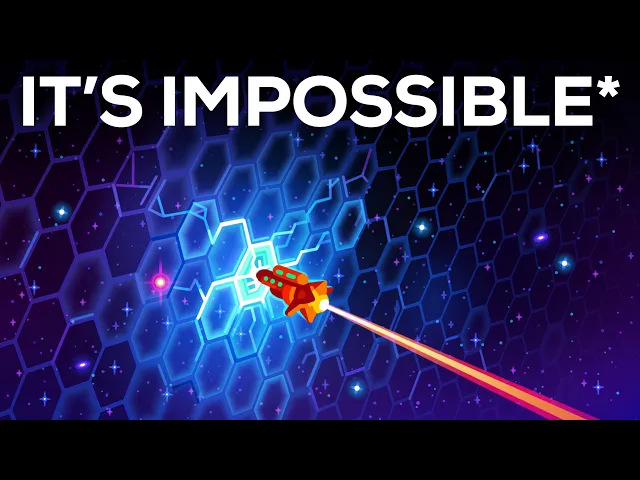
Why Humanity Will Never Leave The Solar System
Kurzgesagt – In a Nutshell
0:00 The latest limited Edition Pin is here.
0:02 Now available on the kurzgesagt Shop.
0:06 You will never leave the solar system.
0:09 Nobody alive today will.
0:11 And maybe no human ever.
0:13 Locked in by an invisible barrier,
0:16 impossible to overcome for carbon based animals like us.
0:20 And not just us– there may be millions of alien civilizations in the universe,
0:25 none of them ever able to venture into deep space in a meaningful way.
0:30 Ok but how can this be?
0:32 We've made countless videos imagining how the exploration of the galaxy
0:36 and beyond should just be a question of time.
0:39 Sort of mandatory for civilizations at a certain point.
0:43 But there is a catch: We are pushing up against fundamental physics.
0:47 What is this barrier, made of dust and nothingness?
0:50 And why is it so hard to overcome?
0:54 You Don’t Understand How Large Space Is.
0:57 We Don’t Either.
0:58 Conceptualizing the size of space is impossible for our ape brains
1:03 that evolved to understand distances like “right here” and “over the next hill”.
1:08 Space is so absurdly huge that we just check out and just hear “very far”.
1:14 “Very far” and “A million times very far” feels the same but it is not.
1:21 To help our brains, let us start with what makes us cross distances: speed.
1:27 The fastest a human ever traveled in space were Astronauts at 40,000 km/h,
1:32 returning from the Moon in 1969.
1:35 Not bad, but way too slow.
1:38 The fastest thing humans have ever built by far is the Parker Solar Probe,
1:42 which at this moment uses a physics cheatcode,
1:45 hurling around the gravity well of Venus, accelerating to get closer to the sun.
1:49 After seven years of doing this, the probe
1:51 is shooting through space at a breathtaking 635,000 km/h.
1:56 Fast enough to go around the world in 4 minutes
1:58 or to cover the distance from Earth to the moon in 36.
2:02 So let’s pretend we had a spaceship that fast,
2:05 with a human crew ready to explore the universe!
2:08 Current rockets would need 7-10 months to reach Mars,
2:11 but our new spaceship covers the distance in just two weeks!
2:15 Pretty good!
2:16 The next stop is Pluto which we will reach
2:19 after about a year– ok much longer, but still ok!
2:22 It only takes two more years to pass
2:24 the heliopause and one more to pass Voyager II,
2:27 which traveled over 50 years to get this far.
2:30 Great!
2:31 The next stop is the end of the Oort cloud,
2:34 the true edge of the solar system where open space begins!
2:38 We reach it in… 2,500 years.
2:42 Oh.
2:43 Oh no.
2:45 Not only did we travel for the amount of time it took
2:47 to get from the founding of the Roman Republic to the present day,
2:50 there is NOTHING out here.
2:52 This is the invisible barrier.
2:54 The barrier of nothingness that might trap us in the solar system forever.
3:00 Space tends to be like that.
3:02 There is a place that is very far away
3:04 but with human ingenuity and billions of dollars we can get there!
3:07 Then you zoom out one more time and all hope leaves your body.
3:11 And the problem is that we have barely started zooming out...
3:14 Why don’t we just go faster?
3:17 Well we don’t know of a non-magic way to travel faster than light,
3:21 teleport or freeze people.
3:22 So no warp drive for now.
3:24 But things like a propulsion system that uses nuclear fusion or antimatter,
3:28 powerful enough to reach a substantial fraction of the speed of light,
3:31 are in the realm of the physically possible.
3:34 Ignoring the technical details and various
3:36 problems that these energy sources have,
3:38 we’ll be very optimistic and make the reasonable assumption that we can
3:41 get a spaceship to fly at around 20% the speed of light!
3:44 Which is extremely fast– 60,000 kilometers per second,
3:49 216 million kilometers per hour.
3:52 Fast enough to reach the edge of the solar system in just
3:55 3.5 days and the outer edge of the Oort cloud in eight years.
3:59 Alpha Centauri, the closest star system to our own in 20 years!
4:04 We can work with that!
4:05 There is only one small problem: We don’t have internet!
4:09 Wait, what?
4:11 Just kidding– but our sponsor Saily can
4:14 help YOU with that problem while travelling.
4:17 Saily is the eSIM service app from the creators of NordVPN.
4:21 You can choose from a wide range
4:23 of affordable eSIM plans for over 200 destinations,
4:25 so you’ll never be without an internet connection while traveling.
4:29 Just download the app, pick a data plan,
4:31 use the code “kurzgesagt” for a 15% discount on your first data package,
4:36 and install the eSIM in advance.
4:38 It’ll activate automatically when you arrive,
4:40 and you can start browsing right away.
4:42 You can also use Saily to feel like a local– it now comes
4:46 with an app-based phone number for voice
4:48 calls and SMS that stays the same everywhere.
4:51 Perfect for local apps,
4:52 shops and travel companions– and to keep your real number private.
4:57 With just one app download,
4:58 you’ve solved your internet problem while traveling once and for all,
5:02 saving time and expensive roaming fees.
5:05 Download Saily and use the code “kurzgesagt”
5:08 at checkout or go to saily.com/kurzgesagt All you have
5:12 to do is pick your next destination– we'll
5:15 go back to solving our trickier travel problems.
5:18 Everything should be sorted out now, right?
5:21 Well..there is only one small issue: Space Hates You:
5:25 The Barrier of Dust Unfortunately we will run into a few obstacles on the way.
5:32 Literally.
5:33 Because while space is very empty, it is not actually empty.
5:38 There are energetic particles, gas, dust and things bigger than dust.
5:43 As a lot of unhappy people experience every day,
5:46 if you are going really fast and smash into something, you have a huge problem.
5:50 And at 20% the speed of light,
5:53 this is true even if the thing you are smashing into is just an atom.
5:57 An individual iron atom that hits your spaceship at this speed has
6:01 enough energy to carve a damage track tenths of a millimeter deep.
6:04 Over time its hull would be riddled
6:06 with microscopic bullet holes, which is not great.
6:09 Of course our engineers knew this and created a shield for our ship.
6:13 A sort of protective sail that absorbs
6:15 or at least slows down most molecules we smash into.
6:19 And while this makes the journey much safer,
6:21 there are things floating around in space that are larger than atoms.
6:24 Running into a single grain of dust at 20%
6:26 the speed of light is like running into a grenade,
6:29 causing a tiny detonation as the dust explosively evaporates,
6:33 grinding away our protective shield.
6:35 But you can also hit something bigger than a grain of dust.
6:38 Like a small rock, the size of a golf ball.
6:41 Hitting that at 20% the speed of light releases more than
6:44 double the energy of the nuclear bomb that was dropped over Hiroshima.
6:48 We’ll not even talk about anything larger.
6:50 Atoms, dust and pebbles are dangerous enough.
6:54 We might have reached our natural speed limit here– besides the fact
6:58 that we don’t have a good idea how we could possibly fly any faster,
7:01 all of the damaging effects of hitting stuff
7:03 floating around in the void get much worse fast.
7:07 Having said all that, it’s probably fair to assume that with enough shielding,
7:10 our spaceship should be able to survive
7:13 traveling through space at roughly 20% the speed
7:15 of light long enough to get to at least
7:18 nearby stars in a reasonable amount of time!
7:21 Only one more issue to overcome!
7:24 Almost Everything in Space that's Close is Super Lame The first
7:30 proper target outside the solar system is the Alpha Centauri System.
7:33 Which is roughly 10,000 years with our original slow,
7:36 more realistic ship but only 20 years with our super fast fictional ship!
7:41 So let’s cram a few unlucky humans into a tiny box for 20 years
7:45 and send them on their way and assume
7:47 they somehow make it without murdering each other!
7:50 Four years after their arrival, their message reaches earth.
7:53 People around the globe gather together and hold their breath,
7:57 eager to listen to it: “We arrived!
8:00 Alpha Centauri and its planets are very pretty up close!
8:04 Unfortunately they are all super deadly and uninhabitable.
8:08 But we are doing extremely cool astrophysics and are learning a LOT,
8:12 which is pretty exciting!
8:13 We are getting kind of tired of freeze dried
8:15 food and desperately need new shows to watch though.
8:18 Not sure what we were thinking coming here…”
8:21 The thing with space is that almost all “close destinations”,
8:25 if close means something different from what it usually means, are pretty lame.
8:30 Not from a scientific perspective of course!
8:32 It would be an absolute dream to have the privilege to set
8:35 foot on foreign planets and marvel at the wonders of our universe!
8:39 But if 20% of the speed of light might be our speed limit,
8:42 and we give humans a realistic travel time of say,
8:44 40 years, we could reach things that are up to 8 light years away.
8:48 None of the targets remotely within this range, within a human lifetime,
8:52 may be worth traveling dozens of years in a tiny box,
8:55 through one of the deadliest environments imaginable.
8:58 Our solar system is a bit unlucky in that regard,
9:00 we are in a relatively empty pocket of the galaxy.
9:03 This might change in a few million years as we move through the galaxy,
9:06 and there might be small,
9:08 localized star spanning civilizations– we discussed this in another video.
9:13 Let’s say that we could go much further,
9:14 to any of the stars within our stellar neighborhood,
9:17 a sphere about 25 lightyears in diameter.
9:20 0.02% of the milky way by the way.
9:23 This tiny bubble is currently inhabited by 34 stars, and 6 brown dwarfs.
9:29 Only three stars in our neighbourhood are similar to the sun.
9:32 But one of them is actually the sun and another one is Alpha Centauri A.
9:37 The other stars close to us are mostly red
9:39 dwarfs with planets that vary from deadly to super deadly.
9:43 There are a few planets in the habitable zones of their stars,
9:46 where water can be liquid.
9:48 But, Mars is also in the habitable zone of the Sun and it is really bad.
9:53 Even the planets that we think look most like Earth,
9:57 like GJ1061 d, come with no guarantees.
10:00 Imagine traveling your entire life and then arriving at a Mars.
10:04 What a brutal letdown that would be.
10:07 There are a few stars that would be interesting targets and may
10:11 have actual habitable planets– planets
10:13 with oceans and atmospheres that are breathable,
10:15 which probably would mean that they have
10:17 some form of microbial life, if not more.
10:20 It would be extremely interesting and definitely worth it to check them out!
10:24 But they could be dozens, if not thousands of light years away.
10:28 Which means journeys of hundreds or thousands of years,
10:30 even at a large fraction of the speed of light.
10:34 Of course it is maybe feasible that a future humanity that is
10:37 technologically way more advanced than us
10:39 and very motivated could find solutions.
10:42 Maybe they have solved biological aging and a travel time
10:45 of a few hundred years doesn't seem that bad to them.
10:48 Maybe they could send AI spaceships with embryos
10:51 or some version of that into space.
10:53 They would probably have way more advanced telescopes to make
10:56 sure they don’t choose star systems that are deadly and empty.
10:59 But it is still hard to imagine without real science fiction technology,
11:03 how they could build and sustain a connected civilization.
11:07 Conclusion The longer you think about deep space, the less it makes sense.
11:12 The distances are too vast,
11:14 there is a deadly speed limit and even if we could solve
11:17 these issues almost all destinations even remotely
11:20 reachable may not be worth the trip.
11:23 Space is the greatest challenge humanity will ever face.
11:27 Right now we are just not equipped or able to solve it.
11:30 Rockets, computers and even nuclear fusion reactors are hopelessly underpowered.
11:35 We need technology that is overwhelmingly transformative.
11:39 Something as wild to us as flying
11:41 to the moon would have been to a hunter gatherer.
11:44 Will we ever get there?
11:45 We genuinely don’t know.
11:48 But it is good to remind yourself of something:
11:50 there are few things that make you
11:52 look dumber than predicting the future of technology.
11:55 In 1903 the New York Times published an editorial,
11:58 "Flying Machines Which Do Not Fly” that confidently predicted it would
12:02 take humans one to ten million years to achieve powered flight.
12:06 69 days later the first successful flight happened.
12:11 66 years later humans landed on the moon.
12:14 So we really hope this video will seem
12:17 as dumb as this article in a hundred years.
12:20 And there is another option entirely– maybe
12:23 our thinking about all this is just completely wrong.
12:25 Maybe the future is not out there,
12:28 but deep down– but we’ll explore that in another video… The latest LTD.
12:35 Edition Pin is here, continuing the Cosmic Time Collection.
12:39 Predicting the future is really hard.
12:41 But this device offers you a rare glimpse into the end of the Universe.
12:45 Spoiler: one by one, all the stars will die,
12:48 until everything is swallowed by darkness.
12:51 Wear this animated, lenticular pin as a reminder that you exist right now,
12:56 in a brief and extraordinary moment in time when the Universe is still
12:59 filled with stars and light and there is so much left to discover.
13:03 You are exactly where you belong in cosmic time and the Universe.
13:07 Only 10,000 Vanishing Stars Pins exist, and each one is individually numbered.
13:12 Add it to your collection, or start a new one while supplies last.
13:16 And while humanity may still be confined to a tiny corner of the cosmos,
13:20 we've already achieved some remarkable things.
13:23 To celebrate these milestones,
13:25 we created our Cosmic Milestones Poster Collection,
13:27 featuring the first Moon landing,
13:29 the Mars rover Curiosity, and the Wilson Observatory,
13:32 all enhanced with shimmering foil details.
13:35 Get your favorite, or better,
13:36 all of them and create a gallery wall that will inspire
13:40 you every day and remind you of what humanity is capable of.
13:44 Head over to our shop, we’ve put together a few deals for you– get
13:48 your special piece of kurzgesagt and the cosmos now.