A Hidden Antarctic Tipping Point May Have Just Been Triggered
PBS Terra
0:00 A tipping point that scientists didn't even know
0:02 about may have just been crossed in Antarctica.
0:05 I'm not sure if I can communicate how important this change is,
0:09 but stay with me because I'm gonna try.
0:12 After we began observing the earth from space in the 1970s,
0:16 researchers noticed something strange in the Arctic Sea ice
0:20 declined just like you'd expect on a warming planet.
0:23 Scary but predictable.
0:24 But in Antarctica, the sea ice was growing, the pattern held for decades.
0:31 But then around 2015, everything changed,
0:34 and Arctic sea ice suddenly fell off a cliff leaving scientists dumbfounded.
0:39 In a matter of months, we saw a massive decline,
0:41 roughly one to two times the size of Greenland.
0:44 This fast of a trend reversal is extremely rare in nature,
0:48 especially at this scale.
0:50 Then it happened again.
0:53 It got to seven standard deviations.
0:55 At that point, it's just dumb, right?
0:56 If you do the numbers, it's one in 700 billion.
0:59 So now the question becomes, is this change permanent?
1:02 This matters because Antarctic sea ice helps
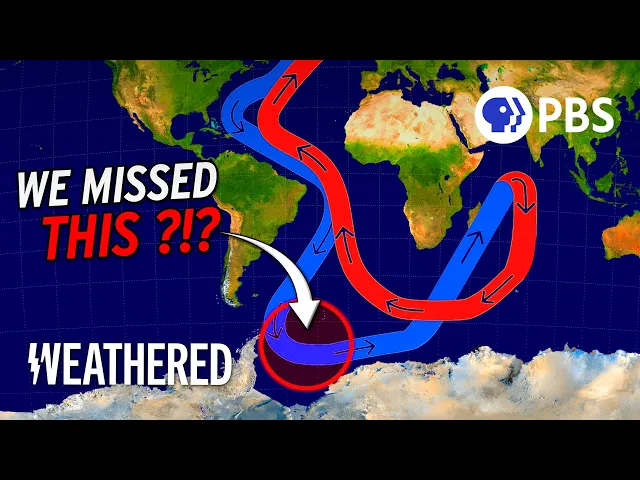
1:05 drive the planet's overturning circulation, including the Amoc,
1:08 which is the planet's largest heat transfer system,
1:11 and it regulates global weather.
1:13 Massive loss of sea ice will slow this system down, speed up,
1:17 sea level rise, and warm the planet far faster than currently predicted.
1:22 And to understand if this is permanent,
1:24 first we need to understand why it crashed
1:27 and why it was even growing in the first place.
1:29 Let's find out.
1:35 Before we go any further,
1:37 I just wanna thank everyone who's joined our Patreon or purchased merch.
1:41 Your support really helps us,
1:43 so please click the link in the description and join us.
1:46 Bottom water formation has to be one
1:49 of the least interesting scientific terms ever invented,
1:52 but it is also one of the most important for understanding
1:56 this story and quite literally the fate of the planet.
1:59 So, here goes.
2:00 Around Antarctica in the Southern ocean.
2:03 When sea water freezes into sea ice,
2:05 most of the salt gets left behind In the surrounding ocean water,-
2:10 Extra salty brine is actually rejected from the bottom of the sea ice.
2:13 When the sea ice is freezing and this really dense heavy water,
2:16 it circulates around the shelf around Antarctica,
2:18 and some of it sinks into the deep
2:20 ocean and it forms this deep ocean circulation.
2:22 And this is really important for the global ocean circulation,
2:25 how the oceans distribute oxygen and nutrients and uptake heat and carbon.
2:29 And so sea ice is important in this ocean functioning,
2:32 which is also important for our global climate.
2:34 And then there's sea level rise,
2:35 which sea ice protects against in two major ways.
2:39 The first is something called the albedo effect,
2:42 or how much sunlight a surface reflects back into space.
2:45 Bright sea ice acts like a mirror reflecting a lot of the incoming solar energy.
2:50 Dark ocean water absorbs much more of that energy
2:53 on the other side of the world.
2:55 Near the North Pole, Arctic sea ice has been declining for decades,
2:59 meaning it has less albedo or reflectivity.
3:02 As a result, the Arctic is warming four times faster than the global average.
3:07 Four times.
3:08 That's incredibly significant.
3:10 This extreme warming is called arctic amplification,
3:14 and we haven't seen nearly as much
3:16 of this amplification around the South Pole yet,
3:21 if these recent losses in sea ice around the South Pole are in fact
3:25 the new normal and begin to look anything like it has at the North Pole,
3:29 this is going to change.
3:30 And extreme disproportionate warming at the South
3:33 Pole is especially bad because that's
3:35 where the vast majority of Earth's ice sheets and sea level rise, potential lie.
3:43 The second way sea ice protects against sea level rise
3:46 is by acting as a buffer for Antarctica's ice shelves.
3:50 It physically protects the Antarctic coast and the ice shelves.
3:53 So when waves travel through sea ice, they're damped.
3:55 This means that they can't impart their energy on the ice shelves.
4:00 But when sea ice is absent waves,
4:02 they break on the ice shelves and they can break
4:04 up the ice shelves faster than they other otherwise would.
4:07 Once we have these ice shelves collapsing,
4:09 this means that the Antarctic ice sheet, the ice that sits on the continent,
4:13 can slide into the oceans faster, and this will raise global sea levels.
4:20 So for all of these reasons,
4:22 it was great news when Antarctic sea ice hit a record high in 2015,
4:27 even as the world and the Southern Ocean grew warmer.
4:31 Then all over the sudden, in a matter of months,
4:34 we saw a massive decline, roughly one to two times the size of Greenland.
4:38 So it's a very large change in the ice coverage, completely unexpected.
4:41 There was a discussion about what if
4:43 the satellite data are for some reason not correct,-
4:47 The sea ice remained low through the next
4:49 few years before slightly rebounding in 2020 and 2021.
4:54 We thought, okay, maybe that was kind of an extreme event,
4:57 and then things are going back to normal.
4:59 But instead around 2022, we saw another big decline.
5:03 This collapse was catastrophic for the emperor penguin population.
5:07 The sea ice broke up in 2022 before the babies were ready to swim.
5:12 Nearly 10,000 died leading to the species to be listed as threatened.
5:17 So why did the ice grow in the first place and why the sudden crash?
5:21 Well, a decade after the first crash, scientists think they have an answer.
5:26 Ocean water is usually layered or stratified in a pretty intuitive way.
5:31 The sun warms the surface and colder, denser water sits below,
5:35 but around the poles that layering flips
5:38 because the extremely cold air freezes the surface,
5:41 while the water underneath remains warmer
5:43 and closer to the ocean's average temperature,
5:46 this layering is only possible because the surface
5:49 water is less salty than the warmer water underneath.
5:53 We've been observing that this two layer system strengthened for decades,
5:57 so we had colder and fresher surface waters and warming at depth.
6:02 In that sort of scenario, these two layers tend to be kind of separated,
6:06 and therefore the heat that is stored at depth
6:09 cannot really reach the surface where there is ice.
6:11 During this staple two layer era, the prevailing winds around Antarctica
6:16 called the Westerlies strengthened as well.
6:18 These winds pushed Antarctica's coldest surface
6:21 water northward into the open ocean, which promoted sea ice formation.
6:26 And as the fresh water cap blocked heat from the warm water below,
6:29 sea ice reached a record high.
6:32 Then in 2016, the rising water temperature
6:36 below the surface finally combined with changing wind
6:39 patterns and ocean currents to mix the deeper
6:42 warmer salt water with the colder surface water.
6:45 So similar to the sea ice decline,
6:47 we see an increase in salinity at the surface of the ocean.
6:50 Meaning the cold fresh water cap was disrupted preventing ice formation,
6:55 which allowed more solar heating of the surface water,
6:58 which melted more ice, which allowed still more solar heating.
7:02 This feedback loop led to such a dramatic loss of sea
7:06 ice in 2023 that it appeared to be statistically impossible.
7:10 It got to seven standard deviations.
7:12 At that point it's just dumb, right?
7:14 If you do the numbers, it's one in 700 billion.
7:17 Now that scientists had a good idea of what caused this feedback loop.
7:21 The question became was this just an incredible
7:24 anomaly or something more fundamental and long lasting?
7:28 Ed and his team turned to a large computer model to find out.
7:33 We ran it from about the 1950s through
7:35 to the modern day just a couple of years ago.
7:39 And we looked at the relationship between summer sea ice and ocean temperature.
7:43 And then what we did is we imposed a massive loss
7:46 of ice on that to mimic the 2017 record low summer.
7:50 And that's when things began to click.
7:52 When you force an extreme summer ice loss,
7:55 the model shows the ocean holding onto extra heat.
7:58 So the following winter sea ice has a harder time bouncing back.
8:02 This creates a compounding effect from one year to the next.
8:05 And that persistence very likely explains the second extreme drop in 2022.
8:12 So it has gone low and it has stayed ridiculously low,
8:16 which I mean four years in, it's kind of hard to say it's a blip, right?
8:19 This, this looks like the change is here to stay.
8:24 So all signs point to this extreme drop
8:26 of sea ice being a tipping point for Antarctica.
8:30 Now that it's been triggered,
8:32 researchers believe that the change is likely permanent.
8:36 The response to an extreme loss of sea ice
8:38 is not just the normal response made a bit bigger,
8:42 but it is structurally different.
8:45 Once you've put heat into the ocean, it's really difficult to get that heat out.
8:49 The ocean holds onto it, and the ocean is gonna continue to take up heat.
8:53 And so because of that, our understanding of that process and that mechanism,
8:57 I don't see a way that the Antarctic sea ice is gonna bounce back from that.
9:05 The Southern ocean has likely tipped into a feedback
9:08 loop of warming that will continue for centuries.
9:11 So what does that mean for us and the natural world?
9:15 Well, it probably means we will lose most emperor penguins.
9:18 And as we mentioned earlier,
9:20 it also means a slowdown in our planet's circulatory system,
9:24 including the Amoc, which is the ocean's
9:27 largest heat transfer system and its sibling.
9:29 The Antarctic overturning circulation,
9:32 which models suggests could slow by around 40% as soon as 2050.
9:37 And as Ariaan mentioned earlier,
9:39 sea ice protects Antarctics ice shelves from waves,
9:42 which slowly chip away at them leading to faster sea level rise.
9:47 So that's bad news, but it's really bad because we don't actually incorporate
9:51 that effect in our climate models that we use to predict sea level rise.
9:55 So we're almost certainly under predicting how fast sea levels will
9:59 rise using these models because we're not accounting for that impact.
10:03 There have been multiple studies coming out in the last
10:06 few years suggesting that we have already passed,
10:09 or we are super, super close to the points of no
10:12 return for multiple different bits of the Antarctic ice sheet.
10:15 So then the question becomes how quickly is it gonna melt?
10:17 And this question, as well as methods
10:19 to adapt are what researchers are currently studying,
10:22 which is why funding for scientific research is
10:25 crucial because the choices we make now still matter.
10:29 They can slow the pace of change and buy us time to adapt.
10:34 Climate doomerism is already a problem.
10:36 That's like saying, oh, well I've, I've injured my arm,
10:39 so I might as well just chop it off, right?
10:41 That's not helpful because we know that the more we warm,
10:45 the faster these things come.
10:47 The more sea level rise, there will be, the faster ecosystems will collapse.
10:52 But the converse of that is that we can warm less quickly, we can slow it down.
10:57 We can have sea level rise that happens more slowly.
11:00 We can have ecosystems collapsing more slowly
11:03 and that gives us time to save them.
11:06 And that's really important.
11:09 I wanna give a huge thank you to our Cat five Patreon members right here.
11:13 If you wanna go deeper,
11:15 we've got extra interviews and behind the scenes on our Patreon.
11:18 And if you found this video helpful, like,
11:21 subscribe and let us know what questions you want us to chase next.
11:25 We'll see you next time.