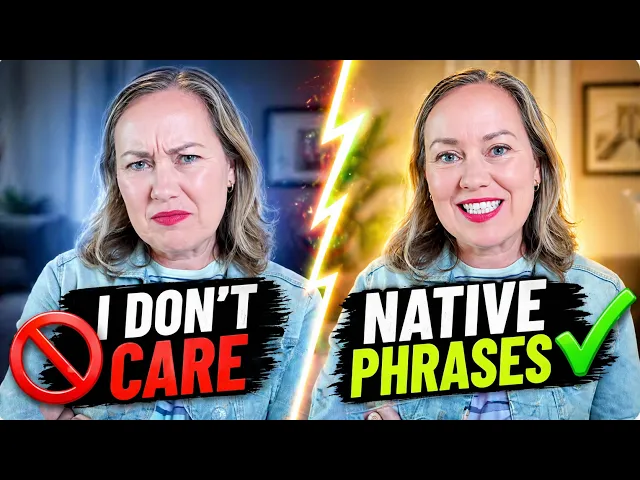
Stop Saying “I Don’t Care” — Use These Fluent Phrases!
Go Natural English - Real Life English with Gabby
0:00 Have you ever said, don't care in English
0:03 and suddenly the conversation felt really awkward?
0:06 Yeah, that's because in English,
0:09 I don't care can sound cold, dismissive or even rude.
0:14 But here's the deeper problem.
0:16 You're translating your thoughts directly instead
0:18 of thinking in English like a native speaker.
0:22 Native speakers don't usually think, I don't care.
0:27 Instead, they think, more specifically.
0:31 This isn't my responsibility.
0:33 I don't know enough about that.
0:35 That's not my role.
0:36 That's not my interest.
0:38 And I'm going to teach you some more idiomatic phrases that we
0:44 use in everyday real life conversation instead of I don't care.
0:49 So today I'll teach you to think
0:52 in English more precisely so you sound more natural,
0:56 polite, confident, and of course, fluent.
0:58 And a quick note, I made a free PDF
1:03 study guide for this lesson with all the phrases,
1:07 example sentences, and a practice session.
1:10 You can download it below.
1:12 The link is in the description and the pinned comment.
1:16 And practice these until they feel automatic.
1:19 And a quick tip, if you're serious about thinking in English, don't just watch.
1:24 Write these phrases down.
1:26 Use the PDF.
1:27 You can download it.
1:28 print it off, and you can also use a small notebook
1:33 just for expressions like this so you can review them daily.
1:37 I'm going to link to one of my favorite notebooks
1:40 that I recommend if you'd like to check it out.
1:43 Okay, let's start with the first phrase, one of my favorites.
1:48 It comes from baseball.
1:49 So if you're a baseball fan, this is a fun one.
1:53 It's out of my league, like a baseball league.
1:57 You know, we have an amateur and a professional league.
2:01 So if we're talking about something that is a little too advanced for us,
2:05 we would say it's out of my league.
2:08 And we can say this jokingly, but it basically means that something is
2:14 too advanced or beyond your knowledge or experience.
2:17 And I thought of this phrase this morning while I
2:20 was walking my dog with my neighbor and his dog.
2:23 So we were out walking around and he
2:27 told me that his sister just became an attorney.
2:31 She just passed the bar exam,
2:34 which is a difficult test that makes you officially able to practice law.
2:40 So he then said, I don't really know how all that works.
2:45 It's out of my league.
2:46 And I thought that's a great phrase to talk about with you.
2:51 So he said, Honestly, that's out of my league.
2:56 I don't really understand how all that works.
3:00 This is humble, natural, slightly informal.
3:04 So whenever you feel like something is a bit beyond what you know,
3:10 you can use this phrase.
3:12 It's out of my league.
3:14 And it can be used like kind of jokingly too.
3:17 Or if you just don't want to talk about something,
3:20 it's also a good phrase to know.
3:22 Okay, another one that's above my pay grade.
3:27 I also used this phrase this morning and I couldn't wait to share it with you.
3:32 So I was talking to my neighbor and he told me
3:36 that his boss wants him to start taking clients out to lunch,
3:41 but he's not in sales or marketing.
3:43 He's an engineer.
3:45 So I said, that's kind of outside your job description.
3:50 And he said, yeah, it's way above my pay grade.
3:54 Meaning it's not part of his expected work.
3:58 So he doesn't really want to do it.
4:02 It's not part of his job and he's not a very social person.
4:07 So he said, yeah, it's above my pay grade.
4:12 It's a professional phrase, slightly playful and very natural.
4:17 Another one that's used at work.
4:20 or in professional situations a lot is, it's out of my wheelhouse.
4:25 This is another idiom that comes from baseball.
4:29 A wheelhouse is the zone where you can hit the best.
4:34 So if something is out of your wheelhouse, it's not where you perform best.
4:40 So out of my wheelhouse means it's not
4:43 your area of expertise or something you're comfortable with.
4:46 For example, technical SEO.
4:49 is kind of out of my wheelhouse.
4:52 I focus more on content strategy.
4:56 Another one.
4:57 It's not my strong suit.
5:00 And by the way, if you're just listening, stop, repeat after me.
5:06 After I say these phrases, you're going to learn so much faster.
5:10 You're going to remember more if you repeat them after me.
5:13 So if you haven't been repeating,
5:16 be sure to go back and repeat these phrases along.
5:19 with me.
5:20 It's also a good idea to write them down as I mentioned before.
5:24 So let's practice your pronunciation.
5:26 Let's practice your speaking together.
5:28 And let's say this one again.
5:29 Ready?
5:30 It's not my strong suit.
5:32 So this means it's not something you're especially good at.
5:35 For example, public speaking in large groups isn't my strong suit.
5:41 I prefer smaller conversations.
5:44 It's honest, humble, very natural.
5:47 By the way, Maybe you can see this microphone here.
5:51 I wanted to tell you,
5:54 I recently got the Shure MV7 Plus microphone and I love it.
5:59 It's really been helping me to create the Private Fluency podcast,
6:04 which uh you can listen to if you go to gne.supercast.com.
6:09 I'll also add that link in the description and the pinned comment.
6:13 And I'm really excited because...
6:15 I'm gonna add another microphone for guests to have conversational lessons.
6:20 And I got this pod track.
6:22 This is where I plug both microphones in and mix them.
6:25 I guess this is a little mixer.
6:27 I'm learning a lot, technologically speaking.
6:30 This used to be out of my wheelhouse,
6:33 but no more, no longer, because I'm learning.
6:36 I'm educating myself about how to video podcast with two people or more.
6:42 And if you're interested,
6:43 I'll link to this as well if you're interested in creating content.
6:47 Okay, I have more phrases for you.
6:49 Are you ready?
6:51 That's not really my area, meaning not your expertise.
6:56 I work in marketing, so finance stuff isn't really my area.
7:01 I'm not involved in that, meaning you're not part of the situation.
7:06 For example, I'm not involved in that project, so I don't have the details.
7:12 That's outside my scope, meaning it's not part of your role.
7:17 For example, hiring decisions are outside my scope.
7:22 That's not my call, meaning not your decision.
7:26 To be your call means your decision.
7:29 So this is a really good one to know.
7:31 It's very common.
7:32 For example, whether we approve this, that's not my call.
7:36 Next, I'm not the right person to ask, meaning someone else knows better.
7:42 For example, I'm not the right person to ask about legal stuff.
7:45 I'm not a lawyer.
7:47 That's not really my thing, meaning it's not your interest.
7:52 This is much better than saying you don't care about something.
7:55 That's not really my thing.
7:57 Another bonus phrase that's even more idiomatic is that's not my cup of tea.
8:03 I learned when I was living in Brazil
8:07 that the equivalent phrase is it's not my beach.
8:10 Nãoé minha praia if you speak Portuguese, please correct me if I'm wrong,
8:16 but I thought that was really cute sometimes We have
8:20 the same meaning in totally different idiomatic phrases like you can't
8:25 translate directly and that's why it's so important to remember
8:29 these phrases and not Translate in your head from your first language.
8:34 Okay moving on I don't have much insight into that Meaning,
8:40 you don't know enough to comment.
8:42 I don't have much insight into that decision.
8:47 I can't really speak to that.
8:49 Meaning, you're not qualified to give an opinion.
8:52 I can't really speak to that.
8:54 I wasn't there.
8:55 I wasn't in the meeting.
8:58 That's a bit beyond me.
9:00 It's slightly too complex.
9:02 All the technical details are a bit beyond me.
9:06 I'll have to defer to someone else on that.
9:09 you're passing it to another person.
9:12 For example, I'll have to defer to the legal team on that.
9:17 So remember, when you say, don't care,
9:20 it doesn't mean what you think it might mean.
9:24 We really only specifically use, I don't care if something is truly unimportant
9:31 and we don't really want to talk about it.
9:35 It sounds...
9:37 It can sound rude.
9:38 So be careful using this phrase.
9:42 It can sound like saying, isn't important.
9:44 This is a waste of time or stop talking.
9:48 Yes, saying I don't care actually conveys
9:51 these very kind of strong and negative meanings.
9:55 So be careful because most of the time that's not what you mean.
9:58 So instead of translating, don't care from your native language,
10:03 pause and think, what do I really mean?
10:06 It's not my job.
10:07 It's not my expertise, not my interest.
10:11 Then choose the exact phrase.
10:14 And that's how you start thinking in English
10:17 is thinking how natives really use the language,
10:20 not how you would translate from your mother tongue.
10:24 All right.
10:24 Now it's your turn.
10:26 In the comments, complete the sentence.
10:29 When it comes to fill in the blank, I usually say fill in the blank.
10:35 For example, when it comes to investing,
10:38 I usually say, that's not really my area.
10:41 Or when it comes to the law, that's outside my wheelhouse.
10:47 So you can practice more than one of these phrases in the comments.
10:50 Be sure to subscribe to get new lessons every week here.
10:55 And remember to get your free PDF download to study along with me.
10:59 Remember, the goal isn't just to speak English,
11:02 it's to think in English like a native speaker.
11:05 and small shifts like this using the right idiomatic phrases,
11:09 they completely change how people experience you.
11:13 Thanks so much for watching and I'll see you next time.
11:15 Bye for now.