The Truth About Quantum Computers | What the Physics?!
NOVA PBS Official
0:00 - It's bold.
0:01 It's weird.
0:03 And it could change pretty much everything.
0:06 I'm talking about quantum computing.
0:08 For decades, the tech world has been trying
0:11 and kinda failing
0:12 to figure out how to actually make quantum computers
0:14 live up to the hype.
0:16 Until early 2025
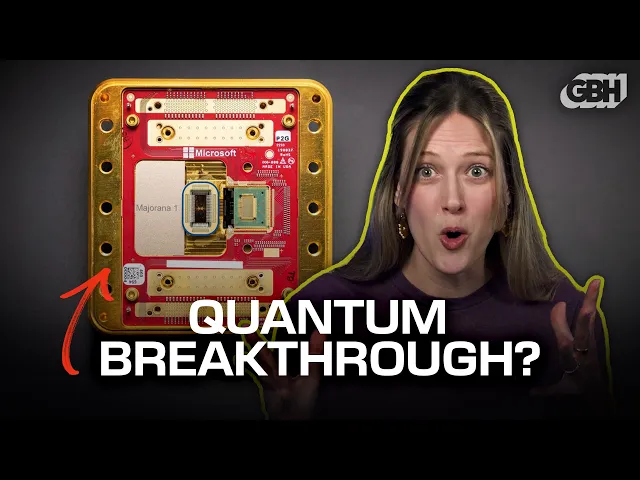
0:19 when Microsoft announced they'd cracked it.
0:21 They say the key is hiding in
0:23 some of the strangest particles in the universe,
0:27 majoranas.
0:28 Tiny, ghostlike quantum entities
0:31 that are their own antiparticles.
0:34 If they're right, Microsoft is closer than ever
0:36 to a massive breakthrough.
0:38 But what makes them so confident now?
0:39 And why has quantum computing been so hard to get right?
0:45 To understand quantum computing,
0:46 first we need to understand what quantum computers are,
0:50 exactly what problem Microsoft was trying to solve,
0:53 and why this is all such a big deal.
0:55 And stick with me,
0:56 because we're going quantum here,
0:58 and any time we do that, things can get a little spooky.
1:03 See, quantum computing is a field
1:05 within computer science and engineering
1:07 that pulls from quantum mechanics,
1:09 the physics of matter and energy
1:11 at the atomic and subatomic level.
1:14 One of the strange properties of physics
1:16 at the quantum scale is superposition,
1:19 the idea that particles can exist
1:20 in two or more states at once,
1:23 like a top spinning clockwise and counterclockwise
1:26 at the same time.
1:28 I told you, spooky.
1:30 The idea is to use these strange laws of quantum mechanics
1:33 to build computers that can quickly solve
1:35 really complex problems.
1:37 Take data encryption,
1:39 which is used to keep information secure.
1:41 Right now, online data encryption uses a lot of math
1:45 to send information that can easily be understood
1:47 by the intended recipient,
1:49 but not by anyone else.
1:51 At the most fundamental level,
1:53 online encryption relies on multiplying
1:55 two large prime numbers together,
1:57 making a new, incredibly large number.
2:00 Without any additional information,
2:02 it can take a lot of computing power
2:04 and a really long time
2:05 to figure out those first two prime numbers.
2:08 Which makes this method pretty secure
2:10 for traditional computers.
2:11 See, from your personal laptop
2:13 to the world's biggest supercomputer,
2:15 traditional computers are based on classical physics,
2:18 and they use electrical impulses
2:20 that code information in a binary way,
2:22 using either 0 or 1, which are bits.
2:26 But the limits of binary
2:28 and possibilities of problems like overheating
2:31 mean there will be some problems
2:33 traditional computers simply don't have enough power
2:36 or enough time to solve.
2:38 Quantum computers, on the other hand,
2:40 compute in a whole different way.
2:42 Instead of bits they use quantum bits called qubits,
2:46 which can be zero or one or both
2:49 or anything in between.
2:51 Because qubits can be more things at once,
2:53 they can find and compare possible solutions
2:55 to some problems
2:57 much more quickly than a traditional computer.
3:00 But we don't fully have quantum computers yet
3:02 because qubits are really sensitive
3:04 to their surrounding environment,
3:06 making them susceptible to decoherence.
3:09 Basically, the qubits can lose their quantum state.
3:12 They become damaged, losing information
3:15 and making errors.
3:16 The more qubits you add to a chip,
3:18 the more powerful the computer will be,
3:21 but the more likely it is
3:22 for the qubits to lose their state and make errors.
3:26 So that's the problem the tech world
3:27 has been grappling with for decades.
3:30 How to avoid decoherence
3:31 and make a quantum computer that's reliable
3:34 and practical at scale.
3:36 And tech companies have tried a few different methods
3:38 for solving this problem.
3:40 IBM and Google have both built quantum computers
3:42 using superconducting materials to create qubits,
3:45 and the Canadian company Xanadu
3:47 has made a quantum computer that uses photons,
3:50 particles of light, to create qubits.
3:53 But neither of these methods
3:54 is completely reliable or scalable.
3:57 That's because superconducting quantum computers
4:00 need to be kept super cold,
4:02 and photons are really easy to lose
4:04 and really hard to manipulate.
4:07 So Microsoft is working on another approach,
4:09 topological qubits,
4:11 which use special particles called Majorana fermions.
4:15 In particle physics,
4:16 the idea is that somewhere out there,
4:18 most particles should have a corresponding antiparticle,
4:22 which has the same mass,
4:23 but with an opposite charge.
4:25 And if a particle meets its antiparticle,
4:28 boom, it's over for them both.
4:30 But Majoranas are particles
4:32 that are also their own antiparticles,
4:34 meaning if they met, they might annihilate each other,
4:38 or they might not.
4:39 They can exist in two states.
4:41 In theory, anyway.
4:42 No one's ever been able to actually use Majoranas.
4:46 Until now.
4:47 Microsoft claimed not only had they observed Majoranas,
4:50 they also figured out how to control them.
4:52 And they said they'd be able to use them
4:54 to build reliable qubits
4:56 that would be able to hold up
4:57 in ways that other qubits can't.
4:59 This breakthrough would provide a much faster pathway
5:01 to quantum computing at a much larger scale
5:04 than anyone else has been able to achieve.
5:07 Microsoft was faced with an avalanche of skepticism.
5:10 And as of filming,
5:11 the data hasn't firmly established everything they claimed.
5:15 But some are optimistic
5:16 that Microsoft can improve its chip
5:18 and provide the breakthrough
5:20 the industry has been waiting for.
5:22 If they do, the whole world will change fast
5:25 as we gain the ability to solve all kinds of problems
5:28 we can't currently fully explore.
5:30 For example, we might be able to create
5:32 computer simulations of our world,
5:34 down to the molecular level.
5:36 That would open the door for incredible breakthroughs
5:38 in chemistry and medicine.
5:40 Or we could develop new battery technology,
5:43 which could be key for mitigating climate change.
5:46 But quantum computing could also open up new problems.
5:49 Remember how it could take traditional computers
5:51 a really long time to access encrypted data?
5:54 Quantum computers would have access to
5:56 all of our private information within minutes.
5:59 That means whoever cracks quantum computing
6:01 on a large scale first
6:03 could get really powerful, really fast.
6:06 The field of quantum computing
6:08 holds fascinating and exciting possibilities
6:10 for science and technology,
6:13 but it also opens new questions for all of us to consider.
6:17 Can we build these powerful new machines?
6:19 And if we can, what will it look like
6:22 to wield that kind of technological power responsibly?
6:28 (gentle music)