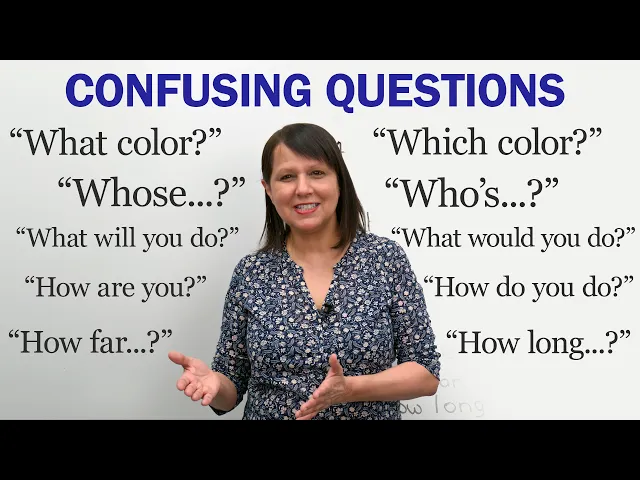
12 Confusing English QUESTIONS
Learn English with Rebecca · engVid
0:00 Do English questions confuse you? That's because
0:03 they can be confusing. So, in this lesson,
0:07 we will look at 12 different questions in English, very common questions, which sound
0:14 similar and often are similar, but the meaning
0:18 is very different. So, let's see if you know
0:22 the difference, and by the end of this lesson,
0:24 you will be able to ask questions correctly
0:27 and more confidently. All right? So, let's get started.
0:32 So, these are actually six pairs of questions.
0:37 So, let's look at the first two. So, I'm going
0:43 to read it for you. Listen, tell me if you know what the difference is, if there is a
0:48 difference, and so on. Okay? Number one, "How
0:55 are you?" Number two, "How do you do?" So,
1:02 there is a difference between these two questions.
1:05 Do you know what it is? Which one do you use
1:08 most often? And which one do you use for what
1:12 purpose? Okay? All right. So, this is the
1:16 difference. Let me start with the second one.
1:19 "How do you do?" is only used the first time you
1:23 meet someone. So, for example, when you're introduced to someone in a slightly formal
1:29 context, and also perhaps more in England and so
1:33 on, then people say, you know, "Hello, my name is
1:36 so-and-so. How do you do?" And the answer to "How
1:41 do you do?" is "How do you do?" So, you don't
1:44 actually... You're not asking the first one, "How
1:48 are you?" You're just saying, "How do you do?"
1:51 "How do you do?" This is what the two people say,
1:54 and all they're saying is it's like it's nice to
1:57 meet you. Okay? Because it's only used the first
2:01 time you meet a person. After that, you don't say
2:05 "How do you do?" again. After that, you say the
2:09 first one, if you meet that person or anyone.
2:12 Just say, "Hi, John. How are you?" "Hi, Mary.
2:16 How are you?" Okay? So that question, actually,
2:20 is answered. All right? Whereas this one is "How
2:23 do you do? How do you do?" The first one is if
2:26 someone says, "Hey, John. How are you?" And so John
2:29 will say, depending on the relationship and how
2:32 formal it is, John will say, "Oh, fine. Good.
2:36 Great. So-so. Excellent." Whatever John is feeling
2:40 that day. Okay? So there, you are looking for an
2:43 answer, and after you give your answer, usually,
2:46 you switch it around and you say, "I'm great.
2:49 How are you?" Or, "I'm great. How about you?" Or,
2:52 "And you?" Okay? So, "How are you?" is really
2:56 asking how you are, and "How do you do?" is just
3:00 something formal that we say when we're introduced
3:03 to someone the first time, not after that. All
3:07 right? Now, in spite of what I've said, in North
3:10 America, we tend to not use the "How do you do?"
3:13 so much, and even the first time we're introduced
3:16 to someone, we might just say, "Hello. I'm John.
3:19 How are you?" Okay? So keep that in mind.
3:22 Next, let's look at the next pair of questions.
3:27 So here, I've written color, but really, the
3:31 question is, do we say... When do we say "what",
3:35 and when do we say "which"? Okay? So let's look at this example. If I were to ask you,
3:42 "What color do you like?" or "Which color do
3:46 you like?" What's the difference? Is there any
3:50 difference? There is, actually. So if I say,
3:55 "What color do you like?" I'm just saying,
3:59 out of all the colors in the world, all the
4:02 beautiful colors, which is your favorite? Which
4:05 one do you like? Okay? So out of all the colors,
4:09 what color do you like? It's not a specific
4:11 choice; it's just wide open. Here, with "Which
4:15 color do you like?" So maybe I have a red marker
4:19 and a blue marker, and I say, "Which color do you
4:22 prefer? Which color do you like, red or blue?"
4:26 Okay? So there, we have a choice. It doesn't
4:29 have to be only two; it could be three, or five,
4:33 or seven, but it's a limited choice. Okay? So
4:37 for example, if I ask you, "What kind of music
4:41 do you like?" Okay? I don't know you at all, so
4:44 out of all the different kinds of music in the
4:47 world, what kind of music do you like? What?
4:51 What kind? Okay? Or I could ask you, "Which kind
4:56 of music do you prefer, rock or jazz?" Okay?
5:00 Now it's out of a limited choice. Got it? Okay.
5:05 So as I said here, you could actually say
5:08 anything, like, "What kind of books do you like
5:11 to read?" or "Which book do you prefer, this one
5:14 or that one?" "What kind of movies do you like?"
5:18 or "Which kind of movies do you prefer?" Okay?
5:21 So keep that in mind. Next, we come to this one,
5:25 which is really important and actually leads to
5:29 lots of mistakes. So what is the difference if I
5:33 say - if I start a question with "How much?"
5:36 or if I start a question with "How many?"
5:41 Which one do you choose and why? So, this has to
5:46 do with a point of grammar, which has to do with
5:51 the countable or uncountable nouns. Okay? What
5:56 does that mean? So for example, "How much time
6:01 do you have?" Uncountable. In English, "time", the word "time" is uncountable.
6:07 But, "How many hours do you have?" Okay? "How
6:10 much time do you have before your flight?"
6:14 or "How many hours before your flight?" So
6:17 "time" is an example of an uncountable noun,
6:21 and "hours" is an example of a countable noun.
6:25 All right? Or, for example, "At the airport",
6:29 again, they may ask you, "How much luggage do
6:33 you have?" "Luggage" is uncountable, so we say,
6:37 "How much luggage?" But they may ask you, "How
6:42 many suitcases do you have?" Okay? They're talking
6:47 about the same thing, but "luggage", they're
6:50 talking about overall. Okay? It's like a category.
6:53 And "how many" is the individual pieces. So
6:56 "how many" is always used when you can count
7:00 whatever you're talking about. So let's say you
7:03 go into a coffee shop where you can also buy
7:06 coffee in bulk. Okay? You can buy it in
7:09 quantities. So, "How much coffee would you like?"
7:12 Half a kilo, one kilo. Okay? Quantity-wise.
7:16 Or, "How many bags of coffee would you like?"
7:20 "How many cups of coffee?" We can count the
7:24 bags, we can count the cups, right? Similarly,
7:28 "How much information is needed?" Or, "How many reports?" You see? Information,
7:37 uncountable; reports, countable. All right?
7:41 And the uncountable nouns are always singular.
7:46 All right? Now, I have a special lesson on
7:49 those... On that particular point about countable
7:52 and uncountable, and also about some of these,
7:55 and I will give you the links to those lessons
7:58 if you want to get a better understanding of
8:01 that particular point. This one in particular
8:04 could lead to a lot of very basic mistakes. Okay? So be careful.
8:08 Next, this is really interesting and a bit
8:12 advanced. So, do we say, "What will you do?"
8:16 or "What would you do?" This is a bit of an advanced point. Okay? So, "What will",
8:25 let me give you an example. Okay? So, somebody's
8:29 interviewing a candidate who's running for the...
8:33 To be the president, and so the journalist asks
8:37 the person, "What will you do when you become
8:40 president?" Okay? It looks like the person's
8:43 going to win. "What will you do?" It's just
8:46 a future question, and it's a real question because there is a very strong chance that
8:53 this person will become president. "What will you do?" Okay? But, "What would you do
9:02 if you became president?" This is an unreal situation. So, these are sort of, like,
9:08 conditional questions. "What would you do if
9:11 you were president?" It's unreal, conditional.
9:15 "What will you do when you are president?" Okay?
9:19 So, here, it could also be, "What will you do
9:23 when you are?" "What would you do if you were?"
9:27 Okay? Or, for example, let's take an ordinary
9:31 example. It doesn't have to be "what", it could
9:35 be "where". "Where will you stay when you go to
9:39 London?" Okay? This is a real situation, you're
9:42 really going to London, so I'm asking you,
9:45 "Where will you stay when you go to London?"
9:49 Okay? A real situation. Unreal situation,
9:54 "Where would you stay?" You don't have a plan,
9:56 you're just thinking, it hasn't happened yet,
9:59 it's an unreal situation, so we say, "Where
10:03 would you stay if you went to London?" Okay?
10:07 Now, these questions are a little bit more complex because you have to change
10:12 the other part of the verb there, but be aware
10:15 that "will" is just direct about the future,
10:19 and "would" is an unreal hypothetical possibility. "What will you do when you
10:27 win a million dollars?" is a very positive thinking person asking this question,
10:33 but probably they say, "What would you do?" Okay?
10:36 "What would you do if you won a million dollars?"
10:39 Okay? Alright. So, that's that pair. Now, let's look at the next one,
10:45 nine and ten. Now, this one, when I say them,
10:49 you're not going to hear any difference. So,
10:53 I could say, "Who's", or I could say, "Who's".
10:57 Did you hear any difference? No, because it sounds
11:01 the same. These are homonyms, okay? They sound
11:04 the same, but they are spelled very differently,
11:06 so if you're writing, you need to make sure
11:10 you're using the right word. So, what is "who's"?
11:13 What does it stand for? It could be "who is", okay? Or it could be "who has", okay?
11:23 So, the "who" apostrophe "s". So, for example, "Who's coming to the party?"
11:30 means "who is coming", right? And "who has",
11:35 it could be like "who's been", "who has been to
11:40 London", right? "Who's", again, this could be
11:44 "who is" or "who has", alright? "Who's there?",
11:48 alright? "Who has been there?" Okay? And this one, "who's", which sounds the same,
11:55 but spelled differently, this is talking about
11:58 possession or ownership. "Whose cell phone is
12:02 this?" "Whose book is this?" "Whose backpack
12:06 is that?" Okay? "Who does that item belong to?"
12:10 Alright? There we go. So, that's "who's" and
12:14 "who's", but spelled very differently, okay?
12:17 And the last two, "how far" and "how long", okay?
12:23 What's the difference there? Do you know? Think
12:28 about it for a second. So, if I ask you, "How
12:32 far is your home?" Now, if I say "how far",
12:36 usually I'm talking about distance, okay? So, I could say it's 2 kilometers away,
12:43 but it could also... You could also answer me
12:46 in terms of time. So, "Oh, it's about 20 minutes
12:49 away." "How far is your home?" "It's about 20
12:52 minutes away." Or, "How far is this... Is your
12:56 office?" "2 kilometers away." Okay? Usually,
12:59 it depends for what reason you're asking,
13:02 and then you may answer according to that, okay?
13:06 Now, "how long" is really usually talking about
13:10 time. For example, "How long is your flight?" "Oh,
13:14 it's 8 hours." "It's 4 hours." "It's 18 hours."
13:18 Okay? So, usually, it's talking about time,
13:22 how long, but "how long" could also be physical
13:25 measurement, like "How long is this table?"
13:27 Okay? Or something like that, if you're measuring
13:30 something, alright? So, it could be time, and
13:33 it could be something physical, which you are
13:35 measuring the length of something, alright? So, here we go with 12 different questions.
13:42 I hope that now you have a much better understanding of what they are. Let's just
13:47 review very quickly a few of them. So, which of
13:50 these do you say when you meet someone for the
13:52 first time only? You say the second one, "How do
13:57 you do?" And how do you answer it? "How do you do?"
14:01 Okay? And what and which? What is out of all the
14:06 possibility? What do you want to do today? Okay?
14:10 Out of all the possibilities of what we could
14:13 do, or which restaurant would you like to go to?
14:16 The Chinese one or the Thai one, okay? A
14:19 specific choice. Next, "how much" and "how many",
14:23 remember? How much water, but how many glasses
14:27 of water, like that, okay? Countable...
14:31 Uncountable and countable. What will you do after
14:36 this lesson? Okay? Or what would you do? Okay?
14:41 So, "would" is a hypothetical possibility, and
14:45 "will" is a real possibility. What you could do
14:49 is go to our website, www.EngVid.com, and do a
14:53 quiz on this so you can master that, okay? Master
14:57 the questions. Next, "whose" and "whose", again,
14:59 this is a mistake in writing, so "whose" is "who
15:02 is" and "who has", and "whose" means "who does this
15:06 belong to?" Okay? And "how far" and "how long",
15:10 we talked about that. How far is it in terms
15:13 of distance, or sometimes in terms of time?
15:17 And "how long" means, usually for a time, how
15:20 long is the movie? Oh, it's two hours. Okay? Or
15:24 how long is the table? And it's this length.
15:27 Okay? So, there you are. I hope this lesson helped
15:31 to clarify for you some of these very commonly
15:34 used questions. All right? So you'll ask them
15:38 correctly and also answer them correctly. Thanks very much for watching. Bye for now.