Stop Being Casual: 15 English Phrasal Verbs to Sound Professional at Work
Adam’s English Lessons · engVid
0:00 Hi, everybody.
0:01 Welcome to www.engvid.com.
0:02 I'm Adam.
0:03 In today's video, I want to talk to you about phrasal verbs,
0:07 and I also want to make sure that everybody
0:09 understands that phrasal verbs are not just casual language.
0:14 You can use phrasal verbs in many situations,
0:17 including academic, but especially in business contexts.
0:21 So today, we're going to look at a bunch of business phrasal verbs.
0:24 Now, again, just a little reminder, what is a phrasal verb?
0:28 It's a verb and a preposition that when
0:30 they are joined together often have other meanings,
0:35 or can have more than one meaning.
0:36 So it's a bit of a collocation and an idiomatic language.
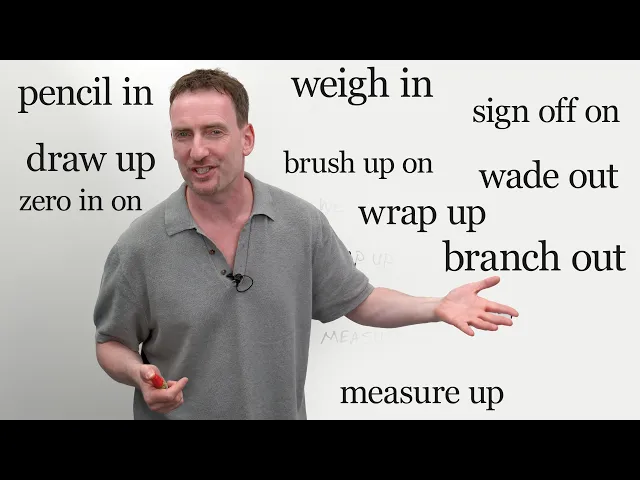
0:40 So today, we're going to look at iron out,
0:44 brush up on, weigh in, or sometimes weigh in with something, wrap up, burn out,
0:52 measure up, sift through or comb through, branch out, wade out,
1:00 zero in on, pencil in, draw up, and sign off or sign off on something.
1:07 So we're going to go through each one.
1:08 I'll give you some...
1:10 A little bit of an explanation and a sample, right?
1:13 So, to iron out, it's just like you would iron your shirt,
1:17 except in a business context, you know,
1:20 you're having negotiations, for example, and you have some...
1:24 Maybe some problems, some disagreements,
1:25 or some things don't really work, but little minor things.
1:29 They're sort of like wrinkles on a shirt.
1:32 So you discuss, you make some changes, and you iron them out.
1:35 You get rid of the little problems,
1:37 just like you would iron out wrinkles in your shirt.
1:42 Yeah, okay, so that's it.
1:43 So brush up on.
1:45 To brush up on means to a little bit...
1:47 Do a bit of a review on something and make
1:49 sure you're a bit familiar with it or comfortable with something.
1:53 Again, so in a business context, before you go to your meeting,
1:57 brush up a little bit on your presentation skills,
2:00 or brush up on your English if you're going to do a presentation in English.
2:06 Just brush up on it, just review a little bit,
2:08 make sure you have all the little particular skills you
2:11 need just in case you have to use them for whatever.
2:16 To weigh in.
2:18 So you don't weigh, like you put yourself on a scale and you weigh yourself,
2:21 but to weigh in means to add or contribute,
2:24 usually your opinion or your thoughts.
2:28 So you weigh in with...
2:30 So you weigh in with an idea or with a proposal,
2:33 so what you're contributing or what you're adding to the conversation.
2:38 But otherwise, in a meeting, you're...
2:41 Everybody's sitting around a table,
2:43 the manager will ask everybody to weigh in with their ideas
2:46 about whatever the topic is for the day.
2:49 Okay, not a big deal.
2:51 Wrap up.
2:52 So when I finish this video, I will wrap it up by telling you to, you know,
2:57 like my video, subscribe to the channel, and so on.
3:00 So to wrap up means to close, to finish something.
3:03 Just like you would wrap a gift, that's the last thing you do with the gift.
3:07 You wrap up a meeting, you wrap up a proposal, you wrap up some paperwork, etc.
3:14 Burn out.
3:15 If you're working too much, then you might feel at some point that you
3:20 just have no energy and you can't think well,
3:23 no mental energy, no physical energy, and you just can't do anything anymore.
3:28 You have to stop, you have to rest, or you have to quit your job.
3:31 So for a lot of people,
3:33 they burn out means they just can't do something anymore.
3:37 Now, there's different degrees, different levels of burning out.
3:40 Some people burn out and they just have to quit their job.
3:43 Other people just burn out today and they
3:45 have to take a little break, so it depends.
3:48 The key is don't burn out, because you don't want to do that, right?
3:51 Because it means you've a little bit melted your brain, maybe.
3:56 Measure up.
3:57 So again, to measure like the length, height, width, your weight, etc.
4:01 But to measure up means to reach a certain level of something, right?
4:08 Like a quality, or qualifications, or all kinds of different levels.
4:13 So when you go for a job interview,
4:16 what they are actually doing is measuring you up.
4:21 They're seeing like do you have enough skills,
4:22 do you have enough background, are you a nice person?
4:25 Or they want you to measure up to their level of sophistication, for example.
4:32 So if you're going to apply to like Google or some big international company,
4:38 you have to measure up by being a graduate of the top schools,
4:41 or having a great resume,
4:43 or being able to do the things that people at that company do, right?
4:47 If you don't measure up,
4:49 you should go look for a job at like Radio Shack or something like that.
4:54 They don't exist anymore.
4:56 Sift through or comb through.
4:58 So a comb, you know, like you comb your hair, so there are like little teeth,
5:03 so some things go through and some things are blocked out.
5:07 Sift, to sift something, like if you cook,
5:10 you have some flour, you're going to bake some bread.
5:14 So what you do, you put the flour through
5:17 a sifter to make sure there are no big pieces,
5:20 so all the small flour comes out and all the big pieces stay up top.
5:24 So when we sift through or comb through,
5:27 we are looking through something to find
5:29 all the little things that don't belong there.
5:32 So before you're going to sign a contract,
5:35 you have to make sure to comb through it
5:37 carefully to make sure that every word is perfect, every detail is perfect,
5:41 so you don't get into an agreement or into a contract you don't want.
5:46 You can sift through it or you can comb through it.
5:49 Basically the same thing.
5:50 Sift through is more commonly used with physical things.
5:54 So here's a box full of papers,
5:56 just sift through it and find the little things that don't
5:59 belong or the little things that you're actually looking for.
6:03 To branch out.
6:05 So when a company gets bigger,
6:07 they don't want to have only the office they're at now,
6:11 they want to have an office in this city and an office in that city.
6:14 If it's a store, they want to have a store here and a store there.
6:18 So you've heard of branch stores.
6:20 So some big companies have branches in many different places.
6:23 So to branch out is to spread and go different places.
6:29 To wade out.
6:30 Now, if you...
6:32 If sometimes you go to a swimming pool,
6:34 some people like to dive in, they just go quickly into it.
6:37 Some people like to put their toe in, feel how the temperature,
6:40 you know, "Oh, it's not too cold", go in a little bit more, a little bit more,
6:44 and then they slowly start swimming until they get to the deep end.
6:48 That slow movement is basically to wade out.
6:53 So, if you're going to wade out into this business...
6:56 So some companies, like, let's say they do computers, but they want to a little
7:01 bit start experimenting with cryptocurrencies, for example.
7:05 So they're going to wade out into this field,
7:07 they're not going to invest too much money,
7:10 they're going to put a little bit and see what happens,
7:12 and they're going to hire one person and see what happens.
7:14 If they see success, then they might dive in and do the full investment
7:19 and build this business or this side of the business.
7:23 To zero in on, so zero, like the number zero.
7:27 When you zero in, so like you have a circle, a zero, and then a zero,
7:31 smaller, smaller, smaller, smaller, boop,
7:32 until you hit that point that you're looking for.
7:35 To zero in on means to focus or to target something very, very specifically.
7:40 And it's always the full thing.
7:42 You can't say zero in, it has to be all three,
7:45 zero in on your target and make sure that you aim for it particularly.
7:51 Pencil in.
7:52 Now, this is a bit of a casual one, but it's still...
7:55 The idea is there.
7:56 A pencil, like you write with a pencil in your notebook.
7:59 If you pencil, and usually you would
8:01 say pencil someone in, you would pencil someone
8:04 in for an appointment or you pencil in an appointment
8:07 to meet that person, you can use both.
8:10 To schedule, basically.
8:12 To write someone into the time schedule for appointments, usually.
8:19 To draw up, basically means to create, but usually on paper as well.
8:23 So, I'll draw up a contract and we can sign it and then go on from there.
8:28 So, you don't have something and then you're creating it very
8:33 casually and quickly until you can do a more formal one later.
8:37 So, you can draw up a contract, draw up a proposal, draw up a plan,
8:41 all kinds of different things that you
8:44 can just quickly do and then formalize later.
8:48 And sign off.
8:49 So now, I'm almost done, I'm going to sign off.
8:52 It's very similar to wrap up.
8:55 Sign off, basically, especially in TV and radio,
8:57 they say goodbye and now we're going to go and that's their sign off.
9:01 But in a more business context, sign off on something.
9:07 So, before a business can do anything, the person in charge,
9:11 like the CEO, the president, etc., must authorize it, must agree to it.
9:17 So, he will give his signature to say, "Okay,
9:20 go ahead and do this plan." When he does that signature,
9:24 that means he is signing off on the plan.
9:27 He is giving it authority, giving it permission, etc.
9:30 Okay?
9:31 And that's all of these business phrasal verbs.
9:34 Very useful and very commonly used.
9:38 It's not just for this video here.
9:40 You will hear these, you will say these in business situations a lot.
9:46 Okay?
9:47 So, if you have any questions about this, of course,
9:49 come to www.engvid.com and ask me there.
9:51 And you can also take the quiz, of course, make sure you understand all these.
9:55 And, again, if you like the video, give me a like and subscribe to my channel.
10:00 And come back next time,
10:01 we'll give you some more useful tips to help you in the business world.
10:06 See you then.