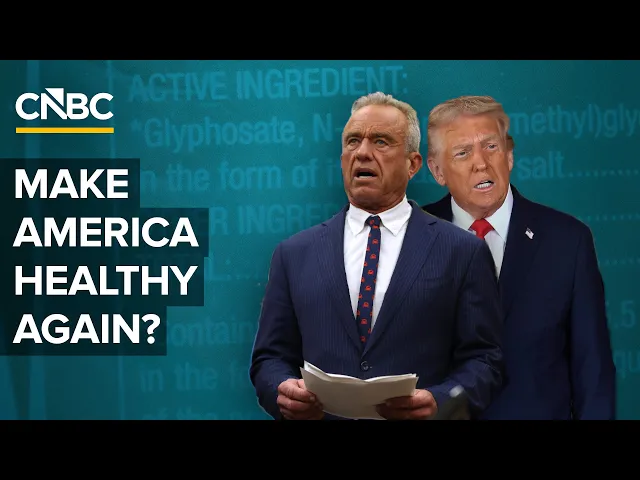
Glyphosate: The Chemical Putting Pressure On RFK Jr.
CNBC
0:05 When glyphosate was introduced, it was a miracle.
0:08 It truly was.
0:09 Before that time we had to till the ground twice.
0:12 It changed our lives in a very good way.
0:15 In April, the Supreme Court took up a case around glyphosate,
0:18 a weed killing herbicide sold commercially
0:20 by Monsanto under the brand name Roundup.
0:24 The chemical maker is a subsidiary of the German pharmaceutical company Bayer.
0:28 The chemical is used to kill weeds,
0:31 but litigants over the years have said the chemical causes cancer,
0:34 blaming it on their diagnoses and suing
0:36 Bayer and Monsanto for millions of dollars.
0:39 Here's the background.
0:40 Monsanto is asking the court to protect
0:44 them from lawsuits filed by cancer patients.
0:48 But just last month, President Trump, in a brief,
0:52 asked the Supreme Court to side with Monsanto and Monsanto was thrilled.
0:59 The high court is determining whether federal laws preempt state-level lawsuits
1:02 stemming from the absence of warning
1:05 labels for products containing the chemical.
1:07 In a statement to CNBC,
1:09 a Bayer spokesperson said that no health regulator anywhere in the world
1:13 has ever found glyphosate to pose a risk to human health.
1:16 This isn't the only development for glyphosate in Washington.
1:19 President Donald Trump in February signed an executive
1:22 order to promote the domestic production of glyphosate.
1:25 He used a law called the Defense Production Act to do it.
1:28 That means that the government will take efforts to procure
1:31 glyphosate because it's deemed as a national security priority.
1:36 That executive order incensed Make America Healthy Again
1:39 supporters who are opposed to glyphosate in agriculture.
1:43 I don't think he's trying to protect Monsanto.
1:45 I think he's trying to protect the 80%
1:47 of American farmers who are addicted to glyphosate.
1:51 The MAHA Coalition was a sizable voting bloc
1:54 that helped deliver President Trump, the White House.
1:56 If they lose the MAHA coalition, they're at serious risk of losing the Senate
2:00 and losing the House of Representatives in the upcoming midterms.
2:06 Blake Hurst is a farmer who relies on Roundup.
2:09 I grow corn and soybeans and flowers, and I've been farming here for 49 years.
2:15 Most of my corn is fed to animals, goes to pigs.
2:18 We use these chemicals to replace labor.
2:20 I couldn't possibly cultivate all of my acres that I grow.
2:23 I don't have the labor.
2:24 I don't have a way to do it.
2:27 Farmers rely on Roundup for several reasons,
2:29 the first of which is it's just really efficient.
2:31 Think planes dropping glyphosate over big fields of crops,
2:35 or think big machinery being used to target areas that might be prone to weeds.
2:40 Roundup kills weeds, and it doesn't kill the plant that they're trying to grow.
2:45 Another reason farmers use it is it allows them to do things like till less,
2:49 which helps the soil remain healthier.
2:52 We are no till farmers, meaning we don't control the weeds mechanically.
2:56 We don't till the soil which saves soil,
2:59 which cuts down on erosion and also cuts down our use of fossil fuel products.
3:04 We can lose up to 30 to 40% of our production if we don't control weeds.
3:10 So it's a big challenge.
3:12 There are very real concerns that glyphosate is a carcinogen,
3:15 and that this chemical that could cause
3:17 cancer is pervasive throughout our food system.
3:20 There's extensive research on the negative health impacts from glyphosate.
3:24 The one that is highlighted often is non-Hodgkin's lymphoma.
3:28 There's also research on all kinds
3:30 of different physiological effects that glyphosate has,
3:32 specifically on endocrine disruption impacting fertility.
3:37 The Environmental Protection Agency, which regulates pesticides and herbicides,
3:41 does not classify glyphosate as a carcinogen
3:44 and therefore does not require disclosures of cancer risk.
3:47 It is not hazardous.
3:50 The EPA, the Canadian counterpart to the EPA,
3:53 the European Union all have found glyphosate not dangerous, not a threat.
3:59 The company has faced thousands of lawsuits over
4:02 the lack of health risk disclosures on their Roundup product.
4:05 Glyphosate ends up in our food supply a few different ways.
4:10 The primary way is through something called pre-harvest desiccation,
4:13 where farmers want to ripen an entire field of grains
4:18 at one time to make it easier to harvest.
4:20 This has been happening for about 20 years,
4:22 where the farmer will spray it just before harvest with glyphosate,
4:24 and then they'll go and they'll harvest it.
4:27 The average consumer has no no danger
4:30 from the products I'm using here on my farm.
4:34 Farm groups and President Trump both made
4:36 the case that there's no direct alternative to glyphosate.
4:39 They say there's just nothing else they can use
4:41 that will protect crops as well as roundup does.
4:45 Why do we do without glyphosate?
4:47 Well, we continue to spray.
4:49 We'll use chemicals that are more dangerous to me
4:51 and the people around me who apply these chemicals.
4:57 RFK's nomination to lead the Health and Human Services
5:00 Department caused a lot of fear in the agriculture community.
5:03 Since joining the administration,
5:04 Kennedy has made clear he's still no big fan of glyphosate.
5:08 You guys helped create this problem over the past 30 years.
5:11 And you just told the big corporation
5:13 that they don't even have liability for it anymore.
5:16 He is dealing with a national security vulnerability where the Chinese
5:18 could shut off our food supply in a single day.
5:22 Department of Health and Human Services Secretary Robert F Kennedy Jr
5:25 has a long history of being opposed to glyphosate as an attorney.
5:29 He actually took Monsanto to court over the issue back in the 2010s.
5:33 MAHA supporters, though, were willing to come along to support Trump
5:36 at Kennedy's behest because they saw someone talking about
5:40 what they have lobbied so long for, which
5:43 is to get chemicals out of the food system.
5:46 The combination of the executive order and going to bat
5:49 for Bayer at the Supreme Court are really inexcusable.
5:51 And I think it showed a deep disconnect between what
5:55 the administration thinks that MAHA cares about and what is actually true.
5:59 There's a real conflict around glyphosate.
6:02 If all of a sudden glyphosate wasn't available for farmers to use,
6:05 yields would likely fall, and that would likely make food prices go way up.
6:10 There are also very real political concerns for the White House and Republicans,
6:14 who could lose their control of both
6:15 the House of Representatives and the Senate come November.
6:19 The likelihood isn't that people are so frustrated in the MAHA movement,
6:22 they go and vote for a Democrat.
6:23 They just won't vote.