The Brain-Changing Benefits of Exercise | Wendy Suzuki | TED
TED
0:12 What if I told you there was something that you
0:15 can do right now that would have an immediate,
0:19 positive benefit for your brain including your mood and your focus?
0:24 And what if I told you that same thing could actually last
0:28 a long time and protect your brain from different conditions like depression,
0:33 Alzheimer's disease or dementia.
0:36 Would you do it?
0:37 Yes!
0:39 I am talking about the powerful effects of physical activity.
0:43 Simply moving your body, has immediate,
0:47 long-lasting and protective benefits for your brain.
0:51 And that can last for the rest of your life.
0:54 So what I want to do today is tell you
0:56 a story about how I used my deep understanding of neuroscience,
1:01 as a professor of neuroscience, to essentially do an experiment on myself
1:05 in which I discovered the science underlying
1:08 why exercise is the most transformative thing
1:12 that you can do for your brain today.
1:15 Now, as a neuroscientist, I know that our brains,
1:19 that is the thing in our head right now,
1:22 that is the most complex structure known to humankind.
1:27 But it's one thing to talk about the brain, and it's another to see it.
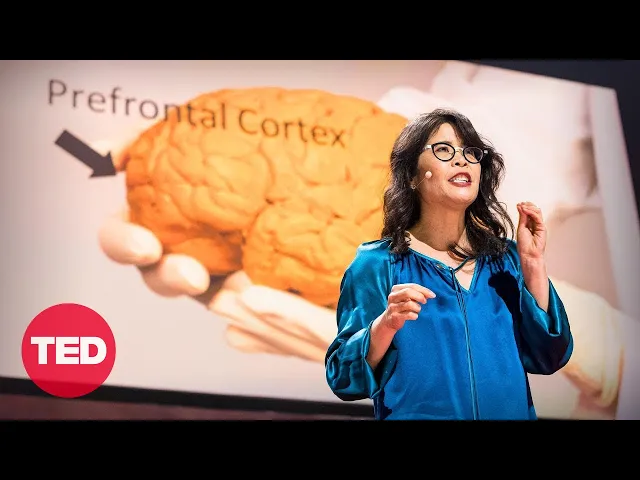
1:31 So here is a real preserved human brain.
1:34 And it's going to illustrate two key areas
1:36 that we are going to talk about today.
1:38 The first is the prefrontal cortex, right behind your forehead,
1:42 critical for things like decision-making, focus, attention and your personality.
1:49 The second key area is located in the temporal lobe, shown right here.
1:53 You have two temporal lobes in your brain, the right and the left,
1:56 and deep in the temporal lobe is a key structure critical
1:59 for your ability to form and retain new long-term memories for facts and events.
2:05 And that structure is called the hippocampus.
2:08 So I've always been fascinated with the hippocampus.
2:12 How could it be that an event that lasts just a moment, say, your first kiss,
2:19 or the moment your first child was born,
2:23 can form a memory that has changed your brain, that lasts an entire lifetime?
2:28 That's what I want to understand.
2:30 I wanted to start and record the activity of individual
2:34 brain cells in the hippocampus as subjects were forming new memories.
2:39 And essentially try and decode how those brief bursts of electrical activity,
2:44 which is how neurons communicate with each other,
2:47 how those brief bursts either allowed us to form a new memory, or did not.
2:52 But a few years ago, I did something very unusual in science.
2:56 As a full professor of neural science,
2:58 I decided to completely switch my research program.
3:02 Because I encountered something that was so amazing,
3:07 with the potential to change so many lives that I had to study it.
3:11 I discovered and I experienced the brain-changing effects of exercise.
3:18 And I did it in a completely inadvertent way.
3:21 I was actually at the height of all the memory work that I was doing— data
3:25 was pouring in, I was becoming known in my field for all of this memory work.
3:31 And it should have been going great.
3:34 It was, scientifically.
3:35 But when I stuck my head out of my lab door, I noticed something.
3:41 I had no social life.
3:43 I spent too much time listening to those brain cells in a dark room, by myself.
3:47 (Laughter) I didn't move my body at all.
3:51 I had gained 25 pounds.
3:54 And actually, it took me many years to realize it, I was actually miserable.
3:58 And I shouldn't be miserable.
4:00 And I went on a river-rafting trip— by myself, because I had no social life.
4:04 And I came back— (Laughter) thinking, "Oh, my God,
4:08 I was the weakest person on that trip." And I came back with a mission.
4:12 I said, "I'm never going to feel like the weakest person
4:14 on a river-rafting trip again." And that's what made me go to the gym.
4:18 And I focused my type-A personality on going
4:22 to all the exercise classes at the gym.
4:24 I tried everything.
4:26 I went to kickbox, dance, yoga, step class, and at first it was really hard.
4:32 But what I noticed is that after every sweat-inducing workout that I tried,
4:37 I had this great mood boost and this great energy boost.
4:41 And that's what kept me going back to the gym.
4:44 Well, I started feeling stronger.
4:47 I started feeling better, I even lost that 25 pounds.
4:50 And now, fast-forward a year and a half into this regular exercise program
4:56 and I noticed something that really made me sit up and take notice.
5:00 I was sitting at my desk, writing a research grant,
5:03 and a thought went through my mind that had never gone through my mind before.
5:07 And that thought was, "Gee,
5:10 grant-writing is going well today." And all the scientists— (Laughter) yeah,
5:15 all the scientists always laugh when I
5:17 say that, because grant-writing never goes well.
5:20 It is so hard; you're always pulling your hair out,
5:22 trying to come up with that million-dollar-winning idea.
5:26 But I realized that the grant-writing was going well,
5:29 because I was able to focus and maintain
5:32 my attention for longer than I had before.
5:35 And my long-term memory— what I was studying
5:38 in my own lab— seemed to be better in me.
5:43 And that's when I put it together.
5:45 Maybe all that exercise that I had included
5:48 and added to my life was changing my brain.
5:52 Maybe I did an experiment on myself without even knowing it.
5:55 So as a curious neuroscientist,
5:56 I went to the literature to see what I could find
5:59 about what we knew about the effects of exercise on the brain.
6:02 And what I found was an exciting and a growing
6:06 literature that was essentially showing everything that I noticed in myself.
6:11 Better mood, better energy, better memory, better attention.
6:15 And the more I learned, the more I realized how powerful exercise was.
6:21 Which eventually led me to the big
6:23 decision to completely shift my research focus.
6:28 And so now, after several years of really focusing on this question,
6:33 I've come to the following conclusion:
6:36 that exercise is the most transformative thing that you can
6:40 do for your brain today for the following three reasons.
6:43 Number one: it has immediate effects on your brain.
6:47 A single workout that you do will
6:50 immediately increase levels of neurotransmitters like dopamine,
6:54 serotonin and noradrenaline.
6:56 That is going to increase your mood right after that workout,
7:00 exactly what I was feeling.
7:01 My lab showed that a single workout can
7:04 improve your ability to shift and focus attention,
7:07 and that focus improvement will last for at least two hours.
7:11 And finally, studies have shown that a single
7:14 workout will improve your reaction times which basically means
7:18 that you are going to be faster at catching
7:20 that cup of Starbucks that falls off the counter, which is very, very important.
7:25 (Laughter) But these immediate effects are transient, they help you right after.
7:30 What you have to do is do what I did, that is change your exercise regime,
7:34 increase your cardiorespiratory function, to get the long-lasting effects.
7:38 And these effects are long-lasting because
7:41 exercise actually changes the brain's anatomy, physiology and function.
7:48 Let's start with my favorite brain area, the hippocampus.
7:52 The hippocampus— or exercise actually produces brand new brain cells,
7:58 new brain cells in the hippocampus,
8:00 that actually increase its volume, as well as improve your long-term memory, OK?
8:07 And that including in you and me.
8:10 Number two: the most common finding in neuroscience studies,
8:14 looking at effects of long-term exercise,
8:16 is improved attention function dependent on your prefrontal cortex.
8:21 You not only get better focus and attention,
8:23 but the volume of the hippocampus increases as well.
8:27 And finally, you not only get immediate effects of mood
8:31 with exercise but those last for a long time.
8:33 So you get long-lasting increases in those good mood neurotransmitters.
8:39 But really, the most transformative thing that exercise
8:43 will do is its protective effects on your brain.
8:47 Here you can think about the brain like a muscle.
8:50 The more you're working out,
8:52 the bigger and stronger your hippocampus and prefrontal cortex gets.
8:57 Why is that important?
8:58 Because the prefrontal cortex and the hippocampus are the two areas
9:03 that are most susceptible to neurodegenerative
9:07 diseases and normal cognitive decline in aging.
9:10 So with increased exercise over your lifetime,
9:14 you're not going to cure dementia or Alzheimer's disease,
9:17 but what you're going to do is you're going to create the strongest,
9:20 biggest hippocampus and prefrontal cortex so it takes
9:23 longer for these diseases to actually have an effect.
9:27 You can think of exercise, therefore, as a supercharged 401K for your brain, OK?
9:35 And it's even better, because it's free.
9:39 So this is the point in the talk where everybody says,
9:42 "That sounds so interesting, Wendy,
9:44 but I really will only want to know one thing.
9:47 And that is, just tell me the minimum amount of exercise I need to get
9:52 all these changes." (Laughter) And so I'm going
9:55 to tell you the answer to that question.
9:57 First, good news: you don't have to become a triathlete to get these effects.
10:01 The rule of thumb is you want to get three
10:04 to four times a week exercise minimum 30 minutes an exercise session,
10:09 and you want to get aerobic exercise in.
10:12 That is, get your heart rate up.
10:14 And the good news is,
10:15 you don't have to go to the gym to get a very expensive gym membership.
10:18 Add an extra walk around the block in your power walk.
10:22 You see stairs— take stairs.
10:24 And power-vacuuming can be as good as the aerobics
10:28 class that you were going to take at the gym.
10:31 So I've gone from memory pioneer to exercise explorer.
10:37 From going into the innermost workings of the brain,
10:41 to trying to understand how exercise can improve our brain function,
10:45 and my goal in my lab right now is to go beyond that rule
10:49 of thumb that I just gave you— three to four times a week, 30 minutes.
10:53 I want to understand the optimum exercise prescription for you,
10:59 at your age, at your fitness level, for your genetic background,
11:04 to maximize the effects of exercise today and also to improve your brain
11:11 and protect your brain the best for the rest of your life.
11:15 But it's one thing to talk about exercise, and it's another to do it.
11:19 So I'm going to invoke my power as a certified exercise instructor,
11:23 to ask you all to stand up.
11:25 (Laughter) We're going to do just one minute of exercise.
11:29 It's call-and-response, just do what I do, say what I say,
11:32 and make sure you don't punch your neighbor, OK?
11:36 Music!
11:37 (Upbeat music) Five, six, seven, eight, it's right, left, right, left.
11:43 And I say, I am strong now.
11:48 Let's hear you.
11:49 Audience: I am strong now.
11:52 Wendy Suzuki: Ladies, I am Wonder Woman-strong.
11:56 Let's hear you!
11:57 Audience: I am Wonder Woman-strong.
12:00 WS: New move— uppercut, right and left.
12:02 I am inspired now.
12:05 You say it!
12:06 Audience: I am inspired now.
12:10 WS: Last move— pull it down, right and left, right and left.
12:14 I say, I am on fire now!
12:17 You say it.
12:18 Audience: I am on fire now.
12:22 WS: And done!
12:23 OK, good job!
12:24 (Applause) Thank you.
12:31 I want to leave you with one last thought.
12:34 And that is, bringing exercise in your life will not only give you a happier,
12:41 more protective life today,
12:42 but it will protect your brain from incurable diseases.
12:47 And in this way it will change the trajectory of your life for the better.
12:53 Thank you very much.
12:55 (Applause) Thank you.
12:59 (Applause)