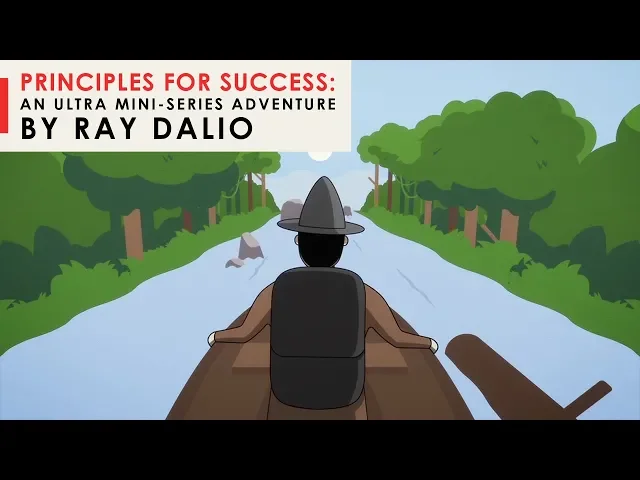
Principles For Success by Ray Dalio (In 30 Minutes)
Principles by Ray Dalio
0:00 [Narrator] Principles For Success.
0:02 An ultra mini-series adventure in 30 minutes, and in eight episodes.
0:07 Episode one, The Call to Adventure.
0:12 Before we begin, let me just establish the fact that I
0:15 don't know much relative to what I need to know.
0:19 Whatever success I've had in life has had more to do
0:22 with my knowing how to deal with my not knowing than anything I know.
0:27 That I should be telling other people what
0:29 to do sounds kind of presumptuous to me, but I'm going to do it,
0:33 because I believe that the principles that have made
0:36 me successful could help others achieve their own goals.
0:40 I'm now at a stage in my own life in which it is much more important to me
0:44 to pass along what I've learned about how
0:47 to be successful than to seek more success for myself.
0:51 What you choose to do with these principles is up to you.
0:55 You have to be an independent thinker,
0:57 because only you can develop your own principles based on your own values.
1:03 This brings me to my first and most fundamental principle,
1:06 which is that you need to think for yourself about what is true.
1:11 So let's get started.
1:13 Early on, I discovered I needed principles.
1:16 Principles are smart ways for handling things
1:18 that happen over and over again in similar situations.
1:21 There are principles for everything,
1:23 from skiing to parenting to cooking, and so on.
1:28 I'm going to share some of my most important, overarching,
1:31 life principles that influence how we approach everything that we do.
1:37 I didn't start out with principles.
1:40 I acquired them over a lifetime of experiences.
1:44 Mostly, from making mistakes and reflecting on them.
1:48 My life principles are simple, but they're not complete.
1:52 I still struggle to make the best decisions,
1:55 and I still make mistakes and learn new principles all the time.
1:59 This is the reality.
2:02 At the beginning, I needed to escape the conventions that surrounded me,
2:07 which meant that I needed to think for myself.
2:09 Unless you want to have a life that is directed by others,
2:13 you need to decide for yourself what to do,
2:17 and you need to have the courage to do it.
2:21 But I didn't know that at first.
2:23 I only learned that from going on my adventure.
2:26 Looking back on my own journey, I now see that time is like a river that carries
2:31 us forward into encounters with reality that require us to make decisions.
2:37 We can't stop our movement down this river, and we can't avoid the encounters.
2:42 We can only approach them in the best possible way.
2:46 In your lifetime, you will face millions of decisions.
2:50 The quality of your decisions will determine the quality of your life.
2:54 Over the course of my lifetime,
2:56 the most valuable things I've learned were the results of mistakes I reflected
3:01 on to help form principles so I wouldn't make the same mistakes again.
3:06 These principles took me from being a very ordinary middle class kid
3:10 from Long Island to becoming very successful as judged by conventional measures.
3:15 They also gave me the meaningful work and meaningful
3:18 relationships that I value even more than these conventional successes.
3:23 People often ask me how I did it.
3:25 I can assure you it wasn't because of my uniqueness as a person.
3:29 It was the result of a unique approach
3:31 to life I believe almost anybody can adopt.
3:35 It starts with embracing reality and dealing with it.
3:40 The path you take in life is your most important decision.
3:44 In my case, I wanted my life to be great,
3:47 and I feared boredom and mediocrity more than I feared failure.
3:52 Since I didn't start out with money,
3:54 and I didn't need much more than a bed to sleep in and food to eat,
3:57 I could skew my decisions to pursue my adventures.
4:01 So ever since I was a kid,
4:03 I ran after the things I wanted, crashed, got up and ran again,
4:09 and crashed again, and each time I crashed,
4:12 I learned something, got better, and crashed less.
4:16 By doing that over and over again,
4:18 I learned to love this process, even the crashing part of it.
4:23 Through it, I encountered reality, and I learned how to deal with it,
4:28 which inspired another one of my most fundamental principles which
4:33 is that truth is the essential foundation for producing good outcomes.
4:39 By truth, I don't mean anything more than the way the world works.
4:43 I believe that we were given the laws of reality by nature.
4:47 Humans didn't create them,
4:49 but we can use them to foster our own evolution and achieve our goals.
4:54 Realizing that made me a hyper-realist, by which I mean I became someone who
5:00 has discovered the great rewards of deeply understanding,
5:04 accepting, and working with reality as it is, and not as I wish it would be.
5:11 When I say I'm a hyper-realist,
5:14 people sometimes think I'm saying that dreams can't come true.
5:18 That's absolutely not true.
5:20 Without pursuing dreams, life is mundane.
5:24 What I mean is that, to me,
5:26 hyper-realism is the best way to choose one's dreams and then achieve them.
5:31 Having big dreams, plus embracing reality,
5:35 plus having lots of determination will bring you a successful life.
5:40 I believe this formula is true for everyone.
5:44 But what does a successful life look like?
5:46 We each have to decide for ourselves what success is.
5:50 I don't care whether you want to be a master
5:53 of the universe or to live under a palm tree, or anything else.
5:56 I really don't.
5:59 Each of us chooses goals based on our values
6:02 and decides on the best path to achieve them.
6:05 But we all need approaches to making decisions that work well,
6:10 especially when facing problems, mistakes, and weaknesses that stand in our way.
6:15 To succeed, we must embrace all our realities,
6:18 especially the harsh realities that we wish weren't true.
6:22 At first, looking at these harsh realities caused me a lot of pain.
6:26 But I learned that this pain was just psychological,
6:30 and that my seeing things differently made all the difference.
6:34 I came to view problems like puzzles that would reward me if I could solve them.
6:39 They would help me deal with the problem at hand,
6:41 and they would give me principles
6:43 for dealing with similar problems in the future.
6:47 I learned to treat pain as a cue that a great learning opportunity is at hand,
6:53 which led me to realize that pain plus reflection equals progress.
7:00 Meditation has been invaluable in helping me see things that way.
7:05 I found that when I calmed myself down and embraced my realities,
7:09 and dealt with them, the rewards brought me pleasure, and the pain faded.
7:15 Each of us has the unique capability to think logically,
7:19 to reflect on ourselves, and our circumstances,
7:22 and to direct our own personal evolution.
7:25 Doing this well is just a matter of following a simple five-step process.
7:32 (warm music) We've discussed how important it
7:35 is to reflect carefully after experiencing pain.
7:39 When I did this, I was usually able to discover principles
7:43 that would prevent me from repeating the same mistakes in the future.
7:46 And I could see that being successful simply consisted of five steps.
7:51 Step one is to know your goals and run after them.
7:55 What is best for you depends on your nature,
7:58 so you need to really understand yourself
8:00 and know what you want to achieve in life.
8:03 Step two is to encounter the problems that stand
8:06 in the way of getting to your goals.
8:08 These problems are typically painful.
8:10 If handled badly, some of them can lead to your ruin.
8:14 But to evolve, you need to identify those problems and not tolerate them.
8:19 Step three is to diagnose these problems to get at their root causes.
8:24 Don't jump too quickly to solutions.
8:27 Take a step back and reflect in order
8:30 to really distinguish the symptoms from the disease.
8:33 Step four is to design a plan to eliminate the problems.
8:38 This is where you will determine what you need to do to get around them.
8:42 And step five is to execute those designs,
8:45 pushing yourself to do what's needed to progress toward your goal.
8:49 A successful life essentially consists of doing
8:52 these five steps over and over again.
8:54 This is your personal evolution, and you see this process everywhere.
8:59 It's just a law of nature.
9:01 Think of any product, any organization, or any person you know,
9:05 and you will see that this is true for them.
9:08 Evolution is simply a process of either adapting, or dying.
9:14 Conceptually, it looks just like the five-step process I've described.
9:19 As you push through this often painful process,
9:22 you'll naturally ascend to higher and higher levels of success.
9:26 I found that when I did it better, my struggling never became easier,
9:31 because the more capable I became, the greater the challenges I would take on.
9:37 Because different people are strong and weak at different things,
9:40 most people can't do all five steps well.
9:43 Not facing this reality means you could stretch further than you should.
9:48 And as the heights get greater, your falls could also be greater.
9:52 (wind howling) Sometimes terrible things happen to all of us in life.
9:57 They can ruin us, or they can profoundly
10:00 improve us depending on how we handle them.
10:03 Something like this happened to me in 1982.
10:08 We progress forward until we encounter setbacks.
10:12 Whether or not we get out of them and continue forward or spiral
10:16 downward depends on whether or not
10:18 we're willing to face the failure objectively,
10:21 and make the right decisions to turn the loop upward again.
10:25 Something terrible happened to me in 1982,
10:29 when I bet everything on a depression that never came.
10:34 (crashing) (birds chirping) The period between 1979
10:38 and 1982 was one of extreme turbulence,
10:41 for the global economy, the markets, and for me.
10:46 And I believed that the US economy,
10:48 with the world economy tied to it, was headed toward a catastrophe.
10:53 This view was extremely controversial.
10:56 I wanted the great upside,
10:58 and very publicly took a big risk and was wrong, dead wrong.
11:03 After a delay, the stock market began a big bull market that lasted 18 years,
11:09 and the US economy enjoyed the greatest growth period in its history.
11:13 This experience was like a blow to my head with a baseball bat.
11:17 I had to cut my losses so that my company,
11:20 Bridgewater, was left with one employee, me.
11:24 (door slams) (paper shuffles) I was so broke,
11:26 I had to borrow $4,000 from my dad to pay my bills.
11:30 But even worse was having to let go the people I cared so much about.
11:36 I wondered whether I should give up my dream
11:38 of working for myself and play it safe by working
11:41 for someone else in a job that would require
11:44 me to put on a tie and commute everyday.
11:46 Though I knew that for me, taking less risk would mean having a less great life.
11:52 Being so wrong, and especially being so publicly wrong, was painfully humbling.
11:58 I am still shocked and embarrassed by how arrogant I
12:02 was in being totally confident in a totally incorrect view.
12:08 Though I had been right much more than I had been wrong,
12:11 I let one bad bet erase all my good ones.
12:14 (dramatic orchestral music) I thought very hard
12:17 about the relationship between risk and reward, and how to manage them.
12:22 But I couldn't see a path forward that would
12:25 give me the rewards I wanted without unacceptable risk.
12:29 This kind of experience happens to everyone.
12:33 It will happen to you.
12:35 You will lose something, or someone you think you can't live without.
12:40 Or you will suffer a terrible illness or injury,
12:44 or your career will fall apart before your eyes.
12:48 You might think that your life is ruined, and there's no way to go forward.
12:53 But it will pass.
12:55 I assure you that there is always a best path forward,
13:00 and you probably just don't see it yet.
13:03 You just have to reflect well to find it.
13:06 You have to embrace your reality.
13:12 Sometimes things happen that are hard to understand.
13:15 Life often feels so difficult and complicated,
13:18 it's too much to take in all at once.
13:21 My deep pain led me to reflect deeply on my circumstances.
13:25 It also led me to reflect on nature,
13:27 because it provides a guide for what's true.
13:30 So I thought a lot about how things work,
13:33 which helped to put me, and my own circumstances, in perspective.
13:39 I saw that at the big bang,
13:41 all the laws and forces of the universe were created and propelled forward,
13:46 interacting with each other as a perpetual motion machine,
13:49 in which all the bits and pieces coalesce into machines that work for a while,
13:55 fall apart, and then coalesce into new machines.
13:58 This goes on into eternity.
14:01 I saw that everything is a machine.
14:03 The structure and evolution of galaxies, the formation of our own solar system,
14:08 the make-up of earth's geography and ecosystems,
14:12 our economies and markets, and each of us.
14:16 We individually are machines, made up of different machines.
14:20 Our circulatory system, our nervous system,
14:23 that produce our thoughts, our dreams,
14:26 our emotions, and all the other aspects of our distinct characters.
14:30 All of these different machines evolve together through
14:33 time to produce the realities we encounter every day.
14:37 And I realized that I was just one tiny bit in one nanosecond,
14:41 deciding what I should do.
14:44 While that perspective might sound very philosophical,
14:47 I found that it was very practical,
14:50 because it showed me how I could deal with my own realities in a better way.
14:54 For example, I observed that most everything happens
14:58 over and over again in slightly different ways.
15:01 Some in obvious short-term cycles that are easy to recognize,
15:05 so we know how to deal with them, like the 24-hour day.
15:09 Some so infrequently that they haven't occurred in our lifetimes,
15:13 and we're shocked when they do, like the once in a 100 year storm.
15:18 And some we know exist, but are encountering for the first time,
15:22 like the birth of our first child.
15:25 Most people mistakenly treat these situations as being unique,
15:29 and deal with them without having proper perspective
15:32 or principles to help them get through them.
15:35 I found that if instead of dealing with these events as one-offs,
15:38 I could see each as just another one of those, and approach
15:43 them in the same way a biologist might approach an animal.
15:47 First, identifying its species,
15:49 then drawing on principles for dealing with it appropriately.
15:53 Because I could see these events transpire
15:55 in pretty much the same ways over and over, I could more clearly see
16:00 the cause-effect relationships that govern their behaviors,
16:03 which allowed me to develop better principles
16:05 that I could express in both words and algorithms.
16:09 I learned that while most everyone expects the future
16:12 to be a slightly modified version of the present,
16:15 it is typically very different.
16:17 That's because people are biased by recent history,
16:20 and overlook events that haven't happened in a long time,
16:23 perhaps not even in their lifetime.
16:25 But they will happen again.
16:28 With that perspective, I realized that what I missed when I mistakenly called
16:32 for a great depression was hidden in the patterns of history,
16:36 and I could use my newfound knowledge
16:38 of these patterns to make better decisions in the future.
16:41 And when I thought about my challenge, balancing risk and reward,
16:46 I realized that risk and reward naturally go together.
16:50 I could see that to get the most out of life, one has to take more risk,
16:54 and that knowing how to appropriately balance risk
16:58 and reward is essential to having the best life possible.
17:02 Imagine you were faced with the choice of having a safe,
17:06 boring life if you stay where you are, or having a fabulous one if you take
17:11 the risk of successfully crossing a dangerous jungle.
17:15 That is essentially the choice we all face.
17:18 For me, the choice was clear,
17:20 but that doesn't mean the path forward was without challenges.
17:24 I still needed to face two big barriers that we all must face.
17:28 (peaceful music) I can't tell you which path in life is best for you,
17:34 because I don't know how important it is for you to achieve big goals relative
17:38 to how important it is for you to avoid the pains required to get them.
17:43 This is the courage I spoke of earlier,
17:46 and we each have to feel these things out for ourselves.
17:49 After my big mistake in calling for a depression,
17:52 I had come to one of life's forks in the road, as we all do.
17:56 If I made the choice to take a normal job and play it safe,
18:00 I would have ended up with a very different life than the one I had.
18:04 (door slams) (paper shuffles) But as long as I could pay the rent,
18:07 put food on the table, and educate my kids,
18:10 the only choice for me was to risk crossing
18:13 the jungle in pursuit of the best life possible.
18:16 My big mistake in betting on a depression gave me a healthy fear of being wrong.
18:22 In other words, it gave me deep humility, which was exactly what I needed.
18:28 At the same time, it didn't stop me
18:30 from aggressively going after the things I wanted.
18:33 To succeed, I needed to see more than I alone could see.
18:37 (strikes match) (flame hisses) But standing in my way
18:40 of doing that were the two biggest barriers everyone faces.
18:44 Our ego and blind spot barriers.
18:48 These barriers exist because of how our brains work.
18:51 First, let's explore the ego barrier.
18:54 When I refer to your ego barrier, I'm talking about the parts of your brain
18:58 that prevent you from acknowledging your weaknesses objectively,
19:02 so that you can figure out how to deal with them.
19:05 Your deepest seated needs and fears reside in areas of your brain
19:10 that control your emotions and are
19:12 not accessible to your higher-level conscious awareness.
19:16 And because our need to be right can be
19:18 more important than our need to find out what's true,
19:21 we like to believe our own opinions without properly stress-testing them.
19:26 We especially don't like to look at our mistakes and weaknesses.
19:30 We are instinctively prone to react
19:33 to explorations of them as though they're attacks.
19:36 We get angry, even though it would be more
19:39 logical for us to be open to feedback from others.
19:42 This leads to our making inferior decisions,
19:45 learning less, and falling short of our potentials.
19:49 The second is the blind spot barrier.
19:52 Everyone has blind spots.
19:54 The blind spot barrier is when a person believes he or she can see everything.
19:58 But it's a simple fact that no one alone can see a complete picture of reality.
20:04 Naturally, people can't appreciate what they can't see,
20:08 just as we all have different ranges for singing,
20:11 hearing pitch, and seeing colors,
20:13 we have different ranges for seeing and understanding things.
20:17 For example, while some people are better at seeing the big picture,
20:22 others excel at seeing details.
20:26 Some are linear thinkers, and others are more lateral.
20:29 While some are creative but not reliable,
20:33 others are reliable but not creative, and so on.
20:37 Because of how are brains are wired differently,
20:39 everyone perceives the world around them differently.
20:43 By doing what comes naturally to us,
20:46 we fail to account for our weaknesses and we crash.
20:50 Either we keep doing that, or we change.
20:53 Aristotle defined tragedy as a terrible
20:56 outcome arising from a person's fatal flaw.
20:59 A flaw, that had it been fixed, would have instead led to a wonderful outcome.
21:06 In my opinion, these two barriers are the main
21:09 impediments that get in the way of good decision-making.
21:13 (noble orchestral music) Taking risks
21:17 and occasionally being ruined wasn't acceptable
21:21 and neither was not taking risks and not having exceptional results.
21:26 I needed an approach that would give me
21:27 the exceptional upside without also giving me the exceptional downside.
21:33 When I discovered it, it turned out to be my holy grail.
21:37 To get it, I needed to replace the joy
21:40 of being proven right with the joy of learning what's true.
21:46 This need prompted me to seek out the most
21:48 thoughtful people I could find who disagreed with me.
21:52 I didn't care about their conclusions,
21:54 I just wanted to see things through their eyes,
21:57 and to have them see things through my eyes,
22:00 so that together we could hash things out to discover what's true.
22:05 In other words, what I wanted most from them was thoughtful disagreement.
22:11 Going from seeing things through just my eyes,
22:14 to seeing things through the eyes of these thoughtful people was like
22:18 going from seeing things in black and white to seeing them in color.
22:22 (birds chirping) The world lit up.
22:26 (growling) (wings flapping) That's when I realized
22:30 that the best way to go through
22:32 the jungle of life is with insightful people who see things differently from me.
22:38 Think about the five-step process I described earlier.
22:41 As I said, because we are wired so differently,
22:44 not everyone can do all the five steps well.
22:47 But you don't have to do them all alone.
22:50 You can get help from others who are good at what you're not,
22:54 who are wired to perceive things you can't.
22:58 All you need to do is let go
22:59 of your attachment to having the right answers yourself,
23:03 and use your fear of being wrong to become open-minded to these other views.
23:10 In this way, you could point out
23:12 the risks and opportunities that you would individually miss.
23:16 I found that taking this radically
23:18 open-minded approach and believability-weighting people's
23:21 thinking significantly increased my probabilities
23:25 of making the best decisions possible.
23:27 This enabled me to ascend to greater heights and greater challenges.
23:32 In the past, I would have always wanted to do what I, myself, thought was best.
23:37 But now I sought out the strongest independent thinkers I could find.
23:41 I still do.
23:43 There is nothing better to be on a shared mission with extraordinary
23:47 people who can be radically truthful and radically transparent with each other.
23:53 This approach led me to create a company with the unique idea meritocracy,
23:57 operating in a unique way, that produced unique successes.
24:02 In an idea meritocracy, you get the best of everybody.
24:06 Everyone thinks independently,
24:09 then we work through our disagreements to get at what's best.
24:13 However, not every opinion is equally valuable.
24:16 And we had to learn to distinguish between good
24:18 ideas and bad ones to get the best decisions.
24:22 In other words, we needed to believability-weight people's thinking.
24:27 But that's another story I will explain in my work principles.
24:31 Right now, there are many wonderful opportunities
24:34 and dangerous risks surrounding you that you don't see.
24:39 If you saw them free of the distortions
24:42 produced by your ego or your blind spots,
24:45 you would be able to deal with them more effectively.
24:48 If you could acquire this ability,
24:50 and with practice you can, you will radically improve your life.
24:57 So far I described how I learned to confront my own realities,
25:01 my problems, my mistakes, and weaknesses.
25:04 And how I surrounded myself with others who could do things better than I could.
25:09 This was the most effective way I discovered for making great decisions.
25:15 This is not the normal way of being,
25:17 but through this approach, I became very successful.
25:20 And being successful enabled me to meet
25:23 extraordinarily successful people and see how they think.
25:28 I've discovered that their journeys were similar to mine.
25:31 You might not know it, but they all struggled,
25:35 and they all have weaknesses that they all get around by working
25:39 with people who see risks and opportunities that they would miss.
25:43 Over time, I leaned that by nature, most people's greatest strengths are also
25:48 connected to their most significant weaknesses.
25:51 And striving hard for big things is bound to lead you to painful falls.
25:56 It's just part of the process.
25:59 Such setbacks will test you.
26:01 They sort people.
26:03 Some think hard about what caused their setbacks,
26:07 learn lessons, and continue progressing toward their goals,
26:11 while others decide that this game is not for them, and get off the field.
26:16 I've come to realize that success is not a matter of attaining one's goals.
26:22 I've found that when I reached each new higher level of success,
26:26 I rarely remained satisfied.
26:28 The things we are striving for are just the bait.
26:32 Struggling to get them forces us to evolve,
26:35 and it is this struggle toward personal
26:38 evolution with others that is the reward.
26:41 I no longer wanted to get across the jungle,
26:44 but instead wanted to find greater and greater challenges to go after,
26:49 surrounded by great people working together on a shared journey.
26:54 Eventually the success of the mission and the well-being
26:58 of the people alongside me became more important than my own success.
27:03 I also started to see beyond myself,
27:05 and wanted others to be successful when I'm no longer here.
27:10 I realized that if I fail to do that, I will be a failure.
27:15 I struggle with this now.
27:18 We all struggle with different things at different times,
27:21 until we either choose to give up,
27:23 or until we die and become part of the larger evolutionary story.
27:28 This is how all machines work, and are recycled through time.
27:32 When a machine breaks down, its parts go back into the system to become
27:37 parts of new machines that also evolve through time.
27:41 Sometimes this makes us sad, because we become very attached to our machines.
27:46 But if you look at it from the higher level,
27:48 it's really beautiful to observe how the machine of evolution works.
27:53 Now you must decide for yourself how you will evolve.
27:58 Forget about where these principles came from.
28:01 Just assess whether or not they are useful to you,
28:04 and evolve them to suit your own needs.
28:07 As with all of life's decisions, what you do with them is ultimately up to you.
28:13 My only hope for you is that you have the courage to struggle
28:17 and evolve well to make your life as great as it can be.
28:22 Thank you, and goodbye.
28:24 (warm orchestral music)