Imagining YOUR life in the year 2100 | BBC Ideas
BBC Ideas
0:00 NARRATOR: It's Saturday night in the year 2100,
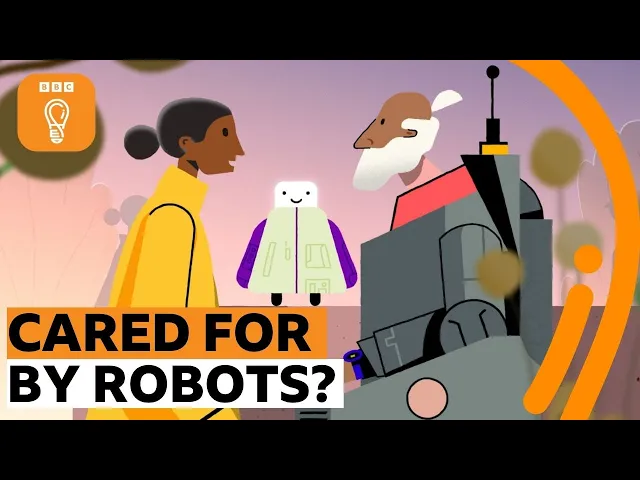
0:03 and you're at the quiz night in a care home.
0:05 The Saturday night quiz is serious business.
0:08 While the residents battle it out,
0:10 a team of carers quietly ensures the smooth running of the home.
0:15 Luna announces the questions.
0:17 Zach serves dinner and drinks, and Qi-Young administers evening medications.
0:22 But Luna, Zach and Qi-Young aren't human.
0:26 They're robots.
0:28 And one day, they could be your retirement companions.
0:34 One in three people born today will live until they're 100.
0:38 The world's population of over-60s has doubled since 1980 to around a billion,
0:44 and it's projected to double again by 2050.
0:47 That's a lot of people who may one day
0:50 need additional support to live fulfilling and comfortable lives.
0:53 Assistive intelligent robots could relieve pressure in understaffed care homes.
0:58 So what would being looked after by robots actually feel like?
1:02 Imagine- you're woken up by your favourite song played by a music robot.
1:07 Luna, a humanoid, is ready with your perfect brew,
1:11 milk and sugar selected with precision.
1:13 Luna helps you choose your outfit for your morning
1:16 walk and assists you into your exoskeleton,
1:19 an aid that gives you full control of your mobility.
1:22 You take a stroll around the gardens with your human carer, Dan.
1:26 You choose your own route and your exoskeleton
1:28 responds to your subtle movements and commands,
1:30 which it picks up via smart wearables so you're fully in control.
1:35 Along the way, you see robots maintaining the beautifully manicured grounds,
1:40 alerting carers to any potential hazards.
1:42 You stop to chat to a friend, and if your conversation is cut short,
1:46 a robot attendant will remember what you were talking
1:49 about and set up another time for you to chat.
1:52 When you return to your room,
1:54 it's been cleaned by a team of housekeeping robots.
1:57 Unburdened by time-consuming routine tasks,
2:00 your human carer Dan can take his time chatting to residents,
2:04 giving everyone his full attention.
2:06 You then enjoy a sumptuous communal
2:09 breakfast with the other residents and staff.
2:11 Bruno, the kitchen robot,
2:13 serves up a feast customised to your personal dietary requirements,
2:17 allergies, and he doesn't forget that you hate mushrooms.
2:21 Clara, a humanoid robot with soft silicone skin and a calming voice,
2:26 assists you with medication.
2:28 Her senses can immediately detect changes in your mood,
2:32 walking pattern or skin temperature.
2:34 Prakash, a robot designed for emotional wellbeing, tells you a joke.
2:38 His AI adapts to each resident's personality and allows him
2:42 to keep up to date with their interests, likes and dislikes.
2:46 While this scenario may sound idyllic, it's not without serious considerations.
2:51 Take, for example, logistics.
2:54 This vision would mean extensive building redesigns to accommodate robot carers.
2:59 Care homes of the future would need
3:01 to take into consideration how robots navigate rough terrain,
3:05 shared spaces and moving around one another, all while ensuring that they don't
3:10 themselves become mobility hazards for residents.
3:13 And on an ethical and legal level,
3:15 there's a ton of complexities with no easy answers.
3:19 Imagine a scenario where a robot makes a mistake,
3:22 perhaps administering the wrong medication or failing
3:26 to alert staff during an emergency.
3:28 Who or what would be held responsible?
3:31 And what are the privacy implications of sharing
3:34 all your personal health data with a robot?
3:36 And what will all of this mean in terms
3:38 of maintaining the skills and jobs of human care workers?
3:42 And then there's, of course,
3:44 the question at the heart of what it means to give and receive care.
3:48 Empathy, emotional support and human contact are essential for all of us,
3:53 particularly when we're at our most vulnerable.
3:56 While robots may be able to help out with physical caring,
3:59 health monitoring, and even limited companionship,
4:02 could they ever be a true substitute for the humans currently doing those jobs?
4:08 This leads us to perhaps our most important question.
4:11 Would we have the right to refuse robot care?
4:14 And how might we be empowered to do so?
4:17 These aren't just questions for engineers or policymakers.
4:20 They're for all of us.
4:22 What do we want our care to look like in the future?
4:26 Today's research looks at how robots can make
4:28 their own decisions using data from their sensors,
4:32 other robots and tech worn by residents and carers.
4:35 By 2100, robots will be far more capable than they are today.
4:40 If they can allow for more time and attention
4:42 from human carers and empower our older selves to live safe,
4:46 dignified and fulfilled lives,
4:48 perhaps it's not a question of if they should be used, but how.