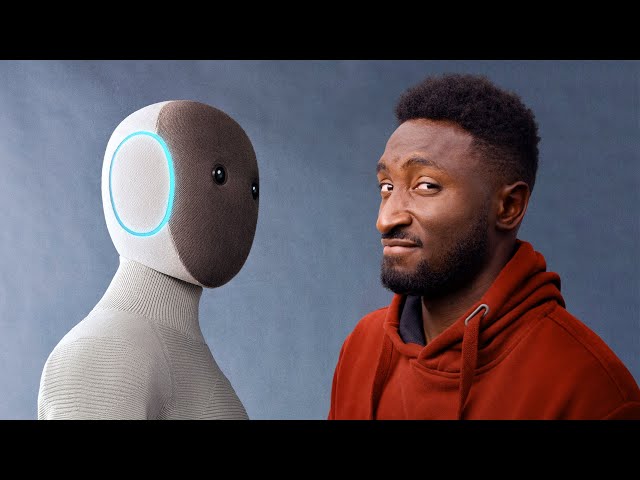
The Problem with this Humanoid Robot
Marques Brownlee
0:00 (upbeat music)- Okay.
0:04 We have to have a conversation about this.
0:06 I feel like it's been a minute since I've
0:07 done just an old school straight to camera rant video,
0:12 but this has been all over my timeline lately, so I feel like I have to.
0:16 So meet NEO, potentially, the most futuristic product we've ever seen.
0:22 This thing is a full-fledged humanoid robot, 5'6", 66 pounds,
0:26 four-hour battery life, self-charging, and it lives in your house.
0:31 It's finally here.
0:32 Get your mind out of the gutter.
0:34 It's for doing chores.
0:36 It's a housekeeper.
0:37 It has the same dexterity as a human because it's shaped just like a human,
0:41 walks around on two legs, has 10 fingers.
0:44 It can fold laundry and put it away for you,
0:47 or it can do the dishes for you from start to finish,
0:50 and then put everything away.
0:52 It can go around and water the plants outside or inside,
0:55 on a perfect schedule, and it never forgets a single plant.
0:58 And then it'll go around and vacuum and tidy
1:00 up the house if anything gets left out.
1:02 It always knows where everything is.
1:04 It can find the TV remote,
1:05 and it'll basically actively do all the chores that you know
1:08 you have to do but you don't actually want to do.
1:11 And when it's done, it goes back to its little docking spot and charges itself.
1:16 Imagine going out for the day of work and coming back a few hours later,
1:19 and everything's done.
1:21 All the chores are finished every single time every day.
1:24 You never have to do chores again.
1:26 That's amazing.
1:27 Or maybe let's say you have mobility issues,
1:28 this thing can sort of act as a personal assistant in a lot of ways.
1:32 These are things that represent massive value for a lot of people,
1:36 and it's available to order...
1:39 Now?
1:40 This is available to order?
1:42 This feels like it could be the best tech announcement of all time,
1:45 in 2025, except this isn't real.
1:49 And I mean that in the most literal way possible.
1:52 This is not real.
1:53 First of all, it's a pre-order.
1:55 So you can go to this website right now and you can pick between three colors,
1:59 and then it's either 500 bucks a month subscription for a standard delivery,
2:03 or you can pay a flat $20,000 to own it outright and get priority delivery.
2:08 Just drop a $200 fully refundable deposit to get in line today,
2:12 and deliveries in the US start sometime next year, and that's just allegedly.
2:17 We don't know when it's actually gonna ship.
2:19 Now, to be clear, it's not actually the price that I have a big problem with.
2:23 I know these numbers seem eye popping on paper,
2:25 but this is a first generation bleeding edge humanoid robot assistant.
2:30 Like I never thought that this would be cheap.
2:31 And also there isn't really competition yet.
2:34 So you gotta imagine the target audience is gonna be people
2:37 whose time is worth more than the money they're spending on it.
2:40 This is for people who the idea of saving a few hours on chores every
2:43 week so that they can use that time
2:45 to make more money actually makes logical sense.
2:48 People really think like that.
2:49 It's for early adopters.
2:51 It's for people who wanna spend however much they
2:53 think it's worth on this brand new novel thing.
2:56 That's fine.
2:57 But my issue with this product is the gap between what it's actually
3:04 capable of today and what they're promising as they take your money today.
3:09 I think when people watch a video like
3:12 this, they expect that this robot has some
3:15 sort of built-in artificial intelligence that allows it
3:18 to recognize objects and navigate around on its own,
3:21 and learn your house, and be productive for those hours while you're gone.
3:25 And that I think would be a reasonable thing to get
3:27 out of watching that video because that's what it's designed to show.
3:30 That's what you're supposed to feel.
3:31 That's the dream.
3:33 But that's not actually what's happening.
3:35 So Joanna Stern, the legend, she did a video with this NEO robot,
3:39 also this week, where the company showed her all the things that it could do.
3:43 And turns out, 100% of the things that they showed her were remotely
3:48 controlled by a human in another room wearing a VR headset with controllers.
3:52 That's not exaggerating.
3:53 100% of the stuff they showed her, the carrying things around,
3:57 the loading up the dishwasher.
3:59 I mean, look at this thing.
4:02 (gentle music) Yeah, all of this is teleoperated,
4:18 and this was a demo set up by this 1X company.
4:21 So this is like best case scenario stuff.
4:22 And I see a lot of people defending this robot online,
4:24 like, "Oh, there's probably other things that it can do autonomously.
4:27 They just didn't show her yet." Really?
4:31 you don't think they would show her the best stuff
4:33 that this could do autonomously to keep selling the dream?
4:36 If you watch that keynote video back, to their credit,
4:39 you'll notice that they actually are very careful to label
4:42 exactly when the robot is doing something autonomously and not teleoperated.
4:48 And in that whole nearly 10-minute video,
4:50 there's exactly two scenes that have this label.
4:53 There's the get the door command.
4:55 [Homeowner] Can you get the door, please?
4:56 Where the robot walks over to the door because someone's coming up.
4:59 It grabs the handle, waits for the guest,
5:01 and then sort of pulls the door open and fumbles backwards a little bit,
5:05 kinda like a toddler, to let them inside.
5:07 And then there's the put away the dishes command where the robot toddles
5:11 over to the person recognizes the harmless not glass empty cup in its hand,
5:16 grabs it, and then walks away with it.
5:19 Cool.
5:20 No, seriously, that's actually pretty impressive.
5:22 Even if I could already today unlock the door
5:26 with my Google Home and a smart lock,
5:28 which is my voice, there is something at least a little
5:31 bit futuristic about a humanoid robot going to do that.
5:35 That's part of the dream.
5:36 It's doing it autonomously.
5:37 But then that also means that everything else happening in this video
5:41 and everything else we've ever seen this NEO robot do,
5:44 we can safely assume is remote controlled.
5:48 So the gap between what this product can actually do today and what
5:54 it can maybe hopefully do someday in the ideal future, it is massive.
6:00 They're massively far apart.
6:01 And so that's really my main issue.
6:05 There seems to be a bit of a lost art in waiting
6:08 for a tech product to be actually finished before announcing and unveiling it.
6:14 Do you remember when tech companies would unveil a brand new
6:16 tech product that they'd been working on, and then do a demo.
6:19 And then the next slide was like this thing is going on sale tomorrow,
6:23 or next week, or something like that.
6:24 And that hype would carry right into the buying cycle.
6:27 You remember that?
6:28 That was sick.
6:29 But now, in this age of all these AI products,
6:32 it's like there's this thing where you end up
6:36 selling the dream before you sell the actual product.
6:40 And that is dangerous.
6:41 The promise of AI is so huge, and so massive, and magnificent, and awesome,
6:46 but is also so clearly not done yet
6:49 that you end up with stuff like the Humane Pin,
6:51 or even the Rabbit r1 for example,
6:54 or heck even Apple Intelligence where you have these big promises,
6:57 but the capabilities are still over here while
7:00 the promise is all the way over here.
7:02 And I'm trying to figure out why they do that.
7:04 And I think really there's two main reasons, and believe it or not,
7:08 I think Tesla self-driving is a really perfect
7:11 parallel example for a lot of this stuff.
7:13 See, basically, in order for this robot to be everything people want it to be,
7:17 they need to develop a super smart AI system
7:21 that looks through the robot sensors and is able
7:23 to learn its environment and recognize everything it's looking
7:26 at and teach itself to navigate that environment and perform tasks.
7:30 It has to learn what a laundry room is and what
7:33 the laundry looks like and how to fold each type of clothing,
7:36 and it needs to learn what cups, and forks,
7:38 and glasses are, and how to pick them up.
7:40 And it has to be adaptable to all these different sizes,
7:42 and shapes, and materials, and things of all these household objects.
7:46 So that when the user asks for it to do something, just like, "Hey, NEO,
7:50 vacuum the living room when I'm gone," or something like that, then NEO can go,
7:55 "Okay, I know where the living room is.
7:57 I know where the vacuum is.
7:58 I know how to use the vacuum,
8:00 where the handle's at, how much battery life I have,
8:02 how much I need to vacuum the whole living room.
8:04 I know not to knock over lamps or certain
8:07 objects in there." And even the laundry folding thing,
8:09 just that requires a ton of training data or at least
8:12 some way to understand all these different shapes of shirts,
8:15 and jackets, and hoods, and vests, and all sorts of things, and hooks,
8:19 and hangers, and what gets folded,
8:21 what gets dry cleaned, all these different things.
8:23 And the list just goes on and on.
8:24 And like, what if one of the tasks is
8:26 going and getting the right medication for an elderly person,
8:29 bringing it to them?
8:31 It has to get that right.
8:33 It needs to identify the correct medication
8:36 at the right time and the right intervals, and bringing it to them.
8:40 That is one of a ton of household objects
8:43 that it has to specifically get really good at.
8:45 Now, in the self-driving car world,
8:48 no matter what you think of them, Tesla's definitely a leader here,
8:51 and they've had a pretty clever approach to trying to work on this problem.
8:54 Because their problem is their robots on wheels need to learn all
8:59 these possible variations and ways to navigate
9:01 situations that could happen on the road,
9:03 and how to get around them, traffic cones,,
9:06 construction zones, weird lane markings, et cetera, et cetera.
9:10 So, with their millions of cars already on the road, they have slowly,
9:16 very slowly let people turn on this beta self-driving feature in small stages
9:22 in their cars while instructing people to keep their hands on their wheel,
9:25 of course, so that they can slowly start
9:28 to gather information from people willing to beta test.
9:31 And so those cars will encounter and navigate
9:33 all sorts of situations for the first time,
9:36 and then the second time, and then the fifth time, and then the 100th time.
9:39 And all this data can go back into the system
9:42 to help all these cars learn and get better.
9:45 And now at this point, this is their primary advantage,
9:48 is they have millions and millions of miles
9:50 of training data from people essentially beta testing for Tesla.
9:54 It's a robotics challenge, it's an AI challenge, but yeah,
9:59 they're essentially using early adopters to beta test
10:02 to make the systems better for the eventual masses.
10:05 And now, this home AI robot challenge is essentially the same thing,
10:11 but in people's homes, which is potentially way more variables.
10:16 Cars have to stick to what's on the road and mostly are operating in a 2D plane,
10:21 while there's obviously different...
10:22 People's houses are crazy different shapes, and there's all sorts of objects,
10:25 and different shapes and types of them
10:27 and a million different variables just with household objects.
10:30 And maybe you could argue that the stakes of self-driving
10:32 cars are a little higher because of all the safety risks.
10:35 And if it messes up, someone could die.
10:38 Maybe that doesn't happen as often with the home AI robot,
10:42 but then again, if it gets someone's medication wrong,
10:45 it's still pretty important.
10:46 So, I think the point here is you don't get
10:50 to make this awesome perfect home robot without all of this information.
10:55 And so they need the training data and so they go right back to early adopters.
11:00 So people who press that order now button first and who actually,
11:03 I guess, get one of these when they start to ship them,
11:06 will get a robot that can probably do a few simple things autonomously,
11:10 like opening doors, but there will be many things it can't do.
11:14 And for that, if you scroll down on their website,
11:16 you can see there's expert mode,
11:18 which is when you have something the robot can't
11:20 yet do and you schedule one of their teleoperating employees
11:24 to look through the sensors into your home and do
11:27 the task so that the robot can learn from it.
11:29 And this is something that they've pretty directly said
11:33 that they expect early adopters to be totally cool with.
11:36 Go watch Joanna's video, I'll link it below the like button.
11:38 She basically grills the CEO about all this stuff, and he's kind of just like,
11:42 "Yeah, if you wanna be on the bleeding edge of this...
11:47 We'll probably blur faces and maybe let you
11:49 geofence certain areas of your house, but yeah,
11:51 that'll be one of the things that they allow you to do." So, look,
11:55 there are certain industries where pre-ordering something
11:58 that's not finished yet is actually normal behavior.
12:02 This happens all the time with smartphones now.
12:05 This happens in video games, even happens a bit with cars these days,
12:09 although sometimes that can even go too far.
12:11 But now with all these AI products coming out now,
12:14 it's resulted so many more times in this strategy.
12:17 They feel like they have to announce the product way before it's done,
12:22 and they end up putting out this thing that is just nowhere near the dream.
12:27 And that's how you get...
12:28 We talked about the Humane Pin.
12:31 Doesn't that sound familiar?
12:32 Getting announced with such a high potential ceiling and promising
12:35 that this could maybe be a post-smartphone world type of gadget,
12:39 but it was just absolutely not good when it came out,
12:41 and not enough people were willing to beta
12:44 test something with that miserable of an experience.
12:47 And then the Rabbit r1, like I said, that's another one.
12:49 They are surviving and they're improving,
12:51 but absolutely with those early adopters.
12:54 But a $20,000 5'6" humanoid that wanders around your house and does chores,
13:03 are there really that many people you think that are willing to spend
13:07 that amount of money and know that they're gonna have to potentially give
13:11 up some pretty serious privacy and are basically going to be a beta
13:14 tester for some unknown number of years
13:16 to hopefully maybe someday achieve that dream?
13:22 Some of those people are out there, but is there enough of those people?
13:24 I don't know.
13:25 I clearly don't know, and I think a lot of other people don't know.
13:29 There are obviously a lot of potential downsides to this robot.
13:33 It's too small and weak to carry anything super heavy.
13:35 It's also too slow and a bit too clumsy,
13:37 it looks like, to do anything really serious.
13:41 And it requires inviting a ton of remote
13:43 viewable cameras and microphones into your house,
13:46 and it could also fall over and have a hard time getting up.
13:48 And also, just like the self-driving car, there are a number of situations where
13:52 the robot getting enough things wrong could be dangerous.
13:55 Even just the medication stuff that I talked about earlier,
13:58 or even it just clumsily dropping something made of glass,
14:01 or any other various potentially dangerous household situations.
14:05 And also, I'm not even sure it has to be human shaped,
14:10 but that's another argument for another video.
14:13 But the upside clearly is the dream.
14:17 Like Rosie the Robot from "The Jetsons" type of dream,
14:20 a personal assistant that seamlessly goes around your house
14:23 and quietly does all the stuff that you don't wanna
14:25 do and does it better and faster as time goes
14:28 on, and does it in quiet hours of the night.
14:30 The point is this is the new AI promise problem that we have.
14:36 It's not just this product and this company.
14:38 This is the most visible one on all our timelines right now.
14:41 But it's like all these AI products are promising the world way,
14:46 way before they have a product that's ready
14:49 to actually show anyone and take money for it.
14:52 And theoretically, this is what we want AI to do.
14:54 It's not just like AI-generated videos
14:57 and slop and random copyright infringement.
14:59 We want it to be doing actually useful, productive stuff.
15:02 That's not the issue.
15:03 It's just the gap.
15:05 The gap, that's the issue.
15:07 And closing that gap is so, so hard.
15:09 And this is one of the obvious examples.
15:12 The people that would benefit most from the ideal version of this robot,
15:15 like the elderly or people with disabilities,
15:19 are the least likely to become early adopters.
15:22 So it's tough.
15:23 I can actually applaud them for showing everything
15:25 that they did to Joanna in that video.
15:28 Fun fact, they actually reached out to me 10 months ago
15:31 in January from a random Gmail address offering to do a sponsored video.
15:36 I didn't respond.
15:37 I didn't think it was anywhere close to real
15:39 or worth doing a video or talking about, but we'll see how this ages.
15:43 We might look back at this in 12 months,
15:45 and everyone everywhere shipping great AI products and humanoid robots,
15:48 and it's all a dream, and I look like an idiot,
15:50 in which case, great, we made it through that gap somehow.
15:54 But history seems to be suggesting that I'll probably
15:57 be right about this one, at least for now.
16:00 But, hey, subscribe to see me in my words if I'm wrong.
16:03 Thanks for watching.
16:04 Catch you in the next one.
16:06 Peace.
16:07 (gentle music)