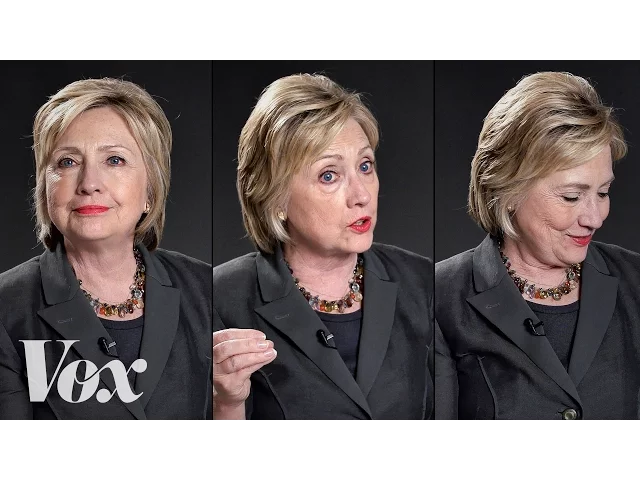
Hillary Clinton: The Vox Conversation
Vox
0:00 Ezra Klein: So let’s start with poverty.
0:05 Scholars have estimated or found that the number
0:08 of American families living in extreme poverty,
0:11 under $2 in cash income, has skyrocketed in the last 20 years.
0:15 You have about 1.5 million families and 3 million children.
0:19 Given how many children are now in that condition,
0:22 should we be following the model of countries— like Sweden,
0:26 Germany, and now Canada under Trudeau— that have
0:29 a universal child allowance to cut or eliminate child poverty?
0:32 Hillary Clinton: Well,
0:33 this is a very personal and important issue to me— because,
0:38 as you know, I started out my work as a lawyer for the Children’s Defense Fund.
0:44 And I have been focused on child poverty and what
0:47 we can do to alleviate it for a very long time.
0:51 I would just slightly amend your question,
0:53 because we were making progress in the ’90s.
0:56 We had more people lifted out of poverty.
0:59 We had a 33 percent increase in the African-American family income.
1:05 We were on the right track.
1:07 That doesn’t mean we shouldn’t have been looking
1:09 at more ways to lift more kids out of poverty,
1:13 but we were on the right trajectory— and, unfortunately, we changed direction.
1:20 We had policies that I think contributed
1:23 greatly to the increase in childhood poverty,
1:27 starting in 2001, the Great Recession being the worst of those.
1:33 But there were also policy decisions,
1:36 regulatory changes— providing more leeway to the states,
1:40 so that they did not have either
1:44 the requirement or the incentive to continue lifting people,
1:49 particularly kids, out of poverty.
1:50 So we’ve got a big problem, and it’s a problem that’s a reflection
1:56 on our political as well as our economic systems.
2:00 And I do think we should focus on how we’re going to support more families,
2:06 and there are a number of inputs.
2:09 But trying to create more financial support is something that we should look at.
2:14 I’m not ready to adopt a plan that comes from some other country,
2:17 because we have to look to see how we would do anything in our federal
2:21 system— and how it would be workable
2:24 and what the cost-benefit analysis might be.
2:29 But while we’re looking at how we lift incomes— which
2:33 is the defining economic challenge that we have for working, middle-class,
2:36 and poor families— we need to do much more to provide
2:41 the proven interventions in early childhood education that help families,
2:48 even poor families, know more about how to better prepare their kids.
2:53 We need to do more with nutrition— and we’re making progress with health care
2:58 thanks to SCHIP [the State Children’s Health
3:00 Insurance Program] and the Affordable Care Act.
3:02 So it’s not just a decision about whether or not to increase the child
3:06 tax credit or some other means of providing a greater financial safety net.
3:12 It’s also what we can do to really support families.
3:14 And I think we have to move on both tracks.
3:17 EK: But to ask a big-picture question about that policy shift:
3:19 Something a lot of poverty scholars argue to me is that we made
3:23 a very big change toward trying to support the working poor— welfare reform was,
3:26 of course, part of that.
3:28 It went, from in the numbers I’ve seen,
3:30 from bringing a million of these families out
3:32 of poverty to around 300,000 in more recent years.
3:35 But the expansion of the EITC [earned income tax credit],
3:37 other things we’ve seen— do you think we do too
3:40 little now to support the poor who for, whatever reason,
3:43 cannot find or cannot keep a job?
3:46 HC: I do.
3:47 I know there’s a big debate—
3:49 and it’s an, important debate— about welfare reform.
3:51 Because when welfare reform was passed,
3:54 there was an expectation— certainly on my part,
3:58 and I think on the part of many who
4:01 had supported it— that there would be an expectation, in fact a requirement,
4:07 that states would have to be contributing to the broadest possible safety net,
4:15 particularly in economic downturns.
4:17 So that we wouldn’t help the working poor,
4:20 particularly through the EITC— which I think
4:22 is one of the best anti-poverty programs
4:25 that we have devised— we would not be doing it at the expense of the poor.
4:30 We would also be providing a continuing safety net for the poor.
4:35 And that’s one of the programs that I
4:38 was referring to when I said that after 2001,
4:41 there were a lot of decisions made that basically did not carry on what
4:45 had been not just the spirit but also the requirements in the law,
4:51 because we had set the base payment at the highest
4:55 possible rate and expected states to do that.
4:58 So we are back to a serious problem of poverty,
5:02 and I think we have to do much more to target federal programs to the poorest,
5:10 where intergenerational poverty is once again a cycle.
5:16 Congressman Jim Clyburn has a creative idea called the 10-20-30 approach,
5:20 where you woul’d put a percentage of federal funds— 10 percent of federal
5:25 funds— in those communities that are most
5:28 impoverished and have been for 30 years.
5:31 So I think we’ have got to address really systemic,
5:40 generational poverty differently.
5:43 We still have to lift up working people,
5:45 we have to make it worth everyone’s while to work,
5:48 we have to create more good jobs, we have to have the training pipeline there.
5:53 But we are now, unfortunately,
5:56 back having to face poverty that we thought we had a better approach toward
6:03 ending than it turns out— given the change
6:06 in administrations and attitudes— that we did.
6:08 EK: Let me ask you about how to pay for that.
6:10 So I looked at the Treasury’s real daily yield curve website today,
6:14 as I do every morning when I get out of bed.
6:17 And short-term interest rates on US government debt are negative;
6:21 they will pay us to take money.
6:24 That is how much the market wants more US government debt.
6:27 Should we be taking the markets up on this offer of free money?
6:30 Should we be doing more short-term
6:32 deficit spending for infrastructure, for poverty,
6:34 for middle-class tax cuts— and worrying less in the near-term about deficits?
6:39 HC: I think we have missed an opportunity over the last eight years
6:45 to make some big bets on America— to make some investments with, as you say,
6:52 money that is as low in terms of interest rates as it’s ever going to be.
6:58 I have put forth ways of paying for all the investments that I make,
7:02 because we do have the entitlement issues out there that we can’t ignore.
7:08 But we are failing to make investments that will
7:12 make us richer and stronger in the future.
7:15 And that’s where I think our biggest gap is.
7:18 I think it’s important that we look for ways to pay for our investments.
7:23 But I think there can be short-term decisions about
7:27 the kind of federal dollars that are available now,
7:31 with a revenue stream to pay them back in the future
7:35 that would bridge the gap if we can’t do
7:39 everything we need to do to really give the economy
7:42 and job creation the kind of boost that it needs.
7:46 But I’m not going to commit myself to that because I
7:48 would like first to figure out what we’re going to do,
7:51 because I think we’ve had a period where the gains have gone to the wealthy.
7:57 The Great Recession wiped out $13 trillion in family wealth.
8:01 And a lot of people have come back roaring— they are doing better than ever,
8:07 corporate profits are up,
8:09 whereas so many Americans are stalled or have fallen backward.
8:14 Real family income hasn’t moved.
8:15 In fact, it’s below where it was in 1999 and 2000.
8:21 So we do have a problem.
8:22 It’s a real problem.
8:24 Because we are a 70 percent consumption economy,
8:27 so we’ve got to get more growth going.
8:30 And the best way to do that is to invest in these jobs,
8:33 and I think we can pay for what we
8:35 need to do through raising taxes on the wealthy
8:40 and making it clear that there’s a commitment
8:44 to these investments if we’re going to grow the economy,
8:46 which will benefit everybody.
8:48 EK: So that’s interesting.
8:49 I’ve not heard you say it that way before.
8:50 So part of the argument of doing pay-fors in the near term is not just balancing
8:56 the budget or reducing the deficit but also bringing
8:59 a distributional fairness to the aftermath of the recession.
9:02 HC: That’s right.
9:03 Last summer, I gave two economic speeches which called for strong growth,
9:09 fair growth, and long-term growth.
9:12 And I think the three go together.
9:14 It is important that we look at how they can converge,
9:19 because I do believe we’ve got to grow the economy.
9:23 I’m an economic growth Democrat, so I believe that.
9:29 But we also have to make it fairer, and part of the way we make it fairer is
9:34 by shifting some of the tax burden onto those who have
9:37 done really well despite all of the macro- and microeconomic
9:40 ups and downs in the global economy and here at home.
9:45 And that’s why the Buffett Rule;
9:48 that’s why a fair share surcharge on incomes above $5 million;
9:53 that’s why closing the loopholes, like the carried interest loophole.
9:56 It’s not just a symbolic effort to say, “Hey,
10:00 we gotta get rid of the gimmicks and the games.” It’s also to get money
10:06 to do what we need to do to lift the bottom and the middle up.
10:10 And it is a way of making clear that growth and fairness have to go together.
10:15 EK: I think it’s probably an understatement at this point to say
10:18 that immigration has been a big part of this year’s campaign.
10:22 We talk a lot about the folks who are already
10:26 here— the roughly 11 million unauthorized immigrants who are already here.
10:30 And I know you’re supportive of comprehensive immigration reform.
10:33 But in the broader question around immigration and the economy,
10:36 the economic data I’ve seen suggests pretty straightforwardly
10:39 that immigrants are good for the US economy;
10:42 particularly they are as the population ages.
10:44 So do you think it’d be good for the economy to double
10:47 or triple the number of people who could come here legally?
10:49 HC: I think we have to deal with first things first.
10:54 It is certainly the case that immigration has
10:58 been and continues to be good for our economy.
11:03 Immigrants start businesses at a faster rate;
11:06 they seem to grow those businesses more successfully;
11:10 they do fill certain gaps in skills
11:13 and knowledge that are good for the overall economy.
11:17 But I think there are three big problems we have to address.
11:21 One is just the human cost of those 11 million undocumented immigrants.
11:27 I have met many of them— in fact, we all have, whether we acknowledge it or not.
11:33 And these are hardworking people.
11:35 These are people who are contributing already to the economy,
11:38 whose children are in schools,
11:39 who are really absolutely committed to the American dream.
11:44 The little girl I met in Las Vegas who is
11:47 living in fear that her parents are going to be deported,
11:50 with stomachaches and all kinds of physical ailments,
11:53 and she should be a kid and she should be
11:57 enjoying school and learning and deciding what she’s going to do.
12:01 So I do think we have to be very understanding and accepting of the human
12:10 stories that are behind these statistics
12:13 that people like Donald Trump throw around.
12:16 I think also, though,
12:18 there’s a lot of evidence that moving toward comprehensive immigration reform
12:22 with a path to citizenship would be good for our economy.
12:26 We already know that undocumented workers are
12:28 putting about $12 billion into the Social
12:30 Security trust fund with no anticipation
12:33 at this point that they’ll ever get anything out.
12:37 They’re paying payroll taxes;
12:38 they’re paying other forms of taxes— state and local as well as federal.
12:42 So we do have a productive part of our economy,
12:46 and most of the analysts that I have seen suggest that this idea
12:51 of deporting everybody would be a severe blow to the economy.
12:55 That it would cost millions of jobs, that it would depress economic growth.
13:00 There’s a moral, humanitarian kind of “American values” argument,
13:04 and there’s an economic argument.
13:07 I think it would be very difficult to do anything on immigration
13:13 until we make the decision that there will be comprehensive immigration reform.
13:19 Because otherwise we are mixing up a lot
13:23 of the concerns about immigration in a way that I think will hurt both the side
13:31 of immigration about people who fill jobs we need, particularly high-value jobs,
13:36 and the people who are here living in fear
13:38 that someone’s going to round them up and deport them.
13:42 I think we have to look at all of these issues.
13:44 The idea of a comprehensive immigration reform with a path to citizenship that I
13:48 would envision is one that would deal with a lot of these concerns,
13:52 not just the 11 million people here: how we would regularize them,
13:56 what kind of steps they’d have to go through.
13:58 Because I believe they do have to meet certain standards
14:01 if they’re going to be on a path to citizenship.
14:05 But I don’t want to mix that with other kinds of changes
14:11 in visas and other concerns
14:13 that particularly high-value technical companies have.
14:18 In fact, I think keeping the pressure
14:20 on them helps us resolve the bigger problem,
14:23 and then we can look to see what else, if anything, can and should be done.
14:28 But I would also add one of the biggest
14:32 complaints I hear around the country is how callous
14:36 and insensitive American corporations have become to American workers who
14:42 have skills that are ones that should make them employable.
14:47 The many stories of people training
14:49 their replacements from some foreign country are heartbreaking,
14:53 and it is obviously a cost-cutting measure to be able
14:57 to pay people less than you would pay an American worker.
15:01 I think it’s also a very unfair and sad commentary
15:06 that we don’t want to invest in training American workers
15:12 because that’s just “time-consuming.” And it’s a cost— so even
15:16 if they could do what we’re wanting them to do,
15:19 it’s just easier to get someone who will be
15:22 largely compliant because they want to stay in the country.
15:27 And that’s just wrong.
15:28 So there’s work we have to do on all sides of the immigration debate,
15:33 and I want to see companies have
15:36 to do more to employ already qualified Americans.
15:41 EK: Why do you think it is that it is so intuitive to people,
15:46 or so intuitive to many people,
15:48 that there is a zero-sum competition with immigrants for jobs?
15:51 As you said, that’s not what the economic evidence shows,
15:54 but it’s powering a lot of politics in this country.
15:57 HC: I think it’s because everybody with six degrees of separation
16:03 either knows or thinks they know someone who knows somebody
16:07 who lost a job to an undocumented worker or to a worker
16:12 brought over on a visa to do their job.
16:15 There’s just a lot of churn that suggests this is a real problem.
16:20 Now, the argument that I have been making is: Look,
16:25 part of the reason why Americans are agitated about
16:29 immigration is because they do believe their jobs are being
16:33 taken out from under them— and there is an unlevel
16:37 playing field— because if you are employing undocumented workers,
16:40 and no one is holding you accountable— which we haven’t,
16:43 we haven’t enforced those laws in a very comprehensive way—
16:49 then it’s easy to undercut the market and to say,
16:54 “Hey, roofer, come down, I’m substituting this man for you.
16:58 Goodbye.
16:59 Thank you very much.
17:00 Here’s your last paycheck.” Because the man
17:03 they’re putting up there will cost maybe
17:06 as little as a tenth of the price as the guy who was on the roof.
17:12 So I think it’s real.
17:15 It’s hard to argue an economic, analytics abstraction— that, you know,
17:22 really it’s not that much job displacement;
17:24 and, you know, the overall economy is better;
17:27 and they’re making these investments in Social Security trust funds— it’s
17:30 really hard when you’re the one who has lost the job.
17:33 When you are at Disney in Orlando and you’re told
17:37 to retrain your successors and then kicked out the door.
17:41 Or when you’re on a construction site,
17:43 and all of a sudden you show up the next morning and they tell you they don’t
17:48 need you anymore because they’ve picked up a bunch
17:51 of folks at a job corner in the neighborhood.
17:55 So there’s enough real-world experience that gives people
18:00 the anxiety that we’re seeing in the political environment.
18:07 Is it a big job displacement?
18:09 No.
18:10 But is it something?
18:11 Yes.
18:12 Is it something that is painful and personally hurtful to somebody you know,
18:18 maybe not you but someone down the line?
18:22 Absolutely.
18:23 And I think it’s a mistake to just make the economic argument.
18:28 I think it’s important that we see the undocumented as people with real stories,
18:34 with kids who are going to school,
18:37 with people working 70 to 80 hours a week to have a good life.
18:41 But it’s also important we see the other side of the story,
18:44 with people who feel doubly hammered.
18:47 They feel hammered by global competition,
18:50 particularly from China taking their jobs,
18:52 and then they feel hammered from within by employers who are
18:57 willing to hire undocumented workers and never get held accountable for it.
19:00 EK: During the debates with Sen.
19:02 Sanders, you guys clashed on free college.
19:04 And you made the argument that you did not want
19:06 to be subsidizing the tuition of Donald Trump’s children, and fair enough.
19:09 But that argument could also be made on public elementary school,
19:13 on public high school, on public libraries.
19:16 So how do you think about when a policy should be universal
19:19 in nature and when it should be specifically targeted at the needy?
19:24 HC: I think about that in the following way:
19:30 We have always had a mixed public-private higher education system.
19:35 And although we do have private
19:38 schools within elementary and secondary education,
19:42 they have not been as big a factor as private higher education has been.
19:50 So what we’re really talking about already is a hybrid system.
19:54 Because even Sen.
19:56 Sanders is not talking about subsidizing private higher education.
20:02 And I think that’s a significant difference.
20:05 The cost of higher education has always
20:09 been an individual family responsibility aided by scholarships,
20:14 grants, work-study programs— the whole mix of ways
20:21 we enable people to go to college.
20:24 But we don’t pretend we’re going to do
20:27 anything for those who choose a private college.
20:29 Now we let the GI Bill go to either public or private schools;
20:33 we let Pell Grants go to public or private schools.
20:36 So we do help to subsidize individuals at private colleges or universities,
20:41 but we have never taken the position that there
20:45 is no difference between the two of them.
20:48 Just like we have a big fight— as you know,
20:51 all the time— in federal and state legislatures about:
20:54 Will we subsidize private elementary and secondary education?
20:58 And with very few exceptions, the answer has been no.
21:01 That we do believe in the importance of a public education system,
21:07 so we have adopted these approaches.
21:11 I had several concerns about Sen.
21:15 Sanders’s program.
21:16 I thought it was hard to justify claiming it was free when
21:22 it was going to have to be paid for by state governments,
21:27 by a lot of state governments— up to a third of the cost— that were not
21:35 particularly well-known for supporting higher education.
21:37 They’ve in fact been disinvesting.
21:40 And I think it’s more important
21:43 that we incentivize reinvestment in public higher education.
21:47 So rather than holding out the promise
21:50 of free college— which wasn’t really free; it was going to be paid for by state
21:56 and federal dollars— I think it’s important that we say:
21:59 We’re going to subsidize as far as we can responsibly go,
22:04 but we’re going to expect states to reinvest in higher education.
22:09 And I know the arguments that have been made,
22:12 and he was an eloquent advocate for the argument
22:15 that it should be like Social Security.
22:17 It never has been; it’s not how we view it;
22:21 and it would be incredibly expensive to do that as he had proposed.
22:25 And even he relied on states which had been disinvesting,
22:28 and we need to reverse that so they start investing.
22:32 So I want to go as high up the income
22:35 scale as I can to make sure that middle-class,
22:38 working, and poor families don’t have to borrow money to go to college.
22:42 But I don’t want to add the cost of subsidizing me,
22:45 or subsidizing Donald Trump, at this point.
22:47 I don’t think that’s a sensible way for us to approach this.
22:50 EK: To ask about another interesting fissure from the primary:
22:53 You often said that your preference was that we
22:56 built on Obamacare to get to true universal coverage.
22:59 And I’ve read your plan around Obamacare, and it doesn’t do that yet.
23:03 So what would be your approach for taking that program
23:07 from the roughly 90 percent covered that it’s at now to 100 percent?
23:10 HC: Well, let’s celebrate that we’re at 90 percent coverage.
23:13 And I think that is one of the differences:
23:16 I see the glass at 90 percent full, not empty.
23:19 And starting over again— either by repealing it, as the Republicans advocate,
23:23 or by coming up with a whole new plan.
23:25 So I think it’s tremendous.
23:27 There was a new Robert Wood Johnson study that pointed
23:31 out that just in the five years it’s been implemented,
23:35 health care spending has gone down $2.6 trillion
23:39 from the projection that it originally thought it would increase by.
23:45 So we are really making progress,
23:47 and I think it is important to build on that progress.
23:51 We have 20 million people who are now in the Affordable Care system.
23:56 We’ve expanded Medicaid,
23:58 which I want to see expanded in every state that hasn’t,
24:02 because I think that was an ideological rather than economic or moral decision,
24:09 and I want us to build on the Affordable Care Act.
24:13 Now, how are we going to do that?
24:14 We’re going to have to be clear about
24:17 the competition that is needed to keep costs more reasonable.
24:23 It is going to require us to take a hard look at premiums, copays, deductibles,
24:28 and see what we can do to limit the kind of additional
24:33 costs— particularly for prescription drugs—
24:36 that policyholders have under the exchanges.
24:41 We have got to encourage more competition.
24:44 Not just by working with the existing insurers but really trying to open
24:49 the door— more successfully than was achieved— to other forms of insurance.
24:56 The cooperative insurance plan hasn’t worked in most places,
24:59 but it’s worked in some places.
25:01 What are the lessons we can learn from that?
25:03 So I’m actually very excited about this, and I
25:06 think we will get to 100 percent coverage,
25:09 and I think we will do it by building on what people are
25:13 now accepting by spending their own dollars and by our subsidies of those.
25:18 And it is a much more acceptable, less disruptive approach than starting over
25:25 and trying to impose a single-payer system— because,
25:29 remember, the vast majority of Americans are
25:32 getting their health insurance through their employment.
25:34 There’s very little evidence they are unsatisfied by it.
25:38 I certainly saw that firsthand when I was working on this back in ’93 and ’94,
25:44 and I favor a public option so we can try to lower the costs
25:49 even further for people who have a larger risk of bad health problems.
25:56 EK: Should that public option be able
25:58 to link with Medicare to bargain down prices?
26:00 HC: I think it’s going to be something we’ll have to look at.
26:03 I have long been in favor of giving Medicare the authority to bargain.
26:10 And I voted for it; I’ve spoken out for it— EK: You mean on prescription drugs?
26:13 HC: On prescription drugs.
26:15 And if it were to be a broader public option, maybe there as well.
26:21 Because it is clear that we don’t have enough bargaining
26:25 power yet to deal with some of the big cost drivers, like prescription drugs,
26:32 that are still not reacting the way we had hoped that they would.
26:38 In fact, there’s a lot of new gimmicks
26:40 to try to drive up the cost of prescription drugs.
26:42 But I’m actually optimistic.
26:44 I think we’re on the right track with the Affordable Care Act.
26:47 And of course we’re going to have to make adjustments.
26:49 We did with every other program that people now defend and love,
26:54 and we’ll have to do it with the Affordable Care Act.
26:57 EK: So we’ve talked about a number of policies
26:59 here— not so much about how to get them done.
27:02 What are the qualities you think you possess that are needed
27:06 for an effective presidency that aren’t
27:08 rewarded or revealed by the campaign trail?
27:11 HC: Well, I think a lot of governing is the slow, hard boring of hard boards.
27:16 I don’t think there’s anything sexy, exciting, or headline-grabbing about it.
27:20 I think it is getting up every day, building the relationships,
27:25 finding whatever sliver of common ground you can occupy,
27:28 never, ever giving up in continuing to reach out
27:32 even to people who are sworn political partisan adversaries.
27:38 I’ve seen it work.
27:40 I’ve seen it work.
27:42 And I’ve been part of seeing it and making it work.
27:46 I really believe there’s no shortcut; there’s no quick answer.
27:50 Now, if there’s a major national disaster,
27:53 then— like the Great Recession— you could
27:57 get things done that you couldn’t otherwise.
27:59 And you have to seize those moments, and I think President Obama did that.
28:04 But I think you’ve got to try to push forward
28:08 as many different issues as you can all at the same time,
28:12 because you never know what’s going to turn the tide.
28:17 So I just think it’s that getting up every day and working on it.
28:21 It is not flashy, and you don’t telegraph everything you’re doing,
28:26 because that would be breaching the relationship
28:29 and the negotiation that you may be involved in.
28:33 I certainly saw my husband do it,
28:35 and he did it with people who were trying to destroy him.
28:40 Every single day, he’d meet with them at night; they’d hammer out deals;
28:45 they would negotiate over very difficult things;
28:48 they’d shut the government down; he’d veto them; they’d come back.
28:52 You just keep going.
28:53 Because we’re dealing with a hyperpartisan
28:56 opposition who has decided their ideology is
29:00 more important than actually getting results— either
29:03 for their constituents or for their country.
29:07 They really have put ideology above everything else,
29:10 and I don’t know all the reasons— I’m going to wait for a smart
29:14 political scientist to explain it all
29:16 to me— but it makes the negotiating harder.
29:21 Back in the ’90s, after criticizing Bill all day,
29:24 Newt Gingrich would come over to the White House
29:27 at 9 o’clock and they’d negotiate for a couple of hours.
29:30 And certainly with the work that I did
29:33 on the Children’s Health Insurance Program and the work
29:37 I did as a senator— I worked with people who were very much political opponents,
29:43 but we found that common ground.
29:44 And the same as secretary of state.
29:46 I had to round up, I think, 13 Republicans to pass the New START treaty.
29:50 And you just keep working at it.
29:52 It takes a lot of effort, but if you’re persistent you can get things done.
29:59 EK: The background for that is
30:01 a real structural rise in partisanship and division.
30:04 Barack Obama is the most polarizing president since we began polling;
30:07 before him, it was George Bush; before him, Bill Clinton.
30:11 Both you and Donald Trump begin as the least
30:14 favorably viewed major party nominees since we began polling.
30:17 What do you think are the background drivers of the higher polarization,
30:23 higher bitterness, that seems to afflict politicians of both parties now?
30:29 HC: I think there are a number of factors.
30:32 Again, I’m not sure I totally understand it all.
30:37 The media environment— particularly
30:40 the social media environment— drives negativity.
30:43 It’s what captures eyeballs.
30:46 It’s what gets people to tune in or log on.
30:52 It is just human nature.
30:54 Saying something negative about somebody, whether it was a negative ad 30 years
30:58 ago or a negative tweet or other allegations
31:02 today— there’s just a really rich environment
31:07 for that to capture people’s minds and change their attitudes.
31:13 There’s a lot of behavioral science that if
31:16 you attack someone endlessly— even if none of what
31:20 you say is true— the very fact of attacking
31:24 that person raises doubts and creates a negative perspective.
31:29 As someone Exhibit A on that— since it has been
31:34 a long time that I’ve been in that position— I get that.
31:39 I get it.
31:40 And it’s always amusing to me that when I have a job,
31:44 I have really high approval ratings; when I’m actually doing the work,
31:47 I get reelected with 67 percent
31:49 of the vote running for reelection in the Senate.
31:52 When I’m secretary of state, I have [a] 66 percent approval rating.
31:56 And then I seek a job, I run for a job,
32:01 and all of the discredited negativity comes out again,
32:05 and all of these arguments and attacks start up.
32:09 So it seems to be part of the political climate
32:14 now that is just going to have to be dealt with.
32:20 But I am really confident that I can break through
32:25 that and I can continue to build an electoral victory in November.
32:31 And then once I’m doing the job,
32:32 we’ll be back to people viewing me as the person
32:35 doing the job instead of the person seeking the job.
32:38 Look, I’m not making any special plea, because it’s just reality.
32:43 But every recent study has shown that if you take all
32:46 of the media and all of the Republicans and all of the independent expenditures,
32:50 tens of millions of dollars of negative attacks have been run against me.
32:55 And that’s just something I’ve learned to live with, and I
32:58 don’t pay a lot of attention to it anymore.
33:01 EK: Do you think you get pulled along that substream?
33:02 I think here of the debate when you
33:04 say you were proud of having Republicans as enemies.
33:06 Do you think part of this environment has put you
33:09 in a place of feeding it and running more negative campaigns?
33:13 HC: Not very much.
33:14 I mean, you can go back and look at how I’ve worked with Republicans,
33:17 and I think I have a very strong
33:20 base of relationships with them and evidence of that.
33:26 But, you know, they say terrible things about me,
33:28 much worse than anything I’ve ever said about them.
33:31 That just seems to bea part of the political
33:34 back and forth now— to appeal to your base,
33:38 to appeal to the ideologues who support you.
33:41 We have become so divided,
33:43 and we’ve got to try to get people back listening to each other
33:47 and trying to roll up our sleeves and solve these problems that we face,
33:51 and I think we can do that.
33:53 EK: I know we have to let you go, and I’ll ask you this one final question.
33:57 What are three books that have influenced how you
33:59 think about policy that you think everyone should read?
34:02 HC: Oh, my gosh, there are so many I’ve read over the years.
34:05 I wrote one called It Takes a Village,
34:07 which I highly recommend— EK: You can’t plug your own book.
34:11 HC: [Laughs] I think there’s a lot
34:14 of wisdom in Bob Putnam’s latest book, Our Kids.
34:18 I think there’s a really great story that he tells about
34:22 going back to the town he grew up in outside of Cleveland,
34:28 where kids of all different backgrounds, economic family standing,
34:34 and they’re all together and everyone was in it together.
34:38 And there was so little distinction,
34:41 and there was so much economic integration in that small town.
34:47 Now he goes back to it, and it’s so divided.
34:49 It’s divided on income; it’s divided on race;
34:53 it’s just a very different environment.
34:56 And winners and losers are preordained at a very early age.
35:01 So I think that’s a book that people should read right now.
35:06 I think that a lot of Christopher Lasch’s work and Alan Wolfe’s work and Habits
35:12 of the Heart— that wonderful old sociological work
35:17 that was led by Robert Bellah— are also really helpful.
35:23 Because we need to be reminded of what is unique about the American experience.
35:29 De Tocqueville saw it.
35:31 Habits of the Heart came from his writings,
35:35 and you can see how more difficult it is in a 24/7,
35:43 360-degree media environment to find the time to think,
35:53 to breathe, to spend relaxation hours getting to know people.
36:00 We just don’t do that.
36:01 We don’t build relationships; we don’t,
36:06 on the Republican-Democratic divide in Washington,
36:10 spend any time with each other— even less than what I did when I was there,
36:15 and that wasn’t that long ago.
36:18 So I think looking at writings both by political
36:22 scientists and sociologists about how America worked well and trying
36:27 to sort through what did we lose that has made
36:31 it so hard for people to even listen to each other.
36:35 And I do think— and I keep saying this, because I believe
36:39 it— I think the media environment
36:41 where people are rewarded for being outrageous, for yelling at each other,
36:46 for saying things that are untrue without being held accountable
36:51 for it has contributed to this attitude of divisiveness and separation.
36:58 And I regret that.
36:59 I think people— maybe it’s not the media’s role to say, “Well, wait a minute,
37:03 that’s just not right.” I mean, it was shocking when CNN fact-checked some
37:07 of Donald Trump’s sayings the other day.
37:10 But it’s hard for the average viewer or listener to do that himself,
37:15 and there is no guide any longer.
37:20 It’s just not easy to sort out what you’re being told.
37:24 And if people are being addressed in their fear—
37:29 as opposed to their openness, their tolerance,
37:33 their hopefulness— it just creates an even more hardened view
37:39 about whether we can work with each other or not.
37:43 And I worry about that; I worry it is undermining our democracy.
37:49 A democracy relies on the glue of trust.
37:53 You don’t have to agree with me, but I do have to believe,
37:57 whether it’s an economic transaction or my vote,
38:00 that there’s a certain expectation.
38:02 That, yeah, there are people who go off
38:05 the rails— everybody’s not what they pretend to be,
38:09 we all know that— but in general there’s got to be that rock-solid belief
38:16 that this transaction between us as voters
38:20 and citizens rests on something deep and sacred.
38:24 And I don’t know how we get back to that.
38:26 EK: To ask just one more follow-up, and then I swear I’ll let you go.
38:28 The invocation of trust there I think is really interesting.
38:30 You bring up the media.
38:32 We are one of many institutions that the public, if you look at the polling,
38:35 has lost trust in tremendously over the last 50 years.
38:39 They’ve lost trust in their politicians;
38:40 they’ve lost trust in business; they’ve lost trust in the media.
38:43 So when you say that there are gatekeepers who should fact-check— and at Vox
38:47 we do a lot of fact-checking— but one issue is that people don’t listen anymore.
38:53 Why do you think there’s been such a systemic loss
38:57 of trust across so many different institutions all at once?
39:00 How do you explain that change in America?
39:02 HC: Well, because I really believe that none of us have done what we should
39:08 have done in being really straightforward about
39:11 what we know and what we don’t know.
39:14 And being willing to say, “We reported that story last week;
39:17 it turns out we were wrong.” Or, “We didn’t tell you
39:21 everything you might have needed to make a decision.” I’ve argued
39:25 with network executives for 25 years that somebody is going to really
39:31 figure out that running a news program where you actually say, “Hey,
39:37 we got that wrong,” or, “I’m not so sure what he just said was right,
39:42 and I don’t think it is and let me tell you why,
39:46 and here’s the evidence to that effect,” where someone is trying to pull
39:51 the curtain back as opposed to everyone going back to their corners,
39:56 whether it’s ratings or whether it’s
39:58 an ideological position— that’s really what we’re about.
40:00 As opposed to, “We have a really solemn responsibility,
40:03 and we’re going to level with you.
40:06 You may not like what you hear,
40:08 but we’re going to try to the best of our ability not to get it wrong.
40:12 And when we do, we’re going to be the first to tell you.”
40:15 I think politicians— look at the nonsense that people say running for office,
40:20 just ridiculous stuff,
40:22 and they get away with it because there’s no big gong that rings;
40:27 “Oh, my God, look what so-and-so just said.”
40:31 But there should be some reward for trying
40:35 to get it right and for trying to correct it when you get it wrong.
40:41 And maybe it’s too threatening— whether you’re in politics, business, media,
40:48 wherever you are— maybe it’s just too threatening to admit that.
40:52 I don’t know how we’re going to rebuild the trust,
40:55 because it really starts with saying,
40:56 “Hey, I made a mistake,” or, “I didn’t get it right,” or, “Hey,
40:59 I’ve got more information,
41:00 and let me tell you,” and just doing it in a very matter-of-fact way.