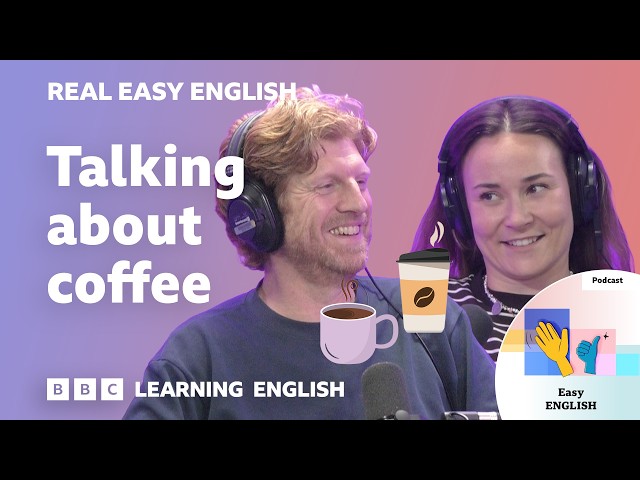
How do you take your coffee? ☕🥛🍯 Improve your listening skills with Real Easy English
BBC Learning English
0:00 Hi Neil.
0:00 How are you?
0:01 I'm very well thank you, Georgie.
0:03 Are you enjoying your coffee?
0:05 I am, but it's got a bit cool now.
0:08 I prefer my coffee hot, but...
0:11 oh well!
0:12 Are you enjoying yours?
0:14 I've finished mine.
0:15 Oh, that's a shame.
0:16 It's a sad moment when I've finished
0:19 my second coffee of the day, because that's it.
0:23 I don't have more than two.
0:25 So, we're talking about coffee in this episode, aren't we?
0:29 We are.
0:30 But before we start, of course,
0:32 everyone needs to know that there is a free worksheet on our website.
0:37 That's at bbclearningenglish.com.
0:40 Yes, they can also find a free transcript, can't they?
0:44 They can, yes, at the same address.
0:52 So, Georgie, we're talking about coffee.
0:55 How much coffee, or how many coffees if we're talking
0:59 about cups of coffee– how many do you have a day?
1:03 I usually have two, and I know that you do as well,
1:07 because we drink them both in the office, don't we?
1:10 We have one cup of coffee in the morning and one usually in the afternoon,
1:16 when we need to regain some energy and alertness.
1:21 Yeah.
1:22 And so, we all know because we make each other...
1:26 at BBC Learning English, we make each other coffee,
1:29 so we know how we take our coffee.
1:33 Yes.
1:33 'How we take our coffee' is how we like it– what we like to put in it.
1:38 For example, sugar or milk.
1:41 I know that you don't like milk in your coffee.
1:45 You take your coffee black.
1:47 I do.
1:47 I like black coffee and you take your coffee white and you used to have sugar,
1:53 but you don't anymore.
1:54 That's right.
1:55 Occasionally when I'm at home I put some honey
1:59 in my coffee to make it a bit sweeter.
2:02 Eurgh!
2:02 Honey in coffee?
2:04 Yes.
2:04 Is that surprising?
2:06 I've never heard of that.
2:07 Really?
2:09 Sugar, but not honey.
2:11 But why would that be so bad?
2:14 Well, I don't know.
2:16 It's just I've never heard of it.
2:19 It's really good.
2:20 I would recommend.
2:21 OK.
2:22 So, Georgie, what happens if you don't have your coffee?
2:29 Well, in the morning if I don't have coffee, I feel very grumpy and very tired.
2:37 In the afternoon if I don't have a coffee,
2:40 it's not terrible, but I would prefer to have my afternoon coffee.
2:45 How about you?
2:46 Yeah, I need my coffee, especially in the morning,
2:50 but I don't have my coffee first thing in the morning.
2:54 Oh, interesting.
2:55 I have it, kind of, I don't know...
2:58 work time– nine o'clock.
2:59 Why is that?
3:01 I think it's too strong, too powerful.
3:03 Or maybe just the way I drink it.
3:06 What happens if you drink too much coffee?
3:08 Ooh, then it's difficult to sleep because of the caffeine.
3:14 Caffeine is that chemical in coffee and tea that makes you feel awake and alert.
3:22 But too much means you're too alert.
3:26 I don't think that caffeine has a big effect on me.
3:31 I don't think I have trouble sleeping if I drink too much coffee.
3:35 It's strange.
3:36 Yeah, because sometimes I'll have an espresso after dinner.
3:40 Really?
3:41 Yeah.
3:41 And I can still sleep.
3:43 That's crazy.
3:44 Yeah.
3:44 Lucky me.
3:45 Lucky you!
3:47 Neil, have you ever tried to cut down on coffee?
3:51 Cut down on...
3:52 You mean have less?
3:54 No, I haven't tried to cut down on coffee,
3:57 but I've tried to cut down on caffeine.
4:01 OK.
4:02 So, I...
4:03 For a while, I only drank decaffeinated coffee, or decaf, as we call it.
4:10 OK.
4:10 And how was that?
4:12 Well, I didn't miss caffeine at the time, I don't think.
4:18 It lasted for a long time, but now I drink caffeine.
4:23 I don't care.
4:31 OK.
4:31 Neil, it's time to recap the vocabulary we used in the conversation.
4:36 We used the verb 'take'.
4:38 So, Neil, how do you take your coffee?
4:40 I take my coffee black, and I know you take your coffee white.
4:45 Yes.
4:45 We also heard 'caffeine', which is the chemical that is in coffee,
4:50 which makes you feel more awake.
4:52 Yes, but you can also get decaffeinated
4:55 coffee or tea– it means there's no caffeine.
4:58 And we usually shorten that just to 'decaf'– decaf coffee.
5:03 Yes.
5:04 We also heard the phrasal verb 'cut down
5:06 on', which means you have less of something.
5:09 Yep.
5:09 And you can also say 'cut back on'.
5:12 It means the same thing.
5:13 OK.
5:14 Well, that is the end of this conversation about coffee in Real Easy English.
5:19 Yes, and if people want to watch more episodes of Real Easy English,
5:23 what should they do?
5:24 They should go to our website, bbclearningenglish.com,
5:28 where they can find a free worksheet to test what they've learned.
5:31 Goodbye for now.
5:32 Goodbye!