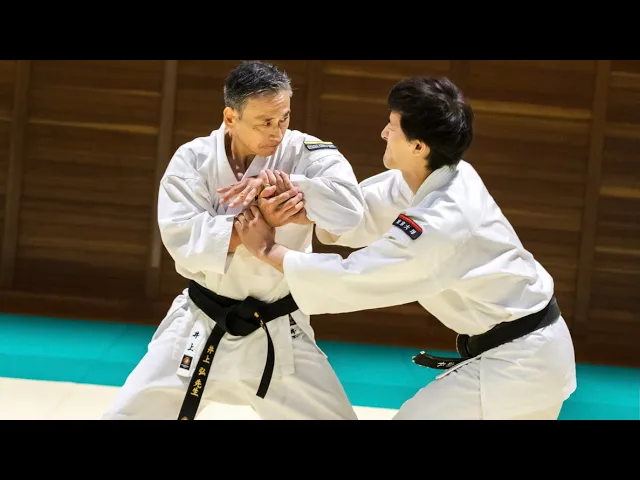
【55 minutes】This is amazing techniques of Shorinji Kempo!!
kuro-obi world
0:07 "The Iron Fist Karate Man" Taka Ishibashi will experience the techniques of Shorinji Kempo.
0:16 A special 55-minute edition with a thorough explanation by Hiromu Inoue sensei.
0:24 Let's learn together.
0:28 First, this is a protective gear specially made by Shorinji Kempo.
0:32 It was developed to ensure safety during intense practice.
0:36 What kind of structure is it?
0:39 Check it out, Taka!
0:41 This is a Shorinji Kempo's protective gear,
0:44 and this handsome man is Kawashima-sensei.
0:47 This is a funny situation that he is just being hit.
0:51 Thank you very much for your help.
0:53 What is the banging of it like?
0:54 It's very comfortable.
0:56 Let me try with "Seiken".
0:58 OK. I'm going to hit it.
1:01 I look happy, right?
1:05 OK.
1:07 Today, we are not here to film your training.
1:12 No.
1:13 We are here to film an introduction to Shorinji Kempo.
1:16 Yes. That's why we are here.
1:17 Kawashima-sensei, how did you feel about Taka's punches?
1:22 I felt they were heavy and was pleasantly surprised to take it.
1:28 Your protective gear is ingenious, isn't it?
1:32 Yes. It has a double structure - one on the inside and one on the surface - to absorb impact.
1:43 It is designed to cultivate a sensation similar to that of actually hitting the body.
1:51 If you hit it properly, it makes a good sound.
1:56 You can hear good hitting sounds like this.
1:59 If the hit is off, it sounds weird, doesn't it?
2:02 Yes. If it's just rubbed, it doesn't.
2:04 If the punch is correct, it makes a good sound.
2:07 The more accurate it is, the better, and I want you to look at this.
2:10 It perfectly covers the side of your body.
2:16 Even if you take down your training partner and hit the side, this will defend the person's body.
2:23 This is really well made.
2:25 It must be expensive, right?
2:26 Yes.
2:28 Was it developed by Shorinji Kempo? -Yes.
2:32 This was developed by senior instructors, including Inoue-sensei.
2:41 A face protector has also been developed, which has previously been shown on DVD.
2:51 Their "Kinteki" protective gear is also impressive.
2:55 It is also developed by Shorinji Kempo, isn't it? -Yes.
3:00 As Taka says, Shorinji Kempo protective gears are impressive.
3:05 Let's look back on that with the DVD "The Great Legacy2".
3:12 It's easy to hit, isn't it? -Yes.
3:14 May I do "Tsuki"? -Yes.
3:16 Yes. It's like that.
3:17 Sorry. I did too much.
3:20 This is great.
3:21 Is there no impact?
3:23 No. It escapes.
3:25 Even if I get punched, I can still see you.
3:30 So I can experience what kind of attack is coming
3:36 That's great.
3:37 This is how it is structured. It's double cushioned.
3:44 And we also developed this.
3:47 This is the one for matches.
3:53 I'll show you the principle behind this.
3:56 It's spherical so that this glove glides.
4:00 It slides in this way.
4:04 This is made to slide, so it has mitigation.
4:09 That means if you don't deliver your punch properly, your fist will slide on the surface.
4:18 When I teach the students, I let them punch this in this way.
4:22 A strike to the forehead or chin is a good way to know how to defend against it.
4:27 Then the defender parries the punches.
4:31 Finally, he practice to dodge them.
4:47 I see.
4:48 May I punch again? -Yes.
4:54 This is very useful. -Yes.
4:56 This product has a double cup.
4:59 You can kick here as hard as you want.
5:02 These are tightly fitted together.
5:10 Can I kick it normally? -Yes.
5:15 Naka-sensei was also surprised!
5:18 You can check your technique by hitting the gears accurately.
5:24 Both defenders and attackers are safe.
5:28 So it's a very good system.
5:30 In Shorinji Kempo, do you wear that protective gear in your "Enbu" practice?
5:37 Yes, we do.
5:39 And we also wear it when we punch and kick in the "Goho" practice.
5:45 You can use this to check the five elements of "Atemi" to see if your techniques actually work.
5:56 This way, the person receiving the technique must also take it seriously.
6:00 "Shushukoju".
6:02 This type of protective equipment is necessary to develop defensive skills.
6:07 Now please show us your "Enbu" practice wearing with that protective gear.
6:29 OK! Go!
6:31 OK. Make sure you lock the person.
6:33 OK.
6:42 Oss!
6:43 How did you feel?
6:44 To be honest, that was more than I expected.
6:53 I was very surprised.
6:56 What exactly surprised you?
6:58 I'm a bit of a learner myself, sorry,
7:02 but in Shorinji Kempo, your techniques are set in advance, aren't they? -Yes.
7:07 I didn't feel that at all.
7:11 They looked as if they were fighting normally.
7:16 It was very powerful and realistic.
7:20 I shouldn't compare with movie actions,
7:23 but it didn't look like the sort of moves where they were taking the attacks that came, and then attacking back.
7:29 I felt I didn't know what to expect.
7:33 The other thing is that their attacks were solid and accurate.
7:42 It's amazing because you can see that from their appearance.
7:45 Kawashima-sensei, as this is a demonstration, the techniques to be attacked are set, but I didn't feel they were set either.
7:52 Moreover, I thought each technique was well delivered as "Bujutsu".
8:01 What reason could there be for that?
8:05 The moves we make, for example attacking the partner's "Jodan", are preset.
8:11 But, there are "Maai" with the partner and a reading the atmosphere at each moment.
8:17 We're supposed to be doing the same thing every time, but because we're living beings it becomes slightly different.
8:23 So we have to think about that and attack strongly.
8:27 The defender also has to take it properly.
8:30 It is as if you are playing catch with your partner.
8:33 So not only do you have to work according to the arrangements, you have to think about the different "Maai" or timing.
8:43 In particular, punching and kicking while moving can be surprisingly difficult.
8:48 But, that's fun and good practice.
8:53 Striking, joint-locks and throwing have to be real, right?
9:01 Yes. In "Juho", your partner pushes, pulls or counterattacks, each moment being slightly different.
9:12 You have to read the direction of the force at that moment, handle it and counterattack.
9:18 I think that part of the demonstration helps train real techniques.
9:30 Awesome "Shorinji Kempo" kick!
9:32 The blade of the foot cuts the pressure point of the neck!
9:41 Today's theme is Shorinji Kempo kicking techniques!
9:45 First, let's start with this side kick!
9:49 Akimoto-sensei.
9:51 I've noticed you make an excellent side kick.
9:53 Could you do it again?
10:07 Now, Inoue sensei, please explain this kick.
10:12 For us, Akimoto-sensei's side kick is very impressive.
10:17 There are two patterns of side kicks.
10:21 This is the first pattern that you only turn your big toe up.
10:27 The second one is to turn all the toes up.
10:31 There are two.
10:34 By holding all your toes up you can use your extensor muscles and put this part out.
10:42 However, the disadvantage is that it is easy to sprain the toes.
10:51 If the toes are pointed downwards, this part is less likely to come out.
10:59 Then you will be less likely to strain your toes.
11:03 There is a difference between this and this.
11:05 I'll show you the difference with a stick.
11:11 There are two main ways of using the side kick.
11:18 You can use the heel of "Sokuto"( blade of the foot) by doing this.
11:22 It's this part of "Sokuto".
11:27 It's a point.
11:28 If I explain it with a stick, it's here.
11:33 When you use this part of "Sokuto",
11:41 you aim at "Suigetsu", "Maezanmai",
11:44 and "Danchu".
11:49 You want to aim at these and a pressure point is usually a point.
11:55 We believe that the correct attack is to thrust the point with such a tip.
12:04 So when you attack "Suigetsu", you can use your ball of the foot like this.
12:11 If you want to attack with "Sokuto", you use your heel instead of whole edge.
12:20 You tend to kick with whole "Sokuto" if the partner wears a gear.
12:23 If you use "Sokuto" as a line, in fact, it's dangerous.
12:33 Here there is a meridian vein, which is tubular in shape.
12:44 You should use a line against the one on the line.
12:46 What?
12:47 Here is a pulse.
12:49 It's not a point, it's a tube.
12:54 There is a pressure point here, but the pulse is also flowing, so you attack with "Sokuto" like cutting.
13:00 You use the line here.
13:03 So you may attack your opponent with the line,
13:07 or you may attack with your heel on a pressure point, such as "Mikazuki" here.
13:12 The foot is attached to the leg like this,
13:15 so kicking heavy objects such as human body can cause injury.
13:18 When kicking heavy objects you kick with this part of the foot, aiming for the pressure point.
13:25 And when kicking an area such as the neck, this is the better way to kick.
13:30 Taka! Please come!
13:32 You have 45 year experience of Karate.
13:34 Did you hear his explanation of "Sokuto"?
13:37 I see.
13:38 I explain to my students that you use the edge because "Sokuto" means a blade of the foot,
13:48 but when I actually kick I use my heel.
13:52 I was horrified to hear that they use their feet like blades to break the pulse here.
14:01 I've never heard of that. -Me neither.
14:05 You may have seen pictures of us jumping and kicking - that's what that means.
14:13 It's a dangerous technique though.
14:15 "Sokuto-geri" that cut off the pulse!
14:18 That sounds cool!
14:20 The idea is really impressive.
14:23 It's to the pulse of the meridian.
14:25 Therefore, we kick with a line.
14:27 Because you are kicking the weakest part of the body, you don't hurt your foot.
14:31 If you kick a human body with your foot in this shape, you will injure yourself.
14:38 That's why you need to use the point here.
14:42 Kicking to the face with "Mawashi-geri" is common.
14:46 But the idea of kicking the neck with "Sokuto" is surprising.
14:50 In Karate, we often see pictures of one person kicking another person in the neck.
14:56 Now I understand what it is.
14:59 When I was a university student and went to the headquarters to attend a training camp,
15:03 there were still direct students of the founder there.
15:07 I asked one of them about "Kote-nage".
15:14 He made the person in this state.
15:18 Then what he did next was,
15:20 kicking here.
15:23 This is a dangerous one.
15:25 That sensei was an old teacher from the founder's time.
15:29 He kicked me in the stomach and then stopped the kick short here.
15:34 He told me that it was the real fight.
15:37 We don't teach it now.
15:40 That was 40 years ago at a training camp at headquarters.
15:44 The old senseis were still alive.
15:46 They taught me that and stopped their "Sokuto" just short of my neck.
15:50 They did this.
15:51 I still remember the fear.
15:53 You may see pictures of someone jumping and kicking with "Sokuto", but that's not everything.
15:58 You can also kick down.
16:00 That's rather more practical in a real fight, isn't it? -Yes.
16:05 Maybe, this is for telling the opponents the fear and made them lose their will to fight.
16:12 It could be over-defense, couldn't it? -Yes.
16:16 To prevent that, they stopped their "Sokuto" on purpose and discouraged their opponents from fighting.
16:26 That's the way it used to be.
16:30 So, "Sokuto" has its use.
16:34 "Sokuto" can also be used for two-stage kicks, like Bruce Lee used to do.
16:39 In practice, I use "Sokuto" in this way.
16:57 It's like this.
16:58 Do you kick slightly downwards?
17:00 Yes. There are actually two patterns.
17:02 This is a normal kick that I also teach my students.
17:08 But you can also drop the kick.
17:10 You make your opponent like this and give the second one.
17:13 In other words, you don't let him do anything.
17:18 The normal kick goes upwards.
17:22 Like this.
17:25 But you drop it.
17:27 ※This is from another angle.
17:35 Kawashima sensei, could you teach him how to put the protective gear on?
17:43 It doesn't wobble at all.
17:46 Kawashima sensei, please hit him.
17:54 How is it?
17:55 That is double, so you don't get much of a shock, do you?
18:01 No.
18:02 But I still feel the weight of his punches.
18:07 His punches are very strong!
18:08 But this absorbs the shock properly!
18:12 What is this like?
18:14 I see, the inside is also hard.
18:16 Yes, it is.
18:17 Yes, two hard things collide with each other.
18:19 This is great.
18:21 It's surprising.
18:24 You will be safe.
18:26 Let's talk like TV shopping.
18:29 How much is that?
18:30 It must be expensive.
18:33 Amazing!
18:34 Now, take a kick from Inoue-sensei.
18:37 It's scary! Slowly first please.
18:41 Yes. I'll do it slowly.
18:43 You are the same age, 63 this year, right? -Yes.
18:47 I'll kick lightly. -Please.
18:51 Should I bend forward a little? -No. That's fine.
18:53 A little use of the ankle can help with this.
18:58 Can you kick gradually harder?
19:05 I'm totally fine with it!
19:06 Do you feel no pain but the shock comes? -Yes!
19:10 I feel the mass of the kick is transmitted.
19:15 Both the inside and outside plates are hard,
19:19 so indeed the kick does not smash through them.
19:24 This is a really well-made!
19:27 Incredible!
19:28 Here is the feature of this.
19:30 I have now mainly done this kind of "Keri-komi".
19:33 This kick is actually used when the opponent attacks.
19:37 He is attacking my "Chudan".
19:40 In this situation, if a woman kicks a man, she may be pushed back.
19:51 It's difficult to perform "Keri-age" in Shorinji Kempo.
19:54 So in the old days, when we had a single layer of protective gear, we used to teach people to counter kick.
20:01 Our original technique is using this kind of "Go-no-sen", but it was not easy to do.
20:07 With this kind of double structure, however, you can kick in space.
20:13 Someone said that this is space like a physical body.
20:16 By having space in this moment you can kick after blocking the attack.
20:25 With a single layer of protection, the impact will bounce back at you.
20:30 But with two layers, you can kick like this,
20:35 or like this.
20:38 So the double layer allows you to practice with "Keri-age" .
20:44 That is the best feature of this.
20:46 The other thing is when you practice punching like Taka-san did.
20:50 We normally use these 3 knuckles to punch.
20:53 But when we practice with this protective gear, we use 2 knuckles.
20:59 This is an applied way of punching; you use a grip.
21:03 We use these three when punching the body.
21:09 But when we punch hard objects like this, we use these two.
21:16 By practicing this applied punching technique, you will not hurt your fists.
21:22 In other words, this is like the difference between eating curry and rice with a spoon and eating pasta with a fork.
21:30 So when you hit the body you punch in this way.
21:34 This way is for hitting the gear.
21:36 Teaching in this way prevents everyone from getting hurt.
21:40 This approach causes injury.
21:43 So you do this way.
21:46 It's like this.
21:49 Actually, to tell you the truth, this is very hard.
21:53 Your fists will get a workout if you hit this every day.
21:58 Inoue-sensei's knuckles are actually big.
22:03 You can see these.
22:07 These are bigger than mine.
22:09 They've developed big.
22:11 It is not a callus on the fist, but the joint itself is developed.
22:15 Like you, when I use these two, I grip them in a way that puts the other two inside.
22:22 You need to study the grip too.
22:24 We do the normal Shorinji Kempo grip, and we also do a grip that dares to put these two out.
22:29 Could you do that again?
22:31 We usually grip in this way.
22:34 It looks like this.
22:37 But we also do the grip that put these two out.
22:41 The other two is in. -Yes.
22:42 Did you see it?
22:44 The normal Shorinji Kempo grip is like this.
22:48 It curved this way.
22:52 Yes. And another way is this.
22:55 These two come out.
22:57 We use this grip too.
22:58 We use this kind of grip when we punch the protective gear.
23:03 Do you need change the angle of the wrist?
23:06 Well... Obviously yes.
23:07 Yes. This part here is straight.
23:09 That's the difference between this and this. -Yes.
23:13 This is what it looks like at the moment the punch hits, but not before.
23:19 When it hits, these two go in and the other two come out.
23:22 I see.
23:22 You keep this state when you punch the body.
23:25 You also need to study how to grip to prevent injury.
23:30 I sometimes teach this to our students.
23:33 Another thing I thought is,
23:34 you hit such a hard object that if you don't know how to punch accurately and tighten your wrists, you will quickly get hurt.
23:45 Perhaps they can learn how to punch and kick accurately, with a lot of mistakes, and that is the beauty of this protective gear.
23:56 This is great.
23:58 Whether you are punching or kicking, you must think about "Seichusen".
24:02 If your punch is off the "Seichusen" your opponent will rotate.
24:06 It's same for kicking.
24:07 If the kick is off the "Seichusen", it doesn't work.
24:11 You have to capture it.
24:15 He will rotate if you punch like this.
24:18 It is a basic principle that you capture the "Seichusen" even though you attack from different angles.
24:25 Both attackers and defenders have to think about capturing and off the "Seichusen".
24:46 What is the secret of the arm that wraps around you like a dragon?
24:50 When you kick, you measure the distance with your supporting foot.
24:54 It's same as punching.
24:55 If the target is far, you kick this way.
24:58 So this leg decides the distance.
25:01 Kick goes from here.
25:04 If the target is bit far, you kick this way.
25:07 All kicks need this.
25:08 If you open this foot, the opponent will notice the kick is coming.
25:13 So your feeling has to be same as punching.
25:18 From here, you have to be able to do any attack.
25:22 You need this practice.
25:24 Kicking is one of the options during a series of attacks.
25:32 Even attacks are coming, you go in this way.
25:37 Inoue sensei, please let Taka experience this.
25:43 I'm going to attack this way.
25:49 I can't see his kick!
25:52 Yes. I can see that you are not seeing the kick.
25:55 You kick "Kinteki" in this way too, right?-Yes.
25:59 Wow! I don't want that!
26:00 It's incredible.
26:03 From here, I can see his whole body.
26:06 But from here, I can't see the kick.
26:08 He has a punch too.
26:10 You can hide your kick by this hand.
26:12 Yes.
26:13 So the kick will be thrown like this.
26:16 His kick comes from under this sleeve and I can't see it's coming.
26:23 So the attack will be like this.
26:27 You must be free to move in this way.
26:32 I feel that he has four hands.
26:35 You can do "Juho" from there, can't you? -Yes.
26:38 You said four but actually there is another one.
26:43 You have a head-butt too!
26:45 We don’t use it because it’s dangerous but you have to have these five.
26:50 I see.
26:51 After these you can head-butt.
26:56 So you go in this way.
26:58 Your leg is here.
26:59 Yes. I can sweep your leg.
27:04 This is great.
27:05 You are stunned.
27:08 When you punch me, for example,
27:11 I block and attack in this way.
27:16 But I can also capture the punch like this.
27:19 I see.
27:21 As long as my hand is inside, even if you withdraw your hand, I can capture it this way.
27:28 You have to be able to catch any attack.
27:30 This is one of the examples.
27:32 You can also go in this way.
27:35 When you punch, I catch it this way.
27:43 Is this what you did earlier? -Yes, spiral.
27:46 Actually, that was something I was wondering when I was watching their movements.
27:53 I'm going to ask the explanation for Sensei.
27:56 Punches go this way normally.
28:01 I'm going to use "Gyakute".
28:03 This block is one of the options.
28:12 Then I kick.
28:14 Let's do it slowly because it's hard to see it.
28:17 You put your hand out as if cross-counter.
28:22 Then you go in this way.
28:25 You draw a spiral.
28:28 His hand draws a small spiral.
28:32 Your opponent attacks in this way.
28:35 This is a normal block but you do this instead.
28:42 I'll show it slowly.
28:45 This is cross-counter.
28:48 When you do that, you take insurance.
28:51 Let’s change the angle.
28:55 It's this kind of punch.
28:57 You just change the punch this way.
29:00 And you go in.
29:03 Even if you block the attack with your line, you'll get punched depending on the timing.
29:11 But this way your hand will hit somewhere on his arm.
29:16 Then you go in this way.
29:20 Once you capture the opponent, you simply continue to do your technique.
29:28 You can do "Tenbin" to take him down.
29:33 You can attack inside here.
29:37 From here, we can continue 10 or 20 techniques.
29:41 Please explain this again to Taka.
29:43 At this point, you are in a position to cross-counter in one way or another.
29:47 This is a vital spot.
29:49 So you change it this way.
29:53 Taka, what do you feel at this moment?
29:56 You can see it's coming, right?
29:58 In Karate, we are used to this kind of movement.
30:03 But I don't like this because it's coming from below what should have come from above.
30:11 It's not here, but here.
30:14 Yes, plus we always put both hands in at the same time.
30:19 You'll get confused because what should be coming from the top is coming from the bottom.
30:25 And you get entangled.
30:28 This is called the "Ryu-no-te"(dragon's hand) and you entangle the opponent and you go in.
30:36 This is great.
30:37 You use the spiral to take the attack.
30:40 What about the position of the head?
30:43 It's normally here, right? -Yes.
30:45 So you do "Chidori" movement.
30:47 It'll be like this.
30:48 Your face will be still in danger so you put your hand here.
30:52 So you double or triple guard?
30:55 Yes. Your face should not be exposed in full.
30:59 As you block the attack, you can also do "Shuto-uchi",
31:02 then elbow strike.
31:04 In short, you also have your next next move ready.
31:07 If you throw a technique without thinking, you will be beaten immediately.
31:11 So you must prepare your next as soon as you enter.
31:18 From both sides.
31:20 If your opponent is large, you risk being lifted up,
31:25 so you entangle his leg.
31:27 Look at this!
31:29 You have to think about the low.
31:31 If the person is strong, you have to do it strongly.
31:35 Your weight will be on his leg fully.
31:37 That hurts the knee, doesn't it?
31:40 Yes, so this is dangerous.
31:41 The more he put up with it, the more my weight is on him.
31:45 That’s not good so we don't do that.
31:50 We do this when our opponent grabs us by the collar in this situation.
31:56 I just do it with my leg.
31:58 Instead of doing this,
32:02 I twirl my leg around him.
32:06 This is an application of that technique.
32:08 It can be used in many situations.
32:12 He is attacking me from the other way.
32:16 In response, I use my back leg.
32:24 It's hard to expect your moves.
32:25 Back leg can go inside.
32:28 You have to figure out all the "Kyo" above and below.
32:36 In practicing it, do you do it slowly at first, gradually speeding up and practicing it over and over again? -Yes.
32:49 Basically, if you practice this with the intention of blocking the attack, the movement becomes weaker.
32:55 So you need to be aware that you are cross-countering.
32:59 You go in this way while cross-countering.
33:05 What important is,
33:09 you have to be able to cross-counter properly.
33:15 You need this practice.
33:18 All you have to do is change the trajectory of this punch.
33:24 "Tai-no-sen" practice is first and then you can change it to capturing.
33:31 That's how the receiving side practices.
33:38 That makes sense because the moment you are counter-attacked there is nothing you can do.
33:43 Yes. That's what we want.
33:47 This is difficult to do, but in fact we practice entangling arms that have been grabbed in the early green belt stage.
34:01 We do this when we are held by an arm and take their hand in this way.
34:06 You can let your hand go through this way.
34:09 Or this way.
34:12 So I think we can learn this feeling at an early stage. -I see.
34:21 I think it's an interesting point,
34:25 because if you mix that into your punches and "Goho", you can do applied techniques like Inoue Sensei.
34:34 It also means how important it is to practice when you are a beginner? -Yes.
34:39 You must develop a sense of that. -Yes.
34:42 You said earlier it was like a snake fist.
34:45 But we compare it to a dragon.
34:47 You move your body like a dragon.
34:50 That's how I felt that if you practice it properly at the beginner stage, you can apply it later on.
35:02 What a sharp kick by Hiromu Inoue sensei, Shorinji Kempo!
35:07 Today, we will get to know the secret of this kick.
35:11 This is "Kaeshi-geri".
35:14 It is used in situations where your opponent is beside and in front of you.
35:20 There are many variations, such as you holding his sleeve.
35:24 The kick is released from this angle.
35:27 What was that?
35:29 In the first phase, you take a step forward and then kick.
35:33 But basically this kick is directly thrown from the side.
35:38 You have no motion.
35:41 This is how to kick.
35:42 He kicks with his ball of foot and I can't do that.
35:49 Look at his flexibility.
35:52 May I take your foot?
35:54 Look at this shape!
35:56 That's great!
35:58 So this is the opposite way of "Mawashi-geri".
36:02 Can you use the other leg?
36:03 What would you mean?
36:05 Can you kick with your left leg? -Yes.
36:07 Wow! Great!
36:11 Little further is better.
36:14 Amazing!
36:15 It's hard to see!
36:17 You can't expect you get kicked here!
36:22 He doesn't move his upper body at all. Great!
36:24 You keep this state and then kick.
36:29 Great!- Thank you.
36:32 There is another one.
36:35 You have this,
36:37 and this.
36:39 You use the instep to kick the face.
36:41 You have that one too. -Yes.
36:44 For example...
36:47 We have this.
36:48 I couldn't see it.
36:51 Kick him while apologizing like this.
36:54 It's also used this way.
36:55 It'll be so painful!
36:57 Even little touch hurt me.
37:00 Because I can control my foot well, I can kick here.
37:04 It's "Sokusen-geri"(kicking with toes).
37:06 Incredible!
37:08 You make the shape like this.
37:12 You use your ball of foot,
37:15 and the instep.
37:17 It is like this.
37:22 It must be painful.
37:24 So as you're apologizing and you kick.
37:28 I'll stop it though.
37:31 I can kick this side too.
37:33 Its variation and depth are amazing.
37:36 As with the fists, it is important how to use the feet.
37:40 You have to make a shape. -Yes.
37:42 You use "Sokuto"(edge)
37:44 and "Zensokutei"(ball of foot).
37:46 You use your ankle.
37:48 His feet can be used as weapons in various forms.
37:52 Everything must be done that way.
37:56 It's same as Karate.
37:57 Karate has "Koken" and "Uraken" etc.
38:00 You have to be able to use anything.
38:04 This kick can be used in these situations.
38:08 It's "Gedan-gaeshi" in "Enbu".
38:11 What a great kick!
38:16 Incredible!
38:20 Can you stop when you block the kick?
38:23 This is the angle.
38:24 It is hard to kick straight.
38:29 But this angle is easier.
38:31 You kick at right angles to the plane? -Yes.
38:35 One last time.
38:36 Then you can kick like he does.
38:40 This is a characteristic of the "Kaeshi-geri".
38:45 It has to be done from many different angles.
38:47 Moreover, you need to take the opponent's "Seichusen".
38:51 Taka, can you please throw a kick?
38:53 Am I kicking this way? -Yes.
38:55 "Mawashi-geri" is coming, then...
38:59 Amazing!
39:01 I couldn't do anything!
39:03 That's dangerous!
39:04 Incredible!
39:05 Let me do that again.
39:07 Kick is going then...
39:08 Great!
39:11 It could be to "Kinteki".
39:13 Did you hear that?
39:16 Your "Kinteki" could be kicked.
39:17 You would die, wouldn't you?
39:21 This is intense!
39:24 His flexibility is also great.
39:27 I don't think I can kick like this.
39:30 It's hard for me.
39:33 What kind of exercise do you do?
39:37 You'd better start with kicking a low target.
39:40 Step forward and take this angle if you want.
39:43 Contrary, we practice with bowlegs like this.
39:47 But you can use the step and kick "Gedan".
39:51 Then, you tilt your knee to the side while holding it in front of you.
39:56 Like "Namigaeshi? -Yes.
39:59 You take your knee this way and kick.
40:01 May I try? -Yes.
40:02 Put your leg forward little and kick from there.
40:06 From here? -Yes.
40:12 This is the same feeling as "Tekki Shodan" in Karate!
40:18 Sensei is good at teaching!
40:22 Now I was OK with "Gedan" but it would be hard if it's higher.
40:27 I think you can make it.
40:29 This is little bit hard.
40:31 You are almost there.
40:33 Really? -Yes.
40:36 This is great.
40:38 I had no idea of kicking in this part of the foot.
40:41 It was a good study.
40:43 Sensei is really good at teaching!
40:46 Because your body has already built.
40:49 We've just watched their "Enbu" and picked up what we noticed.
40:54 But I didn't expect each one is so deep.
40:59 Yes! That's right!
41:00 Each one of the techniques must have lots of essences.
41:03 Yes! It must have a lot!
41:06 Thank you very much.
41:09 This is surprising.
41:12 Earlier in "Enbu", I'm curious about something.
41:16 I've seen this kind of block in this channel before.
41:23 But, today, Sensei showed us a different one.
41:26 He was talking something about knee.
41:30 I'll show you how to go in against "Mawashi-geri".
41:33 First, you stop the "Mawashi-geri" this way.
41:36 Knee is the reference point.
41:38 Because you can estimate the length by the knee position.
41:43 So you react to the knee.
41:48 What?
41:49 I couldn't get it.
41:50 It's coming this way.
41:51 Your opponent cannot kick with this distance.
41:54 So you get close to him.
41:57 He can't go beyond this point.
42:00 So as you get close to him, you just move little inside.
42:05 It'll be like this.
42:06 There seems to be a secret to his footwork.
42:11 When this kick comes, you move this way.
42:15 You don't do any extra moves!
42:18 No. It's just little move.
42:20 The kick is coming this way and this is the key.
42:23 So the movement is this.
42:25 Please kick me.
42:30 I will go in like this.
42:33 Sensei disappeared now.
42:35 You're supposed to be here.
42:39 If your knee is this close, you can't kick, can you? -No.
42:45 If I'm inside this line, you can't kick me, can you? -No.
42:49 So you just change the distance and position.
42:52 I see.
42:52 Everyone loses balance.
42:53 As you get close, you change the angle. -Yes.
42:57 And you take the opponent's "Seichusen".
43:03 May I kick again?
43:05 Wow! This is it!
43:06 Take "Seichusen".
43:07 What about footwork?
43:09 It's like this.
43:12 Like this.
43:12 You move that leg first.-Yes.
43:14 Basically, it's this way.
43:16 But sometimes this way.
43:18 The basic is stepping with this leg.
43:20 As you change the angle...
43:23 You move this way first and change the angle.
43:26 And then you drop the kick.
43:30 When the opponent kicks, drop it like this.
43:34 As you drop it, you go in this way.
43:36 This is "Gyakute".
43:38 The last one was with my front hand but this is the other hand.
43:42 Do you feel he is shrugging off your kick?
43:46 Well... I feel my kick itself doesn't reach him.
43:49 Yes. It's like he is shrugging off my kick.
43:52 Just now, I dropped your kick.
43:54 Yes. I can feel that.
43:56 But the other one is...
43:58 See, it feels as if you're kicking air.
44:00 The most amazing thing about Sensei is that he counter-attacks with this move.
44:06 Everything goes with one count.
44:08 It's same timing as my kick.
44:10 Right?
44:12 Yes. It's all in one count.
44:13 This side can't do anything.
44:15 Avoiding is not this way.
44:18 It's this way.
44:20 I see. You use the imbalance.
44:21 Yes. Instability pushes stability.
44:24 You don't stand firmly.
44:27 So the movement will be like this.
44:29 You move off centre of gravity and use it to move forward.
44:35 You wouldn't be able to do this without building on this practice on a regular basis.
44:41 Taka-san noticed this particular point of your "Enbu".
44:46 Don’t you think he is also great? -Yes, he is.
44:49 He was looking carefully about my "Maai" and positions, so I feel he knows about "Budo" very much.
44:58 But I can't do the same though.
45:00 I think the level of this technique is quite high. -I think so too.
45:03 Do you have any particular name for that?
45:06 Yes. This is called "Haraiuke-danzuki".
45:09 You block and attack with the same hand.
45:12 Sometimes you step this way as an application.
45:15 The thing is that you have to be able to do that with both sides.
45:20 You do the same on both sides.
45:24 I noticed that you were saying anythings had to be done.
45:27 Even this little point has to be applied to a "Kinteki" attack like this.
45:36 You have to be able to attack other parts of the body as well.
45:41 That's what we do.
45:46 So we continue the attacks like this.
45:51 How should Taka attack if Inoue Sensei is in front of him?
46:01 For that matter, actually, we don't initiate an attack.
46:08 Because that's the self-defense techniques.
46:11 I see.
46:12 When I face Taka-san, I would change my "Kamae" depending on his "Kamae".
46:18 So if we face each other, I change my "Kamae" little bit like this.
46:24 If I take this "Kamae", will you change yours?
46:27 Yes, I'll change it naturally, because there are things that bother me.
46:33 So you adjust your "Kamae" to mine? -Yes.
46:36 It's like rock-paper-scissors.
46:41 "Kamae" shouldn't be like this.
46:43 When I take "Kamae", my opponent will take "Kamae" too, so I see it and adjust my hand positions.
46:51 You can see it, can’t you?
46:53 In everyday life, as a practice you can be aware of your posture by what kind of person is next to you.
47:01 Not every time, but I often think about whether my own posture is right for the person next to me.
47:11 For example, on the train, I think to myself, this person is here and I should protect my chin.
47:18 Then I think that the other side is open, so I should keep my hand free and ready for an eye strike at any time.
47:27 You do simulations, don't you? -Yes.
47:30 One technique for self-defense is how you position yourself according to the other person's style, the distance and the angle.
47:40 In your everyday life? -Yes.
47:41 I don't do it every time, but I think about it quite often, when I pass people, for example.
47:47 I can understand that.
47:49 I sometimes avoid people like this in crowded places.
47:52 Also, when there is someone in front of me, I sometimes anticipate their movement.
47:57 Some people may see me as a funny person though.
48:01 That is what self-defense means to us.
48:05 I often teach my students to take this "Kamae" and attack in this way.
48:10 You can block and punch with this.
48:13 But actually this is the same as apologizing.
48:17 This "Kamae" itself is self-defense.
48:21 The person may attack.
48:22 Yes. Then you can move this way.
48:25 So this is the meaning of your hand positions.
48:27 I see.
48:29 With this "Kamae", you can come close to the person, then also attack.
48:34 So one of the most important things to do is to take the "Kamae" so that the opponent doesn't know.
48:40 It shouldn't be like this.
48:42 This is your "Kamae" actually.
48:45 "Gasshourei" is the same.
48:47 You can do anything from here.
48:49 The opponent's mind is "Kyo" to me.
48:55 And I'm "Jitsu".
48:56 The difference between self-defense and matches is the presence of a referee.
49:02 You don't know when your match starts. -Exactly.
49:05 You have "Hajime!" in the matches but self-defense is different.
49:08 At this moment, it'll be over.
49:12 So it'll be no good to provoke a fight.
49:16 I believe that avoiding conflict is the spirit of self-defense.
49:22 It all depends on how you take "Kyojitsu".
49:28 How you make your opponent “kyo” is important.
49:31 Apologizing can actually lead to winning.
49:47 This hand goes back to the shoulder.
49:49 So you take your elbow to his shoulder.
49:54 Take your elbow here.
49:56 Then you can hook his arm.
49:59 It doesn't matter if it's a vertical or horizontal fist.
50:02 You can hook his arm.
50:03 Now, he is punching.
50:07 So you can use that move this way.
50:10 I didn't tell him what I was going to do.
50:13 He's never experienced it before. That's why he was surprised.
50:18 Instead of doing this,
50:21 I went in this way.
50:22 My elbow goes inside, so even if he backs off, it doesn't really matter.
50:29 At that moment, you can take the person down.
50:32 If it doesn't work, you go this way.
50:35 So you can use this to deal with the punch.
50:41 More he pulls back his hand, more you can go in.
50:45 If you want to use the other hand, it'll be like this.
50:52 I see. You don't catch his punch. -No.
50:55 That's the detail for the movement!
51:00 You don't grab it, you hook it naturally.
51:06 If you try to grab the hand, it will come off.
51:12 The opponent will try to pull back his hand naturally.
51:15 So you just put your hand in this way.
51:23 If you want to use the other hand, it'll be like this.
51:30 It's hard to see.
51:31 It's this way.
51:35 In fact, this is the basic movement for that.
51:38 Sorry. Does it hurt your fingers? -No. I'm fine.
51:42 He is coming so you go in this way.
51:43 He will pull back his hand definitely.
51:46 That's the moment, you go in.
51:50 He reacts this way.
51:52 So you move this way.
51:55 Prepare the next as well.
51:58 This is how we practice.
52:00 The same applies to "Jodan-zuki".
52:02 He pulls back his hand naturally.
52:05 So you put your elbow inside here.
52:08 This is same as these attacks.
52:12 So you apply these.
52:16 So you catch his elbow.
52:18 I've shown throwing from here.
52:23 But you can also take his wrist from the same position.
52:30 You immobilize the person.
52:36 This is the idea for everything.
52:40 For example, this is the same thing.
52:43 Give me a kick slowly.
52:44 He is kicking the inside of my leg.
52:49 So I put my foot the inside of his leg.
52:51 When he pulls his leg, my foot hits him.
52:54 So it's not block and kick.
52:56 You just put your foot in after blocking.
52:58 It goes to the target when he pulls back the leg.
53:01 Your foot is taken by him. -Yes.
53:02 That's the purpose of crossing.
53:05 You must always set up a counter-attack after the defense.
53:09 It's just like this.
53:11 After blocking the kick, you move your leg this way.
53:15 He pulls his leg and my foot hits the target.
53:18 It'll be a return move.
53:20 You set up and make sure this always goes to the target.
53:28 He is punching my "Jodan". This will be the same.
53:33 You move this hand in a spiral,
53:36 and you go in to his shoulder.
53:38 This is the same principle.
53:42 His hand always goes back to the shoulder.
53:44 You take your hand here and then it naturally goes there.
53:47 Everything is the same.
53:49 You need to insure this way because it is dangerous.
53:53 And you go in this way.
53:57 As long as you put your hand on it, you can manage it.
54:00 So it enables you to do the technique like this.
54:06 You can do this too.
54:09 You've given us lots of information.
54:13 But it's something even deeper than what I understand.
54:16 The timing is also important, isn't it? -Yes.
54:19 You have to grab your opponent's arm the moment he punches you.
54:22 You are led by your opponent's move, right? -Yes.
54:26 You really need to practice this over and over again to be able to do it.
54:32 You wouldn't want to punch someone like Sensei, would you? -No.
54:36 You wouldn't want to do anything if you knew he could do something like these.
54:44 What I've shown can be applied to anything.
54:47 "Chudan" kick is coming, for example.
54:50 You block it this way.
54:53 His leg gets floated.
54:57 Block the opponent's kick with your knee and his leg will be here.
55:01 You bring his leg here, then you deal with it.
55:08 What I did was raise my leg to solid this part here.
55:13 I made my flesh stronger.
55:15 I raised my leg in this way to avoid spraining my toes.
55:19 So when the kick comes here, I kick it back.
55:22 If I make it, I can continue to fight like this.
55:25 When I show them my techniques, they can do it in no time.
55:28 Because those are applications of the basics of Shorinji Kempo.
55:33 Same for local practitioners.
55:34 Those who has 4dan or 5dan cannot understand what has been done to them.
55:38 But once I explain it, they get it so quickly.
55:41 Because they've practiced the basics and the "Hokei" properly, they can apply them immediately.
55:46 80% of them master it immediately.
55:48 Those who haven't practiced can't get it.
55:50 Everything I do is application.
55:52 They know the importance of practicing basics and "Hokei" hard.
55:58 I think that is the good thing about Shorinji Kempo.
56:02 Inoue sensei, thank you very much.
56:10 Now, look forward to the next series!