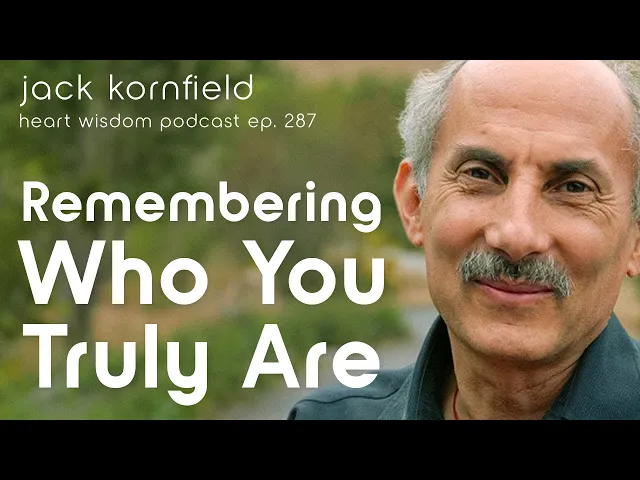
Jack Kornfield on Remembering Who You Truly Are – Heart Wisdom Ep. 287
Be Here Now Network
0:03 [Music] Greed, fear, hatred, and confusion are enormous forces.
0:12 It's just they're not who we really are,
0:15 says Jack Kornfield in episode 287 of Heart Wisdom.
0:23 Remembering who you truly are.
0:26 I am loving awareness disguised as Ganesha welcoming you to this episode
0:33 which was supposed to be from 1992 if you've been
0:36 following along but partway through Jack began talking about Ramdas
0:42 and his stroke so I know this one was at least beyond 1997.
0:49 The reason Jack brings up the namesake of this podcast network,
0:53 this Be Here Now Network, is because this episode is all about identity.
1:00 And no one better to exemplify this than Ramdas in all of the various
1:06 roles that he played throughout his incarnation
1:12 from astute Harvard professor to America's favorite
1:18 psychonaut to bakti guru upon his return
1:22 from India his time creating good change
1:26 in nonprofits and then the big maybe identity crisis of his life, the stroke.
1:35 So Jack speaks to his time with Ramdas after the stroke
1:41 and how Ramdas was exploring this mystery of identity ever deeper.
1:47 And I think the reflection here that Jack seems to be
1:50 pointing to is we are a society with an identity crisis.
1:56 the quote from the beginning.
1:58 Greed, fear, hatred, confusion, they're enormous forces.
2:02 It's just that they're not who we really are.
2:06 And it may seem oversimplified.
2:09 But if we were to all sit down
2:12 in spiritual practice and remember who we truly are,
2:17 that's the outside of the edges of the book.
2:21 Be here now.
2:22 It's not just be here now.
2:24 It's remember, remember, remember remember.
2:27 And in this podcast, Jack invites us into the space of meditation,
2:34 framing it as a sacred space of non-conumption.
2:40 I was just on a call with Jack and Trudy the other day talking about content,
2:45 creating content for social media and things like that.
2:50 And without thinking, I use the word consume.
2:52 It's actually a pretty common word nowadays that we're consuming content.
2:59 But I noticed this sparked Trudy and she made mention, oh, this word consume.
3:06 We're consuming content.
3:08 Look, look how things have changed the way we relate to what we're taking in.
3:16 Well, it seems in today's world, we're always taking something in.
3:21 Whether it's on our phone, whether it's on the computer through emails,
3:25 whether it's walking into a room and the television's going
3:29 or walking outside and there's a a billboard and music and ads,
3:36 and we're always consuming.
3:38 And what Jack offers is a perspective
3:42 of meditation as a sacred space of non-conumption.
3:49 He says there's no grade, no accomplishment, nothing you have to become.
3:54 It is the sacred space to listen and remember to listen and remember.
4:01 So that is why this episode is called remembering who you truly are.
4:06 Before we dive in, I just have the quickest
4:10 and most exciting bit of housekeeping I've given in a while.
4:16 Jack has a brand new course, Stand Up for Compassion, and it is completely free.
4:23 It is on jackhornfield.com and contains many hours worth of guided meditations,
4:32 teachings, instructions for walking meditation, brilliant writings,
4:37 journal reflections, and so much more.
4:41 All on how in this time of great change, this time of the great turning,
4:46 we can ground ourselves, find a deep spiritual rudder,
4:51 and from that place of balance,
4:54 stand up for compassion for ourselves and those around us,
4:58 and from there allow ourselves to imagine a beautiful new world.
5:04 This is a free resource, a free course on jackornfield.com.
5:10 stand up for compassion.
5:13 Hope to see you there.
5:15 There will be a link in the show notes if you just want to click in and sign up.
5:21 Otherwise, I invite you to sit back, relax,
5:24 and enjoy this episode 287 of the Heart Wisdom Podcast with Jack Hornfield.
5:30 Remembering who you truly are.
5:34 May you be happy and healthy.
5:36 May you be safe and protected.
5:38 May you find grounding and stand up for compassion.
5:42 And may you always remember who you truly are.
5:45 Namaste.
5:55 So the last few weeks for some of you who have come
5:59 on the previous Monday nights have been uh talks in the um domain of wisdom.
6:09 And one night a couple weeks ago,
6:11 we talked some about um knowing and knowing for oneself and really
6:17 investigating um the spirit of one's
6:20 own direct understanding, the one who knows.
6:23 And last week talked about the um reality of change
6:29 and the discovery of wisdom in the midst of change.
6:34 And tonight I'd like to continue with this theme of dimensions of wisdom.
6:39 Um sometimes for people um you get wisdom if you will
6:45 which in part tonight I'm going to equate with a kind
6:48 of perspective on life not being lost in life
6:52 but somehow having a broader wiser more spacious more gracious perspective.
6:58 Sometimes it comes from travel.
7:01 I have a psychologist friend years ago who did a a study of what had
7:05 really transformed and opened people's consciousness and traveling
7:09 to really different cultures and times and places
7:13 um is is one of the things that has done it because you step out
7:16 of your ordinary habits and roles and identity and see something in a new way.
7:24 Sometimes it's a brush with death only because death is stalking you.
7:30 Um, uh, does life become an unfathomable mystery?
7:35 Says Don Juan.
7:37 If it weren't for the fact of death, things would be ordinary.
7:40 But here we are, and then at some point, we're not going to be here in this way.
7:45 And of course, we don't really believe it.
7:48 But, you know, you can reflect on that yourself.
7:52 This from Susan Griffin, a poem called Born into a World Knowing.
7:58 This will happen.
8:00 Oh God, we say, just give me a few more breaths.
8:04 And don't let it be terrible.
8:06 Let it be soft.
8:08 Perhaps in someone's arms, perhaps tasting chocolate.
8:13 Perhaps laughing or asking, "Is it over already?" Or saying, "Not yet.
8:19 Not quite yet.
8:21 Not yet.
8:21 The sky has at this moment turned another shade of blue."
8:25 And see there a child still plays in the fresh cut grass.
8:35 And so we come to the temple or we
8:38 come to meditation to reconnect with another dimension
8:42 of our life than the kind of ordinary way
8:46 of doing and being to find wisdom or a perspective.
8:53 How refreshing.
8:54 The winnie of a packorse unloaded of everything.
8:58 It's an old Zen saying and it really talks about meditation.
9:03 Finally, you sit down and you just let things go
9:06 in a certain way and my experience whether it's traveling cuz
9:19 next week I'm going to go to the east coast
9:21 and I come back and then I go to Europe and teach
9:23 in the Alps for a bit and come back and you
9:26 know in this culture many of us travel a lot
9:30 even not traveling um is how um how different it is
9:36 from one place to another and how different I can be.
9:39 Um and then I come back and I say, "Oh yeah, right.
9:42 I live in this house and I have these roles to do,
9:44 but if I'm away for for a while, it's not really um so natural or obvious.
9:51 You know that experience?
9:52 You go for a even you go for vacation and you come back and you say,
9:55 "Oh yeah, work, right?
9:56 I have to do that again and how do I do all of that?" As I've said,
9:59 sometimes I'll sit on the airplane, people, you know,
10:02 introduce themselves and say, you know, what do you do?
10:05 And sometimes I'll say, well, I'm in sales, right?
10:08 It's just sometimes I say I'm in theater also.
10:13 And it's kind of I think it's honest, but you know,
10:17 but I come back um and and I think, okay, well, who am I now?
10:22 What is this role that I have to fulfill?
10:25 you know, you're pretending to be students and I'm
10:27 pretending to sit up here and be the teacher, but it's just tentative.
10:31 You know, we could easily switch places.
10:33 Um, and it keeps changing that way because our experience is not one life.
10:39 It is a succession of lives.
10:42 In the Mayan mythology, every hour is a deity, is a god.
10:48 and the Navajo teach their children that every morning when the sun comes up,
10:54 it's a brand new sun.
10:56 It's born each morning and lives for only one day
10:59 and in the evening it passes away, never to return.
11:02 The sun has only one day, they'll say to the children.
11:05 So you must live this day in a beautiful
11:08 way so the sun won't have wasted its precious shine.
11:17 in Buddhist teachings.
11:19 Although there are all these teachings of many
11:21 lives which are the kind of cosmology that you
11:24 may or may not believe and really isn't important
11:27 because birth and death take place all the time.
11:30 Even though the many lives stuff is true, you don't have to believe it.
11:33 It's all right.
11:34 You'll see anyway.
11:36 But anyway, um each moment is a new birth and each day is a new birth.
11:47 I remember talking to Ramdas after his stroke five or six years ago.
11:52 Um, and it was maybe a year after a year and a half
11:55 and he was still having a lot of trouble speaking and getting around at all.
12:00 And then he went to do teaching.
12:02 He did his first teaching gig after the stroke somewhere in the city
12:07 and someone took him there and he got up in his wheelchair and he
12:10 tried to speak as best he could and he came back and I saw
12:13 him that week afterward and I said how was it to be out teaching?
12:16 He said I didn't like it.
12:18 I said why not?
12:20 And he looked at me and there was this kind of sadness in his face
12:24 and he said because they want me to be Ramdas and I'm not him anymore.
12:35 And then as he's gone on to teach about it,
12:37 he says, you know, I've had so many incarnations.
12:40 I the the incarnation of the you know beautiful um son
12:45 in college and the professor at Harvard and then of course
12:48 getting kicked out and going to India and oh well
12:50 oh no before that getting kicked out and becoming the LSD
12:54 um you know guru of the country for a while
12:58 and then going to India and becoming the other kind of guru
13:01 with the sandals and beads and Baba Ramdas and so forth
13:05 and after that dropping that mostly and becoming the SA foundation.
13:10 patient founder and building eye hospitals and um you
13:15 know uh um all kinds of support and development
13:20 aid in every place from Guatemala to Indian
13:24 reservations to India and Africa and all this great
13:28 service or SA um and then um you
13:33 know doing a whole period of working with hospice
13:36 and death and dying he said each of these has
13:38 felt like an incarnation And now in my driveway,
13:41 he said, there was there's my old, you know, stick shift sports car.
13:44 In the closet is my cello and golf clubs.
13:48 And if I think I can't play golf anymore, I really suffer.
13:53 I can't play my cello anymore.
13:55 It's so sad.
13:57 But that's not me.
13:58 That was somebody else.
13:59 And now I'm born again into this disabled body.
14:04 And this is my new life.
14:07 And this is what you get.
14:08 You have to die and be born again
14:10 and again and take the curriculum basically whatever is offered.
14:14 This is the new class.
14:17 So who are we?
14:19 You know, are we the roles that we play
14:23 or is there some deeper truth of who we are?
14:26 I remember at the end of one of our three-month retreats that we've had
14:30 on the east coast at our center in Massachusetts for the last 30 years,
14:36 one year um the last week we had different visiting teachers come in and Kusan,
14:41 the great Korean Zen master from Nine
14:44 Mountains Monastery came in with his Zen staff
14:47 and looked out at these people who just
14:49 spent three months sitting and walking in silence,
14:51 peered at them for a while and said,
14:54 someone explained to him what they were doing.
14:56 And he said, "So you sit and walk, pay attention to the breath and mindfulness
15:00 of everything." He said, "Ah, this no good.
15:03 Wrong practice, you know.
15:08 Already everyone is in shock, you know.
15:11 Oh, I bet on the wrong horse or whatever,
15:13 you know." And then he picked up his staff and he looked very fierce
15:18 the way his end master does and he pounded his staff and says, "Only this?
15:21 What is this?
15:23 What is this?" This was his his whole teaching.
15:26 What is this?
15:27 To be alive, to be in a body.
15:29 What is this life?
15:31 This only only this is your meditation.
15:34 Of course, they were all like sitting in shock for three
15:38 more months to kind of come to terms with this visit.
15:43 But in fact, it was the same teaching.
15:46 It was the same practice as as they had been doing.
15:50 Who am I really?
15:52 What is this mystery of our identity?
15:57 Oh, nobly born.
15:58 It says in the Buddhist text, do not forget who you really are.
16:04 Or there's that beautiful story um in India,
16:08 the kind of Hindu story where the baby's in the womb and sings,
16:12 "Oh, do not let me forget who I really am."
16:15 And then the song changes right after birth to, "Oh, dear,
16:18 I'm forgetting already." But who are we that come into this remarkable
16:25 incarnation with the little fingers in the end that we take, you know,
16:28 takes a year or two to learn how
16:29 to grab things or some months anyway and, you know,
16:32 move it around and operate and then get
16:34 other people to do what you want and stuff.
16:37 I'm still working on that.
16:42 But who who are we really?
16:45 A poem from William Stafford, a wonderful poet called Ways to Live India.
16:50 It's titled in India in their their lives they happen again and again being
16:57 people or animals and if you live well your next time could be even better.
17:05 That's why they often look into your eyes and you know some far off
17:09 story with them and you in it and some animal waiting over at the side.
17:15 Who would want to happen just once?
17:18 It's too abrupt this way.
17:20 And when you're wrong, it's too late to go back.
17:22 You've done it forever.
17:24 And you can't have that soft look when you pass the way they do it in India.
17:32 So there's this sense somehow if we really
17:36 look at the mystery of coming into a body and having this form and sharing it
17:42 with all these seemingly separate bodies around us.
17:47 And it's there from when we were the smallest children.
17:50 I mean, if you have the chance to go and hold a newborn
17:54 baby and kind of look in the eyes of this newborn baby,
17:58 like just coming from wherever we come from, it's so wonderful.
18:04 Tell me a story about when I was a baby.
18:07 When you were a baby learning to fly, you couldn't control your lightness.
18:12 We never had a moment's peace.
18:14 We kept the windows closed all summer, but you were happy.
18:18 And everyone said, "Enjoy this.
18:20 He'll forget how by the time he's old enough to walk." And they were right.
18:26 By the time you were old enough to walk, it was all a story we were told.
18:30 When you were a baby and learning to fly,
18:33 you flew back and forth between your mother and I.
18:40 And so there's this returning to the temple
18:43 to meditation whatever spiritual life we have to come
18:48 back and touch the the the secret beauty
18:51 that Thomas Burton calls it that we were born with.
18:55 And it's not just us but it's really there in everything.
18:58 I mean, I remember going to see um Koko,
19:02 you you know her, everybody knows who Koko is,
19:04 who lived for a long time in PaloAlto and I think
19:07 has moved to Hawaii like many of us would like to do.
19:10 Anyway, um and Koko's the sign sign language speaking gorilla.
19:15 And we went up to see Koko cuz a friend of ours who speaks good sign
19:20 was taking my wife and daughter and I up to see her um and introduce us.
19:25 And we got up there and there's
19:26 this little green lawn outside where her pan was.
19:31 And we walked across the green lawn, my wife and daughter and I,
19:34 and we were introduced by our friend to Coco.
19:37 Coco, hey, this is Lyanna and Caroline and Jack and so forth.
19:40 How do you do?
19:41 And then Koko signed hello.
19:43 And then she signed pretty flowers.
19:46 And I looked all around.
19:47 There was just grass and dirt around there, you know.
19:50 And I shook my head.
19:51 I didn't understand.
19:52 And Coco looked again.
19:53 pretty flowers.
19:55 And then I I looked and I realized
19:57 that my daughter was wearing a floral print dress
20:00 with little flowers on it and Koko had
20:02 seen those and kind of like nice dress kid.
20:04 Where'd you get that?
20:05 You know, and it's so amazing because
20:09 there's Coco in there looking at us, right?
20:11 Or if as I have if you've ever swam with the dolphins,
20:14 swim with the dolphins and there's this huge wonderful eye that looks
20:17 at you and it's like you know the Dalai Lama kind of saying
20:21 cool you know how how about this one and you realize how mysterious
20:26 it is just to be incarnate and what do we do with this?
20:34 Now in our culture usually we make
20:37 our identity from what we do or our accomplishments.
20:40 you know that list of stuff that you put out
20:43 in India when you meet somebody they don't ask what you do
20:48 very much it's just not part of the culture so much
20:51 here it's like what do you do that defines you in India
20:54 the most common question when you meet somebody who's new
20:59 is what god do you worship you know is it Shiva
21:02 or Sarasati or Duruga or you know or or um Krishna
21:09 or whoever it happens to because that tells more who you are.
21:12 What what is your spirit, your soul you're being connected to?
21:17 That kind of a cool way to meet somebody, huh?
21:19 What what are you what are you here
21:21 to worship in this world rather than what's your job?
21:24 You know, I mean, what is our true nature?
21:28 Is it our job?
21:31 Ancient Mayan poetry.
21:34 If I were to lead you into the depths of the temple,
21:37 if I were to ask you which of these bones were which king, what could you reply?
21:43 You would say, I know not,
21:44 for the greatest and least are co confounded in common clay,
21:50 and the blackness of the tomb is the sun's womb,
21:54 and the dark night shines with bright stars.
21:56 And we are thus we are all arising out of the same source.
22:03 and disappearing into the same source.
22:06 You live in illusion, says Kalurbache, an illusion and the appearance of things.
22:12 There is a reality but you do not remember this.
22:16 And when you understand, you will discover that you are nothing.
22:21 And being nothing, you are everything.
22:24 That is all.
22:27 So we live in this illusion of separateness and as if this small
22:31 sense of self and our doing and activity is who we are.
22:35 But we are something so much greater than this.
22:39 And part of what makes meditation so extraordinary is
22:43 that to simply sit and not try to make anything happen
22:48 or get anywhere or do something is to step out
22:52 of our identity and our roles in the small sense of self.
22:58 As the said, the soul grows by subtraction and not by addition.
23:05 When we let go, when we make space,
23:07 that's when the heart grows, when we understand.
23:11 And here we are.
23:12 We sit down in meditation to kind of quiet
23:15 the mind and open the heart in whatever way.
23:17 And then we see our stories.
23:20 The victim, you know, that one,
23:24 the warrior, the workhorse, the nurturer, you know,
23:28 the the great mother or the lost soul, the fatalist or the sage.
23:33 I mean we can you know it's like Shakespeare what part do you want to play?
23:37 It really is you know and then we feel the roles
23:40 that have been dumped on us by society because of its expectations.
23:45 The suffering of it the injustice the the racism and the the complete
23:51 insanity of saying okay you look this way that's going to be your role.
23:55 You know um the kinds of fears that are sold to us.
23:58 a society currently that lives a lot from fear.
24:03 Are we going to take that as a role or the the role of the consumer?
24:08 You are a consumer.
24:10 You know, we want Uncle Sam wants you to consume
24:15 basically that that's what our nation has become in a way.
24:22 And then we come to meditation.
24:24 [Music] Yeah, quite a good product here.
24:28 And and what it offers us is a sacred space of non-conumption.
24:37 There's nothing to do, no grade, no accomplishment, nothing to have or become.
24:44 It is a sacred space to listen and remember and touch
24:49 the freedom of heart or spirit that is possible in any circumstance.
24:55 No matter what drama that you're in, being born or dying
24:59 or gaining or losing or praise or blame or pain or pleasure,
25:04 you got one of those today and tomorrow it might be different.
25:08 Whatever it is, there is within us a possibility of freedom in the midst
25:13 of all of that because those outer things are not who we really are.
25:20 They're part of the play, the game of life.
25:24 And in the stillness we rediscover
25:27 our connection to that which is silent, timeless.
25:32 We are surrounded by silence.
25:35 The galaxies are surrounded by intergalactic silence and so are we.
25:40 This vast stillness surrounds all the doing.
25:44 And it just takes a moment to remember it and reconnect with it.
25:51 And it's so nourishing and healing.
25:54 It's it's as if, you know,
25:56 that old African story of the people who put down the the bearsers who
26:00 put down their the luggage they were carrying um to let their souls catch up.
26:05 You know, we're not going to finish the journey until our souls can catch up.
26:11 So we begin to practice and it's really a practice
26:14 of letting go of emptying of the perspective of wisdom.
26:20 As the alchemical sage Hermes Tris Majistus says,
26:25 see with the eyes that can view your life as not
26:29 yet begotten and then that you are in the womb,
26:34 that you are young, that you are middle-aged, that you are old,
26:39 that you have died, that you are in the world beyond the grave.
26:43 Grasp in your mind all of these times at once and then
26:49 you can begin to see with the eyes of the divine.
26:53 See the whole arc of life, the dance.
26:56 Because time is really an illusion.
26:58 There's only now.
27:00 And now we can see all that there is in its own way.
27:06 And so we begin to meditate and space opens.
27:10 the kind of letting go, emptiness,
27:14 the spaciousness of awareness itself that thoughts come and go,
27:18 feelings arise and pass, and we can bow to them all.
27:22 And it's not that they're easy.
27:24 I mean, the forces of greed and fear
27:26 and hatred and confusion and so forth are enormous forces.
27:32 It's just that they're not who we really are.
27:35 They may be big, but they're not true in some fundamental sense.
27:42 They're part of the dance of life.
27:45 But when we sit and open and listen,
27:50 look with the eyes and heart of a Buddha, something else happens.
27:55 The armor of the body starts to loosen.
27:58 All the stuff that we hold inside,
28:00 you know, the unfinished business of the heart,
28:02 the tears come because we've been too busy running around
28:05 to grieve our losses and bow to them and let go.
28:10 General Norman Schwarzoff said,
28:12 "I don't trust a man who can't cry." Thank you, General.
28:17 You know, I mean, there's something important about that.
28:22 And so we allow the small sense of self,
28:25 the body of fear to be bowed to and respected and honored.
28:29 It's so precious that we have this day in this form.
28:33 And in doing so, it opens.
28:35 It starts to release.
28:36 It heals.
28:36 It allows and the heart starts to open.
28:41 The sorrows and creativity and grudges and longings and excitement
28:45 and expressions and all these different things are love come and go.
28:50 Bow all that to yes and we become the space
28:54 that senses our life coming and going all of it.
29:01 The mind quiets the heart opens in its own way and we see
29:05 the places that we get caught entangled and this is the basic Buddhist teaching.
29:10 There's suffering when we get entangled and there is
29:12 the freedom the joy of life when we let go.
29:18 And even now we sit this evening.
29:19 Are you listening?
29:20 And you know the places that you know cause the suffering now the clinging,
29:25 the fear, the confusion.
29:28 And underneath you also can probably equally well
29:31 sense the possibility of release and letting go.
29:35 The freedom of it.
29:37 This freedom is your birthright.
29:39 It is always with us.
29:41 It is always possible.
29:44 Who are we really?
29:45 Are we these limited roles or do we know and trust and live in this freedom?
29:54 You remember the passage from the Ojiway Indians.
29:58 Sometimes I go about pitying myself and all the while
30:02 I'm being carried by great winds across the sky.
30:09 And so we sit and after some
30:12 initial quieting the breath starts to breathe itself.
30:16 The thought storms come and go.
30:18 All the stories tell themselves and then there's a kind of opening.
30:22 We begin to trust the space of awareness
30:25 itself of compassion and the great heart
30:28 of a Buddha within ourselves to allow the praise and blame and gain and loss.
30:34 The mystery of life just to see it.
30:36 Isn't it amazing?
30:38 because it's not very much in our control.
30:41 I mean, you have things to do and tend to, but the big things who
30:45 you end up falling in love with or falling out of love with, you know,
30:50 what happens to your body probably where you end
30:54 up living and certainly where you were born and what
30:56 your family was like and various other things like
30:59 that you really don't have much say about, do you?
31:03 They happen.
31:05 And so there comes a sense that we are living out this pattern of mystery.
31:12 A friend of mine I remember who's a Buddhist teacher told me about
31:16 first going to the Himalayas and she was traveling around India just kind
31:20 of as a tourist and then she went up in the mountains and met
31:23 this Tibetan llama and he said you must come for our fire puja that we're doing.
31:27 So she decided to kind of follow this llama
31:30 and they went back into this valley in the Himalayas.
31:33 And there were about a dozen old llamas in a huge
31:37 fire and they were saying mantras and pouring butter on the flames
31:40 and you know there were the snowy peaks behind them
31:44 and around them some of the animals from the forest had come.
31:47 all these birds and creatures had come out.
31:49 And she said, "I walked in this glade
31:51 and there was the smoke pouring and the chanting
31:54 and the huge bonfire and the butter poured
31:56 on it and these animals looking along with the llamas.
31:59 And I felt that I had walked into an ancient world that was so
32:03 much more connected with what was true than anything I'd seen in my life.
32:08 And I just bowed down to this llama and I said, "Teach me something.
32:12 Teach me." But it's not just in Tibet.
32:16 I mean, it is every time a bird sings.
32:21 It doesn't have to be in the Himalayas.
32:24 Someone left here this beautiful poem
32:26 from Wendel Barry about the yellowthroatated warbler,
32:30 the highest remote voice singing in the top of the tallest sycamores.
32:37 You know, all he he was too close and then he landed on the railing of my porch.
32:42 He was too close to see with binoculars.
32:46 Only the naked eye could take him in.
32:48 A bird more beautiful than every picture of himself,
32:51 more beautiful than any human mind,
32:53 so small and inexact, could ever hope to remember.
32:57 My mind became beautiful by the sight of him.
33:04 And it's here.
33:05 It is.
33:05 It's around us.
33:06 The the people around us, even when they're in bad moods.
33:09 I mean, it's kind of like the wrathful deities at the temple.
33:12 You know, you go through the gates of the temple
33:14 and there's always these guardian demons and stuff like that.
33:16 So, sometimes you live with them.
33:18 That's okay.
33:19 You know, for a time you bow to them, you know,
33:22 thank you for meditation opens us to this mystery
33:29 and to the freedom beneath it all.
33:32 the mystery of identity because we take this small
33:35 sense of self you know and I had asparagus
33:37 for dinner right does that make me asparagus right
33:42 and I had bread so you know here's wheat from Argentina
33:47 and I had some cheese probably French cheese so
33:51 now I'm French partly I know that's not politically correct
33:54 but I am you know I mean it's so remarkable
33:59 that our life is so intertwined with all of life.
34:04 As Tiknan Han says, you know, when you can see with the eyes of a poet,
34:09 this piece of paper has the trees that made
34:13 it and the rain that rainclouds that watered the forest
34:17 and the logger who cut the tree down
34:19 and the logger's wife who made his lunch that day
34:22 and you know the baloney that was in his sandwich
34:26 and and the worms that arrated the soil
34:30 under that particular fur tree that was cut
34:33 And the history of a hundred million years of fur trees,
34:37 all of that and the engines that people have designed to, you know,
34:42 work chainsaws and the history of petroleum that works
34:47 in that and and every other mystery all
34:49 in this piece of paper because everything is what
34:52 we are seeing this we are nothing and being nothing.
34:56 We are a part of this fabric of everything.
35:01 And when we see with the eyes of a poet,
35:03 Miss Tiknad Han says, then we realize that the small sense of self,
35:08 what we get so frightened about the how we get
35:11 caught in our small story is not the whole game.
35:16 Whatever you think you are, says Narodat, my teacher, you take it to be true.
35:22 You identify with everything so easily.
35:24 I'm this or I'm that.
35:26 The habit of imagining yourself as perceivable or describable,
35:30 giving yourself a role is so strong with you.
35:34 I find this impossible.
35:36 The understanding that I am not this or that is the ground of my being.
35:41 Wisdom says I am nothing.
35:44 Love says I am everything.
35:46 Between the two my life flows.