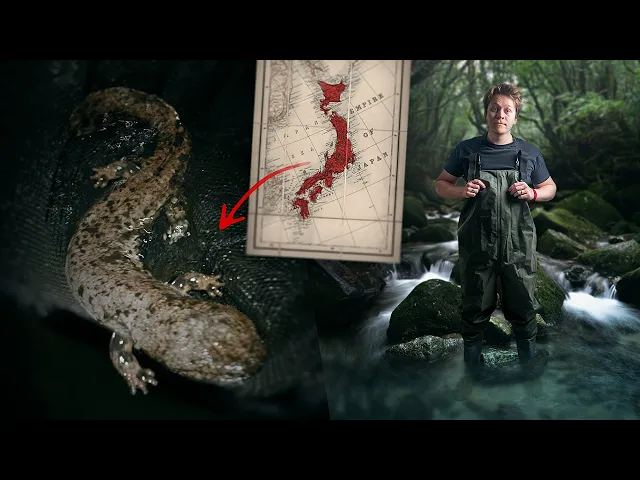
Searching for Japan's Giant Salamanders
Aidin Robbins
0:01 (water gurgling)- [Researcher] It is so different
0:04 than most other creatures living on this planet.
0:06 This is a big one.
0:09 [Researcher] It really is like seeing something from another
0:12 world or from the distant past in a modern time.
0:17 [Narrator] In 1726, Swiss zoologist,
0:19 Johann Jakob Scheuchzer finds an impossible fossil in Germany;
0:23 it doesn't look like any creature he's seen before.
0:27 (slow dramatic music) Scientists in the 1700s didn't believe in extinction,
0:33 so they weren't sure what to make of something like this.
0:37 Some said that it was a lizard or a fish,
0:40 but Scheuchzer claimed that this was the skeleton
0:43 of a human killed by the biblical flood.
0:48 In the 1790s, French zoologist Georges
0:51 Cuvier published a paper comparing the skeletons
0:54 of mammoths and elephants proving that they
0:56 were different and mammoths were gone.
1:00 He did the same for giant ground sloths,
1:03 pterodactyls, mosasaurs, proving the very concept of extinction.
1:09 (gentle music) In 1811, Cuvier takes a closer look at Scheuchzer's fossil,
1:16 and he concludes that the fossil represents not a human fish or lizard,
1:21 but an extinct giant salamander.
1:24 Yet another bizarre creature from the distant
1:27 past long gone from our world today.
1:31 (gentle music)- [Researcher] There are river systems already lost.
1:38 So we've got 23 million years,
1:40 couple of decades they've basically been wiped out.
1:44 (water gushing)- [Dr.
2:04 Yuki] I always think about, gentlemen, that 24 hours, 365 days per year.
2:11 [Interviewer] How many videos of salamanders do
2:13 you think you have on your phone?
2:15 Oh, yeah (laughing).
2:17 I never counted.
2:18 Maybe one...
2:23 In my dream I search giant salamander, "Oh, this is a salamander place,
2:27 but I can't, I can't find it." One million?
2:31 Maybe.
2:33 [Interviewer] Why is this a good place to come and find a giant salamander?
2:37 Yeah, because there is relatively big agriculture dam,
2:41 so they can't go upstream,
2:44 but another aspect, fish also difficult to go upstream.
2:49 So maybe they can get fish easily here yeah.
2:56 (water gushing) (gentle music)- [Narrator] The majority
3:04 of Japan is covered by steep mountains.
3:06 Some rising over 3000 meters high.
3:10 The climate is rainy, especially up here,
3:13 carving fast flowing rivers prone to flash floods.
3:16 Water from the mountains drains into the flatter valleys below.
3:21 Japan spans over 3000 kilometers north to south.
3:25 In the north it's subarctic, brown bears, salmon, puffins,
3:30 sea lions, in the south, subtropical, sea turtles, coral reefs, dolphins.
3:37 During ice ages, sea levels dropped connecting parts of Japan
3:41 to the mainland and allowing species to cross over from Korea,
3:44 Taiwan, and Siberia.
3:46 When the climate warmed and sea levels rose,
3:49 they became isolated, evolving into species,
3:52 distinct from those on the mainland, like the Japanese otter and tanuki.
3:57 This is the boundary between two of Japan's main islands, Honshu and Hokkaido.
4:03 They're really close together,
4:04 but the channel between them is over 200 meters deep.
4:07 So even when sea levels fell, these islands were separated.
4:11 The result is a strikingly different suite of animals,
4:15 black bears and Japanese wolves in the south,
4:18 brown bears and Hokkaido wolves in the north.
4:21 The endemic Japanese macaque and serow are only found to the south,
4:25 one endemic salamander and Hokkaido, all of the others to the South.
4:32 Japan is made up of thousands of islands,
4:35 including volcanic islands that have never been connected to the mainland.
4:39 Millions of years of isolation has
4:41 caused them to evolve completely unique ecosystems.
4:44 The Nansei Shoto in the south has also been shaped by deep ocean channels.
4:49 North of the Tokara Strait, the ecosystem overlaps with Mainland Japan,
4:53 south of the Kerama Gap, it's more like Taiwan.
4:57 The islands in between have been isolated for millions of years,
5:01 evolving countless endemic species, including the flightless Okinawa rail,
5:06 only discovered in 1981 and new species are still being described here.
5:12 This incredible variation in climate, land bridges,
5:16 islands, volcanic activity, connection, and isolation.
5:21 These are the factors that have given Japan one
5:24 of the most diverse collections of animals on the planet.
5:28 Over 170 mammals, 50 of them endemic.
5:32 In flat valleys and along the coast,
5:34 wetlands provide key habitat for insects and migrating birds.
5:39 The rainy forests and mountain streams are amphibian heaven.
5:44 Japan has nearly 50 frogs and over 60 salamanders,
5:48 almost all of them endemic, including the giant salamander.
5:53 (rain pattering) They're found in mountain streams in Central Japan,
5:58 spending the day hiding in burrows along
6:01 the riverbank and emerging at night to hunt.
6:04 They can live for over a hundred years and grow up to five feet long.
6:10 During the breeding season, they migrate upstream to spawn.
6:15 [Researcher] So we're in a feeder river within the Nawa River Basin.
6:20 [Interviewer] So this is like a perfect giant salamander habitat?
6:22 Absolutely.
6:22 There's lots of rocks of various sizes.
6:26 So salamanders can shelter during heavy rains, but also during the daytime.
6:31 The riverbank aren't concreted up, so they can also make nests.
6:35 There's lots of fish, crabs, and other prey items.
6:39 The flow of the river doesn't get so intense.
6:43 It's a stable environment for amphibians.
6:46 [Interviewer] How common is a habitat like this throughout Japan?
6:50 At this altitude, is extremely rare.
6:52 (water gushing)- First day in what sounds like just an absolutely magical place,
6:59 almost too good to be true.
7:01 It's a sacred mountain covered with old growth forests with clean water,
7:06 providing a critical refuge for Japanese giant salamanders.
7:11 (water gushing)- Someone told me about a teaching program in Japan.
7:15 A few months later, I was here in Tottori Prefecture
7:19 and I've been here 18 of the last 20 years.
7:22 On my first time in the river, I got to see a giant salamander and it
7:27 turned and slowly moved up through my legs,
7:30 brushing past my boot, and then slowly moved away.
7:34 That flicked a switch in my brain.
7:37 My nonprofit organization, Sustainable Daisen's focus,
7:41 for now at least, is on the Nawa River Basin.
7:44 There’s cool, oxygen-rich water running all the way to the ocean.
7:50 They can survive and breed at very low altitudes However,
7:55 because it's lower altitude, that means there's more people, more agriculture,
8:01 more industry, et cetera, and more disturbance.
8:05 So there's a lot more problems.
8:08 [Narrator] Around 13,000 years ago,
8:09 Japan's hunter gatherers began transitioning to a more sedentary lifestyle.
8:14 Many live near the coast or rivers, relying on resources from the water,
8:19 but choosing village sites carefully to avoid flooding.
8:23 Around 2,500 years ago, rice was introduced from the mainland.
8:27 Over several centuries,
8:29 its spread throughout the country and became Japan's main food source.
8:33 Valleys were cleared of their forests to make room.
8:36 Growing rice requires a lot of water, so people used earth,
8:41 stones or wood to build small dams,
8:44 irrigation channels, and embankments along the river's edges.
8:48 In the seventh century, they began damning valleys to fill reservoirs.
8:52 As the valleys got more crowded, flooding became a hazard,
8:56 so they built more canals to guide flood water
8:59 away from and small dams to slow water down.
9:03 Pictured rolling something down a set of stairs instead of a ramp.
9:07 Water became a key transportation network connecting Kyoto to trade
9:11 ports at the coast and logging operations in the mountains.
9:15 Rivers were dredged out to make room for boats and rafts.
9:19 Dams kept sediment out of the lower
9:21 reaches of rivers so ships could navigate them.
9:23 River courses were straightened or redirected entirely.
9:28 By the 1600s, around 30 million people lived here.
9:32 Growing Japan's population to this size
9:34 meant clearing forests, draining wetlands,
9:38 utilizing every inch of flat land available and reshaping how water moved.
9:45 (slow dramatic music) (insects chirping)- Now
10:00 it's just after the breeding season.
10:04 Actually, this season is the most difficult season to find giant salamanders.
10:10 because breeding behavior is very tough work for them.
10:16 So I guess after that tough working, they want to take a rest.
10:22 So most of them take a rest in the hole.
10:27 Giant salamanders want to go upstream to find
10:32 a good breeding nest before the breeding season.
10:34 Breeding nest is very special, restricted, special place,
10:39 so they have to reach to that place.
10:43 In urban river near my house,
10:46 two years ago, we could make sure they're breeding,
10:51 but last year and this year, I can't find any breeding behavior itself.
11:00 No giant salamanders gathering in the den.
11:05 (water roaring)- We've been in the water for 10 seconds.
11:18 And Alema just spotted a salamander.
11:20 I did.
11:21 I found one!
11:22 (water gushing)- [Dr.
11:26 Yuki] Japanese know giant salamanders over 1000 years ago.
11:30 There is a book about giant salamander
11:33 so people know the giant salamander itself.
11:38 [Narrator] Japan's culture has evolved in much the same way as its nature.
11:43 People and ideas have crossed over from different
11:45 parts of the mainland and evolved in isolation.
11:48 That isolation was particularly intense under the Tokugawa Shogunate.
11:53 Beginning in the 1600s, no one in no one out.
11:57 The only exception was Dejima Island.
12:00 This tiny Dutch trading post.
12:02 Merchants brought their doctors with them, including Philipp Franz von Siebold.
12:08 He arrived in 1823 and began trading his knowledge
12:11 of western science and medicine for information and permission to travel.
12:17 He hired Japanese collectors to track down rare plants and animals,
12:20 shipping hundreds of specimens back to Europe.
12:25 In 1829, the Japanese government suspected Siebold was a spy and deported him.
12:31 He took a giant salamander home with him,
12:33 the first ever seen alive outside Japan.
12:37 For European zoologists, this was insane.
12:40 Turns out Scheuchzer's fossil wasn't some extinct beast from the distant past.
12:47 Dozens of scholars wrote about the new species.
12:50 Some compared it to historical accounts from China.
12:53 Accounts of a giant four-legged river fish.
12:56 Giant salamanders were shipped to zoos in London,
12:59 Paris, Berlin, Frankfurt, Vienna, Hamburg.
13:04 At the same time, Spain was strengthening colonial control at the Philippines,
13:08 Britain was colonizing India.
13:10 The Dutch were colonizing Indonesia and France
13:13 was beginning to colonize Cambodia, Vietnam, and Laos.
13:17 China also had a policy of isolation.
13:20 Beginning in 1840, British warships forcefully
13:23 reopened ports and took control of trade.
13:26 In the following decades, other countries got involved.
13:29 France, Russia, the US, Spain, Italy,
13:32 Germany, Denmark, Belgium, Austria, Hungary, Netherlands.
13:35 By the end of the century,
13:37 about 90 Chinese ports were open and controlled by foreign powers.
13:41 (upbeat music) Understandably, many in Japan feared that they were next.
13:49 In 1868, a political revolution ousted the shogun
13:53 and declared a new government aiming to modernize, industrialize and westernize.
13:59 To resist the western powers by beating them at their own game,
14:04 they reorganized the government, prioritized rapid economic growth,
14:08 invested in infrastructure,
14:09 including beginning to use cement for their dams and canals,
14:13 and they embraced Western science.
14:16 Scientists flocked to Japan to study its endemic species.
14:21 In 1869, a French zoologist found a giant
14:25 salamander in the mountains of Western China.
14:28 The first European documentation.
14:31 Two years later, another French geologist compared giant salamanders from Japan
14:36 and China and claimed that they were two different species.
14:40 Most scholars were quick to dismiss that claim.
14:45 (gentle music) Japanese scientist Sasaki Chujiro
14:50 published new findings on giant salamanders reproduction.
14:54 Ishikawa Chiyomatsu made expeditions into remote mountainous regions of Japan
14:59 to study giant salamanders publishing his findings in European journals.
15:05 He recounts stories from people in the mountain villages,
15:08 what he describes as ancient fairytales,
15:10 to quote, "Many people believe in the presence
15:14 of colossal salamanders and misfortunes caused by them.
15:18 I was once told that in a deep spot upstream, a huge animal lived,
15:23 which once swallowed a woman and her child."- There is a very interesting story.
15:29 Huge giant salamanders over 10 meter.
15:32 All the people eaten by huge giant salamanders.
15:37 The brave young man killed that salamander.
15:41 But he killed by the ghost of the salamander and also his family.
15:49 Local people made the shrine to calm the ghost of the giant salamander.
15:56 Very special place.
16:00 [Narrator] Ishikawa also describes being served
16:02 giant salamander meat cooked in miso soup, simmer in shoyu or fried.
16:08 He claims that salamanders are hunted in large numbers,
16:11 eaten as a delicacy and used for traditional medicine.
16:14 He writes of rivers where giant salamanders were
16:17 once as common as frogs, but today are rare.
16:21 In some, they've nearly disappeared.
16:24 (water gushing) At the same time,
16:30 Chinese scientists were studying their own giant salamanders.
16:34 In the 1930s, they began claiming
16:36 that the Chinese version was a unique subspecies,
16:40 but most scientists in Europe and Japan continued to dismiss those claims.
16:45 (gentle music) Liu Cheng-Chao studied amphibians
16:50 and taught at the university near Shanghai.
16:55 In 1937, Liu became a refugee.
16:59 He spent 73 days trekking nearly 2000 miles
17:03 to Chengdu at the foot of China's western mountains.
17:08 Ironically, he had always dreamed of visiting
17:10 this region and studying its amphibians.
17:13 He took refuge here for eight years,
17:16 making expeditions into the surrounding mountains, finding new species,
17:21 and writing a detailed text on the amphibians of Western China,
17:25 including giant salamanders.
17:26 The book makes a bold claim that the Chinese giant
17:30 salamander is not the same species as the Japanese giant salamander,
17:35 not even a subspecies, but an entirely distinct species.
17:43 Around the same time, Ikio Sato was writing a similar book about the salamanders
17:48 of Japan conducting extensive field work
17:51 throughout the country and its colonies.
17:54 He wrote in detail about giant salamanders, including their breeding behavior.
17:59 He theorized about Japan's biogeography, the variations in climate,
18:04 the deep ocean channels, the ice ages, the islands.
18:09 The book was completed in 1943 with about
18:12 a thousand copies printed by a publisher in Osaka.
18:19 In the spring of 1945, the US began bombing Osaka.
18:24 Most copies of Sato's book were destroyed.
18:30 On August 6th, 1945, Sato was commuting to his lab in Hiroshima.
18:38 Sato's lab, his specimen collection and the original
18:42 version of his book were destroyed.
18:46 He suffered burns and radiation poisoning and died five days later.
19:03 The Second World War left Japan with a weak economy,
19:07 flattened infrastructure and food shortages.
19:10 The government poured money into flood control, agriculture,
19:14 hydropower and water building thousands of dams and canals.
19:22 In 1951, Japan's government took action to address the overhunting of giant
19:27 salamanders for food and medicine by designating
19:30 the species as a natural monument,
19:33 even just touching a giant salamander without a special license was now illegal.
19:39 In 1973, a businessman in Okayama, let's say spotted a loophole.
19:46 He imported about 800 giant salamanders from China,
19:50 keeping them in captivity and selling them to fancy restaurants for food.
19:55 Because the animals weren't from Japan, they weren't legally protected.
20:00 Before long, the government shut the operation down.
20:04 Probably some of that animal escaped or released.
20:08 (gentle music)- [Narrator] At the start of the 2000s,
20:14 DNA testing was allowing researchers
20:16 to study salamander populations in more detail.
20:20 It revealed new species and subspecies and proved without a doubt
20:25 that Chinese and Japanese giant salamanders were two separate species.
20:32 In 2005, a DNA study recorded Chinese
20:36 giant salamanders in the Kamo river in Kyoto.
20:40 In 2008, the same researchers published the first
20:43 evidence that Chinese and Japanese giant salamanders were hybridizing.
20:49 The Chinese giant salamanders and the Japanese
20:52 giant salamanders are capable of breeding.
20:56 So you've got hybrid salamanders.
20:59 [Narrator] A study published the next year found that three quarters
21:02 of the Kamo River's giant salamanders were either Chinese or hybrids.
21:08 The year after that, it was 86 out of 87.
21:14 Hybrid animal is so strong and so active.
21:18 Far more aggressive than either of the parent species.
21:21 [Dr.
21:22 Yuki] They can move very long distance.
21:25 That is not like pure giant salamander.
21:28 Eat more food, grow quicker, fight stronger and harder,
21:32 and the way the breeding biology works is
21:34 that males will fight to control a breeding nest.
21:39 So it’s difficult for pure giant salamander to win the hybrid.
21:44 There are river systems already lost.
21:47 [Interviewer] Is there a risk of them expanding into other rivers?
21:51 Yeah, in the future, yeah.
21:53 Many place probably.
21:54 Yeah.
21:55 Hybrid animal can spread.
21:58 (gentle music)- The Japanese giant salamander has been
22:09 in its present form morphologically for around 23 million years.
22:15 If the hybrids take over, that ancient lineage is lost.
22:20 So the species is lost.
22:23 [Interviewer] What can be done to mitigate the spread?
22:29 Yeah so difficult.
22:30 One big female can breed over 1000 eggs.
22:36 If 1% of the offspring can grow up, 10, yeah hybrid animal spread.
22:45 So it's so difficult.
22:47 All we can do is to get rid of the hybrid animal from the wild.
22:56 Japan has an aging population, so more old people and very few children,
23:01 empty elementary schools and nursery schools all around Japan.
23:05 And a lot of those have swimming pools.
23:07 So they've been filling up these swimming pools.
23:10 It has become so expensive just to keep them alive.
23:14 Plus conditions they're in is really unnatural and awful.
23:18 It's not the hybrid's fault that they're hybrids, right?
23:21 This area has no known records of hybrids yet.
23:27 (water gushing)- [Narrator] Even in the rivers the hybrids haven't reached,
23:30 giant salamanders are still at risk.
23:36 This is what's called a weir or an agricultural dam.
23:37 Basically a wall within the river system.
23:41 In Japan, we have also concentrated heavy rain.
23:44 Giant salamander also washed away.
23:46 They can't go up to the agriculture dam.
23:51 So many giant salamanders stopped.
23:54 If the sides of the river were kind of natural around it,
23:58 then they would be able to come out and around.
24:00 But always, there's high concrete walls.
24:03 They'll spend night after night trying to get up.
24:07 It's very common to find quite severe injuries to their feet.
24:12 Giant salamander want to go upstream to find
24:16 a good breeding nest before the breeding season.
24:19 There are many damns, so they can't go back, so they move gradually downriver.
24:26 Some females spawn the eggs just down place of the dam,
24:31 but that is not good place.
24:32 So the eggs washed away.
24:35 (gentle music)- Nearly every river in Japan has been dammed.
24:42 Even deep in the mountains, small dams for flood control are everywhere.
24:47 In just this short section of river, I counted 53 of these walls,
24:53 and each one of those walls is a barrier,
24:56 which restricts them moving to suitable breeding grounds.
25:00 And it also means one step closer to the ocean,
25:05 and once they get into brackish water, sooner or later they're dead.
25:09 In Hiroshima several years ago,
25:11 we found one big giant salamander three kilometer from the sea place.
25:15 We moved the animal to the zoo.
25:19 But a few weeks later, the animal passed away,
25:23 probably have a bad effect of salt.
25:27 Probably many, many giant salamanders washed away.
25:30 People don't notice.
25:33 So we have to make a gentle slope.
25:41 This is an example of quite an effective ramp that we built ourselves.
25:45 So we basically piled up huge amounts of rock into the corner here.
25:52 So a salamander could climb up on its own accord.
25:57 [Narrator] It really is this simple,
25:59 a little concrete ramp for each little concrete dam.
26:03 So what's the holdup?
26:06 Most of the river is government.
26:11 So government have to manage the river environment.
26:16 So we have to get government permission
26:20 and Japanese government want to follow another example.
26:26 It's difficult to do the fast action.
26:29 It's difficult to gather much money.
26:33 I managed to get a meeting with the top politician for this region.
26:37 We demonstrated to him that this situation
26:41 could be largely fixed by installing ramps.
26:45 In his opinion, there wouldn't be enough
26:48 public interest and therefore there's no money.
26:50 Our plan is to privately fund ramp installation
26:55 all the way to the ocean and then
26:57 all the way up where they can move to a beautiful natural habitat to breed.
27:02 We ask the construction companies to come and give us a quote,
27:06 and then we find a private sponsor for each and every weir.
27:10 So it could be a private company, it could be a Saudi prince,
27:14 it could be an elementary school in Wyoming that does a readathon.
27:20 I'd have no idea why I said Wyoming, by the way.
27:22 Or you could sit in a bathtub of maggots
27:24 for a week for sponsorship, whatever it takes.
27:27 They're always trying to feed this construction industry beast.
27:32 So we're actually feeding the beast, but in a way that's actually beneficial
27:36 to the environment for a pleasant change.
27:41 [Narrator] Dams aren't just bad for salamanders.
27:43 They allow sediment to accumulate and alter the flow of the river,
27:47 degrading the entire ecosystem.
27:52 The rivers, apart from one or two,
27:54 that flow into specific areas, have almost zero protection.
28:00 It's no use just to focus "Don't touch the animal,
28:04 don't hunt the animal," if all around them concrete has been poured.
28:10 [Narrator] Dam construction peaked in the 1960s and has been declining since.
28:15 As the population leveled out and eventually started to decline,
28:19 demand for water followed.
28:21 Also, so many dams had already been constructed
28:25 that there just weren't many places left to put them.
28:29 Today, many dams are aging and becoming expensive to maintain.
28:34 And in 2003, Japan's first ever dam removal was announced.
28:43 I would like to say yes, we can convince the government that they're
28:49 important enough to do something about.
28:51 It's clear that the government systems in place are 100% uneffective.
28:58 Japanese giant salamander is designated a natural special monument.
29:02 So giant salamander is a cultural being.
29:08 So the staff of the culture organization do giant salamanders working.
29:16 They don't have a special knowledge for the biology.
29:20 In Japan, we don't have specific biologists in the government.
29:26 Probably many government doesn't know the present situation well.
29:34 We have good culture.
29:36 So bottom up approach is a very
29:39 important approach to promote conservation activity.
29:43 (water gushing) Asa Zoological Park, Hiroshima developed the artificial nest.
29:54 After they succeeded in the zoo facility,
29:59 they put the artificial nest in the wild as well,
30:02 and they also succeeded breeding in the wild as well.
30:07 River environment is very difficult.
30:09 Many sand compiles.
30:12 Zoo staff and local people clean the nest before the breeding season every year.
30:19 Every year, early September is breeding timing.
30:23 This year, breeding behavior is a delayed one week.
30:27 Probably the high temperature
30:29 of the summers delayed giant salamander's breeding.
30:35 In Japan, we have also concentrated heavy rain.
30:39 In the past that is very long time, once a long time,
30:43 but now every year we had many severe damage of flooding and heavy rain.
30:51 I worry about in the future if the Japanese summer becomes hotter and hotter,
31:00 I think many can't breed in the future.
31:05 (solemn music) (solemn music continues)- [Narrator] Overhunting
31:48 and habitat loss have tanked populations of brown bears,
31:52 black bears, sea otters, seals.
31:57 Loss of lowland forests and wetlands has reduced populations of serow,
32:02 migratory birds and so many others.
32:06 On smaller islands, introduction of invasive
32:09 predators threatens countless endemic species.
32:13 The Hokkaido wolf was hunted to extinction by the end
32:16 of the 1800s and the last recorded Japanese wolf was shot in 1905.
32:22 The last Japanese sea lion was recorded in 1974 and in 2012,
32:28 the Japanese otter was declared extinct.
32:32 The Ministry of Environment lists about a fifth
32:35 of Japan's reptiles and birds as extinct, endangered or vulnerable.
32:40 A quarter of fish and a third of mammals and amphibians.
32:47 Things are disappearing and that's such a shame for future generations
32:52 that it's gonna be pretty much wiped out by one generation.
32:57 (water gurgling) People have made mistakes in the past, but for me,
33:04 it's like, okay, what's in the past is in the past.
33:06 How do we change it now?
33:08 I think we have to make some protected area.
33:13 Now there's no like these protected places.
33:17 In my opinion, we gather some wild animal
33:20 and breed in the artificial condition and spread some animal.
33:26 When they are young stage, the mortality is very high.
33:30 So to take care of them for several years and after that, they're released.
33:37 Maybe in the future we should do like that activity.
33:42 A large focus of what we do is on the whole environment.
33:48 How are the forests at the side of the river?
33:50 How about farming practices?
33:52 What waste is going in?
33:53 How is the water quality affected by what's around the river?
33:58 The good habitat we have to conserve and for the bad environment,
34:04 we have to modify them.
34:07 [Narrator] Thanks to decades of work from conservationists,
34:09 things are slowly but surely improving for many of Japan's endangered species.
34:15 But for others, the country is at a crossroads.
34:19 Invest heavily in protecting habitat and controlling invasive species
34:24 or allow some of the planet's most unique creatures to disappear.
34:30 (solemn music)- I strongly believed that I could do something,
35:06 so therefore it's my responsibility to do it.
35:10 And if I don't do it,
35:12 then I am also responsible for the death of the giant salamanders in this river.
35:18 It's been equally frustrating, depressing, inspiring, wonderful.
35:28 (gentle music)- We have very good culture of giant salamander.
35:41 We have many, many books and we have festival of giant salamander.
35:45 We have songs.
35:46 Many Japanese loves animals.
35:53 Japanese toad.
35:54 Super cute.
35:55 [Dr.
35:55 Yuki] Yes, super cute yeah.
35:56 [Interviewer] Endangered Japanese toad.
35:59 [Dr.
35:59 Yuki] One species of snake like to eat this toad.
36:03 That species got poison from this toad.
36:07 [Interviewer] Huh?
36:08 Fascinating.
36:09 [Dr.
36:09 Yuki] Yeah.
36:10 (gentle music)- Despite all the rumors
36:14 and legends of this river dragon or whatever, they're really chill creatures,
36:21 and I've had the honor to be able to research
36:23 them and it's important to check their feet, for example.
36:27 If I'm gentle and soft,
36:28 they will let me count their toes with my hand under the water.
36:33 So these gentle, beautiful dinosaurs,
36:38 it's so different than most other creatures living on this planet.
36:42 It really is like seeing something from another world
36:45 or from the distant past in a modern time.
36:50 (gentle music)- [Dr.
36:55 Yuki] They're one species,
36:56 but they live a lot of habitat from very tiny to very big river.
37:03 So I want to know their adaptation.
37:07 Their lifespan is so long.
37:09 So I want to know their behavior in each life stage.
37:14 I want to know all the night behavior,
37:16 yeah, I wanna know all the aspects of them.
37:20 I'm not sure why I love giant salamander
37:24 like this, so I want to know the reason.
37:28 (solemn music) (water gurgling) (solemn music fades)