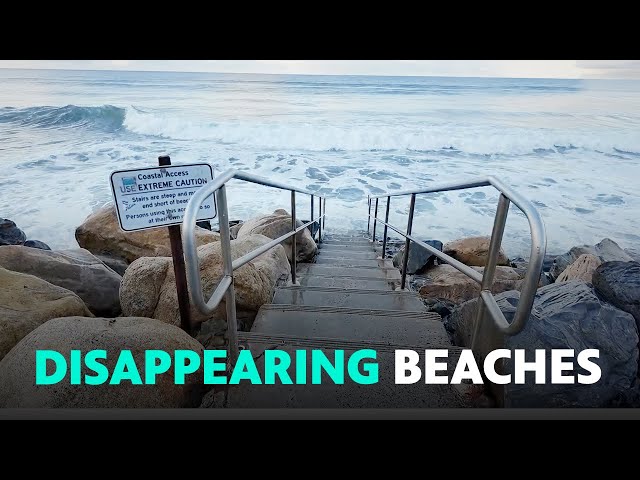
The Fight to Save California’s Coast
PBS SoCal
0:04 -The beaches in Oceanside are super important to the individuals that live here.
0:09 It's a part of their culture.
0:11 Most people have been in the water,
0:13 and a lot of them surf on a daily to weekly basis.
0:17 They're also raising their kids in that same style to enjoy the ocean.
0:22 It's our most beloved piece of Oceanside.
0:25 -A lot of people assume that beaches are natural,
0:28 but, especially in Southern California,
0:30 we are trying to control the beaches, maintain them, keep them around.
0:36 If you've lived here your whole life, you've seen very lush, wide beaches,
0:42 but in one or two generations,
0:44 we've seen a dramatic change in the beaches, a dramatic loss.
0:47 We haven't been able to keep pace with the rate of erosion.
0:51 Climate change, sea level rise are
0:53 a definite threat to the community of Oceanside.
0:56 That's why the city has been investing in trying
0:59 to adapt the coastline and get it ready for these conditions.
1:03 -It's hard to walk here because these rocks are brand new to the area.
1:09 Five years ago, we never had rocks like this on the beach.
1:13 I have to come from a point of always safety.
1:18 Has the ocean remained safe to teach surfing?
1:21 Yes.
1:22 Now, has changes in the sand, in how far the tide comes up,
1:28 how far the tide goes out, have those looked different over time?
1:31 Absolutely.
1:34 -In Southern California,
1:35 we have this loss of sediment that's getting to our coastline.
1:39 That really has a big effect
1:41 on the natural sand restoration that happens on beaches.
1:45 In Santa Ana River watershed, for instance,
1:48 in Orange County, that's all been flood-controlled.
1:51 It's all concrete lines.
1:52 That means your river system is not eroding anymore.
1:55 It's not gathering sediment and eroding on the banks.
2:00 Basically, what's happening is there's not
2:02 enough sediment traveling through the watercourse out
2:04 into the literal cell or the currents that flow around in the ocean.
2:09 That's not allowing for sandbar development,
2:12 which diminishes surfing and a lot of other things,
2:16 but it also diminishes that capability
2:18 for naturally beaches to restore themselves.
2:21 -What would the shoreline look like without a beach?
2:24 -If you'd like to see what it looks like, you can go down to South Oceanside.
2:28 Without a beach, what we have is a fixed shoreline that is lots of revetment,
2:34 essentially riprap revetment, which is large boulders that are placed.
2:37 The whole purpose is just to protect the home or the infrastructure behind it.
2:43 The more and more erosion that we see,
2:46 the more we see those types of ad hoc protection mechanisms,
2:50 throwing riprap against a piece of infrastructure to protect it.
2:54 That's really not what we're trying to do.
2:56 We're trying to be more proactive and thoughtful about it.
2:59 -If you even flail off to the side or just
3:02 jump in, it's all a part of the process.
3:05 over.
3:05 People want sand.
3:06 [chuckles] People want the sand.
3:08 I think it's the softness, the welcome-mat aspect of it,
3:13 the fact that it's sand and you're at a beach and you expect sand.
3:16 That's huge just to not have access to all of this and to not
3:21 have part of the world closed off to you that's right in your backyard.
3:26 -In Oceanside, we're trying to use
3:28 many different coastal management tools to restore
3:30 all the beaches on our 3.75 miles of coastline that we own.
3:35 To the north of the pier, where we have sustained beaches,
3:37 we're trying to utilize the sand that we still have,
3:41 and we're trying to build up the back beach with sand dunes.
3:46 In Southern California, sand dunes are not like the East Coast dunes.
3:49 They're about 2 to 3 feet high.
3:52 What's interesting about the use of sand dunes in coastal resilience
3:55 is that they can rise faster than the seas are rising.
4:00 It's a really simple, cost-effective,
4:03 nature-based solution to sea-level rise, to combating climate change.
4:09 What Oceanside is doing right now is the coastal sand dune restoration project.
4:15 We're doing about 10 different plots,
4:18 totally 1 acre of coastal dune restoration using simply just
4:23 sand fencing and some native vegetation that's native to sand dunes.
4:28 It's a really low-budget,
4:30 natural solution to building resilience on the coastline
4:33 rather than a big engineering project.
4:35 -Can we use that little bit that they're bending over the pole?
4:38 -These are some seeds of native plants that we are putting here.
4:43 We have three species.
4:44 The common name for these plants is sand verbena
4:48 and the beach bar that are the important species for sand growth.
4:54 When the vegetation starts to grow,
4:57 they help accumulate sand, and then they grow together.
5:01 -Essentially, nature takes its course after this.
5:04 -Exactly.
5:04 It's because that's called nature-based solutions.
5:07 We are passively helping rebuild the dunes or restart
5:13 the dunes that are here in 1920, 1930.
5:19 -My concern partly is the beauty of it.
5:23 I don't think they're very attractive,
5:25 but also I don't know how effective it's going to be.
5:28 My other concern is I think there might be people
5:32 around that are going to just destroy these fences at night.
5:35 Having this place for 30 years and being a taxpayer here,
5:39 I just don't think it's a good use of money as far as protecting the sand.
5:48 -The number one thing I would like to happen with the issue of sand retention
5:53 and the difference in the tidal waters is everyone
5:57 coming together to understand that we have different opinions,
6:00 but we all love the ocean.
6:02 We're all on the same team there.
6:05 -What Oceanside is now trying to do is this project called Rebeach,
6:09 which includes sand nourishment,
6:11 but it also includes the construction of an artificial reef
6:15 that will dampen that wave energy in that location and allow
6:19 some of those erosive forces to stay away from the shoreline
6:23 where we're trying to put the sand back to.
6:25 The waves break on the outside reef on the rock,
6:28 and then they come into the shoreline with a little less wave energy,
6:31 so a little less energy, a little less of that erosive force.
6:34 We expect there to be more sand
6:37 retention with the placement of this artificial reef.
6:40 What that'll do is give Oceansiders at least 30 years of sandy
6:45 spaces here in areas where it's really desired to have a sandy beach.
6:50 -Thanks for watching.
6:51 If you liked this story, don't forget to like, comment, and subscribe for more.
6:55 Stick around for the next video.
6:57 I think you're going to love it.