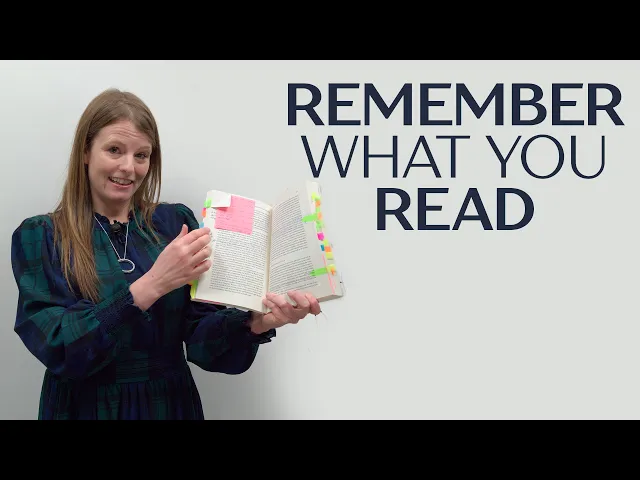
Understand and Remember What You Read!
English with Emma · engVid
0:00 Hello, my name is Emma, and today I am going to teach you how to read better.
0:07 So, when you go to high school or university or even for work,
0:12 sometimes you have to read very difficult things in English.
0:16 I'm going to teach you a method today to help you
0:21 understand what you read better and remember what you read better.
0:25 Now, first of all, I just want to show you how I used to read textbooks.
0:30 So, this is a book from when I was in university.
0:37 What you will see is everything is highlighted.
0:40 So, I would take a highlighter, and I would just highlight everything.
0:45 Now, this is not a good idea.
0:48 It did not help me remember the information.
0:52 Instead, what I should have been doing
0:55 is something like this method, the SQ3R method.
1:00 So, the SQ3R method, many teachers use this method when they teach,
1:05 and it's a method to help you read better.
1:10 Specifically, there are five steps.
1:13 The first step is survey.
1:17 The second step is question.
1:19 These steps happen before you read,
1:21 and I will go through each of these steps in detail in a moment.
1:26 Then we have the third step, which is you actually read.
1:30 Then the fourth step, recite, and the fifth step, review.
1:34 These two steps are done after reading immediately.
1:38 So, by using these five steps when you read, you can understand a lot more,
1:46 and that is very important when you are reading difficult books,
1:51 especially if English is not your first language.
1:54 These tips can also help people who English is their first language,
1:59 but they're just trying to remember more of what they read.
2:02 So now, let's get started by understanding what you do when you survey.
2:08 The first step in the SQ3R method is to survey what you're going to read.
2:16 So, I've chosen here a textbook I had to read in university,
2:21 Principles of Human Physiology.
2:23 This was a very difficult textbook to read.
2:27 So, what you can do if you have something difficult
2:30 to read like this is imagine I'm looking at this page.
2:36 The first thing I want to do before I read
2:41 everything is I want to prepare my brain for the information.
2:45 So, I'm going to look at the pictures,
2:47 if there's any pictures, try to figure out what the pictures mean.
2:52 If there's any graphs or tables, I might look at those.
2:57 I will look at headings.
2:58 So, right here, I don't know if you see it, but in green, there's a heading.
3:03 It says structure at the molecular level.
3:06 I'm going to look at anything that has a heading or a subheading,
3:10 and I'm going to think about, okay, what is this going to be about?
3:13 What is this going to tell me about?
3:16 Another thing I can do is look at anything in bold.
3:19 So, this page actually has some writing that's in bold,
3:22 and there are some definitions, so I might quickly look at that.
3:26 The point is, when I survey, before I read,
3:30 I look at headings, subheadings, bold text, charts, graphs,
3:36 and photos, and the point is to start to think,
3:39 okay, what am I going to be reading about?
3:43 It prepares my brain for new information, and that's why I'm doing this.
3:48 It gets you ready for the actual reading you're about to do.
3:53 This should not take long, maybe a minute or two minutes.
3:57 It's a very quick thing to do.
3:59 You're just very quickly looking at what
4:01 you're going to read before you read it.
4:04 The second step in our method is to question.
4:09 Before you read, it's a good idea to create
4:13 some questions about what you're about to read.
4:15 So, the way you can do this is you can open up your book.
4:20 So, here's the book I'm reading, and again,
4:23 I find those headings or subheadings, and I can ask questions about them.
4:29 So, in this case, the first heading I see says dating techniques,
4:34 so I might ask a question.
4:38 What are dating techniques?
4:48 Okay, and then I might look
4:51 at another heading that says relative dating methods, so I might ask a question.
4:57 What are relative dating methods?
4:59 And then I see there is something in bold, F-U-N TRIO.
5:04 I don't know what that is.
5:06 I might ask, what is the F-U-N TRIO?
5:09 What does it stand for?
5:11 And then I might look at this picture, so you can see a picture here.
5:16 I might say, what's this a picture of?
5:19 What does this line mean?
5:22 So, asking questions before you read is a good idea.
5:26 This is just one example, but again,
5:29 you turn whatever you're reading, turn the headings into questions.
5:34 What, why, how, when, where, these types of questions.
5:39 And then, again, asking questions before you
5:42 read helps you become an active reader.
5:46 And remember, when you're actively reading,
5:49 you understand better and you remember more.
5:53 So, now it's time to actually read.
5:56 So, we've already surveyed the book, we've already asked some questions.
6:02 The third step is reading the actual thing you need to read.
6:07 So, the first tip is read carefully.
6:10 Take your time.
6:11 You might have to reread parts, and that's okay.
6:15 And try to answer the questions you came up with during the Q part of the SQ3R.
6:23 So, think about, remember you had questions
6:26 about the subheadings and the headings, you can,
6:29 or some of the pictures, you can try to answer those questions as you read.
6:34 You can also look for key points in what you're reading.
6:37 If you see a definition,
6:39 that might be important, you know, what something means.
6:43 You can look at examples,
6:45 try to understand the main ideas of what you're reading.
6:50 And write down important information.
6:52 So, remember I showed you the book I used in my first year of university.
6:57 I used a highlighter and highlighted everything.
7:00 By my third year of university, I'd learned.
7:03 So, this book I had to read in my third year of university.
7:06 And what you'll see is all these little tabs here.
7:09 But I started to use sticky notes.
7:12 And so, what I would do when I would read is I would read something,
7:17 and then I would write down questions,
7:19 or I would write down key points that I was reading, and I'd use sticky notes.
7:25 Sometimes I would actually write in the actual book.
7:29 Some people hate doing that, and that's okay.
7:32 Some people like to write in their books, and that's okay, too.
7:36 Whatever works for you.
7:37 But the main thing is you want to start thinking,
7:40 "What am I reading that is important?
7:43 What do I need to remember?" So, ask yourself these questions as you read.
7:49 Again, ask yourself, "Is this important?
7:52 Why or why not?" There's a lot of information in these books,
7:57 and some of it's details that you might not need to remember.
8:02 So, it's a skill to learn what do I need to remember,
8:05 what's important, what should I take notes on, and what is less important.
8:12 One trick is if you're in university or college,
8:17 and your professor mentions an idea,
8:21 and then you see the same idea in the book you're reading,
8:25 it's probably an important idea that you should remember.
8:28 So, if you notice the professor has said something,
8:32 the book says the same thing,
8:34 that probably is important to remember, especially for a test.
8:40 You can also use the...
8:42 In some textbooks, there's a summary at the end of each chapter.
8:47 So, you can also use these summaries to help
8:49 you figure out if something's important or not.
8:52 So, I'm going to show you another book.
8:56 So, again, this was my physiology textbook,
9:01 and I don't know how well you can see it, but at the end of every chapter,
9:05 there is something called a chapter review or summary,
9:09 and it writes all the key ideas that you
9:12 should know that were important in the chapter.
9:16 So, sometimes reading this can really help you understand what's
9:20 important and to make sure you didn't miss anything that's important.
9:25 So, read carefully, read for the main ideas, and take notes while you read.
9:32 This is how you become an active reader.
9:35 If you're just reading without taking notes,
9:38 you're probably going to forget something.
9:41 The next step in the SQ3R method is recite.
9:47 So, this is done after you read.
9:52 And what do you do?
9:54 Well, imagine I've just finished the chapter, read everything,
9:59 now what I do is I close the book and I test myself.
10:03 So, I try to answer the questions I had from earlier.
10:08 Remember in the Q part, the question part,
10:11 we came up with some questions based off of the headings and subheadings?
10:15 Now I'm going to ask myself some questions.
10:18 What did I just read?
10:20 What were some new words that I learned?
10:22 What does, you know, earlier I mentioned the fun trio from that one book,
10:27 what does the fun trio mean again?
10:29 So, I might ask myself questions based off of what I learned.
10:35 And I can try to ask other questions.
10:39 So, what did I learn?
10:41 What new words did I learn?
10:43 What were some of the key findings or key points that I just read about?
10:48 And I should quiz myself.
10:50 Okay, I learned the word fun trio.
10:54 What is fun trio?
10:55 Let me think.
10:57 Oh, okay, I remember what the fun trio is, just as an example.
11:01 I actually read that book a long,
11:03 long time ago and I don't remember anything about this fun trio.
11:07 It's just an example.
11:09 The last R in the SQ3R method stands for review.
11:15 It's what you do after reading.
11:19 It's the last thing you do, which is you review your notes.
11:23 Remember I mentioned you can write on sticky pads or even
11:27 in the book or on a separate piece of paper.
11:31 Review the notes that you wrote while you were reading the text.
11:35 You can review the sections or sections that you've read.
11:42 You can ask yourself, did I understand the main idea?
11:46 Did I understand the key details?
11:49 If you're still confused,
11:50 you can go back and reread the parts that are confusing.
11:55 Another thing I would recommend is think about it.
11:58 Can you explain this information to someone else?
12:01 You can even try.
12:03 If you had to sum up the chapter you just read,
12:08 how would you explain it to somebody?
12:11 These are great ways to actively read.
12:14 And remember, when you are actively reading, you remember way more.
12:19 And even though it feels like this is a lot of work,
12:24 when it's time for exams or tests,
12:27 I promise you will actually have saved yourself some time.
12:33 And you'll remember this information for years and years to come.
12:37 So, it's actually a really good idea,
12:40 if you want to learn something, to use this method.
12:43 And again, when I first started university, I did this.
12:48 I highlighted everything.
12:50 By the end, I actually was using this method.
12:53 And I found this method has been so
12:56 helpful that even though I'm out of university, I use this in everyday reading.
13:02 Whenever I have to read something difficult, this is how I do it.
13:06 Or if I want to read something and remember it, this is how I do it.
13:11 So, thank you so much for watching today.
13:14 Practice makes perfect.
13:15 So, if you want to practice what you learned here today,
13:19 you can visit our website at www.EngVid.com.
13:22 And you can take a quiz to review the concepts in the SQ3R method.
13:29 So, you can also check out my YouTube channel.
13:33 We have a lot of different information
13:36 and a lot of different videos on different learning strategies,
13:39 on tips about reading, writing, and so much more.
13:44 So, thank you so much for watching, and until next time, take care.