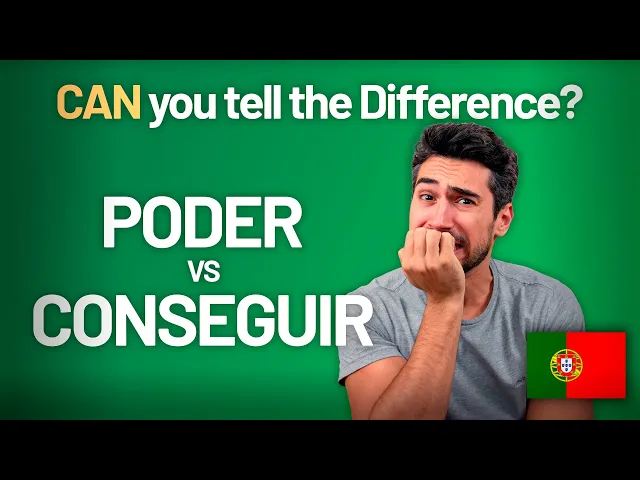
Poder vs Conseguir // Learn European Portuguese
Portuguese With Leo
0:00 Hello and welcome back to Portuguese With Leo and another Portuguese lesson!
0:08 Before we begin, remember that in the first link in the description
0:13 you can download a free worksheet with a summary of this lesson,
0:19 example sentences, and exercises for you to practice.
0:23 Typically, when I meet a foreigner learning Portuguese,
0:28 I always hear one of these three phrases:
0:32 "Eu posso falar português" "Não posso falar bem português" "Entendo português,
0:39 mas não posso falar" When people say this, they're trying
0:44 to say whether or not they are capable of speaking Portuguese.
0:48 They're trying to say: "I can speak Portuguese"" I can't speak Portuguese well".
0:55 "I can understand Portuguese, but I can't speak it." But the problem is that all
1:01 of these phrases are wrong because they all use the verb "poder" incorrectly.
1:07 In many languages, such as English, French, Spanish, or German,
1:12 the verb "poder" is used to describe what we have the ability to do.
1:26 And therefore, those who speak these languages assume that, logically,
1:31 in Portuguese we say "Posso falar português".
1:35 However, in Portuguese,
1:37 we have two verbs that can be translated as "can" in English:
1:44 "poder" and "conseguir".
1:46 And each of these two verbs has slightly different meanings.
1:51 The main difference is this: We use the verb "poder" to say we have permission
1:57 to do something and the verb "conseguir"
2:01 to indicate we have the ability to do something.
2:05 Therefore, we can translate the verb "poder" as "to be allowed
2:11 to," and the verb "conseguir" as "to be able to." In other words,
2:16 when a Portuguese student says the sentence "Eu posso falar Português",
2:20 it seems like they're saying they're allowed to speak Portuguese,
2:24 that it's not forbidden to do so.
2:26 It sounds like you're saying "I'm allowed to speak Portuguese." In fact,
2:31 what this person means is: "Eu posso falar Português":
2:36 "I'm able to speak Portuguese." In this case,
2:40 it would also be correct to use the verb "saber": "Eu sei falar português".
2:46 By the way, if you'd like to learn more about the verb "saber",
2:50 I have a video entirely dedicated to this verb,
2:53 which you can find here and in the description.
2:56 Returning to the verbs "poder" and "conseguir",
2:59 most languages don't distinguish between these two verbs,
3:02 which is why so many people make
3:06 the mistake of using "poder" instead of "conseguir".
3:09 If you also make this mistake, remember:
3:12 "Poder" begins with "P" and indicates permission to do something.
3:18 "Conseguir" begins with "C" and indicates the ability to do something.
3:24 Now I'm going to give you three sentences, and you're going to try to guess
3:29 whether the correct verb is "poder" or "conseguir".
3:33 First sentence: This one is easy; as I explained at the beginning of the video,
3:46 we have to use the verb "conseguir":
3:48 "I understand almost everything in Portuguese,
3:50 but I still can't speak it very well." Second sentence:
4:01 Here we're talking about permission.
4:04 Only authorized personnel, the team, are allowed to go in there.
4:09 Therefore, we use the verb "poder": "You can't go in there!
4:15 It's only for authorized personnel." Third sentence:
4:25 Here we're talking about ability:
4:27 the person wasn't able to finish the work because they were too tired.
4:34 Therefore, the verb "conseguir":
4:36 "Yesterday I was so tired that I couldn't finish work." Okay,
4:41 we've learned the big difference between the verbs "poder" and "fazer":
4:46 poder→ permissão, conseguir→ capacidade.
4:50 But what about these two sentences?
4:54 "If the weather's good tomorrow, we can go on a picnic!" "After studying a lot,
5:01 I managed to pass the test." Here we see
5:05 two other uses for the verbs "poder" and "conseguir".
5:09 Let's first look at the sentence with the verb "poder":
5:13 "If the weather's good tomorrow,
5:16 we can go on a picnic!" We're saying that if the weather's good,
5:21 then it will be possible to have a picnic-
5:24 we will have the possibility of having a picnic.
5:30 The verb poder, besides indicating permission (to be allowed to), can also
5:38 indicate the possibility of doing something-
5:41 to have the possibility of doing something.
5:43 Everything starts with the letter P, so it's easy to remember:
5:49 Poder→ Permissão, Possibilidade Now let's look at the sentence with "conseguir":
5:55 "After much study, I managed to pass the test." The person
6:01 is saying that they achieved their goal of passing the test.
6:07 In other words, the verb "to conseguir," besides
6:10 indicating the ability to do something (to be able
6:14 to), can also indicate the fulfillment or achievement
6:18 of a goal— to manage to/ to succeed in (doing something).
6:25 Again, everything starts with C: Conseguir→ Capacidade,
6:30 Cumprir um objetivo To finish, I'll give you three more sentences,
6:35 and you'll try to guess whether the correct verb is "to be able"
6:39 (in the sense of possibility) or "to achieve"
6:43 (in the sense of achieving a goal):
6:47 First sentence: Here we're talking about possibility.
6:54 There's a chance it will rain tomorrow, so we use the verb "poder":
7:02 "Tomorrow it can/may rain." Second sentence:
7:15 In this case, we're talking about achieving a goal.
7:20 Ana achieved her goal of publishing a book.
7:25 That's why we use "conseguir":
7:27 "Ana worked hard and managed to publish her first book." Third sentence:
7:42 Here, we're also talking about achieving a goal.
7:45 The person managed to achieve their goal of running a marathon:
7:50 After a year of training, I managed to run a marathon.
7:54 I hope you enjoyed this Portuguese lesson!
7:58 If you'd like to review everything and practice with more exercises,
8:02 download the free worksheet that contains the summary of this lesson,
8:07 example sentences, and exercises for you to practice-
8:11 it's in the first link in the description.
8:13 As always, thanks to my bosses who support me every month.
8:17 Click here if you'd like to see more lessons like this, and see you next time!