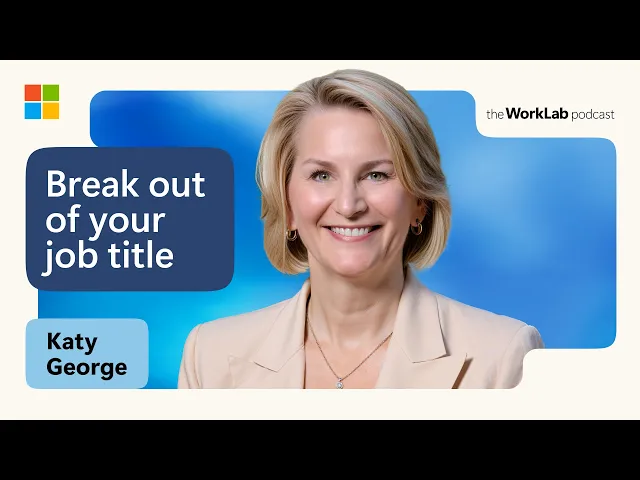
The future of work has no org chart | Microsoft Katy George
Microsoft
0:00 This is not a once and done transformation where we all learn something,
0:03 change the way we work, and then we're done and can go on to the next thing.
0:07 No, this is going to be forever,
0:08 that we are both doing our jobs and changing our jobs.
0:22 Welcome to WorkLab, the podcast from Microsoft.
0:25 I'm your host, Molly Wood.
0:26 Today we're joined by Katy George,
0:28 corporate vice president of workforce transformation at Microsoft.
0:32 We'll talk about where organizations get stuck
0:34 moving from AI pilots to real transformation,
0:37 what frontier firm leadership looks like in practice,
0:40 and why the way most companies measure AI progress misses the point.
0:45 Katie George thanks so much for joining me on WorkLab.
0:47 Oh, it's a pleasure to be here.
0:49 So we heard your title which has workplace transformation in it,
0:53 but I would love if you could just tell me a little bit about your job,
0:56 because you've been doing this kind of work for a long time,
0:59 and everybody's thinking about it right now.
1:00 It's very relevant to know what that means.
1:02 Yeah, we, to your point,
1:03 we've all been talking about the future of work for a really long time,
1:06 and now it's here for everyone.
1:08 And I couldn't be more excited than to be part of Microsoft,
1:11 really helping shape it.
1:13 So my role sits at the center of Microsoft in our Office
1:17 of Strategy and Transformation and think of us as a learning accelerator,
1:22 in that we have touchpoints across all of Microsoft,
1:25 and we're looking for best practices and patterns
1:27 about what really works to drive AI transformation,
1:31 and how the roles of human beings are changing.
1:34 And you just joined two years ago.
1:37 That's right.
1:38 So I would imagine that your job has already been transformed by AI.
1:42 What's it been like, you know, and what has changed,
1:44 even in that relatively short period of time?
1:47 my team does a ton of research.
1:48 They do a lot of scenario analysis, workforce planning, models and all of that.
1:54 You know, things that used to take months and we'd
1:57 need an external contractor to help with, you know, whatever.
2:00 Now they're building on copilot and demoing,
2:03 and it's just amazing how how fast, things have changed.
2:07 And even I am not a technical person at all,
2:09 but even I am now a builder, which is, really amazing.
2:13 How do you think about.
2:15 I just wonder, you know,
2:16 just to sort of set the stage about your philosophy of workplace transformation.
2:20 Like, if you could boil it down to two
2:21 or three things that have to exist within a culture, what might those be?
2:27 Well, first of all, my strong belief is that when businesses change
2:32 the way work happens in a way that really drives sustainable business results,
2:36 which is really what AI is all about,
2:38 it also makes the workplace better for human beings,
2:41 and I truly believe that will be true for AI as well.
2:44 And we together can help shape that to be true.
2:48 And the second belief I have is
2:49 that the only way you can effectively redesign work
2:52 so that it works even better is
2:55 by involving the people who actually do the work.
2:57 And that is probably more true in the context of AI,
3:01 which is really all about knowledge work,
3:02 where so much of what we do and knowledge
3:05 work is tacit and it's not written down anywhere.
3:08 So the people involved in doing the work have to be the ones who redesign it.
3:11 And that's a super empowering point.
3:13 Yeah, absolutely.
3:15 given that let's move into adoption,
3:17 we're sort of at this point now where we have
3:19 maturing technology as it changes every day, but it's maturing.
3:22 It's available.
3:23 Adoption is still struggling in some areas.
3:27 what do you think of this?
3:28 What do we attribute this gap to right now?
3:30 Lots of people either feel worried that I will eliminate their jobs,
3:33 or actually make their jobs such that they don't,
3:37 They aren’t good at them anymore.
3:38 Like if you think about, our software engineers, you know,
3:41 they have grown up as master craftspeople in coding.
3:46 That's their professional identity and that's very powerful.
3:49 And now we're telling them you no longer have to code.
3:52 Now you are a product builder.
3:55 An end to end builder.
3:57 And that in itself, when I you just think about,
4:00 do I want to be a coder or a builder?
4:02 I'd rather be a builder.
4:02 That sounds very exciting, but it is a real mindset shift.
4:05 And so really bringing people along is is absolutely critical.
4:09 Yeah.
4:09 And that is such a good point, though,
4:10 when you think about the identity that you've built up
4:12 in the the kind of personal equity you have in your skill.
4:16 Yes.
4:17 That transferring that over or thinking of it being replaced would be tricky.
4:21 How do you bring people along?
4:23 I mean, I think that's we all sort of understand that implicitly.
4:26 And yet it has to like, be structured.
4:29 Yeah.
4:29 So what we've we've been innovating,
4:31 in a couple of different ways, around, you know,
4:33 what we would traditionally talk about as change management,
4:36 although this really is about setting
4:38 up continual learning and adaptation skills, Right?
4:41 And mindset because this is not a once
4:43 and done transformation where we all learn something,
4:46 change the way we work, and then we're done and can go on to the next thing.
4:50 No, this is going to be forever,
4:51 that we are both doing our jobs and changing our jobs.
4:54 So one of the programs that we run is called Camp Air,
4:57 and that started in our engineering organization,
4:59 and my team runs that, and it's now starting to spread to other functions.
5:04 And what's special about Camp Air is that, team go as whole teams.
5:08 So this is not about each individual going off
5:11 to a learning program when it fits in their schedule.
5:14 It's about the whole team taking time out of their very busy schedule
5:18 and and production kind of environment to, be in an immersive boot camp.
5:23 The first week is all about talking about mindset,
5:26 but also getting immersed in the tools.
5:28 And we tell people, leave your discipline at the door.
5:31 So it doesn't matter if you're the product manager
5:33 or if you're a software engineer or if you're a designer,
5:36 everybody on the team is going to work together to get immersed
5:39 in all of the tools that are relevant to the team's work,
5:42 not just the ones that fit what you were doing in the past.
5:45 And then by week two, they're starting to experiment and working differently
5:49 and applying it to their own work,
5:51 and then they're starting to apply it to their own work,
5:53 and they still get coaching from other
5:55 practitioners about how they can be most effective.
5:58 And it's really exciting.
5:59 We do exit interviews with our engineers when they come out of this program,
6:03 and they really have this huge shift in attitude.
6:07 Even the ones who come in with the trepidation
6:09 that I described come out as real evangelists,
6:12 saying “I never want to work the other
6:14 way again.” Because it is exciting to actually see,
6:17 how all of the work fits together and really be part of the the total cycle.
6:21 You know, when you look at what's happening with software engineering,
6:24 but we see the same in HR or finance or sales,
6:27 is that sort of the cycles of getting work done are now so much faster.
6:31 You're collaborating more in innovating and inventing
6:34 and thinking about new ideas for for customer impact.
6:38 And that is really fun.
6:39 And it's, so I really do believe that the workplace is,
6:42 is changing for the best.
6:44 what I really like about what you're saying is that there is a tendency,
6:48 even on other episodes in the show,
6:50 we have we have said to people, we have exhorted people, go learn these skills.
6:54 Yeah, experiment, take time to write,
6:57 try to figure out these tools and build an agent for yourself.
7:00 That is ultimately individual and kind of puts the burden
7:04 of keeping up with a changing workplace on the employee.
7:07 How important do you think it is for companies
7:09 to create things like Camp Air or structured experiences?
7:12 Well, what I think is special about Camp Air and some of the other programs we
7:16 do is that we are not only thinking
7:18 of AI as a set of individual productivity tools,
7:22 what we recognize, and so the change management
7:25 programs reflect this, These are about teams and organizational
7:29 system change only if you change the whole
7:31 system of work do you get different business performance.
7:34 And so, whether it's a team based approach like that, where
7:37 the whole team is changing to improve the outputs that they have,
7:42 or we also run some other programs in other contexts.
7:46 For example, in our Salesforce that are role based,
7:48 that is getting everybody who's playing the same role together,
7:51 similar to Camp Air, is practitioner taught.
7:55 This is not someone coming in from the outside is a grant facilitator.
7:59 This is practitioner to practitioner.
8:01 And these role based programs,
8:03 one of them is a weekly huddle where literally everybody who is
8:07 playing the same role in an organization gets together and they compare notes,
8:11 not on what experiments did you do with AI in general?
8:14 But how have you used AI to get better at our job?
8:17 And and what we're finding is
8:19 that that's driving significantly greater adoption,
8:22 but also much more effective adoption and effective adoption
8:25 in the sense that we're starting to see the behavior change,
8:28 that is actually linked to getting better performance.
8:32 And it's because there's collaboration and there's encouragement.
8:35 So, yeah, and and prior to this job at Microsoft,
8:38 you, among other things, were at McKinsey.
8:40 Yes.
8:40 Advising companies.
8:41 And so I wonder, you know, when you turn that lens outward,
8:44 what would you advise companies who might be struggling with some adoption?
8:48 Well, first of all, realize that this is
8:50 business transformation and this is not a product launch.
8:53 So, you know, we have this fabulous,
8:55 collaboration with Harvard Business School around the frontier firm,
8:58 research initiatives, etc.
9:00 and they actually did a case example
9:01 of our initial rollout of Copilot into our own Salesforce.
9:05 And the first time we rolled it out,
9:07 we thought of it as a typical product launch.
9:09 Here's a new product.
9:10 We'll teach you the new product.
9:11 And we expected, great things to happen.
9:13 And people tried it and then they stopped using it.
9:16 so only when we realized, no, this is about a business transformation.
9:20 We have to set clear business outcome goals.
9:22 What are we trying to achieve?
9:24 And then we need to really redesign work along with the people doing the work.
9:28 By bringing together people who understand the tech,
9:30 But also people who understand process.
9:32 So we do a lot of Kaizens, Gemba walks,
9:36 value stream maps, day in the life analysis, etc.
9:39 with people who really understand people,
9:41 how are we changing all three of those things tech process and people together?
9:46 All in service to clear business outcomes and success factors.
9:49 And so, the first thing is to really
9:51 understand that this is a business transformation you're driving.
9:53 And it has a lot in common with other business
9:56 transformations that companies have led around other things in the past.
10:00 But there are also some things that are pretty unique to AI.
10:02 And this whole notion of trying
10:04 to change knowledge work is actually pretty unique.
10:07 I did lots of work in manufacturing, when I was at McKinsey and, you know,
10:12 there when we were trying to change the way
10:13 worked happened with Lean or then Industry 4.0,
10:17 at least you could see in the production line the widgets going down the line.
10:21 Right?
10:21 And you could see where they got delayed and there was inventory being built up,
10:25 or you could see where there were deviations
10:26 in the process that could cause quality problems in knowledge work.
10:30 We don't see any of that.
10:32 so much is tacit.
10:33 It's not standard, it's not written down anywhere.
10:36 So, really understanding the workflow so
10:40 that you can connect AI solutions into workflow
10:43 and drive systematic change in the way
10:46 work happens to accrue to business performance, it’s an art and a science.
10:49 That's such a crucial point too because it not
10:51 only gets your leadership and your managers on board,
10:54 but it actually gives the people undergoing
10:56 this training and adopting these tools a reason.
11:00 You know, a reason, totally.
11:02 My team's now done 100 case studies of AI transformation inside
11:06 Microsoft and looking at patterns and successfactors across those and, you know,
11:11 one of the things we see consistently is
11:14 this really wonderful combination of top down, bottom up.
11:18 And what I mean is leadership is cascading down really clear business goals.
11:23 You know, this is the focus.
11:25 These processes matter.
11:26 This is what we're trying to achieve.
11:28 And they are bringing together resources and creating space
11:32 and time for people to learn and grow and experiment,
11:36 but also resources to do some of the more complicated, you know,
11:39 pro code, technology development to support
11:42 AI transformation of those processes.
11:44 But at the same time, they're also encouraging bottom up grassroots innovation.
11:48 And so some of my favorite case studies are grassroots,
11:51 citizen developer, developed things that then
11:54 are scaled to the whole organization.
11:56 And so that combination of being clear about what the goals are,
12:00 what success looks like, but then unleashing the creativity of the whole
12:04 organization is really where magic happens.
12:06 Yeah.
12:07 How about on the, on the outcomes end on the other end of the transformation?
12:11 I know that businesses love metrics.
12:14 Yes.
12:15 And measuring outcomes.
12:16 And that has been a tricky conversation in this space.
12:19 are the metrics for success?
12:21 Well, it's interesting, I have to admit that when I came
12:23 into this, I thought that was going to be relatively straightforward.
12:26 And I think the world thought it was going to be
12:28 straightforward because we all thought of AI as primarily an automation tool.
12:33 So, you know, even most of the models that economists have
12:37 used to predict what's going to happen with AI take job descriptions,
12:41 break them down into all the tasks,
12:43 figure out what percentage can be automated with AI,
12:46 it's always 30% on average across any group of jobs.
12:50 You drop 30% to the bottom line.
12:52 You reorganize your teams around the rest of the 70
12:54 and and you go and you have a clear ROI.
12:56 That's not how it's happening.
12:59 And actually, the real story from AI is far more interesting because yes,
13:03 I absolutely is a great automation tool
13:06 and that it can automate different pieces of people's jobs,
13:10 not whole jobs, but, different tasks.
13:12 And some of that is quite dramatic,
13:14 like the agentic coding that we're seeing now.
13:16 But where AI adds even more value is
13:19 something that we're starting to call “Capability Add,”
13:21 where it's not just doing the same process
13:24 with the same outcomes that you did before,
13:27 but somehow just faster and better with AI automation,
13:30 it's actually adding whole new capabilities in.
13:32 So the value that's being created is actually a whole different level.
13:36 I'll give you a really simple example that illustrates this.
13:39 Our internal audit team is awesome,
13:41 and they have really leaned into really transforming themselves with AI.
13:45 And yes, they have definitely found some productivity savings,
13:49 some of which they have,
13:51 you know, used so they didn't have to replace people with attrition.
13:53 But, others, they've used to create better coverage for our company.
13:57 So reducing our risk.
13:59 But what they would say is far more valuable than that, is that because of AI,
14:04 every internal audit now delivers proactive risk identification.
14:08 And that's not something that human beings used to do and now we've,
14:12 you know, substituted AI for it.
14:14 It's a new capability that AI has injected into the process.
14:18 So one of the things that we're now increasingly trying
14:20 to help our teams really understand is as you understand,
14:25 you know, workflow, make it visible,
14:27 and start thinking about where AI intervention would be most helpful.
14:31 Make sure you're asking the questions of “where
14:34 should we be doing more decision analysis?
14:36 More scenario work?
14:37 Where should we have more proactive, or preventative kind of quality thinking?
14:42 Where could we add value through this process
14:45 that would delight the customer even more?” Right?
14:47 All of those kinds of questions.
14:49 And therefore, it means that measuring ROI and the metrics gets harder, right?
14:55 It was introducing entirely new variables to your business model.
14:58 Because now we're talking about growth,
15:00 innovation, customer experience, employee experience,
15:03 all of these things that are harder to measure and harder to create
15:07 kind of a simple causation model that allows you to calculate ROI,
15:12 but it's actually far more strategically important.
15:14 You know, if you think about it,
15:15 most companies do not compete on labor cost efficiency.
15:18 maybe it would be, they'd get some benefit
15:20 in the market if they were able to reduce their headcount.
15:24 But actually to be really
15:26 a sustainably exciting company with competitive advantage,
15:29 the AI “Capability Add” that I described is far more valuable.
15:33 Yeah.
15:34 what that means is that it is hard to measure the returns,
15:38 we're trying to create more standards around some of those other
15:41 metrics and how you actually think about accounting for and acknowledging,
15:46 recognizing, kind of the growth and innovation benefits.
15:50 We're also starting to experiment with a way
15:52 of kind of mapping from adoption to metrics,
15:55 which are the easiest thing to measure.
15:56 Are people using the tool or not?
15:58 To behavior change, And then to the business outcomes.
16:01 for example, in our Salesforce, we're doing some work where,
16:04 we've used the, the role based
16:05 change management huddles that I described, actually, to significantly increase,
16:10 the usage and the effective usage of these fabulous AI tools
16:15 that we have built with the people who do the work.
16:18 And as we're seeing that adoption increase and the effectiveness increase,
16:22 which we're looking at, are we seeing an increase in the amount
16:26 of time that our sales folks are spending with customers?
16:29 Are we seeing them spend more of their time demoing and working on, you know,
16:34 the latest and and most current part of our portfolio, right?
16:37 That kind of behavior changes that we wanted AI to lead to.
16:42 And then how does that lead to win rates in qualified pipeline?
16:45 And how does that lead to what we really care about, which is revenue per rep?
16:50 And we see a really nice correlation between the reps who are using AI the most,
16:55 and revenue per rep.
16:56 But this is how we are kind of mapping kind
16:58 of the connection between adoption of new tools to the ultimate business goal.
17:05 What's so cool about this is that you have obviously been
17:08 able to broaden the conversation about what these tools can do.
17:11 And also as they mature, they themselves create new variables.
17:14 Yes.
17:15 And ripples in the pond.
17:16 Yes.
17:17 That actually just makes everything so much more interesting
17:20 and feels like you could say the companies like,
17:22 look, if you just had a leap of faith about what you don't know,
17:26 you could have and could be more creative about the way you get there,
17:31 it's almost like you know, the Artemis II mission.
17:33 It was like, go there, look at the moon, tell us what you see.
17:36 And you're sort of saying, deploy these tools and do a little
17:39 bit of a science experiment, see what happens.
17:41 Well, I'm saying that and I'm saying, spend some time thinking about,
17:46 one of my colleagues calls it “possibility.” What
17:48 is the possibility that I could provide to you?
17:51 And, Satya actually talks about this is what are your private evals?
17:55 So if you're an engineer, you'll understand what that means.
17:58 Like what really makes the secret sauce of your company?
18:01 And what do you want to be accelerated there
18:03 for with the AI system you put in place?
18:06 What is your unique competitive advantage that if you
18:09 could accelerate it with AI would make all the difference?
18:12 So identify that and then focus there.
18:15 When I talk to customers, many of them say “boy,
18:18 a year ago we were just doing lots and lots
18:20 of pilots.” And now what we realize is that's a mistake.
18:23 We're now focusing on three end to end
18:26 business processes that are much more boring, maybe,
18:28 than the cool pilots who were coming up with, but actually
18:31 will make the biggest difference in our business performance,
18:34 and really drive competitive advantage.
18:36 So that notion of being clear about what matters to the business and then
18:40 focusing there and really thinking to your point
18:42 about using an AI as the Artemis, kind of what's possible.
18:47 and really exploring that is something that we think works really well.
18:51 So let's talk about this in context.
18:52 You brought up the partnership Harvard Business School.
18:54 And we are talking a lot about Frontier Firms.
18:57 Yeah, kind of in the abstract.
18:58 But part of that partnership is to nail down what that really looks like,
19:02 you know, to figure out the companies that have this mindset,
19:05 tell us a little bit more about, you know,
19:08 what these organizations do and feel like day to day.
19:12 Yeah.
19:13 Frontier Firm is where we are fully AI powered, right?
19:16 Our decisions are informed by AI.
19:18 Our operations are sometimes done by AI, etc.,
19:22 but we remain very much human centered and human led.
19:25 And one of my colleagues had a wonderful comment
19:27 the other day that that when we're fully imbued,
19:30 kind of with AI and the way that we
19:31 all work and the way that our processes are working,
19:34 it will feel the organization will feel
19:36 more like a living organism and constantly learning,
19:40 our organizations are learning every day because of the reinforcement
19:44 learning that I naturally embeds into our organization,
19:48 which I think is really exciting.
19:49 And so I think we will feel like the organization is much more organic,
19:54 that we're constantly learning, that we're spending more time innovating,
19:57 as humans and that hierarchy and job titles matter much less.
20:03 You know, eventually, I think we'll finally get out of the, you know,
20:06 1900s, you know, matrixed org chart.
20:09 And we'll be much more focused about coming
20:11 together based on the skills we have to get,
20:14 you know, really exciting projects done,
20:16 that really leverage kind of our creativity and innovation.
20:20 So then what does that start to look like?
20:22 As we also bring in or grow or train
20:25 or recruit a new type of leader within those organizations,
20:29 because you know that there are different management
20:31 skills in a no longer 90’s matrixed organization.
20:37 Exactly.
20:37 I mean, one of the things that this means is, first of all,
20:41 that I think leaders in a sense,
20:42 have to become continuous experimentation officers, right?
20:46 They have to be the ones who are really encouraging,
20:49 continual, adaptive kind of changes in their organization and teams.
20:54 They have to be really focused on where value comes from.
20:57 So I think that business understanding is going
20:59 to be more important in more people than ever before.
21:03 They have to be comfortable working kind of end to end.
21:05 One of the things we're seeing, even just at the individual job level,
21:10 is that roles are becoming more T-shaped.
21:13 Human expertise, still very important, judgment,
21:16 very important, maybe even more important than before.
21:19 That's something that, you know, I think a year ago,
21:21 a lot of people thought maybe we will never need human expertise again,
21:25 because we can all just access the world's
21:27 expertise through AI that turns out to be false.
21:29 In order to use AI really effectively, you need judgment, taste, expertise,
21:33 but you're also then able to spend time kind of horizontally integrating across
21:39 the whole process and therefore teams are becoming much more dynamic and fluid.
21:44 And so leading in that environment where you're constantly adapting to changes
21:49 in the technology and in the system of work as it all evolves with technology,
21:54 is going to be really important.
21:55 this is really about creating an organization and a culture
21:58 that thrives on continual adaptation that thinks that's fun and exciting, right?
22:04 As opposed to draining.
22:05 Right.
22:05 I think is really important.
22:07 And then being really clear about being able
22:09 to cascade kind of clear goals and outcome goals, down to the organization,
22:14 because as we are all empowered, anyone in the organization to build and create,
22:19 we need to know what we're building for.
22:21 And that is going to become we're no longer cogs in a machine.
22:25 You know, where we're each doing our job as it's been defined for us.
22:29 We now can be much more creative.
22:31 But then we need to know what we're creating for.
22:33 Right.
22:33 I was just joking with a friend that, we
22:35 didn’t think that there were any C-suite titles left,
22:37 but I think maybe if it doesn’t already,
22:39 Chief experimentation officer is a good one.
22:42 let's talk about, with this idea in mind that you have this kind of you have
22:47 a different set of constituents as you are
22:50 designing a workflow and a workforce for AI transformation,
22:54 who needs to be in the room?
22:58 Well, first of all, the business leadership
22:59 has to sponsor and be actively engaged.
23:02 This is not a tech project.
23:04 This is not something that you know, your CIO leads on their own.
23:07 This really has to start from the business.
23:10 In fact we were in a customer meeting and the CEO said
23:14 “I am not leading AI transformation” and everyone went “Oh,” and he said,
23:19 “I am leading a business transformation and AI
23:21 is helping me.” And I think that's super important.
23:24 So that's where it starts.
23:26 Even for example, in our customer support function, right?
23:29 Which, so we're talking about call centers and things, right?
23:32 The business has to be involved in every
23:34 single part of the process of transformation.
23:36 That's one of their key, key,
23:39 principles for doing any additional AI enablement work, in this space.
23:44 So business leadership, sponsorship, and like, real active sponsorship,
23:48 the leaders who are power users themselves are creating teams of power users.
23:53 That is super clear.
23:55 And then secondly, I think,
23:57 you have to bring together a diverse set of cross-disciplinary
24:00 skills to really change the system of work effectively.
24:04 And so that does include, as I said, tech, process capability, like,
24:08 you know, we're bringing with our continuous improvement teams,
24:11 and people understanding.
24:12 And that has to come together.
24:14 It can't be a handoff.
24:15 And then the third thing I'd say, I would just reiterate,
24:18 the people who are doing the work have
24:19 to be there to be actually redesigning their work.
24:22 And so those are the kind
24:25 of ingredients we're finding for successful transformation.
24:28 I feel like you may end up repeating yourself a little bit,
24:30 but I just want to do a little
24:32 lightning round of kind of concrete advice for people.
24:35 So a leader listening right now wants
24:37 to move their organization from piloting to genuine transformation.
24:41 Yeah.
24:42 What are the first two or three things that they should do tomorrow morning?
24:46 Number one, get clear on what the most exciting,
24:49 ambitious goal in your organization should be and therefore where
24:52 to focus in terms of what processes and what success metrics.
24:57 I just can't overstate how important that is to guide the efforts of your team.
25:03 And then, you know, I'm really getting obsessed with the notion
25:06 of cross generational teams working together on this, you know,
25:09 early career folks bringing so much creativity and innovation,
25:14 because they are, you know,
25:16 AI native and then pairing them with people who really
25:19 understand what great looks like and where value is created.
25:22 So, you know, think about diverse teams
25:24 bringing the disciplines that I describe together.
25:26 But also multi-generational.
25:29 That's, is that happening here?
25:30 That's a very cool point.
25:31 Yes.
25:31 I mean, a lot of the examples that we see in fact work creating more,
25:36 apprenticeship models, two way apprenticeship models.
25:39 And we have a team, actually in our engineering function that's created
25:43 a program called “Praise,” which is
25:45 preceptorship for AI in software engineering.
25:48 And it's literally pairing, you know, early career with more experienced folks.
25:53 That's very cool.
25:54 This leads sort of nicely into the next question,
25:56 which is as for the individual contributor who is using
26:00 AI but maybe hasn't done all of this rethinking yet,
26:03 or had some of this rethinking be communicated as goals,
26:07 What is the first step to start to shift the mindset?
26:11 first of all, you know, I can't emphasize enough kind of experimenting
26:15 and playing around and enjoying it, right?
26:16 Because it is really cool to see.
26:19 And if you tried something a few months ago, try it again,
26:21 because the tools change so quickly,
26:24 that you might be amazed at what you can do.
26:26 Secondly, really talk to people about this all the time.
26:30 Be obsessive.
26:31 What are you doing?
26:32 What are you finding successful?
26:33 And I think that's important both with other people in your same role,
26:37 but also just other people.
26:39 In fact, I was doing a, a video with a colleague, and we were both, you know,
26:43 supposed to share examples of what we've done and she shared
26:46 this example of something that I do all the time manually,
26:48 like, oh my gosh, I never thought of doing that with AI, of course.
26:51 Are you willing to tell us what that process was and have you changed it?
26:55 Oh, yes.
26:56 So I am a total time management geek,
26:59 so I really believe that, if you want to accomplish something,
27:04 the first step is just making sure your calendar is aligned to it.
27:07 Right?
27:07 And I've gotten lots of time management
27:09 coaching and it's really changed my life.
27:11 Anyway.
27:12 So I often on a plane will literally get a notebook out,
27:15 look at my calendar and, and in a really old school way,
27:18 kind of think about, okay, how have I spent my time in the last month?
27:22 And does it align to the things that I think are really most important?
27:26 And she just asks copilot to do it.
27:29 Duh!
27:30 So, yes.
27:31 I haven’t, this just happened.
27:33 I haven't done it yet, but I absolutely am going to do that.
27:36 I'm going to want you to report back, that’s amazing.
27:38 Absolutely.
27:39 I love the idea that to learn AI better used to talk to more humans.
27:42 Oh, by the way, also talk to AI because, actually, you know,
27:46 Copilot has some pretty good answers if you want to find,
27:49 you know, tips and tricks for how to use it even more effectively.
27:52 Very true.
27:53 Katy George, thank you so much for the time today.
27:54 I really appreciate it.
27:55 Oh my pleasure.
27:56 Thank you for having me.
27:57 Thank you again to Katy George,
27:58 corporate vice president of workforce transformation at Microsoft.
28:02 For more conversations from the frontier of AI at work,
28:06 follow the show and listen to past episodes wherever you get your podcasts.
28:09 I'm Molly Wood.
28:10 Thanks for listening.