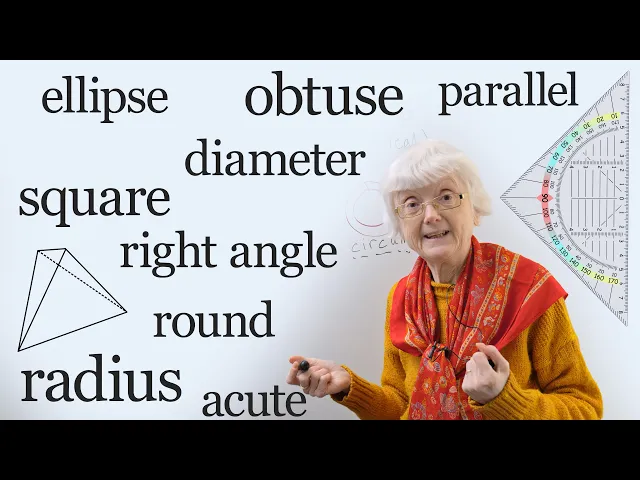
Learn English Vocabulary: SHAPES & GEOMETRY
Learn English with Gill · engVid
0:00 Hello.
0:00 I'm Gill at engVid, and today we have a lesson on geometry, geometrical shapes.
0:09 And we have some of them, the main ones, on the board here.
0:15 You may already have seen another
0:18 lesson that I did which was about shapes and patterns,
0:23 and the shapes in that one, some
0:26 of them are also in this lesson, but this lesson is more about geometry.
0:33 So, let me write it here.
0:38 Geometry, geometry, which you may have studied at school, possibly.
0:47 I remember I did many years ago and found it quite interesting.
0:55 So, these are geometrical shapes,
0:59 and I just wanted to test you to begin with to
1:03 see if you know the English words for each shape
1:08 and some of the different things,
1:11 like what you call this, these things that you're seeing here.
1:17 So, okay, well, let's start with an easy one,
1:21 this one here, which has four equal sides,
1:25 and it's a very straight shape,
1:28 so you probably know the name of this, beginning with S.
1:35 So, this one is a square, and it's a square if all four
1:49 sides are equal, and if this...
1:51 This is straight and not sort of leaning over, like this one is
1:58 sort of leaning over, but this is absolutely straight, so that's a square.
2:07 Okay.
2:07 And then this, what I mean about it not leaning over is because it has this,
2:17 which is called an angle, the angle.
2:23 It's straight up and straight across,
2:31 so that is actually a 90-degree angle, so 90 degrees, degrees.
2:47 Okay, because it's absolutely straight.
2:52 So...
2:53 And that's also called a right angle.
3:01 Okay, so this is a right angle and it's 90 degrees.
3:06 Okay?
3:07 So that's also partly what
3:09 makes it a square.
3:11 Okay.
3:12 So, if that's a 90-degree angle, a right angle, this one,
3:18 this angle here is obviously a lot less,
3:22 and there's a general word to describe that kind of
3:28 angle.
3:28 I don't know if you know it.
3:31 It's...
3:32 It's a word that means sharp, something sharp,
3:35 because it's so pointed.
3:37 I don't know if you can think of it.
3:42 It begins with an A,
3:45 so an...
3:47 A something angle.
3:50 A acute angle.
3:52 So that's an acute angle because it's very sharp
4:01 and pointed.
4:02 Okay.
4:02 And then we have the opposite here.
4:06 This is a much wider angle.
4:08 It's more than this one.
4:11 It's more than a right angle, so it's more than 90 degrees, so that's
4:18 the opposite of an acute angle.
4:20 So it begins with an O.
4:23 I don't know if you can think of it.
4:26 It's an obtuse angle because it's more than 90 degrees.
4:35 Okay.
4:36 Right.
4:37 So there we have a square, and we
4:43 have some different angles.
4:45 A right angle, an acute angle, and an obtuse angle.
4:51 So, just moving on, this looks like a square, but it's wider.
4:57 It has...
4:58 Those two sides are the same, and
5:02 these two are the same, but this...
5:04 These sides are much longer, and these are shorter, so you
5:09 can't really call that a square.
5:11 So what would you call that if it's not a square?
5:16 Can you think of a word?
5:20 So it begins with an R.
5:25 Okay.
5:26 It's a rectangle.
5:33 A rectangle.
5:34 Okay.
5:35 So, if that's a rectangle, this also
5:41 looks like a rectangle, but it's leaning over, so that's...
5:48 That also has a very particular name,
5:52 and I've drawn these two lines here
5:56 because they're absolutely straight with each other.
6:00 They're the equal distance apart.
6:02 So, I don't know if you know the word that describes that
6:07 when two lines are the same distance apart all the way along.
6:16 So, it begins with a P.
6:20 Okay.
6:21 And they are parallel lines.
6:26 So, those are parallel lines, and because these lines here
6:36 are parallel with each other, those two are parallel,
6:41 and those two are parallel, it's called
6:46 a parallelogram.
6:48 A parallelogram.
6:51 Okay?
6:53 So, moving on, we have this one here.
7:04 So instead of four sides, we have three sides for this one.
7:11 So, that's a clue to how...
7:14 The word that you use
7:16 to describe it.
7:17 So, there's another word meaning three.
7:21 If you have a...
7:23 A bicycle has two
7:25 wheels.
7:26 A tricycle has three wheels.
7:30 So "try" means three.
7:33 "Try", and then just like here,
7:37 we have a word "angle" at the end of the word, so this also...
7:44 "Try angle", a triangle.
7:47 Okay?
7:48 So, it has three angles.
7:52 These are the angles.
7:55 One, two, three, and three sides, of course, as well.
8:03 Okay?
8:03 Good.
8:04 So, are you...
8:06 I hope you're still with me so far.
8:11 So, now we have all these round...
8:15 Round shapes, so that's one word you can use to describe them.
8:22 They are round, but the geometrical...
8:25 "Geometry", "geometrical" is the adjective.
8:31 "Geometrical".
8:32 The geometrical word for this
8:39 is beginning with C.
8:45 "Circle".
8:47 "Circle".
8:49 I've tried to make it a perfect circle.
8:53 I'm not very good at drawing circles, but
8:56 I've done my best.
8:57 And then just...
8:58 I've done this one here to explain a little bit more about the
9:03 degrees.
9:04 Okay?
9:04 Because the full circle, I don't know why,
9:10 but a full circle is 360 degrees.
9:16 That's just the way it's measured.
9:21 I think it goes
9:24 back to centuries, back to Pythagoras,
9:29 the Greek person who developed geometry as a subject.
9:37 So, a whole circle is made up of 360 degrees,
9:41 so you can sort of count around it all these
9:46 little degrees all the way round, and it adds up to 360.
9:52 So, half of that, if you're thinking of
9:56 half of a circle, that will be 180 degrees.
10:04 Okay?
10:05 And then half of that will be 90.
10:12 Okay?
10:13 That's why this, this right angle here is 90 degrees.
10:19 You might have thought earlier,
10:22 "Why 90?
10:23 What?
10:23 90?
10:24 That's a strange number." But it's because it's
10:28 a quarter of 360, so that's why that's 90 degrees,
10:34 a right angle, because the full circle,
10:38 the largest number of degrees you can get is 360.
10:44 Okay?
10:45 That's why.
10:48 So, if you cut a circle in half, how would you describe that half
10:54 of a circle?
10:56 So, that would be...
10:59 Another word meaning half is "semi",
11:05 "semi-circle".
11:06 Okay?
11:06 So that one there is a semi-circle,
11:13 and that one is to...
11:16 Two semi-circles.
11:18 Okay?
11:18 And then here's another circle with a line here,
11:24 so that goes from the centre in a straight line to the edge of the circle.
11:30 And if you had to
11:32 measure it, sometimes you would have to measure something like that.
11:38 What you call it is...
11:41 Do you know the name?
11:45 Beginning with "r", that's the
11:49 radius.
11:49 So, the radius of the circle,
11:52 and you can say what the length of it is, depending on the
11:58 size.
11:59 Okay?
12:00 Oh, yes, and the other thing about this one,
12:06 if you draw a straight line right across the middle,
12:09 there is also a name for that.
12:12 It's not just half with the radius, it's the full across at the widest points.
12:21 So, that begins with
12:23 a "d".
12:24 Can you think of the word for that?
12:28 The word meaning "two", which is "diameter".
12:38 So that's the diameter of the circle.
12:41 This is the radius of the circle.
12:44 And then here's another circle with...
12:48 I want to measure the whole...
12:51 Well, all of it, not just to there.
12:54 I want to measure the whole...
12:57 Well, this one, the full measurement all around the outside of the circle.
13:03 So, that's another name which begins
13:06 with a "c", if you know that one.
13:14 It begins like the word "circle", "circ".
13:21 "Circumference".
13:22 "Circum" means "around", and then that's what it means,
13:28 the measurement around the outside of the
13:33 So, the circumference of the circle is another measurement that you can do
13:41 because that's the point of geometry, really,
13:44 to measure things in the real world.
13:47 Okay.
13:47 It's not just for drawing pictures on the board.
13:52 It has a practical application in architecture and things
13:57 like that.
13:58 Okay, so that's the circle.
14:01 Then we have...
14:02 Like we had in the other lesson with
14:06 the shapes, we've got a kind of squashed circle.
14:11 So, in the other lesson, I said you can call it
14:17 an "oval", which is a word that means like an egg, the shape of an egg.
14:24 But in geometry, it has a more technical-sounding name, which is an
14:35 "ellipse", an ellipse,
14:37 and the adjective from that is "elliptical", "elliptical".
14:44 Okay.
14:45 Right, and then finally, what about some shapes which are more than three sides,
14:52 and they're more than four sides?
14:55 So, this one- one, two, three, four, five- that has five
14:59 sides.
15:00 So, can you think of what you would call a shape with five sides?
15:08 There is a Greek word
15:11 meaning five, if that helps at all.
15:16 So, it begins with a "p",
15:22 "pentagon".
15:23 Okay.
15:24 So, that's known as a pentagon, meaning it has five sides or five angles.
15:38 Five sides, but also one, two, three, four, five angles.
15:44 So, a pentagon.
15:46 So, if it was six sides,
15:50 it would be a "hexagon", and then it goes on,
15:57 seven, eight, nine, etc., eight, octagon.
16:02 And all of these with the extra, you know,
16:06 many sides, the general name for that meaning many
16:10 sides or many angles is a "polygon".
16:15 "Poly" means many.
16:17 So, if you don't sort of say it has five,
16:23 six, seven, eight sides, you can just say, "Well, it has a lot of sides",
16:29 and you can just generally say a "polygon".
16:34 So, that's the lesson.
16:36 I hope that's been useful to
16:39 give you the English names for all of these geometrical shapes,
16:45 and there is a quiz on this
16:48 lesson if you'd like to go to www.engvid.com and do
16:53 the quiz based on your knowledge and see how
16:57 you do.
16:58 So, that's it for today.
17:00 Thank you for watching, and hope to see you
17:04 again soon.
17:05 Okay.
17:05 Bye for now.
17:07 Bye.