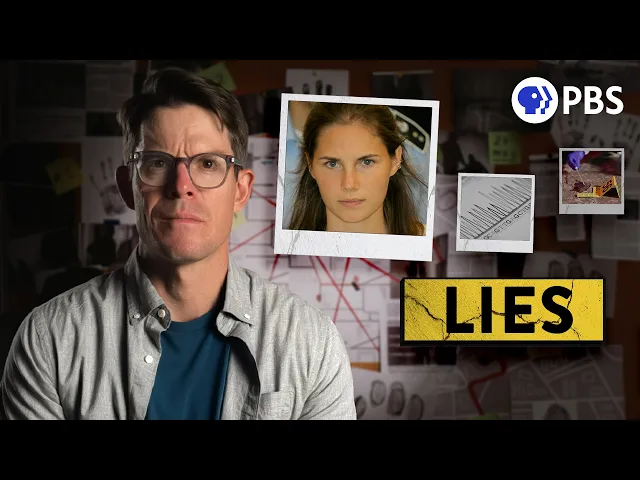
You've Been Lied to About DNA Evidence
Be Smart
0:00 Thank you to Squarespace for supporting PBS.
0:03 I immediately think, oh my God, I'm being framed.
0:08 This is impossible.
0:09 I, I cannot explain how this could be.
0:13 Meredith's DNA should not be on the knife
0:17 that was found at my boyfriend's house.
0:20 Amanda Knox spent four years in prison for a murder that she didn't commit.
0:25 The media circus was honestly pretty insane,
0:29 all because some tiny invisible molecules seemed to say that she did it.
0:35 Her pleas fell on deaf ears.
0:37 Amanda Knox is now a convicted killer.
0:43 A lot of magical claims were made about how,
0:46 if you find DNA, that it's unquestionable and it definitively proves guilt.
0:52 Forensic DNA technologies become so sensitive
0:55 that today a single cell's worth of genetic
0:57 material can be detected at a crime scene and identified to solve that crime.
1:03 Or at least that's how it's supposed to work, but...
1:07 Just because there's DNA doesn't mean we know what happened.
1:13 What happens if we push that science beyond its limits?
1:17 What happens when police start chasing ghosts?
1:27 Hey, smart people, Joe here.
1:29 Forensic DNA technology has totally revolutionized criminal investigation.
1:34 We have the ability to collect, processed and identify invisible,
1:39 beyond microscopic molecules that are left behind at crime scenes,
1:43 which is honestly mind blowing.
1:46 We're all probably somewhat aware of what DNA forensics is,
1:50 and for many people I'm betting that's thanks to TV.
1:57 Shows like CSI created this perception.
2:00 Researchers literally call it the CSI effect,
2:02 where the public and more importantly,
2:05 people on juries came to see DNA evidence as basically magic:
2:09 swab a crime scene, run it through a computer, and boom, you got your killer.
2:14 Juries kind of tend to treat DNA as infallible
2:17 proof rather than one piece of a much messier puzzle.
2:22 That DNA doesn't lie.
2:24 I think it's important and pretty interesting
2:26 to learn how DNA forensics actually works.
2:29 And as we're about to see it isn't always as infallible as we've been told.
2:36 I guess this is a true crime show today.
2:40 On a sunny spring day in 2007,
2:43 two German police officers were taking a break in their car.
2:46 They had the doors open.
2:47 It was a really nice day, but moments later,
2:50 they were both shot in the head from behind.
2:53 One officer, 22-year-old Michelle Kiesewetter didn't survive.
2:58 Investigators diligently swabbed the scene to collect any traces
3:02 of the killer's DNA, and they got a hit.
3:05 To their shock.
3:06 It matched DNA from multiple other crime scenes.
3:09 This suspect's DNA was connected to drug deals,
3:12 burglaries, and assaults in multiple countries across Europe.
3:16 In addition to a half dozen other murders.
3:19 A serial killer and super criminal was haunting Europe.
3:23 The strangest part, all DNA evidence pointed
3:26 to the fact that the killer was a she.
3:29 Despite the fact that only one in six serial killers are thought to be women,
3:34 she was tied to several different accomplices,
3:36 none of whom would give her up to police authorities,
3:39 figured they were all just too scared of her to snitch.
3:42 Police eventually linked her DNA to 40 different
3:45 crime scenes across Europe going back to 1993.
3:49 She was dubbed the Phantom of Heilbronn because
3:52 no one ever saw her commit these crimes, but her DNA was everywhere.
3:58 But fast forward to April, 2008, as evidence is piling up,
4:02 investigators announced we're closing in on her except there was no
4:07 her to close in on because the killer that they were chasing wasn't real.
4:14 Everything started to fall apart when the Phantom's DNA
4:17 showed up in a French case involving a burned body.
4:21 Now, the police had a hunch that the body belonged to a man who'd gone missing,
4:25 but this person had entered the country seeking asylum.
4:27 So investigators had his fingerprints on that asylum application,
4:31 but when they swabbed those fingerprints from his asylum application
4:35 to serve as a reference to ID the burned body,
4:38 the Phantom's DNA turned up in that sample: female DNA.
4:43 This didn't make any sense.
4:45 The swab of DNA wasn't even from a crime scene,
4:49 and it should have only contained male DNA.
4:53 A horrifying realization began to hit the investigators.
4:57 They had indeed been hunting a phantom, but that phantom was DNA contamination.
5:05 So the DNA's strength, like all of our strengths, is also its weakness.
5:12 That's Dr.
5:13 Greg Hampikian, a forensic DNA expert.
5:16 I've gotten DNA out of, you know, 400 year old mummy bones.
5:20 It's very persistent.
5:21 If it's taken care of, it lasts quite well, even at room temperature.
5:25 Every year, in every lab there are contamination events.
5:30 In the Phantom's cases, the contamination turned out to be from the cotton
5:34 swabs used to collect samples at the crime scenes.
5:37 Those swabs had come from a factory in Bavaria where they'd been
5:42 contaminated with DNA from a woman who worked there at the factory.
5:46 Her DNA matched the phantom profile at all of those crime scenes.
5:50 A few stray molecules had led police
5:53 on a wild goose chase across Europe for years.
5:57 It's very easy to move DNA
5:59 and we should never confuse identification information,
6:04 which is, "who is the ultimate source of this?" with questions about activity.
6:12 How did the DNA get here?
6:14 Of course, I had to ask Amanda what she thought of this case.
6:18 She's like, what?
6:18 I just make cotton.
6:21 I, I mean what, what incredible story to talk about how like narratives form
6:27 and like completely take over the public
6:30 imagination and they have a completely different explanation.
6:34 Like, ah, wow.
6:36 Instead of just focusing on the identity,
6:38 which is the only thing that DNA can actually tell you,
6:43 the police made up a story about activity,
6:46 about what had happened, what happened to get the DNA there.
6:50 This was the fatal flaw of the Phantom of Heilbronn investigation.
6:54 They invented a serial killer.
6:57 And that supposedly magical DNA evidence?
7:00 Wasn't so magical here.
7:02 To understand how a cotton swab fooled the entire German police force,
7:07 we need to understand what forensic DNA analysis actually
7:10 is and why it's both incredibly powerful and incredibly fragile.
7:16 So how's it supposed to work?
7:18 Let's solve a murder, shall we?
7:21 Imagine this kitchen knife was collected at a crime
7:24 scene and it's believed to be the murder weapon.
7:27 To catch the killer, we've swabbed the knife hoping that the murderer left
7:31 behind some traces of bodily materials like skin cells,
7:35 hair, blood or semen, because all of those contain DNA.
7:39 Now, importantly, we also have a swab from the victim to make
7:42 sure that any DNA that we find isn't just the dead person's DNA.
7:45 Now, DNA from a single skin cell contains a person's entire genome,
7:50 billions of DNA letters --their full genetic blueprint.
7:55 But investigators today don't usually read all of that DNA to get an ID.
8:00 Sequencing whole genomes is getting mind-blowingly cheap,
8:03 and may be how forensic DNA testing is done in the future.
8:07 But today we're gonna use a different cool trick.
8:09 To read a genetic fingerprint that is currently the gold standard in forensics.
8:14 Our genome has thousands of genes that carry
8:17 instructions for making stuff that keeps us alive.
8:20 But the vast majority of our DNA does not make stuff.
8:25 And in those giant In-between regions,
8:28 there are these short little stretches where DNA sequences repeat back to back.
8:33 They're called short tandem repeats or STR's.
8:36 We have lots of different STRs throughout our genome
8:39 and each STR can vary in how many repeats
8:43 it contains And sequencing just 20 of them can
8:47 create a DNA profile that can identify one unique individual.
8:51 To show you what I mean, let's take a look at the DNA profile of our victim.
8:56 Now at the first STR spot, the little DNA repeating sequence is AGAT.
9:03 Now the victim has one allele or version of the STR
9:07 with five repeats and another allele with nine repeats.
9:12 That's because s STR are something that we inherit from mom and dad,
9:15 just like all of our other DNA sequences.
9:18 So it's possible to have two different alleles for any STR sequence.
9:23 They say ‘ah-le-le’ in Italian, sorry, alleles in English.
9:27 The second STR spot consists of repeating TCATs.
9:31 Our victim only has an allele for 12 repeats
9:35 at this STR because they inherited the same one:
9:39 12 repeats from both parents, mom and dad.
9:43 Now the third STR spot consists of repeating ATTs
9:46 and our victim has alleles for eight and 10 repeats.
9:50 We do this on and on up to the 20 STRs that make up a full genetic profile.
9:55 These 20 STRs are standard across forensic investigations,
10:00 and they form the basis of something called CODIS,
10:03 the massive DNA database maintained by the FBI.
10:06 All of the cells in the victim's body have
10:09 their unique combination of STR repeats except their eggs or sperm,
10:13 which only have half of them.
10:15 But the most important thing,
10:17 the thing that makes forensic DNA identification possible is that the victim
10:22 has a different combination of STR repeats than the murderer does.
10:26 And not just that they have a different DNA profile than any other person does.
10:31 Check this out.
10:32 So two people may share the same number of repeats at one STR,
10:37 maybe even two, but across all 20 STR sites,
10:41 there is less than a one in a trillion,
10:45 trillion chance that they have all of the same repeats
10:48 at all of the same spots unless they're identical twins.
10:52 Those are pretty good odds that any DNA fingerprint is totally unique.
10:57 So let's go back to our murder weapon.
11:00 The swabs will have picked up DNA from our victim,
11:03 and now that we have the STR profile from our victim,
11:07 we can easily separate it from any other STRs that we may find in the mix,
11:12 any other DNA profiles, we find?
11:14 It might be the murderer.
11:16 We can then run those STR profiles against
11:19 those of any suspects to see if there's a match
11:21 or run it through CODIS to search for matches
11:24 from this giant database of criminals and other crime scenes.
11:28 And we found another DNA profile that matches someone near the case.
11:33 So does that mean it's our murderer?
11:36 Well, not so fast.
11:38 First I need to tell you about Lucas Anderson 5,600
11:42 miles away from Ohio Bron in Santa Clara County, California.
11:46 Lucas Anderson was having a very bad day.
11:49 In December, 2012.
11:51 His DNA was found in a sample taken from under the fingernails
11:54 of a wealthy California investor who'd been
11:56 tied up and killed during a home break-in.
11:59 Lucas's name popped up as the match to that DNA because
12:03 he was in the database due to his past criminal record.
12:06 He also had memory problems from an old head
12:08 injury and he routinely blacked out due to alcoholism.
12:11 So he honestly couldn't say for sure that he was innocent.
12:15 To the prosecutors, this looked like an open and shut case.
12:18 The DNA analysis worked as it should.
12:21 It provided an unambiguous match to a known criminal,
12:25 and there was plenty of circumstantial evidence
12:26 to write a story of what happened that night.
12:29 Lucas was sent to jail on a murder charge, which could carry the death penalty.
12:34 But as his lawyers combed through evidence trying to save him from death row,
12:38 they found something pretty important.
12:41 The night of the murder, Lucas had been in the hospital
12:44 for alcohol intoxication after collapsing at a store.
12:47 So how could his DNA be at the scene of the crime when he was in a hospital bed?
12:53 Miles away?
12:55 His defense team interviewed the paramedics who picked him up,
12:58 and it turned out that they were the same paramedics who responded
13:01 to the nine one one call at the scene of the murder,
13:04 and they had processed the victim's body.
13:07 Human DNA can transfer as a solid, a liquid or as an aerosol.
13:13 Lucas's case was one of DNA transference.
13:16 Tiny traces of DNA had traveled from Lucas to the paramedics to the victim.
13:23 But because our scientific technology is so sensitive,
13:26 that was more than enough to yield a positive match to Lucas.
13:30 And we don't know for sure,
13:32 but his DNA may have hitched a ride on a pulse oximeter.
13:35 You know those little things they put on your finger
13:37 that the medics had used on both men?
13:41 We call it activity level proposition.
13:44 Can you tell when it's directly by a hand?
13:47 No, there's no way to tell but there are
13:50 people in my field who will testify that way,
13:53 and I think it's shocking and fraudulent.
13:56 When do people stop asking,
13:58 "Is there an innocent explanation for this DNA?" "Are we taking shortcuts
14:02 to automatically assume the guilt of the DNA
14:05 and not asking that question?"- Thankfully,
14:08 Lucas was eventually freed, but only after he spent five months in jail,
14:13 and the prosecutors weren't the ones asking the questions.
14:16 The science did exactly what it was supposed to.
14:20 Lucas's DNA genuinely was there,
14:23 and that was enough for them to construct a narrative about what that DNA meant,
14:27 A narrative that could have sent an innocent man to death row.
14:31 And this is nothing compared to what happened with Amanda Knox.
14:37 20-year-old Amanda was studying abroad in Perugia, Italy in the fall of 2007.
14:43 She was living with her roommate Meredith Kercher,
14:45 who just started dating a local student named Rafaelle Sollecito.
14:49 On November 2nd, the unthinkable happened.
14:51 Meredith's body was found in her bedroom of their shared apartment.
14:56 She'd been sexually assaulted and brutally murdered with a knife.
15:00 Now, the DNA and fingerprints of a man named
15:03 Rudy Guede were found all over the crime scene.
15:05 He had fled to Germany.
15:07 He was arrested and ultimately charged with the murder.
15:09 But during the investigation,
15:11 Amanda was subjected to an endless series of harsh interrogations,
15:16 ultimately resulting in a coerced confession.
15:19 Amanda and her boyfriend were arrested and also charged with Meredith's murder.
15:25 It affected the way DNA was then processed afterwards.
15:29 So the arrests came before the DNA came.
15:32 I think it took two or three weeks for the DNA
15:35 that they collected at the crime scene to be processed.
15:38 And by that time, they already had arrests.
15:40 They had already announced to the world that the case was closed.
15:43 They already had a narrative about what had happened to my roommate,
15:47 which turned out to be very, very wrong.
15:50 I'm a 20-year-old kid who believes that when
15:53 the actual evidence is processed at the crime scene,
15:57 it will reveal the truth that I had nothing to do
15:59 with this crime and that I'll be released and let go.
16:03 But that's not what happened.
16:05 Investigators found a torn off bra clasp from Meredith's
16:08 room and a kitchen knife in Raphael's apartment.
16:12 Forensic analysis identified Raphael's DNA on the bra clasp and Amanda's
16:17 DNA on the knife handle and Meredith's DNA on the knife plate.
16:22 Amanda was convicted of murder and sentenced to 26 years in prison,
16:27 thanks in large part to this supposedly slam dunk DNA evidence.
16:32 I mean her DNA on a knife handle, a victim killed with a knife.
16:37 What else could that mean?
16:39 Well, as we've seen, DNA evidence isn't always as clear and unambiguous
16:44 as TV would lead you to believe.
16:48 You have DNA experts at war with each other
16:52 who are each claiming to have authority over the truth.
16:56 It was just incredibly frustrating for me to have to sit
17:00 there and listen to people construct a reality out of whole cloth,
17:06 all for the sake of the narrative.
17:08 Four years passed before the court agreed to hear Amanda and Raphael's
17:12 appeal and reexamine the evidence with a panel of independent forensic experts.
17:18 Our crime scene was processed by forensic experts twice,
17:21 once in the immediacy of the crime being discovered.
17:25 But then after those samples had been processed and none
17:29 of it implicated me or my boyfriend or anybody in the crime,
17:34 they went back in 46 days later to try
17:37 to find new forensic evidence to implicate us in the crime,
17:40 and they have completely upended our house and contaminated it completely.
17:47 The only piece of DNA evidence tying Raphael
17:49 to the crime was found in that problematic second
17:53 sweep after evidence had been mixed and thrown around
17:56 all but guaranteeing that the evidence would be contaminated.
18:00 Oh, and the knife?
18:02 I did a little work on Amanda Knox's case.
18:05 I love Greg.
18:06 He's the best.
18:08 Yeah, really it was just that knife for Amanda.
18:11 A single cell can make it look like a suspect was on a piece of evidence.
18:16 When we saw the electropherograms,
18:18 it was clear to us that the DNA was at such a low level.
18:22 How are the Italians looking way below anything I do in my research lab?
18:27 The trace of DNA that is on it is so minuscule
18:30 that it can't be attributed to anyone- I knew right away.
18:34 This was suspicious.
18:35 The guidelines say you need to separate evidence and reference samples.
18:39 You do all of the evidence first.
18:41 When the evidence is finally processed,
18:43 you bring the reference samples into the lab.
18:45 You never bring 'em into the lab before that.
18:48 Reports indicated that the knife blade samples were processed
18:50 in the middle of 50 samples of reference material from Meredith.
18:55 Traces of her DNA could have easily contaminated the knife blade samples.
19:00 And considering that modern forensic DNA technology is so sensitive,
19:03 it can pick up on just a few cells worth of DNA.
19:07 Not following careful contamination procedures is incredibly risky.
19:11 It was another case of confirmation bias.
19:14 Investigators had constructed a grizzly narrative
19:18 of this crime and pushed the science well beyond its safe limits until they
19:23 found data that agreed with their conclusions.
19:26 This is the opposite of good science.
19:29 The independent experts found the exact
19:31 same findings that my defense team found.
19:34 We showed in the end it was probably transfer
19:37 contamination and not the result of a criminal act.
19:41 That took four years of Amanda being
19:43 in prison to convince the Supreme Court in Italy.
19:47 I'm really interested to see a world in which
19:51 the forensic evidence comes so quickly that it can be
19:54 the thing that guides the narrative construction as opposed
19:57 to the thing that tries to justify an already established narrative.
20:03 In a world like the one Amanda describes with faster, better forensic science,
20:08 how many other people would never have
20:10 been arrested for those crimes they didn't commit?
20:15 Anytime you introduce a new process, you introduce a new field of error.
20:19 That's always gonna be true no matter how good the instrument is,
20:22 no matter how good the training is,-
20:25 Because science is evolving at a rapid pace, especially science around DNA,
20:30 it's so important that we open up opportunities to appeal
20:35 decisions that were based on bad science in the past.
20:38 There's a couple of states that have passed laws that say,
20:42 if the science you were convicted by has now
20:45 been superseded by better science that corrects the old view,
20:50 you have a right to retest evidence.
20:53 Most states don't have that law,- And so innocent people are
20:56 sitting behind bars with no legal avenue for proving their innocence.
21:00 How many people have been convicted with sloppy DNA?
21:03 How many times has that happened?
21:05 I bet it's happened a lot of times.
21:07 The beauty of science is that it recognizes that it has its own limitations.
21:12 It's an evolving practice and it's
21:14 willing to revisit and reevaluate certain calculations.
21:18 The problem is that legal systems are not designed like that.
21:22 And I think that the legal system would
21:24 do well to take on a more scientific mindset
21:27 of: "it is possible that we got this wrong."-
21:31 We could all use a little more scientific mindset.
21:34 Something that kept coming up in these conversations and cases was
21:37 how often humans fall victim to constructing stories and then looking
21:43 for evidence that supports those stories rather than following the evidence
21:47 and building the story based only on what can be proven.
21:51 This is what science demands, right?
21:54 With technology that's now sensitive enough to get
21:57 a DNA profile from a single cell, it's more important than ever to avoid
22:01 weaving elaborate stories from a molecule like DNA.
22:05 Because DNA can really only answer the question of who not how.
22:11 With the Phantom, Lucas, Amanda,
22:14 and who knows how many other cases, the DNA never lied.
22:19 We just didn't ask the right questions.
22:22 Stay curious.
22:23 Science is so interesting.
22:27 Happy Earth Month.
22:28 PBS is celebrating Earth Month by releasing
22:30 a ton of great content across our channels, diving deep into our amazing planet,
22:36 like the latest release from Deep Look,
22:39 all about bioluminescence, a video that we would give an...
22:44 a glowing review?
22:46 Links to that video and the full Earth Month playlist are in the description.
22:50 And a thank you to Squarespace for supporting PBS.
22:53 Squarespace is a website building and hosting company that includes
22:57 a range of product capabilities such as online stores,
23:00 print on demand blogs, email campaigns, appointment scheduling, and more.
23:05 With Squarespace, you can also connect with your audience and generate
23:08 revenue through gated members- only content users can manage members,
23:13 send email communications and leverage audience insights all in one platform.
23:17 One of the most popular features is their collection
23:19 of website templates that will help you run a business.
23:22 Whether it's selling merchandise, booking appointments,
23:24 or collecting reservations for a restaurant.
23:26 Squarespace has a suite of tools that will help you
23:29 run an e-commerce site that looks great on desktop or mobile.
23:33 Go to squarespace.com/besmart or click the link
23:37 of the description for a free trial.
23:38 And when you're ready to launch use code "besmart" to save
23:41 10% off your first purchase of a website or domain.
23:44 And thank you to everyone who supports this show on Patreon.
23:48 We quite literally could not make episodes like
23:50 this one without your support, so thank you.
23:54 If you'd like to join our community and get to see videos like this one
23:58 live before everybody else and a lot of other cool behind the scenes perks,
24:02 head over to the link down in the description
24:04 and we'll see you in the next video.
24:06 The researcher...blbllp...
24:08 literally...
24:08 We can then run those STR profriles.
24:11 Profiles...
24:11 Let's go...
24:13 BANG!
24:14 I meant to do that.