The (Critics) History of Warren Buffett's 80 Year Career
How Business Worked
0:00 Even people who know nothing about business
0:02 or finance will know the name Warren Buffett.
0:05 As the story goes, he purchased his first shares over 83 years ago and since
0:10 then has had what many consider to be the greatest investing career of all time.
0:15 His prudent approach to picking and sometimes creating winning businesses
0:18 has made him one of the richest men in the world
0:21 and in the process he has minted over more
0:24 than a dozen other billionaires who followed in his wake.
0:28 Perhaps most interestingly though,
0:30 he has done all of this while remaining largely popular with the general public.
0:35 Today, even after a long enough lifetime to collect potential scandals,
0:40 he is one of the few global
0:42 billionaires to enjoy a positive net approval rating,
0:45 which when you think about it, doesn't make that much sense.
0:49 If you actually look into details of his business's extended history,
0:54 you will find that he has stripped companies for parts,
0:57 helped to kick off the private equity boom,
1:00 lobbyed for favorable regulations at the expense of consumers,
1:03 been embroiled in antitrust lawsuits,
1:05 union fights, and has had more than his fair share of double standards.
1:10 Like the time when he called derivatives financial weapons of mass destruction
1:15 right before his company sold billions of dollars worth of those same
1:19 derivatives or made a big deal about how financially conservative he was
1:24 driving a secondhand car right before purchasing a fleet of private jets.
1:29 During the global financial crisis, he owned businesses which allegedly gave out
1:34 predatory loans to bad borrowers while also owning
1:37 a significant stake in the company that was
1:41 supposed to be overseeing the same market.
1:43 After that whole system imploded,
1:45 he then swooped in and made billions of dollars through
1:48 favorable deals with names like Bank of America and Goldman Sachs.
1:53 This is not to mention that literally his entire business model
1:56 is just moving money around to make rich people even richer.
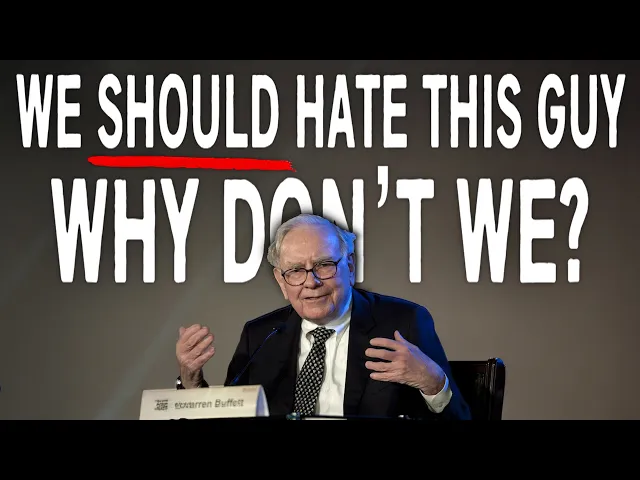
2:00 We should hate this guy, right?
2:03 And yet we don't.
2:05 But why?
2:05 Well, some point to his folksy downto-earth image.
2:08 He drives a beat up car, eats McDonald's,
2:11 and lives in an old house just like you.
2:14 How much of this is real and how much of this is
2:16 played up for the media is something we will need to get to.
2:20 But there is another theory.
2:21 Buffett has been investing in US companies
2:24 for onethird of the existence of the USA itself.
2:27 He has been compounding returns through 15 presidents, 13 major recessions,
2:32 and the most intense period of global wealth creation in recorded history.
2:38 During that time, and up until his planned retirement in just a few months,
2:44 his career has shaped American history as much
2:47 as it's been shaped by American history.
2:51 Maybe he really is as humble and sagely
2:53 as the infested events would have you believe.
2:56 Maybe time heals all wounds.
2:58 Or maybe it just hasn't mattered.
3:00 Warren Buffett shocked tens of thousands of people,
3:03 dulging his plans to retire as CEO of Berkshire Hathaway at the end of the year.
3:08 The time has arrived.
3:10 Greg should become the chief executive officer.
3:13 Warren Buffett is the only person who from scratch built
3:17 a company that is in the top 10 of the Fortune 500.
3:20 One of the lessons of the 2008 was the fact that every company in the United
3:25 States was a domino and those dominoes were placed right next to each other.
3:29 In 1942 at the age of 11 or 12, Warren Buffett made his first formal investment.
3:35 He purchased three shares in the gas and utility company's Services.
3:39 The exact details of this first trade are a bit murky.
3:43 Some historical publications claim that he also
3:45 purchased three additional shares for his sister.
3:47 But in a 2018 letter to shareholders,
3:49 the man himself claimed that he only purchased
3:52 three shares which were for him and him alone.
3:55 Now, regardless of cutting his poor old sister out,
3:59 there were three interesting details about this very first trade.
4:02 The first is something of a historical side note,
4:04 but the company he invested in, City's Services,
4:07 is still technically around today, although not under the same name.
4:11 The business was merged with another company
4:14 in the 1980s before being acquired by 7Eleven's
4:18 holding company before being sold again
4:20 to the Venezuelan State Oil Company in 1986.
4:24 That means today this American oil and gas company, now known simply as Citigo,
4:30 is owned by a government openly hostile to the country it is operating in.
4:35 The committee to humiliate and shame America.
4:38 Yes, it is Hugo Chave's passion project.
4:41 Now, this little detail didn't matter for Buffett because the second point about
4:45 this investment is that he didn't hold on to it for very long.
4:49 There are two reasons why his first share purchase
4:51 gets so much attention in the business history books.
4:54 The first is that Buffett uses it as an example of his missed opportunities.
4:59 He reportedly sold the shares for a small $6 profit.
5:03 But had he held on to them, he would have sold them for over $600,000,
5:08 which even when adjusted for inflation,
5:11 is a clear and practical example of long-term investing doing its thing.
5:15 The second reason this gets talked about so much,
5:18 if you were being a little bit more cynical,
5:20 is that letting everybody know about how you were trading stocks before
5:24 learning to shave is a great way to build a personal brand.
5:27 as someone who was just destined to become an investing genius.
5:31 It sounds silly, but little quirks like these and stories about how he invested
5:37 in pinball machines in college have all
5:40 cultivated a reputation worth billions of dollars.
5:43 But again, more on that later.
5:45 The third detail of this share purchase, which is important to know,
5:49 is that he made it through his father,
5:51 who at the time was working as a stock broker.
5:54 Back in those days, share purchases were obviously
5:56 not handled by tech platforms like they are today.
6:00 Wouldbe investors would work directly with an actual
6:03 middleman who would research the markets for them,
6:06 make recommendations, and execute trades on their behalf for a commission.
6:10 It was a respectable job, but not necessarily comparable to the stock
6:14 brokers of the 1980s making millions of dollars.
6:17 It was more akin to a mortgage broker today.
6:20 Usually they were educated people with skills
6:22 in their particular field but still mostly middle class.
6:25 This was especially true during the years when Buffett was growing up.
6:29 The Great Depression and the Second World War.
6:31 Not exactly boom years for people working in the stock market,
6:34 but the family did have many good fortunes on their side.
6:38 The Buffets may not have been exceptionally well off,
6:41 but they were still a prominent family.
6:44 Shortly after processing young Warren's first stock trade,
6:47 his father gave up stockbroking when he was elected to Congress
6:52 where he would go on to serve four terms in total.
6:56 Howard Buffett actually went against the popular political grain
6:58 on a lot of big issues at the time.
7:01 He spoke strongly in favor of maintaining
7:03 a strict gold standard and warned against international
7:06 overreach by America during the Second World
7:08 War and even in the decades after it.
7:11 These isolationist ideals were not necessarily
7:13 shared by Warren in his own careers,
7:15 but he did certainly inherit a slow considered approach
7:18 to dealing with the hot trends of the day.
7:22 It is however worth recognizing that Buffett
7:24 was not exactly starting from nothing.
7:26 Even back then, having a daddy in Congress was a privileged position,
7:30 even if they weren't all mysteriously multi-millionaires like they are today.
7:34 But anyway, young Warren had another stroke
7:37 of fortune early in his life as well.
7:40 Ironically, another investor essential, and that was simply timing.
7:44 Buffett's father was just slightly too old
7:47 to be drafted into the Second World War, and Warren himself slightly too young.
7:51 This was a turn of good luck that was not common for a lot of families
7:53 at the time who would have had at least one generation going overseas to fight.
7:58 Now, to be fair, Buffett has acknowledged his luck
8:01 of being born in the right place at the right time.
8:05 The luckiest day in my life is the day I was born.
8:09 you know, but I was born in the United States.
8:12 Being born in the 1930s at the onset
8:14 of the Great Depression was also a blessing in disguise.
8:18 His childhood was still comfortable, but he wasn't yet competing for jobs
8:22 with everybody else left behind by the crash.
8:25 He would effectively sit out that period of economic
8:28 history and start his career in the 1950s,
8:31 right before the most intense period of prosperity growth in American history.
8:35 As far as timing goes, he literally bought the dip with his own birth.
8:41 Now, the context of his early life is
8:44 important because when biographers and bootstrap enthusiasts talk about
8:48 his early investing exploits and the childhood side
8:51 hustles that amassed him $100,000 before he left college,
8:55 they often leave out that he was clearly
8:58 born into a privileged family at a privileged time.
9:01 He got into good universities despite by his own
9:05 admission not being a particularly passionate student.
9:08 And he had access to people that most aspiring business owners just didn't.
9:13 I didn't want to go to college and but my dad
9:15 wanted me to go to college and we didn't have SATs then,
9:18 but he practically would have done the SATs for me.
9:21 So he in the truth I always wanted to please my dad.
9:25 I mean he was a hero to me and still is.
9:28 Now, the big difference is he actually does acknowledge this luck.
9:32 Unlike a lot of other billionaires who
9:34 try to talk up their self-made credentials,
9:37 Warren has spoken frequently and passionately about just how
9:40 fortunate he was to have his opportunities and to be
9:44 born during a period of history where reading
9:46 financial documents was a skill that society actually valued.
9:50 To that end, his first real job out of college
9:53 was at his dad's stock broking firm as an investment salesman.
9:57 This is exactly what it sounds like.
9:59 Back in the 1950s, people didn't have sketchy finances
10:03 or crypto bros telling them about the next hot investment.
10:07 Even looking up company financials or price charts
10:10 was extremely difficult for most people before the internet.
10:13 So, they relied on their stock brokers for advice.
10:16 Buffett's job was effectively a a toned down version
10:19 of what you see in the Wolf of Wall Streets.
10:22 He would get on the phone, call clients, and try to get them to make trades
10:26 earning a processing commission every time they did.
10:29 According to his own recounts in the biography The Snowball,
10:32 he hated this job because it was
10:35 just high pressure sales rather than genuine analysis.
10:38 It did however bestow him with the skills to talk up
10:42 a company to investors whether he really believed in it or not.
10:46 Something that even he admits has paid dividends over his lifetime.
10:49 It was at this time that Buffett made
10:52 what he claims was his single best investment ever.
10:55 He enrolled in a public speaking course taught by Dale Carnegie,
11:00 best known as the author of How to Win Friends and Influence People.
11:05 In several press interviews he has given throughout his lifetime,
11:08 Buffett has made special efforts to point out that he displays
11:12 this certificate in his office rather than his master's degree from Colombia.
11:16 He would use his newfound public confidence
11:19 to hold lectures about the stock market
11:21 at a local college in Nebraska where apparently
11:24 most of the students were double his age.
11:26 The point is that for a man who
11:28 wanted to make his whole career about technical analysis,
11:31 he spent his first years in the real world honing his interpersonal skills.
11:36 He eventually left his dad's firm to take
11:38 a job with the one and only Benjamin Graham.
11:41 Graham was one of Buffett's college professors,
11:43 but he also ran a successful investment firm built
11:46 on the ideas of what he called value investing.
11:49 The simple idea was that Graham and his firm would
11:52 try to figure out how much a company was really worth.
11:56 They'd look at earnings, assets, and liabilities,
11:58 but also brand appeal, ongoing contracts, intellectual property, market power,
12:02 and even their long-term track record of predictable dividend payouts.
12:07 Based on this, he would give a company an intrinsic value,
12:11 and if that value was greater than the company's market capitalization,
12:15 he would buy up the stock.
12:17 It was kind of like doing a a blind appraisal of a house based on bedrooms,
12:21 bathrooms, and school districts.
12:22 And if your educated guess of what the home was
12:24 worth was more than what the sellers wanted for it, you would buy it up.
12:28 This sounds easy in theory, but of course, the real skill was in coming up
12:32 with an accurate appraisal of a business's true worth.
12:35 Any schmuck could look through some financial records and make
12:37 a case for a company being worth twice its market capitalization.
12:40 Likewise, someone overly cautious might think
12:43 that the market is overpricing everything.
12:45 At Graham's firm, Buffett learned to scour through business after business,
12:49 finding something that the market was undervaluing,
12:52 so his firm could swoop in and profit off the discount.
12:55 Today, the same kind of operation would
12:57 be next to impossible because algorithms constantly scour
13:00 the market and instantaneously do the work
13:02 that Buffett and his peers were doing by hand.
13:05 But back then, this analytical and measured
13:08 approach to investing was really quite revolutionary.
13:10 It was a good business where Buffett
13:12 learned a lot about actually managing investor money.
13:15 On top of that, he was paid very well.
13:18 By 1956, after just two years with the firm, he had saved up over $170,000.
13:23 That's equivalent to $2.1 million today, and all at the age of just 26.
13:30 But just as Buffett's career was really taking off, his mentor,
13:34 Benjamin Graeme, shut his whole investment firm down so he could retire.
13:38 After just six years working for his father and his college professor,
13:42 Buffett now had to go out on his own to prove his worth against the market.
13:45 His first move was to return back to his childhood home of Omaha, Nebraska.
13:50 He figured that with the money he had saved,
13:53 he could live much longer out there than
13:55 in an expensive city like New York or DC.
13:57 On top of that, his style of investing worked better
14:00 the farther away he was from the noise of Wall Street.
14:04 Coming up with an objective and unbiased valuation
14:07 for a business is a lot easier when you
14:10 aren't chattering with thousands of other market speculators
14:12 day in and day out in big financial hubs.
14:15 Using Benjamin Graeme's old firm as a template,
14:18 he started a series of investment partnerships,
14:20 raising money from family members and contacts he had made
14:24 in his short but successful gig at his father's firm.
14:27 Over the next 5 years,
14:28 he would make a lot of money using a strategy called cigar butting.
14:32 Buffett would look for companies that had more
14:36 assets than their liabilities and market capitalization combined.
14:39 He would then take a large stake
14:41 in those companies and use his influence to encourage
14:44 them to liquidate their assets and cut down
14:47 on expenses to get the business working again.
14:50 For example, one of the biggest early successes was the Sanborn Map Company.
14:54 The company itself had accumulated assets in its
14:57 own share portfolio which was worth around $8 million.
15:00 But the business also had debts of $1 million.
15:03 But overall, the company was trading at a market cap of just $5 million.
15:07 So Buffett correctly summized that he could buy the business, pay off its debts,
15:12 and get $7 million worth of shares in other companies for just $4.5 million.
15:17 Put another way, the market was effectively valuing the operation part
15:21 of the business that actually produced MAPS at a negative $2 million.
15:25 Now, he never actually purchased the entire company because he didn't need to.
15:29 By the time he had amassed a large enough stake in the business,
15:33 company management saw what he was up to and made a deal.
15:35 They would give Buffett a portion of the company's financial
15:38 assets in exchange for Buffett's shares in the company itself.
15:42 This little deal netted him more than a 50% return in just 2 years,
15:47 and it didn't involve any major hostilities.
15:50 Other deals were not quite so pleasant.
15:52 Buffett tried to do effectively the same
15:55 thing on a company called Dempster Mill.
15:58 But turning that company around involved a lengthy
16:00 process of liquidating assets and cutting costs.
16:03 It was profitable, but it made Buffett deeply unpopular amongst workers who
16:08 lost their jobs just so he could take advantage of a market discrepancy.
16:12 But this was why it was called cigar butting.
16:15 The companies that he was targeting were essentially finished.
16:18 But if he could get one last puff out
16:22 of them without having to actually spend any more money,
16:25 they were in theory still a good investment.
16:28 Today, it's essentially impossible to find these kinds of businesses.
16:32 And Buffett's reputation is worth more than any value he
16:35 could suck out of the corpse of a failing company.
16:38 And even if he were a completely heartless
16:41 businessman with a time machine back to the 1960s,
16:44 these deals still carried a lot of risk.
16:47 In 1965, Buffett found this out firsthand when he
16:51 made what he himself calls his worst investment ever,
16:54 a small textile company called Burkshereaway.
16:57 So, it's time to learn how history works to see how Buffett took
17:03 this from the worst investment ever to one
17:06 of the most valuable companies of all time.
17:09 Today's episode is sponsored by Brilliant.
17:11 Brilliant is a powerful learning platform built around the idea
17:15 that the best way to understand something is to do it.
17:18 With thousands of interactive lessons in maths, science, and computer science,
17:22 it helps you build real intuition through problem solving, not passive watching.
17:27 One course that really stood out for me is scientific thinking.
17:31 It digs into how we form models of the world,
17:34 test ideas, and challenge assumptions.
17:36 Basically, the same tools historians and scientists
17:38 use to make sense of the past.
17:40 It's not a history course,
17:41 but it sharpens the kind of thinking that history actually depends on.
17:45 I've been working through it myself,
17:46 and it's made me look at historical analysis differently.
17:49 You start with the basic logic puzzles and end up evaluating evidence,
17:53 spotting bias, and asking smarter questions.
17:56 It's surprisingly relevant and honestly pretty addicting.
17:59 And the best part, you can do it on your own time.
18:03 Whether you've got 5 minutes between errands or an hour to dig deep,
18:07 Brilliant fits around your schedule.
18:09 So, if you're curious about how we learn
18:11 from the past or just want to level up your thinking,
18:14 Brilliant is a great place to start.
18:17 To learn for free on Brilliant, go to brilliant.org/how history works.
18:20 Scan the QR code on screen or click on the link in the description.
18:25 Brilliant also given our viewers 20% off an annual premium
18:29 subscription which gives you unlimited daily access to everything on Brilliant.
18:33 Okay, here's a question for you.
18:35 What is Burkshire Hathaway?
18:37 Just like Lehman Brothers and a lot of the other
18:39 financial firms we have delved into on the channel before,
18:42 the answer is not as clear as people think.
18:45 You might just say it's an investment firm, a hedge fund,
18:48 an asset manager with a private equity wing,
18:51 or or maybe even a glorified insurance company.
18:53 If you are a real history buff,
18:55 or you were paying attention before the outbreak,
18:57 you might even say that it was a textile manufacturer.
19:00 Well, over the company's history,
19:01 it was simultaneously all of these things and none of them at the same time.
19:06 I know I am being deliberately ambiguous here,
19:09 but truly understanding how Burkshire changed over
19:11 its nearly 200year history reveals a lot
19:14 about the man who was at the helm for 55 years of that time.
19:18 It can also help to clear up some pretty logical questions
19:21 like if Warren Buffett really was the greatest investor of all time,
19:25 why doesn't everybody just try to copy this business model?
19:29 Well, Burkshire itself was founded almost 100 years before Buffett
19:32 was born as the Valley Fools Company of Rhode Island.
19:35 The business would buy cotton from the southern states and turn it into textiles
19:39 that could be exported across the country and the rest of the world.
19:42 The early company merged with five other
19:44 mills to stay alive during the great depression.
19:46 These merged businesses collectively
19:48 became Burkshshire Fine Spinning Associates.
19:50 At the same time, Horatio Hatheraway had started
19:53 a competing mill in the same region of America.
19:56 Just to give you a sense of how old these businesses are, Mr.
20:01 Hathaways original business pitch was that textile manufacturing would
20:05 offer a better return to investors than the whaling industry.
20:09 These businesses eventually faced increasing pressure,
20:12 not from overseas, but from within the United States.
20:16 The South slowly developed their own mills, and back then,
20:20 workers down there were paid much less than they were up north,
20:23 even in the early 20th century.
20:25 We don't have time to get into why, but you can probably make an educated guess.
20:29 Anyway, the two companies were struggling.
20:31 So in 1955 they joined in a desperate attempt to stay relevant.
20:35 In the book the complete financial history of Berkshire Hathway.
20:38 Adam me put their business situation like this.
20:41 Berkshire Hathaway at this time was a melting snowball trying
20:45 to maintain its size by furiously appending other wet melting snow.
20:49 Instead of recognizing the heat and seeking shelter or changing course,
20:54 the managers of the 1955 Berkshire Hathway conglomerate stayed on the same path,
20:59 hoping for a different result.
21:00 This book and all of the others that I mentioned
21:03 in this video will be linked down below like always.
21:06 Anyway, despite the merger just 7 years later,
21:08 Berkshire Hathaway was struggling so much that it had become
21:11 a cigar butt which caught the attention of Warren Buffett.
21:14 His early plan was to repeat what
21:16 he had already done with several businesses before.
21:19 take control of the company, sell down its considerable assets,
21:23 and refine its bloated business operations
21:25 for a quick turnaround and a nice little payday.
21:28 He started buying up shares in the business
21:31 and quickly caught the attention of then CEO Sbury Stanton,
21:35 who knew what Buffett was up to.
21:37 In 1964, Berkshire company leadership went to make a deal with Buffett.
21:42 They would sell their assets to buy back his shares at $11.50 each.
21:48 That's an almost 50% premium from his initial purchase.
21:51 Though, what should have been another neat
21:54 little deal went sour when the paperwork
21:57 for the sale came back with a purchase price of just $11.35 per share.
22:03 That's 15 less than the company's management
22:06 had agreed to in their handshake deal.
22:08 Out of principle or pride, Buffett walked away from the deal and continued
22:12 to buy up a controlling interest in the company
22:16 before ousting the management who had insulted him
22:18 and then replacing them with his own directors.
22:21 It was some major big Richard energy.
22:24 But the problem was Buffett was now stuck with a company that he didn't
22:29 really know how to run in a failing
22:31 industry being eaten alive by global competition.
22:34 He sunk a lot of money into getting the business working again,
22:37 but it didn't really achieve much apart from throwing good money after bad.
22:41 So, he pivoted.
22:42 He dissolved all of the separate investment
22:44 partnerships he had built up before and either
22:46 paid out his early investors or gave them stock in his new textile business.
22:51 He figured that Burkshere as a public
22:53 company was effectively just an investment vehicle.
22:56 It was a machine that turned investor money into even more money.
23:00 It's just that in the 1960s that machine
23:03 was trying to achieve this goal by making textiles.
23:06 So instead of throwing it out altogether,
23:08 Warren just got under the hood and changed some of the components.
23:11 Buffett and his early investors never actually
23:13 bought all of the shares in Birkshshire.
23:15 So there are still people around today who
23:17 bought some stock in a failing textile mill
23:20 after the war and accidentally saw it turn
23:23 into one of the most successful investment vehicles ever.
23:26 Not that I think they would complain.
23:29 By 1970, Buffett had appointed himself CEO
23:32 of Burkshere and set about transforming it entirely.
23:35 Sitting at the helm of a company he had purchased effectively by accident,
23:39 he took the advice of a business partner
23:42 who had started working with him along the way.
23:45 Charlie Munger and Warren Buffett met during the late 1950s
23:48 and the pair started working together on various investment partnerships.
23:51 But now that a decade's worth of work had been sunk into this single business,
23:56 Munger made a suggestion.
23:58 How about instead of buying bad businesses at a great price,
24:02 they should instead buy great businesses at a fair price?
24:05 It was a nice sentiment that went on to serve them well.
24:10 But truthfully, the days of flipping undervalued
24:12 businesses were coming to an end anyway.
24:14 More competition had moved into the market,
24:17 so made those already rare cigar butt opportunities even harder to come by.
24:22 Also, or again, if you want to be cynical,
24:25 new capital gains laws introduced in 1969 meant that buying and holding
24:30 became more tax efficient than buying and selling for incremental profits.
24:35 Whatever the real motivation was,
24:37 Burkshere's first step in building its portfolio
24:40 of great businesses was to get into insurance.
24:42 Today, the company is one of the largest insurance businesses in the world.
24:46 On top of its own white label operations,
24:48 it also owns industry giants like Geico.
24:50 But there is a very good reason for this.
24:53 Insurance companies gave the business an enormous
24:56 amount of cash through something called a float.
24:59 Basically, when you go to get insurance,
25:02 you pay your premiums upfront for coverage
25:04 that normally lasts for the next year.
25:06 And when millions of people are paying
25:08 their premiums at the beginning of the year,
25:10 that can add up to billions of dollars.
25:12 You might think how insurers make their money is by writing contracts in such
25:16 a way that less money will be paid out for claims that they receive in premiums.
25:20 Now sometimes this happens if the acties
25:22 do a good job of accurately assessing risk.
25:25 But the real opportunity is actually the simple fact that in the meantime
25:29 the insurance company gets to hold onto this bag of cash.
25:33 To simplify, imagine you are an insurance company who ensures 10,000
25:37 people against the risk of flipping a tail in a coin toss.
25:41 The premium you charge them for this insurance is $1,
25:45 and the payout if they flip a tails is $2.
25:48 Once everybody is lined up to have their turn flipping the coin,
25:52 you should statistically at least break even on the whole endeavor.
25:55 But in the meantime, you could have been collecting interest on the pot.
25:59 By targeting the insurance industry,
26:00 Buffett was essentially playing the same game just on a much larger scale.
26:05 Insurance companies could be purchased for a fraction
26:07 of the money they actually held in their floats.
26:09 This is kind of like how banks hold on to money that isn't really theirs.
26:13 JP Morgan Chase has $3.7 trillion in assets under management,
26:17 but the company itself is only worth $830 billion.
26:21 The difference between banks and insurance companies is that clients
26:23 can take their money out of banks at any time.
26:26 With insurance, clients only get paid if some particular event happens,
26:31 and those events are much less likely to happen all at once.
26:36 In 1967, just 2 years after taking control of Berkshire Hathaway,
26:41 Buffett purchased National Indemnity Company for $8.6 million in total,
26:47 but that gave him access to over $19 million in the company's float,
26:51 which he could then invest.
26:53 This was a particularly smart move because it created a feedback loop.
26:57 If Buffett made good investments,
26:58 it actually didn't matter if the insurers lost a bit of money on premiums
27:02 versus claims because the investment returns
27:04 would cover the difference and then some.
27:06 In a sense, the clients of the insurance company were effectively
27:10 just giving Buffett and Burkshshire a very low interest rate loan.
27:14 But if Buffett made exceptionally strong returns,
27:17 the insurers could lower their premiums even further.
27:19 Yes, they would statistically lose more money on the insurance side,
27:23 but it would attract more new clients, giving Buffett even more cash to invest.
27:28 All of this profit also gave Berkshire the money
27:31 to go and buy even more insurance companies.
27:33 So then, if all of this was working so well,
27:36 why does Buffett insist that Burkshire was his worst investment ever?
27:39 Well, this has more to do with the things he could have invested in instead.
27:45 If he had first built an insurance investment
27:47 vehicle from the ground up instead of, you know,
27:50 just buying and remodeling some random textile meal,
27:53 he would have made a few million extra right at the very beginning
27:58 of his career if he had used
28:00 that money to buy an extra insurance company instead.
28:02 He calculated that he would be about $200 billion further ahead today.
28:07 But he made do with what he had.
28:10 For the first few decades under Buffett's stewardship,
28:13 Berkshire was effectively just an insurance conglomerate
28:15 that happened to invest their float really well.
28:18 Even today, insurance is still one of the central pillars of the business.
28:21 But getting your hands on other people's money is the easy part.
28:24 Turning that into predictable and consistent returns
28:26 was a bit more of an art form.
28:29 Buffett was now flush with plenty of cash.
28:32 He started looking for good businesses that he
28:34 could get control over and own forever.
28:37 Often the best businesses were not listed on public stock markets,
28:40 so he had to delve into everybody's
28:42 favorite financial buzzwords, private equity.
28:44 It's true, some of Buffett's best investments were private equity deals,
28:48 like his purchase of the Nebraska Furniture Mart,
28:51 which Berkshire still owns to this day.
28:53 Now, here's the thing.
28:55 Most people who know about private equity hate private equity,
28:59 and for good reasons.
29:00 But, and if you can hold the tomatoes for a second,
29:03 I would argue that you don't hate what private equity is,
29:06 you hate what it has become.
29:08 Private equity is really just the purchase of shares, also known as equity,
29:13 in any business that is not listed on public markets.
29:16 So, if you buy a stake in a local cafe,
29:20 you are technically a private equity investor.
29:22 The problem is that major investment firms figured out that they
29:26 could pull a lot of financial shenanigans with private companies,
29:29 which is how we ended up with the buyout funds of today.
29:33 Now, we have made a lot of videos
29:35 about exactly how these firms work or don't work,
29:38 so we aren't going to get into the details here, but Berkshire was different.
29:42 Instead of saddling companies with lots
29:44 of debt and cutting everything they could, Buffett and Munger tried to find good
29:49 businesses that they could actually give some
29:52 of their huge cash reserves to for them to reinvest and expand their operations.
29:57 The wider the portfolio of these businesses got, the more secure they became.
30:01 If one business hit hard times or had an expansion opportunity,
30:04 Berkshire could move money from the other
30:07 businesses into the portfolio or the insurance
30:09 float to give them the capital needed without needing to take on debt.
30:13 For a long time, this approach was
30:15 one of Berkshire's most attractive aspects to investors.
30:18 Anybody could buy shares in Berkshire off regional stock
30:21 exchanges and then later the New York Stock Exchange.
30:24 But not everybody could buy entire private businesses
30:27 and even fewer could still do it successfully.
30:30 Ironically, at around about this time, Berkshire Hathaway,
30:34 which was originally listed on those markets as a textile mill,
30:38 closed down its last textile factory and became purely an investment vehicle.
30:44 Berkshire gave regular investors indirect access to an asset class
30:49 that they wouldn't be able to afford or manage themselves.
30:53 But as the company started compounding more and more money,
30:56 Buffett eventually ran out of good small businesses to buy
30:59 and simultaneously started having enough cash to make major public acquisitions.
31:05 Starting in the 1970s,
31:07 Berkshire bought up large stakes in companies like American Express,
31:11 the Washington Post, and Coca-Cola.
31:14 Berkshire and by extension Warren Buffett didn't
31:17 get a controlling interest in these companies, but they didn't really need to.
31:21 Coca-Cola has become perhaps the company's most famous long-term investment.
31:25 Yet, Berkshire owns less than 10% of the business.
31:29 This means that technically Buffett is a minority shareholder like any other,
31:34 and he can't single-handedly force the company to do anything he wants,
31:38 like he could with his wholly owned private businesses.
31:41 However, he still does represent the largest single voice on shareholder votes.
31:47 So, company leadership does want to keep him happy.
31:51 But more importantly than that, these companies value his opinion.
31:55 Berkshire may be the company that owns shares in Coca-Cola,
31:58 but some would argue that Coca-Cola got
32:00 an asset just as valuable because now they have the ability to pick up the phone
32:06 and directly ask Warren Buffett for advice.
32:09 This intangible value is no accident,
32:11 and it's something that the business takes just as seriously
32:15 as any of the other assets in its growing portfolio.
32:19 I hate to be the one to break this to you,
32:22 but the reason you have seen so many clips about Warren
32:25 Buffett's humble lifestyle is because he wants you to see them.
32:29 Talking about his average suburban home and secondhand car makes him look
32:33 like a prudent manager who doesn't waste money on frivolous displays of wealth.
32:38 When he holds an interview in a rundown diner,
32:41 it's not because clearing out an old restaurant was the easiest way to meet.
32:45 It's so he can talk about how he
32:48 prefers it there to some other fancier establishment.
32:51 Of course, it's not just Buffett that does this.
32:54 Workingass people love pretending that they are richer than they are,
32:57 and billionaires love pretending they are poorer than they are.
33:00 Maybe there is some kind of psychological angle to look into there.
33:04 But anyway, the point is that Bezos, Zuckerberg, Gates, Jackmar,
33:08 and even Sam Bankman Freed have all done exactly the same
33:11 kind of press tours talking about their crappy old automobiles.
33:14 Why?
33:15 Well, because it works.
33:17 In reality, Buffett and the rest of them all get
33:21 driven around in big black SUVs with a large entourage.
33:25 And honestly, that's perfectly fine.
33:27 They are high profile public figures
33:29 that can easily justify security and support staff.
33:33 Buffett also flies private jets just like all those other billionaires.
33:36 In fact, he has probably done more than any other
33:40 man to make private aviation as mainstream as it is today.
33:44 One of his largest private acquisitions was the company NetJets,
33:50 which allows mere multi-millionaires to buy time shares in jets
33:54 if they aren't rich enough to buy one all for themselves.
33:58 So, no, none of them are living the simple life
34:01 that their carefully choreographed media appearances would have you believe.
34:04 But if they can win some easy publicity points, why wouldn't they do it?
34:08 Buffett has just been committing to the bit
34:10 harder and longer than the rest of them.
34:12 And it's paid off in more than just good PR.
34:15 Buffett has built up a reputation as not only a shrewd investor,
34:18 but also an honest operator.
34:20 And that reputation has given him access
34:23 to opportunities that nobody else would be considered for.
34:27 Following the 2008 mortgage crisis,
34:29 Buffett was approached to make major strategic
34:32 investments into Goldman Sachs and Bank of America.
34:36 Buffett's slow and steady,
34:37 low debt investment approach meant that by the time of this downturn,
34:41 he had plenty of money in the bank and wasn't
34:43 sweating it like almost every other financial institution in the world.
34:47 That cash was a vital lifeline for these banks to ensure that they
34:51 had enough money to keep on operating if the downturn dragged on.
34:54 But getting that money from Buffett gave them something else.
34:57 It was a tick of approval from someone who
35:00 had built a reputation on being slow and careful.
35:03 If old man Buffett, who apparently won't even spend money on a new car,
35:08 is spending money on your firm,
35:10 it's a pretty good sign to everybody else that you are in a good position.
35:15 It was because of this good PR that he
35:18 got what most analysts considered a sweetheart deal
35:21 that returned over 80% annualized returns over just
35:25 the next 5 years with a large degree of security.
35:29 Today the net asset position of Berkshire Hathaway is around $670 billion
35:34 depending on the markets of the day you actually watch this video.
35:40 But that company itself has a market capitalizations of almost $1.1 trillion.
35:46 Put another way, if you somehow managed to buy
35:50 the entire company for its current market price,
35:52 you would get a pool of assets with a sticker
35:55 value worth just over half of what you paid for it.
35:58 So then why are profitdriven investors paying almost twice as much
36:03 to buy assets through this company
36:05 instead of just buying similar assets directly?
36:08 This is especially confusing when you realize that they
36:11 publicly share which companies they are invested in.
36:14 So if you wanted to, you could just copy them.
36:17 But really, there are three reasons why people still pay the Berkshire premium.
36:20 The first is because there is some accounting trickery that does make
36:24 their asset portfolio look a little bit skinnier than it actually is.
36:28 The second reason is to get access to private market investments without
36:31 having to deal with all of the nonsense of typical private equity firms.
36:36 And the third is because people believe
36:38 that Buffett is the best steward of their money.
36:41 They are not just buying an overpriced bag of assets.
36:44 They are also buying the man filling it up.
36:47 Now, this could present a problem in 3
36:50 months time when Buffett officially steps down.
36:52 He has trained some very competent successes.
36:54 But whether it's logical or not, Buffett's ability to win friends and influence
36:59 people has also won deals and influenced markets.
37:01 A lot of people buy stock in Berkshire just so they can
37:06 attend the now infamous shareholder meetings just to hear Warren Buffett speak.
37:10 The company may technically be the same without him,
37:14 but it also won't be the same without him.
37:18 There probably won't ever be another investor quite like Warren Buffett.
37:23 partly because he was a talented
37:25 operator who recognized his privileges and partly
37:28 because one of his biggest privileges was
37:30 the historical time frame he operated in.
37:33 Go and watch this video next to find
37:35 out why inequality only gets worse over time,
37:38 apart from those few years when Warren Buffett was just getting started.
37:42 And don't forget to like and subscribe to keep on learning how history works.