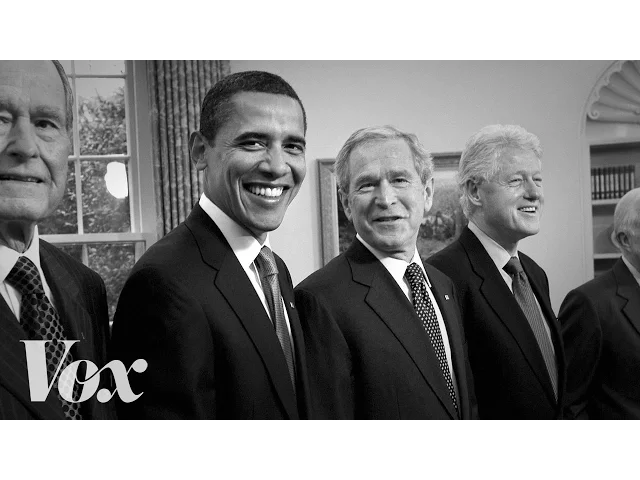
Why Obama is one of the most consequential presidents in American history
Vox
0:00 Let’s be clear about something: Barack Obama has been one of the most
0:04 consequential presidents in recent American history.
0:06 "You can't say it, but you know it's true." In the past eight years,
0:10 he has completely transformed the American healthcare system.
0:12 He got tough reforms to Wall Street
0:14 passed after the biggest financial crisis in decades.
0:16 He appointed two of the 4 women to ever serve on the supreme court,
0:19 both of whom were part of the historic decision legalizing same sex marriage.
0:21 He put in place the toughest climate regulations in American history.
0:24 He opened the US to Cuba for the first time in half a century.
0:27 And he reached a peaceful settlement to the nuclear standoff
0:29 with Iran that lasted for a decade before he took office.
0:32 You can celebrate or bemoan these accomplishments.
0:34 Liberals will think they’re great, conservatives will think they’re awful.
0:37 But it’s hard to deny that they’re big deals.
0:40 So….
0:40 where do we start?
0:41 Obamacare is a big fucking deal.
0:43 For at least 100 years, the big goal of American liberals on domestic policy
0:49 was to get a national health insurance program done.
0:53 A lot of countries implemented universal health
0:55 care in the 20th century— the UK,
0:57 Canada, France— but the US always lagged behind.
0:59 There were attempt after attempt after attempt by American progressives of both
1:05 parties to try to get the US to where everyone else was going.
1:09 And each of those attempts failed.
1:11 Teddy Roosevelt failed, FDR failed, Truman failed, Nixon failed,
1:15 Carter failed, Clinton failed… and then Obama succeeded.
1:19 And he established for the first time
1:21 in American history that healthcare is a right.
1:23 The plan still leaves millions uninsured,
1:25 but it laid a foundation for universal health care.
1:29 To understand what Obama did for foreign policy,
1:32 you have to go back to a moment in 2007, this moment in particular:
1:38 “Would you be willing to meet separately without preconditions,
1:42 in Washington or anywhere else,
1:45 with the leaders of Iran, Syria, Venezuela, Cuba,
1:49 and North Korea, in order to bridge
1:52 the gap that divides our countries?” Obama: “I would.
1:55 And the reason is this, that the notion
1:59 that somehow not talking to countries is punishment to them,
2:03 which has been the guiding diplomatic principle of this administration,
2:09 is ridiculous.” So, this was considered a gaffe.
2:13 The safe thing that you’re supposed to say is “yeah, diplomacy’s great,
2:17 we’ll talk to some people, but there have to be preconditions.
2:20 No preconditions is silly.” And this is
2:22 what other Democrats did say at the time.
2:24 But he didn’t accept that.
2:25 And with two of the countries listed in that question— Iran and Cuba—
2:28 Obama led some of the biggest changes
2:30 to those diplomatic relationships in recent history.
2:33 I’d be remiss in not mentioning the importance
2:35 of the fact that Obama is the first black president.
2:39 After 8 years it seems obvious to point out But the history
2:42 of America is a history of learning to deal with racial diversity,
2:48 and with the legacy of white supremacy.
2:50 In a very real way the history of America is the history of race relations.
2:55 There’s a famous photo that still hangs in the White
2:58 House of a black toddler in the White House who
3:02 asked to touch president Obama’s hair because he thought it
3:05 was great that the president had hair that looked like his.
3:08 It seems cheesy, but it really is a big deal that a generation
3:11 of black children are going to grow up knowing that they could be the president.
3:16 Overall it’s a pretty extensive track record.
3:18 You can generally divide American presidents into two camps.
3:21 There are the ones who were maybe a little good, a little bad,
3:26 but are sorta forgettable: Grover Cleveland, Benjamin Harrison,
3:30 Zachary Taylor, William Howard Taft, Bill Clinton.
3:33 And then there are the ones who were hugely consequential either for good:
3:38 FDR (ending the depression, winning WWII), Lincoln (winning the civil war),
3:44 George Washington (establishing what a president is), or for ill.
3:48 Andrew Johnson, destroying reconstruction and subjugating
3:51 black people for a century.
3:53 Andrew Jackson committing genocide or ethnic
3:55 cleansing against the Southeast Indians.
3:57 I think it’s hard to argue that Obama is in the sorta iffy,
4:03 “eh” camp rather than the big consequential camp.
4:07 He did a lot, he accomplished a lot.
4:10 And I think in the next 10 or 20 years when we have a bunch
4:14 more presidents many more of whom are
4:17 alright or slightly bad but ultimately forgettable.
4:19 We’re going to look back and realize what a rare
4:23 thing a presidency that active and that accomplished is.