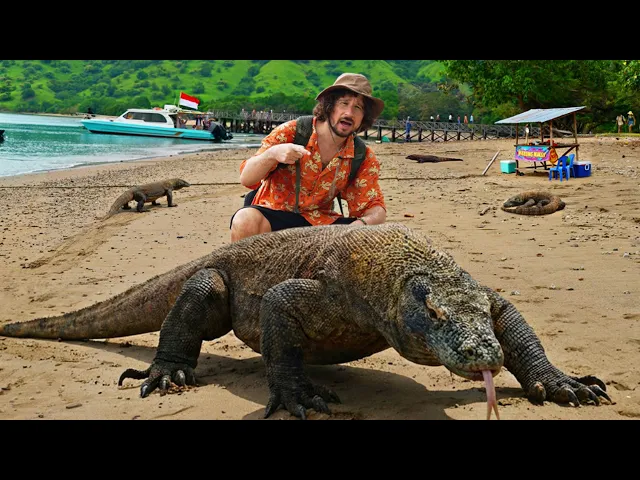
Aquí vive el reptil más peligroso del mundo: DRAGÓN DE KOMODO 🐊
Luisito Comunica
0:00 The reptile we are observing is among the most dangerous creatures globally.
0:05 They are capable of swallowing an entire ape whole with one bite,
0:10 consuming an eel as easily as slurping a noodle from a spaghetti dish,
0:14 and their saliva harbors deadly bacteria.
0:18 The craziest thing is that on this island people walk among them,
0:21 they live their daily lives as if nothing were happening,
0:25 and it is estimated that they eat a small child every two years.
0:29 Literally, outside the school, three huge dragons there waiting.
0:34 Wow, disturbing to be this close to one.
0:38 This is Komodo Island.
0:40 We are on our way to Komodo Island,
0:43 one of the places with the greatest biodiversity on our planet.
0:47 This location is the habitat of the highly feared Komodo dragon,
0:51 an ancient and enormous reptile,
0:53 and certainly one of the most perilous creatures on the planet.
0:58 Our objective is to locate it, document it closely,
1:01 and gain further knowledge about this magnificent yet feared species.
1:06 We have approximately a one-hour journey ahead
1:08 from Flores Island in Indonesia to Komodo Island.
1:11 Let's get going.
1:12 Before our eyes, Jurassic Park.
1:15 You can already hear the, the T-Rex.
1:20 Oh, wow, look.
1:21 We're already seeing this, haven't even entered the island.
1:25 We are already seeing the famous Komodo deer here on the edge of the beach.
1:31 Wow, there's one, over there's another one that's chilling there, my friend.
1:35 Look, they don't know they're the Komodo dragon's number one prey,
1:39 which is interesting.
1:41 Those little deer over there are really
1:43 the reason why the Komodo dragon might say:
1:46 I wouldn't eat a human there, I'm not that hungry,
1:49 because that is the main food for the dragons.
1:53 How funny, right?
1:53 Deer on the beach, I've never seen that before.
1:56 There it is, look, welcome to Komodo National Park.
2:00 Oh, by the way, that's worth mentioning, this is a protected area,
2:04 which is cool so that the little dragons
2:06 and the animals that live here are taken care of.
2:08 It's somewhat like the Galapagos Islands,
2:10 but located in the Asian part of the world.
2:13 Similar in biodiversity and impressiveness.
2:16 Yeah, like a Galapagos.
2:18 By the way, beautiful Galapagos, a shout-out to all my friends there,
2:21 and to all the Ecuadorians watching.
2:23 We should return there soon.
2:24 Ah, wow.
2:25 And let's see, our first steps
2:27 on the island and we're already spotting Komodo dragons.
2:30 I honestly didn't expect it to be this difficult.
2:32 I mean, I thought it would be like a three-hour hike to find them there.
2:37 No, they're everywhere.
2:38 Look how casual it is.
2:39 I mean, my friend is here talking on the phone, making a call for work, right?
2:44 Doing home office from this paradise.
2:47 And there's a dragon.
2:48 It's normal for my friend.
2:50 Yes, people actually live here on Komodo Island,
2:53 around two thousand inhabitants, slightly more.
2:56 And interestingly, our guide, Tali, is here.
2:58 How are you, Tali?
3:00 Are you well?
3:01 Good, good.
3:01 Look, oops, here he comes.
3:03 Wait, it's moving.
3:05 Tali here has a stick that protects us in case something happens.
3:08 Hello!
3:09 See how majestic?
3:11 Majestic animal, how majestic.
3:13 Hey, I need to share my first impressions.
3:16 It's crazy that, look, this is a tourist place, right,
3:18 many people come to visit it, and yet, look how much trash there is, man.
3:22 It's sad seeing the Komodo dragons among so much trash.
3:26 Look at this, someone here left their medicine, their Red Bull.
3:30 And yes, there's trash everywhere among these poor Komodo dragons.
3:34 This is what humans do.
3:36 Humans arrive, and this happens.
3:37 It's really crazy to see them so
3:40 casually passing by next to the little restaurant, it's not very normal.
3:44 This one here, you might be thinking it looks quite small.
3:48 And yes, precisely, according to our guide,
3:50 this one is likely six or seven years old.
3:53 The Komodo dragons, they tell me, can live up to fifty years,
3:56 so they live quite a long time.
3:58 So this one we are seeing here is still learning to eat a deer,
4:03 to suck an eel like it's a noodle.
4:06 And yes, they tell me that they reach adult size around twenty-five years old,
4:11 that's like their big, fat, long size.
4:13 This one here is an adult.
4:16 Wow!
4:16 This one could eat us.
4:18 They tell me that the last incident of a dragon
4:22 eating a human was just about two years ago,
4:25 it was a local kid from this island.
4:28 They have eaten tourists and especially, yes, children from the island.
4:32 Well, yes, if you catch it hungry, then buddy,
4:35 it's you or me, there's no other way.
4:37 And we can observe that the dragons have a painted marking.
4:42 This is because they are counted.
4:44 There are estimated to be fifteen hundred to thousands of dragons on the island.
4:48 And based on the color of the mark,
4:51 their age and seniority can be roughly determined.
4:54 This buddy here must be about thirty years old.
4:57 We're both in our thirties now, considered old folks.
5:01 Oh, look here, a massive statue of a giant dragon.
5:06 Our purpose will be to see one of these dragons,
5:09 which by the way, speaking of purposes, I will take advantage quickly to insert
5:13 the mention of the sponsor of this video.
5:15 Perhaps you made it a New Year's resolution to start a new business,
5:19 to become an entrepreneur.
5:21 And let me tell you that the day is
5:23 today with the sponsor of our video, which is Hostinger.
5:26 Hostinger is an excellent service for creating and hosting a website.
5:31 It's very easy to design,
5:33 and it utilizes artificial intelligence to power your business
5:36 or venture and bring your ideas to life.
5:39 And currently, they offer an all-inclusive
5:41 subscription powered by artificial intelligence.
5:44 Essentially, it covers all services: domains, website hosting,
5:48 email, design, and even a marketing plan.
5:51 They have a really cool feature that uses artificial intelligence,
5:54 where you tell it what you want your page to be about,
5:57 more or less what tones, what colors, and it will give you proposals.
6:00 So simple, so easy.
6:02 It's absolutely fantastic,
6:03 genuinely incredible for you to transition your business,
6:06 something I've always wanted to do,
6:07 to start a venture in this field, right from your very first day.
6:11 The time is right now.
6:13 We've prepared a special discount code exclusively for our channel subscribers.
6:16 I'm providing all the details below; you'll find every link in the description
6:20 so you can launch your venture immediately.
6:22 And that by using Hostinger, which is truly a very, very cool service.
6:26 Thanks, Hostinger, for the sponsorship.
6:29 And come on, now for real, to our purpose of the day,
6:31 which is to find the Komodo dragon.
6:33 Tali informed me that Komodo dragons ingest their prey whole,
6:38 essentially suctioning it down.
6:40 They only chew very large prey.
6:43 For instance, a human of my current size, perhaps in their thirties,
6:46 would be masticated; however, a child of just one year old...
6:54 In fragments.
6:55 Yes, this structure is the nest.
6:59 However, this nest was not constructed by the Komodo dragon.
7:06 A bird made this.
7:08 Oh my, maybe guinea fowl made the nest.
7:11 They can share.
7:12 After birth, the Komodo come to change.
7:14 Oh, they share?
7:15 Yes, they can.
7:16 Ah, look, so they're not that mean, the dragons, they do share.
7:20 Oh, they take over.
7:21 Oh, okay, that makes more sense.
7:23 Ah, yeah, but the communication is limited, that makes more sense.
7:28 Look, Vitaly is our translator.
7:30 How are you, Vitaly?
7:31 Good?
7:31 Very good.
7:32 So the good Vitaly has already translated for me,
7:35 that basically it's not like they share,
7:37 they're not roommates, meaning, rather, the Komodo dragon arrives and says,
7:40 'Dude, get out, the boss is here,' and so
7:43 they eat the bird and they eat its eggs too, and then they use its nest.
7:47 They behave like an ex-partner who
7:48 resided in your apartment without paying rent, and upon separation,
7:51 not only owed you money but also took your bed and mattress.
7:54 That's the Komodo dragon, it's a jerk.
7:57 It's a piece of crap, a parasite.
7:59 We've come across a piece of dung, feces, specifically Komodo dragon excrement,
8:04 and observe its remarkably white coloration.
8:07 They're telling me it's very white because of the calcium from the bones.
8:10 Because they consume their prey whole, encompassing bones and teeth,
8:14 this results in their feces having a distinct whitish hue.
8:17 A fascinating fact is that Komodo dragons typically
8:20 feed only once every two to three weeks,
8:22 sometimes even stretching to a month between meals.
8:25 This explains why we observe them lounging on the beach;
8:28 it seems they consume massive amounts, bones and all.
8:31 Just imagine the digestive process for that, it's intense.
8:35 It's like you after eating forty wings, right?
8:38 Just by yourself at home, unable to move.
8:41 The same with our buddies.
8:43 And a rather unsettling piece of information,
8:45 from the many things we're discovering about these small dragons,
8:48 is their ability to consume such large prey stems from their strategic nature,
8:53 patience, and an exceptionally keen sense of smell.
8:56 Basically, let's say, a buffalo, one would think,
8:58 how can a dragon like this take down a buffalo?
9:00 It turns out they have a lot of bacteria when they bite.
9:03 Consequently, after they bite, these bacteria begin to work, and within days,
9:07 the buffalo will experience illness,
9:09 leading to its solitary decay and eventual demise.
9:13 The dragon will leave,
9:14 and then the Komodo dragon will sense that the meat is rotting.
9:18 In other words, they can detect the scent of decaying
9:21 flesh from a distance of up to three kilometers.
9:24 So they use their long tongue like this and then they smell,
9:27 they perceive, and they say, oh, there's some tasty rotten meat here.
9:30 And one day they decide it's ready to eat.
9:33 Do you remember the brother we bit a few weeks ago, a few days ago?
9:36 Haha.
9:37 They go and now they eat it.
9:38 No, no, no, they are truly, they are cunning, they are intelligent.
9:41 I don't want to run into one that's hungry because the brother
9:44 might not win the first battle and I'll say: ha, I beat you.
9:47 However, the creature will then patiently wait,
9:49 use its sense of smell, and launch an attack.
9:51 So, let's see, if you ever get bitten by a Komodo dragon,
9:54 you have to act fast because in about three,
9:56 four hours they have to inject you so
9:58 the bacteria doesn't reach your nerves and infect you.
10:01 It's not as fast as the venom of, I don't know, a snake,
10:04 people, or something like that, but it gives you a few hours.
10:06 Therefore, if you are bitten here,
10:08 you must immediately take the quickest available transport,
10:11 be it a boat or otherwise,
10:13 to the Big Island's hospital for treatment, to prevent internal decomposition.
10:17 And you'd be done for.
10:18 These bodies of water that one finds can be
10:21 a sign that a Komodo dragon might be nearby,
10:23 because what these little terrors do is they know
10:26 that the little animals come here to drink water, to hydrate, right?
10:30 So they hide here in the leaves and a little pig comes, whatever,
10:34 a wild boar to hydrate, and at that moment, bam, brother, they catch them.
10:39 Although we don't see them at this moment,
10:41 they are undoubtedly concealed nearby,
10:43 observing us and thinking: this tourist appears appetizing;
10:45 when they least expect it, I'll bite their posterior.
10:49 These here are tracks like those of a wild boar.
10:51 There are wild boars, uh, wild pigs around here too,
10:54 one of the main prey of Komodo dragons.
10:57 I'm asking Tali what happens if a dragon approaches.
11:00 He informs me that using this stick here, take a look, is more than sufficient.
11:08 If it comes too close, we can put the stick around its neck.
11:12 And what kind of sound does a Komodo dragon produce?
11:24 Yes, yes, yes.
11:40 That way, and it will make its noises.
11:42 And look, it's funny, this is very touristy in the National Park.
11:46 So the locals here, hello friends, sell you everything Komodo dragon related.
11:51 They sell this, look, it's wood, made here, not from China, from Komodo Island.
11:57 Ah, that's good, that's good.
11:58 And this is abalone shell, not plastic.
12:01 All right.
12:04 Ah, no, well, look, the truth is we are going to buy something
12:06 because it's annoying when they sell souvenirs that are all made in China.
12:09 Here it is, well, yes, it's this, well, it's local manufacturing.
12:14 And yes, they sell you the t-shirt,
12:15 they sell you the jersey, the keychain, the plushie.
12:18 This, I really don't think they make it here, not at all.
12:20 I mean, they must order this from Alibaba, I think.
12:23 It's cool, right?
12:23 And yes, you support the locals,
12:25 whose main economic activity today is this, guiding people,
12:28 talking about the dragons, that's what it is.
12:30 It's quite funny to suddenly find them just sleeping like that.
12:34 Look, here my buddy is chilling.
12:35 It's like a giant iguana, right?
12:37 I mean, it's basically the same animal, but two meters in length.
12:40 We found another one chilling here.
12:41 By the way, maybe you see that I'm close,
12:44 it's actually camera perspective, I'm quite far away.
12:47 Here the camera operator gets creative to make it look closer.
12:51 And this one is really big, by rough estimate,
12:53 two and a half meters I'd say in length.
12:55 We are learning that just as snakes and reptiles in general shed their skin,
13:00 of course, but not in one piece like a snake, but in sections.
13:04 And wow, their claws are really impressing me a lot.
13:08 Yes, they are indeed like giant iguanas,
13:10 that could eat you or kill you with the bacteria from their saliva.
13:21 We came to walk through the village, through where the people from Komodo live.
13:26 I tell you, about two thousand people here.
13:28 And wow, it's very interesting.
13:30 There's a massive mosque, truly tremendous.
13:34 There's a lot of trade, it feels very active.
13:36 Well, as I tell you, quite a few tourists come here to visit,
13:38 and we can see a little bit of what the streets are like,
13:41 what the alleys are like.
13:43 We can observe that most of the houses are tall,
13:46 they are built as if designed for people to live on the upper level,
13:51 because in the rainy season the tide can rise,
13:54 etcetera, etcetera, the village streets tend to flood here.
13:58 So that's why people live upstairs.
14:01 They tell me that traditionally the animals that people raise live below,
14:05 on the lower levels,
14:07 but that there are families who prefer to keep them on a middle level too,
14:12 because there's always the risk that the Komodo
14:15 dragons will come and eat your chickens,
14:17 your goats, your cat, your dog, no, your pet.
14:21 Oh, how awful!
14:22 No, that your pet gets eaten by a Komodo dragon.
14:24 Imagine, look at the dogs we haven't seen.
14:26 You know, we have seen cats, yes we have seen them,
14:28 but we still haven't seen any puppies.
14:30 We are visiting the village right on a Friday,
14:32 so it's the day of prayer in Islam.
14:34 And yes, yes, it's very active.
14:36 Look, check how many shoes are out here.
14:38 Here half of the community is inside praying at the moment.
14:41 And yes, yes, they tell me that practically
14:43 one hundred percent of the population is Muslim, ninety-nine.
14:46 Maybe there's one or two who say no, not anymore,
14:48 but yes, yes, all, all, all here are Muslim.
14:50 We are learning that here in the community they have a flag.
14:54 Look at this, they tell me it's
14:56 a new movement that's about three, four years old,
14:58 and it's very cool that they chose the color
15:01 blue because they depend on the sea, right?
15:03 This is an island in the sea, the hand of the community holding,
15:06 lifting the island of Komodo, and of course the dragon,
15:09 which is like the most iconic thing.
15:12 It's nice, I loved that they have the community flag.
15:14 I present to you our friend Ferian, who is guiding us through the community.
15:18 How are you, Ferian?
15:19 Good, so look, that guy Ferian is bringing me to see the hospital.
15:23 He tells me this is something new, it's good, more than a hospital,
15:26 a clinic, let's say, completely public,
15:28 and that they can provide first aid here.
15:30 So if a dragon bites me, here first aid.
15:33 Yeah, it's a first aid for medicine,
15:35 and after that directly we have to go to the lab.
15:38 It's important for us.
15:40 So here I come, they gave me first aid, and then go to the city.
15:43 Yeah, exactly.
15:44 All right, how far to the closest city?
15:47 It's around six hours by local boat,
15:49 but when I use the speedboat, it's around one point five hours.
15:54 That's good.
15:55 I imagine six hours you die.
15:57 It's become die because the dragon is very dangerous.
16:18 They do cremation or they just leave the bones exposed.
16:21 We've documented quite a few on the channel.
16:23 So yes, what's up?
16:24 Here you have all the tombs together,
16:25 but they tell me that in other places there are more cemeteries,
16:28 that it's not like all the people from the island who die are here,
16:32 but that there are different places, different cemeteries,
16:34 and there will also be different traditions, I imagine.
16:37 We met our friend Shurmani here, and look, Shurmani is an artist.
16:41 Here she is making the little wooden dragons.
16:44 Wow!
16:44 It's super impressive, she's doing it with half a pair of scissors,
16:48 and she tells us that it takes quite a while.
16:50 I mean, in a whole day she can make about ten,
16:53 or if she really tries, about fifteen of these.
16:55 So, wow, it's really good.
16:58 We obviously already bought some from her, a few,
17:00 and we're helping her because her work is truly admirable.
17:03 And man, really good.
17:06 Wonderful Indonesia.
17:07 No, she's a pro, I mean, a real one, what she does is super cool.
17:22 Super cool.
17:22 We're just stepping out of the community a bit,
17:25 but really just a bit, the houses are fifty meters that way.
17:28 And wow, there's a massive one here, but really, Mr.
17:32 Komodo Dragon.
17:33 From here you can see him completely.
17:36 Look at that, hello.
17:37 That one is definitely a big adult, it's massive.
17:41 And it explains why, in fact, what happens, happens, right?
17:44 When children go out walking without supervision and such,
17:47 you can easily run into one of these.
17:50 I mean, but I'm telling you, we walked nothing,
17:52 I mean, the houses are over there,
17:54 we walked this far and saw one here and another one over there.
17:57 And the one that walked a little further that way,
18:00 no, no, you find massive ones easily.
18:02 Well, as I tell you, it's almost the same population of people as dragons here,
18:06 so it's not really difficult to run into one.
18:09 No, yes, with extreme caution, this is certainly not a laughing matter.
18:20 Hello.
18:21 It's still lazy, but when it was doing like this— Yeah, that's more dangerous.
18:25 Furthermore, these dragons possess remarkable speed,
18:28 capable of reaching up to twenty kilometers per hour,
18:31 though only for brief durations.
18:33 They're fast.
18:34 This distance, are we safe?
18:36 We're safe because he doesn't move.
18:38 Exactly, yeah, he's still.
18:40 Hello, this one's big.
18:42 This blue building behind is the school.
18:45 They can study here until high school.
18:48 And hello, big guy, look, outside the school, three dragons.
18:53 Big ones there waiting.
18:56 It makes me think that the children when they go
18:58 to school here have to walk around with that stick, right?
19:00 So that they don't, to avoid the risk, right?
19:02 To be able to scare them away at least, right?
19:04 No way, not like that.
19:05 Oh, how was your day at school, my son?
19:07 It was fine; I was observing the dragons from the window,
19:10 and they were preparing to prey on the neighbor's goat,
19:13 belonging to Doña Juana, you see?
19:15 Our guide did mention that it's highly probable they are
19:18 clustered together because they are anticipating the arrival of those goats.
19:22 I don't know if you can see.
19:23 So, they probably said: oh, tasty little goat, we'll stay here to chill,
19:27 and if a kid from the school happens to cross our path, well, right away, right?
19:31 I don't know, I don't know, it could be, it could be.
19:34 But yes, look, three there as if nothing.
19:36 They catch you in an ambush between the three of them, it's hard to escape.
19:41 The risks change, depending on the place.
19:44 In many places, it's scary for your child to go to school alone because,
19:47 well, I don't know, they'll be robbed, kidnapped, hit by a motorcycle.
19:51 Here the risk is more: a dragon will eat him, or bite him,
19:55 and you might cut off a foot,
19:57 different risks, all equally scary, equally terrifying.
20:01 You see this in very few places.
20:02 Comodo Island is a very, very unique place.
20:06 Another one here, walk a bit more, another huge one.
20:10 And this one, look how it's stalking the goats,
20:13 I mean, it's there, craving them.
20:15 And the goats, I don't know if they
20:17 don't realize or if they've just normalized it,
20:19 it's like, oh, well, there's the risk, no, nothing happens, it is what it is.
20:22 And they're eating as if there were no other field to eat in, I mean,
20:25 the field is huge and there they are as if nothing,
20:28 meters away, really, two, three meters from the dragon.
20:30 How interesting.
20:31 One might assume that witnessing such a scene,
20:34 a Komodo dragon preying on an animal,
20:36 would necessitate venturing deep into the wilderness,
20:38 akin to what is depicted in National Geographic documentaries.
20:43 No, man, this is happening right here.
20:45 And look, here's the school, right after that are more houses.
20:49 I mean, one hundred meters from your house
20:51 you have a scene worthy of the Discovery Channel.
20:53 With all this, I understand why they say this is Jurassic Park,
20:56 Jurassic Park in real life, because yes, no, no, I mean,
20:59 not even Jurassic Park, where the dinosaurs lived alone.
21:04 There's another one, look, me walking,
21:06 vlogging, all relaxed, and there's another guy.
21:09 Unbelievable!
21:09 I'm glad you warned me, Ari, because I was vlogging casually,
21:13 as if I were vlogging in Singapore, completely unaware.
21:17 And that individual over there appears to be vigilant, truly alert.
21:20 He seems to be signaling a 'do not approach' warning,
21:23 maintaining a considerable distance.
21:24 No, yes, I mean, in Jurassic Park, I'm telling you,
21:27 the guys lived alone, here they live among humans, no, this is wow.
21:30 Yes, yes, dinosaurs in reality,
21:32 a species believed to have existed for three to four million years,
21:36 evolving to immense proportions due
21:39 to prolonged isolation and lack of predators,
21:42 establishing themselves as the dominant rulers of the island,
21:45 the apex predators to this day.
21:48 More than present, and present, look, I mean,
21:50 we start walking at that tree over there and look,
21:52 we walk like this, and how many did we see?
21:55 Like five or six, right?
21:56 And huge ones.
21:57 And just like all cities have their main square, right?
22:01 Their main monument, a flag, some liberator,
22:04 whatever, here the monument is a dragon.
22:07 Of course.
22:08 Wow, it's really big, look at this.
22:10 Wow!
22:10 What detail!
22:11 What a piece of art made by local artists!
22:13 They told me, super talented, honestly, it's awesome and I like it, I like it.
22:18 Good place to come and take a photo here, here.
22:21 Perhaps, like myself,
22:22 you are curious if the local populace consumes these dragons.
22:25 The thought crossed my mind,
22:27 imagining a small dragon being prepared like a gar, a pejelagarto.
22:31 We've tried that before on the channel, the pejelagarto, very peculiar.
22:34 But no, they tell me that the dragon is so
22:36 protected that in fact if they catch you hunting them,
22:39 selling them, cooking them, well, you go to jail and everything.
22:43 Obviously not, it's an endangered species.
22:45 And sad, right, because it's millions and millions
22:47 of years old and today there are only like,
22:50 I mean, across all the islands maybe there
22:52 are less than six thousand of these guys.
22:54 So it's good to preserve them, honestly.
22:57 And it's good that Indonesia's laws protect them,
22:59 because yes, Such a majestic species, imagine if they disappeared,
23:03 our great-grandchildren wouldn't know about Komodo dragons, they'd be a legend.
23:06 No way.
23:08 The legend of fire-breathing dragons, well,
23:10 Komodo dragons are real, we must care for them.
23:13 This is the soccer field here.
23:15 It's good, it's big.
23:17 Soccer and volleyball can also be played here.
23:19 It's an interesting scenario, isn't it?
23:20 Everywhere else, it's usually 'Oh no,
23:22 the ball has gone astray!' followed by 'Doña Mari,
23:24 please return it.' 'No, I won't give it back.' And that's the problem, right?
23:27 Like this you lose the ball, right?
23:29 It went to the yard with the biting dog.
23:31 Here you lose the ball because you kicked it too far and the dragon deflated it.
23:42 Well, there you have it, a bit of Komodo Island in Indonesia.
23:46 Wow, I honestly didn't think it would be this interesting.
23:49 I honestly assumed we were heading to a national park,
23:52 perhaps with some zoo-like ambiance, but no,
23:54 this isn't just that; this is the actual reality,
23:57 the everyday existence for countless individuals
23:59 in a remarkably remote region of Indonesia.
24:03 As you've seen, what did you think?
24:04 What else would you have liked to know about this place?
24:07 I'd love to read your comments down below.
24:09 Thanks to the locals for being great, to the guides,
24:12 and to you all for coming along on this adventure.
24:16 See you in a few days with a new video.
24:19 Goodbye!
24:19 Data!
24:20 Hala!
24:20 In the end, the rain did catch us, jacho.
24:23 Look at that!
24:24 You can't see anything over there.
24:27 Hala!
24:27 Hold on, boat, come on!
24:29 Yes, we can, yes, we can!
24:31 Come on!
24:32 We'll arrive safely, we'll arrive safely.