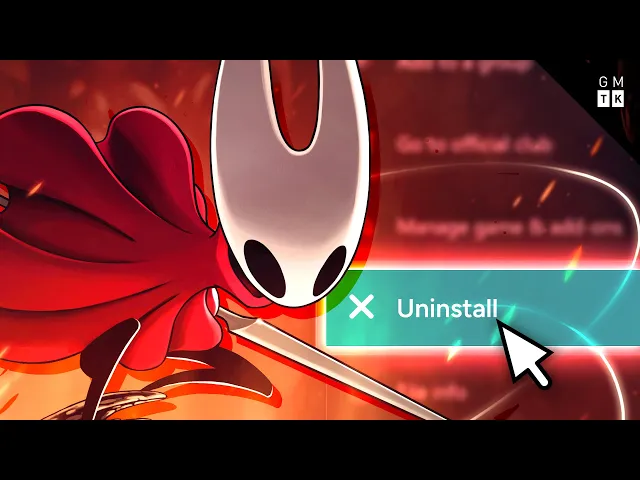
What's The Point Of Hard Games, Anyway?
Game Maker's Toolkit
0:00 This week, the game design discourse is all about Hollow Knight: Silksong.
0:05 Which, don't worry, I won't show any footage beyond Act 1.
0:09 No spoilers here.
0:10 But, yeah, this is Team Cherry's much anticipated,
0:14 much hyped sequel to 2017's incredible Hollow Knight.
0:18 But pretty much the only thing people are talking about
0:21 with this game is its rather brutal level of difficulty.
0:26 For context, this is a Metroidvania about winding through
0:30 an interwoven map- looking for upgrades and secret passages.
0:35 There's nothing too strenuous about that.
0:37 But along the way you'll have to go
0:40 toe-to-toe with a huge cast of terrifying bosses-
0:43 many of which will put your skills to the test in a punishing war of attrition.
0:48 Now, the first Hollow Knight was pretty tough
0:51 at times- but Silksong seems to turn the dial further,
0:55 with even early and mid-game bosses- like the bullying Last Judge at the end
1:02 of Act 1- requiring dozens of failed attempts as you learn the patterns,
1:06 safe spots, and phases you must go through in order to win.
1:10 All of which has left some players feeling dejected and frustrated.
1:16 Review site VGC gave the game 3 stars out of 5- praising almost every aspect,
1:22 but trashing it for a level
1:25 of difficulty that feels "demotivating" and "sadistic".
1:28 And so, with all this chatter going on, I thought it might be interesting
1:32 to talk about the design of difficulty in games through the lens of Silksong.
1:38 To look at why game designers choose to implement a higher level of challenge.
1:42 And- crucially- how they should go about it.
1:45 I'm Mark Brown, and this is a GMTK Mini.
1:49 Okay- so the first question is,
1:51 why would a game designer choose to make their game hard, in the first place?
1:56 What can you gain by amping up the challenge?
1:59 Well, I think there are three main reasons to do it.
2:03 Number one is that the harder a challenge is,
2:07 the more satisfying it feels to finally overcome it.
2:10 If you breeze through a boss fight the first time you play it,
2:14 it might barely even register as something that happened.
2:17 But if you struggle against a boss for an hour,
2:20 slowly improving your skills, your reflexes,
2:23 and your knowledge with each failed attempt,
2:25 and then you finally topple that monster- well,
2:28 that moment of triumph is something you might never forget.
2:32 That's the idea behind the Dark Souls
2:34 series- creator Hidetaka Miyazaki says "I just
2:37 want as many players as possible to experience
2:40 the joy that comes from overcoming hardship".
2:43 And Hollow Knight: Silksong certainly plays into this.
2:46 When I finally beat the Last Judge, my palms were sweaty, my heart was racing,
2:52 my eyes were straining from not blinking- and I let out an embarrassing,
2:56 involuntary noise like "ahhh!" to mark my victory.
3:00 You don't get that with an easy game.
3:02 The second reason to amp up the difficulty is
3:04 to tie in with the game's narrative or aesthetic goals.
3:08 Like, if a game tried to tell you
3:11 that this kingdom is a place of misery and death,
3:14 a no man's zone where hope goes to die.
3:17 And then you play it and it's full of enemies who die in a single hit...
3:21 well that's going to be pretty dissonant.
3:23 So if you want to tell a story about suffering and failure,
3:27 then the gameplay should reflect that.
3:29 That's how Celeste works- the game is about hero Madeline stubbornly
3:33 persisting through hardship and setbacks
3:35 as she climbs a legendarily high mountain.
3:38 And so the player must also stubbornly persist
3:41 through hardship and, well, you get the idea.
3:44 Silksong plays into this too.
3:46 The game's world- Pharloom- is a withered, haunted land.
3:50 There is death everywhere.
3:52 Other characters are seen failing on their pilgrimage to the Citadel.
3:56 Main character Hornet must grow in strength and wisdom to succeed.
4:00 And so must you.
4:01 And the final reason for increasing a game's difficulty is
4:04 to ensure that the player approaches the game in a certain way.
4:08 Take the game Furi- a game about being patient
4:12 and observant as you dodge and parry every incoming attack.
4:16 Before exploiting a rare opening to deal some damage.
4:19 The game is designed as a brutal back-and-forth ballet of defence and offence.
4:25 But if you could also just run up to the boss,
4:27 dodge a few simple attacks, and then wail on it until it dies...
4:30 well you wouldn't have to do any of that stuff I just said.
4:33 And the game would be pretty dull.
4:36 So in Furi, difficulty acts like a teacher:
4:39 punishing you if you play it wrong, rewarding you if you play it right.
4:43 Where easy games let you get away with simple and repetitive strategies,
4:47 hard games require you to use every mechanic, every system,
4:51 every tool, and every inch of the level design.
4:54 And Silksong does play into this also.
4:57 You'll need to learn every boss's patterns, make use of every charm and tool,
5:02 and understand Hornet's moveset on a deep, molecular level.
5:06 So- I think those are the three main reasons to make a game more challenging.
5:10 To increase the sense of satisfaction.
5:12 To mirror the storyline.
5:14 And to discourage boring playstyles.
5:16 All of which turns difficulty into another tool that a game
5:19 designer can use to create the exact experience they want.
5:23 But!
5:23 But but but.
5:24 Big but.
5:25 A tool can't be used carelessly or thoughtlessly.
5:29 I mean- it's simple to make a game really hard.
5:32 Just put spikes everywhere and send the player back
5:35 to the beginning of the whole game every time they fail.
5:37 That's done- but you've now alienated 99% of players.
5:42 No.
5:42 Instead, difficulty is a careful balancing act.
5:46 We want players to feel challenged.
5:47 Maybe even frustrated.
5:48 But we also want them to get that moment of catharsis
5:51 from winning before they go all the way into rage quit.
5:55 Now, I think if a game feels fair- like
5:58 you can see how you might learn from your mistakes,
6:01 you can feel yourself getting better, you blame yourself for slip-ups,
6:05 and you have ample opportunity to repeat and improve- then the game
6:09 can keep you in that challenge zone for a long time.
6:12 And oftentimes, this is where Silksong lands.
6:15 I spent a long, long time fighting the Last Judge-
6:18 but I kept going because I could see a path to victory.
6:22 I was lasting longer and longer.
6:25 And mistakes were my mistakes.
6:27 But if the game is bull-[beep],
6:29 then the player is going to dip into frustration,
6:32 and perhaps even rage quit, much more quickly.
6:36 And, sadly, Silksong has a fair amount of BS.
6:41 Things like the long,
6:42 repetitive journey to the boss fight every time you repeat.
6:46 Things like unpredictable troll moves.
6:48 Things like boss encounters that use extremely random patterns.
6:52 Things like how the ammo for your secondary weapons don't regenerate upon death,
6:56 so you'll have to farm enemies to top up.
6:59 All of this stuff...
7:00 this is what pushes players to get mad.
7:02 To stop playing.
7:03 To write reviews where you call it sadistic.
7:06 And that also means it no longer fits one of those design goals from earlier.
7:11 The first one- where overcoming a tough challenge feels rewarding.
7:15 Because the player either doesn't overcome the challenge at all,
7:18 because they stopped playing.
7:19 Or they feel a different emotion when they finally win-
7:23 just sheer relief that they'll never have to do that again.
7:27 So as game designers, we can't think of difficulty as a single monolithic
7:32 thing that we can add or remove from our game.
7:36 But instead, it's a broad category that includes a whole
7:39 catalogue of different tools- each one changing the game,
7:43 and the player's relationship with it, in a unique way.
7:46 But there's another type of tool we can use.
7:50 And that's giving the player an opportunity
7:52 to change the difficulty in some way.
7:54 To decide just how hard or easy the game should be.
7:58 Perhaps the most obvious version of this is to provide difficulty modes,
8:02 or assist options that let you modify the game.
8:05 And Silksong- like the original Hollow
8:07 Knight- does not include anything like this.
8:10 Which, in some ways, is a shame.
8:13 Because, well- difficulty is a really subjective thing.
8:17 What's "challenging" is different for every player.
8:21 If you asked me to run a 100m dash in, say,
8:25 less than 12 seconds that would be a really tough,
8:28 but plausible challenge to overcome.
8:30 But it would be practically impossible for a young child.
8:33 And completely laughable for Usain Bolt.
8:37 Difficulty adjustments let everyone find a place where they feel challenged.
8:42 And also- there's more to Silksong than just beating bosses.
8:46 This is also a game about untangling an interconnected web of maps and areas.
8:51 And a game about understanding the deep lore of its storyline.
8:55 It would be a shame to deny people
8:57 of those aspects just because they can't beat the bosses.
9:01 It reminds me of Tunic.
9:03 My wife loved playing this game and uncovering its many secrets and riddles.
9:07 But she simply would not have been able to play it without the accessibility
9:11 adjustments that let you tone down
9:13 the difficulty of its crushing Souls-like boss battles.
9:17 But- with that being said,
9:19 Silksong does have one big thing that allows you to adjust the difficulty.
9:24 And that's being able to explore elsewhere.
9:28 You see, one of the bosses that pushed me
9:29 into the frustration zone was this guy- the Savage Beastfly.
9:34 It's not actually a very difficult fight- he
9:37 has pretty simple patterns to avoid and exploit.
9:39 But, he also spawns in loads of enemies who
9:42 just get in the way and drain your health.
9:44 The overlapping patterns make it almost
9:47 impossible to predict where will be safe.
9:50 But, instead of deleting the game and cancelling Xbox Game Pass,
9:54 I decided to just explore somewhere else.
9:57 I found new powers, more charms, I increased my maximum health.
10:01 And when I finally went back to the Beastfly
10:04 I was able to defeat it a lot more easily.
10:07 And in many ways, Silksong is designed around this idea.
10:12 The game is full of completely optional bosses,
10:15 and there are very few times where a boss acts
10:18 like a complete bottleneck to progressing further into the game.
10:22 I'll explore this more fully in the inevitable Boss Keys episode on this game,
10:27 but, basically: you can almost always go somewhere else and come back later.
10:31 Also- Silksong has a mechanic where you
10:33 lose your cash- your rosary beads- when you
10:36 die and you've got to go back to your cocoon corpse to pick them up.
10:40 It's a mechanic that, in most games that do this, forces
10:43 you to keep going back to the same area again and again.
10:47 But it's not as egregious as other games.
10:51 Like, in Hollow Knight 1 you'd have half
10:53 as much mana until you found your corpse.
10:56 Not so in Silksong.
10:58 You can also find ways to bank your rosary beads.
11:01 All things that make it okay to leave
11:04 your cocoon behind and just go somewhere else.
11:06 And perhaps you could even point to the way ammo works.
11:10 Like I said before, ammo doesn't regenerate on death so you'll
11:13 need to go and kill some enemies to top up your reserves.
11:17 This breaks the pattern of going back to the boss over and over again,
11:21 and may encourage you to just do something else.
11:24 In all of these ways- and more- Silksong is telling you that the solution is
11:28 almost never to just keep hitting your head
11:30 against a brick wall until you get through.
11:33 Instead, if you get stuck you should explore.
11:35 Go elsewhere.
11:36 Get more powers.
11:37 Maybe you'll find a friend who will help you in battle.
11:40 Or that one special item that will make the boss fight easier.
11:44 Or maybe you just need a break.
11:46 So, in a nutshell: difficulty is a tool
11:50 that game designers can use to craft a specific experience.
11:54 But, really, difficulty is a huge set
11:57 of disparate tools- which must be deployed carefully.
12:00 And finally, it's always worth thinking about how
12:03 to give players ways to adjust or circumvent the difficulty.
12:08 Right now, Silksong is still in my sweet spot- it's tough, but I'm surviving.
12:14 But how about you?
12:15 Let me know in the comments down below.
12:18 See you soon for a new episode of Game Maker's Toolkit.