English Beginner? Watch Peppa Pig. Here Are 7 Reasons Why.
English with Alex · engVid
0:00 This is one of the best English teachers you can have.
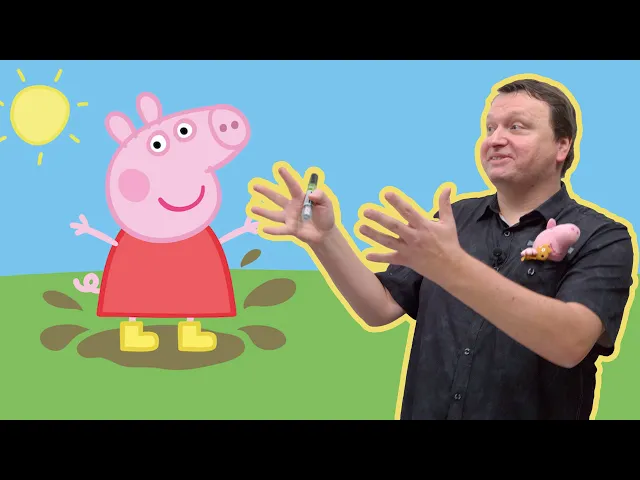
0:04 This is Peppa Pig, and if you don't know
0:08 her, you need to start spending some time with her.
0:12 Many English students ask me, "Alex,
0:15 what shows should I watch to improve my English?"
0:19 Many of these learners are beginners and intermediate students.
0:25 The answer that I have for you today is Peppa Pig.
0:30 It's Peppa Pig.
0:32 I have been using Peppa Pig to help me improve my French,
0:37 and I have found that my vocabulary,
0:40 my speaking, and especially my listening skills have improved.
0:46 So if you are a beginner or an intermediate learner in English,
0:51 I think Peppa is going to do wonders for your English learning.
0:57 She is available on YouTube for free.
1:00 So why is Peppa Pig a great show for English learners?
1:05 First of all, Peppa Pig has short episodes.
1:10 Each episode is only four to eight minutes long.
1:15 Four to eight minutes.
1:17 This means you have less stress on your brain.
1:22 You don't have to focus for a long time like when you watch a movie.
1:28 This also makes the show very easy to re-watch.
1:32 You can go back again and again and again.
1:37 So, short episodes, less stress on your brain.
1:40 This is a good thing.
1:42 Second of all, Peppa has short, clear sentences.
1:47 The characters speak slowly.
1:50 They use clear pronunciation.
1:53 And there are natural pauses so your brain
1:57 has time to process the language it has heard.
2:02 When you are learning a new language,
2:05 if you want to improve your listening skills,
2:08 if you want to improve your vocabulary,
2:11 your brain needs language it can understand.
2:16 If you are a beginner student or a low intermediate student,
2:21 the level of English that is used in Peppa Pig is much better
2:27 for you than the level of English in a standard English movie, for example.
2:33 Third of all, Peppa has useful everyday English.
2:37 This means it uses lots of past and present tense.
2:42 It has a narrator who uses the present continuous a lot to explain a situation,
2:50 often at the beginning of an episode.
2:54 So you might hear, "Mommy Pig is working on her computer."
2:59 "Daddy Pig is cooking in the kitchen." So you hear common,
3:05 useful, everyday English that you can actually use in your life.
3:10 There are also common question structures.
3:13 This goes with lots of past, lots of present tenses.
3:19 "What does the blue button do?" "What do we do now?" for example.
3:25 And finally, you also learn how
3:27 to make polite requests and to give instructions.
3:32 So there are imperatives.
3:34 "Come in," for example.
3:36 There are also polite requests, like, "Peppa,
3:40 could you bring me some flowers from the garden?"
3:44 So a lot of useful, everyday English.
3:47 Peppa also has common situations.
3:50 So characters talk about the weather.
3:54 They look outside, and they say,
3:56 "It's raining," or, "It's snowing." They talk about work.
4:01 They talk about school.
4:03 They visit their family, their grandparents.
4:06 They travel, and they talk about health.
4:09 In one episode, Peppa Pig gets sick.
4:13 That's how she coughs in the show.
4:16 And they have to call the doctor.
4:19 So what's wrong, Peppa?
4:21 Right?
4:21 So you get very common situations,
4:25 a variety of scenarios that people experience in real life.
4:30 It's not just a show that happens in one
4:35 location with the same scenarios again and again.
4:38 And each episode is only four minutes or eight minutes,
4:42 so you get a four-minute episode about the snow,
4:47 a seven-minute episode about visiting your grandparents.
4:51 It's great because you have exposure to a variety of real-life situations.
4:57 You also get a lot of repeated vocabulary in Peppa Pig.
5:02 The best way to learn vocabulary is to hear
5:06 it repeated again and again over a period of time.
5:11 If you watch many episodes of Peppa Pig, you will have this experience.
5:17 You will hear the same family words- brother, cousin, mom, dad, animals.
5:25 Every character has a name plus the animal.
5:29 There is Peppa Pig, Rebecca Rabbit, Susie Sheep, Danny Dog.
5:35 So you have English names and you have the animals that go with them.
5:42 Important for beginners.
5:43 You have home and school words, a lot of common objects- umbrellas, hats,
5:49 coats- everything that you can think of in the home and at school.
5:55 And you also have short,
5:58 common sentences that you will hear in many movies and many
6:03 shows after you finish watching all the seasons of Peppa Pig,
6:09 like "Let's go!" and "Are you ready?"
6:12 The show also has calm, positive scenarios.
6:16 So these are low-stress scenarios.
6:19 It's a feel-good show.
6:22 It is pleasant and easy to re-watch, as I mentioned before.
6:28 Basically, we learn better when we feel comfortable and when we feel safe,
6:34 not when we feel attacked by the language
6:37 and by a horrible situation that we are viewing.
6:41 So it's pleasant.
6:43 It's easy to re-watch.
6:45 It's better for your brain.
6:47 Yeah, it's good.
6:48 Finally, Peppa has strong visual support.
6:52 This means that the actions match the words.
6:56 So what you see matches what the characters say.
7:00 If Peppa says, "I want to play in the garden,"
7:04 you will see Peppa go and play in the garden.
7:08 So the scenarios are clear.
7:11 The facial expressions of characters are clear.
7:15 You can tell when someone is happy, sad, or angry.
7:20 And this, all of this, can also help you guess the meanings of words.
7:26 Because if you see Peppa putting on her boots, you know, "Ah, boots, boots.
7:33 Those are boots," for example.
7:35 If you want to jump in muddy puddles, you must wear your boots.
7:40 Right, Peppa?
7:41 That's right, Alex.
7:43 I knew it.
7:44 And that's why you should learn English with Peppa Pig,
7:48 especially if you are a beginner or an intermediate English learner.
7:53 And if you like this video, hi,
7:56 my name is Alex, and you are learning English with www.EngVid.com.
8:01 You can go there to learn a lot more.
8:05 So until next time, what do I say, Peppa?
8:09 Keep learning and keep practicing.