The 8 Parts of Speech in English Grammar (+ Free PDF & Quiz)
English with Lucy
0:02 (upbeat music)- Hello everyone.
0:11 And welcome back to English with Lucy.
0:13 Today we are going back to basics.
0:16 We are looking at the building blocks of spoken English.
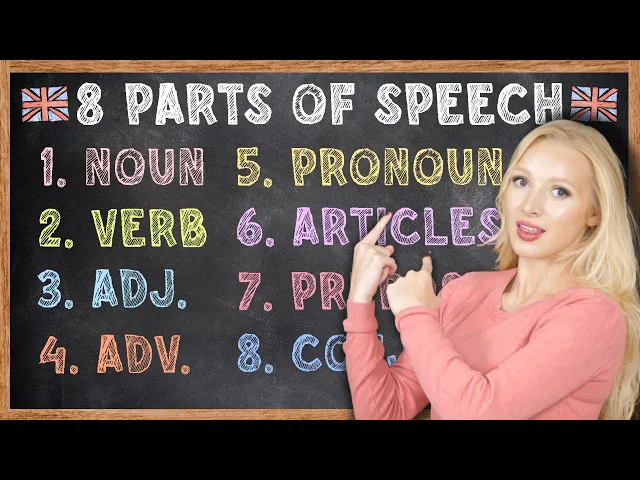
0:20 I'm going to be talking to you about the eight parts of speech.
0:24 Every single word you say has a role within a sentence.
0:29 Every single word is a part of speech.
0:32 Today we're going to be breaking it down and looking at each one.
0:36 It makes up nearly everything that we say in English.
0:39 So we might as well get it right from the very beginning.
0:42 As always there is a free PDF that goes with today's lesson.
0:46 It's got everything we're going to talk about today plus a quiz,
0:50 I know you love quizzes to test your learning.
0:53 If you'd like to download that, just click on the link in the description box,
0:57 you enter your name and your email address.
0:59 You sign up to my mailing list and the PDF will arrive directly in your inbox.
1:03 And then every week after that, you
1:05 will automatically receive my weekly lesson PDFs,
1:15 In my opinion, the most important nouns.
1:18 These are the bread and butter of our speech,
1:21 which is ironic, because bread and butter are both nouns.
1:27 A noun is something that name something, such as a person, an idea or a thing.
1:32 In a sentence, a noun can play the role of a subject, an indirect object,
1:37 a direct object, a subject compliment,
1:41 an object compliment, and a positive or an adjective.
1:45 There are so many different types of nouns.
1:47 They can name people such as a girl, Taylor Swift, my dad.
1:52 They can name a place, a mountain, Spain, the kitchen.
1:58 They can also name things, activities, concepts,
2:02 processes, ideas, such as love, rugby, shorts, knowledge.
2:10 I actually have a video on the 100 most important nouns in British English.
2:17 I will link to that video in the description box.
2:19 It's quite a good one if you want to quickly acquire a lot of vocabulary.
2:24 Let's move on to the second part of speech: pronouns.
2:28 A pronoun is a word that's used instead of a noun or a noun phrase.
2:32 You use them when the reader or listener
2:35 already knows the specific noun that you're referring to.
2:38 If I tell a story, for example, about my fiancee William,
2:43 it will get so boring and repetitive if I just say the noun William,
2:47 over and over again.
2:48 Let's try, let's see how it sounds.
2:50 William is my fiance.
2:52 William is extremely tall.
2:54 William told me that William wants to marry me.
2:57 (laughs) It makes me sound obsessed and weird to be honest, and very repetitive.
3:02 Let's try it with a lovely pronoun instead.
3:05 William is my fiance.
3:07 He's very tall.
3:08 He told me he wants to marry me.
3:09 It sounds a little better, less obsessive, less boring.
3:13 Now there are quite a few different types of pronouns,
3:16 and some pronouns are found in more than one category.
3:19 I will present you with some of the most common.
3:21 We have the personal pronouns: I, me, you,
3:25 she, her, he, him, us, we, they, them.
3:31 We also have the demonstrative pronouns.
3:34 I love the word demonstrative, sounds posh.
3:37 They are: that, this, these and those.
3:41 We also have indefinite pronouns, and these are used when the personal
3:45 thing doesn't need to be specifically identified.
3:49 For example, one, other, everybody, anybody, nobody.
3:54 An example, everybody loves my homemade brownies,
3:58 or some love marmite, others hate it.
4:02 Other types include interrogative pronouns, like who, what, which, and whose.
4:09 Progressive pronouns like my, your, their, whose.
4:15 Reflexive and intensive pronouns like myself, yourself, themselves.
4:21 And relative pronouns, like whom, what, which.
4:27 Let's move on to part of speech number three, adjectives.
4:31 These might be my favourite actually.
4:33 These are the words that describe nouns,
4:35 and adjective can go right before the noun it's describing,
4:39 for example, my orange cat, but it doesn't have to.
4:43 For example, my cat is orange.
4:44 Now one of the most important things that you
4:47 can learn when it comes to adjectives is adjective order.
4:51 I feel like this is a sneaky secret.
4:53 That's like the key to fluency,
4:55 only certain people know about this, and once they learn it,
4:59 they're like, "Oh, my word." It's so secrets
5:02 that many native speakers don't even know they're using it.
5:05 But when you present them with this information, they are blown away,
5:08 because everyone follows the same order without even thinking about it.
5:12 We're not taught this in school.
5:13 I made a video all about this.
5:15 Again, I will link it in the description box,
5:18 but I'll give you a quick summary from one to 10,
5:21 the order in which we naturally say adjectives.
5:24 Number one, opinion; ugly, beautiful.
5:27 Number two, size; big, tall.
5:30 Number three, physical quality; neat, rough.
5:34 Four, shape, for example, round or square.
5:39 Number five, age; old, new.
5:42 Number six, colour; pink, orange.
5:45 Number seven, origin; Egyptian, Japanese.
5:49 Eight, material; plastic, leather.
5:53 Nine, type; unisex, four-legged, for example.
5:58 And number 10, purpose; sewing, cooking, for example.
6:03 So I would talk about my beautiful brown
6:07 leather suitcase or my big black Indian cooking pot.
6:12 I've got two little homework task for you.
6:14 Using what you've just learned there,
6:15 I would like you to write three sentences using the correct adjective order,
6:22 describing three things that you can see from where you are right now.
6:26 Please put that in the comment section.
6:28 Okay, part of speech number four, verbs.
6:31 Listen to me, write what you hear.
6:34 Learn to speak.
6:36 (laughs) Everything that is in bold here is a verb, we use them all the time.
6:40 Verbs are words that describe actions.
6:43 We have dynamic or action verbs
6:45 that describe literal actions like walking, running, singing.
6:50 We also have stative verbs that refer to feelings
6:54 in states like to love, to think, to feel.
6:57 Auxiliary verbs are used in English to change another verbs,
7:02 mood, voice, or tense.
7:04 This is why they're referred to as helping verbs.
7:07 The main auxiliary verbs are be, have, and do.
7:12 We also have modal auxiliary verbs, commonly called modals or modal verbs.
7:18 These are a big pain point for many students
7:21 learning English because they're so annoying, they are annoying.
7:25 Modals are added to another verb to show
7:29 capability or possibility or necessity as well.
7:32 Common examples are may, might, must, can,
7:37 could, should, and shall, and would, and will.
7:40 Ought is also an important one too.
7:43 I made a video a very, very long time ago about modal verbs,
7:47 so you can click on it to laugh about how young I was, I think I was 21.
7:52 Yeah.
7:52 I was 21 when I started teaching English on YouTube, and I'm now 27.
7:58 Can you believe that?
8:00 And by the time this video comes out, I will be married.
8:04 I'm not married right now, but yes, my wedding hopefully will have passed.
8:11 I will put a link to that modals video in the description box,
8:14 but maybe that's something I ought, modal verb, to recreate soon.
8:18 Let me know if you'd like a video about modal verbs.
8:21 One last part of this segment, phrasal verbs.
8:26 I hear you're grown.
8:28 I've heard you're all grown.
8:30 (laughs) Everyone seems to find phrasal verbs so annoying,
8:33 and they're really, really frustrating, but I really enjoy teaching them.
8:38 These are phrases that act as a single verb,
8:41 they usually consist of a verb and a preposition.
8:44 I have made so many videos over the years about phrasal verbs.
8:48 I'll list a few of my favourites in the description box down below as well.
8:51 Right.
8:52 Number five, let's talk about adverbs.
8:55 Adverb is a word that describes an adjective,
8:58 a verb, another adverb, or even a sentence.
9:02 Have a look at these examples: I gently lifted him out of bed.
9:06 Here the adverb is describing a verb.
9:09 He is more interesting than you, that is an unusually tool tree.
9:14 There the adverb is describing the adjective.
9:16 Unfortunately, we had already left.
9:19 Unfortunately, the adverb is describing the whole sentence.
9:23 Okay, let's move on to prepositions.
9:26 Another topic that learners of English tend to find quite tricky.
9:30 A preposition is a word that tells you when
9:32 or where something is in relation to something else.
9:35 It tells you the relationship between words in a sentence.
9:39 I put my bag on the table.
9:42 I sat beside the wall.
9:45 My birthday is on Monday.
9:48 Now let's take this opportunity to bust a myth.
9:52 I hate this myth so much, it annoys me all the time.
9:56 I have lots of students and viewers in my comment section telling me off,
10:00 because they've been mistaught about this myth by their teachers.
10:04 Some people are adamant that you should never end
10:07 a sentence with a preposition and they are wrong.
10:12 And teachers say this and it bugs me.
10:14 What do you think sounds more natural?
10:16 Where do you come from?
10:18 Or from where do you come?
10:22 (laughs) From where do you come?
10:25 It sounds beautiful for game of Thrones.
10:28 Where do you come from, from being a preposition
10:30 at the end of sentence sounds absolutely fine.
10:34 That's where you went to!
10:35 What else am I meant to say?
10:37 That is to where you went!
10:39 No.
10:40 An example, are you going to the party?
10:42 I don't know who I'm going with.
10:44 You could say, I don't know with whom I'm going, but it's just too formal.
10:48 So yes, there are many occasions when using
10:51 a preposition to end a sentence is wrong,
10:54 especially in formal writing or formal speech.
10:56 Don't let pedants make you scared to speak.
10:59 Part of speech number seven, conjunctions.
11:03 A conjunction is a word that's used to connect clauses,
11:06 sentences or words together.
11:08 Firstly, let's look at coordinating conjunctions.
11:11 They allow us to join words, phrases or clauses of equal rank.
11:17 The most common coordinating conjunctions are FANBOYS.
11:22 (laughs) No, literally, for, and, nor, but, or yet, so.
11:29 FUNBOYS, that's a great way to remember them.
11:32 Here we have two sentences or clauses of equal rank: I had a terrible headache.
11:37 I still went to school.
11:38 We can join them together with a coordinating clause.
11:41 I had a terrible headache, but I still went to school.
11:44 We also have correlative conjunctions.
11:47 These are pairs that work together like either and or, or neither and nor.
11:54 I want either the beef or the turkey roast.
11:57 There are also subordinating conjunctions,
12:01 which join dependent and an independent clause.
12:05 Common subordinating conjunctions are: because, since,
12:09 as, although, though, while or whilst, and whereas.
12:15 I ate dinner because I was hungry.
12:18 I drove while talking on the phone.
12:21 Finally, we have number eight, the eighth part of speech,
12:26 the articles, very important part of speech.
12:28 The definite article is the word the.
12:32 It limits the meaning of a noun to one particular thing.
12:36 Give me the ticket.
12:38 I am talking about a specific ticket that both of us know about,
12:42 the ticket, not a ticket, not another ticket, the ticket.
12:46 The indefinite article is a or an, a or an.
12:51 It is a when it proceeds a word that begins with a consonant or it
12:59 is an, or an, when it proceeds a word that begins with a vowel.
13:04 The indefinite article indicates that a noun refers to a general thing,
13:09 a general idea, rather than a specific thing.
13:12 Can you pass me an apple?
13:14 Note that I said an 'cause it starts with a vowel sound.
13:17 Should I bring a bottle of wine tonight?
13:20 Not the bottle of wine.
13:22 Should I bring the bottle of wine implies that it's
13:25 a very special bottle of wine that we both know about.
13:28 No, a bottle of wine, any bottle of wine.
13:31 Right.
13:31 That is it for my lesson on the eight parts of speech.
13:35 I hope you enjoyed it, and I hope you learned something.
13:38 Now it's time for you to complete the quiz.
13:41 If you'd like to complete the quiz, just download the PDF,
13:44 what you've got to do is click on the link in the description box.
13:47 You enter your name and your email address.
13:49 Sign up to my mailing list, and it comes directly to your inbox.
13:53 Don't forget to check out the sponsor of today's video, NordVPN.
13:56 Just head to NordVPN.com/Lucy.
14:00 Don't forget to connect with me on all of my social media.
14:02 I've got my Instagram, my website, englishwithlucy.co.uk,
14:06 where I've got a fabulous pronunciation tool.
14:09 You can click on phonemes and hear me pronounce them,
14:12 and hear me pronounce words that contain those phonemes i, word, no.
14:22 I've also got my personal channel where I
14:25 document my life here in the English Countryside.
14:28 All of my blogs are fully subtitled,
14:31 so you can use them for listening practise and to improve your vocabulary.
14:35 I will see you soon for another lesson.
14:37 Mwah.
14:39 (upbeat music)