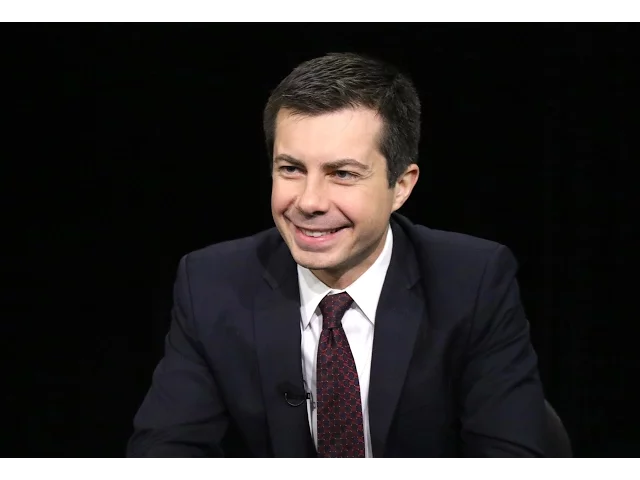
Dreams of the Heartland - Peter Buttigieg | The Open Mind
CUNY TV
1:04 HEFFNER: I’m Alexander Heffner, your host on The Open Mind.
1:07 When visiting three times last year with among the most
1:10 politically engaged students at the University of Notre Dame,
1:14 they recommended booking a public servant
1:17 whom they affectionately call Mayor Pete.
1:19 This is of course mayor Peter Buttigieg, chief executive of South Bend, Indiana.
1:24 His resume did not just merit the invite.
1:28 It was a presidential pedigree no less
1:31 than the legendary fictional fighting Irish alum,
1:33 President Josiah Bartlett, some years removed, of The West Wing.
1:36 A decorated US Navy officer, a Rhodes Scholar,
1:40 and native Hoosier, the Mayor was elected at 29,
1:44 and he is among the youngest mayors in this country,
1:47 and was the youngest mayor of any city over 100 thousand residents.
1:52 So it came to me as no surprise, in fact, told you so, I reminded friends,
1:56 when the mayor burst onto the national
1:58 stage as a DNC candidate in recent months.
2:02 He’s here today with me to discuss what he learned from that road show,
2:05 and what we can learn from him about the key to the American heartland.
2:10 Mayor, welcome.
2:11 BUTTIGIEG: Thank you.
2:12 Good to be here.
2:12 HEFFNER: Really good to have you here.
2:16 What did you learn from your experience as a candidate
2:18 for DNC Chair that might have surprised you, going into the process?
2:23 BUTTIGIEG: Well, one thing I learned,
2:24 is that the Democratic party is struggling to learn how to change.
2:29 You know on one hand,
2:30 I think it's a party that has the right values, that has ideas,
2:34 that actually command the support of most Americans,
2:37 and yet one that has struggled to really face how much trouble we're in.
2:41 You know, even had we won the White House,
2:43 the Democratic Party would be in a tough spot right now.
2:46 If you look where we are in terms of uh,
2:48 state houses, governorships, not to mention congress, uh,
2:51 a lot of offices in addition to the presidency
2:54 that really decided most of the policy in this country.
2:57 We're on the back foot.
2:58 And yet the party has been slow to be able to change.
3:01 My hope is, this whole process of the DNC
3:04 Chair race has surfaced some of the ideas
3:06 that are gonna help us recognize that the party
3:08 needs to position itself as part of a broader movement,
3:12 rather than the other way around, rather than trying to cram all of the things
3:15 that are happening in the progressive space into the political machinery,
3:20 instead making sure that the party has the humility to recognize where
3:24 it fits inside a, a broader movement of what's happening in our country,
3:27 in response to the policies and the politicians
3:30 that are not just disappointing us,
3:32 but really betraying our values in Washington.
3:34 HEFFNER: When you say, Mayor, humility, BUTTIGIEG: Hmm.
3:37 HEFFNER: Um, we've seen a campaign season
3:40 that in some ways rewarded the opposite of that character,
3:47 that ethos, that civility.
3:50 How do you fight back against it without imitating it.
3:56 BUTTIGIEG: Hmm.
3:58 Yeah, we've got to figure out a way
4:00 to defeat Trump and Trumpism without emulating it.
4:02 And I think the key is placing the focus back on real people.
4:06 You know I think there is an extent to which, especially in the last campaign,
4:10 the conversation really became about the politicians themselves.
4:13 And all of us who were supporting Hilary Clinton against Donald Trump,
4:16 we had the T-shirts or the buttons that said,
4:18 “I’m with Her” as if it really were about
4:21 her, and the campaign was largely structured around her.
4:25 Um, then, once it became clear who the nominee was going to be,
4:29 it increasingly became about him.
4:31 It became I'm against him.
4:33 And there was a sense,
4:34 especially in my part of the country, the industrial Midwest,
4:37 that actually he was the only one,
4:39 from the perspective of somebody watching at home, who's talking about me.
4:43 And we made it so much about him, um,
4:45 how terrible he was and how great we thought our candidate was,
4:48 people at home didn't feel like we were talking about them.
4:50 I'm afraid that's happening right now too,
4:52 so when you look at the, the fascination with all
4:56 of the things that make Trump a problematic person, which are obviously many,
5:01 it can often come at the expense of talking
5:04 about how things affect people in their real lives.
5:06 And when we were in the midst of policy
5:08 moves that will amount to a massive transfer of wealth,
5:12 away form the working and middle class and toward, ironically,
5:15 the elite, and those who are best off,
5:18 that is the sort of thing that affects people in their daily lives,
5:21 and yet we have a hard time talking about it,
5:23 because we're so consumed with the show, the, the erratic tweets, uh,
5:28 the intrigue and Russia and everything, some of which has to be talked about,
5:31 but we can't allow it to become the center
5:34 of gravity of a party that, at its best,
5:37 has always been about taking care of people.
5:39 HEFFNER: The center of gravity I'm afraid Mayor, though,
5:42 is in some ways preconceived or premeditated at the state and local level...
5:51 BUTTIGIEG: Hmm.
5:52 HEFFNER: To disfavor progressives or Democrats, because of gerrymandering,
5:56 not just in Indiana, but across the country.
6:00 That is a structural institutional problem that the Democrats
6:06 have to cultivate a response to in town halls,
6:10 and local municipal relationships with constituents.
6:14 How are you modeling that now, going forward,
6:17 in a way that, state houses and legislatures can be responsive to?
6:23 BUTTIGIEG: Yeah, it's, it's an extremely important question,
6:26 and here's how we do it in South Bend.
6:29 First of all, again, when you’re talking about people's lives,
6:31 you can break down some of the ideological barriers sometimes,
6:34 so one of the ways that I've been able to attract
6:37 a lot of support from Republicans in a place like South Bend,
6:40 isn't so much by trying to shoot for a, an ideological middle,
6:45 or get the right kind of conservative elements in my ideology.
6:48 It's more by focusing on delivery, and focusing on impact, um,
6:52 trying to really get the conversation to be
6:54 about what’s actually going to happen to real people,
6:57 if we take this course of action, versus that one.
7:00 Now on a partisan basis,
7:01 there is this very troubling dynamic of redistricting and gerrymandering,
7:05 and we need to be prepared to talk about the fact that this in fact,
7:09 amounts to a rigged politics.
7:11 So, in a twisted way, Trump was right when he said that the system was rigged,
7:15 and even when he said that elections were rigged.
7:17 Now, it wasn't the way he was saying,
7:18 you know that you would have um, busloads of illegal voters changing outcomes,
7:24 and by the way, I’ve never met
7:25 anybody who thinks that happened in their precinct,
7:27 even if they think that happened somewhere.
7:29 But he wasn't wrong when he said there
7:31 is something broken and deeply unfair about our politics.
7:34 Unfortunately the, one of the things that's broken and deeply unfair,
7:37 is that right now, our politicians choose
7:40 their voters rather than the other way around,
7:42 and that has created a structural, uh, setup that certainly,
7:47 in the current phase of it at least, disfavors Democrats.
7:50 Now, Republicans for years, decades even, have patiently,
7:55 and cleverly assembled majorities everywhere
7:58 from the school board to the statehouse,
8:00 where I'm afraid that our party has been a little bit
8:03 inclined to treat the presidency like it's the only office that matters.
8:07 We've got to pay attention to these local offices and these state offices,
8:11 not only because they furnish the farm team,
8:13 the bench, the people who are eventually going to be leading in federal offices,
8:16 but also because they are intrinsically so important,
8:19 not least because many of them decide
8:21 the shape of the districts and the congressional districts,
8:23 which is one of the reasons that, even if Democrats get millions of more votes,
8:27 you know, not unlike the electoral college issue,
8:29 even if we get millions more votes for congress,
8:31 we may not get a majority there.
8:33 HEFFNER: The Republicans in your hometown in Indiana,
8:37 do they view gerrymandering as an anti Democratic practice?
8:41 BUTTIGIEG: Well, let's be clear.
8:43 When Democrats in Indiana had the upper hand,
8:45 they enthusiastically practiced gerrymandering,
8:48 and now the shoe's on the other foot,
8:49 because 2010, which was the last, uh, census year, was a big Republican year.
8:54 Uh, this shouldn't be ideological.
8:56 I mean really both sides should be able
8:58 to embrace the idea that politics should be more representative,
9:01 but in practice, it is partisan for the simple reason
9:04 that Democrats have more to gain from fair districting, HEFFNER: Right.
9:08 BUTTIGIEG: Than Republicans,
9:09 just like we have more to gain form more people being able to vote.
9:11 Um, now, philosophically, you might ask yourself,
9:15 if one party stands to lose from more
9:17 Americans participating in the process, why is that?
9:20 But right now we're at the phase where we just
9:22 have to respond to the reality in front of us,
9:24 and deal with it accordingly in our tactics, as well as in our thinking.
9:27 HEFFNER: The reality, Mayor,
9:29 is that Republicans dominate governorships across the country
9:32 right now to such an extent that, you know, their state legislatures could be
9:38 positioned to offer a Constitutional Amendment.
9:40 That's how...
9:41 BUTTIGIEG: Yeah, we’re one state away from that...
9:43 HEFFNER:...
9:43 What happened to governor Dean’s fifty state strategy?
9:46 I, I know that the the DNC was hacked...
9:49 BUTTIGIEG: Right.
9:49 HEFFNER: I mean there were some tremendous vulnerabilities there,
9:51 but it seems like that dissipated in his success of ten years of Tim Kaine...
9:58 BUTTIGIEG: Yep.
9:58 HEFFNER: And later chair people.
9:59 BUTTIGIEG: Yeah, we really got away with that, and part of that was just uh,
10:03 a result of the, the politics of the time in between.
10:06 Uh, so, uh, take, you know,
10:08 President Obama is a president I deeply admire, and one that uh,
10:12 you know I knocked on doors for, and I
10:14 think his presidency will be looked on uh, very kindly by history.
10:18 Uh, but one of the things, politically, about his playbook is,
10:21 uh, his particular approach to campaigning only worked for one person.
10:27 Uh, that playbook only works if you happen to be Barack Obama.
10:30 It’s very different from a playbook that is, uh,
10:32 that is designed to get people elected in, in different states.
10:35 And so you found that, you know,
10:37 people running for congress had to adopt a very different strategy
10:40 than what the president was using in his reelection for example.
10:43 Um, there’s always going to be differences within the party.
10:45 There's always as going to be times when what's working
10:47 in a presidential campaign is different from what you want to have,
10:49 uh, you know, at a grassroots level,
10:51 but we’ve got to make sure that we are organizing,
10:54 organizing our politics, first around our values,
10:56 and if we do that, then the candidates who embody
11:00 those values are going to be likely to surface and prevail.
11:02 But even more importantly, if those values start to win,
11:05 if we tug the entire country toward greater fidelity to those values,
11:08 then we can expect that the politics on both
11:11 sides of the aisle will begin to embrace them,
11:13 in the same way that the right, I think very effectively,
11:16 didn't just get people from the right elected.
11:19 They actually moved the American political center
11:22 rightward during the 60's, 70's, and 80's,
11:25 so that a Democratic president like Bill
11:28 Clinton was saying things that in the 60’s
11:30 would have been considered a little bit
11:33 conservative for a Republican president to say then.
11:35 We've got to have our eye on a broader gain here, than one election at a time.
11:40 And I think that uh,
11:41 going even beyond the fifty state strategy, which we've got to reestablish.
11:45 We've got to think about a fifty year strategy, one that really, uh,
11:50 celebrates the values that bring us together, not just as Democrats,
11:54 but those of us who believe in America where,
11:57 where freedom means more than just being free from regulation,
12:00 where uh, family values includexs keeping families together,
12:03 and accepting nontraditional families, uh, and above all, one where people know
12:08 that they will have access to the American dream, wherever they came from.
12:12 And I don't know whether that's now considered
12:14 to be an issue owned by liberals or conservatives,
12:16 but what I know is that social mobility is breaking down in our country.
12:20 And I’m concerned that our republic cannot survive much more
12:24 of the kind of inequality and immobility
12:27 that we're experiencing in middle America.
12:29 HEFFNER: I think Senator Sanders, who we hosted before his campaign,
12:36 began to articulate a new definition of, of the values voter today,
12:42 but it doesn't seem to be resonating so fervently with an expanded coalition.
12:50 I'm wondering, when you go out to town halls,
12:52 or travel the state of Indiana, what is the values voter today?
12:57 What are those values?
12:58 BUTTIGIEG: Yeah.
12:59 I think what Senator Sanders got right is,
13:02 if people can see that you're motivated by conviction,
13:04 they're going to respond to you,
13:06 even if your conviction's a little different from their own.
13:09 Um, I think this was something
13:10 that Paul Wellstone was very effective at actually.
13:12 It would be very interesting to see what he would be like today if,
13:15 if we hadn’t been robbed of him by his untimely death.
13:18 You know he was somebody who voted against uh, the war,
13:21 at a time when the war was popular,
13:24 and yet his popularity, this is the war in Iraq, and yet his popularity went up,
13:28 I think because people knew that even if they didn't agree with him,
13:30 they could see that he was motivated by values.
13:32 I think that was the appeal of the Sanders campaign as well.
13:35 HEFFNER: Authenticity.
13:35 BUTTIGIEG: Authenticity, which is associated with uh,
13:39 uh, my part of the country, uh, the Midwest, but also, I think, our generation.
13:42 Um, you know, our generation,
13:43 I think by virtue of having grown up just soaked and marinated
13:47 in every kind of sophisticated marketing on television and the internet,
13:51 has an equally sophisticated radar for efforts to manipulate us.
13:56 And I think insincerity, or a lack of authenticity,
13:59 is something we, we pick up, right like that.
14:02 And so making sure that, that we're
14:04 putting forward candidates who believe in something,
14:07 who can explain to you what's worth more to them than winning, uh,
14:09 is going to be very important if we want to be taken seriously,
14:13 and I think paradoxically,
14:14 there are actually a lot of voters who might vote more conservatively,
14:19 who are available to us, if and only if we won on our progressive value.
14:23 HEFFNER: What do you do in the case that increasing funding
14:30 for the military becomes a value issue that overrides virtually anything else?
14:36 BUTTIGIEG: I think in the same way that the left
14:38 needs to become more comfortable talking about freedom,
14:41 we also need to be more comfortable
14:43 talking about American greatness, because to me,
14:45 what has made America great is not just having a powerful military,
14:49 and I'm proud that I served in our military and um,
14:52 you know, it's done a lot of, uh, extraordinary things across world history.
14:58 But we're not just great because we have a powerful military,
15:00 we’re great because of the power of our culture.
15:03 Uh, I believe we won the Cold War in no small part,
15:06 because we were the country more people wanted to be.
15:09 We were the country people wanted to be part of, and it
15:12 had as much to do with blue jeans and rock music, as it did with ICBMs.
15:17 I mean all of that knitted together into something incredibly powerful.
15:20 And so I think when we're talking about, for example,
15:23 diverting all of our natural resources into a military buildup,
15:26 the question has to be, at the expense of what.
15:30 And if we're losing the ability to fund the arts,
15:34 if we're losing the ability to uh, throw our weight around, not just militarily,
15:38 but economically through foreign aid,
15:40 helping people and having, you know, whole populations, uh,
15:42 look upon us better because we did something uh, for them,
15:46 if we're throwing away, uh, the opportunity to fund research when,
15:52 a matter that's often forgotten today,
15:54 the federal government literally invented the internet,
15:57 right, things like that made America great.
16:01 And without them, if we have a strong military but none of that, we're no
16:04 better than a lot of other countries
16:06 out there that also invest heavily in militarization,
16:09 and yet that nobody at home wants to, wants to be more like.
16:14 We've gotta concern ourselves with whose values
16:16 are really going to dominate the 21st century.
16:19 HEFFNER: That is the critical question.
16:23 But I, I think when you talk about a sophisticated radar,
16:26 there is a Midwestern identity, how is that radar different in a way that we
16:32 can become responsive to, in an increasingly national media environment?
16:36 BUTTIGIEG: Yeah, I mean this is where I think we've
16:38 got to get back to what's happening in people's lives.
16:40 So there are false choices, but there are also real choices.
16:43 There's only so much money to go around.
16:45 What are we going to spend it on?
16:46 Right?
16:46 If we're taking it away form these things,
16:49 these institutions, these efforts toward research and the arts,
16:51 also if we're taking it away from middle class Americans, right,
16:54 if we are distributing wealth away from the middle class,
16:57 which, for example is what,
16:58 some of what's been proposed when it comes to healthcare,
17:00 really amounts to, um, then we're making people worse off.
17:04 And, you know, people that I spend most of my time
17:07 with, in, in my hometown and the area around it,
17:10 are not terribly preoccupied with what's going on in Washington,
17:14 with who's voting on this confirmation or, or that proposal.
17:17 They're concerned with whether they are going to be made better off,
17:21 or worse off, and for all the sophistication of progressive philosophy,
17:25 it had better be prepared to hold itself accountable,
17:28 for whether its application makes people better off or worse off.
17:32 HEFFNER: Well there are abstract questions,
17:34 and the price of milk is not one of them.
17:37 BUTTIGIEG: Yeah.
17:37 HEFFNER: Um, pumping gas is not one of them.
17:39 Um, I think part of the problem is
17:43 that, the fact that people believe we're taxed
17:47 without being represented because we don't feel
17:50 the empowerment in our, in this fiscal, economic situation.
17:54 BUTTIGIEG: Yeah, and I mean can you blame them?
17:57 HEFFNER: No.
17:58 BUTTIGIEG: I mean you have congress that is, HEFFNER: That's the reality.
18:00 BUTTIGIEG: Less and less attentive, right, to, to what communities are saying.
18:03 HEFFNER: It's not a globalist agenda though,
18:04 as was documented or pretended to be in the campaign.
18:06 But, the Clinton campaign, and the Democrats, and anyone besides Trump,
18:09 were unable to compete in that environment,
18:12 except maybe you and Senator Sanders, and a few other people.
18:15 BUTTIGIEG: Well and I think it also, it felt as though, when people like,
18:18 you know, from Bernie Sanders to Donald Trump are saying the system is rigged,
18:22 it felt as though a lot of, the Democrats were saying,
18:24 the system is perfectly fine, when our response should have been, yeah,
18:29 there are a lot of areas in the system that are unfair.
18:31 Our economy and our politics are both broken in many important ways,
18:34 but your way isn’t the way to fix it.
18:36 Our way is.
18:37 And here's how it works.
18:38 And that's when we begin talking about policies
18:40 on the economic side that make people free,
18:43 not only from the unfreedoms that government creates,
18:46 but also from private oppression and private unfreedoms.
18:49 The idea that they're talking about gutting the CFPB,
18:52 the Consumer Financial Protection Bureau, when that is something that protects
18:56 ordinary Americans form shady banking practices,
18:58 is something that I think we should be talking about much more,
19:01 and on the political side,
19:03 you know, we're the party that has stood up for a more Democratic country,
19:06 for one where more people have access to the ballot,
19:09 where it's easier, not harder, to vote,
19:11 and I think we need to also become the party that stands up for the structure,
19:15 from the way districts are drawn to campaign finance,
19:18 to be fair and more representative too.
19:21 Um, you know as much as the specifics of it were twisted, uh,
19:24 again I think there were parts of the narrative
19:26 of the Trump campaign that we ought to take seriously.
19:28 HEFFNER: Well there, there were...
19:29 BUTTIGIEG: Because people were right when...
19:31 HEFFNER: Seeds of truth.
19:32 BUTTIGIEG: Yeah, people are right when they
19:33 feel that this stuff is titled against them.
19:35 It is.
19:35 HEFFNER: Well, it's tilted against them,
19:36 and you said we shouldn't be thinking about fifty states,
19:38 we should be thinking about fifty years.
19:41 There are elections in 2018 and 2020.
19:44 Um, without a counterbalance in any one of the three branches,
19:50 how can we ensure that elections continue to be free and fair.
19:55 BUTTIGIEG: If you look at the, the number
19:57 of people who showed up for the Women's March,
19:58 the number of people who've descended on town halls, uh,
20:01 and other opportunities where you can have these kinds of mass mobilizations,
20:05 I think making sure that translates into electoral
20:07 activity is going to be very important.
20:09 Uh, but we also have to make sure we are securing our democracy itself.
20:12 And there are a lot of issues with that, that's why, you know,
20:15 nothing could be less sexy in national
20:17 politics than a secretary of states race, right?
20:19 But it's incredibly important, because they run the elections.
20:22 Um, we need to be paying much better attention
20:24 to that, not just from a perspective of things that benefit Democrats,
20:27 but form a perspective of things that are more democratic,
20:31 and more accountable for the country as a whole.
20:33 And we've got to think about whether we should be
20:36 trapped in, basically 18th Century methods of arranging our elections.
20:39 You know why election day is on a Tuesday?
20:41 It's so that you could uh, you know,
20:43 ride your horse down on Monday after church,
20:45 and then be back uh, in, in, you know,
20:48 be back in your farming community in time for market day.
20:51 Um, that's not, there's no good reason [LAUGHTER]
20:54 that, that election day is on a Tuesday.
20:56 It's just what it's on.
20:57 I don't think it's even in the Constitution.
20:59 It's just there.
20:59 And we have got to update our democracy to make sure
21:02 that it's keeping up with the democratic demands in the 21st Century.
21:05 HEFFNER: I took a drive from, and I mentioned
21:08 this a couple of times now on this show, from Dayton to South Bend...
21:12 BUTTIGIEG: Hmm.
21:13 HEFFNER: And this was pre-election day.
21:17 And I probably gleaned what you had
21:19 experienced for months prior to the election,
21:22 which was the real plausibility of an upset.
21:24 BUTTIGIEG: Hmm.
21:25 HEFFNER: Um, I think the most important thing that I saw in that drive,
21:31 and it was the same thing when you're in Tampa,
21:34 Florida, or any major urban center, is infrastructure.
21:36 BUTTIGIEG: Yeah.
21:38 HEFFNER: Um, isn't it a major problem
21:43 that this administration did not start with infrastructure?
21:48 Shouldn't that have been the first commitment?
21:49 BUTTIGIEG: Well maybe,
21:50 or maybe there's some clever political calculus going on here.
21:54 Look, uh, I don't discount the fact that a lot
21:56 of jobs may be created by an infrastructure build that will,
22:00 in the long run, be disastrous, because it's not paid for, but will in the short
22:03 run will sell very well and be very appealing.
22:06 Uh, you know, making sure that people see a lot
22:07 of benefits around them in terms of, uh, roads and bridges,
22:10 and seeing a lot of people put back to work,
22:12 is the sort of thing that a more cynical politician
22:14 might ensure happens just in time for the next election.
22:18 So I actually think there's a certain logic
22:20 to it not having happened right out of the gate.
22:22 Now I've also got a lot of deep misgivings about whether, you know,
22:25 the proposals they're beginning to preview are really going
22:28 to lead to the kind of infrastructure benefits we want,
22:31 because a lot of what has to happen,
22:33 and again, I'm talking about things that aren't very sexy, um,
22:36 but it's the sort of infrastructure change that many people don't notice,
22:40 and politicians won't get to take credit for, uh,
22:42 for example sewer infrastructure.
22:44 So, I would love to have a bullet train between South Bend and Chicago,
22:47 and if I can ever figure out a way to help get it done,
22:50 by God, I'll be all over it.
22:51 But, the most pressing infrastructure need we have right now,
22:54 actually has to do with our wastewater.
22:55 It's something that you don't even know it's there,
22:57 until or unless it fails, kind of similar with drinking water which,
23:01 of course we experience every day, but I'm still waiting for the day when
23:05 somebody's gonna come into my office and say,
23:07 you know, I went downstairs today, I turned on the kitchen tap,
23:11 a glass of clean safe drinking water came out,
23:13 it didn't poison my family or anything,
23:14 and just tell the folks at the waterworks to keep up the great work.
23:17 Right.
23:17 It's not that, it was designed so that you can take it for granted.
23:19 And yet, as we learned the hard way form the experience in Flint,
23:23 we're living in times when you can't take it for granted,
23:25 because we have underinvested,
23:26 not just in the kinds of infrastructure that people can see, roads, bridges,
23:30 trains, and we've gotta do more on that, but also in the unseen dimensions,
23:35 that there's very little political reward for doing something about,
23:39 but that's absolutely imperative if we want to continue
23:42 to grow and thrive in the decades to come.
23:45 HEFFNER: And it's not just South Bend or any city
23:48 that is more suburban that doesn't have the reservoir um,
23:53 integrity behind a water system that is funded, and the upkeep is guaranteed.
24:00 We just have a few minutes left Mayor,
24:01 but take us into that mindset in the heartland.
24:06 BUTTIGIEG: Here's the way we look at it.
24:08 Everybody's got some purpose they're going for in their life.
24:12 Um, I don't necessarily know what it is.
24:14 I've got 100 thousand residents, and for every one of them,
24:16 it might be a little different.
24:17 For some of them it might have to do with faith and family.
24:20 For some of them it might have to do with starting a business,
24:22 and economic success.
24:24 Uh, for some of them it may have to do with scholarly pursuits.
24:26 I don't know what the meaning of life is for any given person.
24:29 But I know it's gonna be a lot harder for them to achieve it, if they can't uh,
24:33 count on a glass of clean, safe drinking water when they get up in the morning,
24:37 or if there's hole in the road on their way to work,
24:39 or if we haven't plowed their streets properly, um,
24:41 let alone the, the bigger layers of quality of life.
24:44 Is there a good park system,
24:45 do you have a, do you have a good economy around here?
24:48 Right?
24:48 These are the things that affect us in our everyday lives.
24:51 Uh, whether or not our lives go well,
24:53 depends largely on things that tie back to policy.
24:56 One reason I think even people with not
24:58 a lot of education tend to be very sophisticated
25:01 about what’s happening in their local politics is because
25:04 it’s so clear to them how it affects them.
25:06 The challenge, I think, with federal politics,
25:08 is bringing that same kind of immediacy.
25:10 So it's one thing to talk about immigrants, for example, as a category.
25:15 It's another thing to talk about an individual, I just got word today,
25:18 that somebody who is regarded as a pillar of the community,
25:20 and who was checking in with ICE on a yearly basis,
25:24 but was undocumented, uh, is going to be deported now.
25:27 And he's got not only a family,
25:29 but a small business that people in our community
25:31 really count on, and I know a lot of people,
25:33 many of whom would consider themselves conservative Republicans,
25:36 who are rallying to his cause,
25:39 because we just treat people differently when we actually know ‘em,
25:43 than we do when we view them as categories or as political fodder.
25:47 Those, I think are values that are not just Midwestern,
25:49 but are really human values.
25:51 And yet, we've begun to regard politics
25:54 as something that happens in congress and on cable,
25:56 when really politics happens, you know the War in Afghanistan happens
26:00 to you when somebody you care about is deployed,
26:05 or it affected, or God forbid doesn't come back.
26:08 The Health Care Act happens to you,
26:10 when you have trouble paying for, for healthcare,
26:13 or that happens to somebody you love.
26:14 We've got to make sure that we've got a much more uh,
26:18 immediate way of talking about these things.
26:20 And I think people are smart.
26:21 They can connect the dots, but not if we're not out there telling the story
26:25 to help them see how those dots fit together.
26:28 HEFFNER: Thank you Mayor.
26:29 I hope you'll come back, a lot more ground to cover...
26:32 BUTTIGIEG: Pleasure.
26:32 HEFFNER: Appreciate you being here.
26:33 BUTTIGIEG: Thank you.
26:33 HEFFNER: And thanks to you in the audience.
26:35 I hope you join us again next time,
26:37 for a thoughtful excursion into the world of ideas.
26:40 Until then, keep an open mind.
26:42 Please visit The Open Mind website at Thirteen.org/OpenMind to view
26:46 this program online or to access over 1,500 other interviews.
26:50 And do check us out on Twitter and Facebook,
26:52 @OpenmindTV, for updates on future programing.