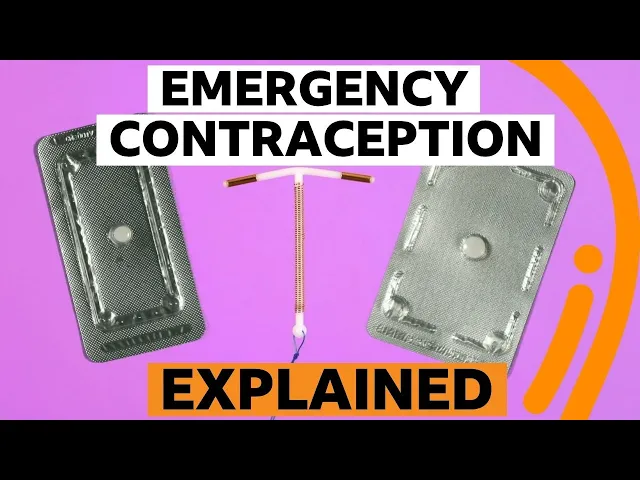
3 myths about emergency contraception | BBC Ideas
BBC Ideas
0:00 OK, so you've had unprotected sex.
0:02 Maybe the condom split.
0:04 You don't want to get pregnant.
0:06 It's OK.
0:07 There are options.
0:08 And a lot of misunderstandings.
0:11 Let's clear them up.
0:17 OK, so let's get this one out of the way...straight away.
0:27 This is a common one.
0:28 No-one really knows where this misconception comes from.
0:31 But humans seem to love the number three.
0:35 It's in so many stories.
0:37 Three little pigs.
0:38 Three wise men.
0:39 Three myths about emergency contraception.
0:42 But it's not true that you can only take the morning-after pill three times.
0:47 It doesn't make you infertile if you take it more than three times.
0:51 It won't reduce its effectiveness if you take it more than three times.
0:55 There's no rule that a pharmacist can only give it to you three times.
0:59 That said, it is a type of emergency contraception,
1:02 so you don't want to be taking it regularly as a form of contraception.
1:07 And you know what?
1:09 It's also not a good name.
1:11 You don't need to take it the morning after unprotected sex,
1:15 but you should do so as soon as possible
1:18 and make sure it's within three to five days.
1:20 Doctors and other medical professionals
1:22 call it Emergency Hormonal Contraception, or the Emergency Contraceptive Pill.
1:27 It's the same thing.
1:29 There are two types in the UK, and you can get it- for free- from a pharmacist,
1:34 GP practice or sexual health clinic.
1:36 A couple of things worth knowing...
1:39 First, the effectiveness of each pill depends
1:41 on exactly where you are in your menstrual cycle.
1:44 The earlier, the better.
1:46 It's always a good idea to take a note of when your period starts each month.
1:49 This is important because the morning
1:52 after-pill won't work if you've already ovulated.
1:54 More on this in a moment.
1:56 And secondly, your weight can affect how effective it is.
2:00 Make sure to discuss both these points with the pharmacist or doctor,
2:03 so they can advise which will be best for you.
2:14 This is a super common misconception- the idea
2:17 that the morning-after pill works like a very early abortion,
2:19 stopping a pregnancy in its tracks.
2:21 This is not true.
2:24 Both types of emergency contraceptive pill- levonorgestrel
2:27 and ulipristal acetate- work by delaying ovulation.
2:32 That's when an egg is released and, if it meets sperm, can be fertilised.
2:37 Ovulation tends to happen about 14 days before your period starts.
2:41 Now, sperm can live in the body for up to five days.
2:45 The emergency contraceptive pill works by delaying ovulation so that any
2:48 sperm will have died by the time an egg is released.
2:51 So the egg is never fertilised.
2:53 And you don't get pregnant.
2:55 But if you're ovulating, or have already ovulated, it won't work.
3:01 But you do still have options- which brings us to misconception number three.
3:13 This is a copper coil.
3:14 It's also known as an intrauterine, or "within the uterus", device- an IUD.
3:20 It's better known as a type of long-term
3:22 contraception or, to use another acronym, Larc.
3:25 Not that type of lark!
3:27 It stands for long-acting reversible contraception.
3:31 But it's also the most effective form of emergency contraception.
3:35 And it can be used up to five days after unprotected sex.
3:39 The copper coil contains no hormones.
3:42 So how does it work?
3:44 This part of the coil sits at the top of the womb.
3:47 See the copper here, and here?
3:49 Copper has a toxic effect on sperm.
3:51 It also makes it difficult for an egg
3:53 to implant itself in the lining of the womb.
3:55 If you're interested,
3:56 you can have it fitted at a sexual health clinic or your GP practice.
4:00 After your next period, the choice is yours.
4:03 You can have it removed.
4:04 Or you can keep it.
4:06 If you do, it can be used as a form
4:08 of contraception for between five and ten years.
4:10 Though do be aware that it offers no protection from STIs-
4:14 that's sexually transmitted infections- and it can make your periods heavier.
4:18 So, a quick recap.
4:21 The morning-after pill does not work like an early abortion.
4:24 It delays ovulation.
4:27 You can take it as many times as you need over your lifetime.
4:31 The morning-after pill won't work if you've already ovulated.
4:34 The most effective form of emergency contraception is the copper coil.
4:40 Thanks for watching