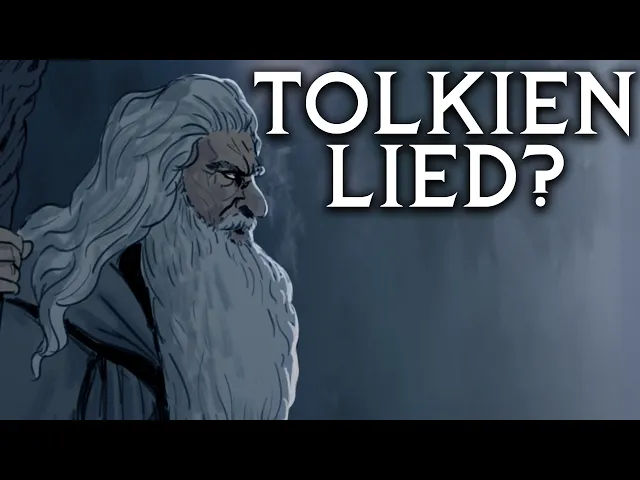
Weird Russian Remake of the Lord of the Rings - Tolkien Revisionist History
Wizards and Warriors
0:11 Did you know that there is a revisionist
0:13 history of Tolkien's The Lord of the Rings?
0:15 Indeed, it seems not everybody believes Tolkien was telling
0:18 the truth about what happened during the War of the Rings!
0:21 Written by Russian paleontologist Kirill Yeskov,
0:24 The Last Ringbearer reinterprets Tolkien’s events as a victor’s history,
0:29 reversing its moral binaries.
0:31 In Yeskov’s interpretation of Middle-earth,
0:33 Mordor is a thriving hub of irrigation, mining, science, and higher education,
0:38 while the West is feudal and magic-dependent.
0:40 Against this backdrop, the War of the Ring emerges not merely as a struggle
0:45 between good and evil but as a geopolitical contest over resources, memory,
0:50 and the meaning of civilization,
0:52 a clash of civilizations whose pursuit of power and progress threatens
0:56 to thwart an industrial revolution and plunge Middle-earth into a dark age.
1:36 Arda reimagined Yeskov reimagined Arda as a world
1:57 split by the magical realm of Aman,
2:00 inhabited by supernatural creatures such as Elves,
2:02 and the physical world of Middle-earth, inhabited by Men.
2:06 Two ancient instruments anchored this division: the Mirror,
2:10 which could glimpse possible futures,
2:12 and seven palantíri, which enabled long-distance communication.
2:15 A few Men who travelled to Aman, known as Wizards,
2:19 dragged palantíri and the Mirror into Middle-earth,
2:22 monopolizing the corridor between the two worlds.
2:25 Some became infatuated with Aman, known as the White Council,
2:29 and sought to mould Middle-earth in Aman’s image.
2:31 To do so, they began migrating Elves into Middle-earth,
2:35 expanding magical influence and eroding
2:37 the political autonomy of western realms.
2:40 The Wizards opposing them, the Nazgûl, began aiding the center of Middle-earth,
2:44 Mordor and her allies, Umbar and Khand, to a lesser extent.
2:48 A Different Mordor Yeskov’s reimagined Mordor is
2:51 not a barren wasteland but a technologically advanced,
2:54 meticulously organized nation sustained by irrigation, mining, and trade.
2:58 Gorgoroth was an oasis that supported two annual crops:
3:03 cotton, rice, dates, and grapes.
3:05 Barad-dúr was “a city of alchemists and poets, mechanics and astronomers,
3:10 philosophers and physicians,” the heart of a civilization that bet
3:13 on rational knowledge and “barely
3:15 adolescent technology” to challenge ancient magic.
3:18 Rather than a monolithic war machine,
3:21 the Mordorian state supported universities,
3:24 engineering, metallurgy, and a diversified economy,
3:27 mining, farming, trade, and crafts.
3:29 It was a scientifically engaged state built upon
3:32 rational knowledge with a heavy emphasis on metallurgy,
3:36 chemistry, mining, and large-scale engineering.
3:38 Its economy and technology were centred on turning
3:41 raw resources into infrastructure, weapons, and power.
3:44 The Mordor we were shown stood on the verge of the industrial revolution,
3:49 producing early forms of steam engines, electricity, and even flying machines.
3:54 Mordor was multiethnic and cosmopolitan.
3:57 The Orocuen were a nomadic tribe of men who inhabited Mordor’s plains,
4:01 labelled with the racial slur “Orcs” by the men of the West.
4:06 Trolls formed a hardy, family-centred culture of men who lived in thick-walled
4:11 stone towers high in the Ash mountains.
4:14 They were proud stonemasons, engineers,
4:16 chemists, masters of mining and metallurgy,
4:18 and the economic and military backbone of Mordor.
4:21 Mordor relied on Umbarian traders who operated the cross-sea networks,
4:26 and a bureaucratic elite that attempted to balance
4:29 security with the preservation of cultural memory.
4:32 Mordor also traded with Khand,
4:34 a Caliphate built on a highly organized slave economy,
4:37 and Harad, a large and diverse
4:40 empire that lacked a centralized urban civilization.
4:43 Mordor was led by Sauron the 8th, who oversaw a parliamentary monarchy.
4:48 Sauron interacted in high diplomacy with other great powers,
4:51 such as the Elves, the White Council, and Gondor.
4:54 The Nazgûl were the professional elite within Mordor,
4:58 doctors, lawyers, merchants, engineers, and others.
5:00 They acted as a specialized governance and security corps,
5:04 blending magical heritage with science.
5:06 They wielded rings made of inoceramium
5:09 that empowered them and engaged in espionage, diplomacy, and covert operations.
5:14 They were Mordor’s bridge between magic and science,
5:18 and Mordor bravely employed adolescent technology against
5:21 the tyrannical ancient magic of the West.
5:25 The Synopsis of the Third Age As the Third Age waned,
5:26 climate upheaval accelerated in Mordor: the savannah dried into desert plains.
5:31 In a bid to irrigate,
5:33 Mordorians unleashed a network drawing on the Sea of Núrnen,
5:36 only to doom their fields with overly saline groundwater.
5:40 Despite this setback, Mordor’s innovation and commerce kept them afloat,
5:45 trading manufactured goods for food with Khand and Umbar.
5:48 The White Council discovered through the Mirror that Mordor was on the brink
5:52 of an industrial revolution that would surpass their magically dominated West.
5:56 To safeguard the West,
5:57 Gandalf devised a “final solution to the Mordorian problem.” The White
6:02 Council would wage a war of attrition and blockade to strangle Mordor.
6:07 Gandalf overthrew Saruman, who advised against the plan,
6:09 and loaned the Elves the Mirror to involve them in the conflict.
6:14 The Elves acted as magical and political brokers, and, in turn,
6:17 manipulated the Men of the West to the cause.
6:20 To counter this and maintain the status quo,
6:22 the Nazgûl and their Mordorian allies began exploiting
6:25 the economic and military networks of Umbar, Khand, and Harad.
6:30 All of this culminated in the War of the Ring.
6:33 The War of the Ring The War
6:35 of the Ring became a high-stakes geopolitical chess game,
6:37 fought not only with swords and sorcery but with strategic deception,
6:42 political maneuvering, and contested narratives.
6:44 The Nazgûl, led by Sharya-Rana, engineered a clever ruse:
6:48 they forged a ring and spread rumours
6:50 that it could grant dominion over all of Middle-earth,
6:53 shipping it towards the Anduin to spark
6:56 distrust and infighting between Gondor and Rohan.
6:59 However, Gandalf quickly saw through the ploy,
7:01 retrieved the ring, and hid it in the Shire.
7:04 In response, the Nazgûl comically stormed the Shire in terrifying disguises,
7:09 scaring and driving village simpletons with the ring eastward.
7:12 After Gandalf’s coup, Saruman broke with the White Council in support of Mordor.
7:17 He gathered an army at Isengard and began courting
7:20 King Théoden of Rohan and Steward Denethor of Gondor,
7:24 assuring them that Isengard and Barad-Dur sought nothing but peace.
7:28 He taught Denethor and Sauron how to communicate
7:31 through the palantíri to build trust and de-escalate.
7:33 Furthermore, he managed to undermine Prince Boromir,
7:37 manipulating him into going on an adventure for the ring.
7:41 The Nazgûl–Saruman plan seemed poised to work,
7:44 but Boromir was murdered by Aragorn,
7:46 who blamed his death on an orc raid, and the ring became lost.
7:51 Likewise, Prince Théodred was killed under suspicious circumstances,
7:54 also blamed on an impossible Orc raid.
7:57 Despite this, the three kings understood that a bad
8:00 peace was better than a good war.
8:03 Meanwhile, the food situation for Mordor
8:05 deteriorated further when Gondorian green cloaks
8:08 speaking a suspicious northern accent began
8:11 raiding Mordor’s caravans along the Ithilien crossroads,
8:13 a chokepoint that united the South
8:15 with the absolute necessity of food and raw materials.
8:19 To protect the routes, on April 14, T.A.
8:22 3016, Mordor deployed 200 light cavalry
8:25 into Ithilien to secure their trade routes.
8:28 Gondor responded by reclaiming the Osgiliath Crossing,
8:31 transforming the Ithilien corridor into a watched seam
8:35 where trade was monitored, taxed, or cut off.
8:38 Mordor faced a dilemma:
8:40 it could not hold Ithilien against both Gondor and Rohan.
8:43 Seeking to split them apart,
8:45 Mordor sent an expeditionary force to try to link up with Isengard,
8:49 believing that a strong garrison there would threaten and hold down Edoras,
8:53 allowing Mordor to compromise with an isolated Gondor over the Ithilien problem.
8:58 However, Gandalf and the Elves foresaw this in the Mirror and took action.
9:03 King Théoden mysteriously became ill,
9:05 allowing Gandalf to ruse Éomer to lead Rohan’s
9:08 army against the Mordorian expeditionary force near Fangorn Wood.
9:12 Éomer’s surprise attack routed the Mordorians toward Fangorn,
9:15 where they were annihilated by Elvish bowmen using poisoned arrows.
9:19 Gandalf then spread rumors of Isengard’s diplomat to Rohan,
9:23 Grima being a spy, spurring Éomer to besiege Isengard.
9:28 Realizing Isengard could withstand a siege for roughly six months,
9:32 Mordor gathered all her resources and hired mercenaries from the Easterlings
9:36 and Haradrim for a blitzkrieg against Gondor before Rohan could aid her.
9:40 The plan was to shock and awe Gondor
9:43 and press for terms over the Ithilien crossroads.
9:46 However, the Elves breached the dams of Isen,
9:49 drowning Isengard before Gandalf spurred the Rohirrim to storm and conquer it.
9:53 With no other option, Mordor unleashed its blitzkrieg.
9:56 A feint attack was laid north toward Lothlórien and Esgaroth,
10:00 tying up most of the Elvish army there
10:02 as the main force of Mordor’s army slammed Gondor.
10:06 Osgiliath fell in six days as siege weapons
10:09 were erected against the walls of Minas Tirith.
10:12 Before attacking the city, Sauron, through the palantír,
10:15 offered an immediate peace in exchange for Ithilien,
10:18 too, which Denethor accepted immediately.
10:20 The next day, through the palantír, a man in a white cloak spoke to Sauron,
10:25 claiming to be the military commander of Minas Tirith,
10:28 as Denethor was gravely ill and Faramir had
10:31 been shot in the back by poison arrows, a weapon Mordorians did not use.
10:35 The commander asked for a few days’
10:38 ceasefire until a proper leader could parley.
10:40 The Mordorians waited, only to be suddenly attacked by the Rohirrim against
10:45 their flanks as Gondorians sortied from Minas Tirith against their front.
10:49 The Mordorians routed the Gondorians as the Rohirrim pressed forward.
10:54 Orocuen horseback archers calmly pelted
10:56 the Rohirrim while performing feint retreats,
10:58 and the Mordorians, though outnumbered two-to-one, were winning.
11:02 Umbarian archers and Orocuen cavalry tied up the armour
11:06 of Rohan to the northern edge of the field,
11:09 while the mûmakil of the Haradrim trampled the Gondorians
11:11 as engineers worked to breach the gates of Minas Tirith.
11:15 To the southeast, however,
11:17 Umbarian reinforcement ships arrived and disgorged a phalanx
11:20 six men deep and about a hundred across,
11:23 led by a mounted Dúnadan ranger, Aragorn.
11:26 The phalanx cut through the Mordorians like butter.
11:29 They had no armour, no helmets, and no shields.
11:33 Umbarian arrows pelted them, but they would not die.
11:36 Cavalry and mûmakil were hurled at these units,
11:39 but the animals became wildly uncontrollable.
11:41 Then it dawned on the Mordorians that these were the living dead.
11:46 The South Mordor Army commander challenged Aragorn to a duel
11:49 only to be stabbed in the back by an undead.
11:52 The commander called Aragorn a coward,
11:54 who smirked and proclaimed he was the new king of Gondor.
11:58 Despite catapults of naphtha destroying some of the undead,
12:02 the Mordorian forces, now leaderless, were driven into head-to-head combat.
12:05 As Éomer made his way past the line of Rohirrim and Dol Amroth cavalry,
12:10 he received word that Théoden had been slain.
12:13 Éomer and Imrahil charged into the Easterlings,
12:16 scattering them like bowling pins as Aragorn’s remaining
12:19 undead and Gondorians struck the Mordorians from the rear.
12:23 The battle ended in a slaughter.
12:26 Aragorn then embraced and kissed Éowyn,
12:28 before holding council in a tent with Gandalf,
12:30 a few Elvish lords, Imrahil, and Éomer.
12:33 Aragorn proclaimed that Denethor had gone insane
12:36 and immolated himself on a funeral pyre,
12:39 while Faramir had been sick from a poisoned arrow,
12:42 but that Gandalf had courageously brought him to the hospital
12:44 and he would be tended personally by him and him alone.
12:48 With no one else able, he, the heir of Isildur,
12:51 would take the burden of leading the Reunited Kingdom.
12:54 No disagreement was heard as Aragorn took command
12:57 of the western coalition and marched upon Morannon,
13:01 joined by turncoat Easterlings.
13:03 The Western coalition easily defeated the last defenders of Mordor
13:06 and began slaughtering all those they could find in Mordor.
13:10 Barad-dur was razed to the ground, and the Elves formed a local administration
13:14 seeking to destroy all remnants of Mordor civilization.
13:18 They hunted down and systematically killed anyone with an education.
13:22 Afterwards, Aragorn refused to treat Faramir’s illness unless
13:25 he gave up his claim to the throne,
13:28 before placing him and Éowyn under house arrest in Ithilien.
13:33 Then Aragorn married Arwen Undómiel,
13:35 becoming King and Queen of Gondor and Arnor.
13:38 Victory was bittersweet as Aragorn's entire
13:41 motivation was to finally lay with Arwen,
13:44 but she refused his advances, deeming it to be bestiality to lay with men.
13:50 With the Mordorian problem seemingly dealt with, Gandalf
13:52 and the White Council sought to exert dominance over Arda.
13:56 However, the Elves refused to give back the Mirror to the White Council,
14:01 seeking to exert their influence over Middle-Earth.
14:03 Aragorn, grown tired of being used as a puppet,
14:06 sought to overcome his Elvish overseers.
14:09 All three enter a covert war against each other,
14:12 with all hope seemingly lost for Middle-Earth.
14:15 The Anti-Fellowship All hope seemed lost,
14:17 if it had not been for an unlikely fellowship.
14:19 Haladdin, an Orocuen field medic, and Tzerlag,
14:22 a Cirith Ungol ranger sergeant, saved the life of a Gondorian baron,
14:26 Tangorn, who was left for dead after trying to stop massacres in Mordor.
14:31 They killed an Elf named Eloar
14:33 before Sharya-Rana appeared and recruited Haladdin
14:35 for a quest to destroy the Mirror held by Galadriel at Lothlórien.
14:40 However, such a magical object could only be
14:42 destroyed by the eternal fire found only in Orodruin.
14:46 Haladdin devised an elaborate plan.
14:48 Tzerlag oversaw reconnaissance and countermeasures
14:50 against the spy networks of Aragorn, the Elves, and the White Council.
14:54 Tangorn, acting as a spy in Umbar, procured a meeting with Eornis,
14:58 the mother of Eloar, who was part of the ruling class of Lothlórien.
15:02 They deceived and blackmailed Eornis, claiming they were working for Aragorn,
15:06 that her son was still alive in a hideout in Mordor,
15:09 and that they would allow her to communicate with him and ransom him.
15:13 They stated that she would be given a palantír
15:15 to use precisely at noon on August 1st.
15:18 To prove she was far from Mordor, she had to open the palantíri in view
15:22 of a known landmark at Lothlórien, the Mirror.
15:25 Meanwhile, Sharya-Rana recruited and gave a palantír to Kumai,
15:28 a troll engineer second class at Dol Guldur.
15:31 Kumai used a dragon of the Nazgúl to drop the palantíri in Lothlórien
15:36 just in time for Eloar to take them to the Mirror and establish communication.
15:41 Then Haladdin and Tzerlag from Mount Doom tossed their palantíri into the fire,
15:45 transmitting the eternal fire and destroying
15:47 the Mirror and the magic of the Elves.
15:50 Conclusion Kirill Yeskov’s The Last Ringbearer
15:52 offered a provocative counterfactual that reframed Tolkien’s
15:56 War of the Ring around geopolitics
15:58 and material power rather than simple good-versus-evil morality.
16:02 The war was read as an imperial contest between a rational,
16:07 industrializing East centred on Mordor and a West imagined as elven-dominated,
16:12 mystically agrarian land,
16:13 with each side pursuing resources, memory, and influence.
16:17 Characters were recast through realpolitik:
16:19 Gandalf as an interventionist seeking to disrupt Mordor’s modernization;
16:24 the Elves as isolationists guarding knowledge to preserve superiority;
16:28 and the Orocuen and their Mordorian allies as multifaceted
16:32 actors driven by scarce resources rather than mindless villains.
16:36 The narrative invited readers to evaluate empires by incentives
16:40 and structures rather than by inherited moral labels.
16:43 Yeskov stated that his work drew inspiration from the logical
16:47 challenge of addressing “several obvious contradictions in the image
16:51 of Middle-Earth.” He argued Tolkien had overlooked Middle-Earth’s economics
16:55 and questioned whether Rohan’s population
16:57 could be sustained by horse-breeding alone.
16:59 How could a city like Barad-Dur, in the middle of a desert,
17:03 sustain millions of Orcs for war campaigns?
17:07 Critics were divided in their reception.
17:09 Proponents celebrated the novel
17:11 for making Middle-earth’s ambiguities legible through
17:14 plausible military reasoning and for entertainingly
17:16 reversing traditional heroic tropes.
17:19 The result felt geographically and strategically grounded,
17:23 encouraging readers to see conflict as contingent
17:26 and tactical rather than simply morally polarized.
17:29 Many argued that the counter-narrative debunked idealized victory myths,
17:33 suggesting that dominant cultural histories,
17:35 Tolkien’s elven-centric lens among them,
17:38 marginalized the losers and elevated realpolitik over ideological purity.
17:42 Critics, however, read The Last Ringbearer as relativistic propaganda
17:47 that rationalized authoritarian structures by casting
17:50 Sauron’s regime as a rational,
17:53 proto-industrial state opposed by elitist imperialists.
17:56 Some worried that this framing echoed
17:59 arguments for centralized power in non-Western contexts.
18:02 Taken together, these perspectives treated the novel as a prompt to re-examine
18:06 entrenched myths and to rethink the drivers
18:09 of conflict beyond simple moral absolutes.
18:11 A frequent critique centred on Yeskov’s background as a paleontologist,
18:16 which some readers saw as injecting
18:18 reductive scientism that sidelined Tolkien’s spiritual
18:21 and ethical concerns—the corrupting lure of power
18:24 that could arise independent of material incentives.
18:27 This tendency was said to bias the inversion toward mechanistic explanations.
18:32 Proponents countered that a scientific
18:35 lens could illuminate propaganda in fantasy,
18:37 while traditionalists worried that such an approach eroded moral
18:41 realism and risked endorsing
18:43 an ends-justify-the-means worldview without transcendent anchors.
18:46 Taken as a whole, The Last Ringbearer stood as a provocative
18:51 invitation to rethink the causes and meanings of war, power, and narrative.
18:56 It challenged readers to question inherited myths and to consider
19:00 how geopolitical incentives and material
19:03 conditions shaped our understanding of conflict.
19:06 More videos on Fantasy and Sci-fi are on the way,
19:08 so so make sure you are subscribed and have pressed the bell button to see it.
19:12 Please consider liking, commenting, and sharing- it helps immensely.
19:15 Our videos would be impossible without
19:17 our kind patrons and YouTube channel members,
19:19 whose ranks you can join via the links in the description to know our schedule,
19:24 get early access to our videos, access our discord, and much more.
19:27 This is the Wizards and Warriors Channel, and we will catch you on the next one.