Why Is the F-16 STILL Being Built?
Mentour Now!
0:01 This is Thunderbird 6, an F-16C taking off for an air show in Mountain
0:06 Home Air Base in Idaho back in September of 2003.
0:10 Unfortunately though, even before takeoff, the pilot,
0:13 US Air Force Captain Chris Elroy Stricklin,
0:16 had made a mistake which meant that this flight
0:19 would end in a crash just 25.5 seconds after liftoff.
0:24 The plan was for Thunderbird 6,
0:26 the opposing solo jet in the formation, to accelerate to rotation speed,
0:30 retract the landing gear and then pitch to a 55
0:34 degree maximum performance climb whilst maintaining runway heading.
0:38 Once the jet reached an altitude of 2,500 feet above the field,
0:42 he would roll inverted and pull to bring
0:45 the nose of the jet down to the horizon,
0:47 still inverted at a target altitude of 3,500 above the airfield.
0:52 The pilot would then continue pulling to complete a split S manoeuvre,
0:56 basically a half loop to reverse direction.
0:59 At the end of this manoeuvre,
1:00 the aircraft would end up straight and level again,
1:02 going straight down the runway but in the opposite
1:05 direction to the one he took off in.
1:07 Again, this was the plan, but unfortunately, it's not how it worked out.
1:12 The F-16 roared down Runway 12 in Mountain Home, lifted off,
1:17 tucked in its gear and pitched for its maximum performance climb,
1:21 but then it rolled inverted far too early.
1:25 Now, as the final report would later explain,
1:27 the pilot miscalculated the difference between his altitude above mean
1:31 sea level and his height above ground level by 1,000 feet.
1:36 Others have pointed out that the field
1:38 elevation of mountain home airbase is around 1,000
1:41 feet higher than that of Nellis Air
1:43 Force Base where the Thunderbirds are normally based,
1:46 which may have played a part in this error.
1:49 In any case, when the F-16 started rolling inverted,
1:52 it was 4,670 feet above mean sea level but only
1:58 1,670 feet above the ground instead of the target 2,500 feet.
2:04 The aircraft kept climbing while its pilot pulled to get the nose
2:07 down to the horizon until it reached 5,760 feet above mean sea level,
2:13 which he misinterpreted as being 3,760 feet above the ground,
2:18 so he actually thought he had a bit of a margin over the required 3,500 feet.
2:23 In reality though, he was 1,000 feet below that at 2,760 feet.
2:30 Captain Stricklin then initiated to split S
2:32 as planned and only realized that something was seriously wrong when the jet's
2:37 nose was pointing straight down and, unfortunately,
2:39 at that point, it was too late.
2:41 The pilot rolled his jet slightly to one side to move it
2:44 a bit further away from the crowd of 85,000 people that were gathered
2:48 to one side of the runway to watch the show whilst he
2:51 pulled hard on the sidestick to try and avoid contact with the ground.
2:55 Incredibly though, the F-16 managed an attitude
2:57 where its nose was just above the horizon, but that wasn't enough.
3:02 The aircraft's energy meant that it was still descending at a rate
3:05 of over 8,000 feet per minute whilst doing 220 knots.
3:10 At just 140 feet above the ground.
3:12 Stricklin pulled the yellow handle between his legs
3:14 just in front of his seat and ejected,
3:17 but these speeds and descent parameters are way
3:20 outside of the ejection envelope of the F-16's seat.
3:24 And by the time the canopy was gone
3:26 and the seat actually fired him out of the jet,
3:28 Stricklin was just 40 feet above the ground.
3:31 (jet bangs) Now these are all just numbers,
3:36 so to give you some context on this, the Martin Baker Mark IV seat
3:40 that I used when I was flying the Hawker Hunter was known as a 0-90 seat,
3:45 meaning that we could eject at 0 feet, on the ground,
3:48 but required a minimum airspeed of 90 knots to ensure that the chute
3:53 inflated enough to arrest our rate of descent before we hit the ground.
3:56 But although it was a 0 height chute,
3:59 that was really only true when we were flying level.
4:02 If we were descending and needed to eject,
4:04 I'd have to pull the handle at a minimum height that was equal
4:07 to 10% of our rate of descent in order to survive the landing.
4:11 So if I was descending at 8,000 feet
4:14 per minute in the Hunter and needed to eject,
4:17 the latest point that I could pull that handle
4:19 would be as I passed 800 feet above the ground.
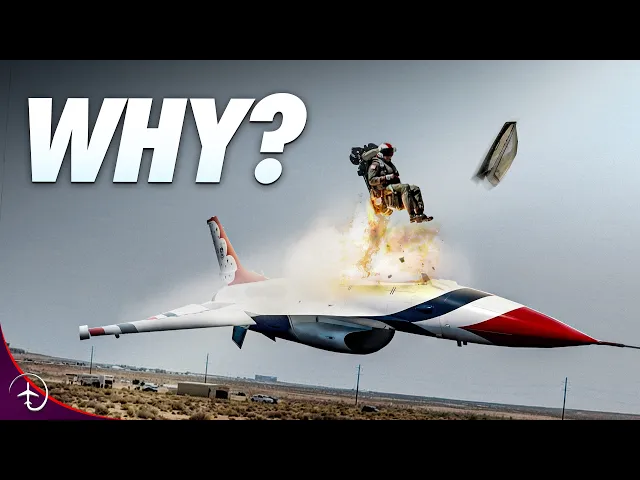
4:22 Now going back to the F-16 ejection, Staff Sergeant Benny J.
4:27 Davis, an Air Force photographer standing halfway up the control tower,
4:30 managed to capture the moment the pilot left the aircraft.
4:34 And you can clearly see here how
4:36 the aircraft nose points above the horizon, but again,
4:39 it's actually still descending at a rate that's almost twice as fast
4:42 as I'd normally descend a 737 even on a steep descent.
4:46 Now the pilot's spine was compressed hard by the ejection
4:49 and it was then compressed even more when he hit the ground.
4:52 The $30 million plus jet hit the ground
4:55 just 0.8 seconds after Captain Stricklin pulled the handle.
4:59 But incredibly, he and everyone watching was safe.
5:03 And based on the circumstances, that really is miraculous.
5:07 Now there are a lot of lessons for the Thunderbirds from this event,
5:10 including how to set and verify
5:12 altitudes and increasing the minimum altitude margins.
5:16 The truly amazing part of this story is
5:19 how close the F-16 actually came to completing
5:21 that split S from a max altitude of just
5:25 2,760 feet or 841 meters above the runway.
5:30 And that brings us to the F-16 itself, the star of our video today.
5:35 Some aircraft are thought as technological milestones,
5:38 machines that push engineering boundaries.
5:40 Others become cultural icons,
5:42 instantly recognizable symbols that represent an era.
5:46 The F-16 is unusual because it does both.
5:51 Even decades after its introduction,
5:53 the F-16 remains one of the most familiar silhouettes in military aviation.
5:57 It continues to fly in huge numbers all over
6:00 the world and perhaps most remarkably is still being built.
6:05 In an age defined by stealth, sensor fusion and increasing complexity,
6:10 here is a design that was born in the early 1970s that somehow remains relevant.
6:15 But the F-16's story is not simply one of longevity.
6:20 What makes the aircraft so enduringly fascinating is that it represents
6:23 a moment when fighter aircraft design
6:25 took a dramatic and deeply unconventional turn.
6:29 Long before it became a global icon,
6:32 the F-16 was an engineering gamble that ultimately paid off.
6:36 Now, to understand why the F-16 exists at all,
6:39 we have to step back into the realities of the early 1970s.
6:43 This was a period shaped by the lessons of the Vietnam War,
6:46 advancing Soviet aircraft design and, crucially,
6:49 a growing concern within the Pentagon about
6:52 the spiralling costs of modern combat aircraft.
6:55 At first, the US wanted to plan its future around the F-15 Eagle,
6:59 an aircraft designed to guarantee air superiority thanks to advanced
7:04 radar systems and the raw performance of those two massive engines.
7:08 It was big, fast, powerful and extraordinarily capable,
7:12 which also made it both complex and expensive.
7:16 Even with the generous budgets of the Cold War era,
7:19 it simply wasn't possible for the US Air Force to fully equip itself with F-15s.
7:24 And this debate between capability and affordability triggered a broader
7:29 discussion about what a fighter aircraft actually needed to be.
7:33 And that gave birth to a small but highly influential group of thinkers
7:38 and engineers at the Pentagon often referred to as the somewhat disturbing name,
7:43 the Fighter Mafia, whose input made the F-16s a reality.
7:47 And I'll tell you what those guys got up to after this...
7:50 On the 12th of August, 2026,
7:52 the European night sky will become visible in the middle of the day.
7:57 Tens of millions of people will be able
7:59 to look up and see the stars in the afternoon
8:02 as the sun disappears behind the moon in the first
8:05 total solar eclipse over the continent since 1999.
8:09 Some are even calling it the eclipse of the century.
8:12 Its path will pass over densely populated regions, including Portugal,
8:16 Spain, France, Northern Italy, Germany, the UK and Iceland.
8:22 The US and Canada will also see a significant
8:24 portion of it in New England and Alaska.
8:27 And if you're in one of these regions,
8:28 get yourself some reliable eye protection to enable you
8:32 to enjoy the event but without burning your retinas.
8:35 And this is VisiSolar's Solar Eclipse viewing kit, the sponsor of today's video.
8:40 Their glasses are approved by the American Astronomical Society,
8:44 so you know they're certified and safe to use.
8:47 And the kit also includes a precision
8:49 photo filter to protect your phone's camera.
8:52 Without it, you'll either ruin the shot or potentially damage your camera.
8:56 With the filter, you get a clear,
8:58 perfect image that protects your camera sensor.
9:01 And it's worth being really careful here.
9:03 There are a lot of low quality knockoffs on the market
9:06 that can damage both your eyesight and your camera,
9:09 so it's really important to stick with properly certified,
9:11 high quality eclipse glasses like these.
9:14 And VisiSolar is offering 10% off if you purchase it
9:17 through this QR code or by using the code MENTOUR.
9:21 Go check it out, I've left a link in the description below.
9:24 Thanks, VisiSolar.
9:25 Now let's get back to the F-16.
9:28 Now, what the Fighter Mafia argued was that decades
9:32 of aircraft development had drifted towards excessive weight and complexity,
9:36 often at the expense of the very qualities that mattered most in aerial combat.
9:41 Their ideas were grounded in the newly proposed energy manoeuvrability theory,
9:46 which emphasised how effectively an aircraft could gain,
9:49 retain and trade energy during a fight.
9:52 From this perspective, agility,
9:53 acceleration and pilot visibility were not secondary considerations,
9:58 they were central to survival.
10:00 The solution they advocated was not a replacement for the F-15,
10:04 but something that would complement it.
10:06 Thus came the Lightweight Fighter Program,
10:09 an initiative that challenged many of the assumptions
10:12 that had guided fighter designs for years.
10:14 Instead of asking how much capability could be added,
10:18 the question became how much could be removed without compromising performance.
10:22 At the heart of this new design philosophy was something
10:25 that we explored recently in another
10:26 video about aircraft instability and fly-by-wire.
10:30 Rather than prioritising inherent stability,
10:33 they adopted a relaxed or negative static stability,
10:36 creating an aircraft that was dramatically more agile.
10:40 And interestingly, the F-16 wasn't a purely unstable aircraft.
10:45 At higher speeds, its stability actually increased,
10:48 but at lower speeds it becomes incredibly unstable,
10:51 requiring hundreds of tiny control inputs per
10:54 second just to maintain the desired trajectory,
10:57 something that only a computer can achieve.
10:59 And it's this change of stability that gives
11:02 the F-16 its relaxed static stability term.
11:05 As we discussed in our B-2 story,
11:07 such designs would have been impractical before the digital era,
11:11 since no human pilot could continuously correct
11:14 an unstable aircraft with the precision that's required.
11:17 And although the F-16 would become the first
11:20 production fighter built entirely around digital fly-by-wire,
11:23 the origins of the technology actually lay in the space program.
11:27 During the Apollo era, NASA faced the unprecedented challenge of guiding
11:32 spacecraft through an unforgiving and highly dynamic environment.
11:36 The Apollo guidance computer, famously primitive by modern standards,
11:40 yet revolutionary at the time,
11:42 demonstrated that machines could monitor complex systems, process data,
11:46 and execute rapid corrections faster and more consistently than any human could.
11:52 And these advances quickly captured the attention of aeronautical engineers.
11:56 And in the late 1960s, NASA began exploring how digital flight control might
12:01 reshape aircraft design through the F-8 digital fly-by-wire program.
12:05 Now, incredibly, a surplus Apollo guidance computer was used in an electronic
12:10 system that replaced conventional mechanical
12:13 linkages in a modified F-8 Crusader,
12:15 which became the first piloted aircraft to rely
12:18 entirely on digital commands for primary flight control.
12:21 The program showed not only that such systems were reliable,
12:25 but they offered clear performance advantages.
12:28 Computers could smooth pilot inputs, prevent departure from controlled flight,
12:32 or at least make departures very unlikely,
12:35 and enable handling qualities difficult
12:37 to achieve with purely mechanical systems.
12:40 By the early 1970s, the implications were becoming unavoidable.
12:44 And it was during this technological shift that the F-16 emerged.
12:49 Rather than treating fly-by-wire as an experimental feature,
12:52 its designers made it the foundation of the aircraft.
12:56 The jet was conceived from the very outset as a machine
12:59 that depended entirely on digital flight control with no mechanical backup.
13:03 The airplane and its computers were designed as a single inseparable
13:07 system which quickly became the norm for all future fighter designs.
13:11 And that design choice had knock-on effects
13:13 for pretty much every other aircraft design out there,
13:17 enabling features that simply just wouldn't have been possible before.
13:21 Now if you look at the F-16's side profile,
13:24 you'll see that its nose isn't really pointing straight ahead,
13:27 instead it's pointing several degrees down.
13:30 And that's for a variety of reasons,
13:32 including its relaxed static stability and vortex generation requirements,
13:36 but ultimately, this design isn't optimized for flying straight and level.
13:40 Instead, the F-16 is optimized for flight at high angles of attack,
13:45 in other words, for turning in a dogfight with other fighters.
13:49 Now fly-by-wire enabled the F-16's designers
13:52 to take such features to the extreme,
13:54 along with forward extensions between the wing and the fuselage
13:58 that increased lift and helped reduce drag at high angles of attack.
14:03 The design was also put on a diet.
14:05 Every kilogram mattered and every subsystem was scrutinized.
14:09 The guiding assumption was that excess mass,
14:12 drag and mechanical complication were enemies of performance.
14:16 Engineers at General Dynamics didn't ask what the plane needed,
14:19 they asked what it could do without, hence why this is a single-engine aircraft.
14:24 This wasn't the first or the last design to rely on a single power plant,
14:29 and given the rest of the plane's brief,
14:31 the layout made sense, but it went far beyond the engine itself.
14:35 For example, the F-16 doesn't have a conventional auxiliary power unit,
14:39 or APU, to supply systems when the engine isn't running.
14:43 Instead, it relies on an EPU, or emergency power unit,
14:47 a tiny engine powered by rocket fuel
14:50 designed only for last resort contingency procedures.
14:53 But even if designers gave away some redundancy in the engine front,
14:56 they went the other way with the aircraft's flight control systems.
15:01 The fly-by-wire system, upon which the aircraft's ability to fly depends,
15:05 incorporates quadruple redundant digital brains, all running in parallel.
15:10 And speaking of flight controls, let's take a look at the cockpit.
15:13 Here, fly-by-wire enabled some real innovation.
15:17 The sidestick controller, fixed to the right console,
15:19 enables rapid precise inputs with minimal movement.
15:23 The seat was fitted with a 30-degree
15:25 recline to increase pilot tolerance to high G,
15:28 directly reflecting and supporting the aircraft's maneuvering capability.
15:32 And the single-piece bubble canopy prioritized visibility because the designers
15:37 believed that situational awareness itself was a form of survivability.
15:41 In fact, the visibility from the cockpit is
15:43 so good that when you're strapped into the seat, no part of the jet is visible,
15:47 just an uninterrupted view of the surroundings which is pretty incredible.
15:52 But all of this was the aircraft's design in theory,
15:55 but did it work in practice?
15:57 Because once a machine enters operational service,
16:00 reality begins to exert its own pressures.
16:03 Missions and requirements shift, and operators inevitably ask the airplane
16:07 to do more than its designers originally intended.
16:10 And the F-16 was no different.
16:12 Actually, the request to change its mission and capabilities
16:15 came even before it was put into production.
16:19 You see, the original F-16 was conceived as a pure day fighter,
16:23 small, agile and optimized for high-energy maneuverability.
16:27 But the design's underlying efficiency and its digital flight
16:31 control system meant that adding new roles was easy,
16:34 with relatively few penalties in handling.
16:36 And sure enough, production F-16A and B models were much
16:40 bigger than the YF-16 prototypes that General Dynamics originally built.
16:44 In service, new technologies allowed
16:47 engineers to integrate terrain following radars,
16:50 inertial navigation systems and precision strike
16:53 capabilities without redesigning the aircraft further.
16:56 Targeting pod came next,
16:58 giving pilots the ability to identify and hit ground targets at night.
17:02 And upgrades, called blocks,
17:04 brought new capabilities to fighters rolling off the production line,
17:07 as well as to existing fighters through mid-life upgrade programs.
17:11 So all of this means that airframes delivered decades
17:13 ago can be modernized with active electronically- scanned array radars,
17:18 digital mission computers and contemporary weapon systems allowing
17:22 operators to extend relevance without replacing the aircraft entirely.
17:27 And importantly, the evolution didn't come at the cost of agility.
17:31 The core airframe retained its responsiveness and its energy efficiency.
17:35 This mission expansion allowed the aircraft to become
17:37 a jack of all trades without becoming bloated or over-complicated,
17:41 although it should be said here that its maximum
17:44 takeoff weight has gone up a bit over the years.
17:47 But that adaptability is a major reason why the F-16
17:50 became one of the most widely-exported fighters in history,
17:53 which gave it an almost unbeatable cost-to-capability balance.
17:57 This allowed airforces with more constrained budgets to acquire a modern,
18:02 high-performance fighter without accepting the financial
18:05 burdens typically associated with larger twin-engine aircraft.
18:08 And because thousands of F-16s have been produced,
18:11 a vast global support ecosystem emerged around the aircraft.
18:15 Manufacturers, suppliers and maintenance facilities distributed
18:19 across multiple continents ensure that parts,
18:22 upgrades and technical expertise remain widely available,
18:25 helping operators maintain predictable life-cycle costs.
18:29 General Dynamics, and later Lockheed, who took over the design,
18:33 increased the jets appeal further
18:35 by licensing production to other manufacturers worldwide.
18:39 Early jets made for European operators were actually
18:42 assembled in the Netherlands by Fokker and later,
18:44 industries in other countries were given parts assembly contracts too.
18:48 So the F-16 isn't an exclusively American fighter.
18:52 Now that global success, however, did not occur in isolation.
18:56 The F-16 emerged from a competitive
18:58 environment filled with aircraft that embodied very
19:01 different design philosophies and few comparisons
19:03 are more instructive than the FA/18 Hornet, which is about as old as the F-16.
19:08 Interestingly, the Hornet's story is actually intertwined
19:11 with the F-16's from the very beginning.
19:13 The aircraft lineage traces back to the YF-17,
19:17 one of the competitors for the lightweight fighter program.
19:20 Now, obviously, the Air Force selected the smaller single-engine YF-16,
19:24 but the YF-17 didn't disappear.
19:27 Instead, it found a second life when
19:29 the US Navy recognized that its characteristics,
19:32 particularly its twin-engine configuration,
19:34 aligned well with the demands of carrier operations.
19:37 Through extensive redesign and navalization,
19:40 which is a really long story in itself,
19:42 the YF-17 evolved and transformed into the F-18.
19:46 Where the F-16 embraced single-engine efficiency and extreme weight discipline,
19:51 the F-18 was shaped by the unforgiving realities of naval aviation.
19:55 Carrier operations demand robustness and redundancy,
19:59 hence the two-engine design, as well as good low-speed handling.
20:03 The resulting aircraft sacrificed some of the F-16's minimalism,
20:07 but gained survivability and versatility within the carrier environment.
20:12 Both designs would ultimately achieve remarkable success,
20:15 albeit in very different ways.
20:17 While the F-16 became a global export phenomenon,
20:20 the F-18 carved out its own legacy
20:22 as a naval workhorse and, somewhat unexpectedly,
20:26 a cultural icon, as it became a movie
20:28 star in the box-office smash hit, Top Gun Maverick.
20:32 But of course, fame isn't everything,
20:34 because while the F-18 may have gotten some screen time with Tom Cruise,
20:37 the F-16 has sold more than three times as many units.
20:42 And some might argue that the F-14 is actually the real star of "Top Gun",
20:46 but maybe we'll keep that for another video.
20:49 Anyway, the F-16 and the F-18 have something else in common.
20:52 They were both continually updated to meet new mission requirements.
20:57 Both jets used digital fly-by-wire with a modular
21:00 system philosophy so they could both be built upon.
21:03 So, these jets did not need to be
21:05 reinvented because they could just continuously evolve.
21:08 The F-16 gained semi-permanent, conformal external fuel tanks on the shoulders,
21:13 while the F-18 was stretched and beefed up into the E and F Super Hornet models.
21:19 Interestingly, the F-18's fly-by-wire works a bit
21:22 differently from that of the F-16's,
21:24 meaning that it's not constrained by angle of attack in the same way.
21:28 So, if we go back to that Thunderbird crash in Idaho,
21:31 some people argue that the F-18's higher angle of attack
21:34 ability and good low speed performance would have potentially saved it,
21:38 but that's hard to prove either way.
21:40 But let us know in the comments below what you think about it.
21:43 Either way, both of these jets managed to stay in production well
21:46 into the era of stealth because
21:48 modern air forces operate within complex economic,
21:51 strategic and operational constraints.
21:54 Stealth aircraft deliver extraordinary capabilities, but at great cost.
21:59 However, not every mission requires stealth characteristics,
22:02 and not every budget can sustain an all-stealth air force.
22:06 Within this environment,
22:07 aircraft like the F-16 continue to serve an important role,
22:11 and incredibly, the plane could still be developed even further.
22:15 Consider the F-16XL, which we featured recently in another video.
22:20 At first glance, it barely resembles the familiar F-16 at all.
22:24 Its defining feature, the cranked arrow wing,
22:27 dramatically altered the aircraft's proportions,
22:29 creating a platform optimized for range,
22:32 payload and high speed efficiency, rather than just pure agility.
22:36 But the XL was not merely an experimental curiosity,
22:40 it represented a serious attempt to adapt the F-16's
22:43 underlying design philosophy to a different set of operational priorities.
22:48 The new wing provided vastly increased internal fuel capacity,
22:52 and improved aerodynamic efficiency at supersonic speeds,
22:55 allowing the aircraft to carry heavier loads over greater distances.
22:59 Few aircraft so clearly embody a shift in engineering philosophy,
23:03 and few have had such an impact.
23:06 The F-16's fly-by-wire and side stick paved the way for airliners to use both,
23:11 for at least some of the same reasons.
23:13 And in that sense, the plane's true
23:15 legacy extends well beyond the fighter world.
23:18 Even today, it continues to pioneer new technologies,
23:21 like the Automatic Ground Collision Avoidance System,
23:24 or AUTO-GCAS, that prevents controlled flight into train,
23:27 which has already saved lives.
23:30 So the F-16 didn't become an icon because it was the largest,
23:34 the most powerful, or the most technologically extravagant fighter of its era.
23:38 It succeeded because its designers were willing
23:41 to challenge the deeply-rooted assumptions about stability,
23:44 manoeuvrability, complexity, and risk.
23:47 By embracing digital flight control,
23:50 disciplined weight management, and maximizing efficiency,
23:52 they created a machine that operated closer
23:55 to the boundaries of performance than many believed possible,
23:59 and one that could evolve to stay relevant for decades.
24:02 This aircraft stands as a reminder
24:04 that revolutionary designs often look like calculated gambles,
24:08 and few gambles in modern aviation have paid off so completely.
24:12 But what do you think?
24:13 What other fighter aircraft would you like us to feature in this series?
24:17 Let us know in the comments below.
24:19 I'm Ben Watts.
24:20 You're watching Mentour Now!
24:21 Have an amazing week, and I'll see you next time.