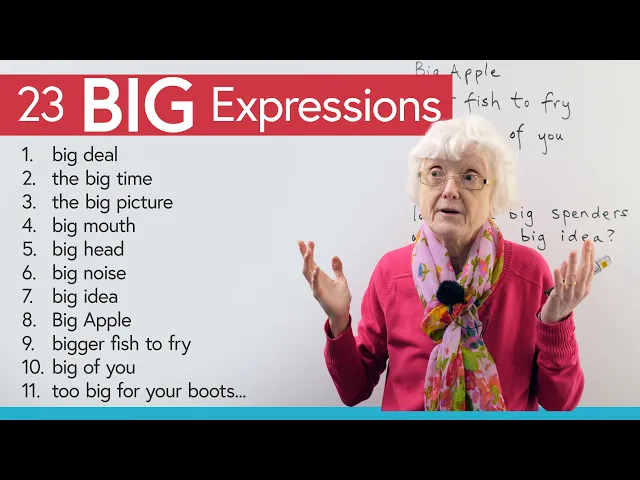
Learn 23 BIG Expressions in English
Learn English with Gill · engVid
0:00 Hello.
0:00 I'm Gill at engVid, and today we have a lesson on the word
0:07 "big" and the use of the word "big" in idioms and expressions in English.
0:14 Okay, so we have quite a lot here to look through, so let's start at the top.
0:24 And "a big fish", so it could be literally just
0:30 a big fish that you see swimming in the water,
0:33 but this is a kind of metaphor that's used for a person.
0:37 If they're working in an organization, they're high up and very important,
0:44 you could say "He's a big fish in that company"
0:48 or "She's a big fish in that company".
0:51 Okay?
0:52 And similarly, "a big noise" is used in the same way.
0:58 Maybe it sounds like, you know, they're very...
1:02 Very dominant as a person, you hear them speaking a lot,
1:07 but "He's a big noise in that organization." It's...
1:11 It can sound a bit sarcastic as well, that kind of expression.
1:18 And also, "a big shot" is a similar thing again.
1:23 So, "He's such a big shot there", or "She's a big shot in that company".
1:31 Again, it sounds a bit sarcastic depending on how the person says it.
1:38 Okay.
1:38 And "a big name", well, that can be a bit more neutral, really.
1:46 Somebody might be a big name in the film industry, for example,
1:51 and they are just, you know, a name that is heard a lot.
1:57 They're quite famous, so they're a big name.
2:01 Okay.
2:03 So, with all that kind of person, you sometimes say, "Oh,
2:08 that person has got a big head" or "They are a big head".
2:13 If it's written as one word, it's the noun, and "Oh,
2:18 she's such a big head" or "He's such a big head", but "They have a big head",
2:24 it can also be used as separate words, adjective, and noun, meaning they...
2:31 They are very...
2:33 They think a lot of themselves.
2:36 They feel very important, so they're not very modest.
2:40 In other words, they're the opposite of modest.
2:44 Okay.
2:45 And then if they're a big mouth, maybe as well as being a big head,
2:51 they might be a big mouth,
2:54 meaning they talk a lot and they like to hear people say,
2:59 "Oh, he likes the sound of his own voice." People who like to talk a lot,
3:05 they like to hear themselves talking.
3:08 So, a big mouth, someone who talks a lot,
3:12 very confidently, maybe a bit too confident, a bit egotistical.
3:19 Okay.
3:20 And then if somebody is getting too big for their boots,
3:27 if you say to someone, "Be careful, you're getting too big for your boots",
3:35 it means they're thinking a bit too much of themselves,
3:41 becoming very sort of self-centered, egotistical, and so on.
3:48 It may be that they're being a little bit bossy,
3:53 they're telling people what to do all the time.
3:57 You're getting too big for your boots, just, you know,
4:01 cut it down a bit when people start to tell other people what to do,
4:09 becoming, you know, authoritarian like that, or bossy.
4:14 So, there is an expression as well, "bossy boots", "bossy boots".
4:20 Often these expressions, they have a repeated letter alliteration,
4:27 "big boots" and "bossy boots".
4:31 It helps, you know, it's part of the style of the language.
4:38 Okay.
4:38 So, okay, so then moving on.
4:41 If something is a big ask...
4:44 Usually "ask" is a verb, "to ask", and "I ask", "you ask",
4:52 "we ask", but this has been turned into a noun, here.
4:58 It's a big ask, meaning a big request, really.
5:02 Somebody is asking you to do something that's going to be quite difficult.
5:08 So, you might say, "Oh, that's a big ask.
5:11 I don't know if that's going to be possible." Or it might be a challenge.
5:17 "Oh, that's a big ask.
5:19 I'll have to see.
5:21 It may be possible.
5:23 I'll try.
5:24 It's a challenge." So, that's a big ask.
5:30 Something could be a big deal.
5:33 You know, you could say, "That's a big deal." That is,
5:38 that's really, you know, there's a lot connected to that.
5:43 It's really important.
5:45 But then you can say, "Oh, that's no big deal." You know,
5:52 that's not very important, so it can work both ways, that one, a big deal.
5:58 It could be just a situation that you're in.
6:02 It might be serious, so that would be a big deal, but it may not be serious.
6:09 You think, "Oh, well, we can easily solve this issue.
6:12 It's no big deal.
6:14 We can soon sort this out." So, it's to do with a situation, really.
6:20 Okay.
6:23 The big picture, that's when...
6:26 Some people, the way they look at things,
6:29 they look at little details, and that's the opposite of the big picture.
6:34 If you look at the big picture or the bigger picture,
6:38 to use the comparative, the bigger picture,
6:42 that's like an overview of a whole situation.
6:46 So, some people like to look at little details, and that's important,
6:54 but other people like to look at the overall image of it, the big picture.
7:01 So, it's good to try to do both,
7:05 really, to get the right balance and perspective.
7:10 Okay.
7:10 Okay, so if somebody says or they hit
7:16 the big time or they've reached the big time,
7:21 that means in their career it may be an actor or a singer,
7:28 and they've been trying for years to make
7:32 progress and to get better and better jobs,
7:36 and then suddenly there's a big breakthrough,
7:40 and they're in a really important place,
7:43 like a big performance space with thousands of people in the audience,
7:49 and they're earning a large amount of money,
7:53 and they've made the big time or they've reached the big time.
7:59 So, that's...
8:00 That's meaning that they've really progressed well in their career.
8:05 This is the big time.
8:07 And when you...
8:09 When you've got that opportunity, you might say, "This is my big moment now.
8:16 Stepping onto that stage now is my big moment." But you
8:21 do hope that you'll have more big moments to follow,
8:25 and that it won't be the only...
8:27 The one and only big moment in your career.
8:31 Okay.
8:33 So, moving on to the second column, "Big Brother".
8:39 I don't know if you know this term with capital B, "Big Brother".
8:45 It comes from a novel written by an English novelist called George Orwell,
8:55 and the novel is called "1984", which is the year,
9:01 but he actually wrote the novel in 1948.
9:06 So what he did, he reversed '48 and made it '84,
9:13 and it's a kind of prediction of a very bad
9:20 society where people are used like slaves and they're brainwashed.
9:27 It's a very controlling society.
9:29 And "Big Brother" is the name of the...
9:35 The person who appears on a screen controlling everybody and watching everybody.
9:42 There's this phrase or sentence,
9:45 "Big Brother is watching you." So you're going around day to day,
9:51 you know this person, Big Brother, is watching you all the time to make
9:56 sure you don't do anything that goes against the rules.
10:00 So, "Big Brother".
10:02 And people use this term now if they feel that a society
10:07 or a government is becoming too
10:10 controlling and they're monitoring what everybody's doing,
10:15 maybe through their mobile phones nowadays.
10:18 And people might say, "Oh, it's just like Big Brother.
10:22 Big Brother's watching us all the time." If we've got
10:25 our mobile phones on, they know where we are and everything.
10:30 So, "Big Brother".
10:32 Okay.
10:33 And the word "brother", you'd think, "Oh, well, that's nice.
10:36 That's a family name." But it's the opposite
10:39 of being a sort of friendly family type of person.
10:44 Okay.
10:46 So, then we have "The Big Apple", which is a nickname for the city of New York.
10:54 So, "The Big Apple".
10:56 Okay.
10:57 If someone says, "I've got bigger fish to fry",
11:04 it's when there's an issue, somebody's mentioned, "Oh,
11:09 what are we going to do about this problem
11:14 we have?" And the other person isn't really very interested.
11:19 They don't really care because they have more important things to think about.
11:25 So, they say, "I have bigger fish to fry",
11:29 meaning I have more important things to think about.
11:33 But this is more metaphorical, more colourful.
11:37 And again, we've got "fish" and "fry",
11:41 so there's the repeated consonant sound again, which is part of the style.
11:48 Okay.
11:49 So, if somebody says, "Oh, that's big of you", it sounds rather sarcastic.
11:58 I don't think it's used to mean that's nice of you, that's very generous of you.
12:08 It's when somebody's doing something for someone
12:12 and they think it's nice of them, they think they're being generous.
12:17 But the other person doesn't think so.
12:20 So, they say a bit sarcastically, "Oh,
12:23 that's big of you", with maybe a facial expression as well,
12:30 and a certain tone of voice, meaning, "Oh, that's very generous of you.
12:35 Thank you." But they're not really, you know, they're being sarcastic.
12:40 Okay.
12:41 Good.
12:42 And then to think big can be a good thing.
12:48 If you think too small, you may not achieve very much in life.
12:54 But if you think big, think of big, challenging things you could do,
13:00 and not to be afraid of it, and just to keep working at it.
13:06 It may be hard work, and there may be a lot of detail.
13:11 It could take some years, but if you think big,
13:14 you can achieve something big, setting up a company, anything like that.
13:20 So, to think big is a positive thing, usually.
13:23 Okay.
13:23 And then if you do think big and you're successful,
13:28 you might make some big bucks.
13:31 So, bucks is a nickname for money, American dollars, really.
13:38 Bucks are American dollars.
13:41 But again, big bucks, we've got the repeated B.
13:46 And if you think big and you're successful, you can make big bucks.
13:53 You can make a lot of money.
13:56 Okay.
13:56 And then you might become the last of the big spenders, but again,
14:03 this is often used in a sarcastic way,
14:07 so that if somebody has spent a little bit of money,
14:12 but not very generously, you know, somebody else might say, "Oh,
14:20 you're the last of the big spenders." But they
14:25 mean it that you're not really spending very much.
14:30 It's...
14:30 It's sarcastic.
14:32 Okay.
14:35 If someone says, "What's the big idea?" it's a kind of challenging question.
14:40 What do you think you're doing?
14:42 What's the big idea?
14:44 Meaning there isn't really a big idea.
14:47 What's the big idea?
14:49 Why are you doing this?
14:51 You might hear this often in...
14:53 I think in American movies, like gangster crime movies, somebody might say,
15:01 "What's the big idea?" if it's a kind of conflict situation.
15:07 Okay.
15:11 "The big smoke" is a reference to any city.
15:18 Going back, of course, hopefully with air pollution,
15:23 we will get less and less air pollution
15:27 if countries start to do something about it.
15:31 But "the big smoke" used to mean a big
15:34 city where there would be a lot of buildings,
15:39 a lot of chimneys, either industrial or residential,
15:43 with smoke coming out of the chimneys, a lot of factories producing smoke.
15:52 So cities used to be very smoky, and I think in some countries they still are.
16:00 So "the big smoke", it's often when people
16:04 are moving to a city from the countryside, and there's a big...
16:08 Or there would have been in the past
16:11 in this country a big difference between living in the countryside
16:16 and then coming to somewhere like London or going
16:20 to a big industrial city with factories and smoking chimneys.
16:25 It would be literally the big smoke.
16:29 Okay?
16:29 And then "to big up" really just means to exaggerate something,
16:36 to make something sound big.
16:39 Probably make it sound bigger than it really is,
16:43 so it is really an exaggeration.
16:45 But maybe if people are selling a product,
16:48 they want to make it sound really good.
16:51 They might exaggerate the product a little bit
16:55 and make it sound better than it really is.
16:58 So "to big it up", "big up".
17:01 Okay.
17:01 So I hope that's been a useful run-through of some interesting idioms,
17:09 all using the word "big".
17:11 So if you'd like to test your knowledge
17:15 on this, there's a quiz on the website at www.engvid.com,
17:20 so do go and give it a try and see how you do.
17:25 And thanks for watching, and I hope to see you again soon.
17:30 Okay.
17:31 Bye for now.