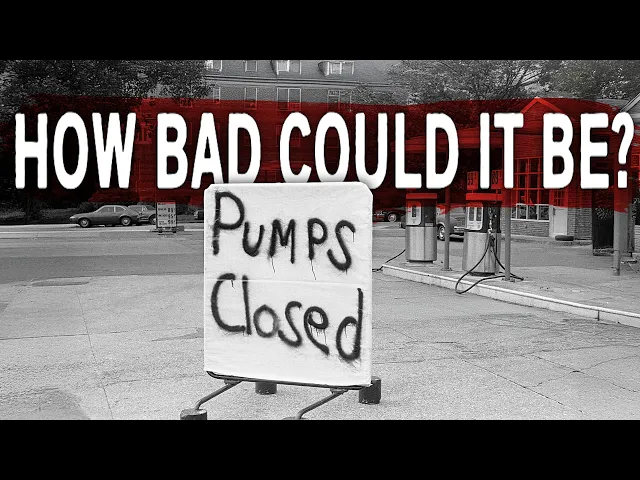
The Year Global Oil Supplies Fell... By 4%
How Business Worked
0:00 In 1979, global oil consumption per capita peaked.
0:03 And even to this day, almost 50 years later, it has never again fully recovered.
0:08 This is an especially shocking statistic when
0:11 you stop to realize that the average person living on Earth today is 500%
0:16 more economically productive than they were back then.
0:19 In plain English, what this means is that since the year 1980,
0:23 our global economy has become six times more fuel efficient,
0:27 which sounds great, but come on, you already know it wasn't diligent,
0:32 long-term planning, or environmental conscientiousness that got us here.
0:36 It was an economic shock so severe
0:38 that it literally reshaped the global economy.
0:41 The oil crisis of the late 70s and early 80s was kicked
0:44 off by a rapid succession of protests and regime change in Iran,
0:47 which was quickly followed by fullcale war across the region.
0:51 The fighting destroyed infrastructure and slowed
0:53 oil exports destined for countries
0:55 in the West that had become very accustomed to having easy energy on demand.
0:59 Prices more than doubled within just a few months.
1:03 And as people panicked to get their hands on fuel for their cars,
1:06 rationing was introduced across the world.
1:07 But cutting off the circulation of oil also impacted far
1:10 more than just the morning commute in 1970s land yachts.
1:13 It was a massive shock to global industry
1:16 that relied on oil to power their machinery,
1:18 fuel their trucks, and produce their chemicals.
1:21 All of these costs were eventually passed along to consumers,
1:25 resulting in some of the highest rates of inflation
1:27 ever seen in advanced economies in modern history.
1:30 Not to mention the most severe economic
1:33 downturn between the GFC and the Great Depression.
1:36 The impacts of what was ultimately
1:38 a short and not even particularly major disruption
1:41 in global oil supplies would also go
1:44 on to echo throughout the decades that followed,
1:47 directly impacting things like the savings and loans crisis of the early
1:51 1990s and of course the wider global industrial landscape of today.
1:55 And well, yeah, that hinted at perhaps the biggest irony of all in this story.
2:00 At the height of the greatest oil crisis in history,
2:04 total oil production was down by less than 5% worldwide.
2:07 Once again, proving that learning from history is easy until
2:11 there is a profit to be made from ignoring it.
2:14 Sum up in the word of one iate motorist,
2:16 the first day of the odd even system was a disaster.
2:20 For the first time since the war with Iran began,
2:23 we've discovered that some South Florida gas stations are running out of fuel.
2:27 You can see the price of unleted tonight is 739.
2:30 That's high enough for any of us who can remember when premium was 279,
2:33 but 739 is not as high as it's going to go.
2:37 The gallon of gas is higher than $4.
2:39 I've been in two gas lines already.
2:42 With war in the Middle East disrupting how the world gets its energy.
2:47 The impact is being felt thousands of miles away.
2:50 This is unreal.
2:51 Isn't this disgusting?
2:52 Why doesn't anybody contact the president?
2:54 Why is he letting this happen to us?
2:58 Now to understand how we got here,
3:00 we need to understand just how dependent the world
3:03 was on cheap oil when heading into the late 1970s.
3:06 The world today still cannot function without a steady flow
3:09 of the easy ondemand energy that comes from fossil fuels.
3:13 But before the 1980s,
3:14 this dependency was even greater both for households and the wider economy.
3:19 Cars at the time were enormously inefficient.
3:22 The average American vehicle in the mid
3:24 1970s got somewhere around 13 m per gallon,
3:27 which for Earth's metric people is roughly 18 L per 100 km.
3:32 And nobody cared.
3:33 Petrol was so cheap that fuel economy
3:35 wasn't even a consideration when buying a car.
3:37 Americans in particular had spent two decades falling in love with enormous
3:41 V8 engines and land yacht sedans that weighed more than some small boats.
3:45 The idea of buying a smaller car
3:47 to save on fuel would have been genuinely laughable.
3:50 We're talking about a country where the Cadillac
3:52 Elorado had a 500 cubic in engine, the largest production that V8 ever made.
3:57 It produced roughly 190 horsepower and got about 8 m per gallon.
4:02 And this dependency on massive fuel inefficient vehicles
4:05 became baked into the very structure of American society.
4:08 The entire highway system had been built around
4:11 the assumption that fuel would remain cheap and plentiful forever.
4:14 Suburbs had been designed for car-based commuting with residential
4:18 areas situated miles away from employment centers and commercial districts.
4:22 Without cheap petrol,
4:23 the whole suburban model started to become economically unsustainable.
4:26 But it wasn't just cars.
4:28 The whole world had truly embraced petrochemicals.
4:30 Heavy industry was a far bigger share of overall GDP than it is today,
4:35 where services and technology have largely taken over.
4:38 Everything from manufacturing to agriculture
4:40 to power generation was built around
4:42 the assumption that oil would remain cheap and plentiful basically forever.
4:47 Plastics, fertilizers, synthetic fabrics,
4:49 pharmaceuticals, road surfaces, heating fuel,
4:51 the list of things derived from or powered by oil was so long
4:55 that most people didn't even realize how
4:57 much of their daily life depended on it.
4:59 Farmers needed oil for the tractors, oil-based fertilizer for the crops,
5:03 and diesel for the trucks that took those crops to market.
5:07 A factory needed oil to power its machinery,
5:09 heat its buildings, and transport its finished goods.
5:11 Even the food on our plates had been touched by oil
5:15 at basically every step between the ground and your kitchen.
5:17 And for a while, the assumption that cheap
5:19 oil would last forever seemed pretty reasonable.
5:21 But while the rest of the world was getting more and more addicted to oil,
5:26 America's own domestic production had actually peaked back in the early
5:29 1970s and was on its way back down again.
5:32 This is something called peak oil and it's worth explaining
5:35 briefly because it matters for the rest of the story.
5:38 Oil production in any given region follows a rough bell curve.
5:42 You find the easy stuff first.
5:44 Production climbs and then as the reserve depletes, you have to drill deeper,
5:48 work harder, and extract lower quality crude that costs more to refine.
5:53 By the early 1970s, America had passed the top of that curve.
5:57 harder to extract, lower quality domestic
5:59 crude was slowly being replaced by nice, cheap Middle Eastern oil,
6:04 and nobody seemed particularly concerned about what
6:06 might happen if that supply was ever disrupted.
6:08 This is one of those things that is incredibly obvious in hindsight,
6:12 but at the time, the logic sort of made sense.
6:15 Why would you spend more money drilling for worse oil at home when
6:18 you could buy better oil from abroad at a fraction of the price?
6:23 Well, because it meant that you were handing a lot of economic leverage
6:27 to a part of the world that had
6:29 some very strong opinions about your foreign policy.
6:31 But it wasn't just America.
6:33 Western Europe was even more dependent on Middle
6:36 Eastern oil than the United States was.
6:38 Countries like France, Germany,
6:39 and Italy imported the vast majority of their oil from the Persian Gulf region.
6:43 And unlike America, they didn't even have
6:46 significant domestic reserves to fall back on.
6:48 This created an interesting transatlantic tension.
6:51 America's foreign policy in the Middle East was shaped
6:54 heavily by cold war priorities and its relationship with Israel.
6:58 But European countries who are far more exposed to Middle
7:02 Eastern oil supplies often wanted a very different diplomatic approach.
7:06 The energy dependency made everyone vulnerable.
7:08 But it made them vulnerable in different ways.
7:10 Now if we are being completely accurate,
7:12 the 1979 oil crisis was actually the second major oil disruption of the decade.
7:18 The first happened in 1973 and it was tied directly to the Yam Kipper war.
7:23 A group of oil producing nations from the Arabian Peninsula attempted an embargo
7:27 of oil shipments to countries that had supported Israel during the conflict.
7:31 And well, it didn't really work.
7:34 Financial historians have generously called the oil embargo a non-event because
7:38 it was only conducted by a few countries on a few countries,
7:43 so it was extraordinarily easy to get around.
7:46 While the embargo itself wasn't all that effective
7:49 in terms of actually cutting off supply,
7:51 it sent a very clear signal about who had the leverage.
7:54 That's because OPEC, the organization of the petroleum exporting countries,
7:59 watched this whole thing play out and realized something important.
8:03 Oil prices adjusted for inflation had actually been
8:05 falling since the end of the Second World War.
8:08 The stuff was getting cheaper in real terms,
8:10 but the countries sitting on top of the biggest reserves
8:13 in the world were not getting their fair share of the value.
8:16 So they did what any rational cartel would do.
8:19 They raised prices.
8:20 Since OPEC had enough market dominance to control the global supply,
8:24 they were able to almost triple the price of oil worldwide,
8:28 and there wasn't much anybody else could do about it.
8:31 Now, it would be easy to frame this as simply
8:34 greedy oil states trying to squeeze the West.
8:36 But the reality is a lot more complicated than that.
8:39 These were developing countries that had watched Western oil
8:41 companies extract their most valuable natural resource for decades.
8:45 And while paying them pennies on the dollar for the privilege,
8:48 the price correction was overdue, even if the timing was terrible.
8:52 The 1973 crisis did cause some economic pain,
8:54 and it did serve as a warning about what could
8:58 happen when your entire economy depends on energy you don't control,
9:01 but the warning was largely ignored.
9:03 Oil prices settled at their new higher levels.
9:06 Some people grumbled about it.
9:08 A few concerned voices pointed out that this could happen again,
9:11 but the world adapted to the higher prices fairly quickly
9:14 and went right back to consuming oil as if nothing had changed.
9:17 Now, some governments did try to respond.
9:20 The United States introduced a national 55 mph speed limit to conserve fuel.
9:27 President Nixon launched Project Independence,
9:29 a grand plan aimed at achieving American energy self-sufficiency by 1980.
9:34 Various conservation efforts were initiated across the developed world.
9:37 But as soon as oil prices stabilized and the acute panic faded,
9:40 all of those efforts largely fizzled out.
9:42 The 55 mph limit became a speed bump that drivers found ways around.
9:47 Project independence was quietly abandoned when the political will evaporated.
9:50 The moment the immediate crisis wasn't staring everyone in the face,
9:54 the world went back to business as usual.
9:56 We've made videos before about how people and governments have
9:59 a remarkable talent for ignoring warning
10:02 signs when the alternative is inconvenient,
10:04 and this was one of the better examples.
10:06 But the first crisis was really just the warm-up act.
10:09 The main event came in 1979.
10:11 The second oil crisis is the one that most people remember.
10:16 Even though in absolute terms,
10:17 oil prices nearly doubled compared to the near tripling from the first crisis.
10:22 This time the trigger wasn't an isolated and largely ineffective embargo.
10:27 It was a revolution.
10:29 The Iranian revolution of 1979 ousted the sha of Iran,
10:33 a westernbacked authoritarian who had been
10:35 keeping the country stable for decades, depending on your definition,
10:38 and replaced him with the theocratic government
10:41 that has ruled the country ever since.
10:44 Now, the char Iran had been one of the West's closest allies in the Middle East.
10:48 America in particular had invested heavily in propping up his regime,
10:52 providing military equipment, intelligence support,
10:54 and diplomatic cover in exchange for reliable oil
10:57 exports and a strategically positioned ally in the region.
11:00 The problem was that a lot of ordinary Iranians absolutely despised the sha.
11:05 His secret police known as Savak were notorious for their brutality.
11:10 Wealth inequality in the country was staggering
11:12 and the rapid westernization that the sha
11:14 had pushed was deeply unpopular with a large portion of the population.
11:19 So when the revolution came, it came hard.
11:22 Millions of people took to the streets.
11:24 The sha's military, one of the largest and most well equipped in the region,
11:28 thanks largely to American arm sales, initially tried to suppress the protests,
11:32 but the scale of public anger was simply too great.
11:35 By January of 1979, the sha had fled the country
11:39 and Ayatollah Kmeni returned from exile to establish the Islamic Republic.
11:44 The speed of the collapse shocked Western intelligence agencies.
11:47 The CIA had reportedly been telling the White
11:51 House just months earlier that Iran was stable.
11:53 It was one of the most consequential intelligence failures of the Cold War.
11:57 But the revolution didn't just oust the sha,
12:00 it also created one of the most dramatic diplomatic ruptures in modern history.
12:04 52 American embassy staff were taken hostage and held for 444 days,
12:09 becoming a constant reminder of the broken relationship
12:12 between the United States and the new Iranian government.
12:15 This hostage crisis consumed American attention,
12:18 poisoned any chance of diplomatic negotiation over
12:21 the oil situation and made it essentially
12:24 impossible to work towards any kind of peaceful
12:27 resolution to the chaos engulfing the region.
12:29 Iran at this time wasn't just any oil producing country.
12:32 It was one of the biggest exporters in the world and its
12:36 oil infrastructure was almost entirely managed
12:38 through the National Iranian Oil Company,
12:41 a state-owned enterprise that was itself the successor
12:44 to the Westernowned Anglo Persian Oil Company.
12:47 Now, despite being a national oil company,
12:50 NIOC was still largely managed by a consortium of for-profit
12:54 oil companies back in the West at the time.
12:58 Western engineers, Western managers, Western expertise running Iranian wells.
13:03 This was a pretty common arrangement across the Middle East,
13:05 and it tells you something important
13:07 about how these relationships actually worked.
13:09 The countries owned the oil on paper, but the knowledge of how to get it out
13:14 of the ground efficiently was kept firmly in Western hands.
13:16 So, when the revolution happened, the new government nationalized the facilities
13:20 and expelled the western personnel working on them.
13:24 Without this expertise,
13:25 Iran struggled to maintain consistent production quality and outputs.
13:28 Wells that had been running smoothly
13:31 under foreign management were suddenly being operated
13:33 by people who hadn't been trusted with the knowledge of how to do it properly,
13:37 which is itself a pretty damning
13:39 indictment of how colonial resource extraction tends
13:41 to leave countries worse off even after
13:44 they take back control of their own resources.
13:46 And it wasn't just a management problem.
13:49 No major international oil company was exactly lining up to do
13:52 business with the same government that had just seized their infrastructure.
13:55 Iran went from being one of the most integrated oil producers
13:58 in the global market to being essentially cut off from it overnight.
14:02 But the disruption didn't stop there.
14:04 In September of 1980, Iraq invaded Iran, kicking off the Iran Iraq war,
14:09 a brutal 8-year conflict that further
14:11 devastated oil infrastructure across the region.
14:14 Between the two countries, millions of barrels of daily production capacity
14:17 were taken offline as refineries were bombed, pipelines were destroyed,
14:20 and shipping routes through the Persian Gulf became active war zones.
14:24 The Iran Iraq war is one of the deadliest conflicts since
14:27 World War II with estimates of over a million casualties combined.
14:32 It gets remarkably little attention in the West relative to its scale,
14:36 which probably tells you something about
14:37 which wars we consider worth remembering.
14:39 But what many people don't realize is that the war also involved a phase known
14:44 as the tanker war where both Iran and Iraq
14:47 targeted oil tankers moving through the strait of Hormuz.
14:50 Commercial vessels carrying oil from other
14:53 producers in the Gulf found themselves in the middle of a military
14:57 conflict with both sides attacking shipping indiscriminately.
15:00 This made the straight of Hammuz one of the most
15:02 dangerous shipping routes in the world and everyone
15:05 transporting oil through it had to pay a war
15:08 risk insurance premium on top of already elevated oil prices.
15:11 Every barrel of oil that passed through that choke point was
15:15 now carrying the literal cost of warfare built into its price.
15:19 A fun little historical footnote in all of this.
15:22 Both the National Iranian Oil Company and the Anglo
15:25 Persian Oil Company are still around today.
15:28 NIOC is still officially Iran's state oil
15:31 company despite the rather dramatic shakeup in 1979.
15:34 And the Anglo Persian Oil Company, well,
15:36 it changed its name a few times over the years.
15:39 First to the Anglo Iranian Oil Company,
15:41 then to British Petroleum, or as we know it today, BP.
15:45 So the next time you fill up at a BP station,
15:48 just know that the company's origin story involves a lot more geopolitics than
15:51 you might expect from a place that sells overpriced snacks and car washes.
15:56 What was about to unfold in the Middle East would
15:59 see Americans queuing for hours just to fill their tanks.
16:02 Western governments scrambling to ration fuel
16:05 and an inflationary spiral so severe that it would
16:09 eventually take the most aggressive monetary intervention
16:11 in modern history to bring it under control.
16:14 And by the time the dust settled, the entire political and economic landscape
16:19 of the Western world had been permanently redrawn.
16:22 So, it's time to learn how history works and to see how a relatively
16:27 small disruption in global oil supply
16:29 managed to reshape the entire world economy.
16:32 If you're not getting enough existential dread from these videos,
16:36 Compounded Daily will blast it straight into your inbox every morning.
16:40 It's a free business and money newsletter.
16:43 And honestly, a better way to start the day than doom scrolling Reddit.
16:47 50% more informative, 30% less catastrophizing.
16:52 Sign up for free at compoundedaily.com.
16:57 All right, so here's where this story
17:00 takes a turn that's almost comically frustrating.
17:02 Because despite all of this chaos, the revolution, the war, the nationalization,
17:06 the expelled engineers, global oil supplies did not actually fall that much.
17:12 By most estimates, the total reduction
17:14 in worldwide oil production was less than 4%.
17:18 Other oil producing countries simply ramped up their own
17:22 output to take advantage of the higher prices.
17:24 That's the thing about commodities.
17:26 When prices go up, everybody with supply rushes to cash in.
17:29 But it didn't matter.
17:30 What followed was one of the most spectacular
17:33 examples of collective panic in modern economic history.
17:37 Everybody from panicked motorists to major industrial companies to speculative
17:42 traders bought up whatever oil they could get their hands
17:46 on in anticipation of supply constraints and price increases that in many
17:50 cases never actually materialized to the degree that people feared.
17:53 Ironically, it was this panic buying that actually
17:56 limited supply and drove prices through the roof.
18:00 The crisis wasn't caused by a shortage of oil.
18:03 It was caused by a shortage of confidence.
18:05 In the United States, this played out in the most visible way possible.
18:09 Lines at petrol stations stretched for blocks.
18:11 Some stations ran out entirely and just closed.
18:14 In states across the country, governments introduced odd even rationing,
18:17 meaning you could only fill up on certain days depending on whether
18:21 your license plate ended in an odd number or an even number.
18:24 There were fist fights at pumps.
18:26 People started carrying siphon hoses in their cars.
18:29 Petrol theft became so common that locking gas
18:32 caps became a standard feature on new vehicles.
18:34 In some cities, the National Guard was
18:37 deployed to maintain order at filling stations.
18:39 Gas station attendants started working behind locked doors.
18:42 The price of oil had become a national
18:45 security issue playing out at the neighborhood level.
18:48 News broadcasts every evening led with the price of oil
18:51 in the same way they lead with the stock market today.
18:54 It became the single metric that defined whether
18:56 the country was doing well or doing badly.
18:59 And for months, it was doing very badly indeed.
19:02 And if that sounds dramatic for a 4% supply reduction, that's exactly the point.
19:07 President Carter appeared on television urging Americans to turn
19:11 their home thermostats down to 65° F to conserve energy.
19:15 Highway speed limits were enforced with unusual strictness,
19:19 and traffic enforcement actually became a tool of energy policy.
19:23 In some cities, petrol stations opened at 5 in the morning only to find cues
19:28 of 200 plus cars with the station's
19:30 entire daily allocation sold out by 7:00 a.m.
19:33 People were waiting 3, four, sometimes 5 hours in line just to fill a tank.
19:38 And that was if they were lucky enough to be there
19:41 on the day when their license plate number was allowed to buy.
19:45 But even if the underlying supply disruption was relatively modest,
19:49 the damage it caused was very real.
19:51 Oil at this time wasn't just an important commodity.
19:54 It was the commodity.
19:56 It literally fueled every part of the economy.
19:59 And this was especially true in the late 1970s when heavy
20:02 industry still dominated in a way that it simply doesn't anymore.
20:06 So when the price of oil doubled,
20:08 the price of basically everything else went up with it.
20:11 Fuel for trucks meant more expensive deliveries.
20:13 Oil for factories meant more expensive goods.
20:16 Prochemicals for plastics and fertilizers meant higher costs across industries
20:21 that most people don't even think about when they think about oil.
20:24 And if that sounds familiar, it should.
20:27 We've seen this exact same dynamic play out with everything
20:30 from toilet paper to semiconductor chips in recent memory.
20:33 Human nature doesn't change.
20:34 It just finds new things to hoard and new supply chains to panic about.
20:40 Now, this is where the real economic damage
20:43 started to compound because workers at this time, and this part is important,
20:47 still had strong union representation across most of the developed world.
20:51 And those unions did exactly what they were supposed to do.
20:54 They demanded higher wages to account for the higher costs of living,
20:59 which is perfectly reasonable,
21:01 except businesses responded by raising their prices even further
21:04 to cover the increased cost of paying their workers more.
21:08 And because consumers had more money from the wage increases,
21:11 businesses could actually get those higher prices because
21:14 people could technically still afford to pay them.
21:17 This created something called a wage price spiral.
21:20 And it is one of the most terrifying feedback loops in all of macroeconomics.
21:25 Prices go up, so wages go up, so costs go up,
21:29 so prices go up, so wages go up, so costs go up.
21:32 And the whole thing just keeps feeding itself with no natural end point.
21:36 Now, you might be wondering,
21:38 couldn't central banks have just stepped in and fixed all this?
21:41 Well, they certainly tried.
21:42 But the problem with a wage price spiral is that the standard tools of monetary
21:47 policy are a bit like trying to put out a grease fire with water.
21:51 It makes intuitive sense until you realize you're actually making it worse.
21:55 Raising interest rates, the go-to move for fighting inflation,
21:59 works by making borrowing more expensive, which slows down spending.
22:03 But it also slows down businesses,
22:05 which slows down hiring, which means fewer jobs,
22:09 which means less spending power for the very workers whose
22:12 wages were supposed to be keeping up with rising prices.
22:15 Lower interest rates would help businesses hire more people,
22:19 but it would also make borrowing easier,
22:21 which would dump more money into an economy
22:24 that was already overheating with inflation.
22:26 There was no good option, only less bad ones.
22:30 The result was something that most economists
22:33 at the time believed was basically impossible.
22:37 Stagflation.
22:38 High inflation and high employment and low economic growth all at the same time.
22:44 This was the macroeconomist's nightmare scenario.
22:47 The conventional wisdom up to this point said
22:50 that inflation and unemployment moved in opposite directions.
22:53 A relationship that economists had even given a name to the Philips curve.
22:57 When prices are high, demand is high, so businesses hire more people.
23:02 When unemployment is high, demand is low, so prices should fall.
23:06 But the oil crisis broke that logic completely.
23:09 Prices were being driven up not by strong demand
23:12 but by supply shocks and the panic that followed.
23:15 There was no extra demand to create jobs, just extra costs destroying them.
23:20 For ordinary people, this was devastating.
23:22 Your groceries cost more, petrol costs more, your heating bill costs more.
23:26 And on top of all of that, there was a real chance you might
23:30 lose your job because the company you
23:31 worked for couldn't afford its own energy costs.
23:34 It was the economic equivalent of being punched from every direction.
23:37 This period also shattered the intellectual consensus
23:40 that had dominated economic thinking since the 1940s.
23:44 Keynesian economics,
23:45 the idea that governments could manage the economy through spending
23:49 and monetary policy had been the bedrock of postwar economic management.
23:53 But stagflation wasn't supposed to be possible under Keynesian models.
23:57 The failure of established economics to predict or fix
24:00 stagflation opened the door to new schools of thought.
24:04 monetarism, supply side economics, the Chicago school,
24:07 ideas that would go on to reshape economic policy for the next 40 years.
24:12 Whether those ideas were actually better is still hotly debated.
24:15 But the point is that the oil crisis didn't just break the economy,
24:19 it broke the framework we used to understand the economy.
24:22 And on top of that, the inflation and the unemployment.
24:26 Something called the misery index,
24:27 the simple sum of inflation rate plus unemployment rate,
24:31 hit its highest point in American history.
24:33 Americans confidence in their economic future created
24:36 to levels not seen since the Great Depression itself.
24:39 People genuinely didn't believe things were going to get better.
24:42 And that psychological collapse was as damaging
24:45 to the economy as the material conditions themselves.
24:48 And there was no easy fix.
24:49 The economic chaos that followed all but guaranteed
24:52 the election of Ronald Reagan in the United States.
24:55 But it wasn't just America.
24:56 Across the developed world, whoever happened to be in charge when the oil
25:00 prices hit was replaced with the other party.
25:03 It didn't even particularly matter how much the sitting
25:06 government actually had anything to do with the crisis itself.
25:09 Voters wanted somebody different and they were going to get it.
25:12 Jimmy Carter in America, James Callahan in Britain, Valer Jesan in France.
25:17 The political casualties of the oil
25:19 crisis stretched across the entire Western world.
25:22 This is a pattern we've seen play out dozens of times throughout history.
25:26 Economic pain leads to political change regardless
25:29 of whether the new people have any better ideas.
25:32 In the USA specifically, inflation had become the problem.
25:36 And because the US dollar was the world's reserve currency,
25:40 there was enormous international pressure to get it under control.
25:44 That was until Paul Vulkar came along.
25:47 Vulkar was appointed chairman of the Federal Reserve in 1979.
25:51 Essentially, he was handed a financial system that was on fire
25:55 and told to do whatever it took to put it out.
25:58 His solution was about as subtle as a sledgehammer.
26:01 He raised interest rates, not by a little bit,
26:04 not by a reasonable amount that might gradually cool things down.
26:09 He raised them to 20%.
26:12 For context, the current rate cycle that most
26:15 people have been complaining about peaked at around 5.5%.
26:19 Vulkus Fed went to 20.
26:21 The man famously said he wanted to break
26:25 the back of inflation and he meant it literally.
26:28 To understand how extreme this was,
26:30 imagine your mortgage payment roughly tripling because the rates
26:34 on your adjustable loan just went from 8% to 20%.
26:38 That's what happened to millions of Americans.
26:41 Now, this worked.
26:42 Eventually, inflation did come down, but the cost was extraordinary.
26:47 By making borrowing that expensive,
26:50 Vulkar essentially forced the economy into a deep recession on purpose.
26:55 Businesses couldn't afford to take on debt.
26:58 Consumers couldn't afford mortgages.
27:00 Construction ground to a halt.
27:02 Unemployment spiked to nearly 11%, the highest since the Great Depression.
27:06 Car dealers and construction workers mailed him 2x4s and car keys
27:10 to protest the fact that their industries had just been crushed.
27:14 Farmers drove tractors to Washington.
27:16 He reportedly received death threats, but he held firm and slowly,
27:21 painfully, the back of inflation was broken.
27:24 Now, most people who know the Vulkar story stop here.
27:29 The brave Fed chairman made the hard call, took the hit, and saved the economy.
27:34 End of story.
27:35 But the thing about Vulkar that doesn't fit
27:37 neatly into the tough leader makes hard choices narrative.
27:40 He was one of the few government officials
27:43 in that entire era who was actually willing to accept being
27:47 despised in the short term to do what he generally
27:50 believed was necessary for the long-term health of the country.
27:54 That kind of willingness to absorb public hatred
27:56 for a principle has become almost unheard of in modern politics,
28:00 where elected officials and appointed technocrats alike seem far more
28:04 interested in smoothing over short-term pain than making difficult choices.
28:08 Vulkar was genuinely hated while he was doing his job,
28:13 and he simply didn't care.
28:15 But it's not the end of the story,
28:17 because 20% interest rates didn't just break inflation,
28:20 they broke a lot of other things, too.
28:23 And this is where one of those long echoing
28:26 consequences of the oil crisis starts to become visible.
28:29 Savings and loans institutions or SNLs as they
28:32 were commonly known were essentially community banks
28:34 that took in deposits from regular people
28:37 and lent that money out as home mortgages.
28:40 Simple boring banking.
28:41 The business model was straightforward.
28:43 Take in deposits at say 5% interest.
28:46 Lend that money out as a 30-year mortgage at 8%.
28:49 Pocket the difference.
28:51 It worked fine as long as interest rates stayed relatively stable.
28:54 But most of these SNLs had locked in long-term mortgages at those lower rates.
28:59 When Vulk had jacked rates up to 20%,
29:02 these institutions suddenly found themselves paying depositors far more
29:05 in interest than they were earning on their existing mortgage portfolios.
29:09 They were losing money on every single account.
29:12 In desperation, many SNLs started making increasingly risky
29:16 investments to try and make up the shortfall.
29:19 lending money to speculative real estate developments,
29:22 commercial ventures, even outright fraud in some cases.
29:26 Congress didn't help.
29:28 In a spectacularly illtimed piece of deregulation,
29:31 they loosened the rules around what SNLs could invest in, essentially handing
29:36 over the matches to institutions
29:38 that were already burning through their reserves.
29:41 The result was this savings and loans crisis of the late 1980s and early 1990s.
29:46 one of the most expensive financial disasters
29:48 in American history up to that point,
29:51 which eventually cost taxpayers over $130 billion to clean up.
29:55 More than a thousand SNLs failed.
29:58 Several executives went to prison, and it all traces back to oil prices in Iran.
30:04 Now, if this sounds like a pattern that should have
30:07 been familiar by the time 2008 rolled around, you'd be right.
30:11 The savings and loan crisis was in many ways
30:14 a dress rehearsal for the global financial crisis two decades later.
30:18 Financial institutions chasing returns to cover losses,
30:22 deregulation removing the safeguards,
30:24 and taxpayers left holding the bill when it all fell apart.
30:27 The specifics were different, but the underlying structure was almost identical.
30:31 All of this was also happening at what might have been
30:35 the worst possible time for the United States and the West more broadly.
30:40 The Vietnam War, which had been lost just 4 years earlier,
30:44 had turned into a costly quagmire that demanded an enormous
30:47 amount of military spending while delivering absolutely nothing in return.
30:52 The war had eroded public trust in the government,
30:55 consumed resources that could have been invested elsewhere,
30:58 divided the country in ways that would take decades to heal,
31:02 and also shook the image of the USA as an unstoppable global force.
31:07 The breakdown of the Bretonwood system in the early
31:10 1970s meant that the United States was no
31:12 longer the deacto center of global trade that it
31:15 had been since the end of World War II.
31:17 There was now genuine uncertainty about
31:20 the reliability of America as a trade partner.
31:23 Most people think of 1971 as just the year Nixon took the dollar off gold,
31:29 but the reality was far more disruptive than that.
31:32 The whole system of fixed exchange rates
31:35 that had provided stability and predictability for decades,
31:38 but was now gone, replaced with floating currencies
31:41 that made international trade more volatile and less certain.
31:45 On top of all of this, America was
31:48 facing rising competition from newly industrializing countries in Asia.
31:52 Japan and South Korea in particular were eating
31:55 into Western dominance in primary industries like steel,
31:59 ship building, and electronics.
32:01 These countries had lower labor costs, newer factories,
32:05 and governments that were actually supporting
32:08 their industrial expansion with subsidies and trade protections.
32:12 For American workers in heavy industry, this was devastating.
32:16 Factories that had employed entire towns for generations were suddenly
32:19 uncompetitive and the jobs that disappeared were not coming back.
32:23 Any one of these problems might have caused a recession eventually on its own.
32:28 The Vietnam spending was unsustainable.
32:29 The Breton Woods collapse was destabilizing.
32:32 The Asian competition was structural.
32:33 But the oil crisis was the perfect catalyst to start the reaction.
32:37 It was the spark that landed in a room full
32:40 of kindling which had been quietly piling up for years.
32:43 Now, if this story so far has been mostly about how everything fell apart,
32:48 the next section is about how the world starting putting
32:51 itself back together in a way that nobody really expected.
32:55 Because by 1982, the problem was almost the opposite
32:59 of what it had been just 3 years earlier.
33:02 The world had a glut of oil.
33:05 Remember all those countries that ramped up
33:07 production to cash in on higher prices?
33:10 Well, they never stopped producing.
33:12 And with global economic activity significantly lower thanks to the recession,
33:17 which Vulkar's interest rates had helped create,
33:20 demand for oil was dropping just as supply was surging.
33:24 The result was a long slow decline back toward precrisis prices,
33:30 not overnights, but steadily over the course of the 1980s.
33:34 Now, this glut actually caused its own set of problems.
33:38 Countries that had based their government budgets on high oil prices,
33:41 particularly in OPEC, suddenly found themselves short of revenue.
33:44 Some of them borrowed heavily to maintain spending,
33:47 setting up debt crises that would play out through the 1980s and 1990s.
33:51 But for the oil importing countries of the West,
33:54 falling prices felt like an enormous relief.
33:57 The higher prices had also done something
33:59 else that people hadn't anticipated at the time.
34:01 They made it economically viable for other
34:04 countries to start exploring their own oil reserves,
34:07 even in locations that had previously been too expensive to develop.
34:10 The North Sea is probably the best example of this.
34:13 Britain and Norway had known about oil reserves under the North Sea for years,
34:18 but the cost of drilling into deep,
34:20 freezing, storm battered waters had made it uneconomical
34:24 compared to just buying cheap Middle Eastern crude.
34:26 But when Middle Eastern crude stopped being cheap,
34:29 suddenly those North Sea wells looked like very attractive investments.
34:33 Britain went from being a net oil importer
34:36 to being essentially self-sufficient in oil by the mid1 1980s,
34:39 which had massive implications for the British economy
34:43 and not coincidentally for Margaret Thatcher's political fortunes.
34:46 Norway, however, took a very different approach to its oil windfall.
34:50 Rather than spending all their revenues
34:53 immediately like other oil producing nations,
34:55 Norway eventually created the government pension fund in 1990.
34:59 Systematically saving oil reserves for future generations.
35:02 While most oil producing nations squandered
35:04 their wealth in a burst of consumption, Norway built a fund that now generates
35:10 hundreds of billions of dollars in annual returns.
35:14 It's one of the rare examples of a country actually learning from the oil
35:18 crisis and making structural decisions
35:19 to insulate itself from future resource shocks.
35:22 The same logic applied to deeper reservoirs,
35:24 oil sands in Canada and fields in West Africa and South America.
35:28 Higher prices didn't just change behavior,
35:31 they changed the geography of global oil production permanently.
35:35 OPEC's share of global oil production actually fell during the 1980s precisely
35:39 because the high prices they had engineered made it profitable for everybody
35:44 else to start producing which is one of those delicious economic ironies
35:48 where trying to maintain a monopoly creates the conditions that destroys it.
35:53 Saudi Arabia in particular found itself in an awkward position.
35:57 As OPEC's largest producer, it had been acting as the cartel's swing producer,
36:03 cutting its own output to keep prices high,
36:06 while other OPEC members cheated on their quotas
36:08 and produced as much as they could.
36:11 By the mid 1980s, the Saudis got tired of being
36:14 the only ones playing by the rules and opened the taps.
36:18 The resulting flood of oil crashed prices even further,
36:21 creating chaos not just in other OPEC nations,
36:23 but also in countries like the Soviet Union,
36:26 whose economy was heavily dependent on oil exports.
36:29 Some historians have argued that Saudi Arabia's decision to crash oil prices
36:33 in the 1980s did more to destabilize
36:36 the Soviet economy than any Western military spending.
36:40 So, the oil crisis essentially created its own solution,
36:43 at least from a supply perspective,
36:45 which is one of those things that sounds reassuring until
36:48 you realize how much damage was done in the meantime.
36:51 But here's where the story gets genuinely interesting,
36:54 because the long-term consequences of the oil crisis were not all bad.
36:59 In fact, some of them might be among
37:02 the most important economic shifts of the 20th century.
37:05 The crisis lived up to its name and generally
37:07 shocked the world into realizing just how catastrophically
37:10 dependent it was on cheap energy to grow its
37:14 economy and people actually started doing something about it.
37:17 Fuel efficiency in cars went from being
37:19 an afterthought to a selling point almost overnight.
37:23 In 1975, the US government introduced calf standards,
37:27 corporate average fuel economy, which for the first time in history
37:31 required manufacturers to meet minimum fuel efficiency targets.
37:34 The average fuel economy of American vehicles
37:37 essentially doubled over the decade following the crisis,
37:40 going from that embarrassing 13 mp gallon we
37:43 mentioned earlier to over 25 by the late 1980s.
37:47 Japanese automakers who had been building smaller,
37:49 more efficient cars for years because Japan had never had cheap
37:53 domestic oil suddenly found themselves with the hottest products in America.
37:58 Toyota, Honda, and Datson went from being curiosities
38:01 to being serious competitors to Detroit's almost overnight.
38:04 It was one of those rare moments where a crisis created a massive
38:08 competitive advantage for the people who had already been doing the right thing,
38:13 even if they were doing it for completely different reasons.
38:16 This shift was so dramatic that it effectively killed the dominance
38:20 of the big three American automakers for an entire generation.
38:23 General Motors, Ford, and Chrysler had spent decades building bigger and bigger
38:29 vehicles because that's what Americans wanted when fuel was cheap.
38:33 When fuel stopped being cheap, they had nothing to offer.
38:36 And by the time they caught up, the Japanese brands had already captured
38:39 a permanent share of the American market.
38:42 Homeowners started insulating their houses,
38:44 replacing old heating systems and paying attention to energy
38:47 costs in a way that they simply hadn't before.
38:50 President Carter literally put solar panels on the White House in 1979,
38:55 which Reagan promptly removed when he took office.
38:58 industry started treating energy inputs as a real
39:00 cost and more importantly as a strategic vulnerability.
39:03 If your business model depended on cheap oil and cheap oil could disappear
39:08 in a matter of months because of a revolution on the other side of the world,
39:12 then maybe it was time to think about plan B.
39:16 Many of those alternative energy efforts evaporated once prices stabilized.
39:19 Carter's solar panel investments were defunded
39:22 almost immediately after Reagan took office.
39:24 Nuclear power expansion plans were abandoned.
39:27 Research into synthetic fuels and other alternatives was
39:30 deprioritized the moment oil stopped being visibly scarce.
39:34 The lesson of the crisis that we needed to diversify our energy sources
39:39 was learned in theory but forgotten
39:42 in practice the instant the financial pain subsided.
39:45 It proved once again that even when a crisis teaches us the right lesson,
39:50 we forget it the moment the immediate danger passes.
39:53 entire governments started building out contingencies.
39:56 Strategic petroleum reserves like the one in the United
40:00 States that holds around 700 million barrels
40:02 today were either created or massively expanded specifically
40:05 in response to the lessons of the late 1970s.
40:08 The International Energy Agency,
40:09 which today coordinates energy policy between major consuming countries,
40:14 was actually founded in 1974, specifically in response to the first oil crisis.
40:18 By the time the second one hit,
40:21 it was already warning governments that they needed emergency stockpiles.
40:24 The idea was simple enough.
40:26 If you can't prevent a supply disruption, at least have enough oil in storage
40:30 to buy yourself time before the panic sets in.
40:33 It was basically a national insurance policy against
40:36 exactly the kind of crisis we've been talking about.
40:39 But perhaps the most profound long-term consequence of the oil
40:43 crisis was one that most people don't immediately connect to it.
40:47 The global economy became far less industrial.
40:50 And to be clear, this wasn't just about energy costs.
40:54 The oil crisis changed the way entire economies thought about risk.
40:58 If your economy was built around heavy industry,
41:01 you were exposed to energy price shocks.
41:03 If your economy was built around services, you were far more insulated.
41:08 Governments and investors started to favor the sectors that were
41:12 less vulnerable to the kind of disruption they'd just lived through.
41:16 Now, the oil crisis was not directly responsible for this.
41:20 The shift towards a service-based economy
41:22 had been happening gradually for decades.
41:24 But the crisis accelerated it enormously.
41:26 Because when you stop to think about it,
41:28 the biggest industries in the world today are not
41:31 really what most people would think of as industrial technology,
41:34 finance, media, and professional services are all far less
41:38 dependent on burning fossil fuels to operate than steel mills,
41:43 car factories, and prochemical plants.
41:45 A tech company's biggest energy expenses are data centers and office buildings.
41:49 A consulting firm's biggest energy expense is business travel.
41:53 A bank's biggest energy expense is keeping the lights on.
41:56 These are all real costs,
41:57 but they're a tiny fraction of what a steel mill or an aluminium smelter uses.
42:01 So, the crisis didn't create the service economy,
42:04 but it made the old industrial economy significantly less competitive,
42:09 significantly faster.
42:10 Companies that could shift toward less energyintensive business
42:14 models had an enormous advantage over those that couldn't.
42:18 And the countries that adapted fastest to this new reality were
42:21 the ones that came out of the 1980s in the strongest position.
42:25 But while the world was shifting away from heavy industry,
42:29 there was a massive social cost that often gets overlooked.
42:32 The rust belt as we know it today.
42:35 Cities like Detroit, Pittsburgh, and Cleveland that had been industrial
42:39 powerhouses was essentially born from this era.
42:42 Manufacturing jobs that had supported an entire generation
42:45 of workers and built the postwar middle class simply vanished.
42:48 Many of these cities that had been
42:51 centers of prosperity became symbols of economic decline.
42:54 And many of them have never fully recovered even decades later.
42:58 The oil crisis didn't just reshape the global economy.
43:02 It left entire regions and communities behind because while the world spent
43:07 four decades reducing its dependence
43:08 on fossil fuels for traditional industrial purposes,
43:11 we might have quietly started building a new one.
43:14 The explosion of cloud computing, artificial intelligence,
43:18 and cryptocurrency mining has created an enormous
43:22 and rapidly growing demand for electricity,
43:24 much of which is being met by natural gas turbines.
43:28 Data centers alone now consume more electricity than some small countries.
43:33 And the largest tech companies are signing deals with power
43:37 utilities that would have been unimaginable even 5 years ago.
43:41 I genuinely hope that doesn't become a problem.
43:44 But if you've been paying attention to the rest of this video,
43:48 you probably already know how that story tends to play out.
43:52 Anyways, now the recovery from the oil
43:54 crisis also had some rather notable political consequences.
43:58 Specifically, it made certain world leaders look really good,
44:01 even when their actual ideas were questionable.
44:04 Ronald Reagan came to office in 1981, right at the peak of the economic pain.
44:09 Inflation was still raging, unemployment was climbing,
44:11 and people were genuinely angry.
44:13 Over the next few years,
44:15 as Vulkar's interest rate medicine worked its way through the system,
44:18 and oil prices gradually fell back to more normal levels, the economy recovered,
44:23 growth came back, inflation dropped,
44:25 people felt better, and Reagan got the credit.
44:29 Was this entirely fair?
44:30 Not really.
44:31 The recovery had more to do with Vulkar's Fed policy,
44:34 which Reagan had nothing to do with, and the natural easing of oil prices,
44:38 which nobody in Washington controlled,
44:40 than it did to any specific policy Reagan implemented.
44:43 But politics is perception,
44:44 and the perception was that Reagan had fixed the economy.
44:48 This is actually a pattern with a name.
44:51 Economists call it attribution bias.
44:53 In political contexts, the tendency for voters to credit or blame whoever is
44:58 in office for economic conditions that are largely outside their control.
45:02 And the oil crisis era might be the single best example of it in modern history.
45:07 Reagan didn't cause the recovery.
45:08 He was simply standing in the right place when it happened.
45:12 But the story of Reagan saved the economy became one
45:15 of the most powerful political narratives of the 20th century.
45:18 This narrative became so powerful that it reshaped
45:21 American economic policy for the next four decades.
45:24 Tax cuts, deregulation, and a general skepticism of government intervention
45:28 became the default approach to economic management.
45:31 Not because they were proven to work in this context,
45:34 but because they happened to coincide with a recovery
45:36 that was mostly driven by completely unrelated factors.
45:39 And this wasn't unique to America.
45:41 Margaret Thatcher in Britain and similar leaders across
45:44 the developed world all benefited from the exact same dynamic.
45:47 The oil crisis created the pain.
45:50 Vulkar style monetary policy and falling oil prices fixed the pain.
45:54 But the politicians who happened to be standing
45:56 there when things got better took the credit.
45:58 But there is something even more unsettling about
46:01 this whole story that we haven't addressed yet.
46:04 If total oil production was only down 4%
46:07 and the crisis still managed to reshape the entire global economy,
46:11 change governments across the western world, create a decade of stagflation,
46:16 trigger a banking crisis, and accelerate the decline of heavy industry,
46:20 then what does that tell us about how
46:22 fragile the systems we rely on actually are?
46:25 The sad truth is that this was largely a crisis
46:28 of human nature rather than a genuine catastrophe of supply.
46:31 The oil was still there.
46:33 The wells were still producing.
46:35 The tankers were still sailing.
46:36 But panic, speculation, and political inaction turned a manageable
46:41 disruption into a decade of economic pain.
46:44 We've actually seen smaller versions of this same
46:47 pattern play out multiple times since.
46:49 The 1990 Gulf War caused a brief oil price spike.
46:53 The 2008 financial crisis saw oil prices swing wildly.
46:56 And of course, the pandemic lockdown of 2020
46:59 temporarily crashed oil prices to negative territory,
47:02 meaning producers were literally paying people to take
47:06 their oil because they had nowhere to store it.
47:09 Each time, the same dynamic plays out.
47:12 A disruption hits, panic amplifies it,
47:14 the consequences ripple outward into parts
47:16 of the economy that seem completely unrelated,
47:19 and then eventually things settle down,
47:21 and everybody goes right back to doing exactly what they were doing before.
47:25 The lesson of the 1979 oil crisis isn't really about oil at all.
47:30 It's about how tightly wound our economic systems
47:33 become when they're built around a single point
47:36 of vulnerability and how a relatively small disruption
47:39 can cascade into consequences that last for decades.
47:42 It's about how panic does more damage than the actual problem in most crises.
47:47 How human nature turns a 4% supply drop into rationing and stagflation.
47:52 and how the political fallout from economic pain
47:55 almost never punishes the people who actually caused it.
47:58 And well, it's also about the fact that we've known all of this since 1979.
48:04 And we keep doing it anyway.
48:06 Not always with oil specifically, but the pattern repeats.
48:10 We build complex, interconnected,
48:12 globalized systems with very little redundancy because
48:15 redundancy is expensive and efficiency is profitable.
48:18 And then we act surprised when a revolution or a war
48:22 or a pandemic exposes the fragility that was there the whole time.
48:26 Supply chains in the 1970s were built around
48:29 the assumption that Middle Eastern oil would flow forever.
48:32 Supply chains today are built around
48:34 the assumption that Taiwanese semiconductors will ship forever,
48:37 that Chinese manufacturing will stay cheap forever,
48:40 that global shipping lanes will remain open forever.
48:43 And the people making the decisions know this.
48:46 They've read the history.
48:47 They've seen the pattern.
48:48 They just don't think it will happen to them.
48:51 Now, if this video made you curious about
48:54 the political fallout from all of this economic chaos,
48:56 especially in the United States,
48:58 we made a whole video about the rise and impact of Ronald
49:01 Reagan that picks up almost exactly where this story leaves off.
49:03 Go check that out if you want to see how the recovery from this crisis
49:07 was used to justify an entire generation
49:09 of economic policy that we're still living with today.
49:12 And don't forget to like and subscribe to keep on learning how history works.