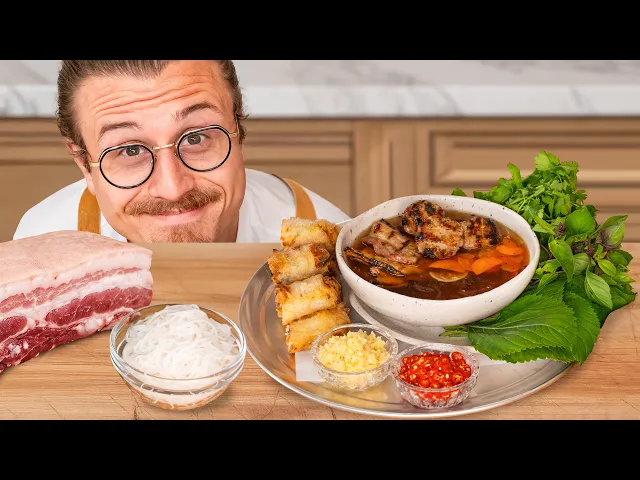
The Most Underrated Vietnamese Dish (Bun Cha Hanoi)
Joshua Weissman Recipes
0:00 Now, you probably never heard of this one, or maybe you have.
0:02 But, if you haven't, it's about damn time.
0:06 [music]
0:08 This is bun cha.
0:10 When I was first introduced to this, we had it as a breakfast [music] in Hanoi,
0:13 and it was incredible.
0:14 It is a multi-sensory experience, just like some of my favorite dishes.
0:18 I'm a very indecisive eater.
0:20 [music] I don't know what I want, so I order too many things.
0:22 If you make this bun cha, it comes with so many other things.
0:24 It comes with a sweet, yet savory,
0:25 [music] hot broth with like a grilled sort of Vietnamese meatball and pork
0:29 belly and rice [music] noodles and herbs and even crispy spring rolls.
0:33 I mean, it's like a whole thing.
0:34 This is like a omakase experience of a dish, all in one.
0:38 So, that [music] being said, let's make this, shall we?
0:40 We're going to start by preparing our meats, then we'll make a quick pickle,
0:43 a simple broth, and lastly,
0:45 a little bonus that is typically traditionally [music] served with bun cha.
0:48 We're going to start with our meatball base,
0:50 and that begins with one stalk of lemongrass.
0:54 And you're just going to beat the out of it.
0:56 Take a bowl.
0:59 You can take the back of your knife and kind of do
1:00 this, but I want you to beat the out of this thing.
1:03 You can kind of roll it a little bit.
1:05 You can use a meat mallet.
1:06 Really, you can use almost anything to break it up,
1:08 but I want it to be really broken up.
1:10 If you smell it, it smells good.
1:13 I'm actually going to smash this a little more with a pan.
1:15 Now, your family's ears might not work anymore,
1:17 but your lemongrass is very close to being finely chopped.
1:20 At this stage, you're going to remove the dry
1:22 top cuz I really only want the bottom half.
1:24 This part is sort of a little too woody to go in there.
1:27 All right, so now you're going to cut on a steep bias.
1:29 The reason we cut on a bias is
1:31 because that's sort of the way that lemongrass grows.
1:33 Once it starts getting hard to cut,
1:35 you know you're going a little too far into the stem, so I'll stop there.
1:38 Then you're just going to take your knife and run it through this.
1:40 And then chop it as finely as you can get it.
1:42 I mean, I just started chopping and it's
1:44 already about 75% of the way there, maybe.
1:47 Okay, once that's finely chopped, it's going to go into a bowl.
1:49 Shallot, you're going to cut that in half lengthwise and half again.
1:53 These shallots look absolutely immaculate.
1:55 And I want you to very finely chop this.
1:58 If you want it even finer,
1:59 you can run your knife through it a couple times after you're doing that.
2:02 All right, I'm going to add that to my bowl.
2:03 Now, four cloves of garlic, also finely chopped.
2:05 You want to make that quick.
2:06 Flat side of the knife.
2:08 That's almost there.
2:09 Again, beat all your garlic,
2:11 and then you just kind of run your knife through it a couple of times,
2:13 and you have finely chopped garlic.
2:15 That can go in here.
2:16 All right, so we've got Thai basil.
2:17 We're going to very finely chop that.
2:19 Sort of like a chiffonade first one direction.
2:22 Now, we have all these lines going this way from the chiffonade.
2:25 So, now we're going [music] to go the other way to get that a bit finer.
2:27 Beautiful.
2:28 We're going to want about a half cup finely chopped into our bowl.
2:32 All right, 1 and 1/2 lb of fatty ground pork.
2:35 You're going to add all that stuff you just chopped
2:37 to your pork along with 2 tsp of ground black pepper, 2 and 1/2 tbsp of sugar.
2:42 I know it's a lot.
2:43 3 tbsp of fish sauce.
2:45 Something magical happens when you add that quantity of sugar and fish sauce.
2:49 And what that is is the process [music] of salty caramelization,
2:52 which is exactly what we want.
2:54 Now, you're just going to mix that together
2:55 thoroughly by hand until not just evenly incorporated, but nice and homogeneous.
3:00 I'm almost sort of kneading it.
3:01 I'm picking up, folding it over itself, and pushing it back in very quickly.
3:05 I almost want to kind of emulsify that fat with both the liquid from the pork,
3:08 but also the liquid from all the vegetables
3:10 so that it becomes one gluey nice mass.
3:13 Should look tacky, beautiful like that.
3:16 Now, it's ideal if you let this marinate.
3:17 This is essentially like a casingless sausage.
3:19 [music] So, cover this with plastic wrap,
3:21 let it marinate for at least 30 minutes or ideally overnight.
3:25 Our other meat is pork belly, but first we need to make a little marinade.
3:28 So, that's going to be 2 tbsp of sugar, 2 and 1/2 tbsp of fish sauce.
3:32 We're seeing a little reoccurring theme here, sugar and fish sauce.
3:35 Three cloves of garlic finely chopped.
3:37 So, I'm going to smash them, and then I'm just going to chop them up.
3:39 And then two green onions, just the whites finely chopped.
3:43 That'll go in to my bowl, and you're just going to whisk that together.
3:46 Now, we have 1 and 1/2 lb of a beautiful skinless pork belly,
3:49 but we We have a nice fat cap.
3:51 You really want to find pork belly that has a nice ratio of meat and fat.
3:54 We don't want anything too fatty, but also if it's too fatty,
3:56 that's not that big of a deal.
3:57 Okay, so you need the pork belly to be sort of in more manageable pieces, right?
4:01 [music] I want this around 2 2 and 1/2 inches long,
4:03 and you're going to cut it into 1/4 inch thick slices.
4:05 [music] But you can see how nice of a ratio of meat and fat is.
4:08 We almost have little bit more meat than fat, and that's kind of optimal.
4:11 When this crisps up, it'll be not only fatty, but nice and juicy and meaty.
4:15 And we're going to add that pork to our marinade, just toss to coat.
4:20 [music]
4:19 Make sure to really massage that in there so it coats every single little piece.
4:23 Now again, you can cook this right away,
4:25 but ideally you'll let this marinate along with your ground pork.
4:27 Again, at least 30 minutes, up to overnight, ideally overnight.
4:32 For your pickles, which I guess
4:34 by technicality could be optional, but they're not.
4:37 Got to make them.
4:37 So, 2 cups of white distilled vinegar, 1 and 1/2 cups of water,
4:41 a 1/4 cup of sugar, and a tablespoon of kosher salt.
4:45 It's a salty sweet kind of a pickle.
4:47 Okay, set that to high and bring it to a boil.
4:49 Now, while that's boiling, we're going to cut our veg.
4:51 We have two large-ish carrots and one daikon, both peeled, stems removed.
4:56 You're going to cut them in half lengthwise, and then I just want to be clear.
5:00 If you don't have a mandoline,
5:01 you can literally just use your knife and cut these yourself.
5:05 The only problem, that's a good carrot.
5:08 The only problem is your cuts might end up being more inconsistent.
5:11 It'll take you a little longer.
5:12 It's not the end of the world, but if you want them thinner,
5:14 you want them really consistent, finger depth trap.
5:17 Okay, whether you're using a knife or a mandoline,
5:19 thickness on this will be We'll just call it an 8th of an inch.
5:22 And you're going to do that with all your carrots and all your daikon.
5:25 Look at that.
5:27 That's all going to go into a heatproof container.
5:29 So, once this liquid comes up to a boil, you can cut off the heat,
5:32 and we just need this hot liquid poured directly over your pickles.
5:36 Go nice and slow.
5:37 You don't want it to splash and burn yourself.
5:39 And you're going to pour just enough to cover them.
5:41 You may have some pickle liquid left over.
5:42 If you do, save it.
5:44 You can use it to pickle other stuff.
5:45 Just let it cool back down.
5:46 You can put it in another container, leave it in the [music] fridge.
5:48 Now, crucial point, we want to make sure this stays submerged.
5:51 So, there's two ways to do that.
5:52 You can either put a paper towel on top and adhere it.
5:54 You can also do it with plastic wrap,
5:55 where you essentially take a very small layer of plastic wrap,
5:58 one singular layer, and you just lay it on top of the vegetables.
6:01 So, you see how I'm pressing it onto the top,
6:03 and it's actually adhering to the liquid.
6:05 [music] So, the surface tension of that liquid kind of suctioning to the plastic
6:10 wrap is bringing just enough of a layer
6:12 of hot pickle liquid above the vegetables.
6:14 So, everything below it gets pickled, and nothing doesn't.
6:17 Let that come to room temperature, and you have pickles.
6:19 Moving on.
6:20 Now, the bún chả dipping sauce.
6:21 Typically, this is mostly just water, sugar, fish sauce, and a little vinegar.
6:25 I'm using pork stock instead of water, because it's yummy.
6:29 Just more flavor.
6:30 But, if you want to be more traditional, you probably would use water.
6:32 That said, pork stock for me.
6:34 So, we're going to do 4 and 1/2 cups of a nice, flavorful pork stock.
6:38 You could hypothetically use chicken stock, maybe even beef stock,
6:40 but [music] I'm doing pork since we have Well, pork is the meat, isn't it?
6:43 Now, we're going to add 1/2 cup of white sugar,
6:45 1/2 cup of fish sauce, and 3 Tbsp [music] of white distilled vinegar.
6:50 Heat that over medium heat.
6:52 I don't really want to boil this too much,
6:53 but you're going to bring it up to a boil,
6:54 cut off the heat, and then all you need to do is just keep it hot.
6:56 Serve it hot.
6:58 Now, once it's time to grill, you want around 2-oz pork patties.
7:01 You can make them smaller, you can make them as big or as small as you want.
7:03 You got 1 and 1/2 lbs of ground meat, so think about it like that, right?
7:06 How many people are you serving, etc.
7:08 I also like my patties to be not too big,
7:10 so they don't have too much presence in the bowl.
7:12 Something kind of like that.
7:13 Almost like a McDonald's chicken nugget sort of shape,
7:15 but more round, more of a patty shape.
7:17 Kind of like that.
7:18 Then, just repeat rest of your pork.
7:20 1 2 3 4 5 6 7 8 9 10 11 12 13 14 15 16 17 18 19 20 21 22 23 24 25 26 27 28 29.
7:28 So, we get We'll call it 28 to 30 of these little patties.
7:30 That way, everybody who eats this beautiful bún
7:33 chả will get a heaping portion of pork.
7:35 We've already finished our pork belly, we've finished our patties.
7:37 Now, spring rolls.
7:39 All right, so we have five wood ear mushrooms.
7:41 They look weird, they feel weird.
7:42 You can cut these out.
7:43 This is kind of optional, but very traditional, adds a really nice texture,
7:46 like sort of a almost like a cartilaginous crunch.
7:48 But, they're mushrooms.
7:49 So, you're going to finely chop them.
7:50 First, you go one direction.
7:52 Crazy, it's really just like an ear.
7:54 So, now we're going to go the other way.
7:55 And then, we have some pre-cooked rice noodles, about a cup of those.
7:58 And you're just going to kind of run your knife through them in three segments.
8:01 One, [music] two, and three.
8:02 About, you know, roughly an inch or so, so that they're in smaller pieces.
8:06 Stir that in.
8:07 And then, we have a half pound of shrimp.
8:09 All of this you can do in a food processor,
8:10 but I'm just showing you how to do it with your knife, right?
8:12 You can take your shrimp, dump them out.
8:14 They're already peeled, they're already deveined here.
8:16 And then, I'm just going to chop them up.
8:18 Just going to run my knife through them,
8:19 bring it together, run my knife through them.
8:21 This doesn't have to be like a fine paste or anything,
8:24 but you want it to look like ground meat,
8:25 and you want it to kind of stick together.
8:27 You can see how it's starting to sort of form [music] a paste,
8:29 something cohesive rather.
8:31 That should be good enough.
8:31 Then, to that, we're going to add a half
8:33 pound of ground pork, 1 tsp kosher salt.
8:36 We have the whites, finely chopped,
8:38 of two green onions, [music] and one medium carrot, julienned.
8:41 Give that a mix by hand till they're really combined.
8:43 And once that's for the most part mixed, we'll then [music] add two large eggs.
8:47 And just mix that in.
8:48 All right, now we're ready to fill our spring rolls.
8:51 This is kind of an optional step, but I do it every time.
8:54 I just can't help myself.
8:55 If you want to make sure that your spring roll filling is seasoned properly.
8:58 You can't eat it raw, but you can cook a tiny little smidgen of it in a pan.
9:01 So, I've got a small pan here, set over a medium medium high heat.
9:04 Put it in there.
9:04 I don't really care about getting any myillard on it.
9:06 I just need to get it cooked all the way through so I [music] don't die.
9:09 And also, so I can taste it for any seasoning level.
9:10 So, we'll let that cook.
9:11 Very very tiny little thin patty,
9:13 like 1 to 2 minutes per side until cooked through.
9:16 All right, smells good.
9:17 This is your last chance to season it.
9:20 So, taste it.
9:21 If you feel like it needs a little something,
9:22 you want to throw in some other flavor, or you want more salt, or whatever,
9:26 this is the chance to taste and [music] add to your taste.
9:29 Next, we'll soak our rice paper in lukewarm
9:30 water for about 2 to 5 seconds free sheet.
9:32 The paper should still feel slightly stiff when you pull it out,
9:35 but as it sits, it will loosen up.
9:37 So, lay flat, preferably on a damp wooden cutting board to avoid sticking,
9:40 obviously, because we don't want it to stick.
9:42 We're going to add our farce to our spring roll.
9:45 I'm going into the lower third,
9:46 kind of making it into the final shape I want it to be
9:48 cuz [music] the filling is the majority of the shape of this.
9:51 We're going to take our rice paper roll,
9:52 fold it up and over that, roll it up slightly,
9:55 and then we're going to take the sides, fold those in, nice and taut,
9:59 and then we're going to roll all the way up, nice and tight.
10:02 Now, repeat that until you've used all of your filling.
10:05 Then you have [music] something that not only looks beautiful,
10:07 but is ready to be fried.
10:09 Now, let's grill.
10:10 So, we're going to start by spraying our grill with cooking spray,
10:13 then lay out your patties side by side in rows.
10:15 Just try to fit as many as you can if you're using a grill basket.
10:18 Let that sear over high heat for anywhere between 2 to 3 minutes.
10:22 Be cautious of flare-ups.
10:23 We don't want these to burn, but we do want a little bit of char on there.
10:26 Then give them a flip and sear for an additional 2 to 3 minutes.
10:29 Now, at this point the patty should be done, but if you want to check it
10:31 with a thermometer the internal temp should be 165° F.
10:35 Now, while those are cooking you should also throw on your pork belly,
10:37 which again, you're going to sear for about 2 to 3 minutes per side.
10:40 These cook very quickly and they flare
10:42 up aggressively if you're grilling over charcoal,
10:44 so you know, be cautious not to completely burn them.
10:47 Now, once you've got some good color and a little bit of char on there,
10:50 remove them from the grill and place them on a sheet tray to rest.
10:52 Now, while those are resting you can
10:53 go ahead and fry your assembled spring rolls.
10:56 Here I have a pot with high smoke point oil, canola oil, avocado oil, etc.
11:00 Filled to about halfway in a 6 and 1/2 7 qt pot, so like 3 qts of oil.
11:03 Heat it to 350° F and we're going to add these little boys to fry.
11:07 Quite simply.
11:08 You may want to have a toothpick or something
11:10 sharp to poke in case they bubble up too much.
11:12 They will get these sort of like crazy bubbles, just pop them.
11:15 All right, now, there's a few ways to tell if these are done.
11:17 First of all, the outside's crisp.
11:18 They're not going to really brown or turn cuz it's rice paper.
11:20 You can take a thermometer and just kind of stick it in one of the ends.
11:23 You want the internal temperature around 165° F.
11:26 If it is, you're done.
11:27 Pull them out.
11:28 If it's a little higher, that's fine, too.
11:29 These These 190° F, that's totally fine.
11:31 But look how crisp these little guys look.
11:34 Take those out, drain them on a wire rack,
11:36 and repeat the rest of your beautiful spring rolls.
11:39 Now we have our crispy guys done, we're ready to plate.
11:43 So, first, if you made the egg rolls,
11:44 you're going to cut them in half and kind of line them up on a platter.
11:47 Then lay out your freshly grilled meatballs,
11:49 pork belly into a shallow serving bowl,
11:50 and ladle over your hot broth, and finally top with some of your pickles.
11:54 Serve and enjoy.
11:56 Finally, it's time.
11:57 How do you eat something like this?
11:58 Well, very simply, however you want.
12:00 It's always served with finely chopped garlic, thinly sliced chilies.
12:03 So, I like a little bit of heat, so I'm going to throw some chilies in there.
12:05 This is a personalized thing.
12:06 You add as much as you want.
12:07 Add a nice little spoonful of garlic.
12:08 Boom.
12:09 Stir that into the broth.
12:10 Let that kind of perfume the whole thing.
12:12 I'm going to grab a little pork [music] patty.
12:15 Mhm.
12:16 The broth is insane.
12:17 Take some noodle.
12:18 Dunk that in the broth.
12:21 Ah.
12:22 You're going to take your egg roll, if you made them.
12:24 Dip that.
12:28 That is phenomenal.
12:29 And then obviously, you can use the herbs as you please.
12:31 You can throw a bunch in, throw a little at a time.
12:33 You can put a little leaf on your spoon and then eat that with the broth.
12:35 Bún chả is a whole experience.
12:38 The sweet, salty, rich umami flavor of the broth.
12:42 The meat is like both herbaceous and refreshing,
12:44 but also rich and charcoaly and smoky.
12:47 Of course, the pork really provides that like fatty richness,
12:49 which is all cut by the broth,
12:51 because the broth is so tart, yet salty, yet sweet, umami-rich.
12:55 And the more chilies you add, the spicier it gets.
12:56 The more garlic you add, the more garlicky it gets.
12:58 But, it's like a slurry of textures and flavors
13:01 hitting me in the face left and right.
13:03 A perfect meal for somebody who can't decide what the hell they want to eat,
13:05 because there's probably 4 million different ways [music] to enjoy this.
13:08 When you sit down to eat this, this isn't one meal.
13:10 This is like 100 meals combined into one.
13:12 And if you decide to make it, this is the one to make at home.
13:15 I feel confident in this recipe.
13:16 It reminds me of what I was [music] in Hanoi,
13:17 which is the first time I ever had bún chả.
13:19 Shout out to A Au from Unnamed Traveler, by the way.
13:21 Thank you for that.
13:22 Here's my bún chả.
13:23 What do you think?
13:23 Let us know.
13:24 A Au, what do you think?
13:25 Anyway, love you, subscribe.
13:26 Bye.