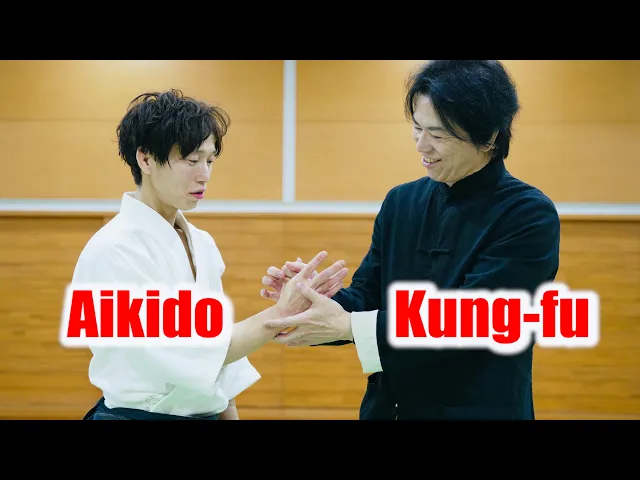
【Chinese Kung-fu and Aikido】Does “Qin-na” work on the well-trained wrists of Aikido-ka?
kuro-obi world
0:07 Ah, this is a very trained wrist.
0:09 I think his principles are similar to those of aikido.
0:11 But the level of his application is amazing.
0:14 And it's very dangerous.
0:15 Aikido and Chinese Kung-fu finally meet!
0:19 This is a scene from the "Crossroad Evolution Blu-ray BOX".
0:26 Aikido: Shirakawa Ryuji, Chinese Kung-fu:
0:29 Miyahira Tamotsu "Crossroad Evolution" ※This Blu-ray BOX is sold only in Japan.
0:33 Are there any large-motion throws in Chinese Bujutsu?
0:37 Large-motion throw?
0:38 In Aikido, there are techniques that involve taking
0:41 your opponent's joint and throwing them like this.
0:45 Let me show you an example.
0:47 First you attack his eyes.
0:49 Then you grab his hand like this and throw him.
0:55 This is a move in kata.
0:58 Let's try it from the other side.
1:00 Strike the eyes.
1:02 Strike the groin.
1:06 Instead of throwing him like this, strike the vital point on his back.
1:14 This is a technique in Bagua Zhang.
1:17 Bagua Zhang?
1:18 We have this kind of technique, but we don't throw with big movements.
1:22 You locked his joints, right?
1:24 Yes, but we stop in practice.
1:26 If you don't stop, it's dangerous, right?
1:28 Yes, but to understand the danger, we actually do it to the limit.
1:34 I think that is the great thing about aikido.
1:37 Aikido is often misunderstood because the opponent
1:42 is thrown with a big movement.
1:46 However, I think it is because the yin and yang are in harmony.
1:51 The attacker and the defender are expressed as a pair.
1:57 So that neither party gets hurt.
1:59 Exactly, the aim is for both parties to improve.
2:01 From that perspective,
2:02 I think the reason why Chinese Bujutsu “Qin-na” has not spread
2:05 as widely as aikido is because it has not been systematized.
2:09 Our goals and methods are completely different.
2:12 Yes.
2:13 Qin-na still exists today only for self-defense.
2:15 I think that is the outstanding aspect of aikido.
2:18 There is a similar technique in aikido.
2:23 Lock the elbow and...
2:31 It's similar.
2:32 There are no blows to the back in aikido.
2:36 This blow is very dangerous, isn't it?
2:38 Yes, it is.
2:39 There is a big throw in aikido.
2:42 This locks his arm.
2:46 Yes, if he doesn't jump by himself, his arm will break.
2:49 If he can't jump, I'll roll him like this.
2:52 Is this “shiho-nage”?
2:54 Yes, it's a very rational technique.
2:57 For example, you can roll an opponent who
3:01 is in a high position from a sitting position.
3:08 You can make it safe, or you can make it dangerous.
3:13 Yes, it can be adjusted to any level.
3:15 I'd like to ask you about "shiho-nage".
3:18 In aikido, you also practice it to improve your partner's "ukemi", right?
3:25 Please try "shiho-nage" again.
3:27 At this time, some people turn around and escape, right?
3:36 Yes, in Aikido, we practice various
3:38 techniques to prevent the opponent from escaping.
3:40 Tighten the sides?
3:42 Yes, there are various methods.
3:44 Try to escape.
3:46 This is the most common way to escape.
3:49 To avoid this, you need to lower your hips,
3:53 make small movements, and he won't be able to escape.
4:03 There are people who try to escape in various ways, right?
4:11 Yes, we can throw them safely, or we can throw them even if they resist.
4:16 We have a similar technique.
4:26 This looks similar, doesn't it?
4:28 Yes, the final dropping motion.
4:30 He must be in pain right now.
4:34 But if there is a moment when the pain goes away, he will fight back.
4:40 So you have to keep hurting him.
4:42 Please turn and escape.
4:48 People with experience in martial arts or Budo may escape in this way.
4:51 In that case, attach this elbow to the head.
4:58 Then he is forced to fall.
5:00 Are you using this kind of theory?
5:02 Put the elbow here.
5:04 Take your hand off the head.
5:07 Then he can resist.
5:09 But if it's attached to the head...
5:12 He can't use his strength.
5:14 We don't use that method very often, but we lock this hand and bend it.
5:20 His hand will be broken.
5:23 When I try to push this hand to touch the head, he resists.
5:31 But hold this part and bend it lightly...
5:35 He rolls over.
5:37 This is exactly the principle of “shiho-nage”, but this way of using it is rare.
5:40 Yes, although the objectives are different, I think they are similar.
5:45 The aikido technique called "ikkyo" is applied to "shiho-nage".
5:52 It is easy to imagine that a lot of strength is generated by the leverage.
5:56 Actually, this is a technique that is too dangerous and is prohibited in aikido.
6:00 I think "shiho-nage" is a dangerous technique.
6:03 Yes, it is scary.
6:04 I want to try "ukemi".
6:06 So please do it slowly.
6:19 As expected, Shirakawa sensei has trained his wrists.
6:25 Ah, this is a very trained wrist.
6:27 Really?
6:28 Yes, I could tell right away.
6:29 However, no matter how much you train your wrists,
6:32 you cannot resist this technique.
6:34 There is a technique in aikido called "ni-kyo".
6:38 In Shorinji Kempo, it is called the S-shape.
6:41 With training, you can resist this.
6:44 But that's not possible in this case.
6:47 This is a technique used by the police for arrests.
6:50 My wrists are flexible, but if Miyahira-sensei really got into it...
6:54 Just by touching Shirakawa-sensei's wrist,
6:56 I can tell that it's a wrist that's been bent tens of thousands of times.
7:07 This is really dangerous.
7:09 For people with wrists like his, I fine-tune my technique.
7:15 The basic techniques don't work for him.
7:19 I think his principles are similar to those of aikido.
7:22 But the level of his application is amazing.
7:25 And it's very dangerous.
7:27 If you ask him to move quickly, you'll definitely get hurt.
7:31 The wrist of a beginner.
7:33 The wrist of a martial arts veteran who has no experience with joint techniques.
7:37 The wrist of someone who has trained
7:39 in joint techniques tens of thousands of times.
7:41 They are completely different.
7:43 His wrist is soft and flexible, but strong.
7:47 It is as tough as having a steel bar buried in the center of a cotton ball.
7:54 You could tell just by touching his wrist?
7:57 Yes, I felt that way.
7:58 I thought he was amazing.
8:02 It is an honor just to have Miyahira-sensei touch my hand.
8:07 We're not exactly the same, but we do have things in common, don't we?
8:12 Yes, the way we use our bodies.
8:14 However, I think that your Bujutsu is more dangerous.
8:16 It's hard to say, but I think it's because it specializes in self-defense.
8:20 In aikido, we pursue a throwing style that maintains
8:23 safety so as not to injure our partner.
8:26 We can make dangerous attacks, but we don't do that on purpose.
8:30 We can choose between those two paths.
8:33 But, Miyahira sensei's techniques are completely for self-defense.
8:37 I don't think that Qin-na is a good way to stay healthy.
8:40 I think that aikido is Budo that is useful for self-defense and is
8:45 also a complete health regimen that can be continued throughout one's life.
8:49 But what about Qin-na?
8:50 It's just an attack, isn't it?
8:52 I felt that the technique that Miyahira
8:55 sensei showed earlier was similar to aikido.
8:58 Throw him here.
9:00 After locking the joint, throw him down.
9:06 In fact, it includes detailed techniques.
9:10 In this case, there are people who can resist.
9:17 Instead of lifting like this, Do it like this.
9:24 You want to go to the other side, right?
9:27 So make this shape and lift it up.
9:29 And then do this.
9:31 This would break my arm.
9:33 It's done like this.
9:34 Be careful, or your arm will break.
9:37 Make a core?
9:38 Yes, make your arm into a single rod.
9:45 For normal people, this is enough.
9:51 When he focuses on here, you do this.
9:56 And this.
10:02 In this case, he can concentrate his mind and resist.
10:10 This makes him focus on the top.
10:13 That's why attacking from below works.
10:16 The danger increases as the arm becomes like a single stick.
10:20 Relax as much as possible and try not to extend your arm.
10:25 It's a quick movement, so it's hard to deal with.
10:27 Plus, I hit you and extending your arm.
10:30 Shirakawa-sensei is truly amazing.
10:31 He instinctively senses danger and relaxes.
10:35 An amateur cannot relax.
10:37 I make my opponent tense.
10:39 I make them tense and extend their arms.
10:42 That is my strategy.
10:44 But Shirakawa-sensei can relax.
10:46 Yes, I felt danger, so I relaxed and tried to escape.
10:49 It's very difficult to relax at the moment you feel danger, isn't it?
10:53 Yes, you definitely need a lot of experience.
10:54 Our instincts make us tense with fear.
10:57 The same is true for insects.
10:59 You stiffen to protect yourself.
11:01 That's what normal people do.
11:03 But this is the opposite.
11:04 You feel threatened and lose strength.
11:07 This is scary because it is left up to the opponent.