Conservation of angular momentum | AP Physics | Khan Academy
Khan Academy
0:00 [Instructor] Did you know that a satellite or a space telescope can turn
0:03 by any amount about any axis in space without using any external force,
0:10 without any thrusters?
0:12 It can do that.
0:13 How?
0:14 By using a principle called conservation of angular momentum.
0:19 But what exactly is this?
0:20 Let's find out.
0:21 Let's start with something that we already know.
0:23 We know that if an object of mass m has some velocity v,
0:27 it has momentum, which is the product of mass and velocity.
0:31 Why do we care about this thing called as momentum?
0:33 Well, that's because if you have a bunch of particles,
0:36 not just one, but a bunch of them,
0:38 and if the total external force on that system of particles is 0,
0:44 then the momentum of the system,
0:46 which is basically the sum of individual momenta, that stays a constant.
0:51 It doesn't change, and we call
0:53 this the principle of conservation of linear momentum,
0:57 and this is a super powerful tool in making predictions.
1:00 For example, imagine a situation in which a block
1:02 is coming with some velocity and hits another block.
1:06 And let's say after the collision, they stick together and they move together.
1:09 We wanna find what that final velocity is.
1:12 Well, if you consider both m1, m2 as our system,
1:16 and if we ignore friction and air resistance,
1:18 then during the collision, the forces are all internal.
1:21 There are no external forces.
1:23 Then we can say the total momentum of the system before
1:28 the collision should equal the total momentum of the system after the collision.
1:33 And just from this, in a couple of steps,
1:36 we can figure out what that final velocity should be.
1:40 Isn't this awesome?
1:41 Why does it work out this way?
1:43 Well, that's because if there are no external forces acting on the system,
1:47 then during the collision,
1:48 when m1 puts a force on m2, m2 puts an equal but opposite force back on m1.
1:53 So, whatever momentum has gained by m2,
1:56 the same amount of momentum must be lost by m1,
1:58 and so the total momentum does not change.
2:01 Well, now, you might say, "In real--life cases, external forces are not 0.
2:05 You have friction, you have air resistance, right?" Yeah,
2:08 but if this was a situation just before the collision,
2:11 and this is the situation just after the collision, then during the collision,
2:16 the internal forces are much higher compared to the external ones,
2:18 and so we can ignore them.
2:20 We can pretty much say that, "Hey,
2:21 momentum changes mostly happen due to the internal forces." And so
2:25 we can pretty much use this principle and make pretty accurate predictions.
2:29 Okay, now, guess what?
2:31 If a rigid body is spinning, then we know it has angular momentum,
2:36 which is given as the product of its rotational inertia and angular velocity.
2:41 And many experiments show, for a bunch of rigid bodies,
2:45 if the net external torque on it is 0,
2:49 then the angular momentum of the entire system, which is, again,
2:53 basically the sum of individual angular momenta, that stays a constant.
3:00 So, now we have something called the conservation of angular momentum.
3:05 The idea is very, very similar to over here,
3:07 except that this will be used for rotation.
3:09 So, let's take a few examples.
3:12 Let's say we have a disc that is spinning on a frictionless table,
3:17 and let the angular velocity be omega1.
3:20 Now, let's say we drop another disc.
3:23 This is not initially rotating, okay?
3:26 We're gonna drop it on this one.
3:27 And there is friction between these two, so this is spinning, this is not.
3:31 What happens when you drop this on this one?
3:34 Well, because there is friction between these two,
3:36 the big disc is gonna put a torque on the smaller one,
3:40 trying to make it spin in this direction,
3:42 but of course, this small disc will put an equal
3:45 but an opposite torque on the bigger disc, slowing it down.
3:50 Eventually, they will have the same angular velocity, and when that happens,
3:55 the torque disappears,
3:56 and now they'll be both spinning together with the same angular velocity.
4:00 And notice, if I consider both the disc as part of my system,
4:04 there are no external torques, and therefore,
4:06 the total angular momentum of the system must stay conserved.
4:11 So, look, just with this principle,
4:12 I can now predict what that final angular velocity is going to be.
4:15 I can say that, "Hey, the total angular momentum of my system before,
4:20 which is just rotational inertia I1 of this disc
4:23 times its angular velocity omega1." And what's the direction?
4:27 Well, remember, for angular momentum, we can use our right hand thumb rule,
4:32 our four curling fingers curl in the direction of the angular velocity,
4:35 then the thumb points in the direction of the angular momentum.
4:38 So, over here, the angular momentum is just upwards, okay?
4:41 Plus the angular momentum of this one, which is just 0, I2 times 0.
4:46 That should equal the final angular momentum,
4:49 which is going to be the total rotational inertia,
4:51 which is just I1 plus I2 times the final angular velocity.
4:56 And look, just from this, I can calculate
4:59 what that final angular velocity is going to be.
5:02 Isn't it amazing?
5:03 Now, of course, one key thing over here is
5:05 that the rotational inertia not only depends on the mass,
5:07 but it also depends upon how that mass is distributed.
5:10 If the mass is distributed farther away from the axis of rotation,
5:13 the rotational inertia is higher.
5:15 So, the distribution of mass also matters.
5:18 For example, for a disc, the rotational inertia is given as 1/2 mR square,
5:23 where m is the mass of the disc and R is the radius,
5:25 so we could plug that in and simplify,
5:27 but you get the point, so we'll not do that.
5:30 Okay, let's take another example.
5:32 Consider spinning tires of an automobile.
5:34 Imagine the car is jacked up, so the tires are not touching the ground,
5:38 so the ground is not exerting any force or torque on these tires.
5:42 Right now, the clutch is not engaged,
5:45 so the two tires can spin independently because they're not connected.
5:49 So, let's say they're spinning with two different angular velocities,
5:53 omega1 and omega2, okay?
5:56 Now, what will happen if I engage the clutch?
6:00 Well, now these two axis are connected and they're
6:03 now forced to spin with one particular angular velocity,
6:07 so now they will have some new angular velocity omega.
6:11 If we ignore friction and if we ignore the mass of the clutch over
6:16 here and all of that, can you
6:18 predict what that final angular velocity should be?
6:22 Assume that the rotational inertia of this wheel
6:24 is I1 and that of this wheel is I2.
6:26 It will be a great idea to pause the video and see if you can
6:29 use the conservation of angular momentum to predict
6:30 what that final angular velocity should be.
6:34 All right, we're gonna consider the two wheels as the part of our system.
6:38 We're gonna ignore the mass of the axles and the clutch and everything, okay?
6:42 So, what's the total initial angular momentum?
6:44 Well, it's going to be the angular momentum of this wheel,
6:46 which is just I1 times omega1, and we have to be careful about the direction.
6:50 In this particular case,
6:51 the angular momentum of this wheel is going to be to the right,
6:54 and this wheel also has the angular momentum in the same direction,
6:58 so I can add it, so plus I2 omega2.
7:01 That should equal the total final angular momentum,
7:04 and the total final angular momentum would be just,
7:06 you know, I1 plus I2 times omega.
7:09 And boom!
7:10 From this, I can calculate what omega should be.
7:14 Of course, you could say that, "Hey, the two wheels are identical,
7:17 so I1 should be equal to I2." And you know,
7:20 we can further simplify this, but you get the point.
7:23 Okay, now consider a box floating in outer
7:26 space with a spinning disc inside of it.
7:29 The disc is connected to a motor and the motor is powered by a battery,
7:32 so everything, the disc, the motor, and the battery,
7:34 all of it is completely inside the box.
7:37 But because of the spinning disc, the entire,
7:39 you know, box disc system has some angular momentum, right?
7:44 But there are no external torques on this system,
7:47 so this angular momentum of this system must stay constant, right?
7:53 Okay, so now imagine we could remotely control
7:56 the motor and change the speed of this spinning disc.
7:59 What do you think would happen if we reduced its speed?
8:03 Well, the angular momentum of the disc would decrease,
8:06 but the total angular momentum must stay the same,
8:10 so how will nature ensure that?
8:12 The answer is that the box itself will begin to rotate in the same direction.
8:18 That way, the decrease in the disc's angular momentum is
8:21 compensated by an equal increase in the box's angular momentum,
8:25 keeping the total unchanged.
8:27 So, look, simply by slowing down the disc,
8:30 we can make the entire box start rotating.
8:33 No external force or torques needed.
8:35 Pretty cool, right?
8:37 Now, what do you think will happen if we
8:39 speed the disc back up to its original speed?
8:42 Well, now, the angular momentum of the disc returns to its original value,
8:46 so the box will stop rotating, again,
8:48 to keep the total angle of momentum the same as before.
8:51 Finally, what if we increase the disc speed?
8:56 Well, that would try to increase the total angular momentum, so to compensate,
9:00 the box would start rotating in the opposite direction,
9:03 again, ensuring the overall angular momentum remains the same.
9:07 Which means just by increasing or decreasing the speed of a spinning disc,
9:11 we can rotate this box by any amount in any direction.
9:16 This device is called a reaction wheel,
9:19 and this is how we control rotations of satellites.
9:23 So, here's an example of how these reaction wheels look like.
9:26 We have three reaction wheels to control rotations along three axes,
9:31 and we usually have another set as a backup
9:34 just in case some of the others stop working.
9:37 So, this is how, by using the reaction wheels,
9:40 we can rotate our satellites or our telescopes
9:44 by any amount along any particular axis.
9:47 Pretty awesome, right?
9:49 What's more awesome is that conservation of angular
9:51 momentum can also be applied to non-rigid bodies.
9:55 Take a look at this.
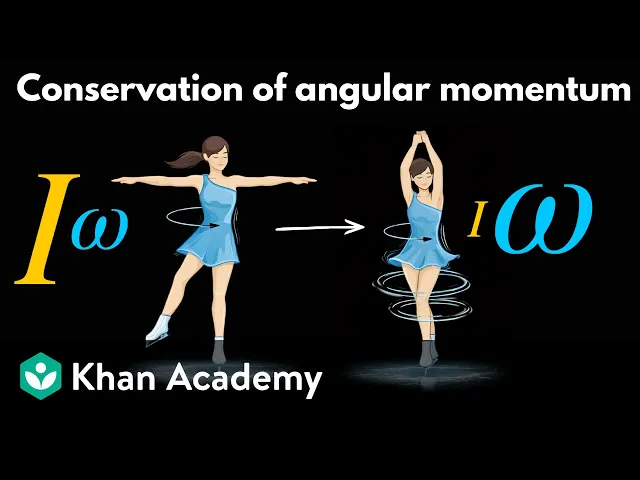
9:58 You have an ice skater who starts out spinning with low speed,
10:00 but then look, she starts speeding up!
10:04 Can you pause the video and think about what's going on over here?
10:08 See if you can explain this using
10:10 the idea of the conservation of angular momentum.
10:14 All right, let's see.
10:15 When she starts spinning, look at how her arms and legs are stretched out.
10:19 Because of this, a lot of particles are far away from the axis of rotation,
10:23 distributed far away from the axis of rotation.
10:25 As a result, her rotational inertia is pretty high.
10:27 She also has some angular velocity, and therefore,
10:30 she has some angular momentum, which is the product of these two.
10:34 Now, as she continues to spin,
10:35 we will see that she will pull her arms and legs closer.
10:39 As a result, a lot of particles now
10:40 are distributed close to the axis of rotation,
10:43 therefore, her rotational inertia goes down.
10:46 But what happens to her angular momentum?
10:49 It has to stay the same.
10:51 Why?
10:52 Well, because all the pooling forces were internal,
10:55 so all of those torques are internal,
10:57 and there are no external torques over here.
10:59 I mean, of course, there is force of friction, but that is very minimal,
11:03 so the torque produced by the friction is very minimal.
11:05 So, if I consider this ice skater as our system,
11:08 then there are pretty much no external torque acting on her, and so her total
11:12 angular momentum must stay the same as she pulls her arms and leg closer,
11:17 which means this product should stay the same,
11:19 which means as her rotational inertia decreases,
11:22 her angular velocity should increase to keep the product the same,
11:28 and that's why she speeds up.
11:31 Let's have a look now.
11:33 Here we go.
11:34 This is what's happening.
11:36 Isn't that amazing?
11:38 Wow!
11:39 And something very similar happens to the stars.
11:43 A star usually forms with huge swirling,
11:46 you know, clouds of gas gravitating together.
11:49 Now, if you consider this entire cloud as our system,
11:52 then particles are distributed very far away from the axis of rotation,
11:56 it's all spread out, so it has a very high rotational inertia.
11:59 And it also has some angular velocity,
12:01 and so it has some angular momentum, which is the product of these two.
12:06 But when eventually a star is formed, look.
12:10 Almost all these particles are distributed much closer than before.
12:14 So, the rotational inertia is much lower than before,
12:17 but the angular momentum must stay the same because
12:21 pretty much no external torque acts on our system,
12:25 and therefore, the product should stay the same,
12:27 and so the angular velocity of the star must be much higher than it was before.
12:32 Says that the product stays the same.
12:34 That's why the star will be spinning faster than before.
12:38 And then big stars run out of fuel to sustain nuclear fusion at the core,
12:43 gravity crushes the whole thing into a very tiny,
12:47 very compact object called neutron stars.
12:50 As a result, the rotational inertia becomes incredibly low, but again,
12:56 the angular momentum must stay pretty much the same as before,
13:00 and therefore, its angular velocity will be much,
13:04 much higher so that the product stays the same.
13:07 Now, this is not to scale.
13:08 Just to give you some feeling for numbers,
13:10 stars usually finish one rotation in, like,
13:13 a few days, but these neutron stars will
13:17 rotate tens or even hundreds of times per second.
13:21 So, now you can see why.
13:23 It's all because of conservation of angular momentum.
13:26 By the way, before we close, did you know how we actually discovered these?
13:30 Some of them actually shoot out beams
13:32 of electromagnetic radiation from their magnetic pulse.
13:34 And as the star spins, those beams sweep across the space like,
13:39 you know, a cosmic lighthouse, if you may.
13:41 And about 60 years ago,
13:43 astronomers noticed incredibly regular radio pulses arriving from deep space.
13:49 It was about 1.3 seconds apart.
13:51 And so the signal was so precise and it was so
13:54 regular that at first they thought it couldn't be natural at all.
13:57 Some even wondered if it might be intelligent alien life signaling us,
14:01 so the mysterious source was labeled LGM-1 for little
14:06 green men (chuckles) until we found more of them,
14:09 and then finally realized that they
14:11 were actually rapidly spinning neutron stars.