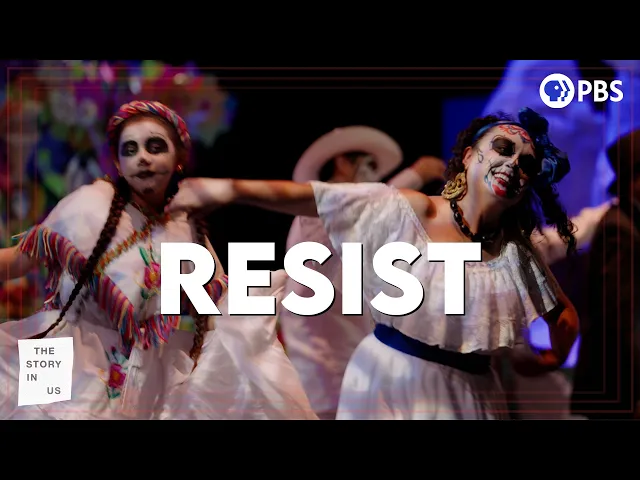
Why This Performance is an Act of Resistance
PBS Documentaries
0:06 Chicano Theatre is a way to use the art
0:11 of theater to talk about social justice through our lived experience,
0:17 based on our cultural heritage, to promote cultural pride, to find liberation.
0:26 Our people need to feel hope, Feel that “sí se puede.” Say,
0:31 it's like, hey, how do we tap into our imagination beyond survival?
0:34 How do we get beyond all this constant violence
0:37 enacted on us that we can actually breathe and imagine?
0:40 Chicano theatre has no reason to exist.
0:43 If it weren't to respond to the oppression or our people.
0:48 To make a statement that we are here, and we are not going anywhere.
1:08 I would define Chicano as a consciousness.
1:12 You know, “herencia mexicana.” But you knew you weren't Mexican.
1:16 And then we certainly, you know,
1:18 we weren't American and we hadn't been accepted.
1:21 And there was a discrimination that we experienced as Chicano people.
1:26 We also were in struggle for bilingual
1:29 education and the unionizing of the farmworkers.
1:35 Well, the origins of Chicano theatre in the US began with “El Teatro Campesino”.
1:40 And it really was a collective structure.
1:43 And its intention was absolutely to organize workers to join
1:47 the farm workers union Luis Valdez and El Teatro Campesino,
1:52 they began making theater on flatbed trucks.
1:57 And basically they were in the fields in order to organize people politically,
2:02 to raise their consciousness.
2:03 So it was a really incredible moment.
2:06 Well, “Actos” were originated by El Teatro Campesino
2:11 to portray oppression and how one then counters the oppresion.
2:16 The “Acto” is a short meant to be a call and action in a way
2:22 that highly exaggerates who the bad guys
2:26 are and the heroes become the organizers.
2:29 They're very accessible to all classes, and they're always super funny.
2:34 Which, you know, entertains and convinces at the same time.
2:38 I was in high school when I went to San Jose State,
2:41 and I saw Teatro Campesino perform for the first time.
2:45 I was just blown away.
2:46 This was our voice.
2:48 It's just like a big explosion went off in my head.
2:53 For me at the time, I wasn’t motivated by wanting to be a performer.
2:58 I was wanting to reach people.
3:01 So I was in college, San Jose State,
3:05 and there was a guy in the Latin American class,
3:08 and he told me about “Teatro de la
3:10 Gente.” And that they were like Teatro Campesino.
3:15 But here in San Jose.
3:17 And I dropped out of college and joined Teatro de la Gente.
3:21 Ran away with the circus.
3:26 The “teatros” were constructed by collectives.
3:28 And those collectives were largely directed by men.
3:33 There was, like in a lot of Chicano organizations,
3:37 the contradiction of gender inequality, of sexism, homophobia.
3:44 Certainly in our group there was like a division of labor.
3:47 What women did and what men did.
3:50 We've, found ourselves oftentimes silenced, kind of relegated to even literally,
3:58 you know, being the ones that cleaned our rehearsal spaces.
4:01 And it was a struggle to challenge that.
4:06 And so I left, and several women left with me, and eventually a couple men, too.
4:11 And we formed the nucleus of “Teatro Visión.” In the 70s, the late 70s,
4:19 there was a great movement of women
4:21 of color beginning to emerge, including Chicanas.
4:26 Suddenly I'm writing in my journal and there
4:29 was this person talking, that wasn’t me.
4:32 And she was this little chicanita.
4:35 Her first lines are like, “the older I get, the tougher I get, the meaner I get.
4:40 Tough cookie, my mom calls me.
4:42 Sometimes I even use a blade.
4:45 Nobody knows it or nothing.
4:46 But I can feel it there.
4:48 Pretend like I'm something.” And it goes on.
4:53 Well, I'm not that little girl.
4:55 And it was like I was giving voice to this character that wasn't exactly me.
5:00 She had more courage than me.
5:02 And I got really excited because I realized that she had a voice.
5:06 In order to have a voice get heard,
5:07 you have to have a body and you have to put the body on stage.
5:10 And it wasn't going to be me.
5:12 That was my first play, Giving Up the Ghost.
5:14 And after that I just continued to write theater.
5:18 Being in a Teatro Visión production included dialog amongst ourselves.
5:23 Participatory experience through telling our story.
5:28 It’s a profound transformation of what we understand as United States.
6:06 In this environment of Teatro Visión,
6:09 bilingualism whether it's Spanish and English, I always call it a superpower.
6:15 Because we're able to communicate in a more extensive way.
6:20 And so we promote that cultural pride,
6:23 the recognition of the power of our language and the power
6:29 that our language has because it is rooted in our culture practice.
6:36 I'm dark.
6:37 Not like my primos and primas who are light.
6:40 I'm a waterfall on dirt.
6:42 “Piel de lodo” with Indio black hair.
6:45 Big lips, “como mi abuela Minga, La Prieta,
6:47 who I've never met I am Los Casitas, the barrio in Guerrero.
6:49 I’m “las casitas de barro en Guerrero.” It is
6:52 this skin that makes people talk to me in broken Spanish.
6:56 “¿Cómo es tu país”, they ask but there's no answer.
7:00 I'm dark.
7:01 Not “blanco or negro.” I am the in-between.
7:06 “Prieto, como maíz.” “No Llegamos Aquí Solos”
7:11 is a play inspired by my neighbors.
7:14 I grew up in an apartment complex inhabited by undocumented folks.
7:18 I didn't necessarily know that being undocumented was a thing.
7:22 I thought everybody lived like this.
7:24 And so I think this play is more about community care,
7:27 the ways in which undocumented people support each other and build ecosystems.
7:42 Oh my God!
7:43 On this play, we want to address the issue
7:46 of gentrification that is happening in East San Jose,
7:50 where the majority used to be Latinos.
7:55 It’s not to present this particular community as the suffering,
8:01 but to present in its complexities and celebrate who we are.
8:07 We also have dreams.
8:08 We also have the power to overcome challenges.
8:12 And we do it every day.
8:14 And this play shows how we still thrive through the circumstances.
8:21 Observing performance, experiencing performance together,
8:25 we can have a healing experience together.
8:28 And seeing a story on stage that is your story also,
8:33 that there's a particular character that you
8:36 just vibe with and you’re, you know,
8:39 with them as they're going through their healing journey and that gives
8:42 you hope or gives you some other kind of insight into the experience,
8:48 your own experience.
8:50 If you touch the wound, it has the possibility of getting healed.
8:53 If you open the wound, it can get healed to give it air.
8:56 And in giving air, there's laughter, there is joy.
9:15 These are the kind of things that inspire art.
9:18 That inspire young people to get engaged in art.
9:21 And if you get engaged in art,
9:23 usually what happens is that it's contagious and that's what you want.
9:26 You want to change minds.
9:29 We carry with the legacy of those who fought so we could be here to develop,
9:37 what was the foundation of Chicano theatre for youth to be on stage
9:44 and see themselves as powerful entities and as powerful drivers for change,
9:51 being assertive of themselves, of their culture, of their own identity,
9:57 and then take action to transform a society.