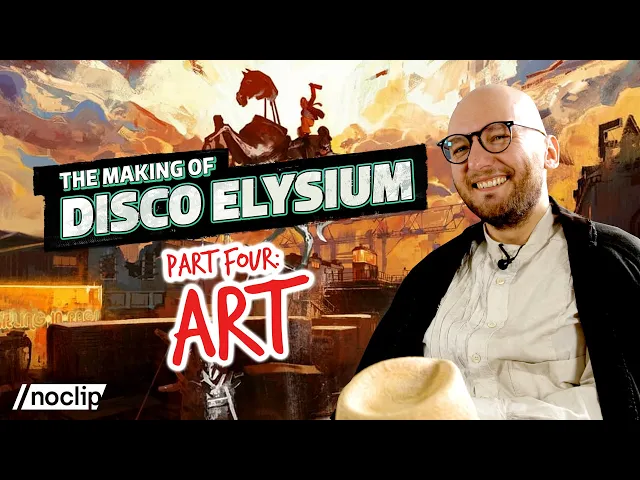
The Making of Disco Elysium - Part Four: Art
/noclip
0:00 [ALEKSANDER ROSTOV] "Ah, the disco." People say weird stuff about it.
0:02 They say that it is about detective stuff,
0:06 or some people say that it's about politics,
0:10 Or some say it's about some deep internal turmoil, or the human condition.
0:15 I don't know what these people are talking about.
0:18 It is obvious that Disco Elysium is about painting.
0:24 (Spaghetti Western music) It has a little bit of everything in it.
0:30 It has portraiture, it has landscape.
0:32 It has metaphysical portraiture, the isometric of course,
0:36 the study of composition; these dialog framings,
0:39 when you're in conversations with characters are
0:42 often comic-bookish if you look at them.
0:44 Y'know, of light and shadow and of techniques like edge hierarchy,
0:47 where you obfuscate a line between one
0:50 shape and another to make the gradation smooth
0:53 and not pull your eye in, as a part of this complex composition of the image.
0:59 That is all in the game.
1:00 The game is a study about all of these things
1:03 and all of these techniques come together to make this game.
1:07 (Guitar strum rings out) [DANNY O'DWYWER] In these documentaries,
1:15 we often dive into the technical.
1:17 It's a somewhat inescapable byproduct of exploring
1:20 the work of pieces of software.
1:22 But today, in the fourth episode of our series on Disco Elysium,
1:25 we're gonna try our best to keep things Artistic.
1:28 Disco Elysium had a small art team by any standards.
1:31 A couple of artists, one animator, a 3D guy and a few other contributors.
1:35 But before we dive into their work I wanted to start with Aleksander Rostov,
1:39 as his painterly style was the visual fulcrum of this entire project.
1:44 What was the pathway through which he achieved the look of Disco Elysium,
1:47 and what practices and decisions led him down his particular artistic path?
1:55 [ALEKSANDER] You need to develop your taste,
1:57 and you need to look at a lot of art.
1:59 Once you see what is good, what is bad, you try to make it like the good guys
2:02 and you try to not make it like the bad guys.
2:05 Physical practice.
2:06 You can finally process it into a thing
2:09 and understand what it is that you were doing.
2:12 Trying out this art stuff autodidactically was just:
2:15 grind the anatomy until you remember it, and draw from memory until it looks
2:20 good enough and compare against the reference drawing.
2:24 All right, just keep painting the colors until they work (chuckles).
2:28 And then the internet as well.
2:30 I'm of the generation of the internet.
2:32 At first there was a little less information there.
2:35 Today there is...
2:36 You can get wonderful information on how to draw,
2:39 how painting works, what are the fundamental concepts of it.
2:42 "In my age, when I was a wee little lad,"
2:46 we only had "how to draw an anime face" tutorials.
2:48 And look and look at your anime faces now.
2:50 (Laughter) [DANNY] And look at your anime faces now!
2:54 Oh my god!
2:55 There was a critical moment in my youth, where I had to...
2:59 Now...
2:59 It's like "this is like a fork in the river
3:02 in the upstream." Does it drown this town, or does it flood this village?
3:09 Where does the river go?
3:10 "Do you choose the anime,
3:13 or do you choose the realism?" And I agonized over that decision!
3:17 But it did give me a kind of perspective on it– well,
3:21 later it came, a perspective on it.
3:22 That decision didn't really mean anything– that it's all the same thing,
3:25 and that you're simply learning different aspects of image craft.
3:29 Well, before me was, then...
3:32 Well, when I was very young,
3:33 was the collapse of the Soviet Union, the end of the world,
3:37 and an apocalyptic event, in which the great endeavor collapsed in on itself,
3:42 and horrible things came out of it.
3:45 And maybe some nice things...
3:47 What the Soviet Union did,
3:49 was that it pumped a lot of money into cultural arts so the artists in the 60s
3:53 and 70s– the people who were translating
3:56 books– were like the intellectuals of the age,
3:58 so this literary quality was extremely high
4:01 and the works that they were writing and, y'know,
4:03 the artist could get a beautiful apartment on the top
4:06 of the building somewhere and it was a respected class.
4:10 And then with the '90s, the artist...
4:12 Suddenly it became derogatory, as an artist,
4:14 and so the prestige of the artist started declining, but this mysterious...
4:20 I don't know, some sort of an "aura" remained,
4:24 still like this Elven world of the arts,
4:27 that people just didn't know how to draw
4:30 like the old masters anymore like we've forgotten ancient,
4:34 secret knowledge impossible to reclaim.
4:37 Later, I thankfully found out that was wrong.
4:41 So, for me, growing up in this– like a ghost of arts being respected,
4:45 and then the state that it was in then...
4:48 The state that it was in, it was unacceptable.
4:51 I don't know.
4:52 The artist was reduced to running around after
4:54 getting grants and then backstabbing each other for €700,
4:58 so you can make your lousy little art thing that can be in the gallery,
5:04 that you barely have any time to conceptualize, or think through,
5:07 or make into something wondrous and big like art needs to be.
5:10 And so all the art you see is mediocre and miserable,
5:12 and the artists are mediocre and miserable
5:15 and the world is mediocre and miserable.
5:17 In the '90s and early 2000s.
5:21 So it makes one very critical towards that and towards the art institutions.
5:25 Art must be done outside of institutions.
5:40 (Greeting noises) [DANNY] Nice to meet you!
5:49 (Laughter) [ALEKSANDER] Hello!
5:53 [HELEN HINDPERE] Oh my God!
5:55 What happened?
5:55 [DANNY] What's Doggy's name?
5:57 [ALEKSANDER] Pushti.
5:58 [DANNY] Pushti?
5:59 [ALEKSANDER] Pushti.
6:00 [DANNY] Pushti!
6:00 [HELEN] Yeah.
6:01 [DANNY] Hello Pushti!
6:02 [ALEKSANDER] This is the neighborhood.
6:04 This is where I grew up.
6:05 This is the Soviet dreams.
6:07 You have the panel houses,
6:08 you have the kindergartens and schools in between the panel houses.
6:11 The panel houses are like fortress walls around, protecting the children.
6:15 Much like the children's creche in Alpha Centauri.
6:18 The best of the civilization games.
6:20 Then you have this forest here.
6:23 There's horses there,
6:25 that just ride around because the hippodrome is over there.
6:27 And then if you follow this...
6:29 wooded road down, then you get to the Stroomi Beach.
6:33 Which is what the Martinaise Beach is sort of modeled on.
6:38 The sad, autumnal version of it.
6:40 If you go there today, you will see the happy summer version of it (chuckles).
6:43 [DANNY] What's it like in the winter?
6:46 [ALEKSANDER] Oh, it's dreadful!
6:47 Sometimes it ices over,
6:48 and there's just this line of ice that goes into the horizon.
6:52 But other times, if you get temperature fluctuations happening,
6:54 you get this cool thing where the sheets of ice, they come on top of each other,
6:59 and it's like shark teeth coming out of the water at you.
7:02 That's very fun.
7:03 But it happens quite rarely.
7:05 The garage is the most important building
7:07 for a child growing up in Eastern Europe.
7:10 Because behind the garage is where The Dominion of the Child lies...
7:14 Where the eyes of The Parent do not reach.
7:16 So, behind the garage is where you keep...
7:19 Well, where you burn the matches of course.
7:21 I might have caused...
7:22 a couple of wildfires here in my youth (chuckles uneasily) It is also,
7:27 of course, where you keep the porno mags,
7:29 with the other children, that you find on the roof of the garage,
7:32 so any adults walking dogs back there don't see them.
7:36 And here they're gonna build a tramway.
7:38 But this just used to be a wasteland.
7:41 A wonderful wasteland.
7:44 [DANNY] Did you find porno mags in The Wasteland?
7:46 We used to find them in the woods.
7:48 [ALEKSANDER] Yeah.
7:48 [DANNY] Sorry I'm asking so much about porn mags.
7:49 [ALEKSANDER] Yeah, I don't know.
7:51 The porn mags are very important for the children.
7:53 It's where you learn the female form for the artist, you see?
7:57 And it's also this secret for children to bind or bond over.
8:01 [HELEN] Great loot.
8:02 [ALEKSANDER] Great loot!
8:02 [HELEN] Looting them from the wasteland.
8:04 This was our Wasteland, too.
8:06 (Laughs) [ALEKSANDER] What's going on, Siim?
8:16 [SIIM RAIDMA] Mmm.
8:18 [ALEKSANDER] Mmm?
8:20 He's doing something with code...
8:24 Why are you sitting in my seat?
8:26 That's where I sit.
8:28 So the art team was quite cozy.
8:31 It was me, Siim Raidma, who I already mentioned,
8:35 who was doing the technical stuff.
8:37 Kaspar Tamsalu, who was doing location concept art.
8:41 He has a wonderful sense for domestic compositions.
8:45 Quite a few of the dialogue frames are also sort of designed by him,
8:49 because he's a comic book artist by heart.
8:52 When you meet Everart Claire, you have these...
8:55 In the image, you will see that the container frames (clicks) put Everart here,
8:59 and you're here and you're lined in between these frames and all of this stuff.
9:04 Yeah, Kaspar designed those locations.
9:08 Rauno Somelar, who was our 3D heavy-canon.
9:13 He was...
9:14 He knew how to do 3D.
9:16 Nobody else knew how to do 3D.
9:19 Young Markus Härma was our junior artist.
9:23 It's hard to sort of pinpoint down what he did.
9:25 He helped out with a lot of stuff, and in the end just...
9:29 It's a little bit all over the place.
9:31 He did the loading screens, for instance,
9:33 that's an image that he did, and modeled a bunch of stuff.
9:37 On the character side,
9:39 we had a wonderful Eastern European caricature, Pavel Kuba.
9:44 We called him "Pasha".
9:46 So he came...
9:46 He came on quite late.
9:47 He sculpted some of the characters.
9:50 He sculpted the Armors and Everart Claire and Morell,
9:54 some of these more involved characters.
9:56 There's Eduardo Rubio, who was the animator.
9:59 He basically animated the entire thing.
10:02 [ARGO TUULIK] Eduardo, I think, came on board around the time I came on board.
10:06 He was there from the beginning and he was there all the way.
10:10 Like, I have nothing but positive things to say about working with Eduardo.
10:15 A wonderful, wonderful person.
10:16 Such a distinct and unique animation style as well.
10:20 It kind of takes this character model art style of Disco
10:28 and it puts a little bit of cartooniness on top of it.
10:30 But exactly this right amount of cartooniness.
10:35 Anything more, and it might actually feel a little childish.
10:38 But anything less, and it would just not have that charm.
10:41 [SIIM] We went for Unity and Blender because that's the tools I knew.
10:47 And the privilege of coming in early is that we're going to use this and this.
10:52 And anyone else we're going to hire is going
10:55 to either deal with it or not join us.
10:57 Which is great, because Blender is really scriptable,
11:00 and something even I could build a pipeline out of.
11:04 So it starts with either a sketch of the level– like
11:10 the interior or the exterior– or just a block-out inside Blender.
11:16 Then we flesh it out,
11:18 but not too much because most of the details will be painted in.
11:22 In Blender, we get to a point where it's mostly color blocked.
11:27 And enough details are there so that objects have their silhouettes,
11:32 which we do need for the height maps and rendering.
11:35 Blender will render out colors, normal maps,
11:38 like the surface normals for the whole map.
11:41 Absolute height, which is a trick we got from the Pillars of Eternity video.
11:46 Then we have a clown map, which is like a different color for each object,
11:49 which helps with the painting over and masking in Photoshop.
11:56 Rostov would grab the color map and just paint over it.
12:00 I got my first Wacom Cintiq.
12:04 "Oh my God, this is the happiest day of my life!" This giant screen
12:09 that I can draw on all day for the next five/six/seven years of my life!
12:13 Oh my God, I was so happy.
12:15 A big distinction in the performance of art
12:19 is whether you are drawing from the wrist, doing little sketchbook drawings.
12:24 This gives you this curvature of the wrist
12:26 or whether you are doing it from the shoulder,
12:28 which gives you this absolute control to do straight lines, or anything.
12:33 From the internet, I learned that they teach you to use your shoulder to draw,
12:37 that this is the superior, more controlled way to do it.
12:41 And with the Cintiq, you can really do it.
12:44 It's big enough.
12:45 You're drawing to imitate painting in the small,
12:49 but on the big, you can kind of paint.
12:51 You can like do these strokes and (whoosh).
12:52 The isometric image is wonderful, in that it is flat.
12:56 There is none of this 3D, a million viewpoints.
12:59 It's just this one image.
13:00 So in essence, you can design the entire game as if it was like a painting.
13:05 And that's kind of what we did.
13:07 It's also the cutest image.
13:09 It's this...
13:09 It's the image of children playing with toys.
13:12 It's just like a childhood wonder of the toy house,
13:15 and moving little guys around, and so on.
13:17 That's why the isometric thing basically just works so well.
13:21 You just plug the painterly knowledge into it,
13:24 and you simply make a better isometric image.
13:28 Because painting is all about the study of the image and how to guide the eye,
13:34 and make this part of the image clean,
13:36 and this part of the image very textured and active and complex,
13:39 to pull your eye here.
13:40 And then design these motion lines through
13:43 the image to draw the eye of the viewer.
13:47 Well, of course, a complex problem then,
13:49 is if you paint this background with all of these brush strokes,
13:52 and then you have these 3D models that you want there to move around,
13:56 because it's so complicated to do...
13:58 2D animate them.
13:59 And then you have this challenge of, "Oh my God,
14:03 how do you take this Blinn-Phong-shaded rounded,
14:05 bulbous 3D form, and how do you integrate
14:10 it into the painterly sensibilities of the image?" So,
14:14 if you know about normal maps,
14:17 a normal map takes a 3D surface and then maps an image on it,
14:22 which says that this point is actually looking that way.
14:25 So you can do this small detail stuff.
14:28 It's standard video game techniques,
14:30 but what is not very standard is what we try to do,
14:33 is that we try to hand-paint them!
14:35 And that is like, oy oy oy, mind arithmetic...
14:39 And in the end, we discovered that you can just kind
14:43 of sculpt it like this, that you just do this planar simplification.
14:47 It's like...
14:48 Soviet monuments often have this (booming sounds) happening.
14:53 The magical Siim Raidma.
14:56 He's just like...
14:57 He's the coder, which basically...
14:59 He made the pixel math and he made the screen do the thing that it needed to do.
15:05 I don't know, this goal would've been impossible without him, basically.
15:10 [SIIM] So the interesting stuff, which is...
15:12 we made up on the go, which was a shadow map, which we had...
15:17 We rendered three directions of shadows, which is the morning, noon and evening.
15:21 And it was interesting to get the angle just right because the whole game
15:27 will have the same direction of sunlight in the morning and in the evening.
15:32 [ALEKSANDER] Basically,
15:32 three times of day with their own lights and the night time,
15:35 which is sort of like without, I guess, shadows in that sense.
15:39 But this shadow information is multiplied over the main like painting.
15:44 So it's just this one painting and then the shadow does like all the...
15:47 [SIIM] And at the last moment we decided, for the noon shadows,
15:52 the sun was going basically from above the camera.
15:56 At the last moment, before rendering out most of the stuff,
15:59 Rostov decided to put the sun on the other side of the map,
16:06 which means all of the ground is still light,
16:10 but all of the buildings are now in shadow, dark.
16:14 So that increased contrast.
16:16 So it was really flat before.
16:18 And that decision made the noon shadows a lot better.
16:22 So this...
16:23 It's three directions because we had like three channels in a PNG, right?
16:28 So RGB will be the three direction of the sun.
16:32 [ALEKSANDER] And the occlusion, he reverse-engineered the depth map thing.
16:39 So that the world is just a flat image, but it has rendered out a height map.
16:44 So that it knows if your character is
16:47 standing behind something or out in front of something,
16:49 Some trigonometric calculations are being done for each
16:52 pixel to like occlude and do stuff like that.
16:54 There's a lot of little shader effect stuff happening there.
16:57 If you walk around the world, for instance, we have a remnant of fog of war.
17:04 But we didn't end up using it in a sort of a traditional way.
17:09 It sort of serves as a, what do you call it?
17:13 vignette in photography, just a vignette around it.
17:15 But because the world is so painterly and such a textured thing,
17:19 then it doesn't work if you just have a gradient on the edge.
17:22 It like makes the image cheaper.
17:24 So instead, the fog of war, this darkness of the image,
17:29 it almost (hisses) snakes through the image.
17:31 Because, what it does is,
17:33 it goes first from the lighter parts and remains longer in the darker.
17:37 So it's like if you're walking along this tiled floor,
17:41 Martinaise ground there, then you will see that this fog at the edges,
17:45 it's (hisses) just snaking away into the cracks
17:48 of between the tiles and the tiles come gleaming out.
17:51 And it's like super subtle, but it adds so much to the liveliness of the image.
17:56 'Cos there was a big problem, in general,
17:58 that the painting is so still, how do you bring it to life?
18:02 Yeah, that was a big problem.
18:04 We just, over the years, developed some...
18:06 There's some obvious things, put a little rotating fan in a room and you
18:10 put these 3D assets that are like doing some stuff somewhere.
18:12 The characters are doing their little like idle loops and stuff.
18:16 Little things like trees are lying about perspective.
18:20 The tops of trees are slightly doing a parallax,
18:23 and then it fades out to the root.
18:26 So just as you're walking, the trees are like slightly just sliding.
18:29 Other things, when you walk, for instance,
18:32 when you go into the courtyard behind the Whirling-in-Rags,
18:36 you will see that the houses that are
18:39 in the foreground [high] up, they get shadowed.
18:42 So it gives you depth perception to the image as well.
18:44 The courtyard is normal color,
18:46 but it calculates this trigonometry that this is closer
18:49 to the camera and it sort of turns it into a silhouette.
18:53 It makes the image more readable.
18:55 Because part of this isometric image is
18:57 also that everything is of the same importance.
18:59 You can't quite...
19:00 You lose one of these tools of like control over it.
19:03 But then with that, we've got to get it back.
19:05 And it also just makes the image change as you're moving.
19:07 It adds a little bit of this life in there.
19:09 I don't know, simmering light beams that are just planes with like
19:12 an animated texture on it and little bugs somewhere flying around, I think.
19:17 But the compositions are mostly in the dialog compositions.
19:21 For the mouse, you just click on the character and then
19:24 your guy walks into a predefined position that looks good.
19:27 They're talking to each other,
19:29 which is kind of annoying when you're gamepad controlling.
19:32 You're up to the character, talk to him,
19:34 but the other guy needs to (clicks) move a little.
19:36 I don't know how to design around it,
19:38 'cos it's kind of important for the composition and the psychology
19:41 of how the two characters are communicating with each other,
19:45 that they are in these specially designed locations.
19:47 And then it goes into this image composition and so on.
19:51 It was quite the effort to figure out how to paint this giant painting,
19:54 'cos you can only have so many pixels in one
19:57 Photoshop file before the computer runs out of RAM.
20:00 Which is a constant problem.
20:02 RAM, my eternal enemy.
20:04 In Photoshop, you can link images into other images.
20:08 So the mega massive painting of the world is basically a bunch
20:15 of Photoshop images that are these tiles that have been (slotting noise).
20:20 Here's the tiles of the...
20:23 behind the Whirling-in-Rags courtyard.
20:26 And this edge overlaps with the...
20:28 what is at the Doomed Commercial Area.
20:30 The outside area, the bookstore and stuff.
20:33 And then you paint this image and you paint
20:36 this image and then you carefully paint what's in between,
20:39 thinking exactly which surface should be considered
20:43 "the master," the overriding truth of of which one.
20:47 And then you just stitch these Photoshop files together into a giant,
20:52 giant, giant painting.
20:53 [SIIM] So we have a lot of pixels in the game, right?
20:56 So the exterior of Martinaise is like...
21:00 I found the number, quoting myself,
21:03 is like 10 gigapixels of texture information.
21:07 It's a lot of pixels, and we wanna make it work without loading screens.
21:12 Virtual texturing came to mind, which was...
21:15 id Software's Rage, in 2011 I think, did the megatextures thing.
21:21 It was quite big at one point.
21:25 Being arrogant and ambitious...
21:26 "Sure, why not?
21:27 Let's do this instead of loading screens." It's a miracle that it worked out.
21:32 But Unity was at a weird spot at this exact moment where they had...
21:38 I think they had bought a company that did virtual texturing,
21:41 but they hadn't done anything with it.
21:43 It's...
21:44 At this point, it wasn't the pattern for Unity yet.
21:47 So it was, that was unavailable to us.
21:50 And the only other competitor with virtual texturing was Amplify Texture 2.
21:56 It was a bit of a gamble, because it wasn't ported to the console yet.
22:00 But luckily enough, they were like super responsive.
22:03 We just started using it and asking dumb questions.
22:07 They kept answering them to the point where
22:10 they just sent the whole source for the plugin.
22:13 So fast forward, Amplify Creations ended up being ZA/UM Porter,
22:19 which is part of the studio.
22:26 [DANNY] So much of the soul of Disco
22:28 Elysium comes through the various character portraits.
22:30 Like much of the art in the game, while Rostov was the primary vision holder,
22:34 there were collaborations between art, writers, and design.
22:37 Doing more than just showing the face of the person or skill you're
22:40 talking to, but giving subtle visual insight
22:42 into their own place within the story.
22:45 So what was the process through which these iconic images were created?
22:49 [ROSTOV] For every portrait artist, there is the hero portraitist.
22:53 And for a lot of them it is of course the Velázquez.
22:57 The original psychological portraitist.
23:02 And there, you look at his portrait of that Pope Innocent X.
23:08 Not so innocent.
23:10 But the look in the eyes and...
23:12 It reveals something.
23:14 It is not simply a flattering picture of some guy,
23:16 but you can also tell that that guy is a bit of an asshole.
23:20 That is the minimum accepted quality.
23:22 The portrait needs to be as good as Velázquez (laughs).
23:26 So there needs to be something in there,
23:28 it just can't be a picture of a pretty person.
23:31 But I don't know, this is sort of just like intuitive stuff.
23:33 You, I don't know, try to read yourself into the character.
23:36 Which is fortunately quite easy,
23:38 because the writers are very good at making them into proper characters.
23:42 Someone who you can read into and really
23:46 picture a depth of emotional world behind those words.
23:50 And eventually the image.
23:52 Ah!
23:52 yes, of course: Symbolism.
23:55 Shapes and images and things.
23:56 They all mean stuff and they do stuff.
23:59 Well, what we do is, we take in the external world.
24:03 The external world is so big!
24:05 But if you put the frame around it,
24:08 it becomes this image that you can comprehend.
24:10 It's like this "framing of the image," I call this event.
24:13 The portrait is this framed image.
24:15 But it is still basically sending in this direct,
24:18 strong, raw signal into your head.
24:20 And different shapes, they have different effects on us.
24:23 Y'know, a circle is round and somehow warm and welcome, 'cos goes on forever.
24:27 There's like other aspects to it.
24:29 But it's like, for the character of Kim, that is the sort of round, solid...
24:36 Is not falling apart.
24:37 Does not have weaknesses in the corners or structural issues or...
24:42 So you just feel this.
24:44 It just communicates with your spine, somehow.
24:47 While Jean has the rectangle and the stuff.
24:49 And it keeps us straight-back and shit together.
24:54 But also it's kind of rotten and black.
24:56 And it's kind of scribbled in, a little (growls).
24:58 And it's also black because of depression, and the color of black.
25:02 And all of these sort of, when you sort of say them out loud,
25:07 are very banal things to point out.
25:09 But when you don't mention it and they're just in the image,
25:12 they just do what I said.
25:14 And you just layer these different effects upon you.
25:17 And eventually it's just,
25:18 there's so many of these effects that you layer upon each other.
25:21 That it just does stuff to you.
25:23 It's like when you look at the Rothko's paintings.
25:26 If you look at them like online, on a computer screen, Mark Rothko.
25:30 It's like...
25:32 He just made a canvas, right?
25:36 But when you like see it in real life
25:37 and you stand in front of it and the uninterrupted, unisolated,
25:40 pure signal enters your eye (gasps) so that you're transfixed around
25:46 it and you understand the strength of what is happening there.
25:50 Very subtle, very easy to make fun of, as well.
25:53 But also incredibly powerful.
25:54 And then, I don't know, then there's the semantic symbolist layer,
25:59 that's sort of above it or together with it,
26:02 with Ikon painting, the halo, the nimbus and so on.
26:07 So all of these things are just...
26:09 Whenever you go in to make one of those portraits,
26:12 you're just trying to feel out like what is a kind of an appropriate trick,
26:18 technique, a curveball that you can put into this image
26:22 to manipulate the player into feeling an emotion.
26:27 And in a way, the entire art style of the game
26:30 is sort of this; is a study into subjectivity.
26:33 When a painting differs from the natural, Real of it,
26:39 one can ask a question: Why does it differ?
26:44 And if you're careful about it, then each of these why's can...
26:48 You can say something with it.
26:49 It's the space that you can put meaning into an image.
26:54 The entire game is a little bit like that.
26:57 But the portraits are like a small, focused study of that.
27:01 A lot of the obvious effects have been sleuthed out by the fans.
27:05 They now point out that Kuno is in the same pose as Half-Light.
27:09 Sort of like embodying that like fight-or-flight response.
27:13 But otherwise Kuno is fairly naturalistically painted.
27:17 Like, it's this child that's in front of you.
27:19 So the symbolism, it's less to do with that.
27:22 These abstract things, it's just a pose.
27:24 It's like really embodying that character.
27:26 Measurehead is a little bit boring.
27:28 He's just trying not to look mega black.
27:30 So just, so it would be...
27:32 The joke would be a little bit more sophisticated than "ha-ha, black racist".
27:36 And it's also a little bit like, all the colors are there.
27:39 So it's, you know, universalizing him a little bit.
27:42 The Klaasje and Sylvie portraits.
27:46 It's interesting to compare the two actually, yes.
27:49 Sylvie is painted in a kind of a naturalism.
27:51 It's just a girl that you talk to, who
27:55 does not pretend to harbor great mysteries behind her.
28:00 Lives a decent life.
28:03 While of course, Klaasje is just all shadow behind the fringe, the bangs.
28:09 Yes.
28:10 Klaasje was also one of the first portraits that I did.
28:12 So it's a little bit more true
28:15 to the original structure that I devised for the portraits.
28:18 So one of these tasks of, "Oh my God,
28:20 can I make this game and have to paint so many
28:23 portraits?" is to figure out how do you do the portraits.
28:25 What kind of techniques do you use to do it with optimal time,
28:29 while also giving you all of these tools of symbolic expression.
28:33 It was constructed out of these flat layers with less rendering time.
28:38 almost like posterized sort of feel with dark blacks,
28:42 kind of like a modernist technique, to use like black lines and stuff in there.
28:46 And Klaasje was one of the early ones.
28:48 So she really exemplifies this approach of simplified flat shapes.
28:54 Later portraits can get more complex as I
28:57 get more comfortable working in the style.
28:59 But yeah, these are two people who are
29:01 trying to communicate different things about themselves to you.
29:03 So you perceive them differently.
29:05 All the paintings are the perception of the Mr.
29:09 Dubois.
29:09 Are all the Mr.
29:11 Dubois' perception of the other.
29:13 So for instance, the twin kids who are painted, Lilienne's twins,
29:16 they're just the same image flipped,
29:19 which is a wonderfully cheap production trick.
29:22 But also really does reflect the understanding
29:25 that like a drunkard middle-aged man has...
29:27 "This child is like a flipped copy
29:30 of that child!" (laughter) [DANNY] What about Mr.
29:33 Dubois himself then?
29:34 'Cos he gets a number of different expressions.
29:37 And "The Expression", of course.
29:38 Ah yes, The Expression.
29:39 The Expression had to be painted many times to find the exact nuance.
29:42 I'm very glad that they repainted the mirror
29:45 painting at the nick of time before release.
29:48 But yes, Mr.
29:51 Dubois, Mr.
29:53 Dubois's visage also keeps changing across every single image of him.
29:58 One of the reasons is that, you see,
30:01 I am an amateur autodidact and I never learned how to draw the same face twice.
30:06 And then, too, it's also...
30:08 No, actually, no, no, forget I said that.
30:11 It's, y'know, "his self-image.
30:14 Sometimes he thinks he's handsome,
30:17 sometimes less so." Y'know, it's all about that...?
30:22 (Chuckles) But yes, well, the cool trick is that the first
30:25 painting is this Francis Bacon-like mystery man,
30:28 who even is this, you only see the soreness of his nose there or something.
30:31 It's red a little bit.
30:33 And then you get to change the portrait, really.
30:37 And it's just, also, every time a game does something on the UI,
30:42 that it changes a UI element or...
30:45 I don't know, it's postmodern game design.
30:47 It's sort of a game design rule, or a game event that happens outside,
30:53 the usual event space where stuff happens in the game,
31:00 that's just juicy, juicy art school shit.
31:04 (Laughter) Same thing when you go talk to the light-bending guy,
31:10 then the net worth (whirring) your money goes like crazy.
31:13 And then, I think you can get the net
31:16 worth counter on your user interface and so on.
31:18 I'm a big proponent of that type of game design.
31:22 I must admit, I might have learned that from Mr.
31:26 Kojima.
31:30 [DANNY] And so ends the fourth episode in our series.
31:32 In the next episode,
31:33 we wander into the programmers' room and then follow the team
31:36 as they split apart from their home base in Tallinn,
31:39 in the months leading up to launch.
31:41 This period of time was the most tumultuous for the team,
31:44 and planted seeds for difficult times many
31:46 of the development team would have over the coming years.
31:49 If you'd like to watch that episode right now,
31:52 you can do so over on our Patreon.
31:53 Our work is entirely funded by people
31:55 who care about telling the stories behind games.
31:57 So we really appreciate all the folks who have
32:00 contributed to our Patreon over the course of this season.
32:03 We simply couldn't do this work without you.
32:09 [ALEKSANDER] Whether you draw with a pencil
32:12 or whether you paint with a paintbrush
32:14 and some wonderfully smelly natural medium with potentially
32:21 toxic chemicals or whether you do it digitally,
32:24 in the end you're doing the same thing.
32:26 And whether you are doing anime or realism, you're doing the same thing.
32:30 In essence, there is this total truth
32:33 of the image that you are trying to construct,
32:37 an expression of an individual image.
32:41 And any tool and any technique,
32:45 any stylistic approach that you use is sort of equivalent in it.
32:52 Fundamentally, you're always thinking the same
32:55 sort of thoughts about what shape,
32:57 value and color should be next to what other shape.
33:00 How does it make you feel?
33:02 What are the cultural symbolic implications of those things?
33:06 So there is a great equivalence to all of them.
33:09 But it is also, of course,
33:11 a great superpower if you have managed to build up competency in all of them.
33:16 'Cos there are tricks that are more easily discovered
33:20 in one medium that you can then translate to another.
33:25 Oil painting teaches you a certain thing which
33:27 you can then try to recreate in digital.
33:29 Digital teaches you other things which you then try to recreate in oil.
33:33 It's this back and forth.
33:36 I'm glad that I got to do a little bit of everything.
33:38 It really like taught me a lot about it.
33:45 (Ident clicks) (Click)